 Learn Car Stuff
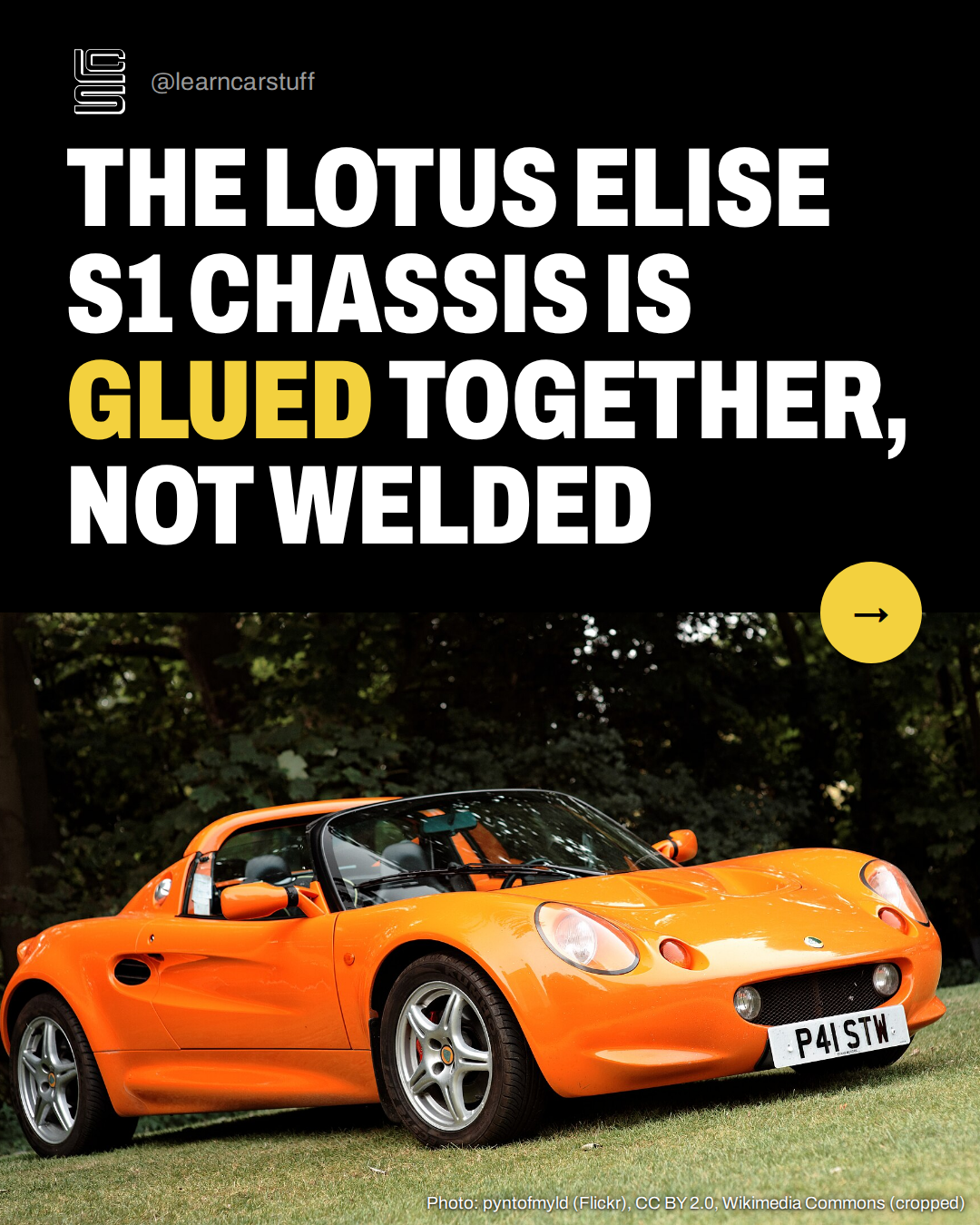
The Lotus Elise S1 chassis is glued together, not welded
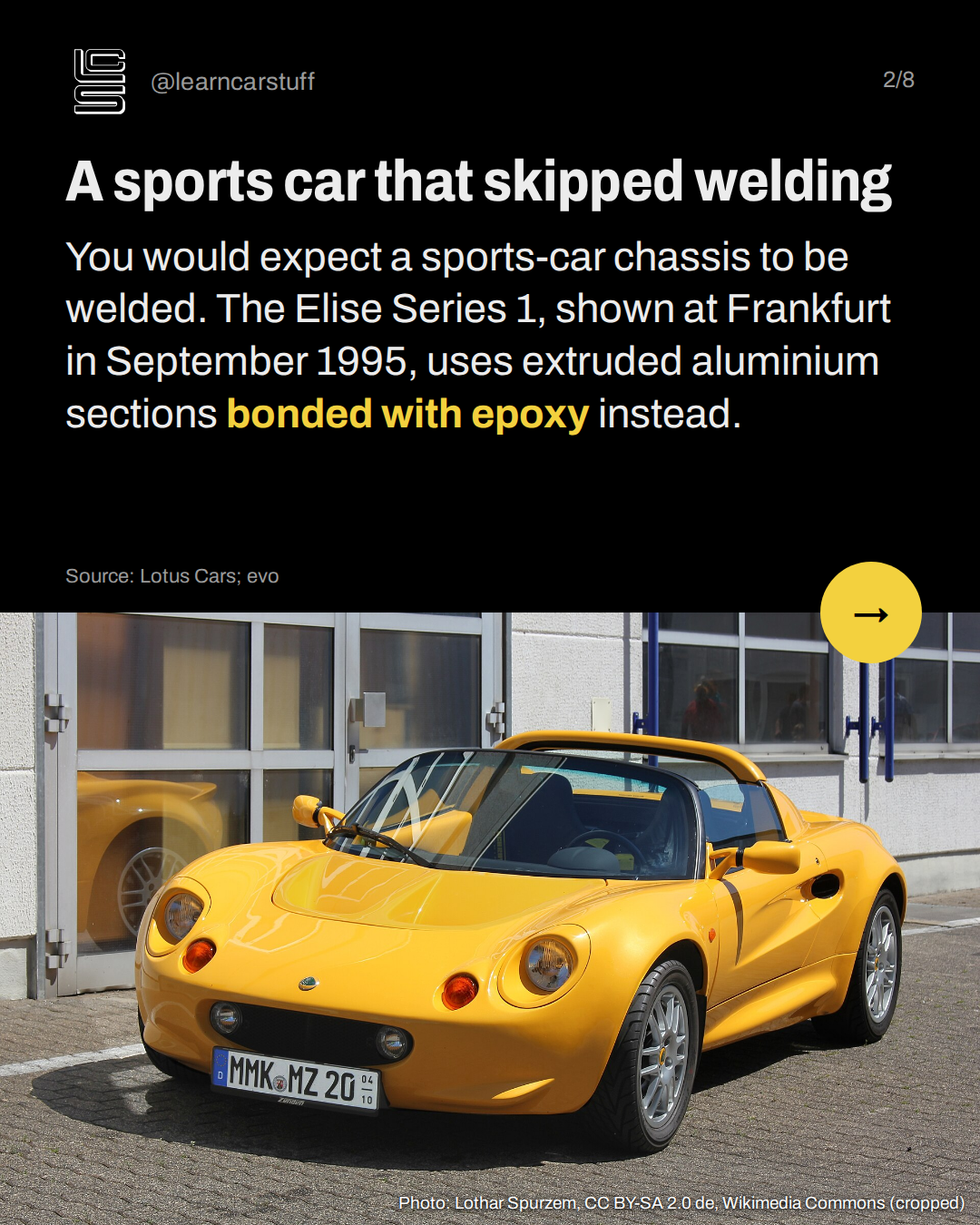
A sports car that skipped welding
You would expect a sports-car chassis to be welded. The Elise Series 1, shown at Frankfurt in September 1995, uses extruded aluminium sections bonded with epoxy instead.
Source: Lotus Cars; evo
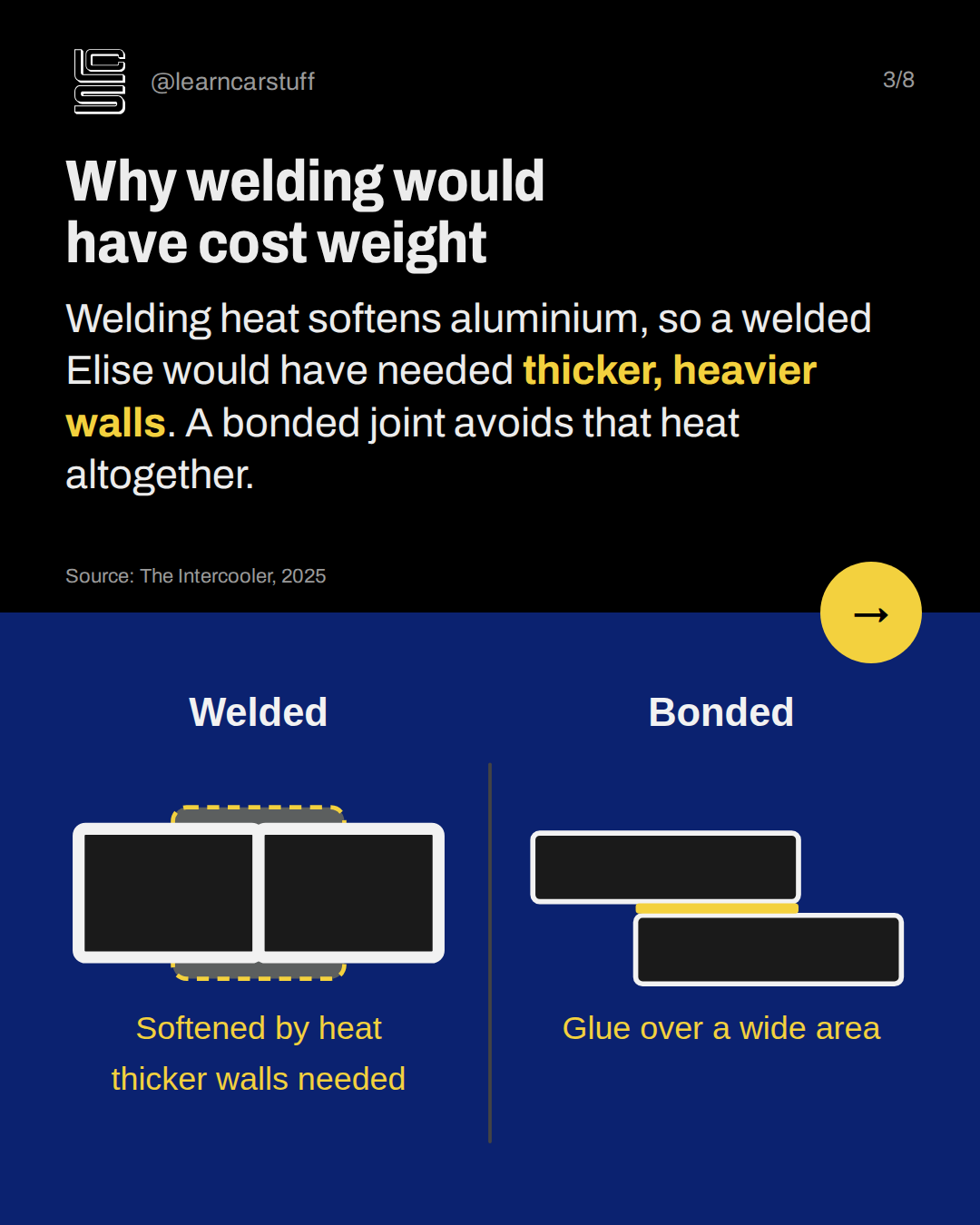
Why welding would have cost weight
Welding heat softens aluminium, so a welded Elise would have needed thicker, heavier walls. A bonded joint avoids that heat altogether.
Source: The Intercooler, 2025
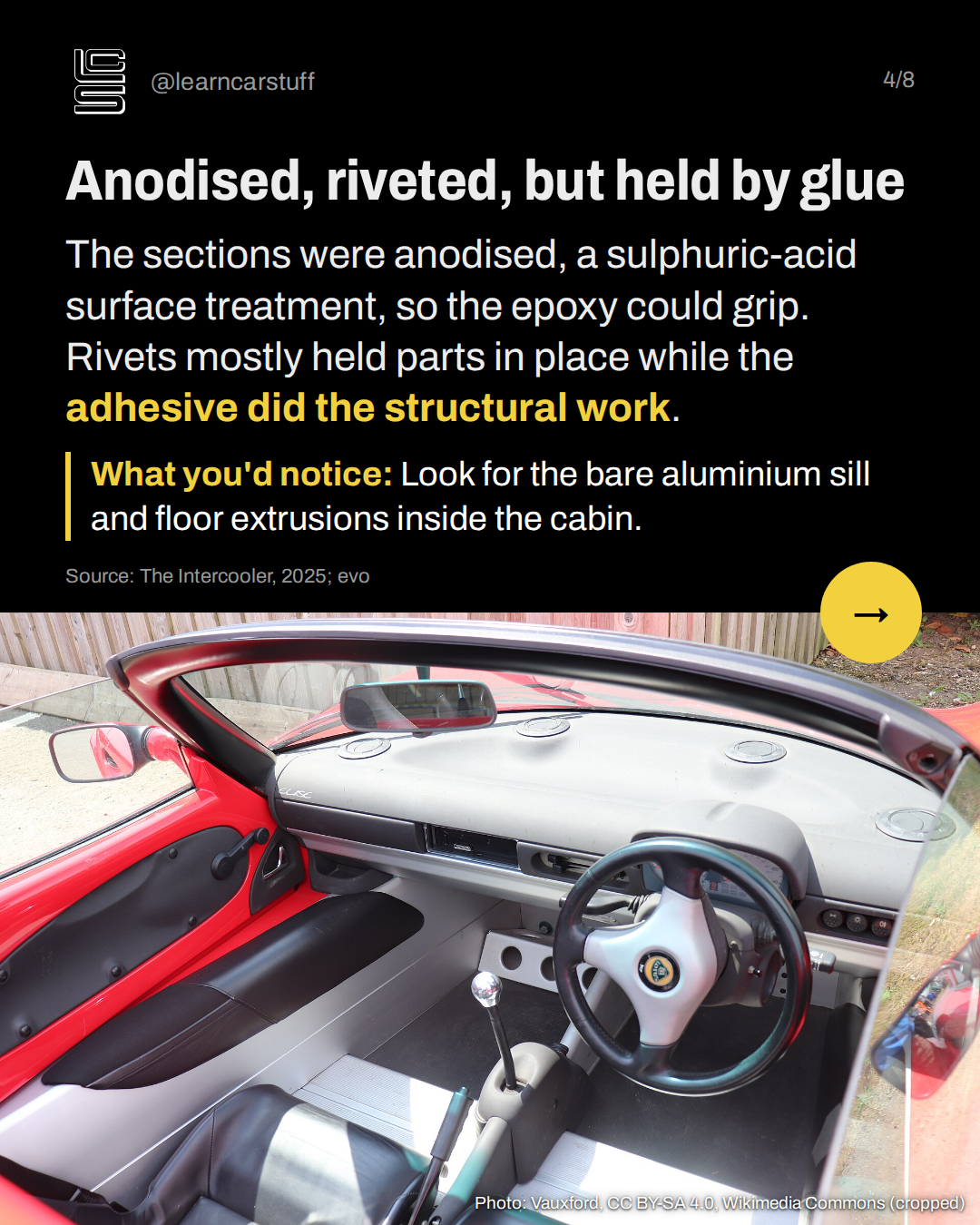
Anodised, riveted, but held by glue
The sections were anodised, a sulphuric-acid surface treatment, so the epoxy could grip. Rivets mostly held parts in place while the adhesive did the structural work.
What you'd notice: Look for the bare aluminium sill and floor extrusions inside the cabin.
Source: The Intercooler, 2025; evo
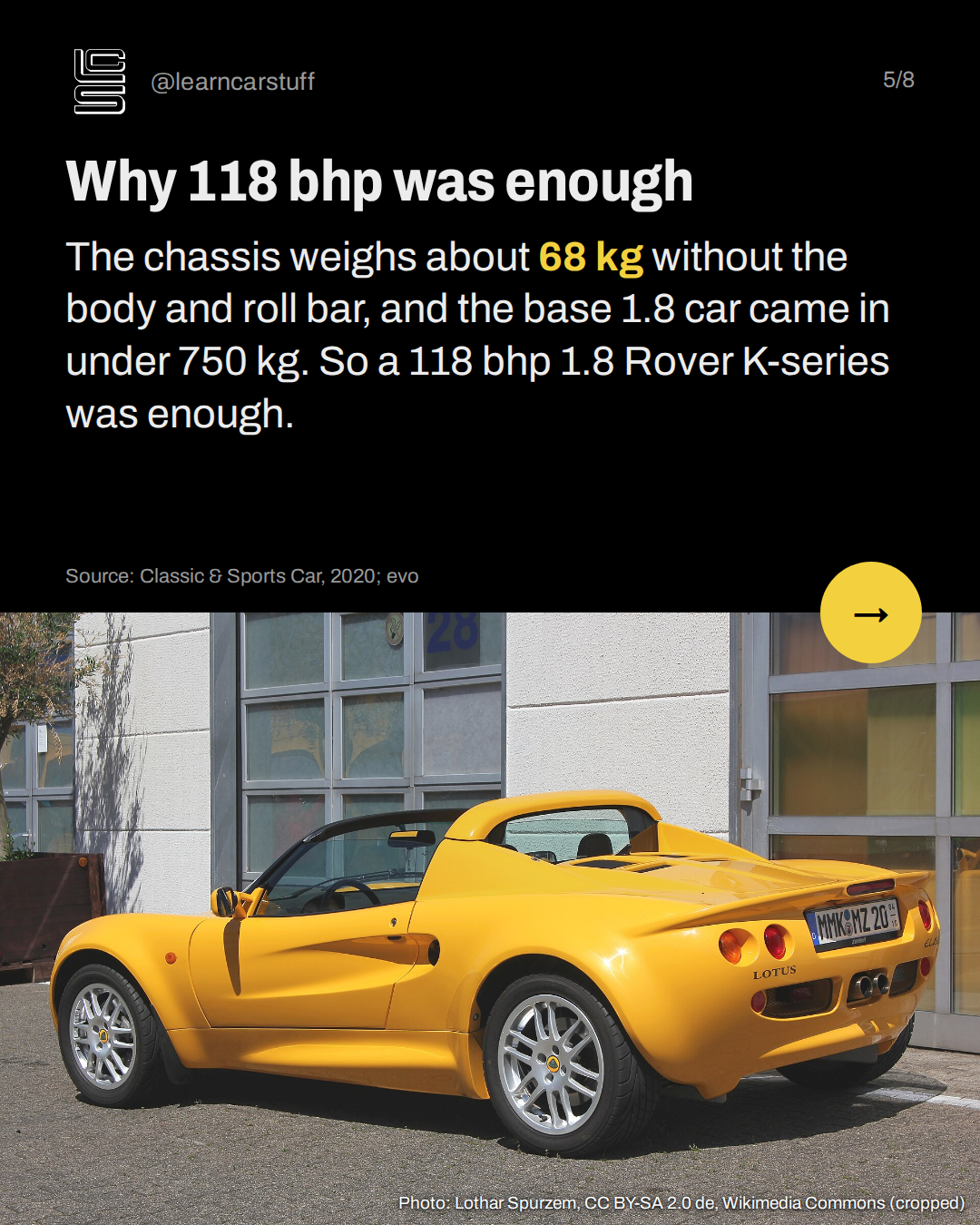
Why 118 bhp was enough
The chassis weighs about 68 kg without the body and roll bar, and the base 1.8 car came in under 750 kg. So a 118 bhp 1.8 Rover K-series was enough.
Source: Classic & Sports Car, 2020; evo
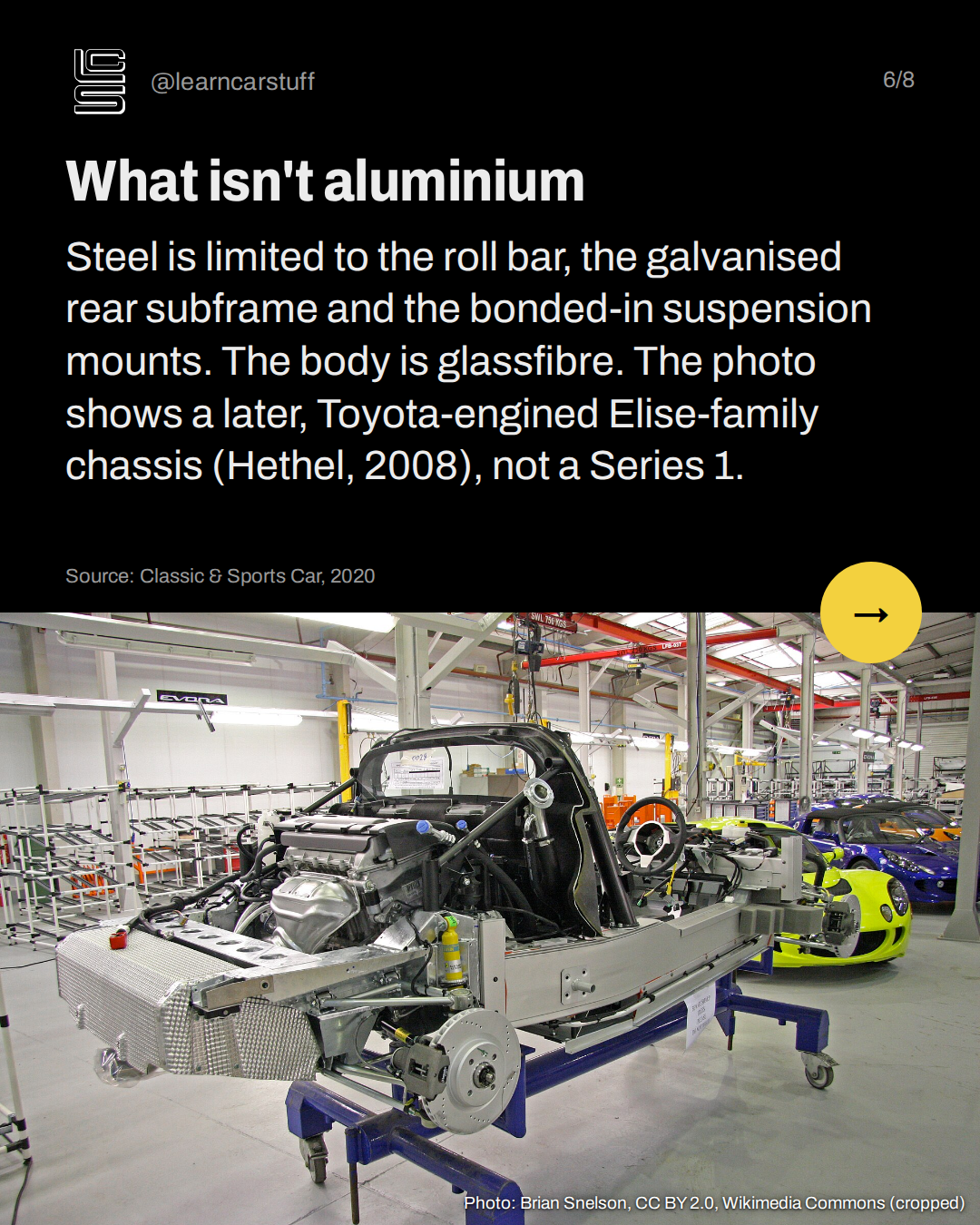
What isn't aluminium
Steel is limited to the roll bar, the galvanised rear subframe and the bonded-in suspension mounts. The body is glassfibre. The photo shows a later, Toyota-engined Elise-family chassis (Hethel, 2008), not a Series 1.
Source: Classic & Sports Car, 2020
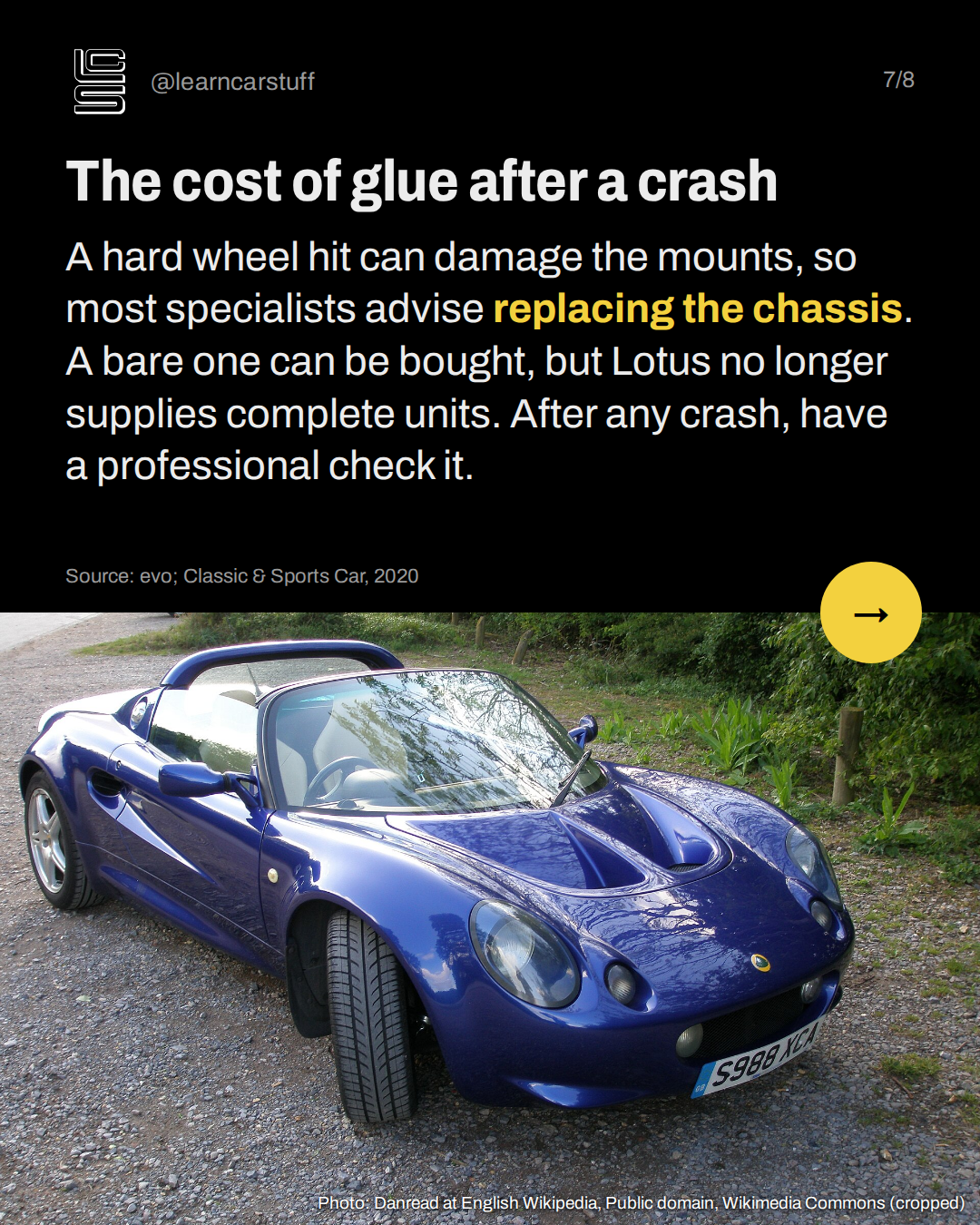
The cost of glue after a crash
A hard wheel hit can damage the mounts, so most specialists advise replacing the chassis. A bare one can be bought, but Lotus no longer supplies complete units. After any crash, have a professional check it.
Source: evo; Classic & Sports Car, 2020
Sources and assumptions
- Classic & Sports Car – Why you'd want a Lotus Elise S1 (Malcolm McKay, 3 Apr 2020): Elise pioneered epoxy-bonded anodised aluminium extrusions for a road-car chassis; high-sided tub with transverse torque boxes; stiffness on a par with steel saloon bodies; 68kg without body and rollbar; whole car under 750kg; steel limited to rollbar, galvanised rear subframe and bonded-in suspension mounts; glassfibre body; Lotus says complete new body/chassis units no longer available (lost the jigs) (checked 2026-10-11)
- evo – Lotus Elise S1 review, specs and buying guide: Extruded aluminium sections bonded with adhesive instead of welded, process developed with Hydro Aluminium, first automotive application; bare chassis 67kg excluding roll hoop; 731kg kerb weight; 1.8 Rover K-series 118bhp at 5500rpm, 122lb ft; produced 1996–2001; wheel impacts can damage suspension mounting points and most specialists advise chassis replacement rather than repair (checked 2026-10-11)
- The Intercooler – Breakthrough: the bonded and riveted aluminium tub (David Twohig, 31 Jul 2025): Rivets were effectively temporary, and most of the bond strength came from the adhesive; welding heat anneals the material, so a welded Elise would have needed thicker-walled extrusions; sealed sulphuric-acid anodising before bonding; large-section thin-walled extrusions form rails and cross-members; partners included Hydro Aluminium and CIBA Adhesives; about 725kg at launch (checked 2026-10-11)
- Hagerty UK – How the first Lotus Elise prototype was built on Christmas Eve (Nik Berg, 16 Dec 2020): First prototype chassis delivered by Danish supplier Hydro in November 1994; extruded aluminium sections bonded rather than welded; prototype structure about 70 kg; Richard Rackham chief engineer (checked 2026-10-11)
- Lotus Cars – Lotus Story: Elise: Debut at Frankfurt Motor Show 12 September 1995; named after Elisa, granddaughter of chairman Romano Artioli; 'bonded and extruded aluminum chassis'; Series 1 weight 690–770kg (checked 2026-10-11)
- Lotus press release 'The lightest Elise ever – the new Lotus Elise Sprint' (19 Mar 2017), as reproduced by GG Lotus: Lotus wording: 'built around an extruded and bonded aluminium chassis which is both tremendously strong and torsionally stiff – weighing just 68 kg' (the 2017 Series 3 Elise) (checked 2026-10-11)
- Automotive Manufacturing Solutions – Lotus loses weight (28 Apr 2016): Elise/Exige chassis 68kg each; sections joined by epoxy adhesive; Lotus uses aluminium to halve the weight compared with steel (checked 2026-10-11)
Assumptions:
- The 68 kg figure is for the bare chassis without the body and roll bar. Published figures range from 67 kg (evo) to 70 kg (the 1994 prototype, Hagerty), so slides say 'about 68 kg'.
- Car weight is given as 'under 750 kg' (C&SC). Exact figures differ by source and spec: 725 kg at launch (Intercooler), 731 kg (evo), 690–770 kg across Series 1 versions (Lotus).
- 'Glued' means structural epoxy adhesive. The chassis also has rivets, but the Intercooler engineer's account says they were effectively temporary and the adhesive carries the load.
- Hydro Aluminium is described by its Danish operation (Tønder), which built the chassis. The parent company is not named as Danish.
- The rolling-chassis photo (2008, Hethel) shows a later Toyota-engined Elise-family car, not a Series 1, and must be captioned that way.
- The repair point is about chassis damage after a crash, not routine ownership; 'most specialists advise replacement' is evo's buying-guide wording.
Photos:
- Photo: pyntofmyld (Flickr), CC BY 2.0, Wikimedia Commons (cropped)
- Photo: Lothar Spurzem, CC BY-SA 2.0 de, Wikimedia Commons (cropped)
- Photo: Lothar Spurzem, CC BY-SA 2.0 de, Wikimedia Commons (cropped)
- Photo: Vauxford, CC BY-SA 4.0, Wikimedia Commons (cropped)
- Photo: Danread at English Wikipedia, Public domain, Wikimedia Commons (cropped)
- Photo: Brian Snelson, CC BY 2.0, Wikimedia Commons (cropped)
The short version
- The Elise S1 chassis is glued, not welded.
- Welding softens aluminium and needs thicker walls.
- The result: about 68 kg of chassis.
- A hard wheel hit can mean a new chassis.




.JPG)
.JPG)


