 Learn Car Stuff
Why did Ferrari's 40th birthday car get a twin-turbo V8?
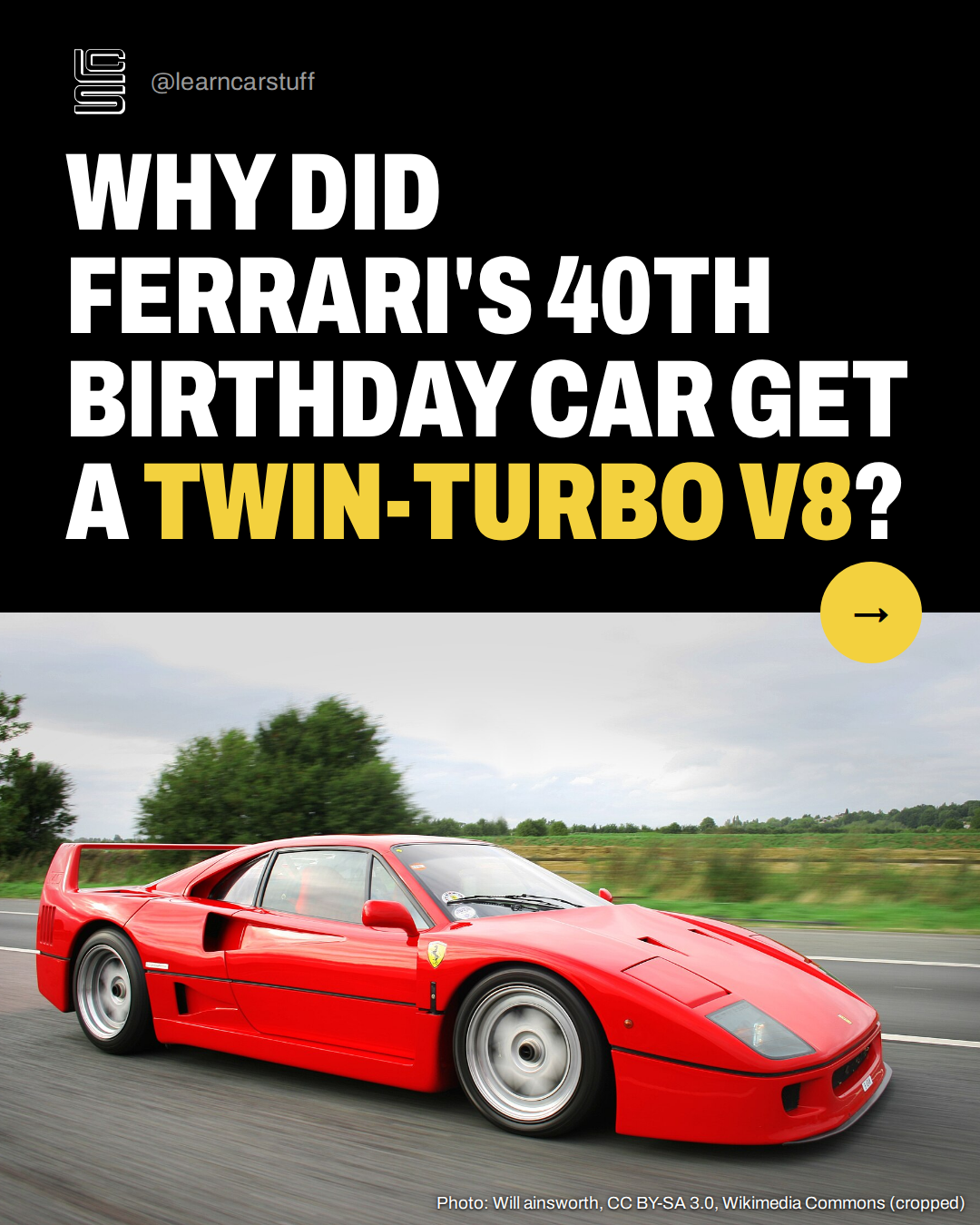
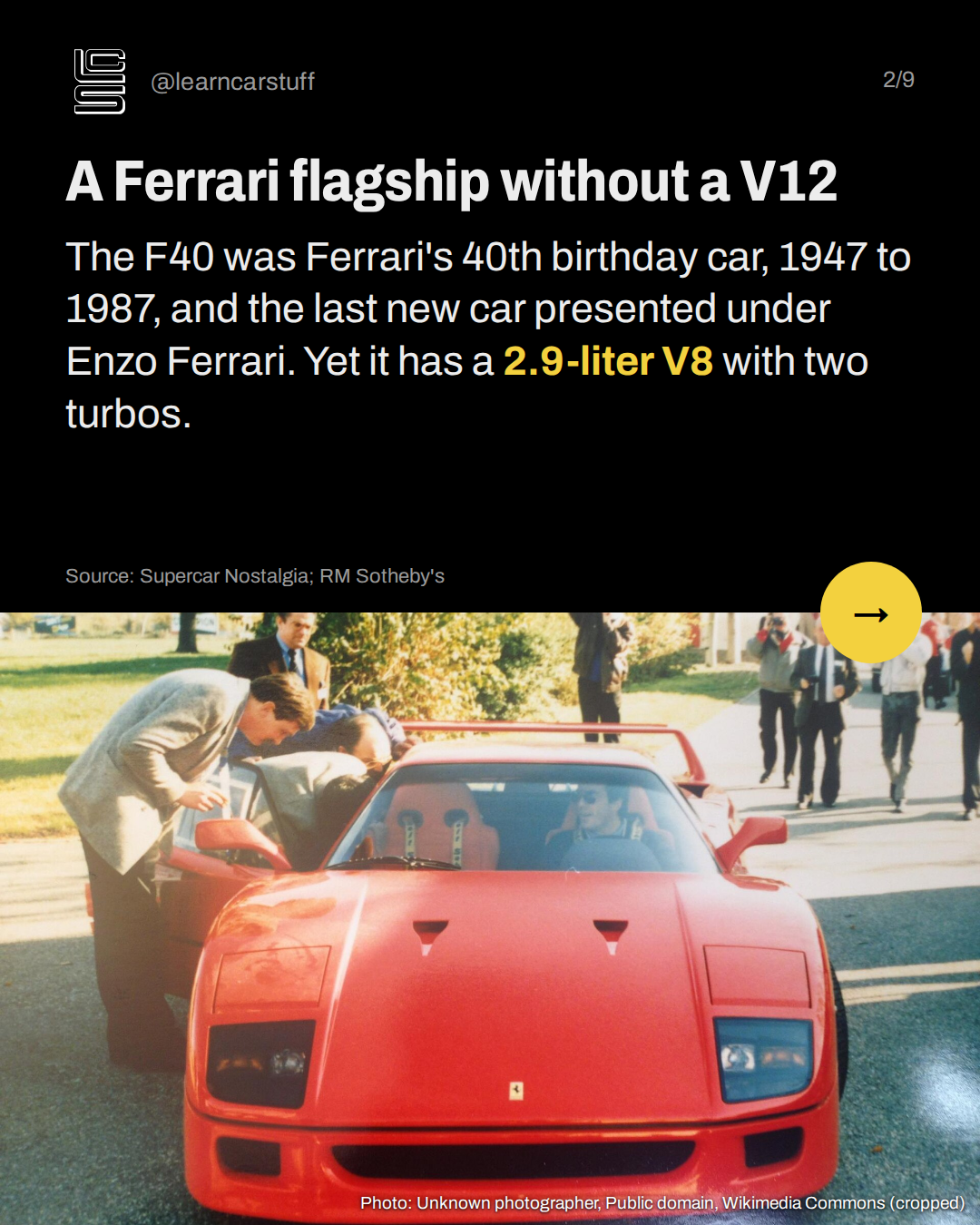
A Ferrari flagship without a V12
The F40 was Ferrari's 40th birthday car, 1947 to 1987, and the last new car presented under Enzo Ferrari. Yet it has a 2.9-liter V8 with two turbos.
Source: Supercar Nostalgia; RM Sotheby's
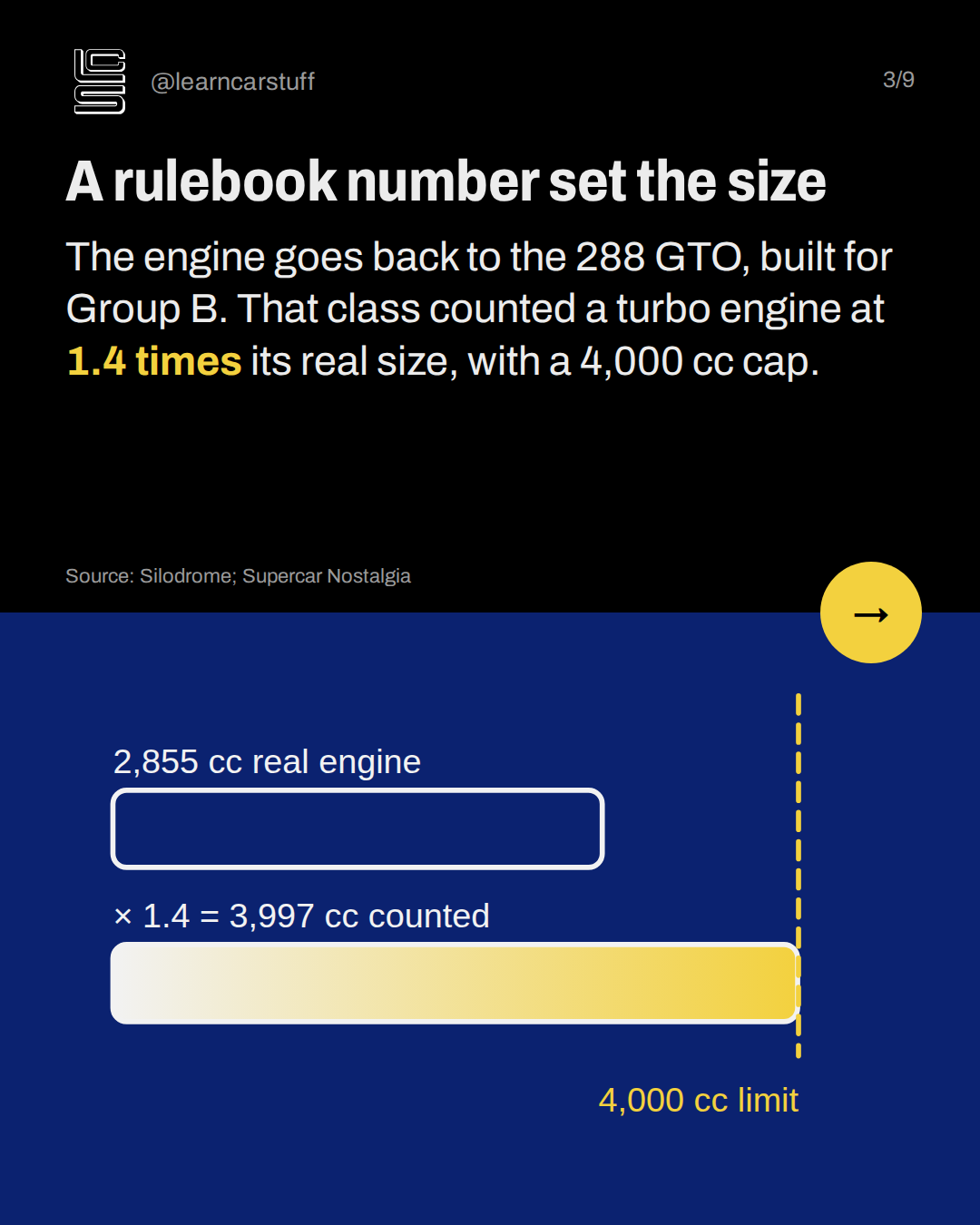
A rulebook number set the size
The engine goes back to the 288 GTO, built for Group B. That class counted a turbo engine at 1.4 times its real size, with a 4,000 cc cap.
Source: Silodrome; Supercar Nostalgia
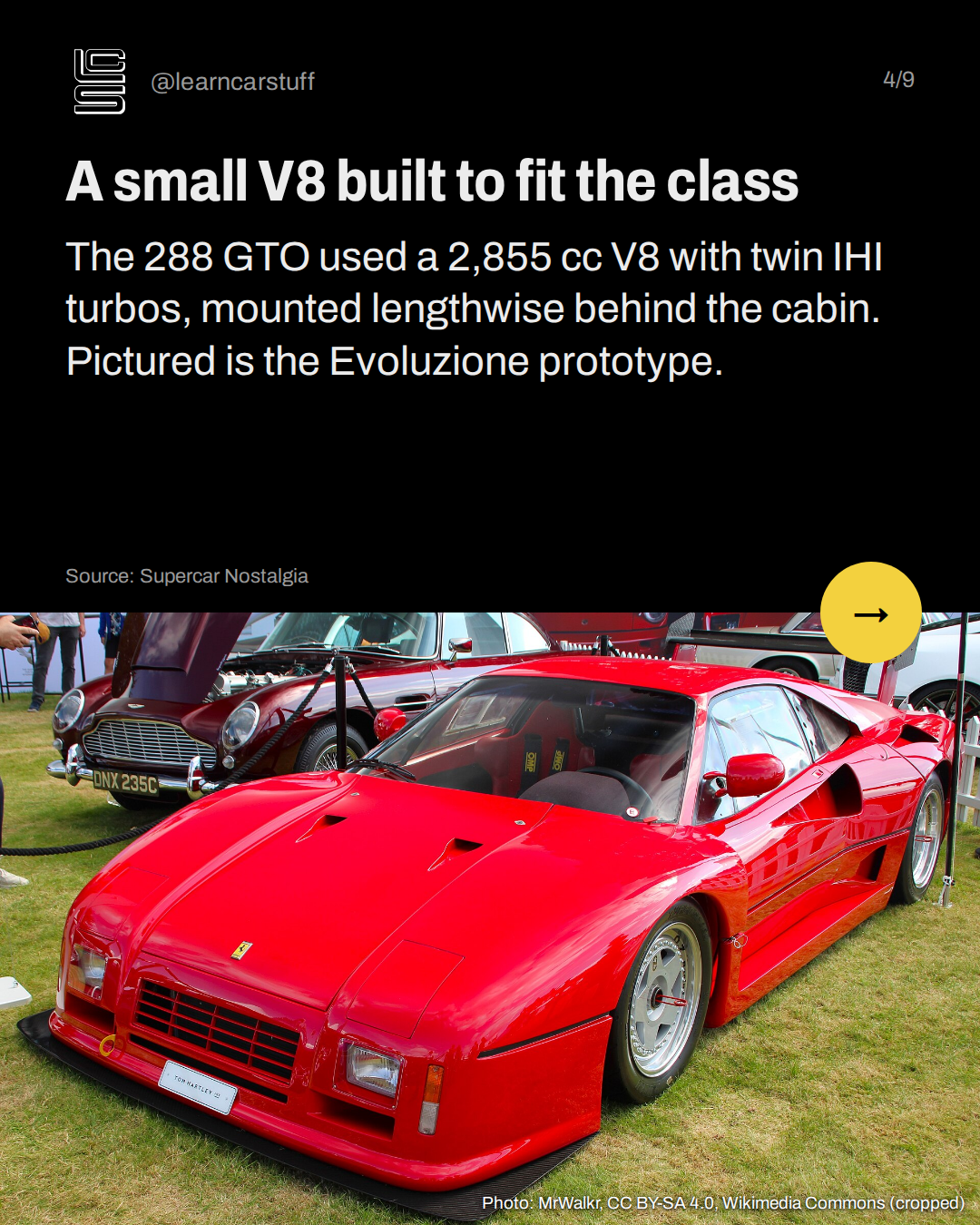
A small V8 built to fit the class
The 288 GTO used a 2,855 cc V8 with twin IHI turbos, mounted lengthwise behind the cabin. Pictured is the Evoluzione prototype.
Source: Supercar Nostalgia
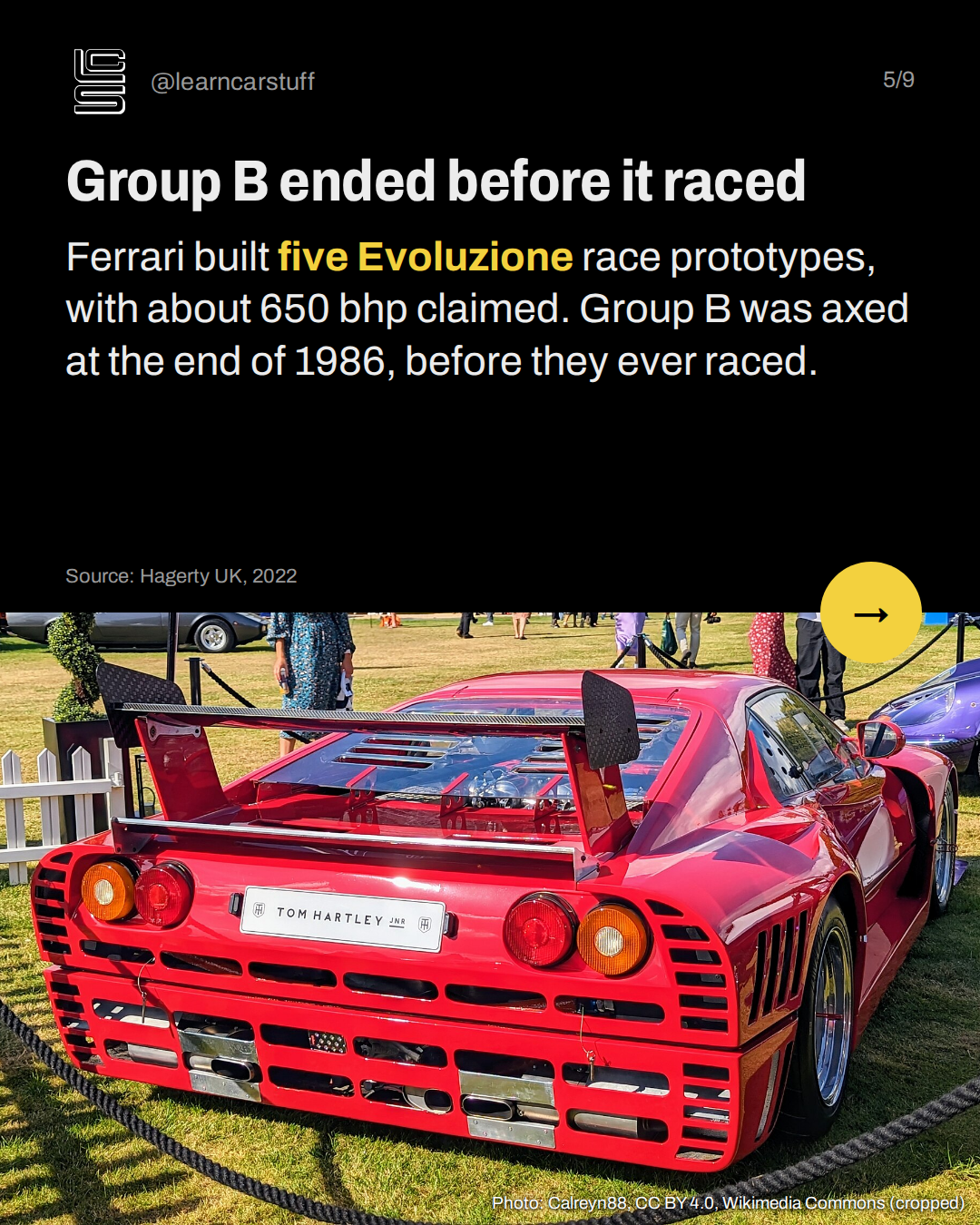
Group B ended before it raced
Ferrari built five Evoluzione race prototypes, with about 650 bhp claimed. Group B was axed at the end of 1986, before they ever raced.
Source: Hagerty UK, 2022
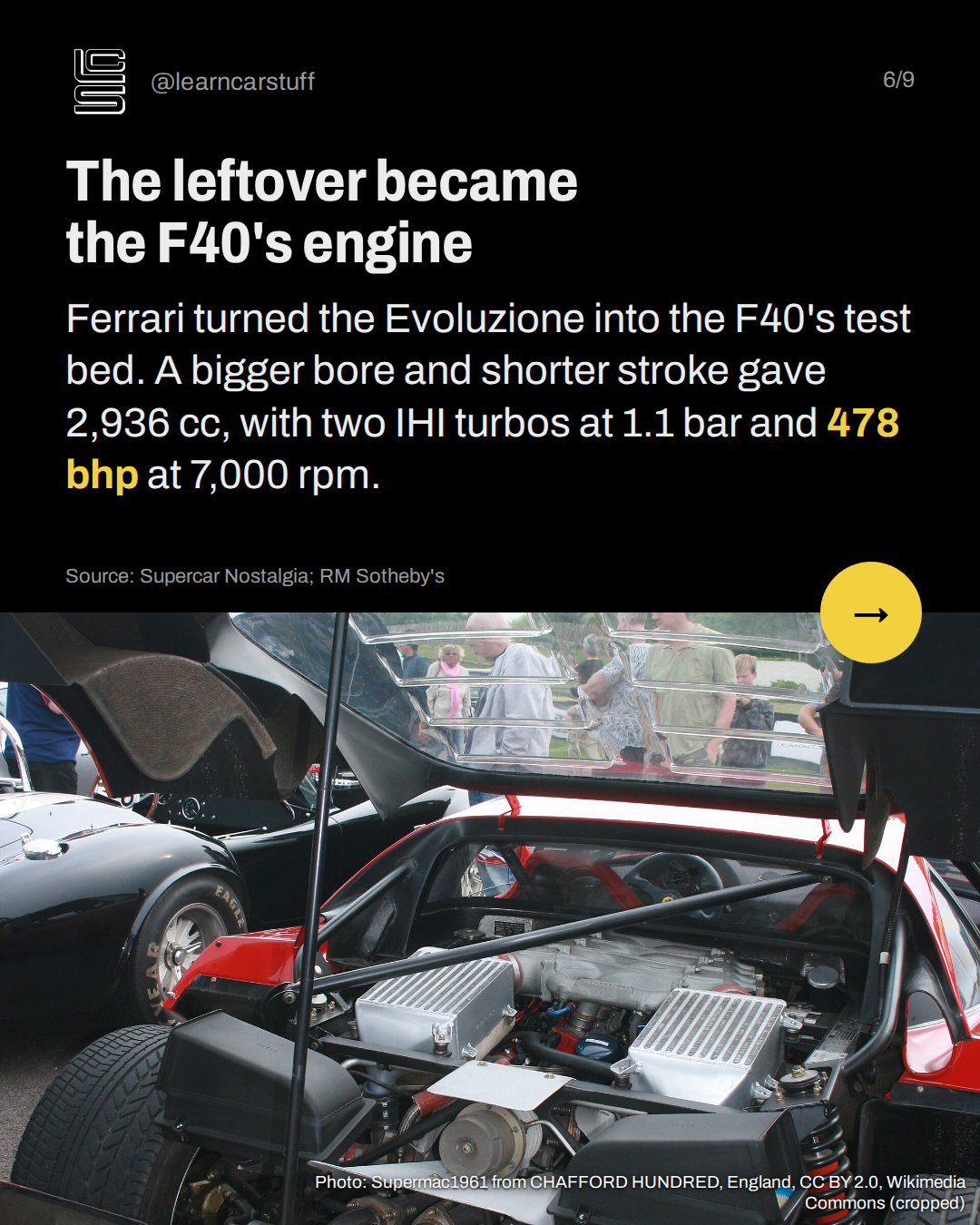
The leftover became the F40's engine
Ferrari turned the Evoluzione into the F40's test bed. A bigger bore and shorter stroke gave 2,936 cc, with two IHI turbos at 1.1 bar and 478 bhp at 7,000 rpm.
Source: Supercar Nostalgia; RM Sotheby's
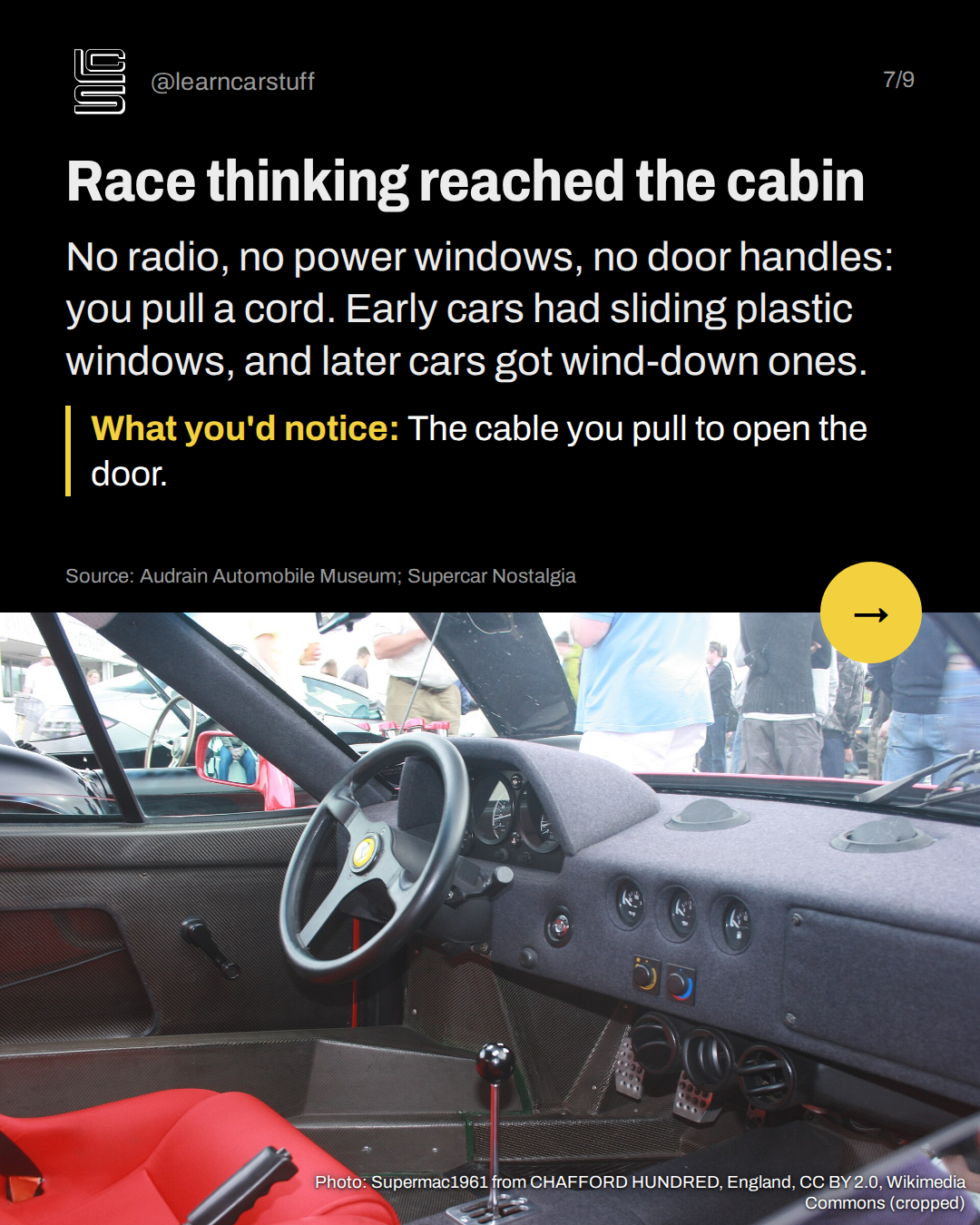
Race thinking reached the cabin
No radio, no power windows, no door handles: you pull a cord. Early cars had sliding plastic windows, and later cars got wind-down ones.
What you'd notice: The cable you pull to open the door.
Source: Audrain Automobile Museum; Supercar Nostalgia
A race car that lost its series
The F40 grew out of a race prototype whose series was cancelled, and it finished as a birthday present. Its V8 traces back to a rulebook's 1.4 turbo factor.
Sources and assumptions
- RM Sotheby's, 1990 Ferrari F40 lot description (Paris 2023): Built to celebrate Ferrari's 40th anniversary; the 288 Evoluzione project was never realised because Group B was outlawed but was the basis for the F40; the 288's twin-turbo V8 was bored out and de-stroked; 478 bhp at 7,000 rpm (checked 2026-10-11)
- Supercar Nostalgia, Guide: Ferrari F40 – a Historical & Technical Appraisal: Tipo F120 A, 2936cc, 81.9 mm bore, 69.5 mm stroke, 478bhp at 7000rpm, two water-cooled IHI turbos at 1.1 bar; unveiled at a Maranello press conference June 1987, last car presented by Enzo Ferrari; early cars sliding Plexiglas windows with no door trim, later wind-down windows with a carbon door panel; pull cable door release; 1311 built, production ended 1992; GTO Evoluzione became the prototype for the 288's successor (checked 2026-10-11)
- Supercar Nostalgia, Guide: Ferrari 288 GTO: 2855cc (80 x 71 mm); FIA 1.4 turbo equivalence gives 3997cc, just under the Group B four-litre limit; 200-car homologation minimum; 272 built in total; 400bhp at 7000rpm; twin IHI turbochargers; Ferrari abandoned the programme and switched the GTO Evoluzione into the F40 development programme (checked 2026-10-11)
- Silodrome, Ferrari 288 GTO: Group B rules: max engine size 4000cc, turbo capacity judged as 1.4 times actual; Group B cancelled at the end of the 1986 season (checked 2026-10-11)
- Hagerty UK, One of five Ferrari 288 GTO Evoluziones is for sale (Nik Berg, 28 Sep 2022): Only five Evoluzione built by the time Group B was axed at the end of 1986; kevlar and fibreglass wide body, carbon rear wing, 940 kg; bigger turbos took power from 400bhp to 650bhp; the Evoluzione influenced the F40, which followed in 1987 (checked 2026-10-11)
- Audrain Automobile Museum, 1991 Ferrari F40: Debuted on Ferrari's 40th anniversary in 1987; no radio, power windows or door handles; doors opened with a simple cord; 2.9 L twin-turbo V8 (checked 2026-10-11)
- Motorious, 10 Facts You Might Not Have Known About The Ferrari F40: Named for Ferrari's 40th anniversary, 1947 to 1987; doors opened by a cable running diagonally in the hollow of the door (checked 2026-10-11)
Assumptions:
- Ferrari's own F40 spec and magazine pages (ferrari.com) would not load for verification (JavaScript-only), so the specs rely on RM Sotheby's, Supercar Nostalgia, Hagerty UK and the Audrain Museum, which agree with each other. Do not write 'Ferrari states'.
- Power is given as 478 bhp at 7,000 rpm (RM Sotheby's, Supercar Nostalgia). Ferrari's metric figure is often written 478 cv/PS. Use one figure and don't convert.
- The F40's weight differs between sources (1,100 kg RM Sotheby's vs 1,202 kg Supercar Nostalgia), so leave weight off the slides.
- The Evoluzione's 650 bhp is Hagerty's figure for a prototype. Present it as 'about 650 bhp'.
- When sliding windows gave way to wind-down ones varies by source (Supercar Nostalgia says after the first 50 cars). Say 'early cars' and 'later cars', with no count.
- Group B is described as an FIA class cancelled at the end of 1986. The 288 GTO was aimed at Group B circuit racing, which never got going. Don't say it was a rally car.
- The 1.4 turbo factor and 4,000 cc cap apply to the 288 GTO (2,855 cc). The F40 (2,936 cc) was not built for that class. 2,936 × 1.4 = 4,110 cc is over the cap, which is consistent with 'no class to fit anymore', but it is an inference: if used, frame it as our arithmetic, not a stated Ferrari reason.
Photos:
- Photo: Will ainsworth, CC BY-SA 3.0, Wikimedia Commons (cropped)
- Photo: Unknown photographer, Public domain, Wikimedia Commons (cropped)
- Photo: Supermac1961 from CHAFFORD HUNDRED, England, CC BY 2.0, Wikimedia Commons (cropped)
- Photo: Supermac1961 from CHAFFORD HUNDRED, England, CC BY 2.0, Wikimedia Commons (cropped)
- Photo: MrWalkr, CC BY-SA 4.0, Wikimedia Commons (cropped)
- Photo: Calreyn88, CC BY 4.0, Wikimedia Commons (cropped)
The short version
- The F40's V8 came from the 288 GTO.
- Group B counted turbos at 1.4× their size.
- 2,855 cc × 1.4 = 3,997 cc.
- Group B ended before the Evoluzione raced.
- Ferrari reused it for the F40.