 Learn Car Stuff
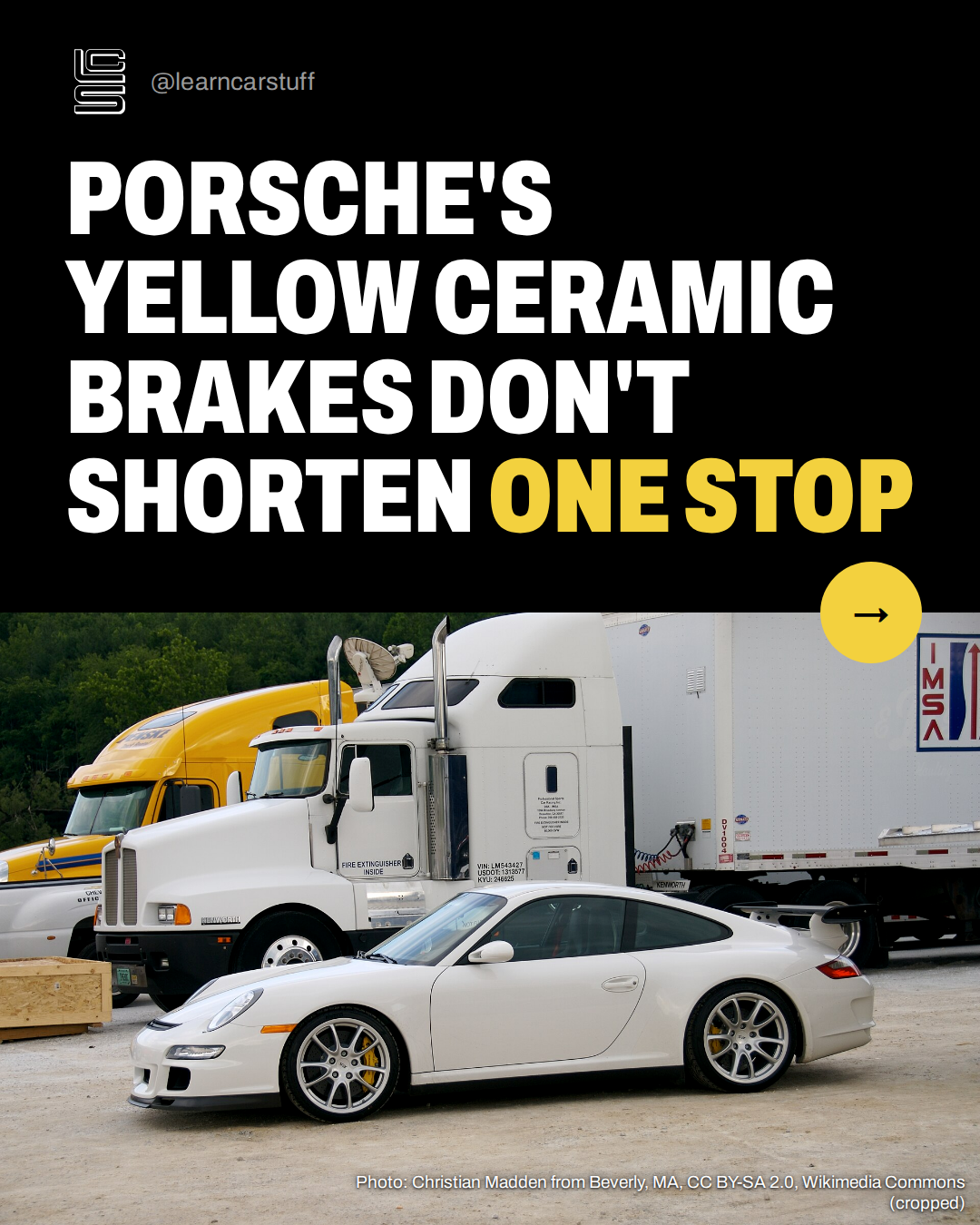
Porsche's yellow ceramic brakes don't shorten one stop
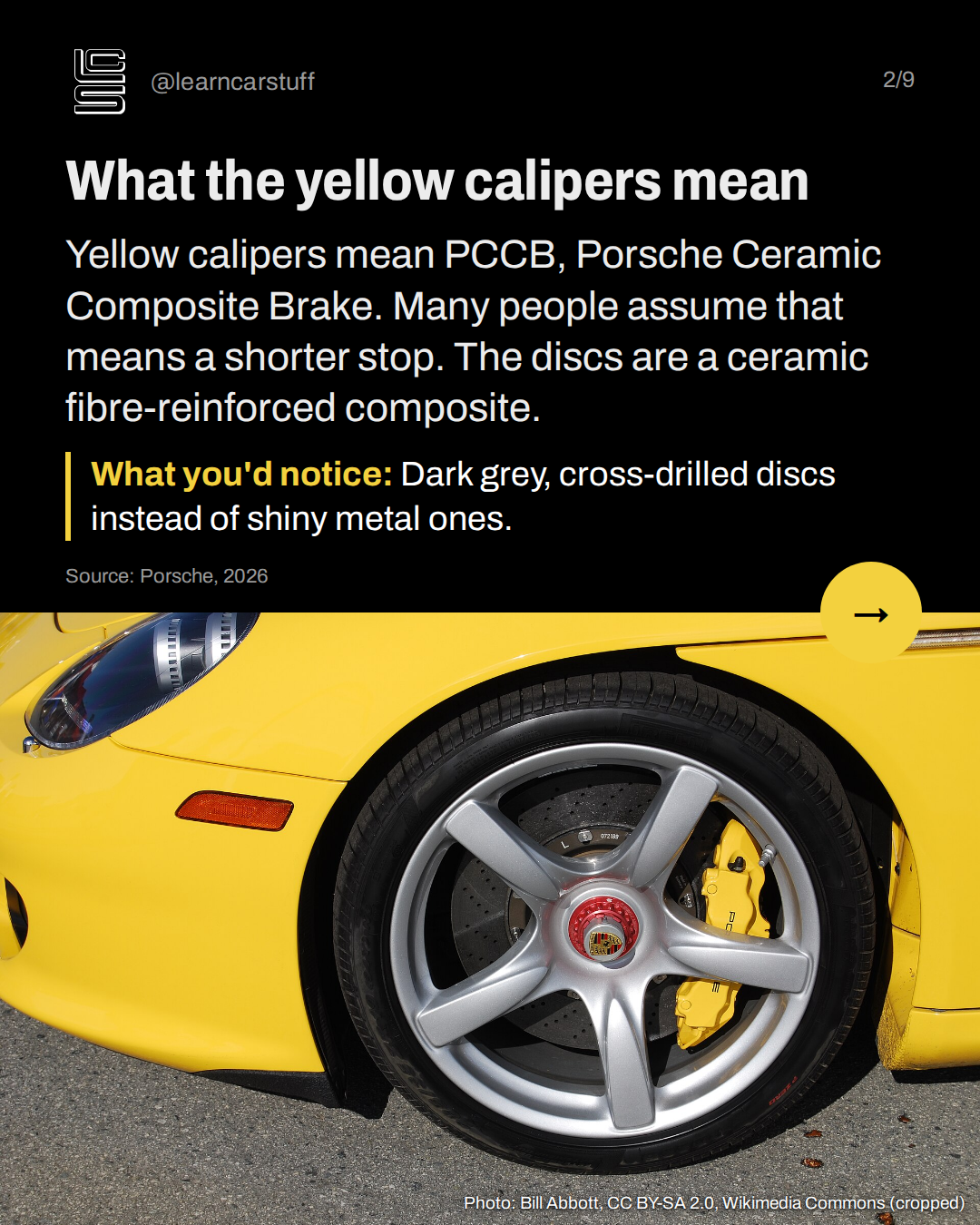
What the yellow calipers mean
Yellow calipers mean PCCB, Porsche Ceramic Composite Brake. Many people assume that means a shorter stop. The discs are a ceramic fibre-reinforced composite.
What you'd notice: Dark grey, cross-drilled discs instead of shiny metal ones.
Source: Porsche, 2026
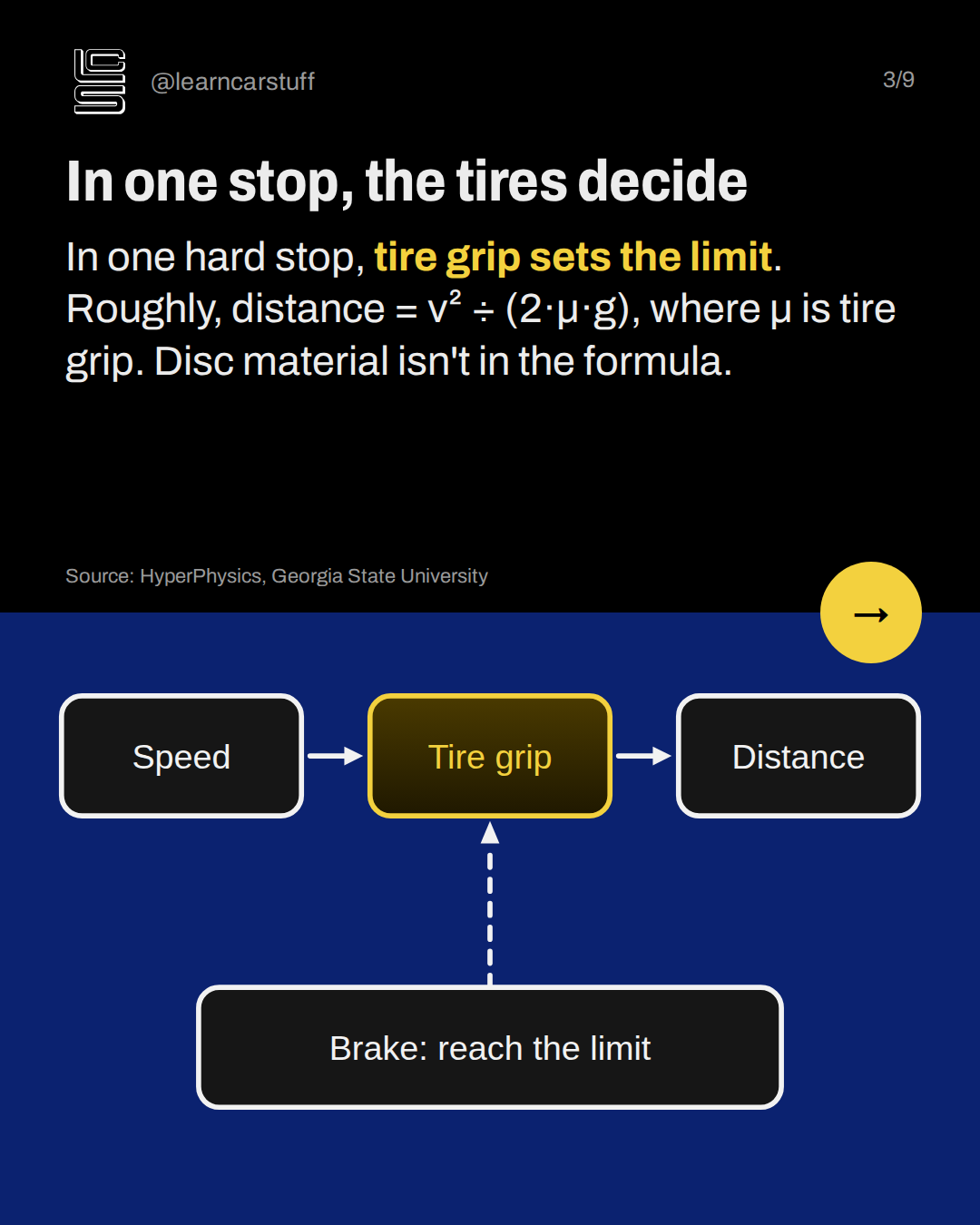
In one stop, the tires decide
In one hard stop, tire grip sets the limit. Roughly, distance = v² ÷ (2·μ·g), where μ is tire grip. Disc material isn't in the formula.
Source: HyperPhysics, Georgia State University
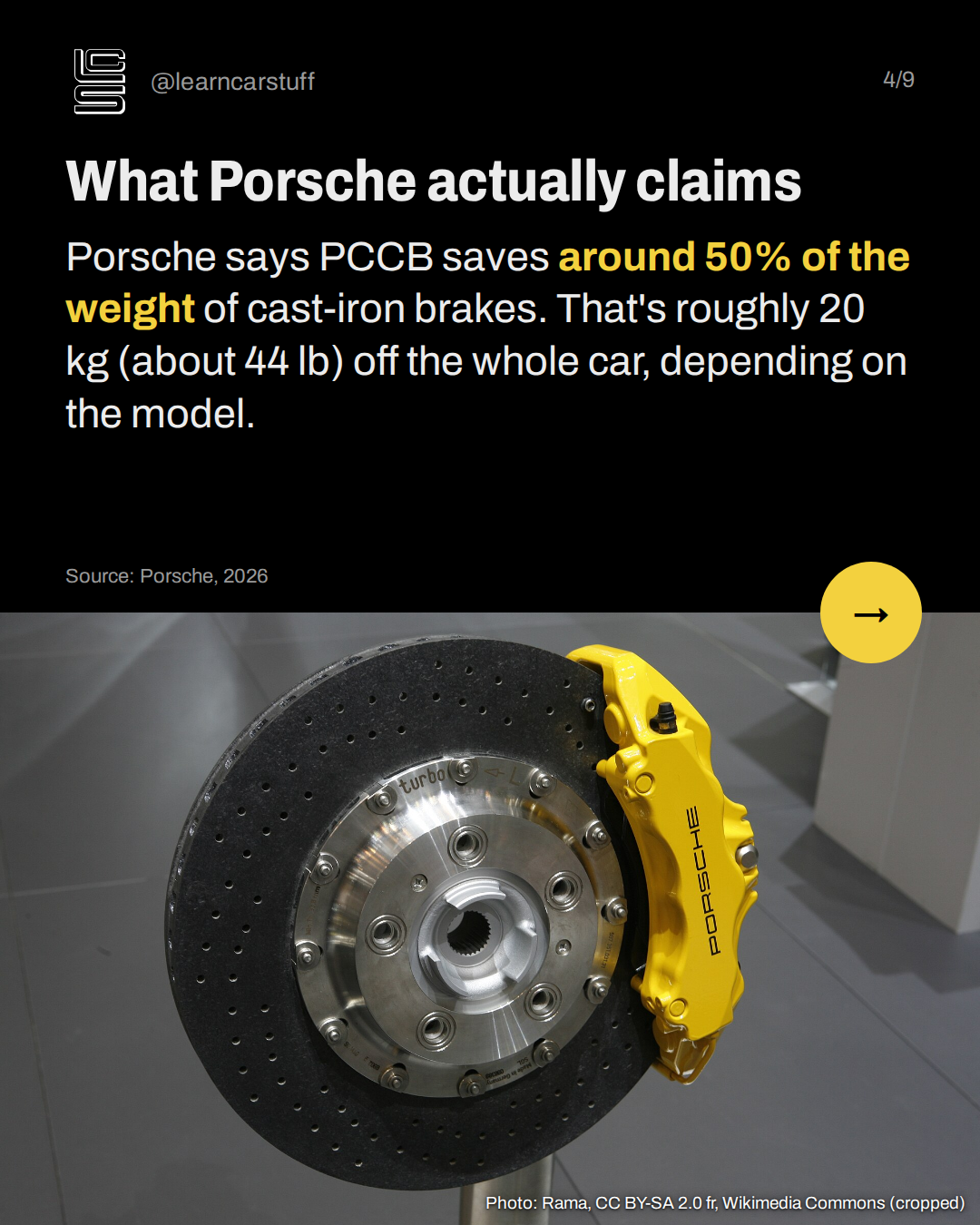
What Porsche actually claims
Porsche says PCCB saves around 50% of the weight of cast-iron brakes. That's roughly 20 kg (about 44 lb) off the whole car, depending on the model.
Source: Porsche, 2026
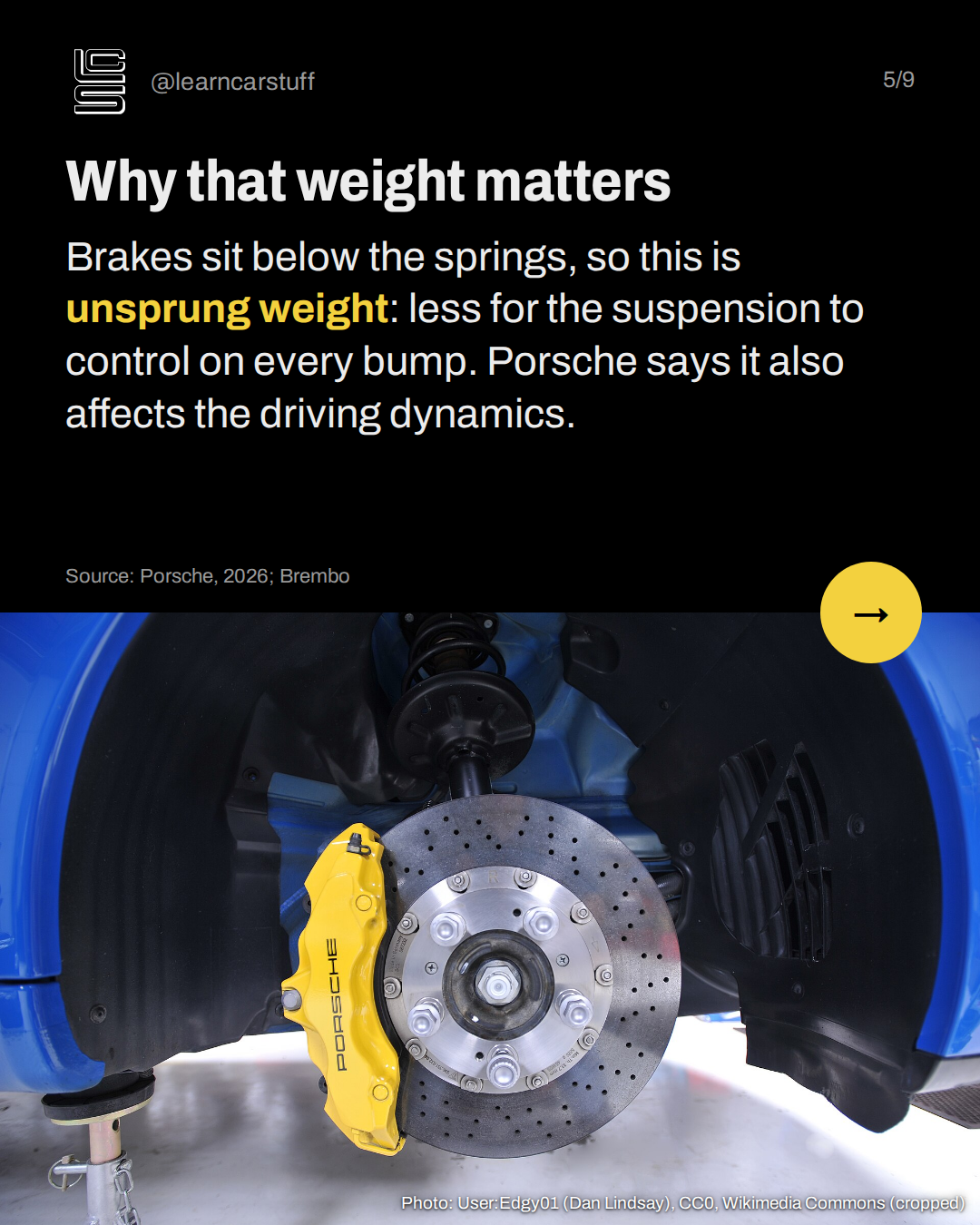
Why that weight matters
Brakes sit below the springs, so this is unsprung weight: less for the suspension to control on every bump. Porsche says it also affects the driving dynamics.
Source: Porsche, 2026; Brembo
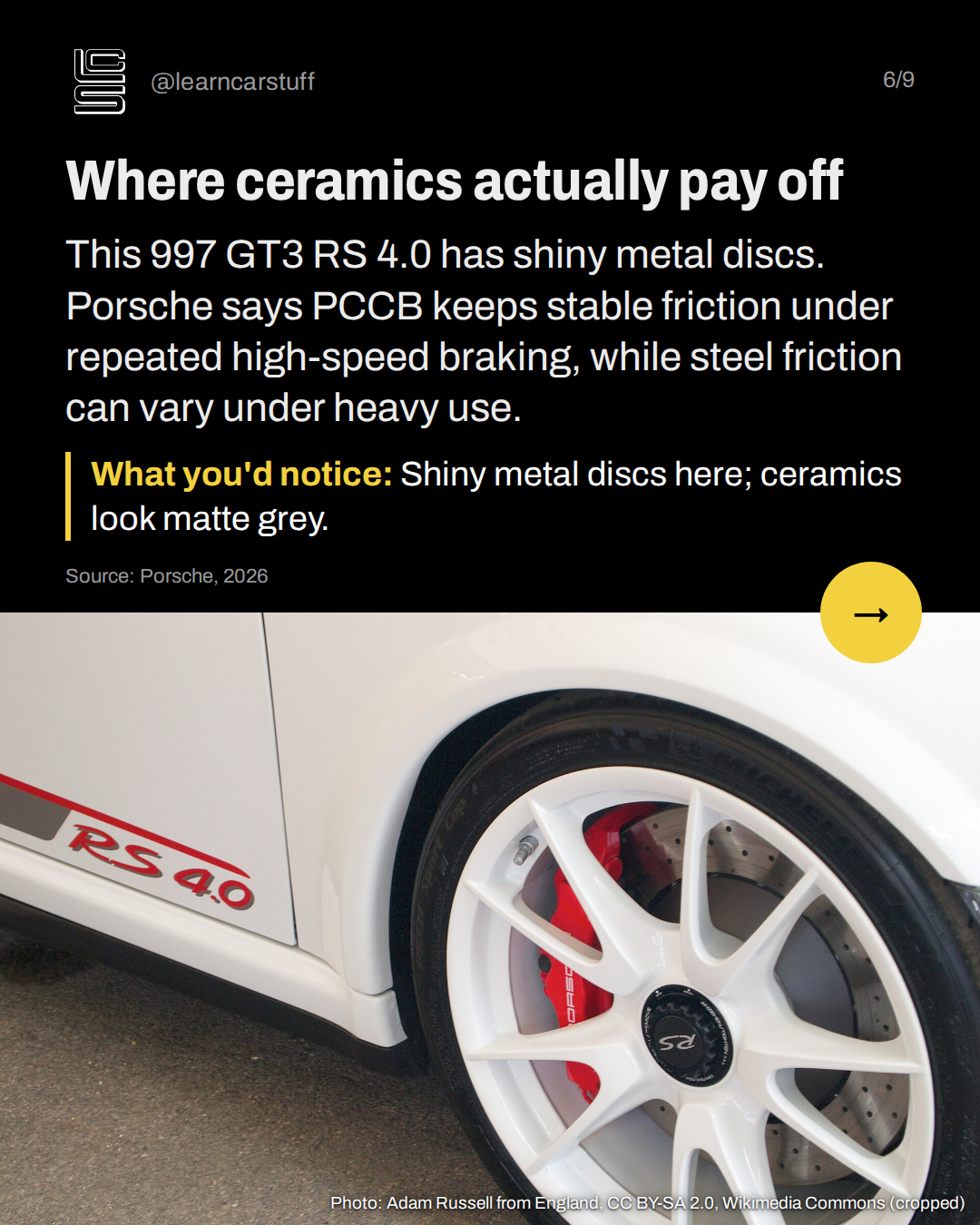
Where ceramics actually pay off
This 997 GT3 RS 4.0 has shiny metal discs. Porsche says PCCB keeps stable friction under repeated high-speed braking, while steel friction can vary under heavy use.
What you'd notice: Shiny metal discs here; ceramics look matte grey.
Source: Porsche, 2026
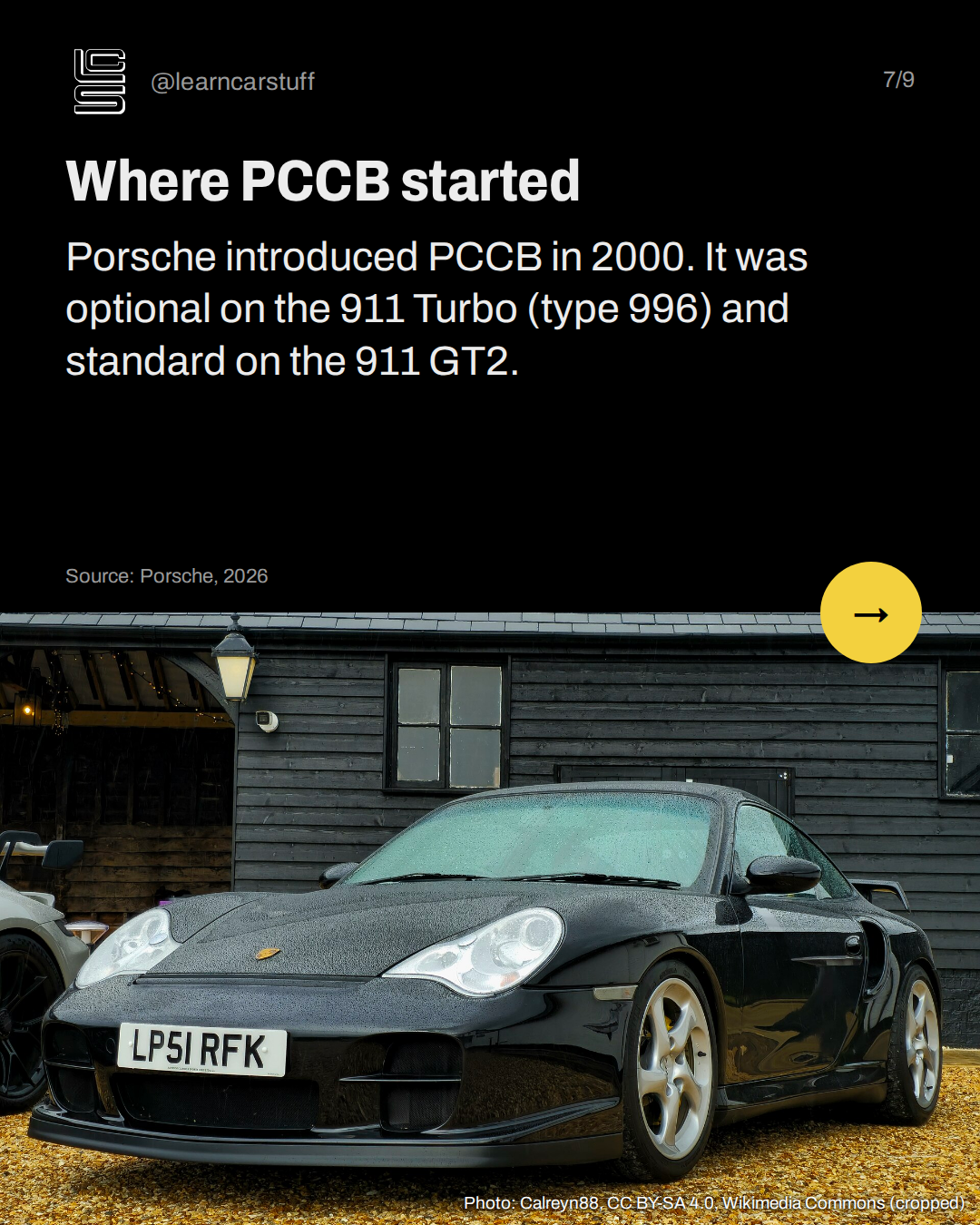
Where PCCB started
Porsche introduced PCCB in 2000. It was optional on the 911 Turbo (type 996) and standard on the 911 GT2.
Source: Porsche, 2026
So who is PCCB for?
For a shorter single stop, look at the tires first. PCCB is for roughly 20 kg less weight, less unsprung mass and steadier braking stop after stop. Have a professional check any brake change.
Sources and assumptions
- Porsche – Porsche Ceramic Composite Brakes (PCCB) explained (porsche.com stories, 5 Feb 2026): 'weight saving of around 50 per cent compared with cast-iron brakes'; 'overall vehicle weight saving of approximately 20 kg, depending on the model'; 'reduced unsprung weight of the PCCB system also affects the driving dynamics'; PCCB 'maintain stable friction even when decelerating repeatedly at high speeds' while steel brakes' 'friction can vary significantly under heavy use'; introduced in 2000, debut as an option on the 911 Turbo (type 996) and standard on the 911 GT2; ceramic fibre-reinforced composite; 'striking yellow brake calipers' (checked 2026-10-09)
- Brembo – Upgrade Line Carbon Ceramic (bremboparts.com): 'The main advantage of CCM is a 50% weight reduction compared to cast iron discs'; it 'reduces the car's unsprung weight', which improves dynamic behaviour; the thermal swings of sustained, prolonged braking 'do not affect the coefficient of friction'; cast iron discs 'tend to deform when repeatedly subjected to major thermal stresses' (checked 2026-10-09)
- HyperPhysics (Georgia State University) – Friction and Automobile Tires: Tire–road friction determines 'your minimum stopping distance'; keep wheels rolling while braking (static friction), since locked wheels lose grip; typical coefficients of about 0.7 dry and 0.4 wet (Jones and Childers) (checked 2026-10-09)
Assumptions:
- The stopping-distance relation d = v² ÷ (2·μ·g) is standard constant-deceleration kinematics with deceleration capped at μ·g by tire grip. It ignores reaction time, downforce, load transfer and ABS cycling, so it is a simplification ('roughly').
- 'The tires set the limit in one stop' assumes a healthy, correctly balanced brake system strong enough to reach the tires' grip (true of factory Porsche iron brakes, which reach ABS). A badly undersized or faded brake changes that.
- Porsche's 'about 20 kg' saving varies by model ('depending on the model'), and the 50% figure is Porsche's 'around 50 per cent' versus cast-iron brakes.
- No measured stopping-distance comparison is used. Car and Driver's iron-vs-PCCB 911 tests are widely quoted on forums, but caranddriver.com could not be opened, so those figures are excluded. One secondary article (CarBuzz) claims ceramics stop about 10 ft shorter from 60 mph without a test reference; it is not used.
- Unsprung mass is the part of the car below the springs (wheels, tires, brakes, hubs); brake discs also spin with the wheel. Only the unsprung point is sourced, and its effect is described qualitatively, as Porsche and Brembo do.
Photos:
- Photo: Christian Madden from Beverly, MA, CC BY-SA 2.0, Wikimedia Commons (cropped)
- Photo: Bill Abbott, CC BY-SA 2.0, Wikimedia Commons (cropped)
- Photo: Rama, CC BY-SA 2.0 fr, Wikimedia Commons (cropped)
- Photo: User:Edgy01 (Dan Lindsay), CC0, Wikimedia Commons (cropped)
- Photo: Adam Russell from England, CC BY-SA 2.0, Wikimedia Commons (cropped)
- Photo: Calreyn88, CC BY-SA 4.0, Wikimedia Commons (cropped)
The short version
- One hard stop is set by tire grip.
- Porsche says PCCB discs weigh around 50% less.
- That's about 20 kg off the car, by model.
- The real edge is steadier braking, stop after stop.
.jpg)
.jpg)


.jpg)