 Learn Car Stuff
How did Chevrolet fix the Corvair's swing axles for 1965?

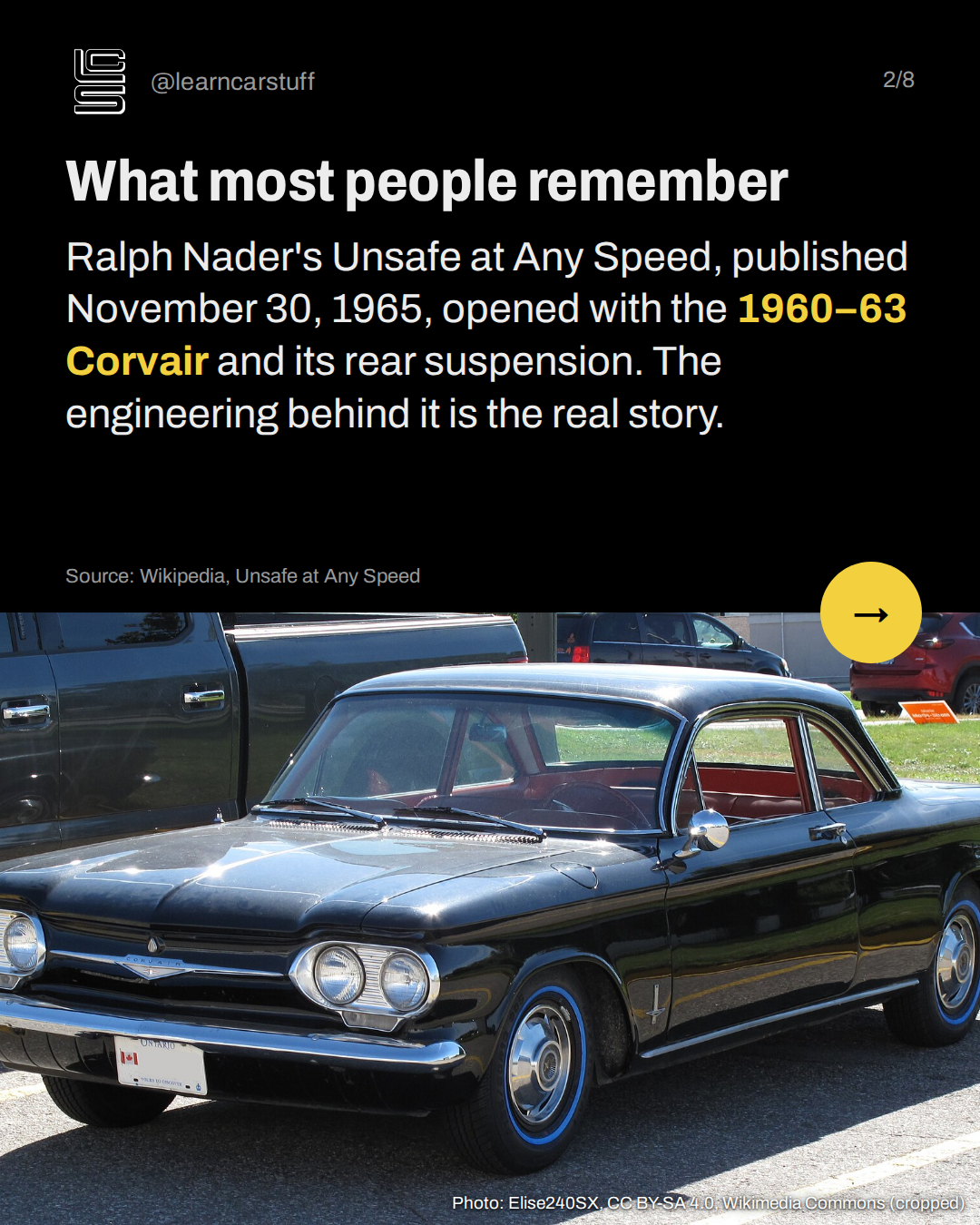
What most people remember
Ralph Nader's Unsafe at Any Speed, published November 30, 1965, opened with the 1960–63 Corvair and its rear suspension. The engineering behind it is the real story.
Source: Wikipedia, Unsafe at Any Speed
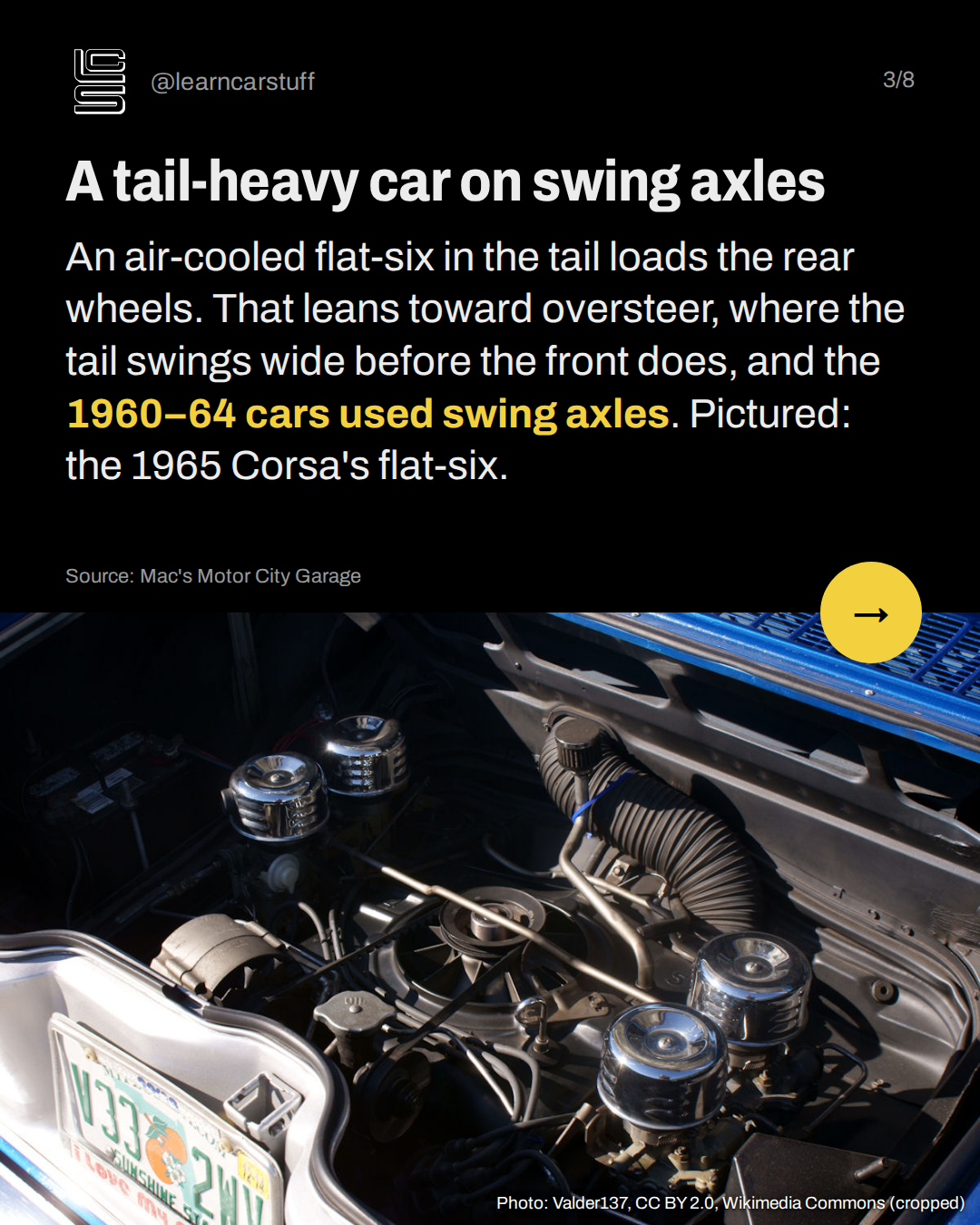
A tail-heavy car on swing axles
An air-cooled flat-six in the tail loads the rear wheels. That leans toward oversteer, where the tail swings wide before the front does, and the 1960–64 cars used swing axles. Pictured: the 1965 Corsa's flat-six.
Source: Mac's Motor City Garage
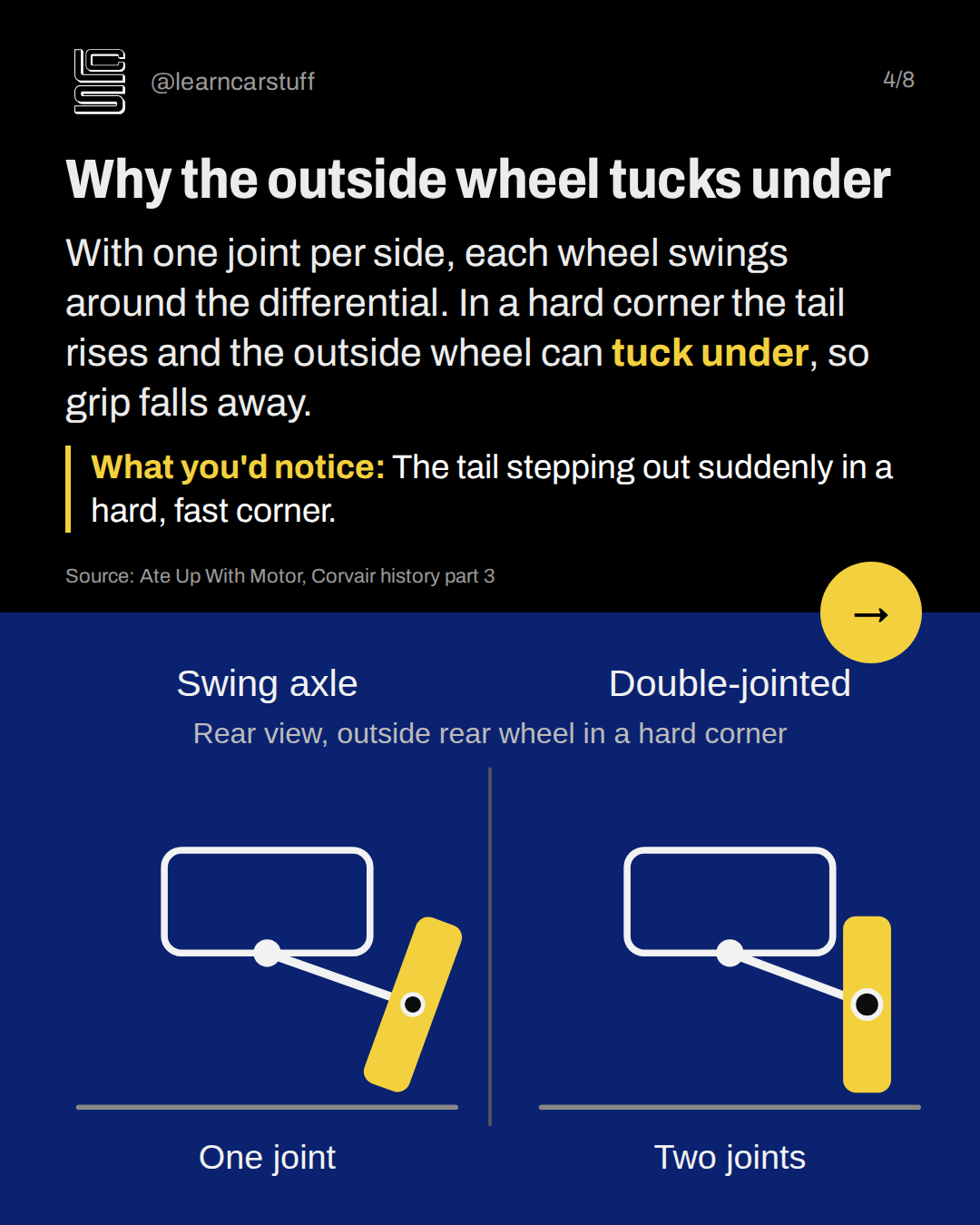
Why the outside wheel tucks under
With one joint per side, each wheel swings around the differential. In a hard corner the tail rises and the outside wheel can tuck under, so grip falls away.
What you'd notice: The tail stepping out suddenly in a hard, fast corner.
Source: Ate Up With Motor, Corvair history part 3
Chevrolet's stopgaps before 1965
Tire pressure came first: 15 psi front, 26 psi rear (cold). A $10.80 option (RPO 696) for the 1962 model year added a front anti-roll bar and stiffer springs. For 1964 a rear leaf spring limited swing-axle movement.
Source: Ate Up With Motor, Corvair history part 3
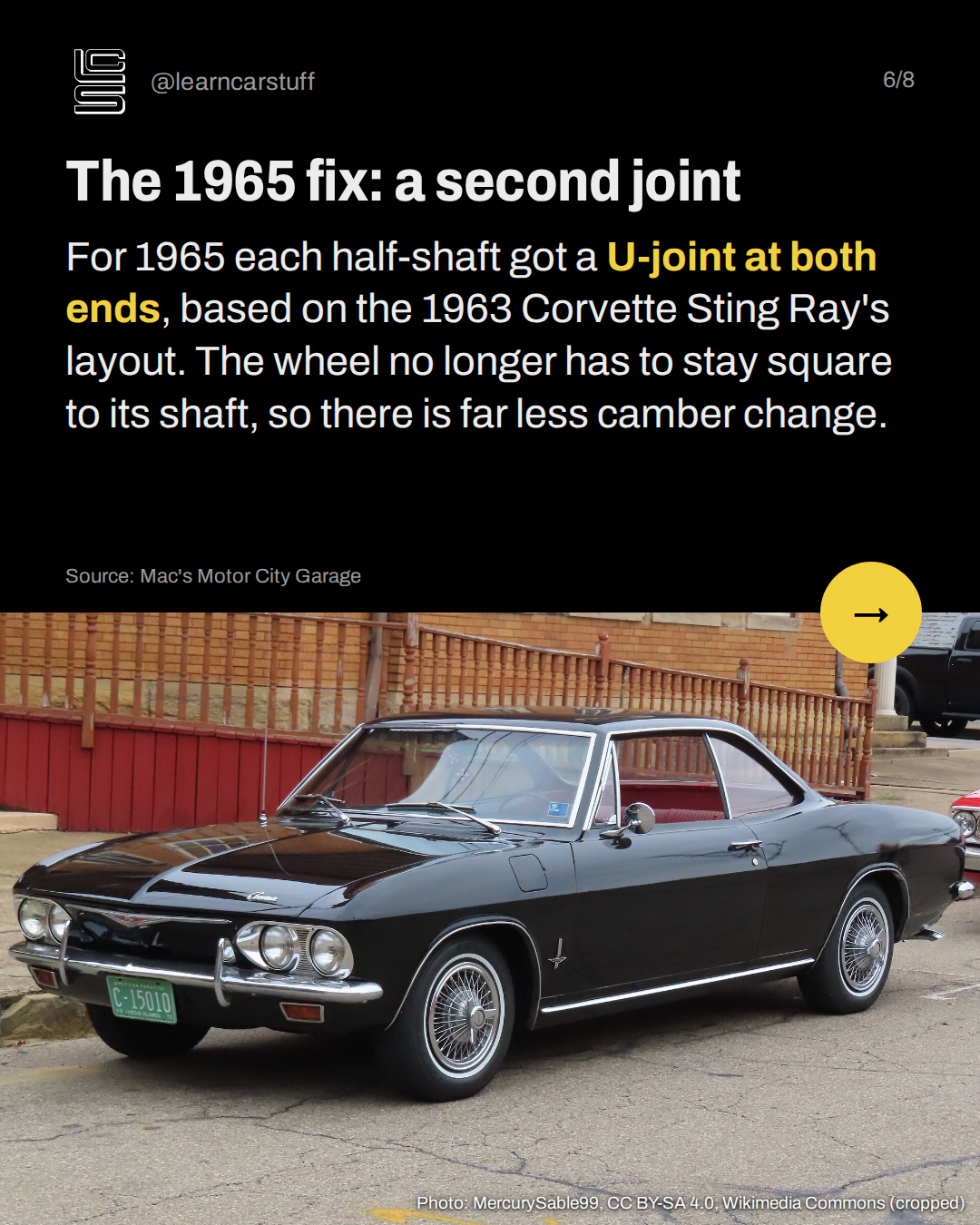
The 1965 fix: a second joint
For 1965 each half-shaft got a U-joint at both ends, based on the 1963 Corvette Sting Ray's layout. The wheel no longer has to stay square to its shaft, so there is far less camber change.
Source: Mac's Motor City Garage
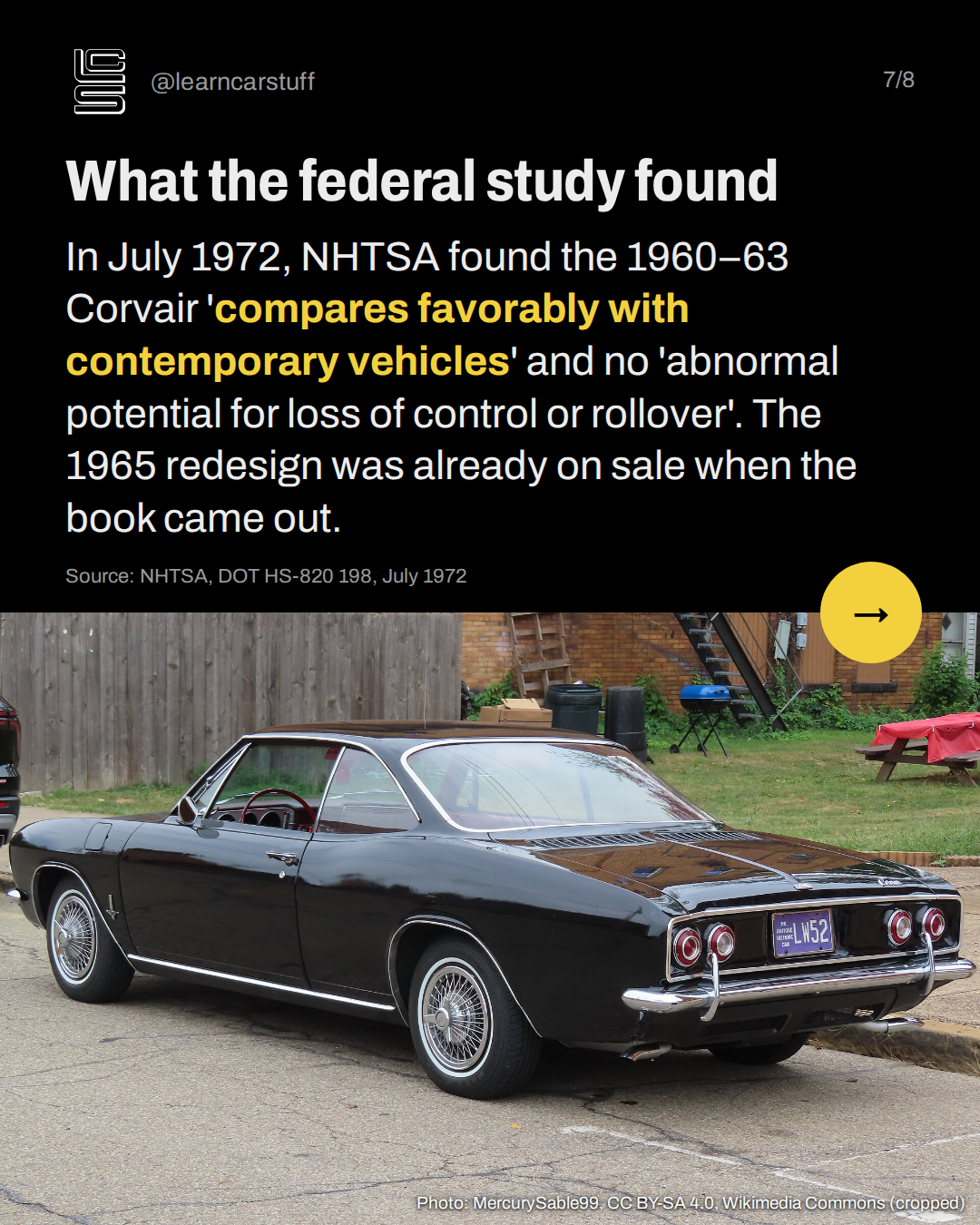
What the federal study found
In July 1972, NHTSA found the 1960–63 Corvair 'compares favorably with contemporary vehicles' and no 'abnormal potential for loss of control or rollover'. The 1965 redesign was already on sale when the book came out.
Source: NHTSA, DOT HS-820 198, July 1972
Sources and assumptions
- Ate Up With Motor: Contrary Compact, The Life and Death of the Chevrolet Corvair (part 3), Aaron Severson: Swing-axle jacking ('the halfshaft acted as a lever, forcing the tail upward') and tuck-under ('the outside rear wheel would tuck under, assuming an exaggerated positive camber angle'); factory tire pressures 15 psi front / 26 psi rear; 1962 RPO 696 heavy-duty suspension at $10.80 (front anti-roll bar, rear axle limiter straps, stiffer shocks and springs); 1964 transverse leaf spring that carried part of the rear weight and resisted swing-axle deflection; 1965 double-jointed half-shafts based on the 1963 Corvette Sting Ray rear suspension (checked 2026-10-08)
- Mac's Motor City Garage: Greater Than the Sum of its Parts, The 1965 Corvair (posted 2023-09-06): The 1960–64 swing axle 'produced extreme camber change and wheel jacking, exaggerating the rear-engine layout's natural tendency to oversteer'; for 1965 'a fully articulated independent rear suspension... with a universal joint at both ends of the left and right axle shafts, which doubled as the upper control arms', engineered by Frank Winchell and similar to the 1963 Corvette Sting Ray IRS (checked 2026-10-08)
- U.S. DOT National Transportation Library (ROSAP): Evaluation of the 1960-1963 Corvair Handling and Stability, NHTSA, DOT HS-820 198: Title, agency (NHTSA), report number and date (July 1, 1972) of the federal evaluation, which reviewed the GM data Nader referenced plus SAE papers and other technical literature (checked 2026-10-08)
- Wikipedia: Unsafe at Any Speed: The Designed-In Dangers of the American Automobile: The book was published November 30, 1965; chapter 1 'The Sporty Corvair' covered the 1960–63 swing-axle cars and the 15/26 psi pressures; the 1972 NHTSA conclusion quote: 'the 1960–63 Corvair compares favorably with contemporary vehicles used in the tests ... does not result in an abnormal potential for loss of control or rollover' (checked 2026-10-08)
- CORSA (Corvair Society of America): Corvair Handling and Stability: Second confirmation of the NHTSA finding ('compared favorably with the other contemporary vehicles used in the NHTSA testing programs'), an NHTSA press release of August 12, 1972, and the full report's NTIS number PB 211-015 (checked 2026-10-08)
Assumptions:
- '1960–64' covers the swing-axle generation; Nader's chapter and the NHTSA study covered 1960–63, because the 1964 car already had the transverse spring. Keep those year ranges distinct on the slides.
- The tire pressures (15 front / 26 rear) are cold pressures for the early car as reported by Ate Up With Motor and Wikipedia; not verified for every model year or body style.
- The diagram is schematic: it shows the direction of the camber change, not measured angles.
- 'Constant camber' was not verified; say 'far less camber change'.
- The engine-bay photo is a 1965 Corsa (four carburetors); it shows the rear flat-six layout shared by both generations, not the early car's exact engine.
Photos:
- Photo: Elise240SX, CC BY-SA 4.0, Wikimedia Commons (cropped)
- Photo: Elise240SX, CC BY-SA 4.0, Wikimedia Commons (cropped)
- Photo: MercurySable99, CC BY-SA 4.0, Wikimedia Commons (cropped)
- Photo: MercurySable99, CC BY-SA 4.0, Wikimedia Commons (cropped)
- Photo: Valder137, CC BY 2.0, Wikimedia Commons (cropped)
The short version
- Swing axles had one joint per side.
- Swing axles exaggerated a tail-heavy car's oversteer.
- For 1965, a second joint meant far less camber change.
- 1972 NHTSA: favorable next to its contemporaries.





.jpg)