 Learn Car Stuff
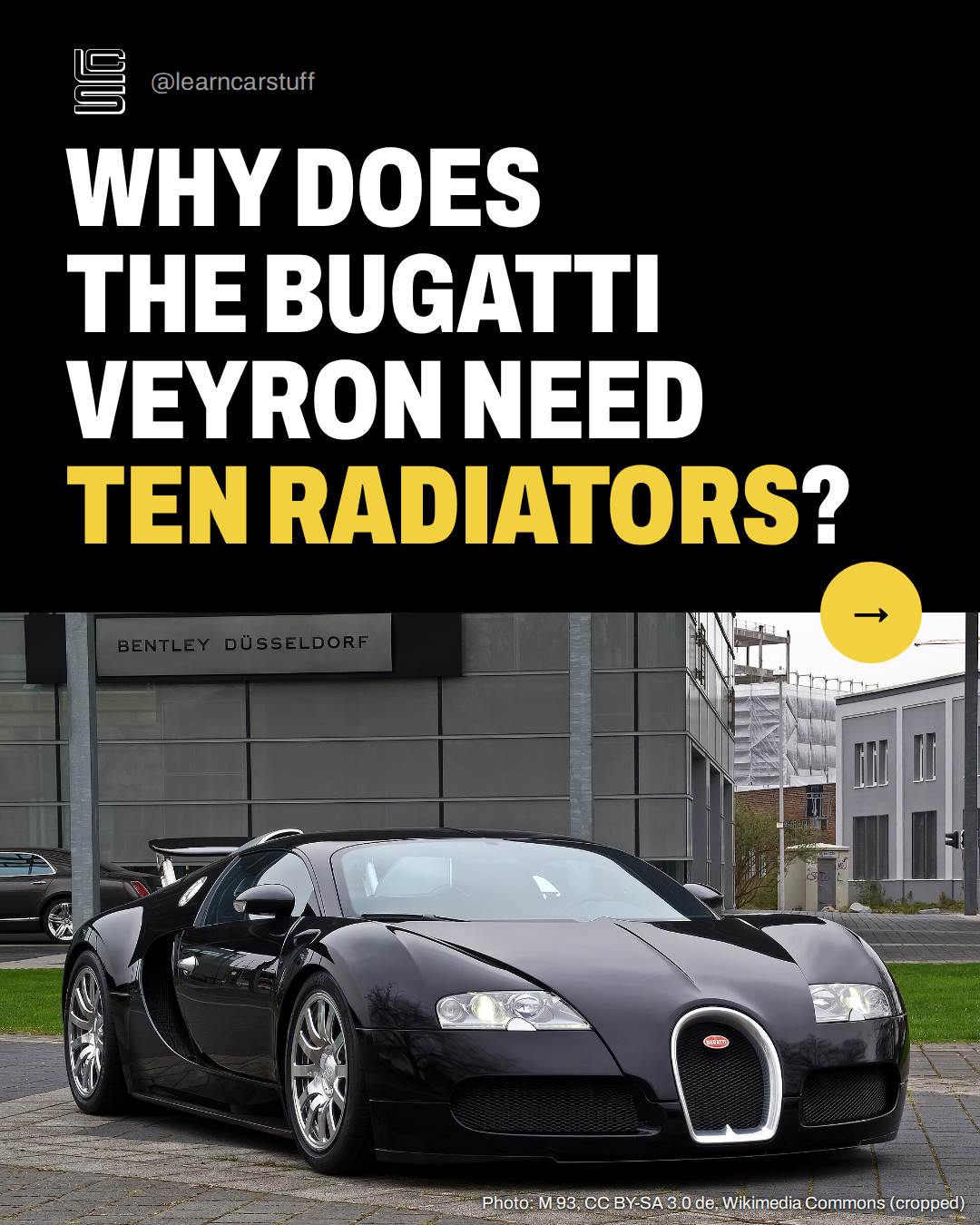
Why does the Bugatti Veyron need ten radiators?
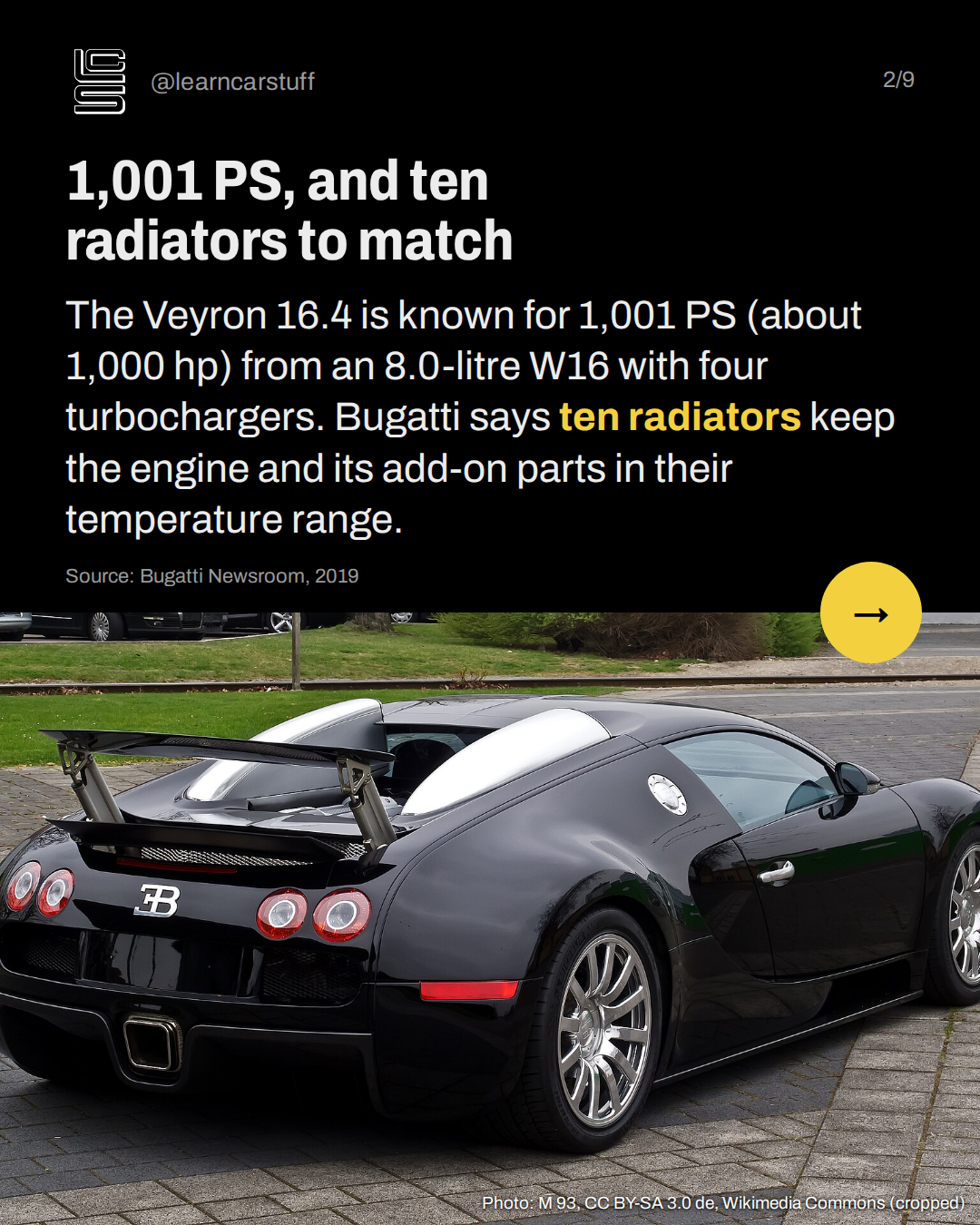
1,001 PS, and ten radiators to match
The Veyron 16.4 is known for 1,001 PS (about 1,000 hp) from an 8.0-litre W16 with four turbochargers. Bugatti says ten radiators keep the engine and its add-on parts in their temperature range.
Source: Bugatti Newsroom, 2019
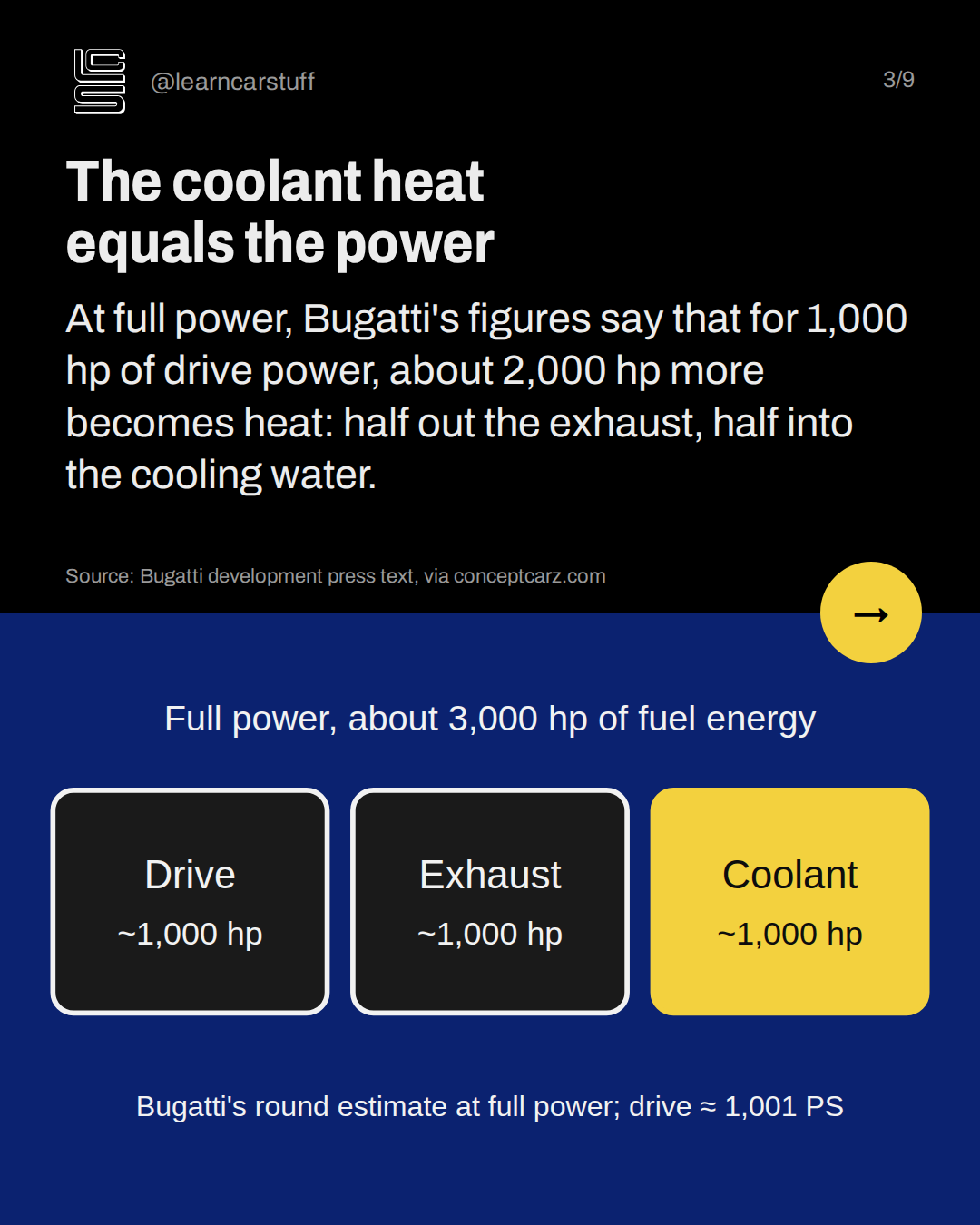
The coolant heat equals the power
At full power, Bugatti's figures say that for 1,000 hp of drive power, about 2,000 hp more becomes heat: half out the exhaust, half into the cooling water.
Source: Bugatti development press text, via conceptcarz.com
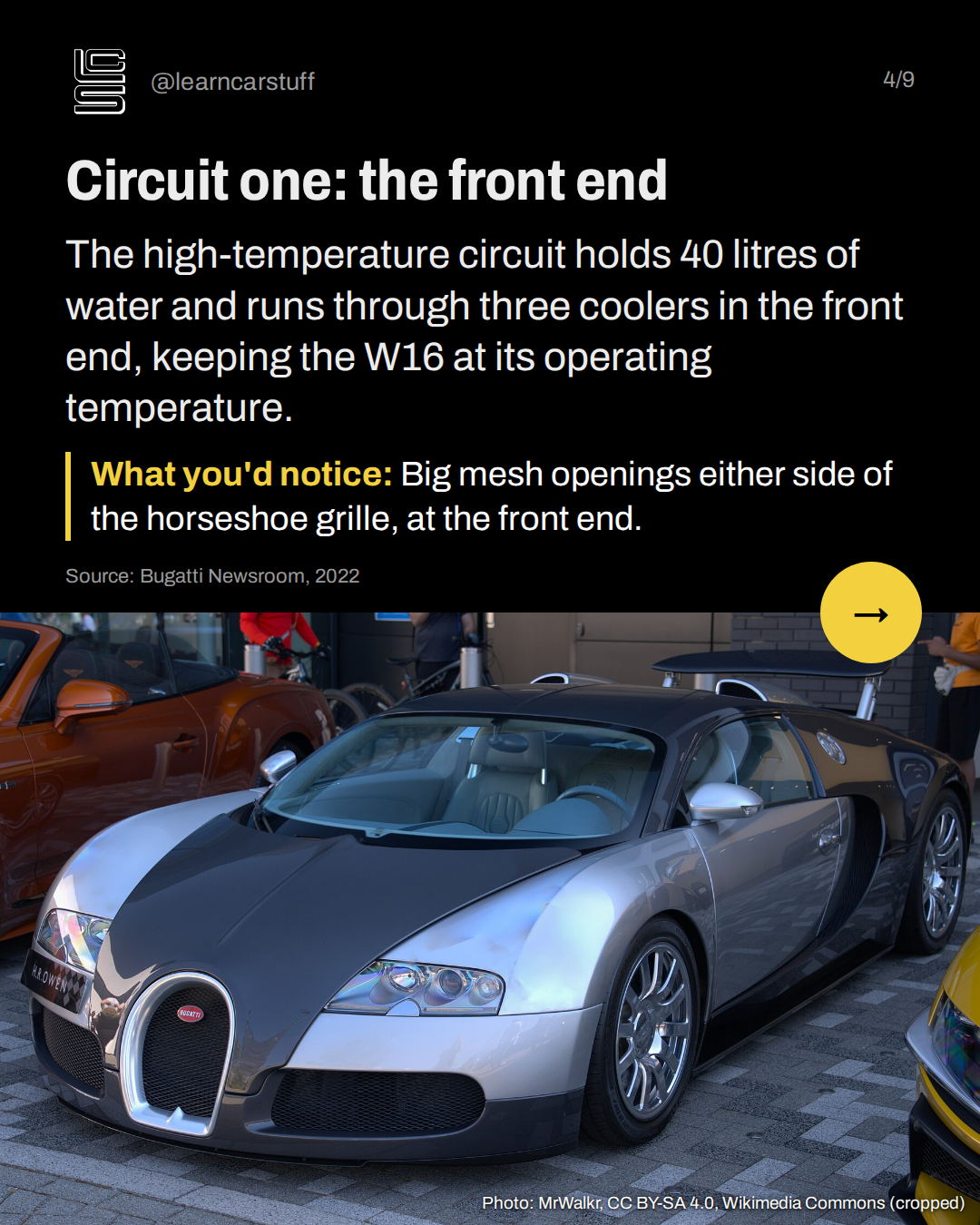
Circuit one: the front end
The high-temperature circuit holds 40 litres of water and runs through three coolers in the front end, keeping the W16 at its operating temperature.
What you'd notice: Big mesh openings either side of the horseshoe grille, at the front end.
Source: Bugatti Newsroom, 2022
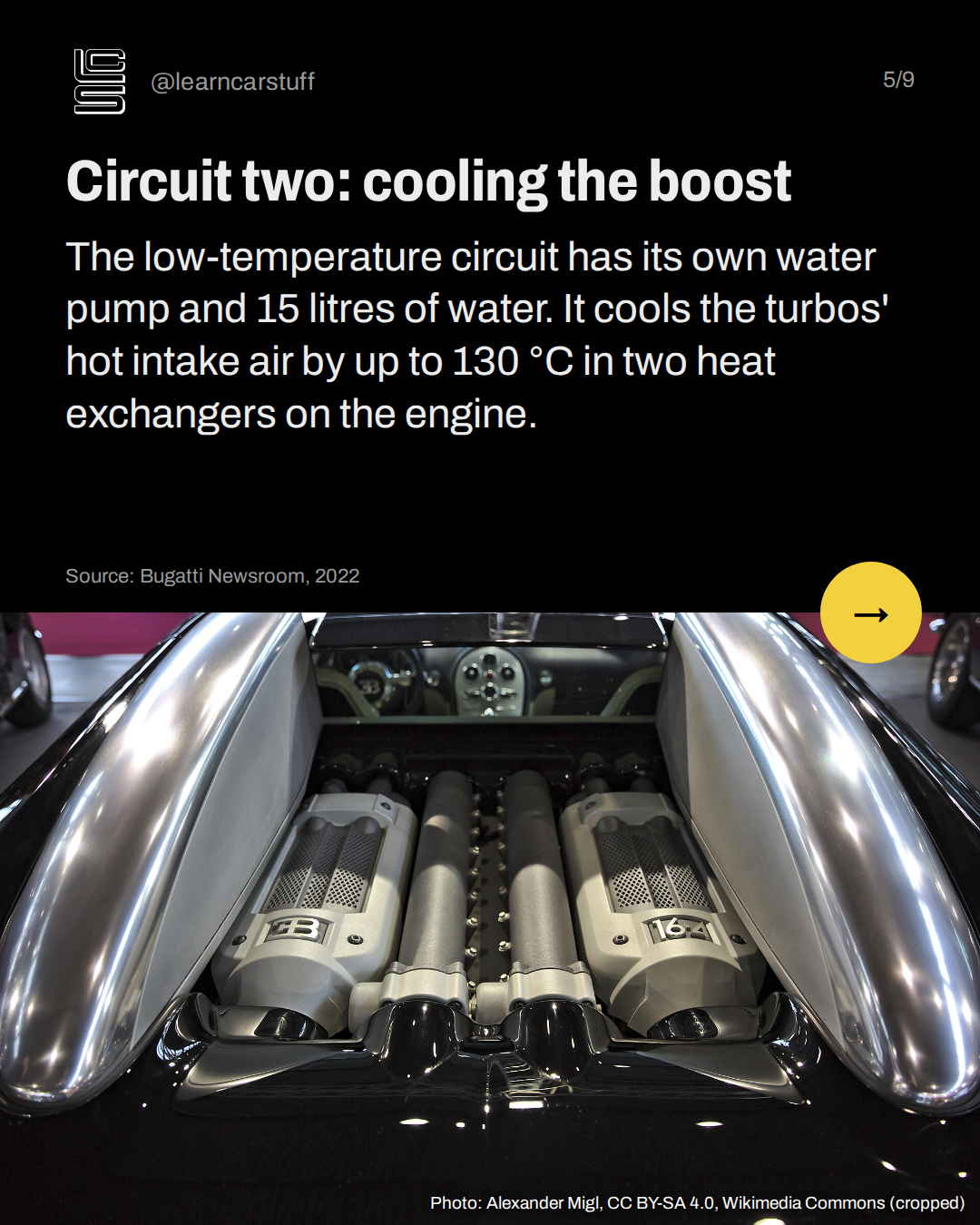
Circuit two: cooling the boost
The low-temperature circuit has its own water pump and 15 litres of water. It cools the turbos' hot intake air by up to 130 °C in two heat exchangers on the engine.
Source: Bugatti Newsroom, 2022
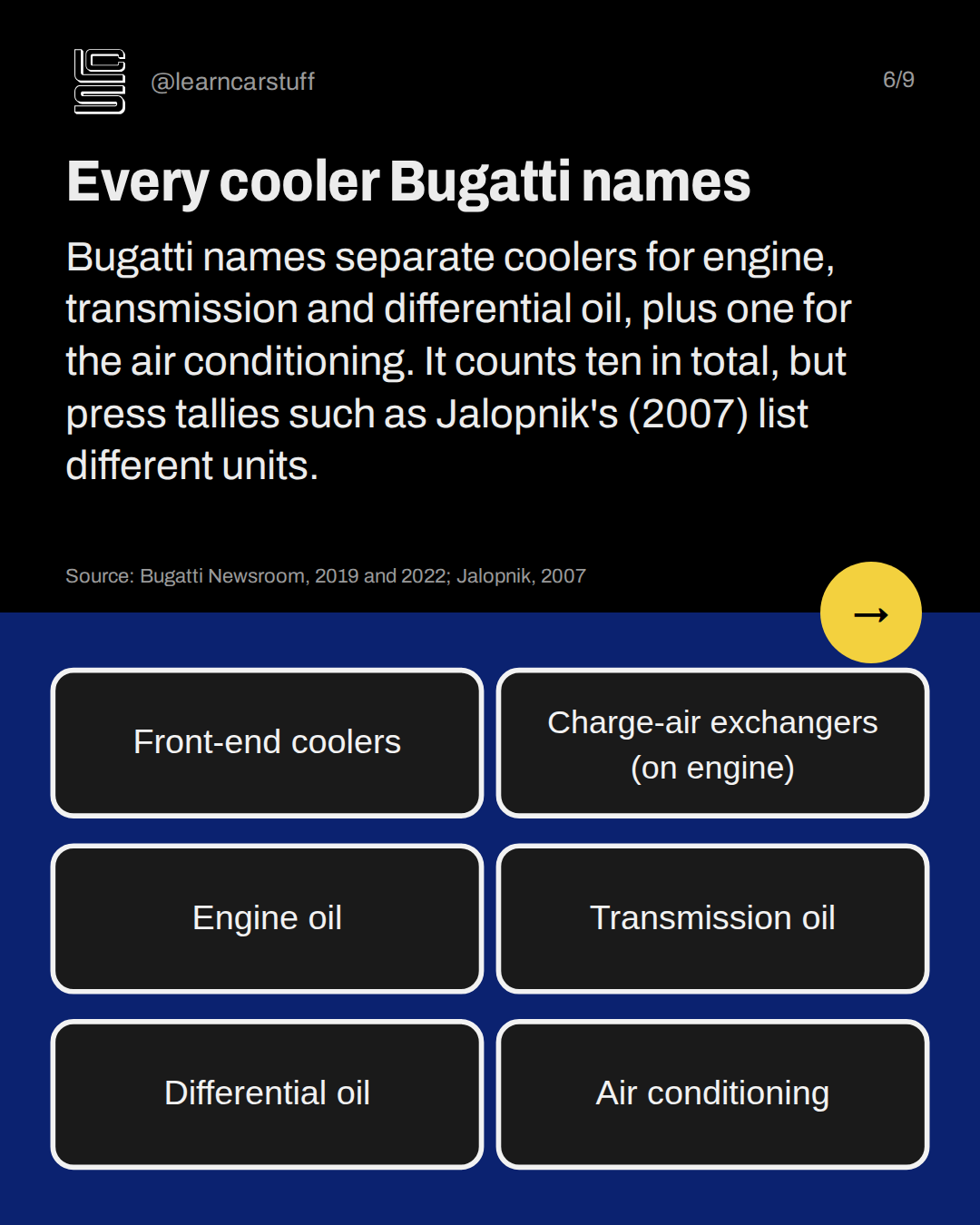
Every cooler Bugatti names
Bugatti names separate coolers for engine, transmission and differential oil, plus one for the air conditioning. It counts ten in total, but press tallies such as Jalopnik's (2007) list different units.
Source: Bugatti Newsroom, 2019 and 2022; Jalopnik, 2007
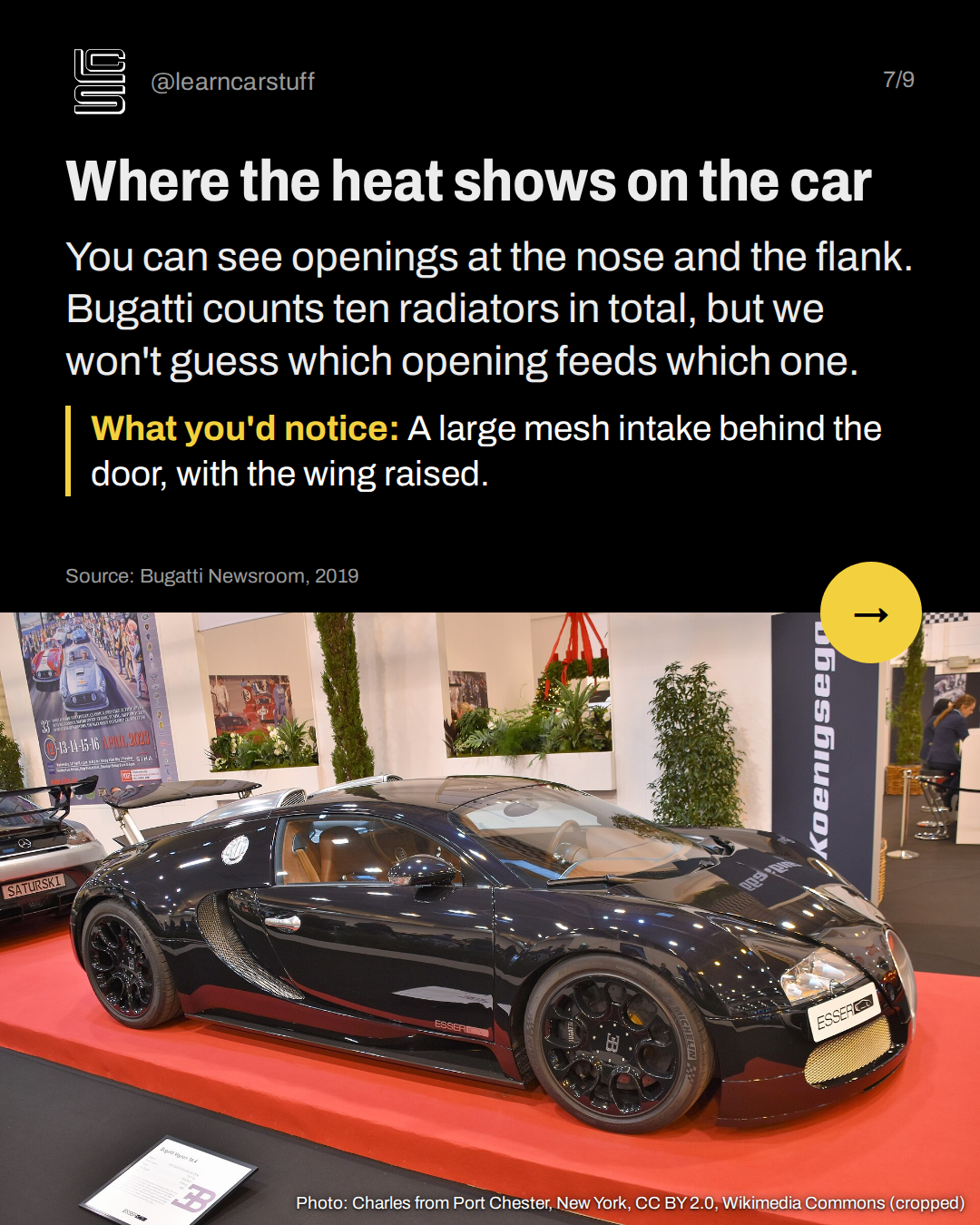
Where the heat shows on the car
You can see openings at the nose and the flank. Bugatti counts ten radiators in total, but we won't guess which opening feeds which one.
What you'd notice: A large mesh intake behind the door, with the wing raised.
Source: Bugatti Newsroom, 2019
Nine named, ten counted
Bugatti's 2022 W16 release names nine cooling units across the two water circuits, the oil coolers and the air conditioning. Its 2019 and 2025 releases count ten radiators. No Bugatti source says which units make up the ten.
Source: Bugatti Newsroom, 2019, 2022 and 2025
Sources and assumptions
- Bugatti Newsroom, 'Bugatti W16 Engine – the last of its kind' (29 Jul 2022): Two water cycles; 40 liters in the high-temperature cycle with three coolers in the front end; low-temperature cycle with separate water pump, 15 liters, cools charge air by as much as 130 degrees in two heat exchangers on the engine; separate coolers for differential oil, transmission oil and engine oil plus an A/C heat exchanger; Veyron 16.4 1,001 PS, 0–100 km/h 2.5 s; Super Sport 1,200 PS, 431.072 km/h (checked 2026-10-07)
- Bugatti Newsroom, 'Bugatti Veyron legends: the modern-day hyper sports car' (29 May 2019): 'Ten radiators keep the unit and its add-on parts within a pleasant temperature range'; 8.0-litre 16-cylinder, four turbochargers, 736 kW/1,001 PS at 6,000 rpm, 1,250 Nm from 2,200 to 5,000 rpm, top speed 407 km/h, seven-speed DSG, all-wheel drive (checked 2026-10-07)
- Bugatti Newsroom, 'The realization of an intractable dream: the engineering genius behind the Bugatti Veyron' (24 Jul 2025): W16 'designed with an 8.0-liter displacement, reinforced with four turbochargers and ten radiators'; 1,001 PS at 6,000 rpm, 1,250 Nm between 2,200 and 5,000 rpm; official top speed 407 km/h (checked 2026-10-07)
- conceptcarz.com, '2002 Bugatti 16/4 Veyron' (reproduces Bugatti's development-era press text): 'For 1000 HP propulsion power, the system demands approximately 2000 HP to be additionally generated as heat energy during combustion. Half in each case is dissipated in the exhaust gas and cooling water.' Also describes the car as a 16-cylinder mid-engine design (checked 2026-10-07)
- Jalopnik, 'Bugatti Veyron 16.4', Jonny Lieberman (15 May 2007): A press breakdown of the ten radiators: 3 engine, 1 intercooler heat exchanger, 2 A/C, 1 each for transmission oil, differential oil, engine oil and the spoiler's hydraulic oil. Used only as an example of how press tallies differ (checked 2026-10-07)
Assumptions:
- The heat ratio comes from Bugatti's development-era (c. 2002) press text as reproduced by conceptcarz; Bugatti's own site page carrying it returned 403/429. It is a round engineering estimate ('approximately') at full power, not a measured figure for the production car, and its 'HP' is applied to the 1,001 PS production engine as 'roughly'.
- 'Half into the exhaust, half into the cooling water' is Bugatti's own approximation; oil coolers and radiated heat are not broken out.
- The coolant volumes (40 L, 15 L) and cooler list come from Bugatti's 2022 W16 release, in the section on the original (Veyron) W16, before the Chiron section.
- Bugatti gives the total (ten) but no official one-by-one list. Its 2022 W16 release names nine units: 3 front-end engine coolers, 2 charge-air heat exchangers on the engine, coolers for engine, transmission and differential oil, and an A/C heat exchanger. It does not say which of these count toward the ten, or whether the charge-air heat exchangers count at all. Press accounts count the units differently: Jalopnik (2007), for example, lists 1 intercooler heat exchanger, 2 A/C units and a spoiler hydraulic-oil cooler.
- All figures are for the original Veyron 16.4 (1,001 PS) unless labeled Super Sport.
Photos:
- Photo: M 93, CC BY-SA 3.0 de, Wikimedia Commons (cropped)
- Photo: M 93, CC BY-SA 3.0 de, Wikimedia Commons (cropped)
- Photo: Alexander Migl, CC BY-SA 4.0, Wikimedia Commons (cropped)
- Photo: Charles from Port Chester, New York, CC BY 2.0, Wikimedia Commons (cropped)
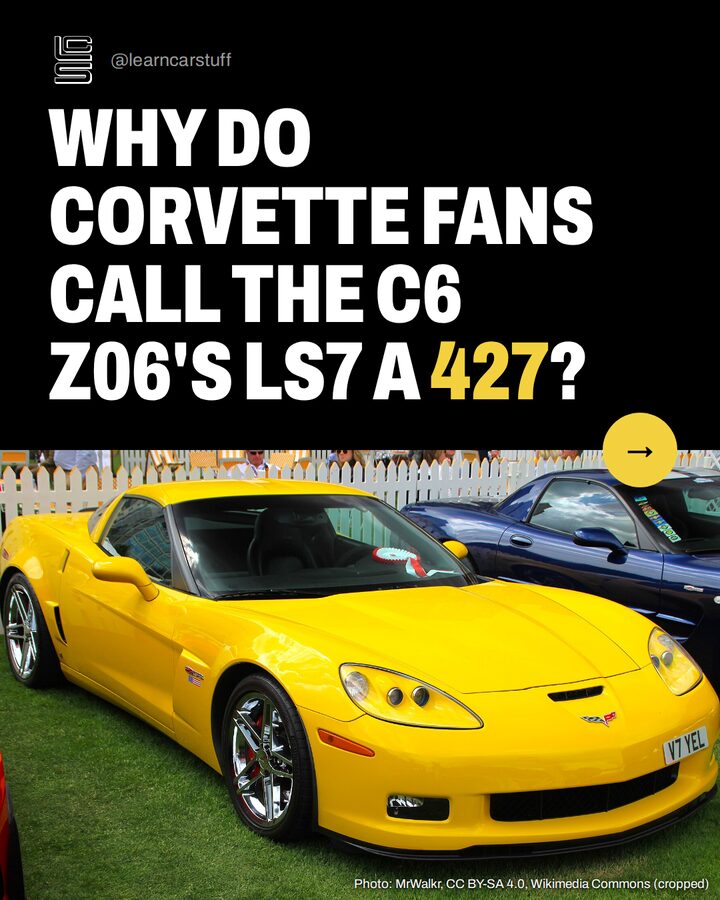
- Photo: MrWalkr, CC BY-SA 4.0, Wikimedia Commons (cropped)
The short version
- The Veyron 16.4 makes 1,001 PS.
- Bugatti: at full power, about 1,000 hp into the coolant.
- Two separate water circuits: 40 L for the engine, 15 L for the boost.
- Bugatti counts ten radiators in total.


,_5._April_2012,_D%C3%BCsseldorf.jpg)
,_5._April_2012,_D%C3%BCsseldorf.jpg)

_(52569946394).jpg)
