 Learn Car Stuff
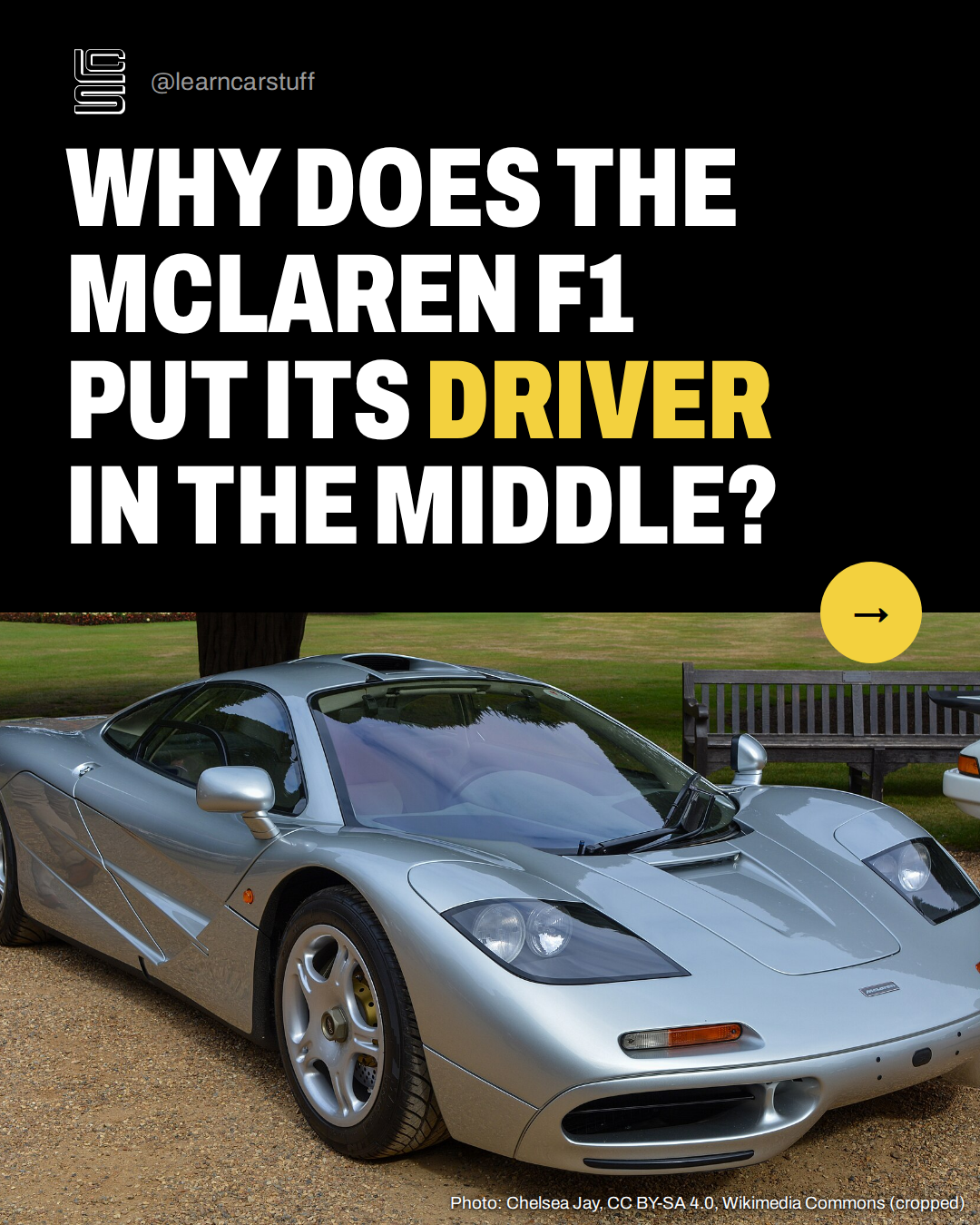
Why does the McLaren F1 put its driver in the middle?
Not a Formula 1 costume
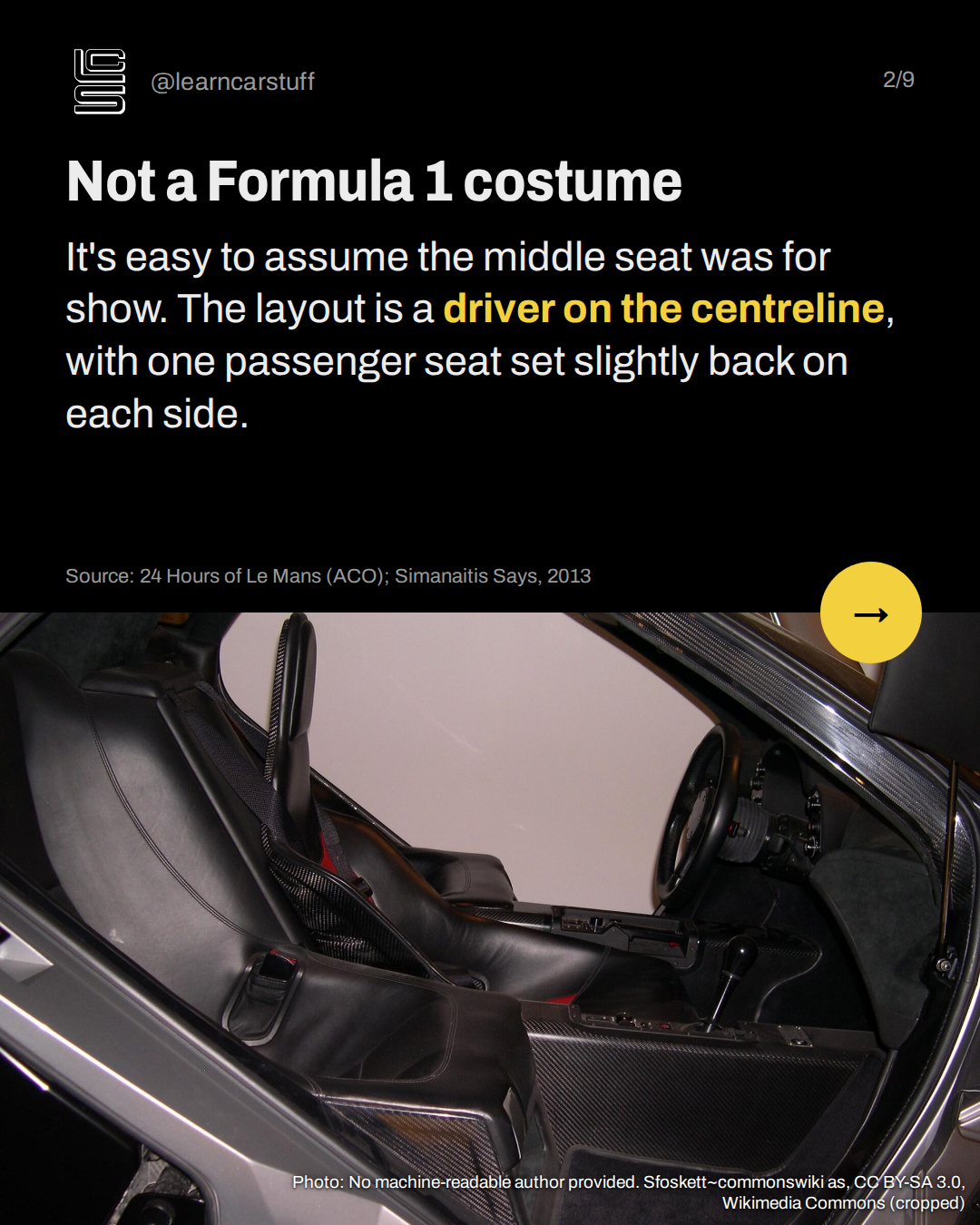
It's easy to assume the middle seat was for show. The layout is a driver on the centreline, with one passenger seat set slightly back on each side.
Source: 24 Hours of Le Mans (ACO); Simanaitis Says, 2013
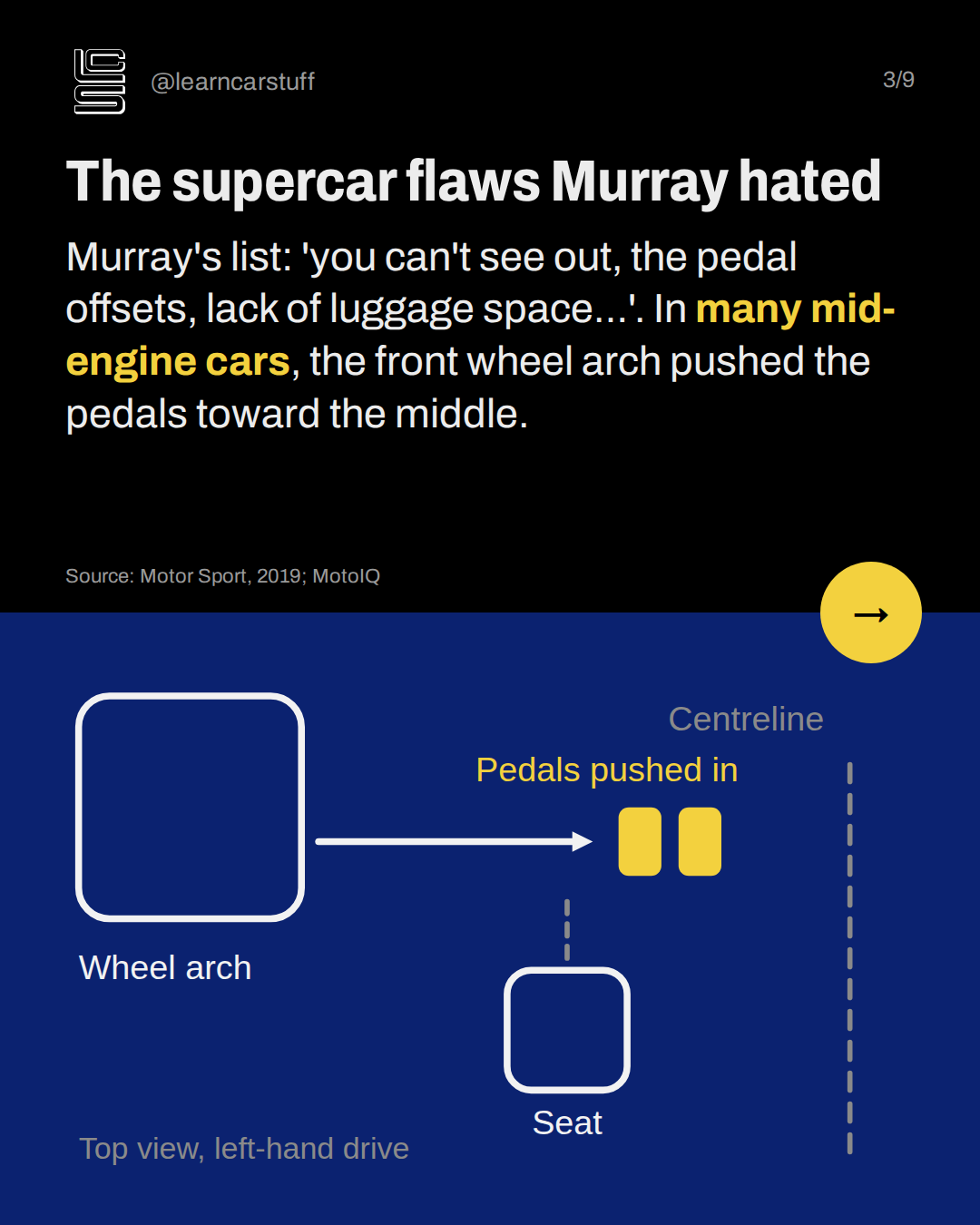
The supercar flaws Murray hated
Murray's list: 'you can't see out, the pedal offsets, lack of luggage space…'. In many mid-engine cars, the front wheel arch pushed the pedals toward the middle.
Source: Motor Sport, 2019; MotoIQ
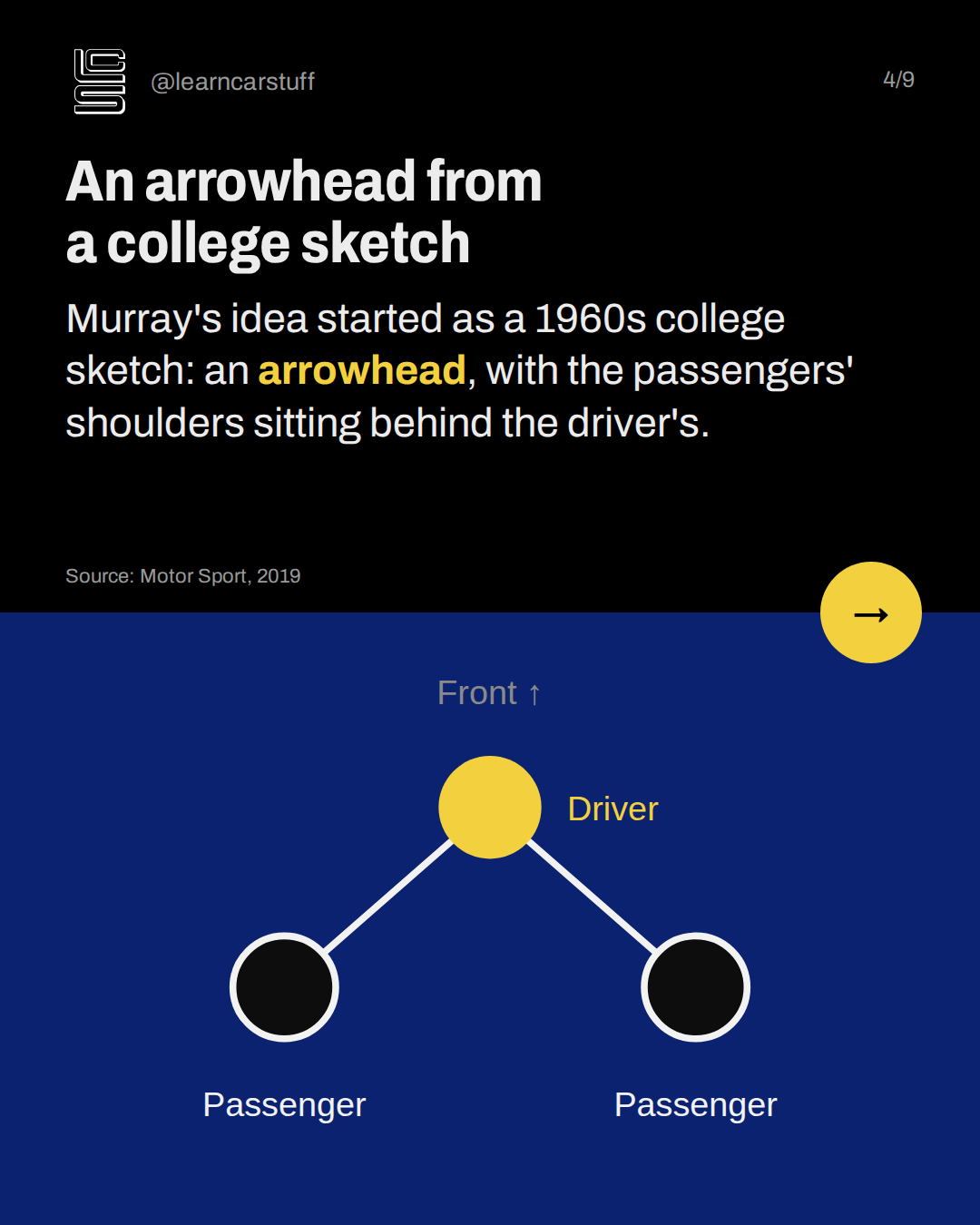
An arrowhead from a college sketch
Murray's idea started as a 1960s college sketch: an arrowhead, with the passengers' shoulders sitting behind the driver's.
Source: Motor Sport, 2019
Everything lines up straight ahead
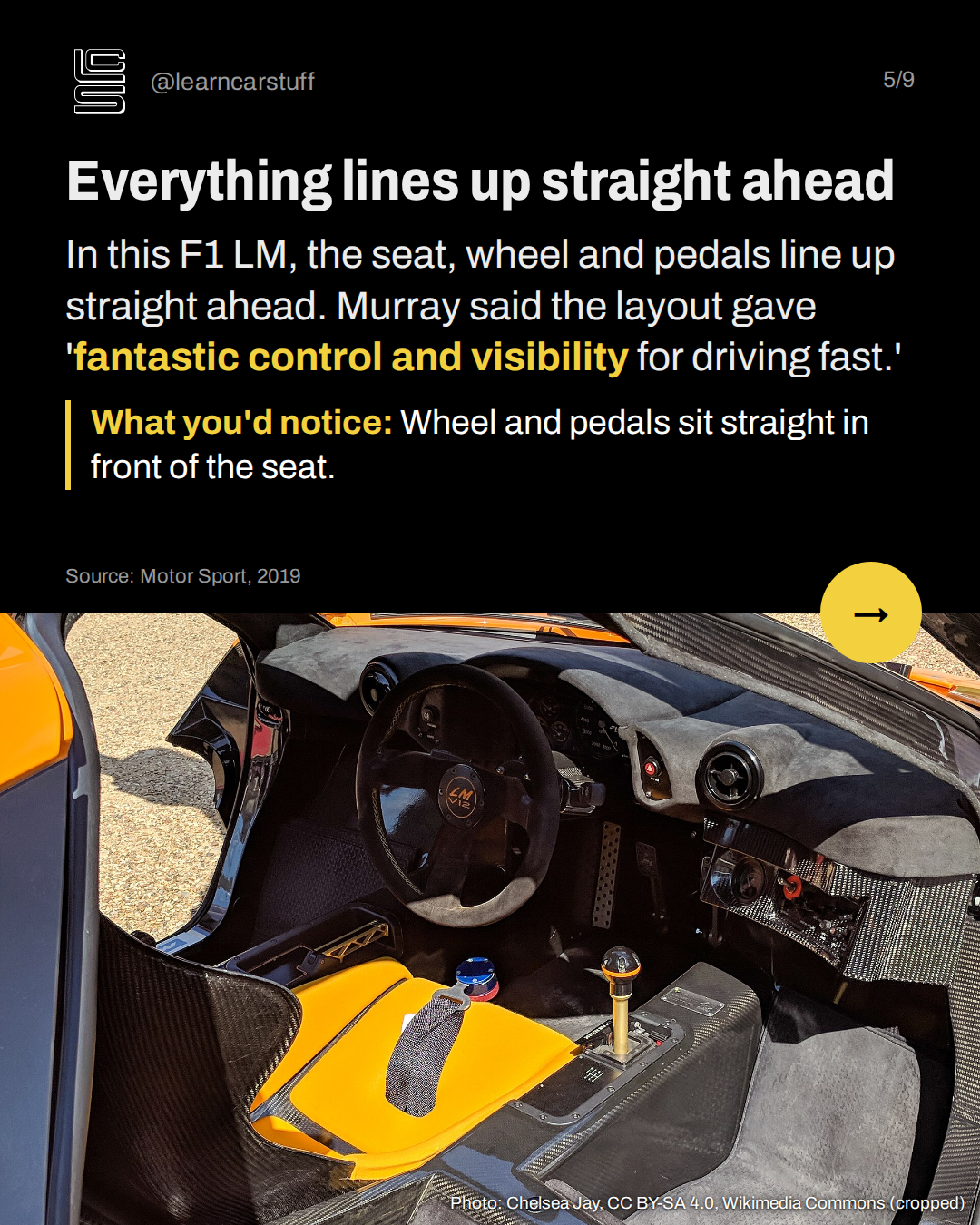
In this F1 LM, the seat, wheel and pedals line up straight ahead. Murray said the layout gave 'fantastic control and visibility for driving fast.'
What you'd notice: Wheel and pedals sit straight in front of the seat.
Source: Motor Sport, 2019
The price is getting in
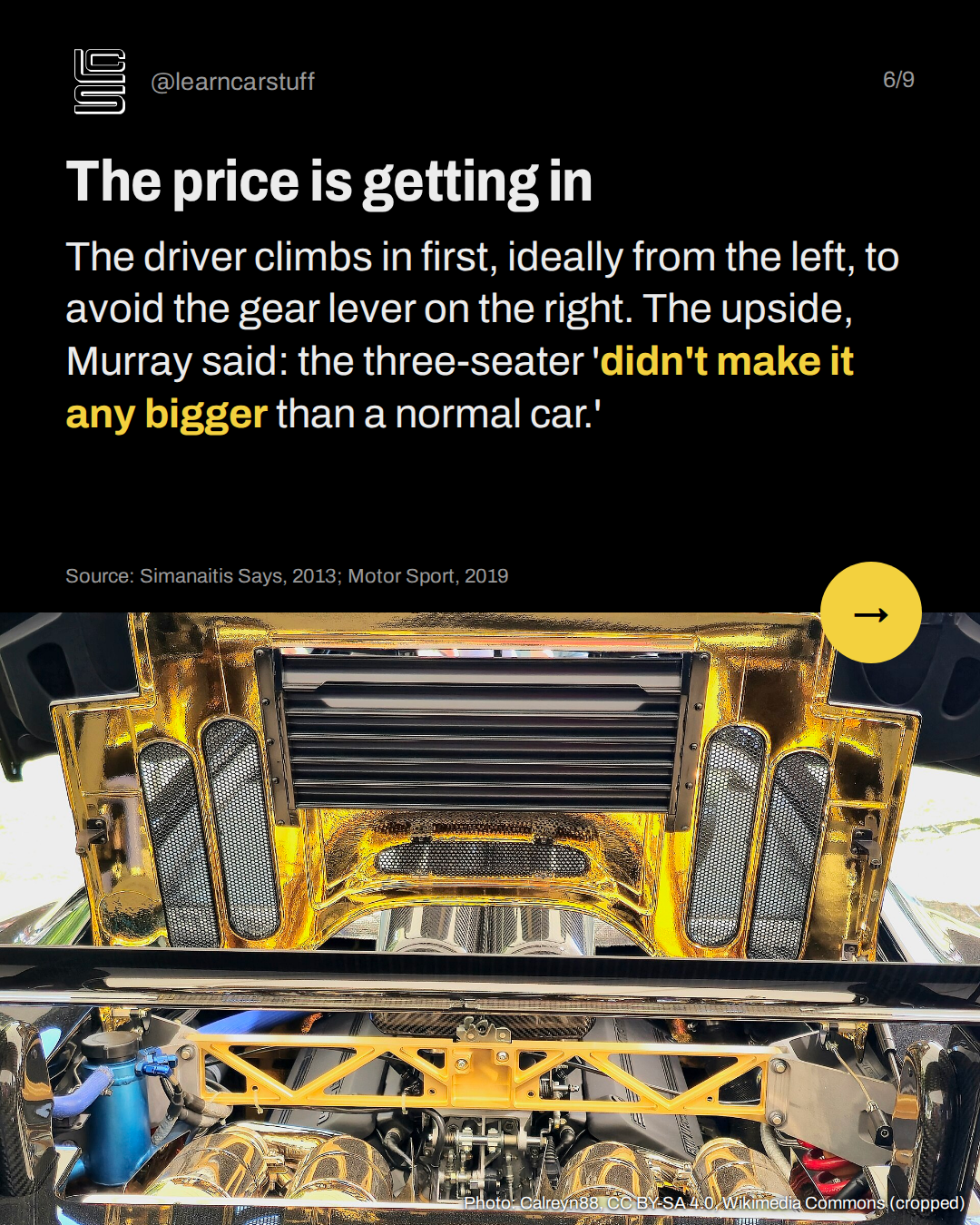
The driver climbs in first, ideally from the left, to avoid the gear lever on the right. The upside, Murray said: the three-seater 'didn't make it any bigger than a normal car.'
Source: Simanaitis Says, 2013; Motor Sport, 2019
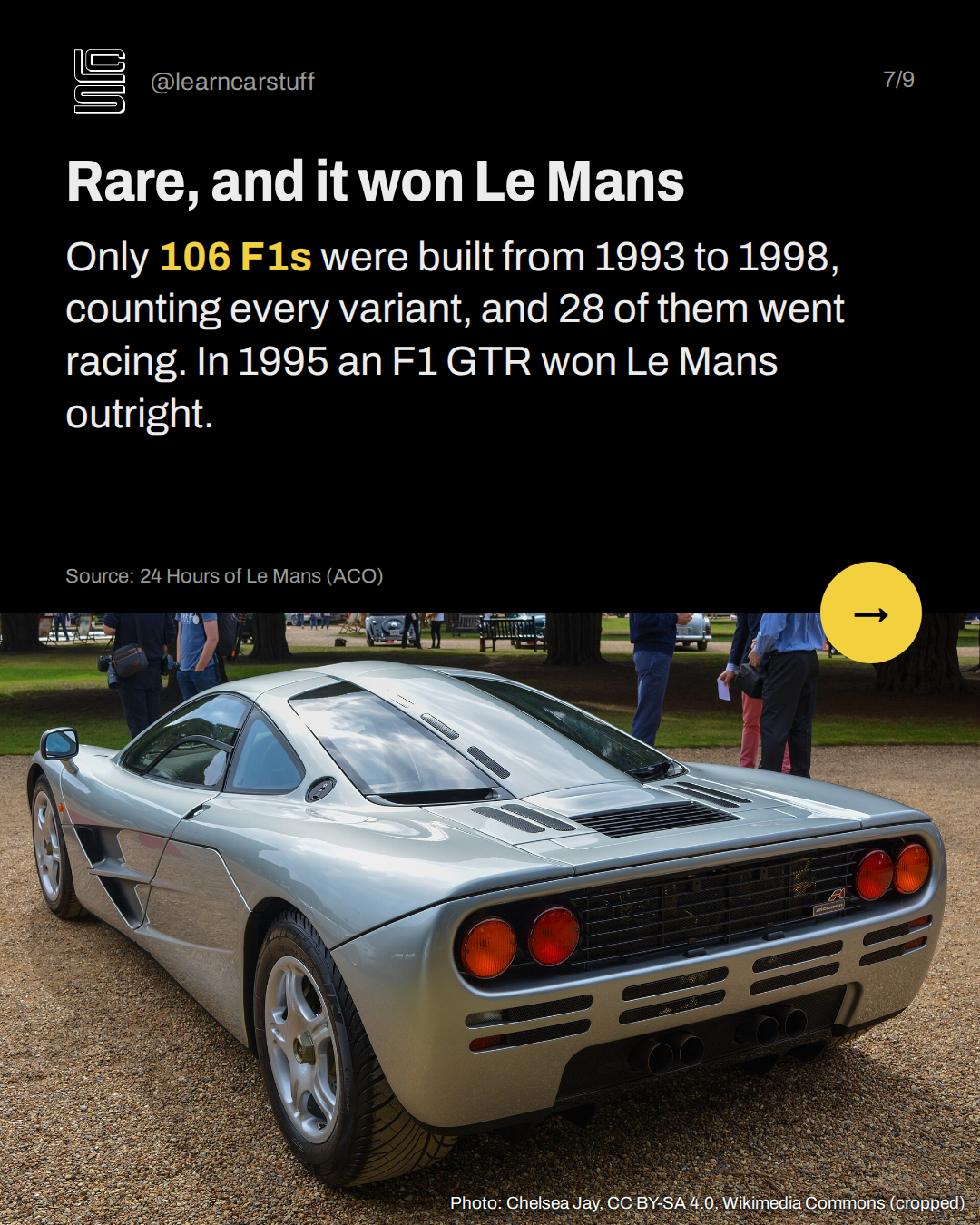
Rare, and it won Le Mans
Only 106 F1s were built from 1993 to 1998, counting every variant, and 28 of them went racing. In 1995 an F1 GTR won Le Mans outright.
Source: 24 Hours of Le Mans (ACO)
The layout came back twice
McLaren's 2018 Speedtail has 'the same layout as the F1', with 106 units to match. Murray's own T.50 (2020) puts the driver in the middle again, in 100 cars.
Source: McLaren release, 2018; ClassicCars.com Journal, 2020
Sources and assumptions
- Motor Sport Magazine: Gordon Murray, 'I designed the McLaren F1 in my head' (25 July 2019): Murray's own reasons: 'If there was a central driving position, it negated all the horrible things you had in current supercars. It certainly gave you fantastic control and visibility for driving fast.' The flaws he listed: 'you can't see out, the pedal offsets, lack of luggage space, the air-con doesn't work'. The 1960s college sketch with an 'arrowhead formation where the passengers were far enough behind the driver that their shoulders went behind the driver'. The three-seater 'didn't make it any bigger than a normal car'. 'I'm in the middle, like a Formula 1 car.' (checked 2026-10-06)
- 24 Hours of Le Mans (ACO official site): '24 Hours Centenary – McLaren, an F1 takes on Le Mans': 'three front seats, with a central driving position shifted forwards'; '106 McLaren F1s were produced between 1993 to 1998, including 28 destined for competition'; designed by Gordon Murray; 6-litre V12 specially designed by BMW; the Dalmas/Lehto/Sekiya car won Le Mans in 1995 (checked 2026-10-06)
- Simanaitis Says (Dennis Simanaitis, former Road & Track engineering editor): 'McLaren F1' (18 Nov 2013): 'The driver's seat is centered, with accommodations for a pair of passengers, slightly aft, to the left and right'; neither left- nor right-hand drive; getting in is easier 'provided, of course, the driver gets in first, ideally from the left to avoid the shifter' (checked 2026-10-06)
- MotoIQ: Project Viper GTS Part 1 (Billy Johnson): 'most mid-engine cars from Ferrari, Lotus, and Lamborghini had the front tires encroach on the foot well which shifted the pedals ... towards the center of the car' (checked 2026-10-06)
- McLaren Automotive news release 'McLaren Speedtail revealed as name of world's first Hyper-GT' (2018, via Automotive World): Speedtail has 'a three-seat cockpit design with a central driving position – the same layout as the F1'; 106 units, matching the number of original F1s; F1 top speed 243 mph (checked 2026-10-06)
- ClassicCars.com Journal: 'Gordon Murray says T.50 rewrites the supercar rule book' (4 Aug 2020): 'As in Murray's acclaimed McLaren F1, the driver sits in a central position in the T.50'; Murray: 'Just 100 customers will share my vision, a car created to improve on the F1 formula in every conceivable way' (checked 2026-10-06)
- Motor Sport Magazine archive: 'Are you sitting comfortably?' (Doug Nye, December 2013): Optional extra: the centre-drive idea wasn't new. The 1922 Armstrong-Siddeley Stoneleigh had a 'centred driver's seat' with two passengers behind, and the F1's centre seat was 'the project's most jealously guarded secret' (checked 2026-10-06)
Assumptions:
- '106 built' counts every F1 variant (road cars, LM, GT, GTR race cars and prototypes) per the ACO. Never call it '106 road cars'. The commonly quoted variant breakdown is not used because sources disagree on the prototype count.
- Production years are the ACO's '1993 to 1998'. Some sources say 1992–1998, so use the ACO wording or say 'the 1990s'.
- The wheel-arch/pedal-offset mechanism describes many mid-engine cars of that era in general, not one named rival car.
- The 'from the left, to avoid the gear lever' entry advice is Simanaitis's description and assumes the F1's gear lever sits to the driver's right.
- The F1 LM interior photo shows the LM variant (race-derived road car), which keeps the same centre-seat layout. The slide must label it 'F1 LM'.
- 'Still unusual today' is an editorial judgment backed by the Speedtail and T.50 examples. It is not a counted market survey.
Photos:
- Photo: Chelsea Jay, CC BY-SA 4.0, Wikimedia Commons (cropped)
- Photo: Chelsea Jay, CC BY-SA 4.0, Wikimedia Commons (cropped)
- Photo: No machine-readable author provided. Sfoskett~commonswiki as, CC BY-SA 3.0, Wikimedia Commons (cropped)
- Photo: Chelsea Jay, CC BY-SA 4.0, Wikimedia Commons (cropped)
- Photo: Calreyn88, CC BY-SA 4.0, Wikimedia Commons (cropped)
The short version
- The middle seat was a fix, not a gimmick.
- Murray wanted straight pedals and a clear view.
- The cost was a tricky way in.
- The layout returned in the Speedtail and T.50.