 Learn Car Stuff
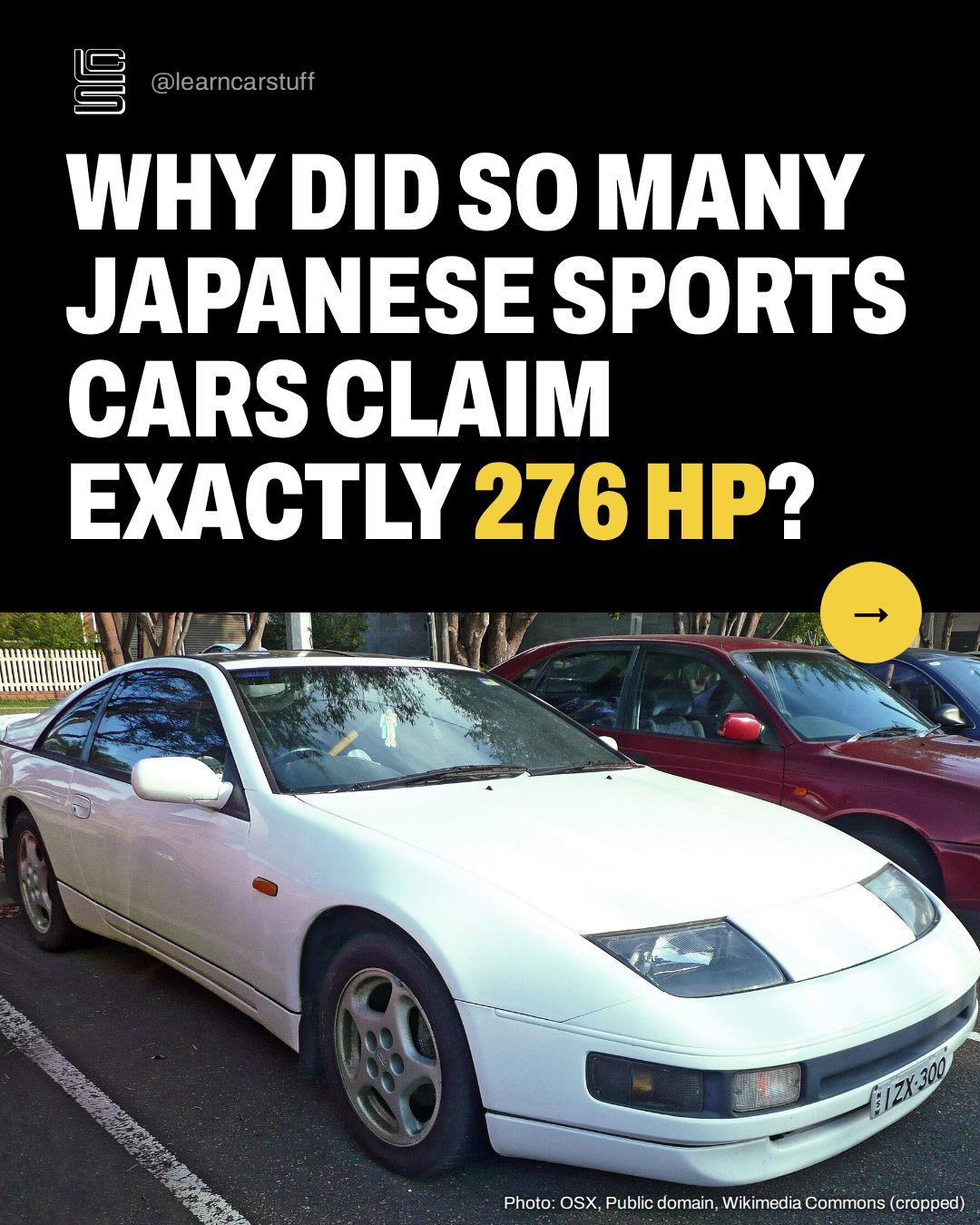
Why did so many Japanese sports cars claim exactly 276 hp?
A number that looked like coincidence
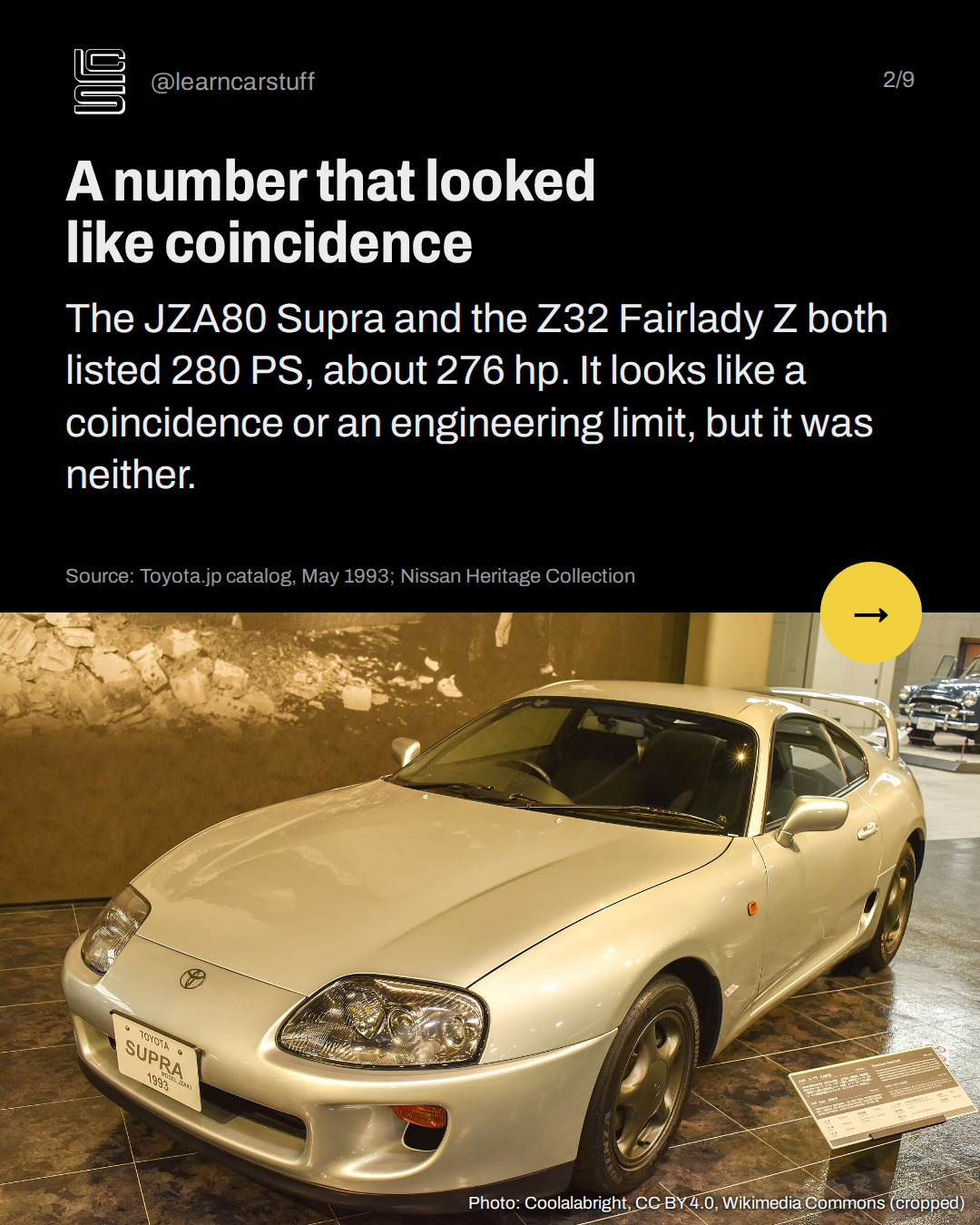
The JZA80 Supra and the Z32 Fairlady Z both listed 280 PS, about 276 hp. It looks like a coincidence or an engineering limit, but it was neither.
Source: Toyota.jp catalog, May 1993; Nissan Heritage Collection
A handshake, not a law
In 1989, with traffic deaths climbing, Japan's Ministry of Transport pushed JAMA, the carmakers' association, to rein in the power race. The makers agreed to a voluntary ceiling on advertised power: 280 PS. It was not a law.
Source: Best Car Web, Nov 2023; Kuruma News, May 2021
The Z32 set the number
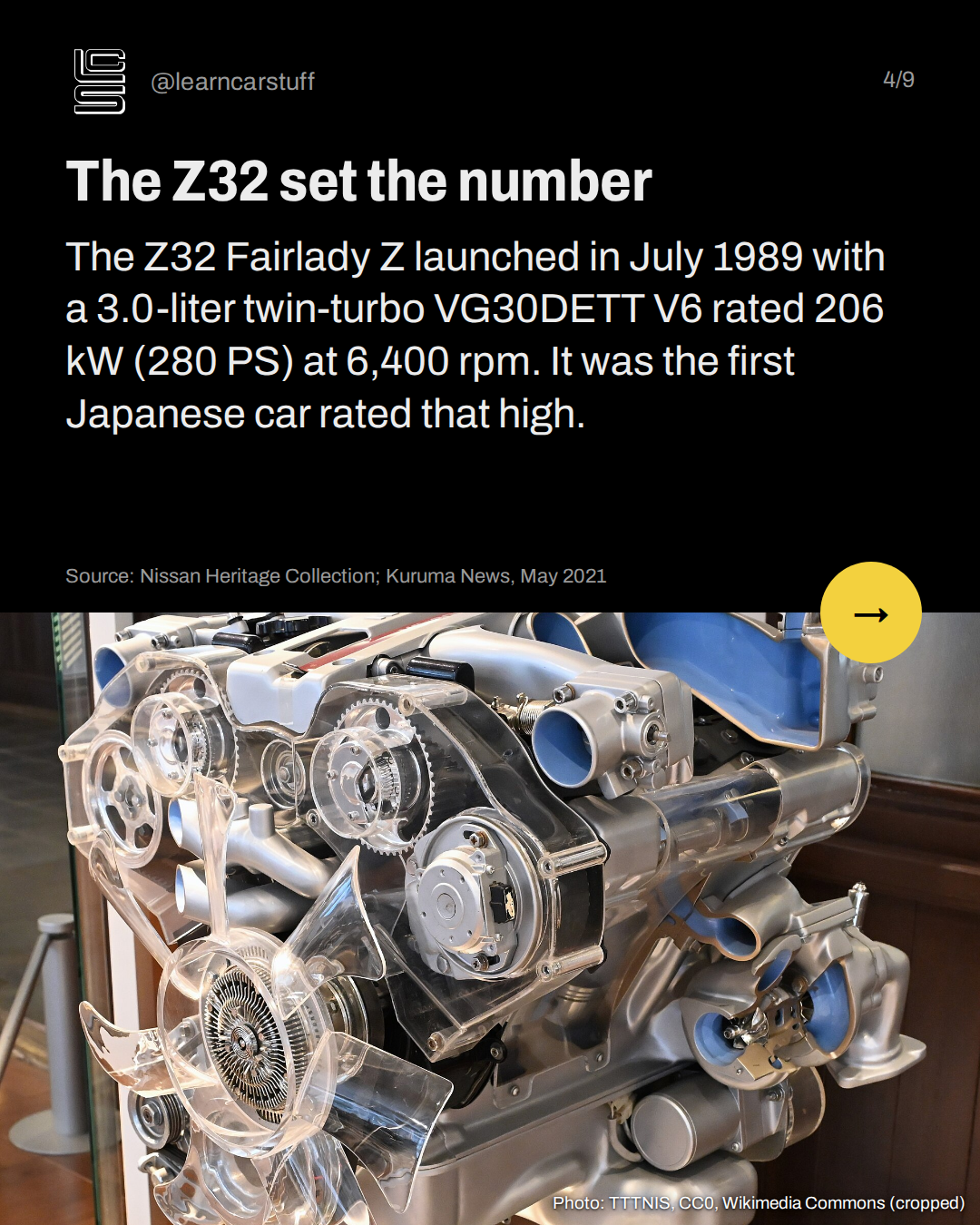
The Z32 Fairlady Z launched in July 1989 with a 3.0-liter twin-turbo VG30DETT V6 rated 206 kW (280 PS) at 6,400 rpm. It was the first Japanese car rated that high.
Source: Nissan Heritage Collection; Kuruma News, May 2021
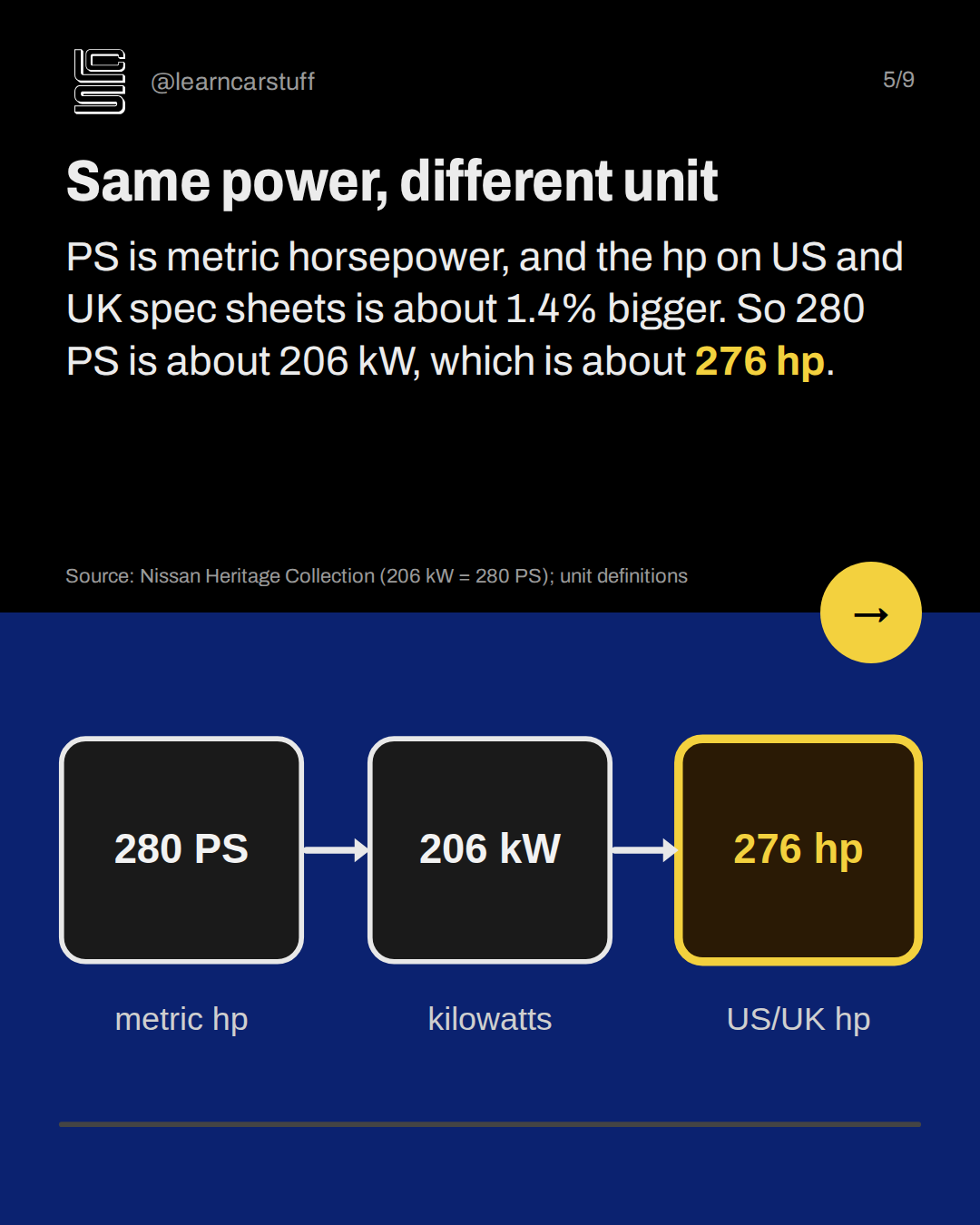
Same power, different unit
PS is metric horsepower, and the hp on US and UK spec sheets is about 1.4% bigger. So 280 PS is about 206 kW, which is about 276 hp.
Source: Nissan Heritage Collection (206 kW = 280 PS); unit definitions
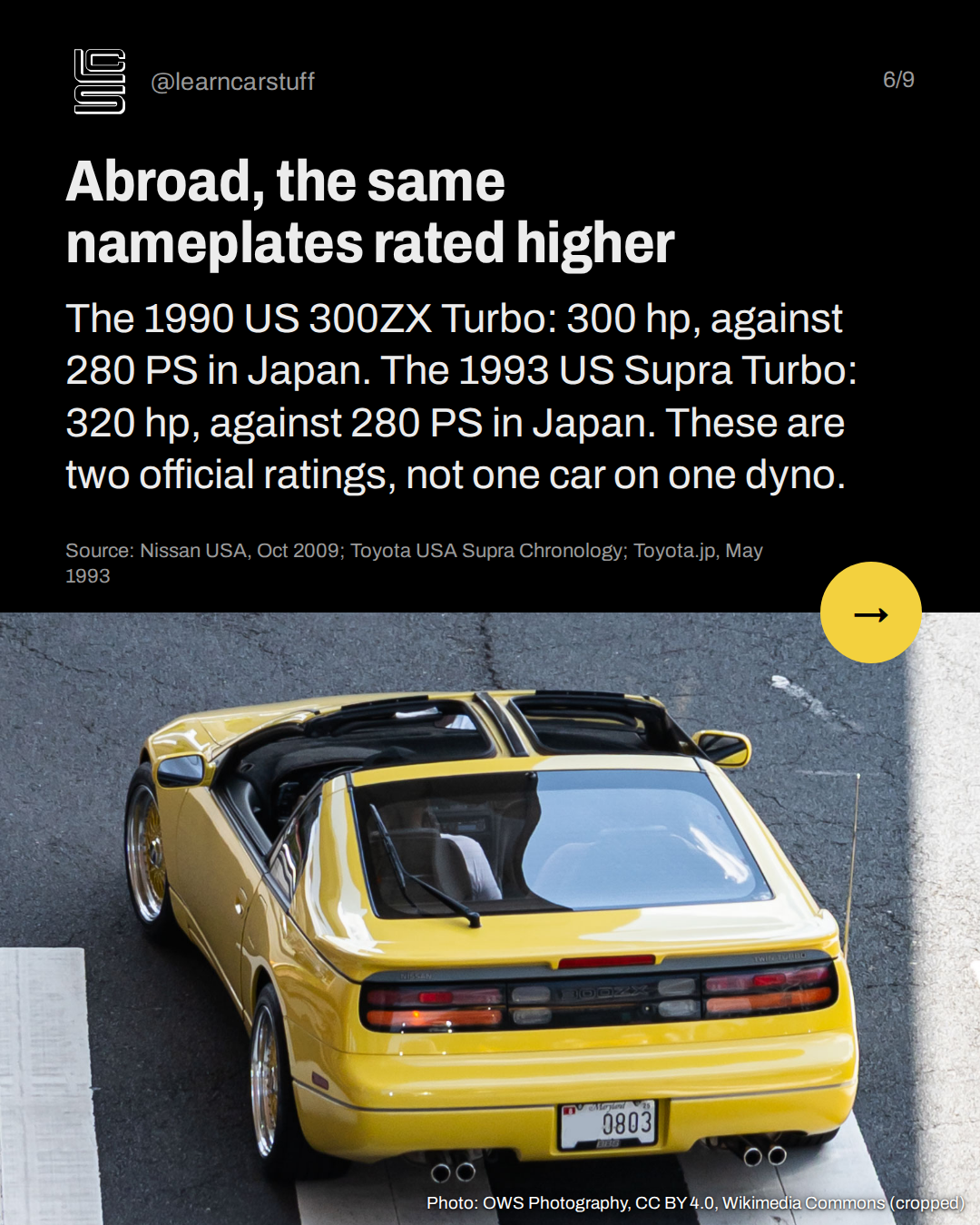
Abroad, the same nameplates rated higher
The 1990 US 300ZX Turbo: 300 hp, against 280 PS in Japan. The 1993 US Supra Turbo: 320 hp, against 280 PS in Japan. These are two official ratings, not one car on one dyno.
Source: Nissan USA, Oct 2009; Toyota USA Supra Chronology; Toyota.jp, May 1993
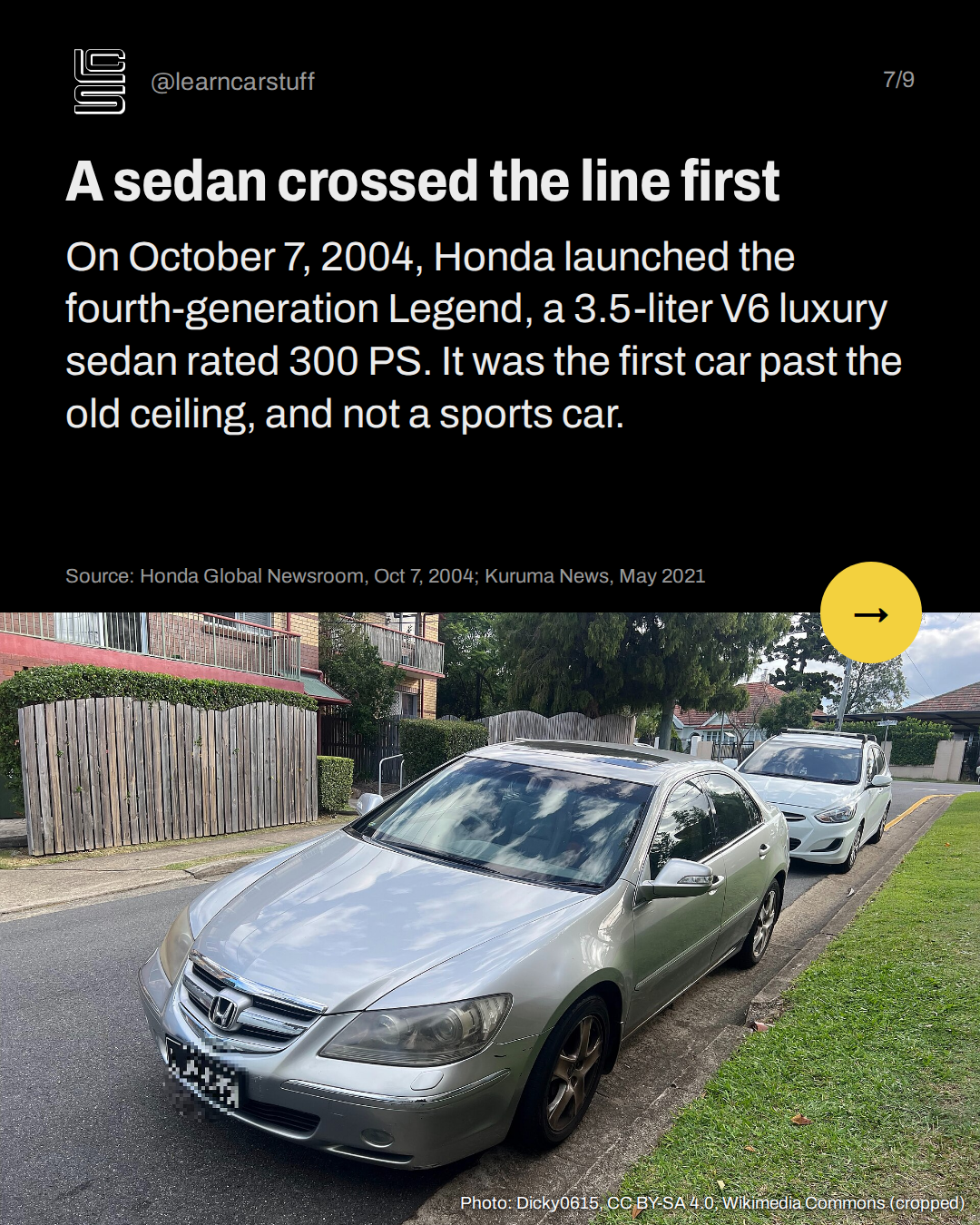
A sedan crossed the line first
On October 7, 2004, Honda launched the fourth-generation Legend, a 3.5-liter V6 luxury sedan rated 300 PS. It was the first car past the old ceiling, and not a sports car.
Source: Honda Global Newsroom, Oct 7, 2004; Kuruma News, May 2021
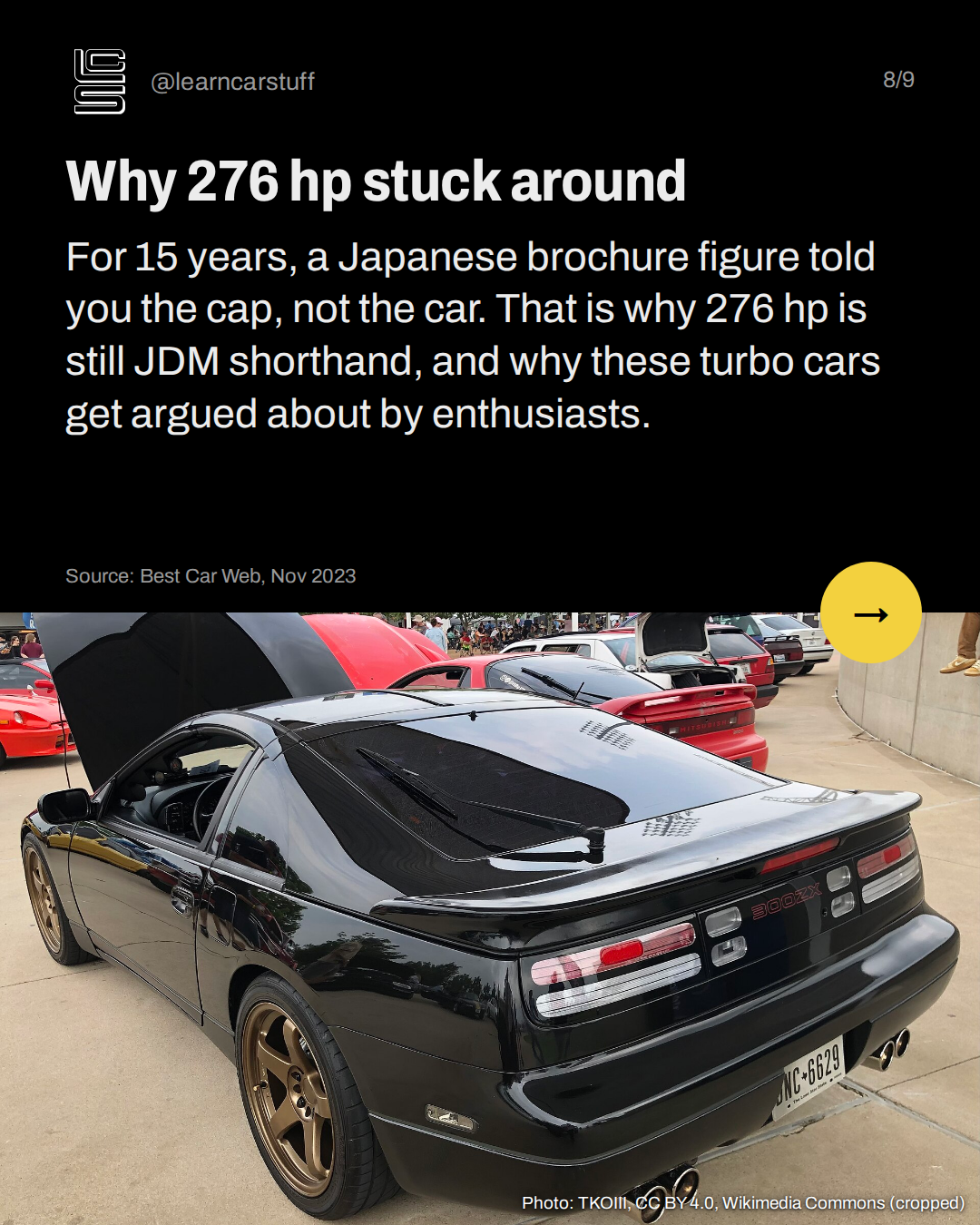
Why 276 hp stuck around
For 15 years, a Japanese brochure figure told you the cap, not the car. That is why 276 hp is still JDM shorthand, and why these turbo cars get argued about by enthusiasts.
Source: Best Car Web, Nov 2023
Sources and assumptions
- Nissan Heritage Collection: Fairlady Z 300ZX: Z32 launched July 1989; 1989 GCZ32; 2,960 cc twin-turbo V6 rated 206 kW (280 PS) at 6,400 rpm, 388 Nm at 3,600 rpm, 1,570 kg (the page writes the engine code as 'VG30DET', a typo for VG30DETT) (checked 2026-10-10)
- Nissan USA newsroom: Nissan Z: 50 years of excitement: Z32 introduced 1989; the twin-turbo VG30DETT produced 280 ps; the non-turbo made 225 ps (checked 2026-10-10)
- Nissan USA newsroom: 370Z 40th Anniversary release (Oct 15, 2009): US 1990 300ZX Turbo rated 300 horsepower; non-turbo 222 hp; US sales stopped after the 1996 model year (checked 2026-10-10)
- Honda global newsroom: Honda Introduces the All-New Legend (Oct 7, 2004): Fourth-generation Legend introduced October 7, 2004 in Japan; V6 3.5-liter VTEC, maximum output 221 kW (300 PS) at 6,200 rpm; world-first SH-AWD (checked 2026-10-10)
- Toyota.jp used-car catalog: Supra GZ Aero Top (E-JZA80), May 1993: Japanese-market JZA80 Supra with 2JZ-GTE, 2,997 cc, 206 kW / 280 PS at 5,600 rpm, 431.5 Nm at 3,600 rpm, on sale May 1993 (checked 2026-10-10)
- Toyota USA Newsroom: Supra Chronology: US 1993 Supra Turbo rated 320 horsepower, electronically limited to 155 mph (checked 2026-10-10)
- Kuruma News: 国産車の「280馬力自主規制」なぜ存在した? (May 25, 2021): The Ministry of Transport (now MLIT) pressed JAMA during a traffic-accident emergency; the 1989 Z32 Fairlady Z was the first Japanese car rated 280 PS; the self-regulation lasted until the 2004 fourth-generation Legend at 300 PS (checked 2026-10-10)
- Best Car Web: 「280馬力規制」は日本車をしあわせにしたのか? (Nov 1, 2023): The cap ran 1989–2004; the ministry recommended it after traffic deaths surged; JAMA adopted it as a voluntary standard, not law; the 280 figure came from the Z32's twin-turbo V6 (checked 2026-10-10)
- Best Car Web: 軽の64馬力自主規制が未だ残る裏事情 (Aug 14, 2019, Yoichiro Watanabe): The 280 PS self-regulation ended in 2004, and in response the fourth-generation Honda Legend launched at 300 PS (checked 2026-10-10)
- Kuruma News: なぜ軽は「64馬力」規制が残るのか (Nov 28, 2018): The Ministry of Transport pressed JAMA for horsepower restraint; the self-regulation was abolished in 2004 (checked 2026-10-10)
Assumptions:
- PS = metric horsepower = 735.49875 W; hp = mechanical (imperial) horsepower = 745.69987 W, the unit US/UK spec sheets use for 'hp'.
- US ratings (300 hp 300ZX Turbo, 320 hp Supra Turbo) are the makers' own US-market ratings. Export cars were tuned and certified for their markets, so the comparison shows a reporting ceiling, not one identical car measured twice.
- The cap governed advertised (catalog) output for Japanese-market cars. It was a voluntary JAMA agreement after a Ministry of Transport request, not a law.
- Start year given as 1989, matching the Z32 launch (July 1989) and Best Car Web's '1989–2004'. Some English sources say 1988, so the slides should tie it to 1989 and the Z32.
- The end is given as 2004 with the October 7, 2004 Legend as the first car past 280 PS. Do not state a month for the formal lifting (one secondary snippet said July 2004, but it was not verified on an opened page).
Photos:
- Photo: OSX, Public domain, Wikimedia Commons (cropped)
- Photo: TKOIII, CC BY 4.0, Wikimedia Commons (cropped)
- Photo: OWS Photography, CC BY 4.0, Wikimedia Commons (cropped)
- Photo: TTTNIS, CC0, Wikimedia Commons (cropped)
- Photo: Coolalabright, CC BY 4.0, Wikimedia Commons (cropped)
- Photo: Dicky0615, CC BY-SA 4.0, Wikimedia Commons (cropped)
The short version
- Japan's makers capped advertised power at 280 PS.
- The Z32 set the number in 1989.
- 280 PS is about 276 hp.
- US ratings ran higher: 300 and 320 hp.
- The 2004 Legend went past it.
_coupe_01.jpg)

_Washington_DC_Metro_Area,_USA.jpg)

_Coupe.jpg)
