 Learn Car Stuff
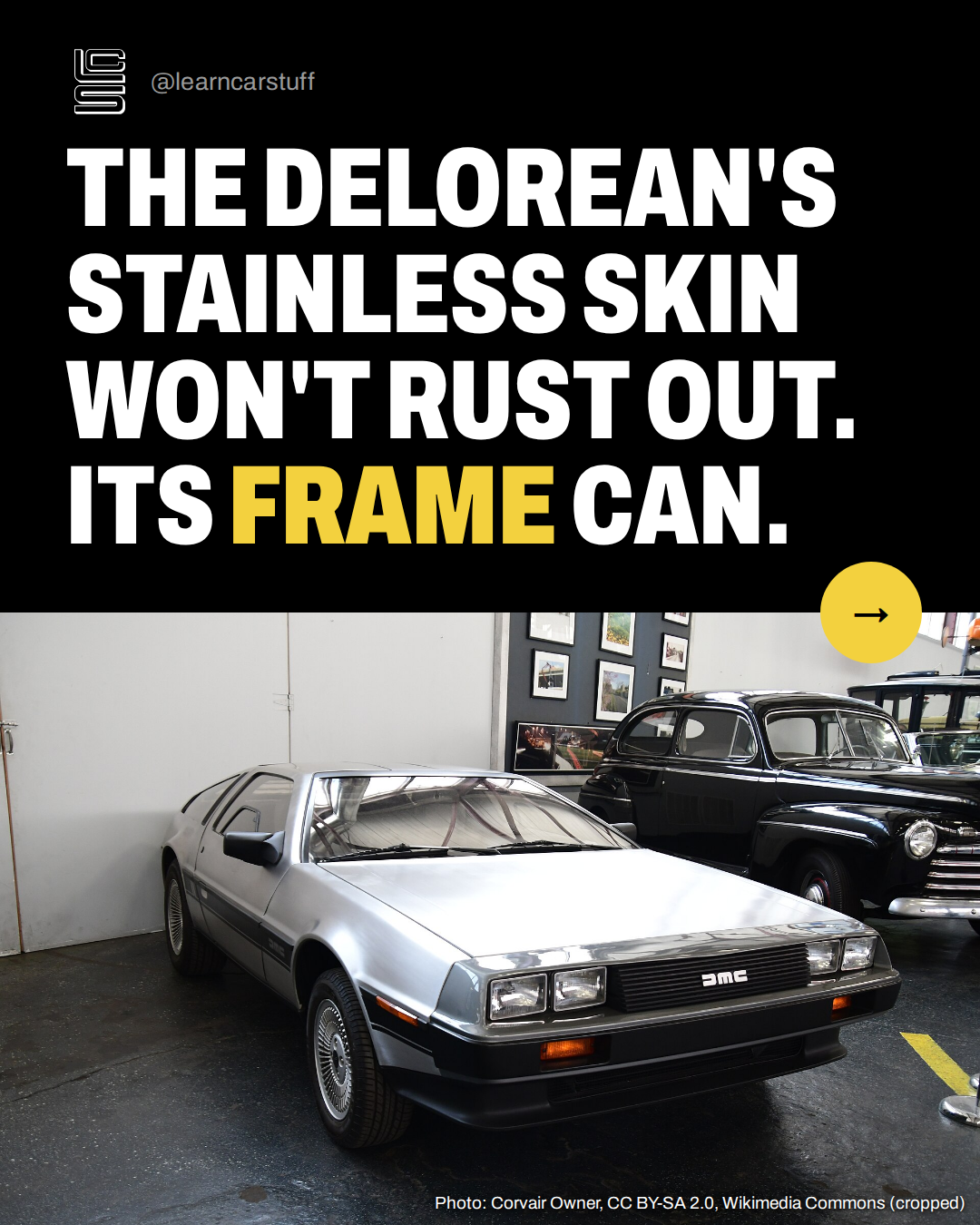
The DeLorean's stainless skin won't rust out. Its frame can.
Bare metal, straight from the factory
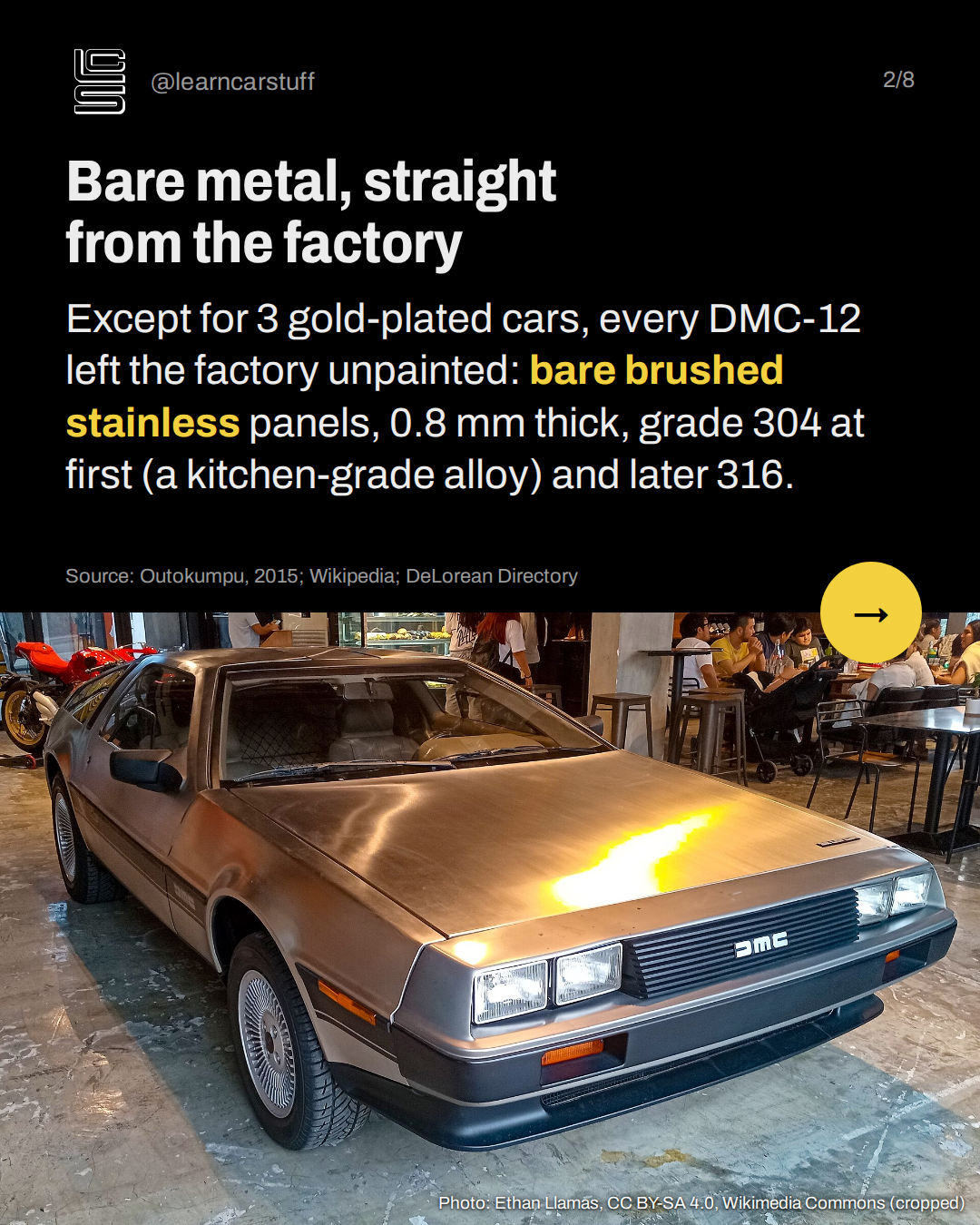
Except for 3 gold-plated cars, every DMC-12 left the factory unpainted: bare brushed stainless panels, 0.8 mm thick, grade 304 at first (a kitchen-grade alloy) and later 316.
Source: Outokumpu, 2015; Wikipedia; DeLorean Directory
Why stainless?
The original plan was a plastic (ERM) body that was hard to paint well, so DMC chose stainless instead. Skipping paint helped offset the cost, and the panels didn't rust.
Source: Wikipedia (Road & Track, 2014); Ate Up With Motor
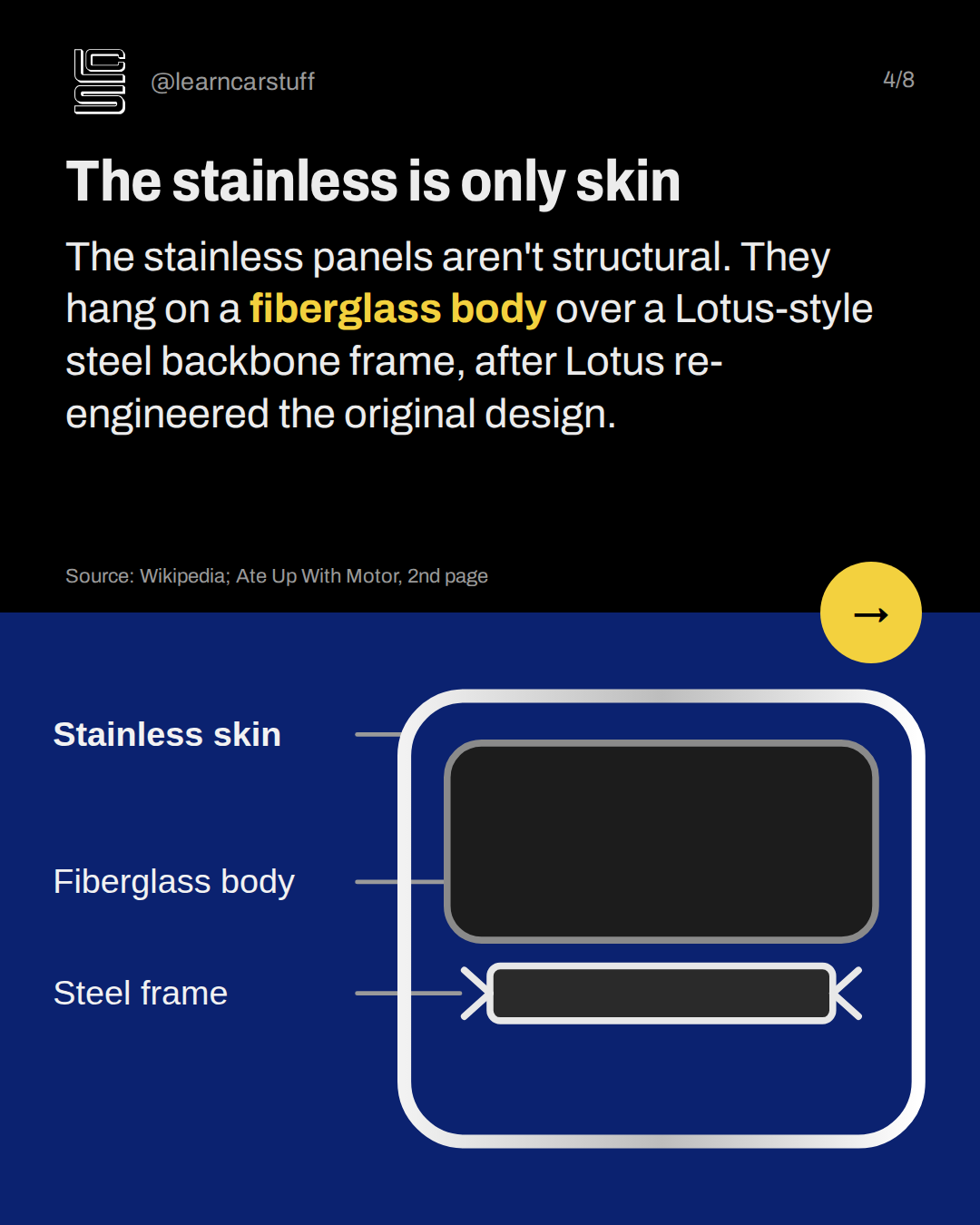
The stainless is only skin
The stainless panels aren't structural. They hang on a fiberglass body over a Lotus-style steel backbone frame, after Lotus re-engineered the original design.
Source: Wikipedia; Ate Up With Motor, 2nd page
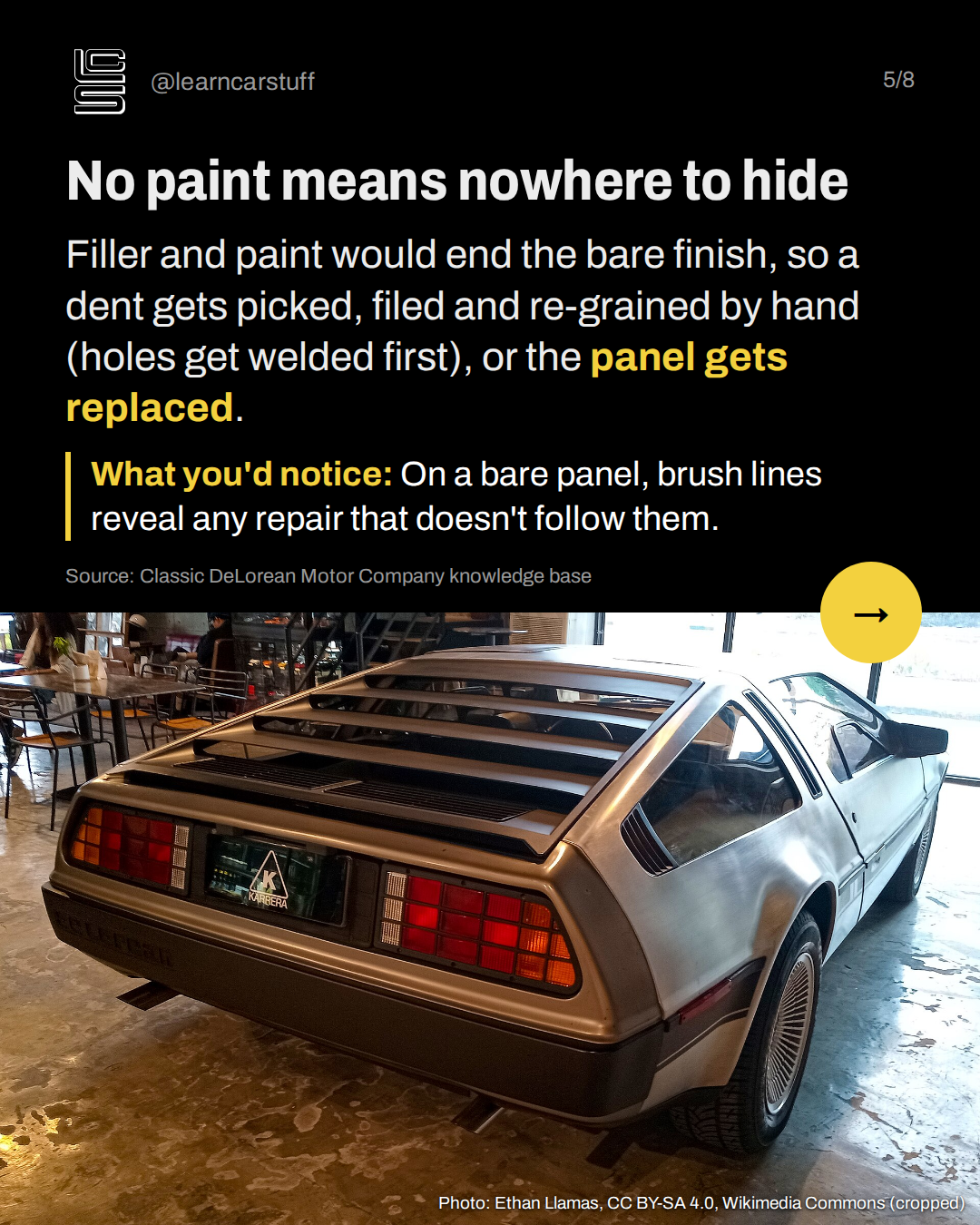
No paint means nowhere to hide
Filler and paint would end the bare finish, so a dent gets picked, filed and re-grained by hand (holes get welded first), or the panel gets replaced.
What you'd notice: On a bare panel, brush lines reveal any repair that doesn't follow them.
Source: Classic DeLorean Motor Company knowledge base
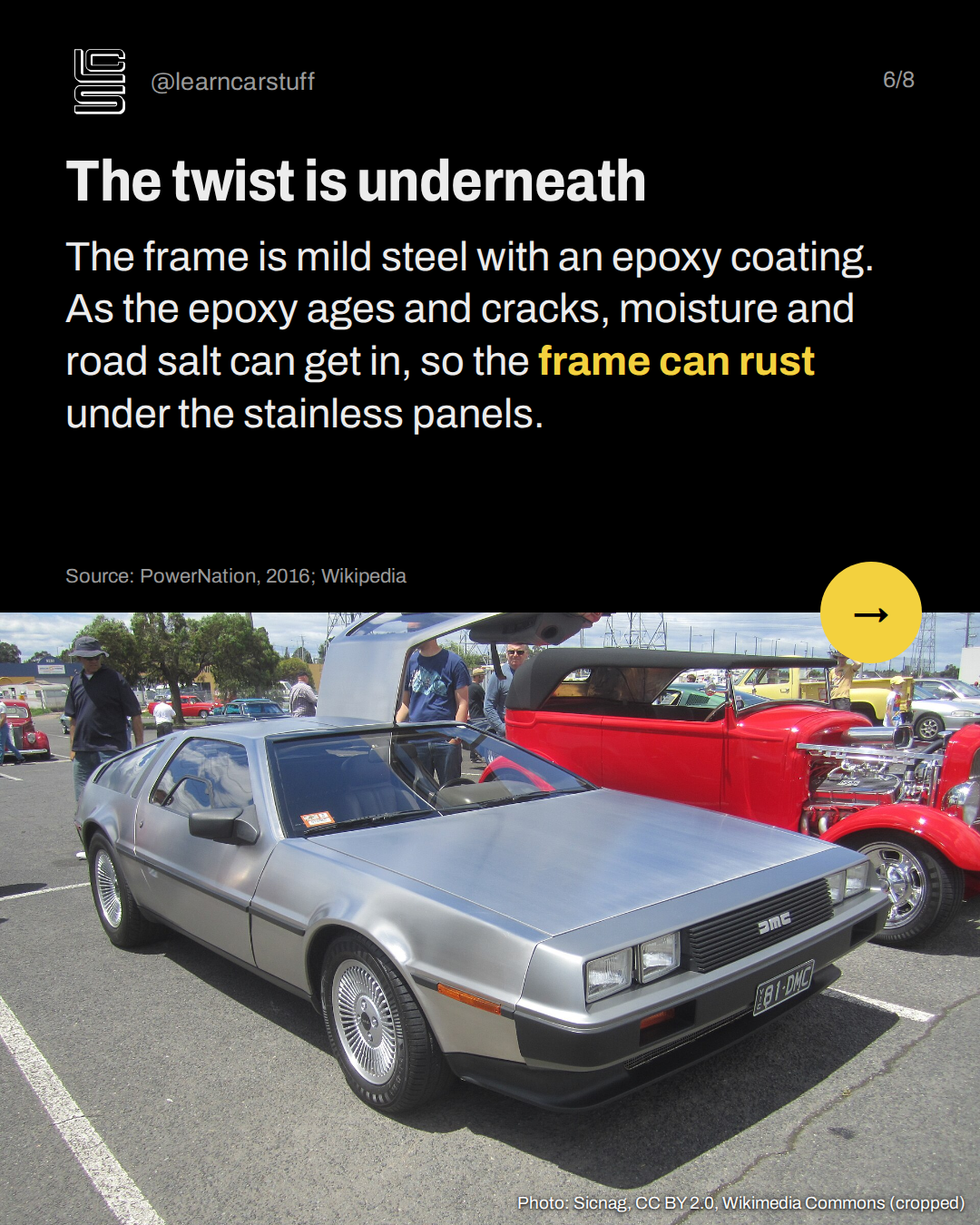
The twist is underneath
The frame is mild steel with an epoxy coating. As the epoxy ages and cracks, moisture and road salt can get in, so the frame can rust under the stainless panels.
Source: PowerNation, 2016; Wikipedia
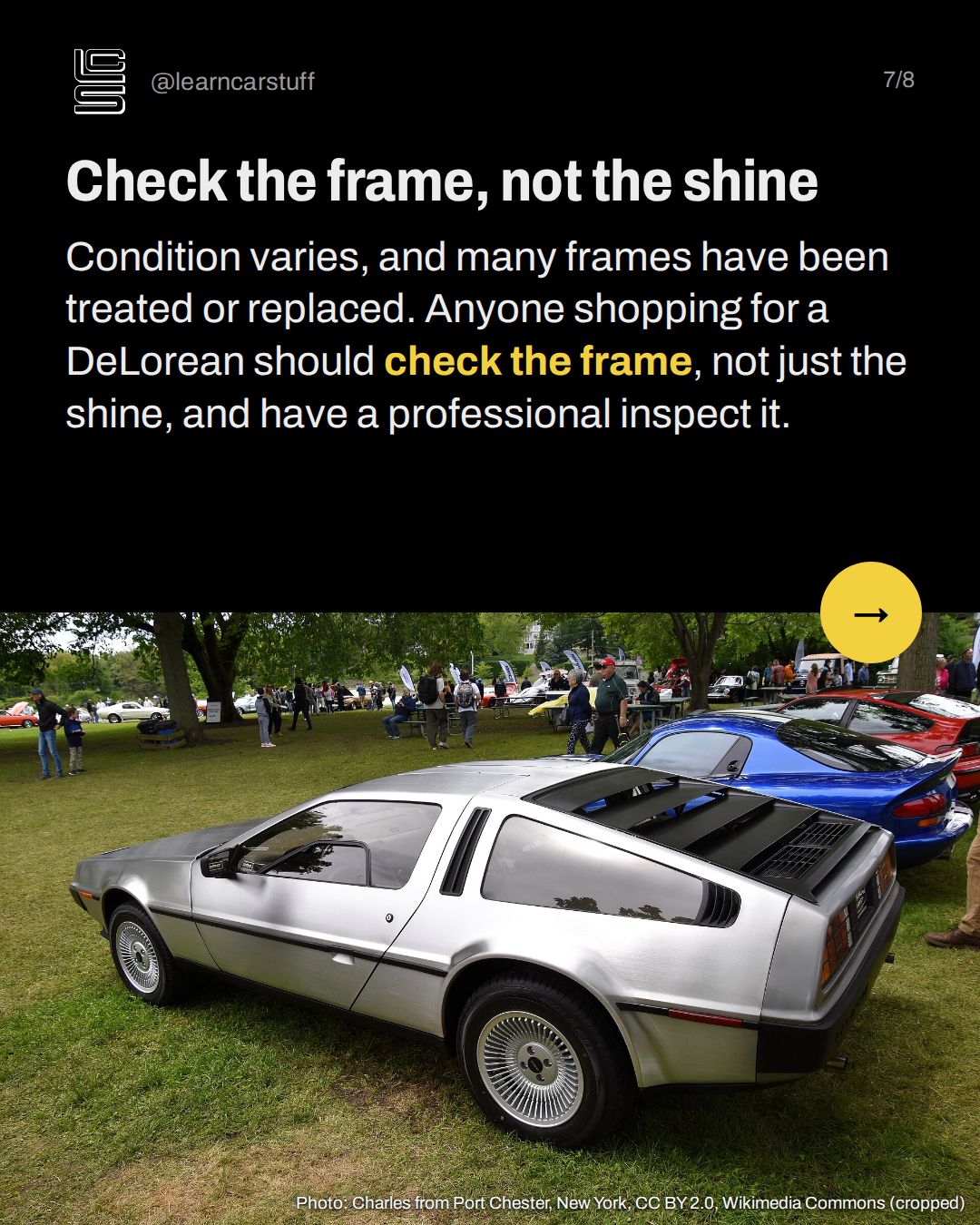
Check the frame, not the shine
Condition varies, and many frames have been treated or replaced. Anyone shopping for a DeLorean should check the frame, not just the shine, and have a professional inspect it.
Sources and assumptions
- Outokumpu: Stainless DeLorean stands the test of time (2015): Panels were grade 304 stainless in 0.8 mm thickness (grade 316 introduced later in the same thickness), produced in Sheffield, UK; brushed finish; around 9,200 DeLoreans made in Belfast 1981–1983; an estimate quoted in the article that two-thirds still exist (checked 2026-10-10)
- Ate Up With Motor: The Harder They Fall, DeLorean DMC-12 history, page 2: Lotus discarded much of the original design, replacing the planned Elastic Reservoir Molding plastic body with a two-piece fiberglass structure (Chapman's VARI process) and a steel backbone frame similar to the Esprit's; stainless didn't rust but scratched easily, and some observers said it looked like a kitchen appliance; rear-mounted PRV V6; Dunmurry, West Belfast factory (checked 2026-10-10)
- Ate Up With Motor: The Harder They Fall, DeLorean DMC-12 history, page 3: Curb weight about 2,750 lb (1,247 kg), more than 500 lb heavier than originally planned; 2,849 cc aluminum SOHC V6, 130 hp and 162 lb-ft; 62% rear weight bias; first production cars 21 January 1981 (checked 2026-10-10)
- Wikipedia: DMC DeLorean (citing Lamm 2003, Clarke 1995, Espey 2014): Brushed austenitic SAE 304 stainless panels fixed to a fiberglass underbody; epoxy-coated steel backbone chassis with Y-frames at each end derived from the Lotus Esprit; except for three 24-karat gold-plated cars, all left the factory without paint or clearcoat; PRV ZMJ-159 2.85 L V6, 130 hp US; curb weight 1,233 kg (2,718 lb); production 21 Jan 1981 to 24 Dec 1982 (checked 2026-10-10)
- DeLorean Directory: DeLorean Stainless Steel Panels: Panels are 304 grade, the same stainless used in commercial kitchens; the choice came from DeLorean's dislike of Detroit's planned obsolescence; panels are bolted to a molded fiberglass shell (checked 2026-10-10)
- Classic DeLorean Motor Company knowledge base: Stainless Magic: Stainless panel repair is done by welding, filing, picking and flap-sanding to rebuild the brushed grain, not by filler and paint (checked 2026-10-10)
- PowerNation: The original DeLorean chassis seemed like a good idea at the time (2016): Original chassis was mild steel coated with epoxy; the epoxy turned brittle and cracked as the chassis flexed, letting moisture and road salt cause rust; replacement chassis electrocoated and powder coated (checked 2026-10-10)
Assumptions:
- Curb weight sources differ: 2,718 lb / 1,233 kg (Espey, via Wikipedia) and about 2,750 lb / 1,247 kg (Ate Up With Motor). Use 'about 2,700–2,750 lb' or 'about 2,750 lb', never a precise figure as if exact.
- 130 hp is the US-market figure. Do not quote the European rating.
- Production totals differ (about 8,975 per Espey, about 9,200 per Outokumpu). If a number is needed, say 'about 9,000'.
- 'Two-thirds still exist' is an estimate quoted by Outokumpu, not a registry count. Label it as an estimate.
- Not every frame rusts. Many cars have had frames treated or replaced. Say 'can rust', never 'will rust'.
- The record has no source for the dent-resistance or fingerprint folklore, so don't use it.
Photos:
- Photo: Corvair Owner, CC BY-SA 2.0, Wikimedia Commons (cropped)
- Photo: Sicnag, CC BY 2.0, Wikimedia Commons (cropped)
- Photo: Charles from Port Chester, New York, CC BY 2.0, Wikimedia Commons (cropped)
- Photo: Ethan Llamas, CC BY-SA 4.0, Wikimedia Commons (cropped)
- Photo: Ethan Llamas, CC BY-SA 4.0, Wikimedia Commons (cropped)
The short version
- The skin is bare brushed stainless.
- The panels bolt to a fiberglass body.
- A steel backbone frame sits underneath.
- That epoxy-coated frame can rust.
- Bare panels leave dents nowhere to hide.