 Learn Car Stuff
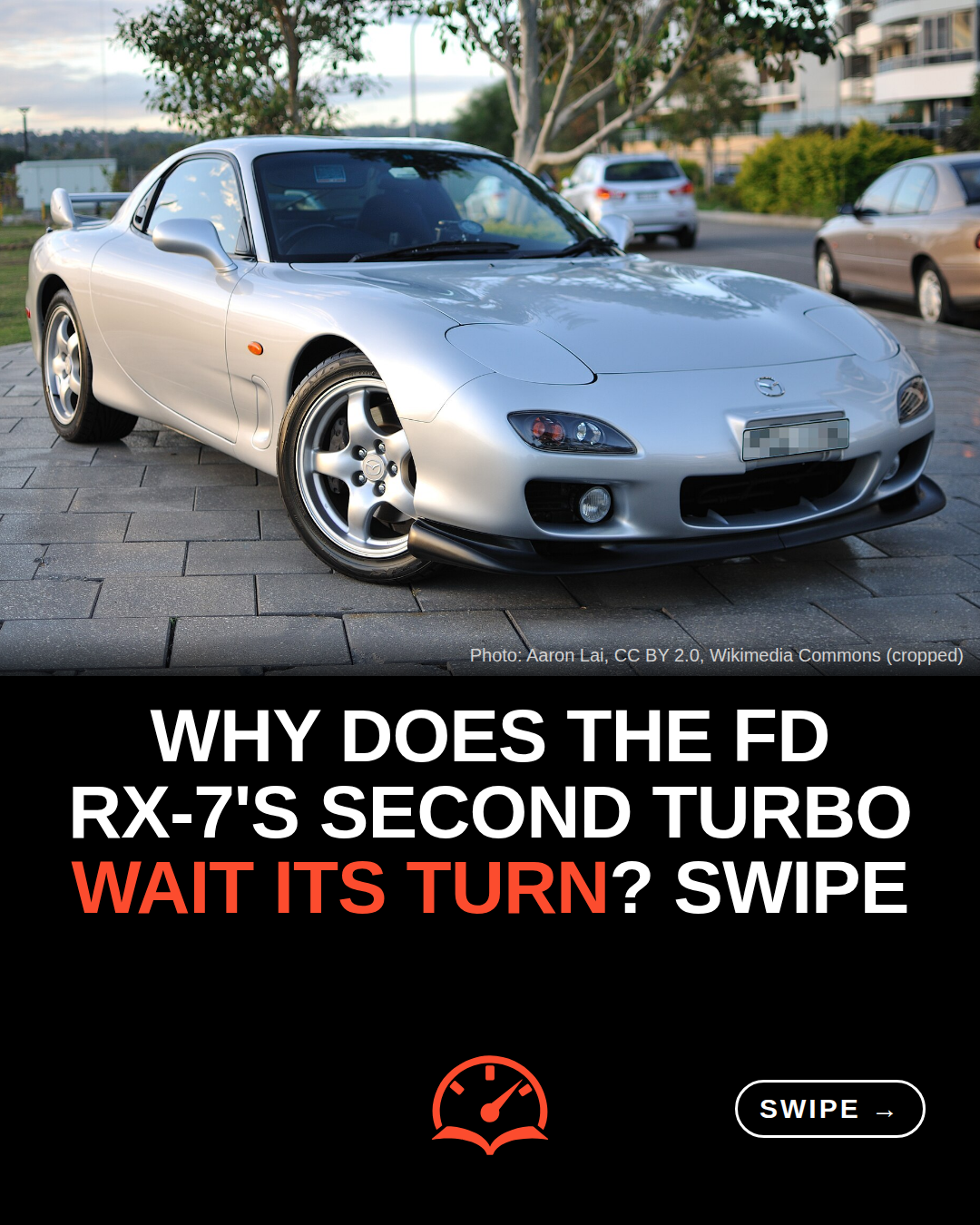
Why does the FD RX‑7's second turbo wait its turn? SWIPE
Two Turbos, Different Jobs
On many twin-turbo engines, both turbochargers work together all the time. The FD (Mazda's third-generation, 1991-2002) RX-7's 13B-REW rotary works differently: one turbo works alone at low revs, and the second joins in later.
Source: Mazda USA, RX-7 Heaven
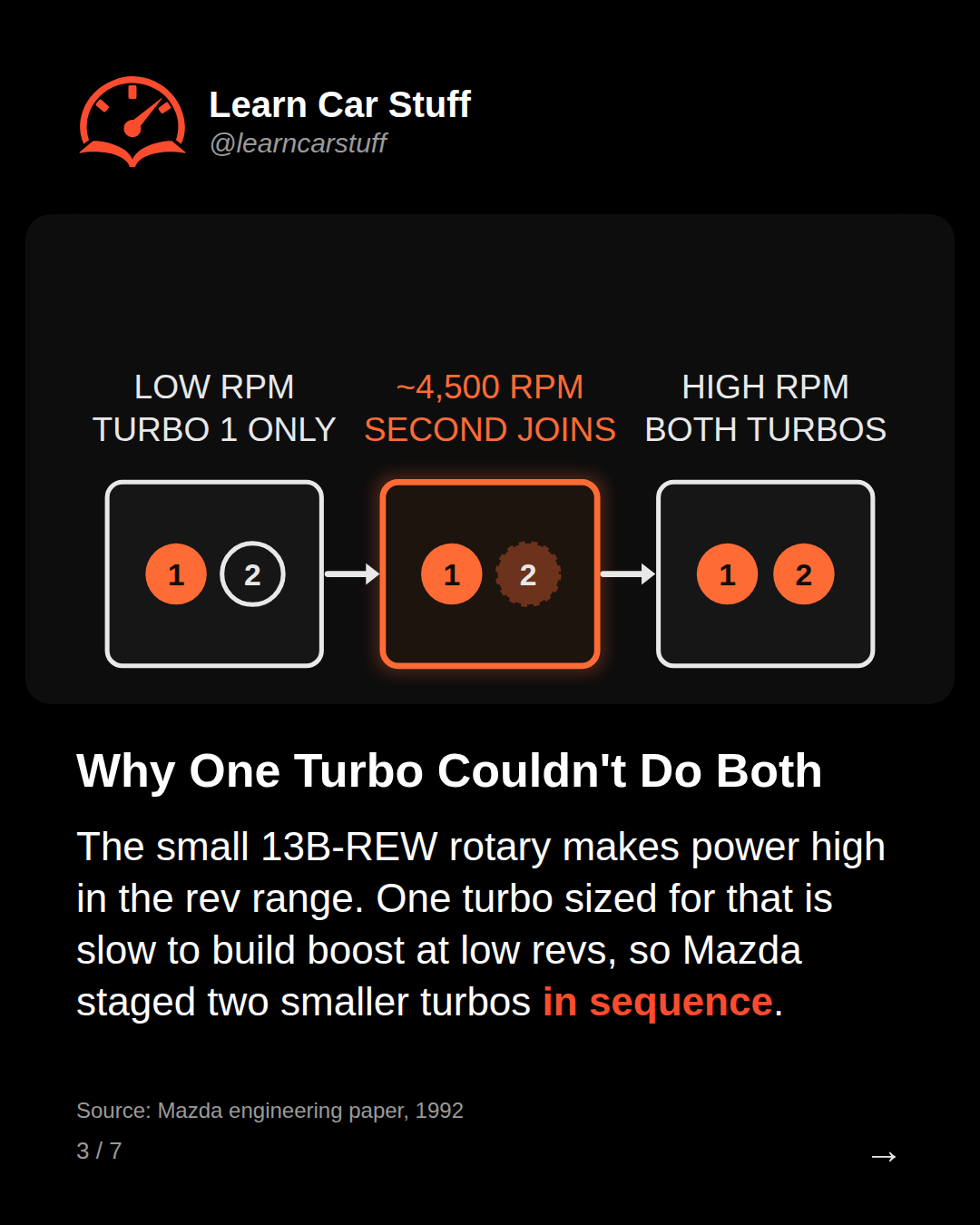
Why One Turbo Couldn't Do Both
The small 13B-REW rotary makes power high in the rev range. One turbo sized for that is slow to build boost at low revs, so Mazda staged two smaller turbos in sequence.
Source: Mazda engineering paper, 1992
The Numbers Behind The Swap
Owners measure the second turbo joining at roughly 4,500 rpm under full throttle. The 1993 US car made 255 hp; Japan's 1999 Type RS made 280 PS (a metric hp) at 6,500 rpm.
Source: Rob Robinette (owner guide); Mazda USA; Mazda newsroom, 1998
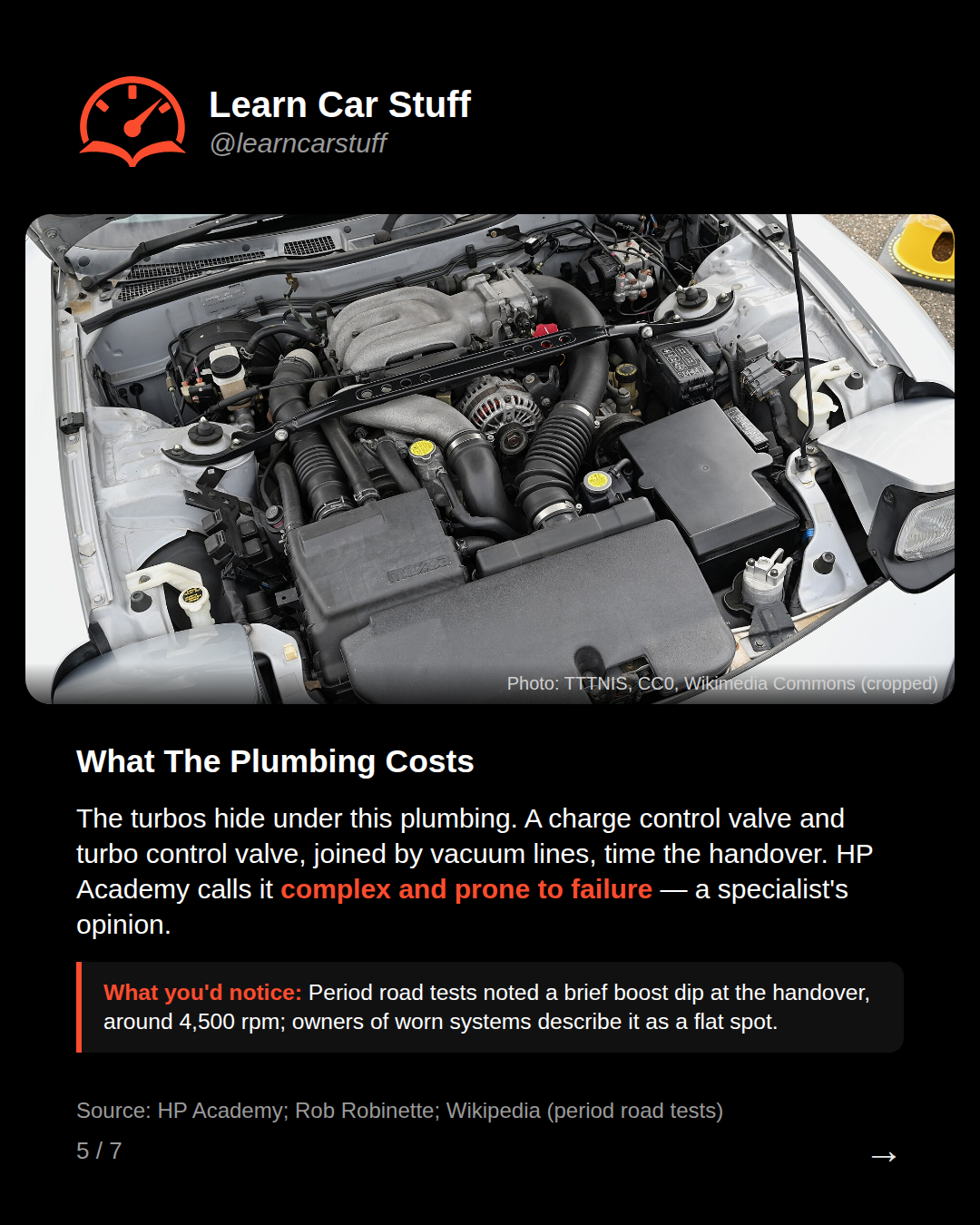
What The Plumbing Costs
The turbos hide under this plumbing. A charge control valve and turbo control valve, joined by vacuum lines, time the handover. HP Academy calls it complex and prone to failure — a specialist's opinion.
What you'd notice: Period road tests noted a brief boost dip at the handover, around 4,500 rpm; owners of worn systems describe it as a flat spot.
Source: HP Academy; Rob Robinette; Wikipedia (period road tests)
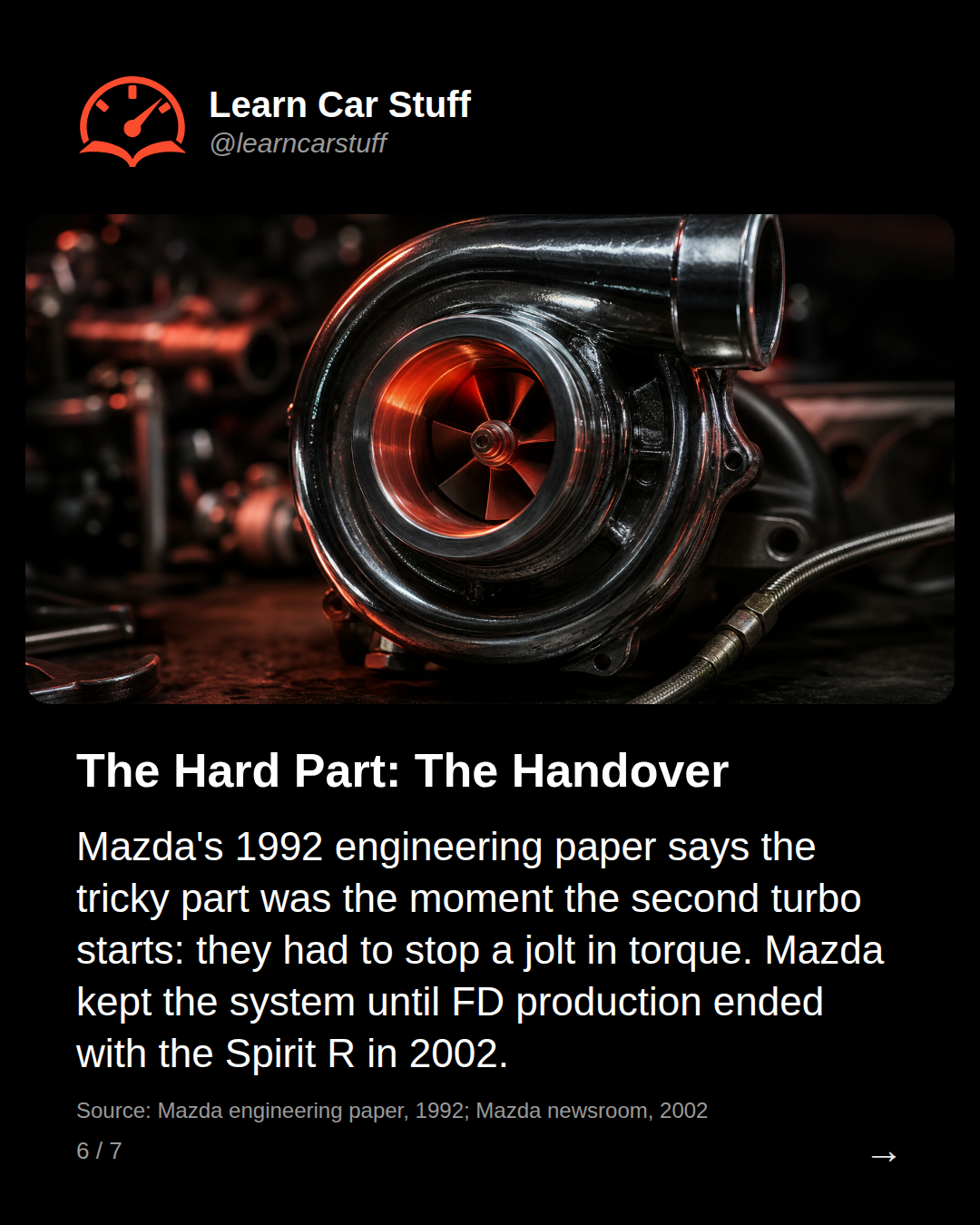
The Hard Part: The Handover
Mazda's 1992 engineering paper says the tricky part was the moment the second turbo starts: they had to stop a jolt in torque. Mazda kept the system until FD production ended with the Spirit R in 2002.
Source: Mazda engineering paper, 1992; Mazda newsroom, 2002
Sources and assumptions
- Mazda USA, 'RX-7 Heaven' history page: Third-generation RX-7 debuted in 1991; the twin-rotor 13B-REW was 'turbocharged by not one, but two turbos arranged in sequence' to boost low-end and top-end performance; 255 hp; weighed 'just 2,850 lbs' (checked 2026-09-29)
- Mazda Corporation, Great Cars of Mazda: The Savanna RX-7 Part 2: The third-generation FD-series RX-7 was launched in 1991; weight-to-power target of under 5 kg per PS was achieved (checked 2026-09-29)
- Tashima, Tadokoro, Okimoto, Niwa (Mazda), 'Sequential twin turbocharger system for rotary engines', JSAE Jidosha Gijutsukai Ronbunshu 23:1, 1992 (OSTI ETDEWEB abstract): The system was developed to improve low-speed boost without losing high-speed performance on a rotary engine: two turbochargers smaller than a conventional single, only one operating at low engine speed and both at high speed; engineers worked to suppress 'torque shock' when the second turbo starts; result is higher torque with less turbo lag at low speed (checked 2026-09-29)
- Mazda newsroom, 'The New Mazda RX-7 Powered by 280 PS Rotary Engine' (Dec 1998): 13B-REW two-rotor rotary; Type RS/Type R 280 PS at 6,500 rpm, 32.0 kg-m at 5,000 rpm; Type RB 5MT 265 PS, 4AT 255 PS; improved turbocharger efficiency with abradable seals and an ultra-high-flow turbine gives boost pressure about 1.2 times earlier models (checked 2026-09-29)
- Mazda newsroom, 'Final Limited Edition of Mazda RX-7 Spirit R Unleashed' (Mar 2002): FD-3S RX-7 production planned to end in August 2002; 1,500 Spirit R units sold only in Japan; 280 PS manual, 255 PS automatic (checked 2026-09-29)
- Rob Robinette, 'RX-7 Boost Control' (FD owner technical guide): Operating phases: below about 4,500 rpm at high power only the primary turbo makes boost (charge control valve closed); above 4,500 rpm the turbo control valve and charge control valve open so the secondary adds boost (checked 2026-09-29)
- Wikipedia, Mazda RX-7 (FD section): Corroborates a changeover around 4,500 rpm with a momentary boost dip (secondary source, cites period magazines; used only to back the 'roughly 4,500 rpm' wording) (checked 2026-09-29)
- HP Academy, 'Everything you need to know about the Mazda 13B Rotary': The FD3S 13B-REW's 'complex sequential turbocharger system was prone to failure' (specialist tuning-school opinion, attributed) (checked 2026-09-29)
Assumptions:
- The '255 hp' and '2,850 lb' figures are Mazda USA's numbers for the launch-era US car. Japanese-market outputs differ by year and trim (255/265/280 PS).
- The 4,500 rpm handover is from owner technical guides and secondary sources, not a Mazda document we opened. The slide says 'roughly 4,500 rpm' under full throttle, and the actual point depends on load and control logic.
- Both turbos are described only as 'smaller than a conventional single turbo' (Mazda paper). We make no claim that the primary and secondary differ in size.
- Tired-car symptoms (flat spot or boost dip at the handover) are owner-reported and must be labeled that way. They are not a diagnosis.
- The single-turbo vs sequential debate is presented as opinion and ownership priorities, not a verdict.
- The cover photo is a facelifted late-production FD (front bumper and lights). The slide calls it only 'Mazda RX-7 (FD)', not a specific year.
Photos:
The Sequential Trick
- Two smaller turbos, not one big one.
- One turbo works alone at low revs.
- The second joins at roughly 4,500 rpm.
- The tradeoff: quick response, extra complexity.