 Learn Car Stuff
Why are the Jaguar E-Type's rear brakes next to the differential?
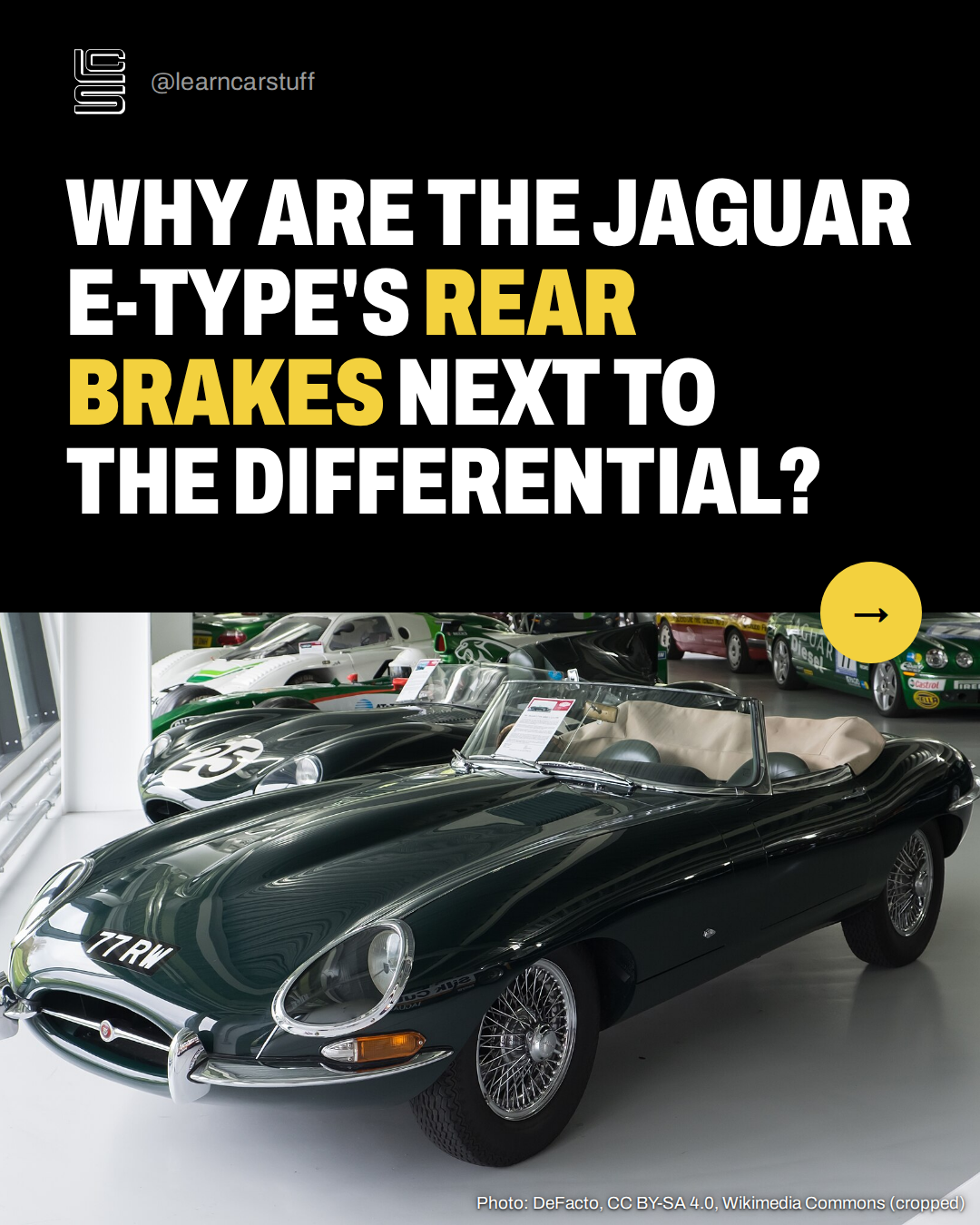
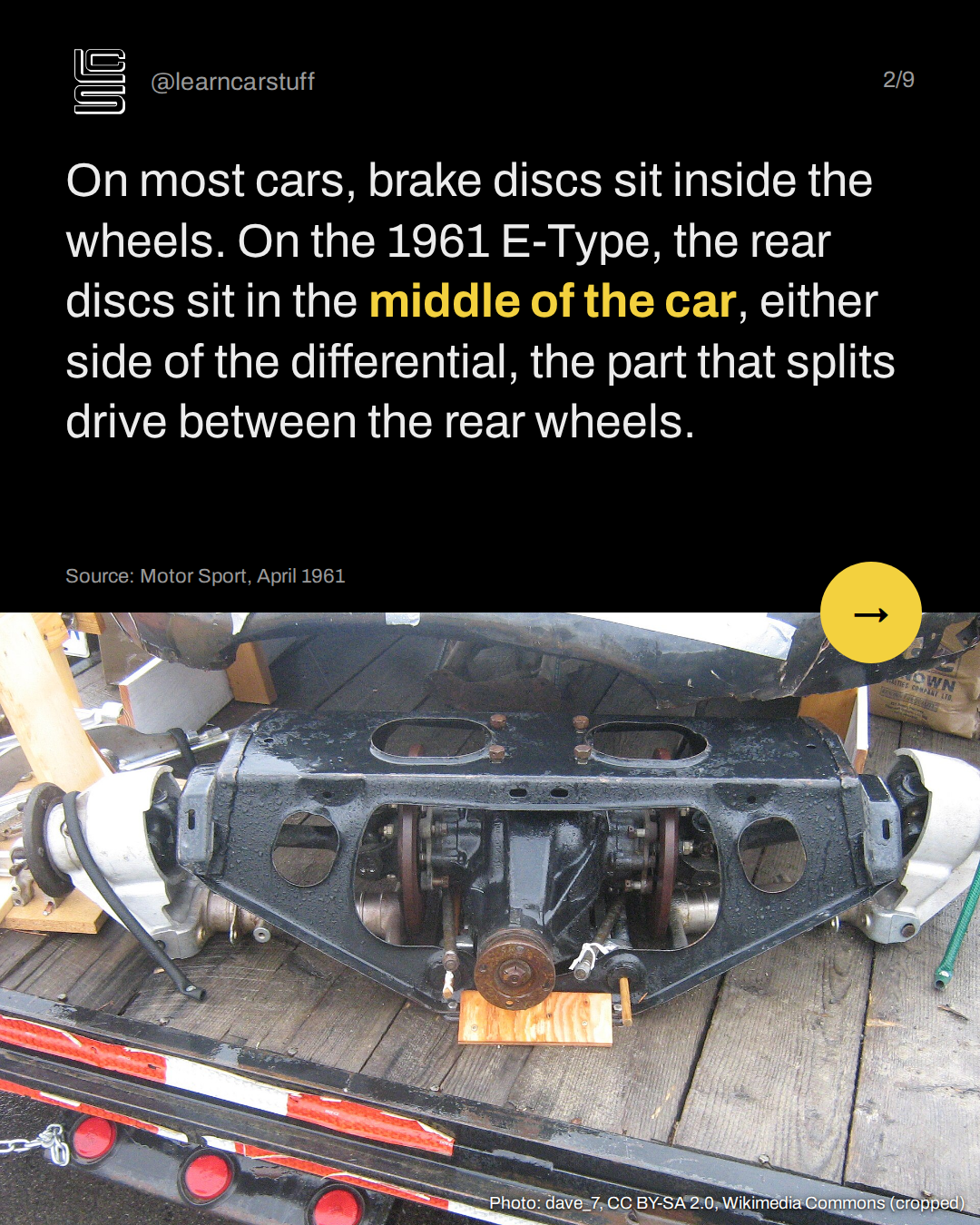
On most cars, brake discs sit inside the wheels. On the 1961 E-Type, the rear discs sit in the middle of the car, either side of the differential, the part that splits drive between the rear wheels.
Source: Motor Sport, April 1961
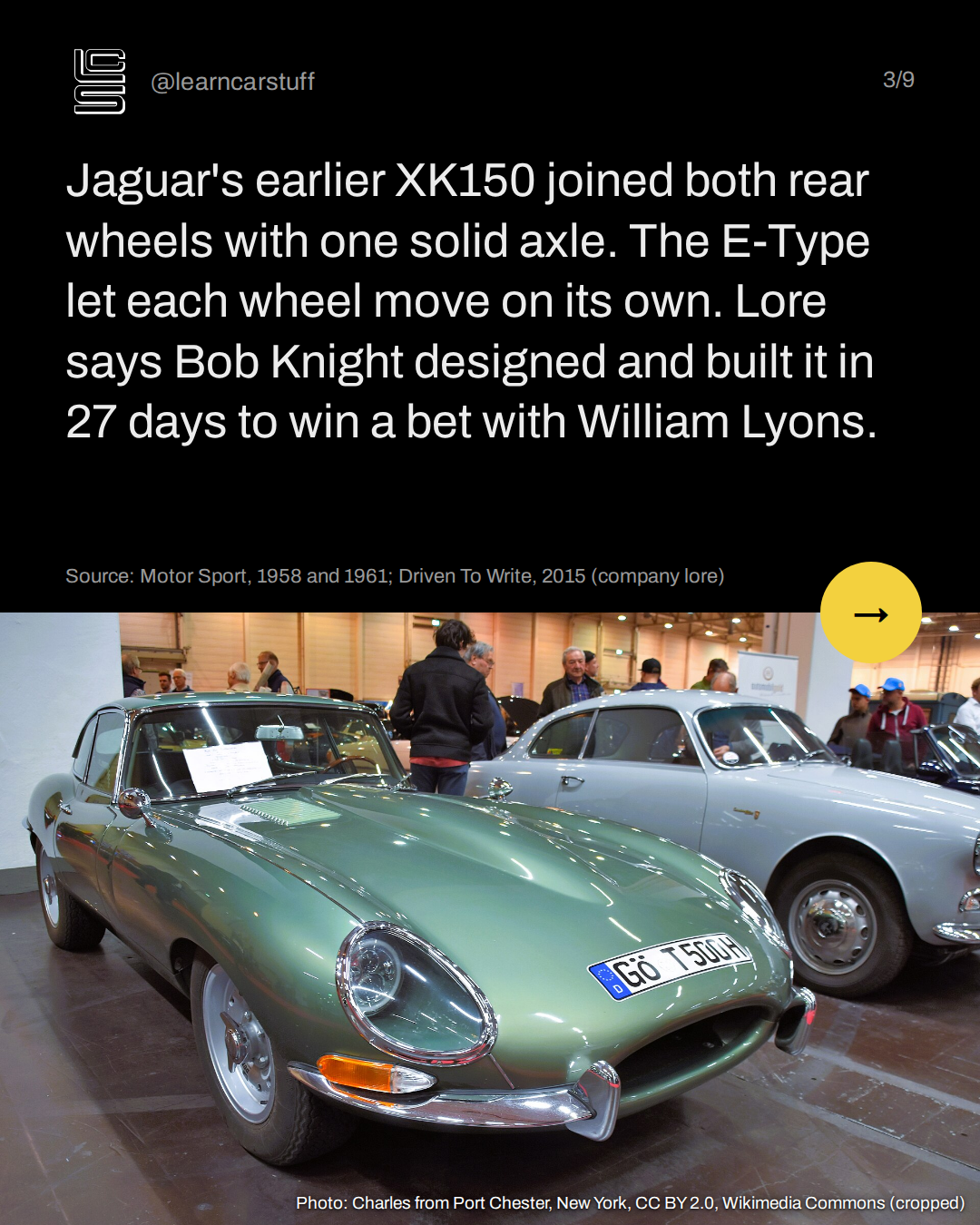
Jaguar's earlier XK150 joined both rear wheels with one solid axle. The E-Type let each wheel move on its own. Lore says Bob Knight designed and built it in 27 days to win a bet with William Lyons.
Source: Motor Sport, 1958 and 1961; Driven To Write, 2015 (company lore)
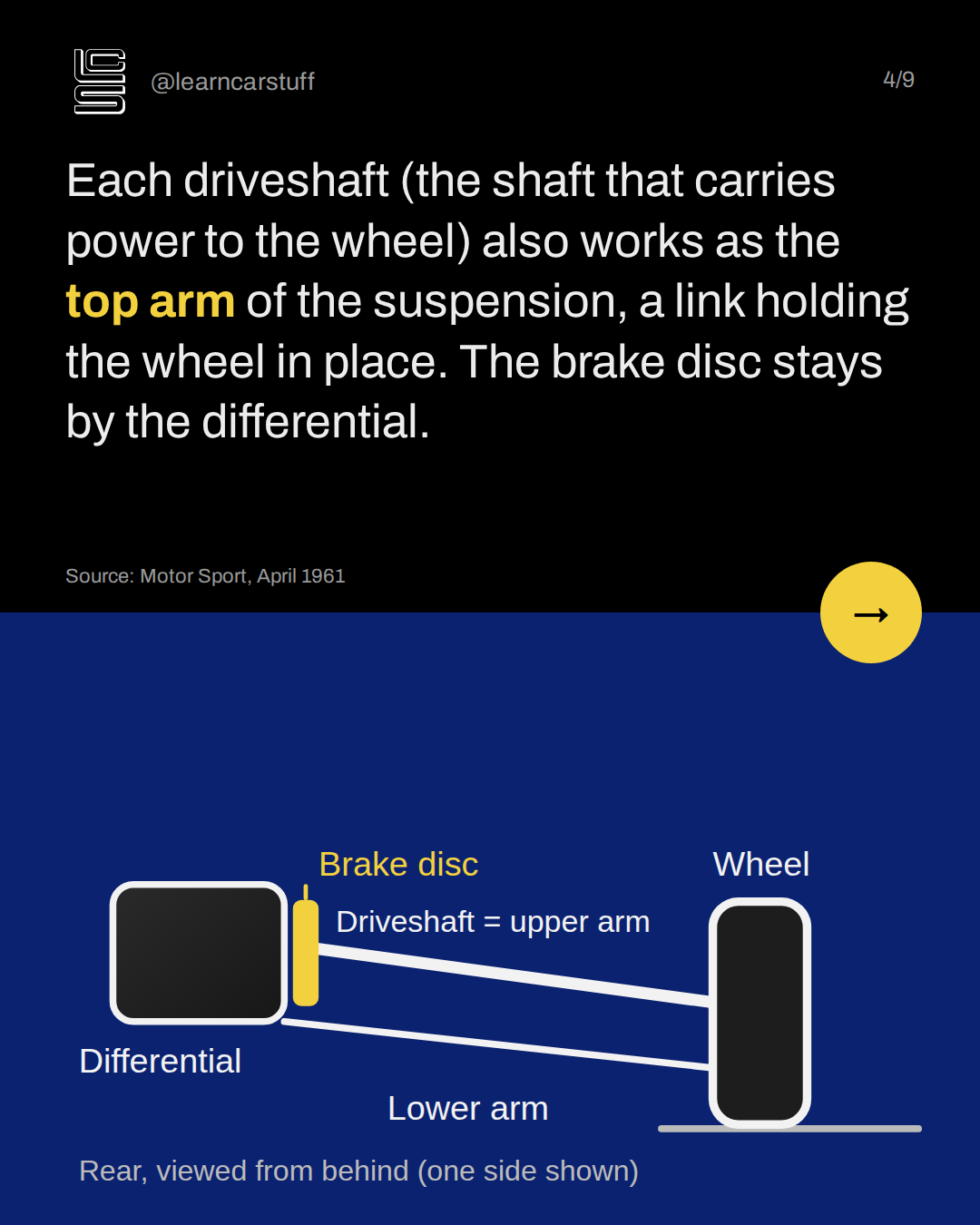
Each driveshaft (the shaft that carries power to the wheel) also works as the top arm of the suspension, a link holding the wheel in place. The brake disc stays by the differential.
Source: Motor Sport, April 1961
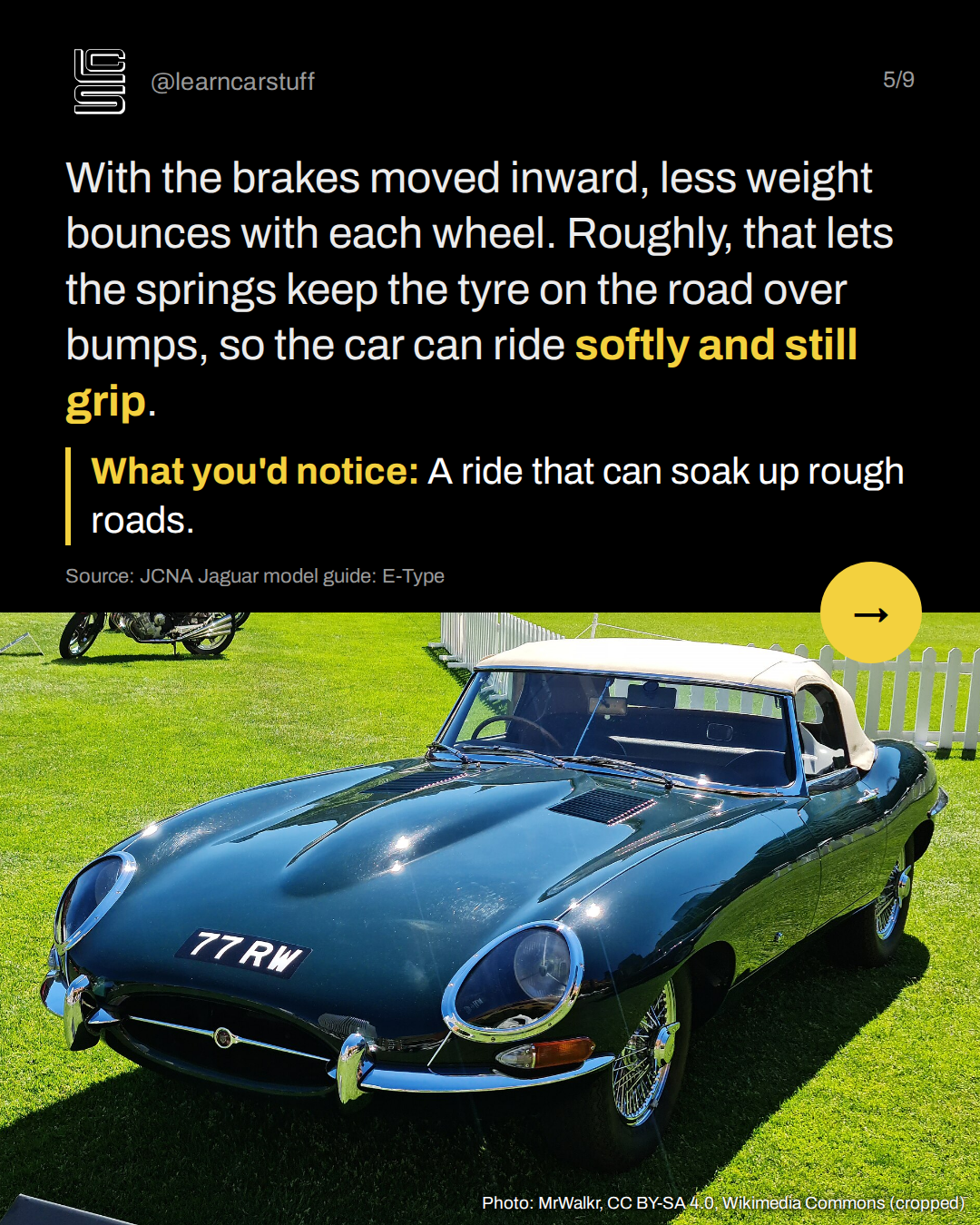
With the brakes moved inward, less weight bounces with each wheel. Roughly, that lets the springs keep the tyre on the road over bumps, so the car can ride softly and still grip.
What you'd notice: A ride that can soak up rough roads.
Source: JCNA Jaguar model guide: E-Type
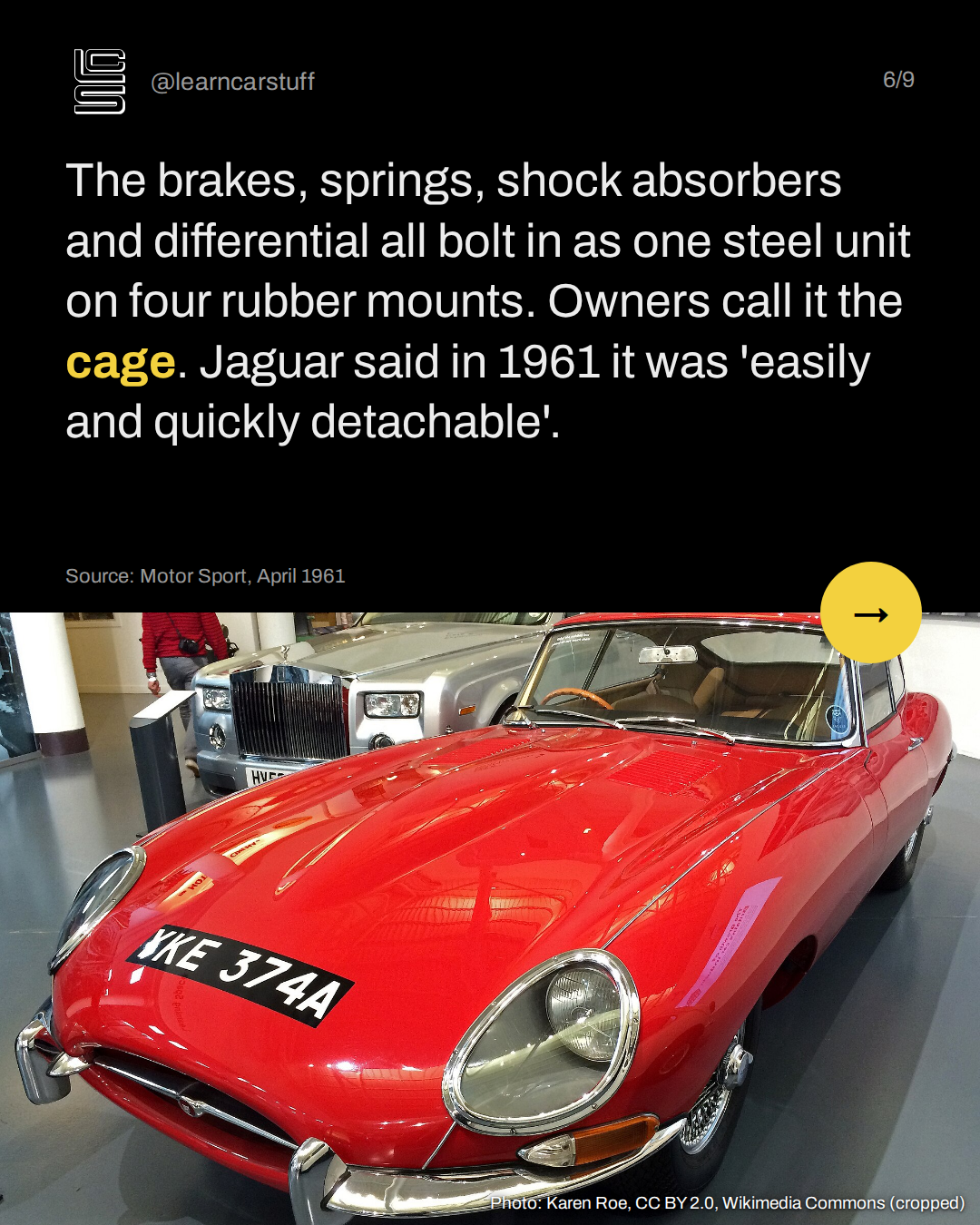
The brakes, springs, shock absorbers and differential all bolt in as one steel unit on four rubber mounts. Owners call it the cage. Jaguar said in 1961 it was 'easily and quickly detachable'.
Source: Motor Sport, April 1961
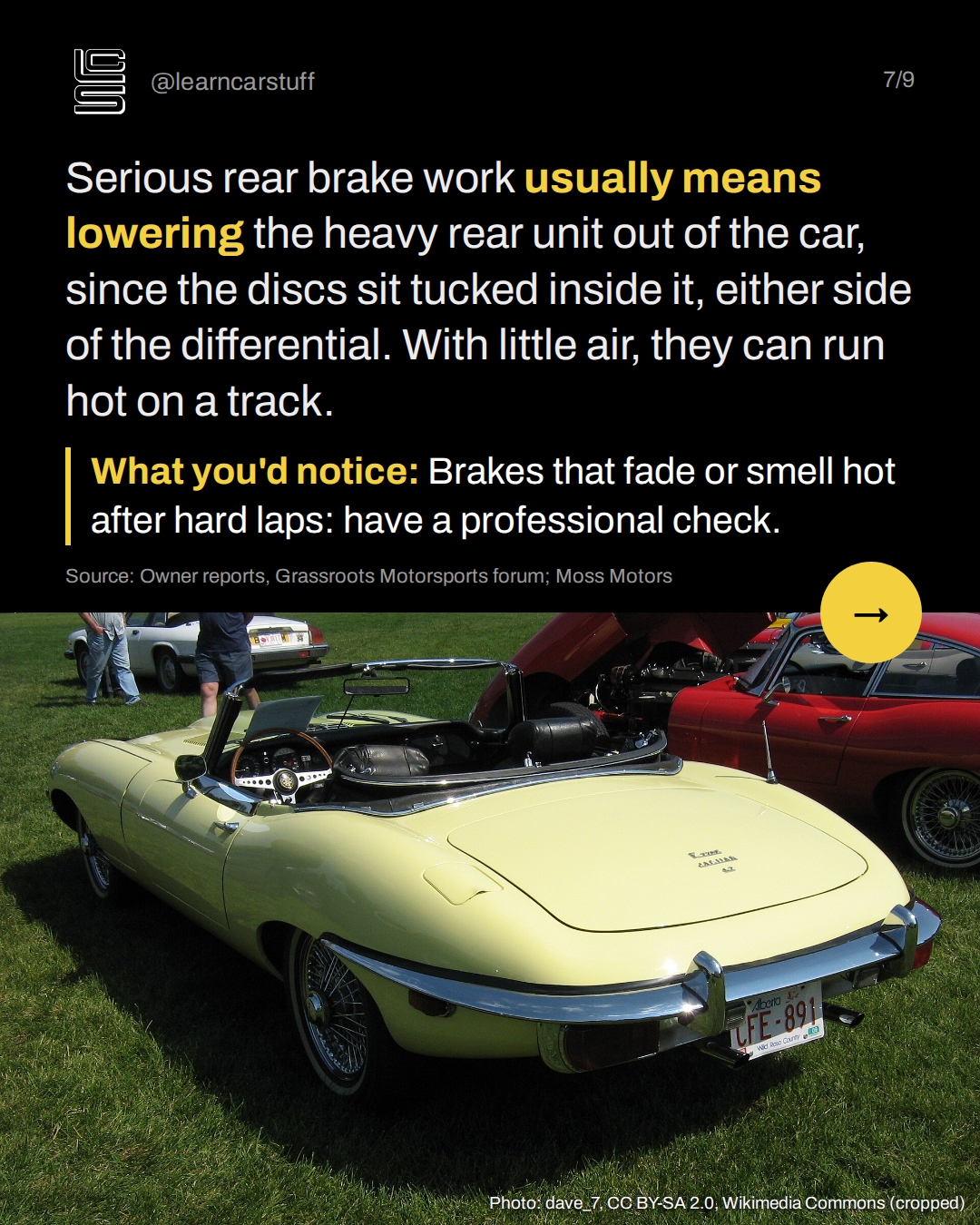
Serious rear brake work usually means lowering the heavy rear unit out of the car, since the discs sit tucked inside it, either side of the differential. With little air, they can run hot on a track.
What you'd notice: Brakes that fade or smell hot after hard laps: have a professional check.
Source: Owner reports, Grassroots Motorsports forum; Moss Motors
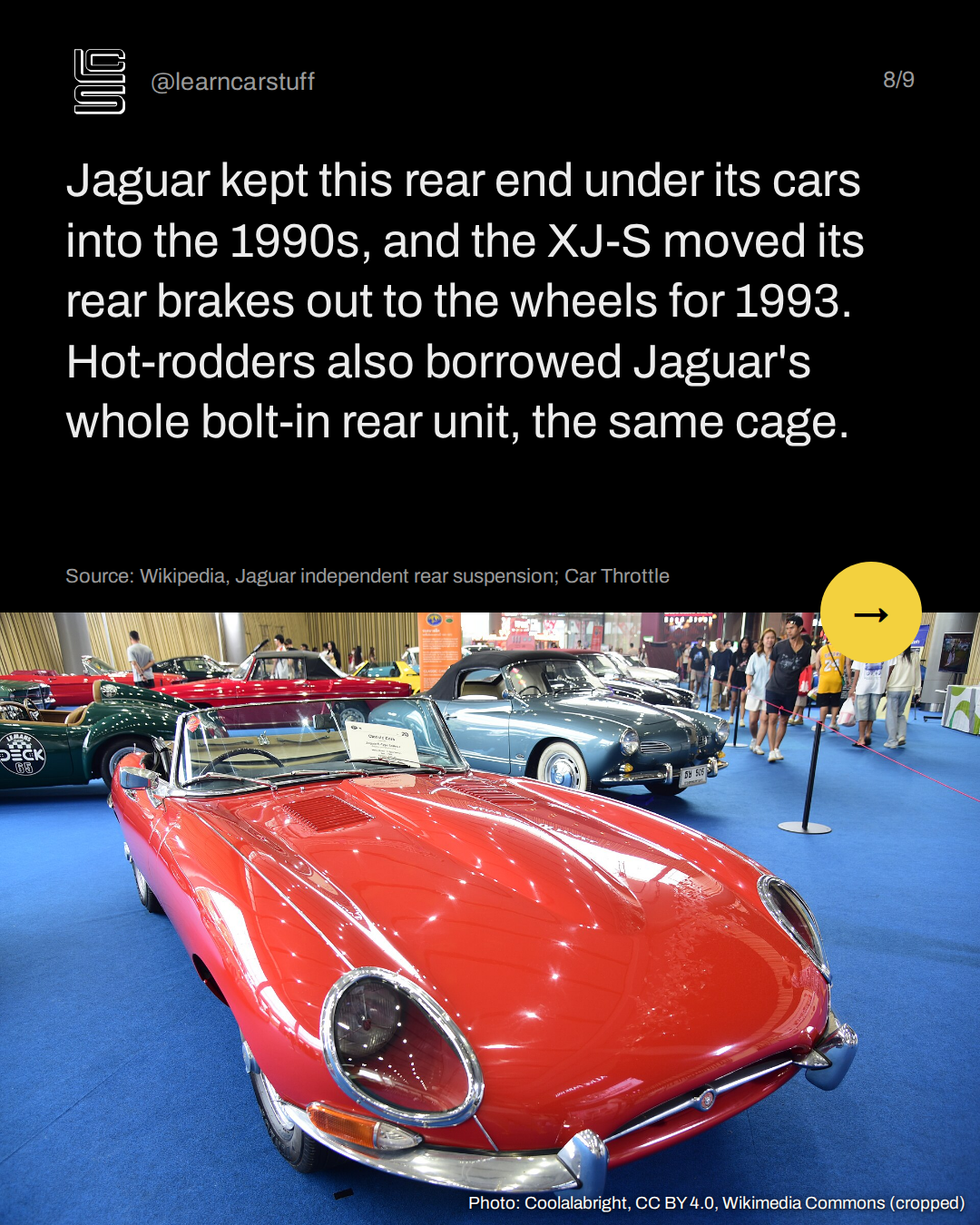
Jaguar kept this rear end under its cars into the 1990s, and the XJ-S moved its rear brakes out to the wheels for 1993. Hot-rodders also borrowed Jaguar's whole bolt-in rear unit, the same cage.
Source: Wikipedia, Jaguar independent rear suspension; Car Throttle
Sources and assumptions
- Motor Sport magazine archive, April 1961, 'The new 3.8-litre Jaguar E-type GT': Announced March 15th 1961; IRS of 'completely new design' with two tubular links, 'the top link is the half-shaft-universally jointed at both ends'; twin coil springs each side enclosing dampers, mounted either side of the differential casing; 'The rear brakes are mounted inboard of the half-shafts and adjacent to the differential unit'; whole assembly in 'a fabricated steel sub-frame which is easily and quickly detachable from the body structure', located 'by four vee rubber blocks'; discs 11 in front (on the hubs), 10 in rear inboard; 3.8-litre XK six, 265 bhp at 5,500 rpm; dry weights 22 cwt two-seater, 22½ cwt coupé; prices coupé £2,196 19s 2d, two-seater £2,097 15s 10d (checked 2026-10-31)
- Motor Sport magazine archive, April 1961, page 35 (page view): Same text as the article: inboard rear brakes adjacent to the differential, half-shaft as top link, detachable steel sub-frame, 265 bhp 3.8-litre XK, claimed 155 mph on 3.31 axle (checked 2026-10-31)
- Jaguar Clubs of North America (JCNA), Jaguar model guide: E-Type: IRS 'self contained in a sub frame, and featuring 4 shocks and springs with inboard disc brakes … mounted near the differential therefore reducing unsprung weight'; 3.8-litre XK six with triple carburettors, 265 hp; Geneva debut March 1961 (checked 2026-10-31)
- Jaguar Heritage, E-type Evolution exhibition: On 15 March 1961 the gunmetal grey E-type coupé 9600 HP was unveiled to the press at the Parc des Eaux Vives in Geneva; prototype 'with Bob Knight's new Independent Rear Suspension fitted' (checked 2026-10-31)
- Driven To Write, 'The Men Who Made the ’40: Bob Knight' (2015): Knight's independent rear suspension was 'originally schemed and built in 27 days to win a bet with Sir William' and became the backbone of Jaguar's road behaviour for decades (told as company lore) (checked 2026-10-31)
- Moss Motors, E-Type rear vented disc brake conversion kit (37-1214): 'For track, or high-performance street use, the inboard rear brakes can easily overheat'; kit fits all E-Types (checked 2026-10-31)
- Car Throttle, 'Inboard brakes: what they are and how they work': Inboard brakes lower unsprung mass so the ride can be softer; downsides: poor cooling in a confined space, driveshafts must carry braking torque, servicing means lowering the differential; older Jaguars as an example; hot rods adopted Jaguar's subframe rear ends (checked 2026-10-31)
- Wikipedia, Jaguar independent rear suspension: First-generation IRS used on E-Type, Mark X, S-Type, 420, XJ6/XJ12 Series 1–3, XJS (through 1996); brakes inboard for the first 32 years; moved outboard on 1993–96 XJS; second-generation IRS (XJ40, 1986) had outboard brakes. Secondary source: use only for 'into the 1990s' and the XJ-S 1993 change, worded cautiously (checked 2026-10-31)
- Grassroots Motorsports forum, 'Replacing rear brakes on a Jaguar IRS': Owner/mechanic experience: servicing the rear brakes in place is like 'building a ship in a bottle'; the right way is to drop the rear unit, a very heavy job; new calipers may need the discs re-shimmed. Owner reports, framed as 'owners usually' (checked 2026-10-31)
- Australian Motor Heritage Foundation, 'Bob Knight' (Robbo's Archives, 2021): 'Sir William Lyons bet him £5 he couldn't design an independent rear suspension inside a month. Working Saturdays, Knight duly presented Jaguar's founder a complete set of layout drawings within the month. Sir William took a fiver out of his wallet and handed it over.' (Enthusiast history: use as lore only) (checked 2026-10-31)
- Motor Sport magazine archive, October 1958, 'The Jaguar XK150': 'over really rough or ripply surfaces the back axle makes its presence felt, reminder that the action of the rear wheels is not independent'; '0.5-elliptic springs are employed at the back, not the 0.25-elliptic springs and ingenious linkage found on the 2.4 and 3.4-litre Jaguar saloons' (checked 2026-10-31)
Assumptions:
- 'Unsprung weight' benefit is stated qualitatively (less mass moving with the wheel helps the springs keep the tyre on the road); no kilogram figure for the brake hardware was found in a primary source, so none is used.
- 'Serious rear brake work usually means dropping the rear unit' reflects specialist and owner reports (forums, Car Throttle); pads can sometimes be changed in place with difficulty. Word it as 'usually', not 'always'.
- The Bob Knight bet is Jaguar lore retold by enthusiast historians, not a company record. Motor Heritage Foundation (motorheritage.org.au) gives '£5' and 'inside a month'. Driven To Write (2015) gives '27 days' and no amount. Always label it as lore.
- Dry weight 22 cwt (two-seater) = 22 × 112 lb = 2,464 lb ≈ 1,118 kg, as quoted by Motor Sport in 1961 (a 'dry' figure, without fluids). Only use it with 'dry, as quoted in 1961'.
- Use of the IRS into the 1990s and the 1993 XJ-S outboard change rest on a secondary source (Wikipedia) plus motorheritage.org.au's 'endured into the 1990s'; keep the wording to 'into the 1990s'.
- Photo years and series are taken from Commons file descriptions; the bare rear-suspension photo is described as a 1962 E-Type unit.
Photos:
- Photo: dave_7, CC BY-SA 2.0, Wikimedia Commons (cropped)
- Photo: DeFacto, CC BY-SA 4.0, Wikimedia Commons (cropped)
- Photo: MrWalkr, CC BY-SA 4.0, Wikimedia Commons (cropped)
- Photo: dave_7 from Lethbridge, Canada, CC BY 2.0, Wikimedia Commons (cropped)
- Photo: dave_7, CC BY-SA 2.0, Wikimedia Commons (cropped)
- Photo: Charles from Port Chester, New York, CC BY 2.0, Wikimedia Commons (cropped)
- Photo: Karen Roe, CC BY 2.0, Wikimedia Commons (cropped)
- Photo: Coolalabright, CC BY 4.0, Wikimedia Commons (cropped)
The short version
- Rear discs sit beside the differential
- Less weight bounces with the wheel
- The whole rear end bolts in as one unit
- Serious brake work usually means lowering it