 Learn Car Stuff
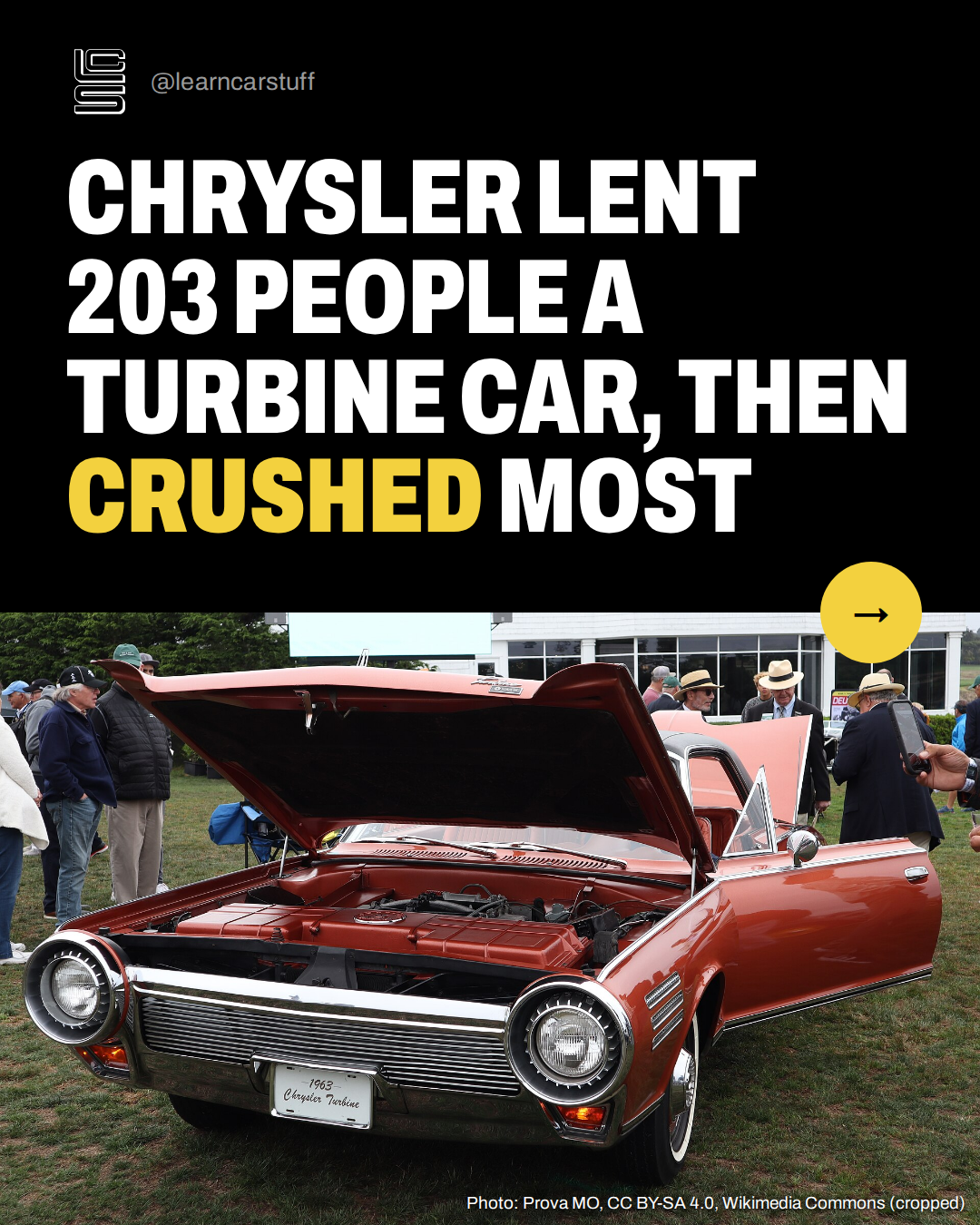
Chrysler lent 203 people a turbine car, then crushed most
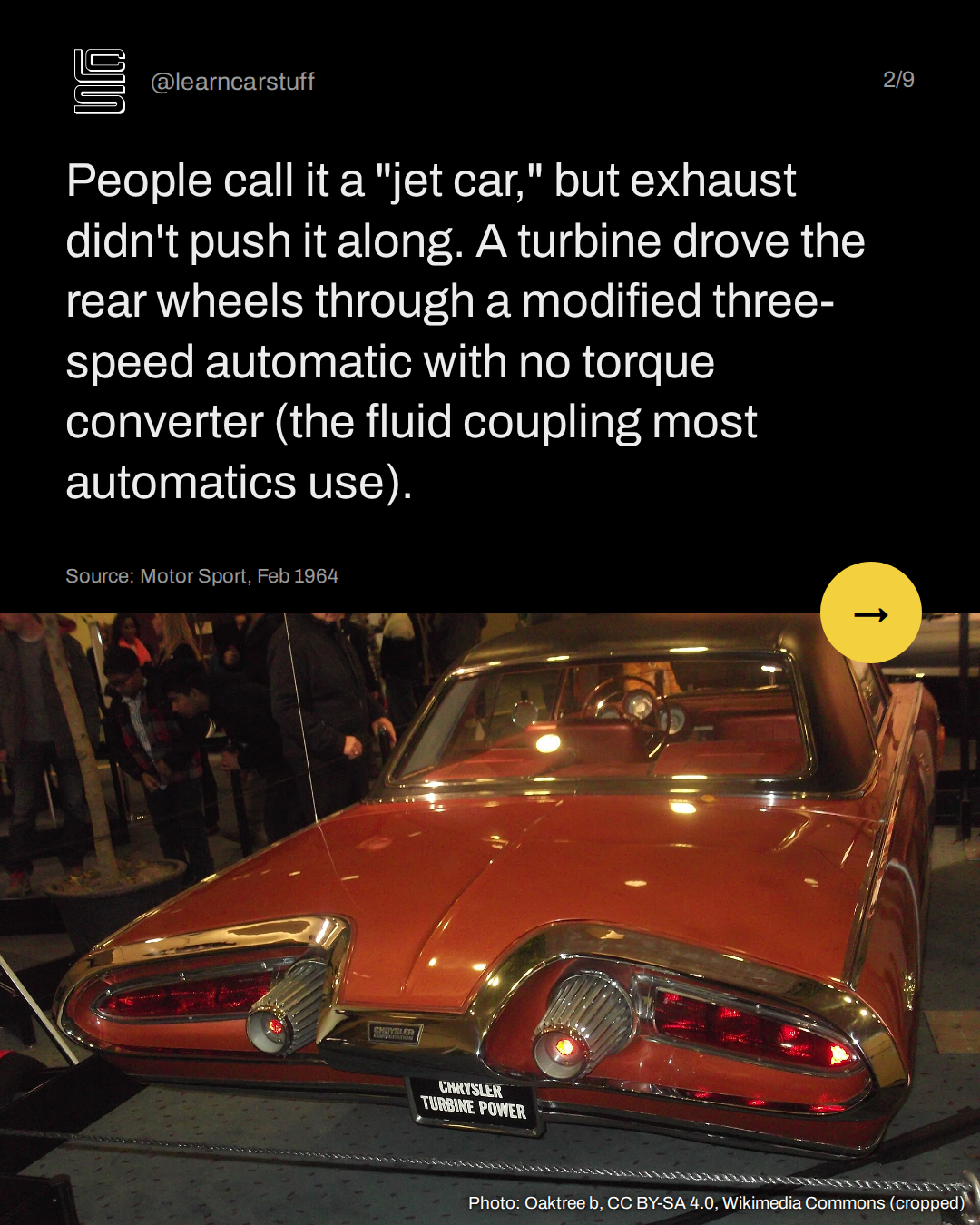
People call it a "jet car," but exhaust didn't push it along. A turbine drove the rear wheels through a modified three-speed automatic with no torque converter (the fluid coupling most automatics use).
Source: Motor Sport, Feb 1964
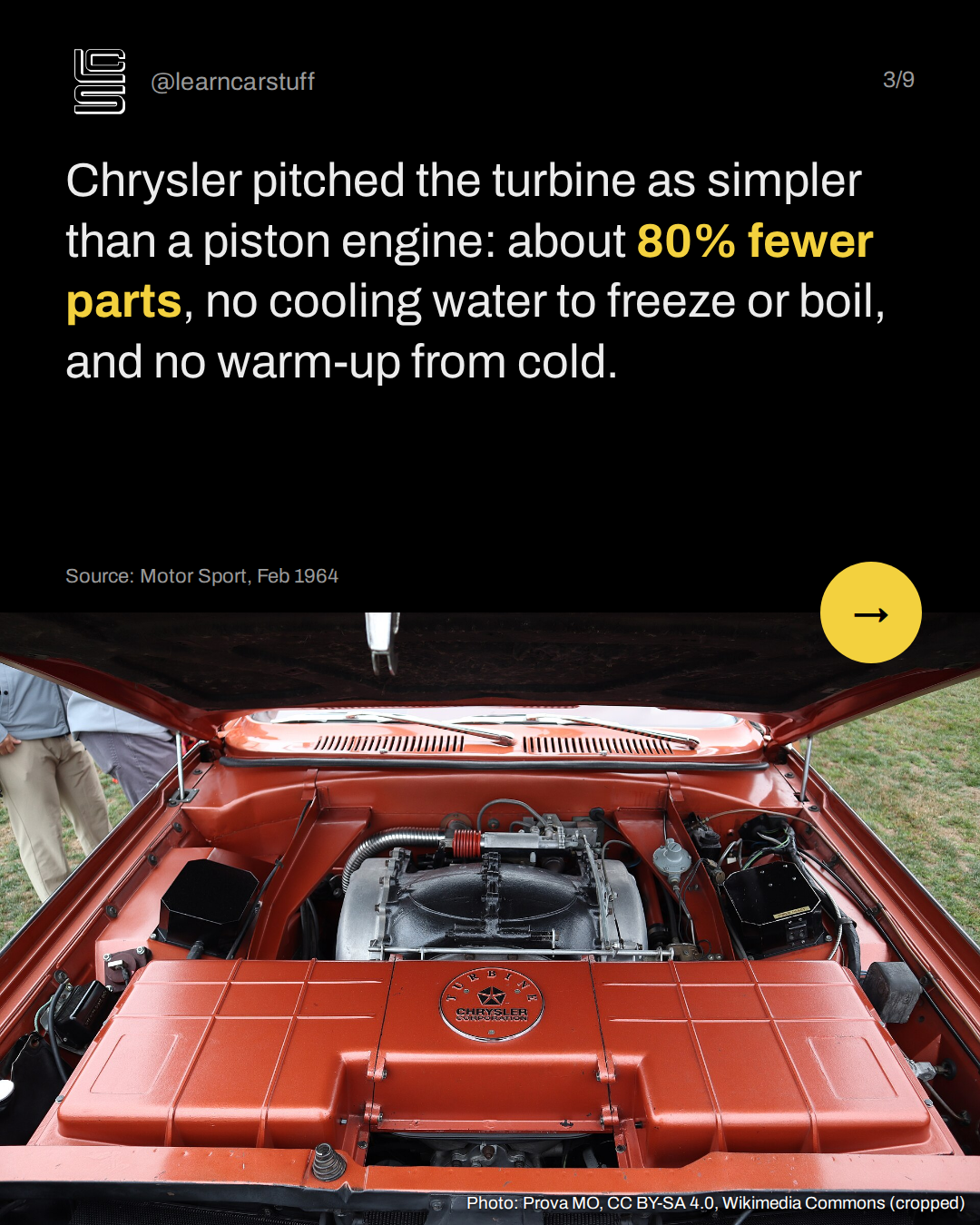
Chrysler pitched the turbine as simpler than a piston engine: about 80% fewer parts, no cooling water to freeze or boil, and no warm-up from cold.
Source: Motor Sport, Feb 1964
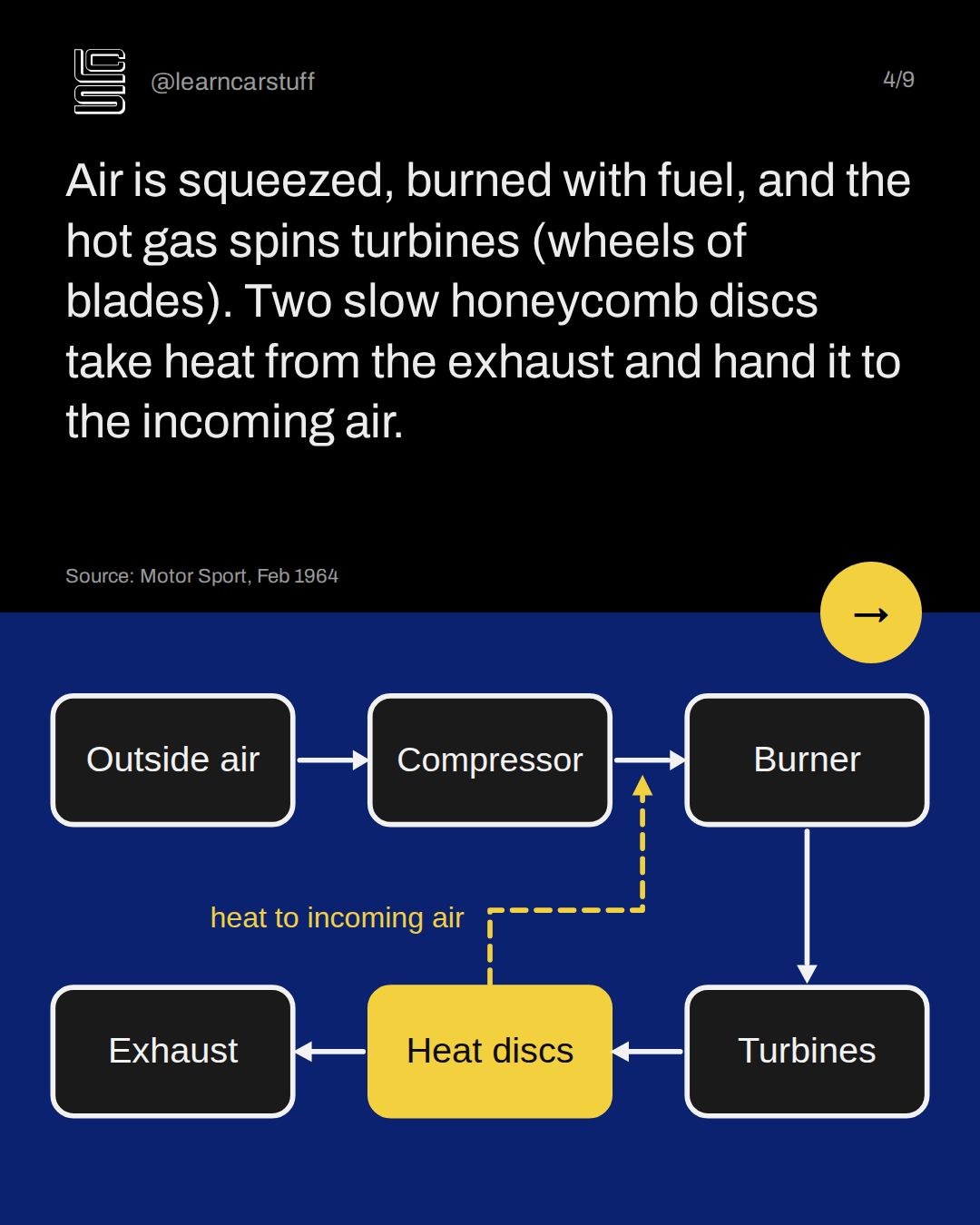
Air is squeezed, burned with fuel, and the hot gas spins turbines (wheels of blades). Two slow honeycomb discs take heat from the exhaust and hand it to the incoming air.
Source: Motor Sport, Feb 1964
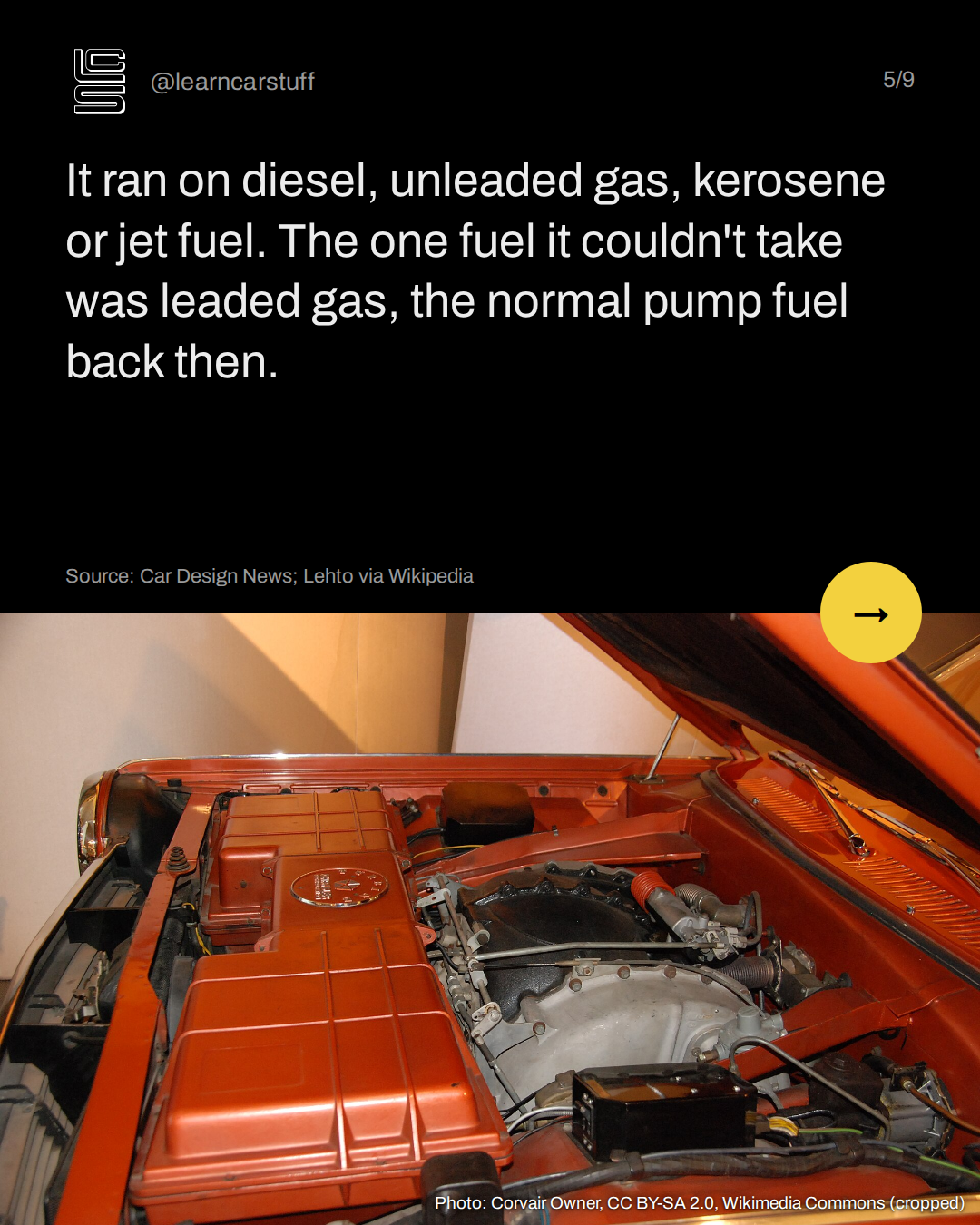
It ran on diesel, unleaded gas, kerosene or jet fuel. The one fuel it couldn't take was leaded gas, the normal pump fuel back then.
Source: Car Design News; Lehto via Wikipedia
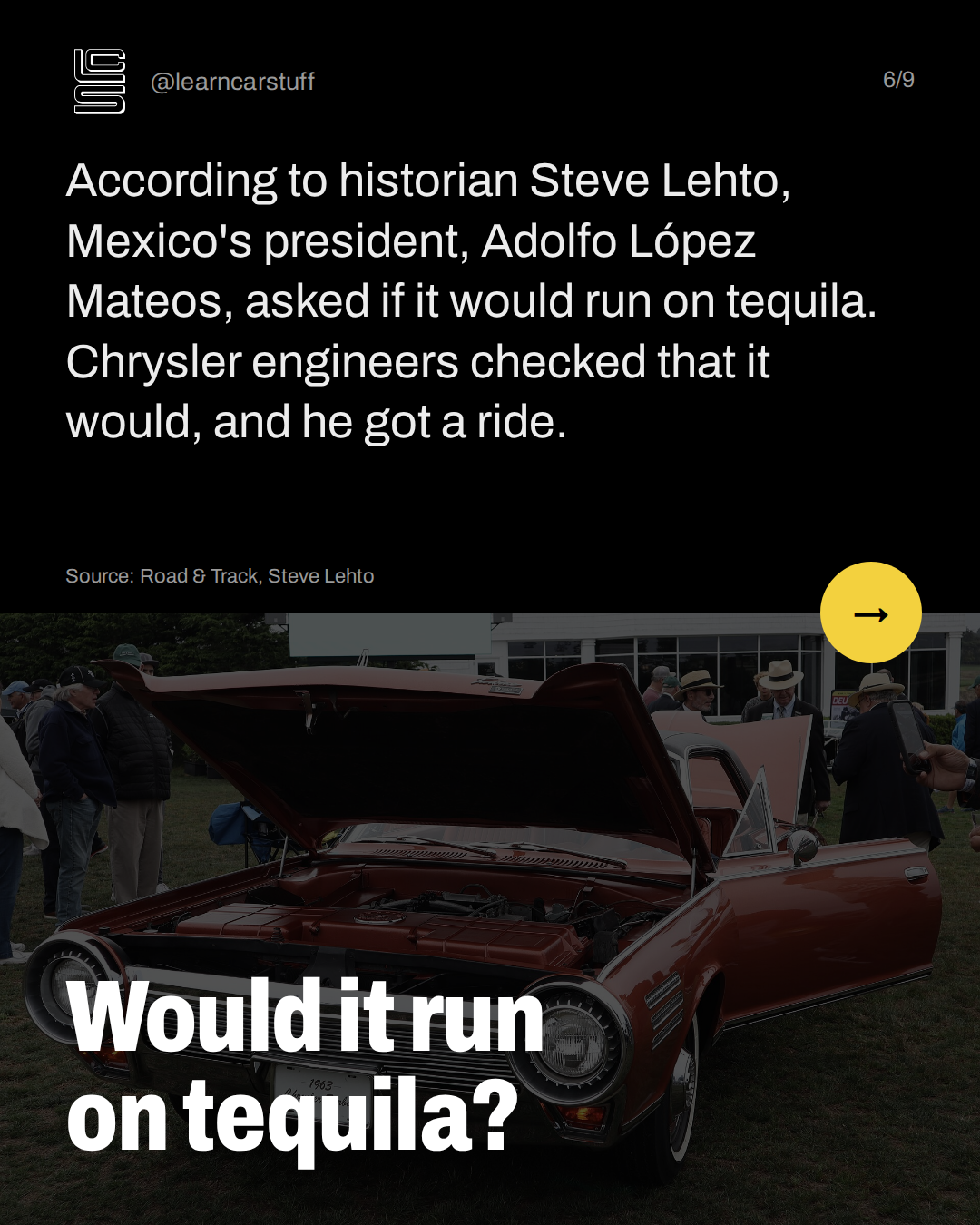
Would it run on tequila?
According to historian Steve Lehto, Mexico's president, Adolfo López Mateos, asked if it would run on tequila. Chrysler engineers checked that it would, and he got a ride.
Source: Road & Track, Steve Lehto
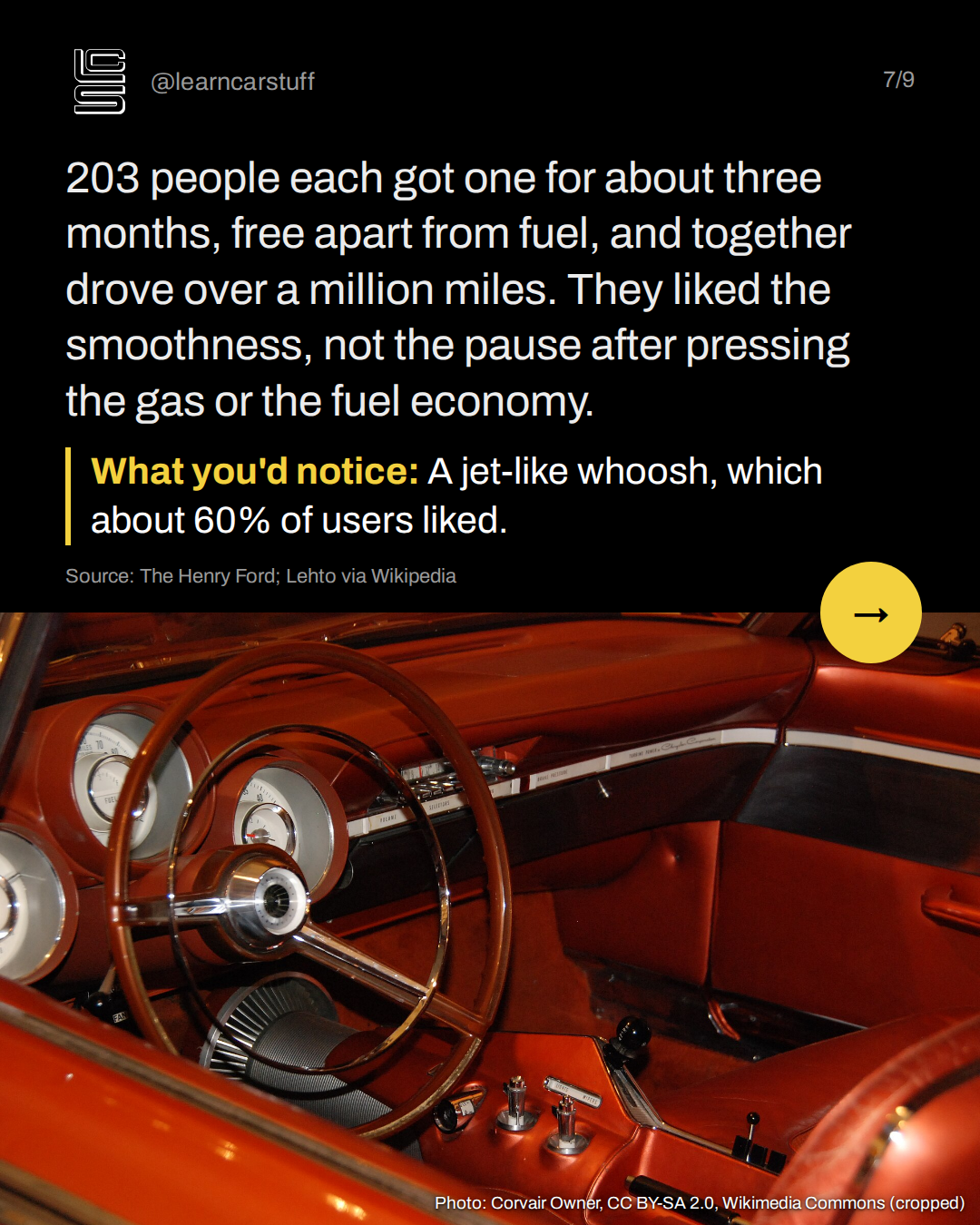
203 people each got one for about three months, free apart from fuel, and together drove over a million miles. They liked the smoothness, not the pause after pressing the gas or the fuel economy.
What you'd notice: A jet-like whoosh, which about 60% of users liked.
Source: The Henry Ford; Lehto via Wikipedia
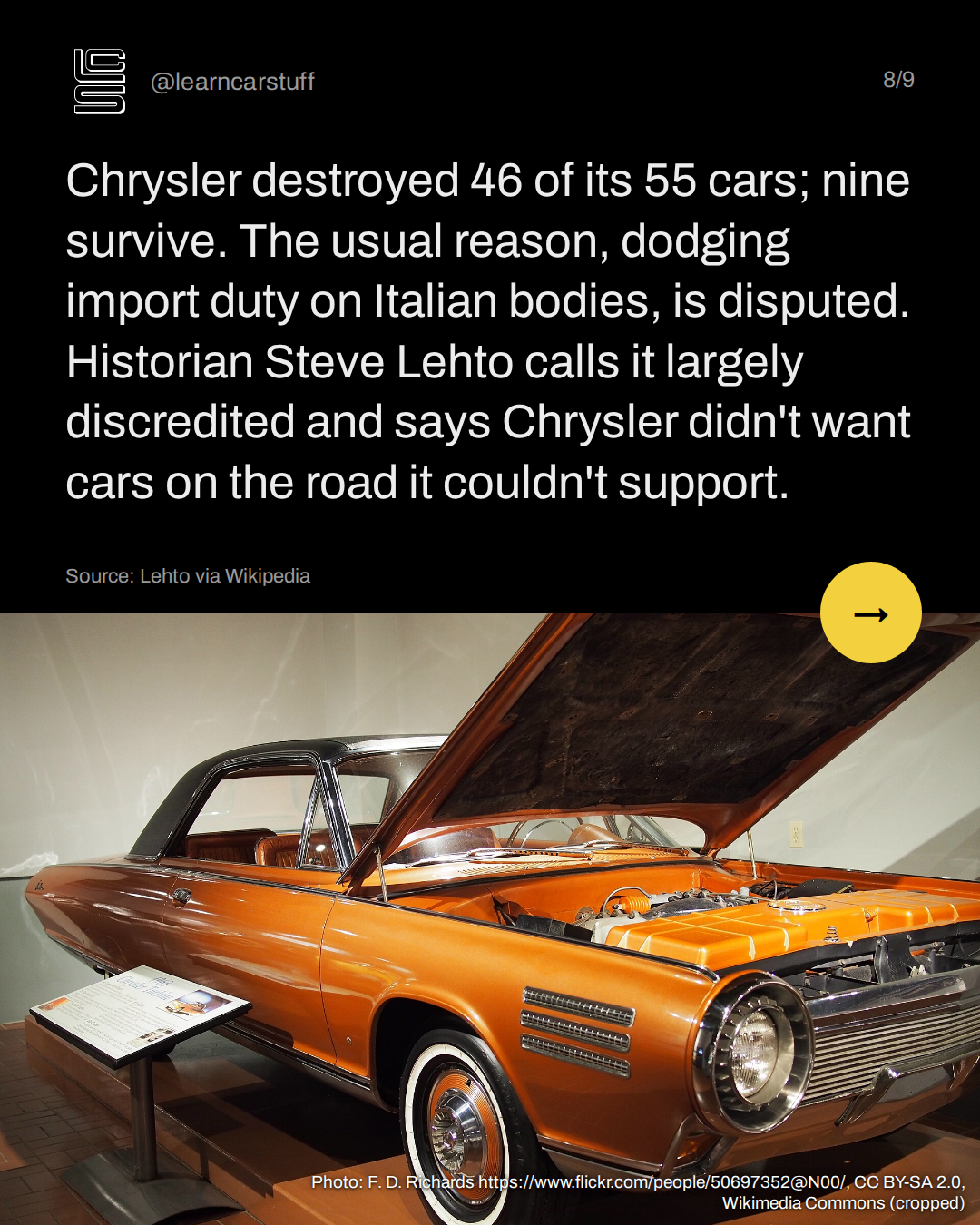
Chrysler destroyed 46 of its 55 cars; nine survive. The usual reason, dodging import duty on Italian bodies, is disputed. Historian Steve Lehto calls it largely discredited and says Chrysler didn't want cars on the road it couldn't support.
Source: Lehto via Wikipedia
Sources and assumptions
- Motor Sport magazine, 'The Chrysler Gas-Turbine Car', Feb 1964 (Bill Boddy): 130 hp at 3,600 rpm output shaft and 425 lb-ft at zero output shaft speed; first-stage turbine max 44,600 rpm; two rotating honeycomb regenerator discs, 90% effective, max 22 rpm; modified TorqueFlite 3-speed without torque converter; compressor and first-stage turbine spin independently of the power turbine; '80% fewer parts'; no cooling water, no warm-up; some drivers complained of poor throttle response; fifty cars for a free-use consumer program; Ghia 4-seat coupe body (checked 2026-10-30)
- The Henry Ford, 1963 Chrysler Gas Turbine Sedan (artifact 33367): Chrysler lent 50 cars to potential customers in 1963; body by Ghia of Turin, engine and chassis by Chrysler; 130 hp regenerative gas turbine; 3-speed automatic; could run on gasoline, diesel, kerosene, even peanut oil; users liked low maintenance and no vibration but complained of sluggish acceleration and poor fuel economy (checked 2026-10-30)
- The Henry Ford, Driver's Guide for the Chrysler Corporation Turbine Car, 1963 (artifact 366685): Same user verdict (low maintenance, no vibration, sluggish acceleration, poor fuel economy); 50 cars distributed to selected drivers (checked 2026-10-30)
- Road & Track, Steve Lehto, 'That Time the President of Mexico Rode in a Turbine Chrysler Fueled by Tequila' (Yahoo Autos syndication): Mexican President Adolfo López Mateos asked if the car would run on tequila; Chrysler engineers tested it and he was given a ride on tequila (checked 2026-10-30)
- Wikipedia, Chrysler Turbine Car (citing Lehto, 'Chrysler's Turbine Car', 2010, and Hyde 2003): 55 built (5 prototypes + 50); user program Oct 1963 to Jan 1966, 203 drivers in 133 cities, more than 1 million miles; ran on diesel, unleaded gasoline, kerosene, JP-4 jet fuel, while leaded gasoline damaged it (Lehto p.36); sound liked by about 60% and disliked by about 20% (Lehto p.118); 46 destroyed, nine survive (Lehto pp.170-171); the import-tariff explanation is 'largely discredited' per Lehto, who cites PR worries about upkeep and engine swaps (Lehto p.121) (checked 2026-10-30)
- Car Design News, Chrysler Turbine (1963): Leaded petrol, the standard fuel of the era, damaged the turbine; about 203 families drove a car for roughly three months; nine survived; Ghia bodies shipped to Chrysler's Detroit plant; Elwood Engel led design (checked 2026-10-30)
Assumptions:
- The '203 drivers' are the people the cars were lent to (Hyde/Lehto via Wikipedia); Car Design News says 'about 203 families'. Use 'drivers' or 'people'.
- The throttle-lag explanation (the compressor's turbine must spin up before the power turbine gets a strong push) is a simplified reading of Motor Sport's description of independently spinning turbines; keep it 'roughly'.
- Tequila story comes from Steve Lehto (Road & Track); present it as the story Lehto tells, not as a Chrysler document.
- Why the cars were destroyed is disputed; the import-duty reason is presented only as the popular explanation.
- No exact mpg figure: sources differ (around 11 vs about 13), so slides say 'poor fuel economy'.
Photos:
- Photo: Prova MO, CC BY-SA 4.0, Wikimedia Commons (cropped)
- Photo: Prova MO, CC BY-SA 4.0, Wikimedia Commons (cropped)
- Photo: F. D. Richards https://www.flickr.com/people/50697352@N00/, CC BY-SA 2.0, Wikimedia Commons (cropped)
- Photo: Corvair Owner, CC BY-SA 2.0, Wikimedia Commons (cropped)
- Photo: Corvair Owner, CC BY-SA 2.0, Wikimedia Commons (cropped)
- Photo: Oaktree b, CC BY-SA 4.0, Wikimedia Commons (cropped)
The short version
- No pistons, just spinning turbines
- Diesel, kerosene or jet fuel, but not leaded gas
- Smooth to drive, slow to respond
- Chrysler destroyed 46 of 55