 Learn Car Stuff
Why does a Lancia Stratos have a Ferrari engine?
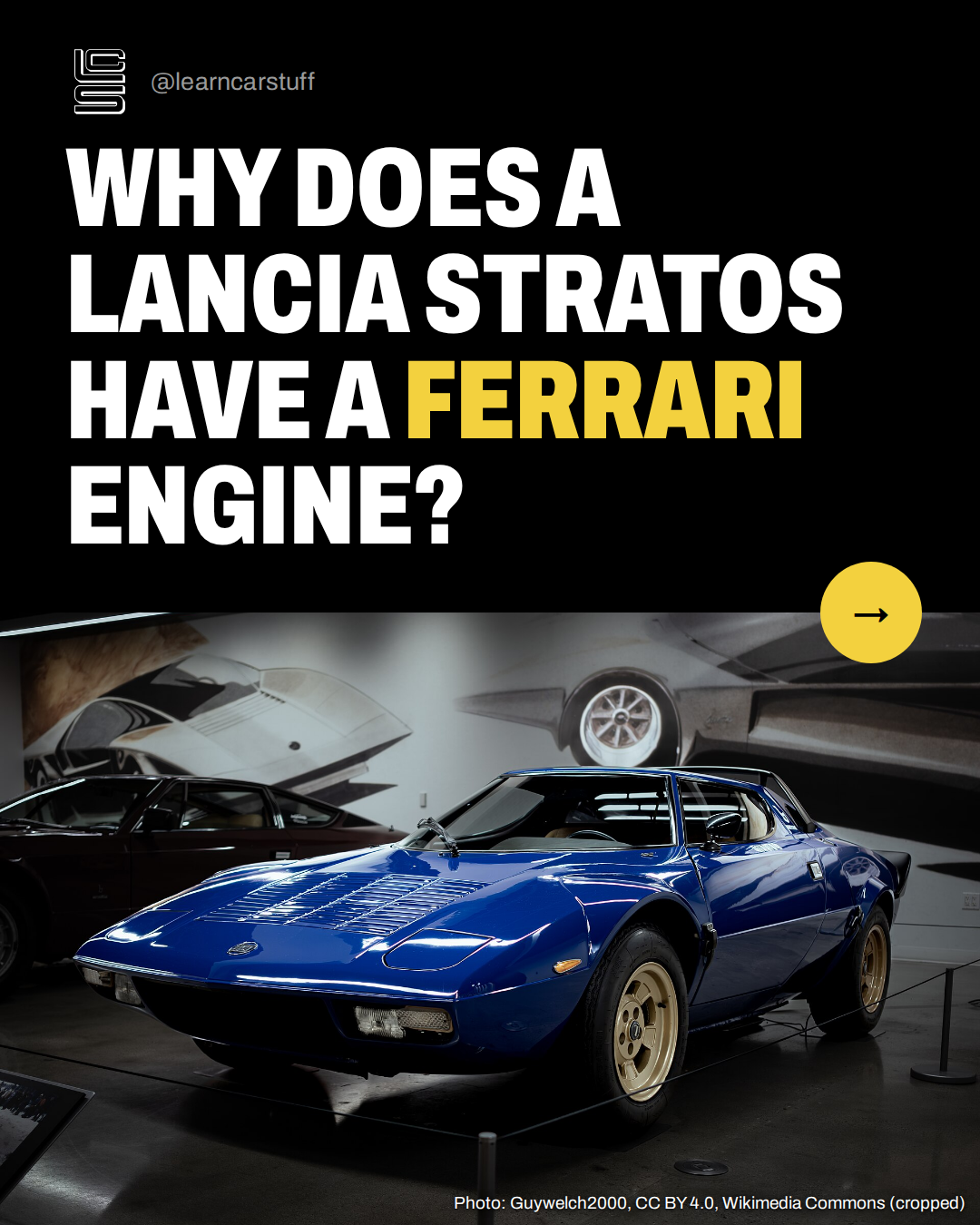
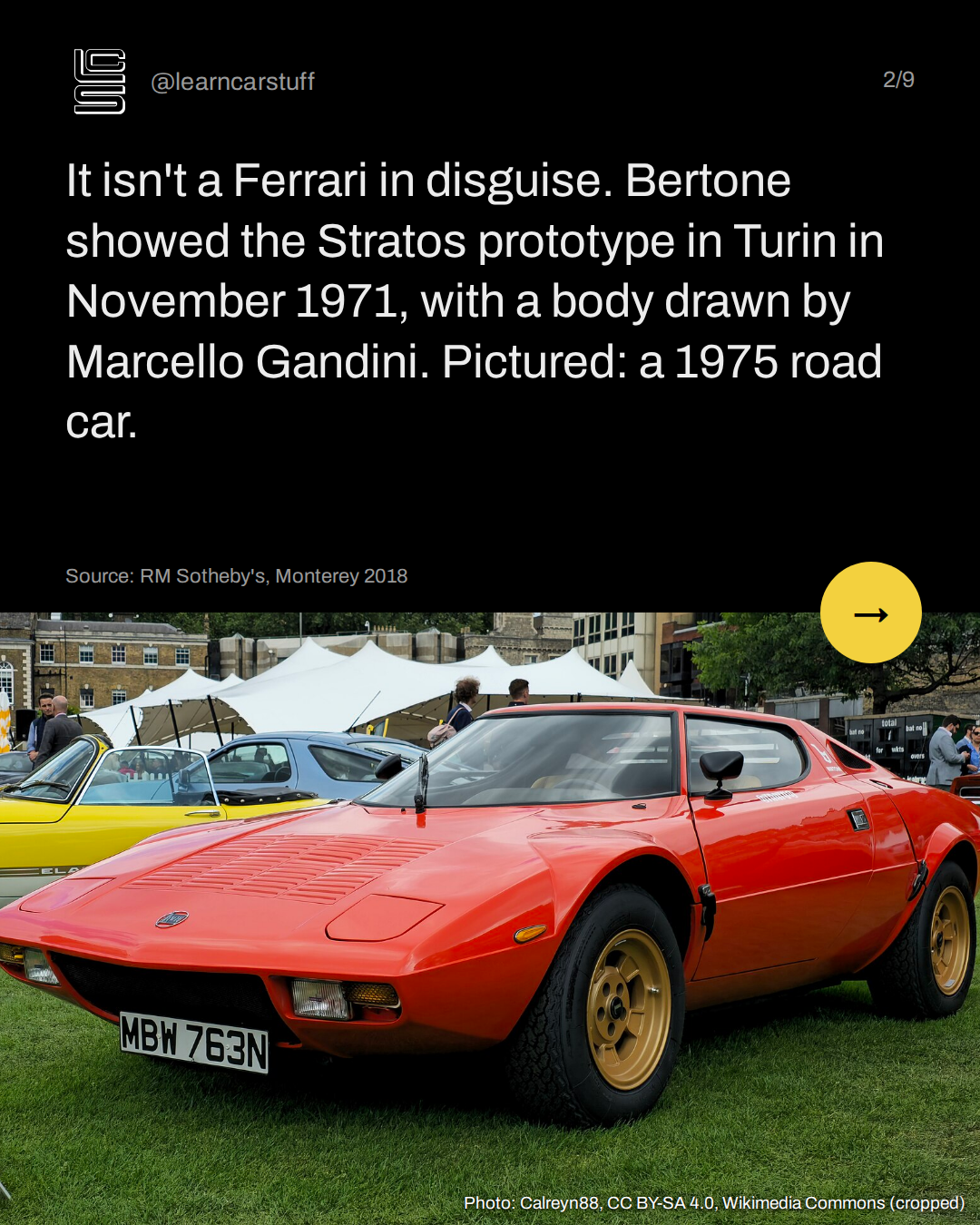
It isn't a Ferrari in disguise. Bertone showed the Stratos prototype in Turin in November 1971, with a body drawn by Marcello Gandini. Pictured: a 1975 road car.
Source: RM Sotheby's, Monterey 2018
A new car needed more muscle
Lancia's rally car, the Fulvia, had a 1.6-liter V4 (four cylinders in a narrow V). A new car needed more muscle, and Cesare Fiorio, Lancia's rally boss, had his eye on the 2.4-liter V6 from Ferrari's Dino 246 GT.
Source: Motor Sport, March 2007
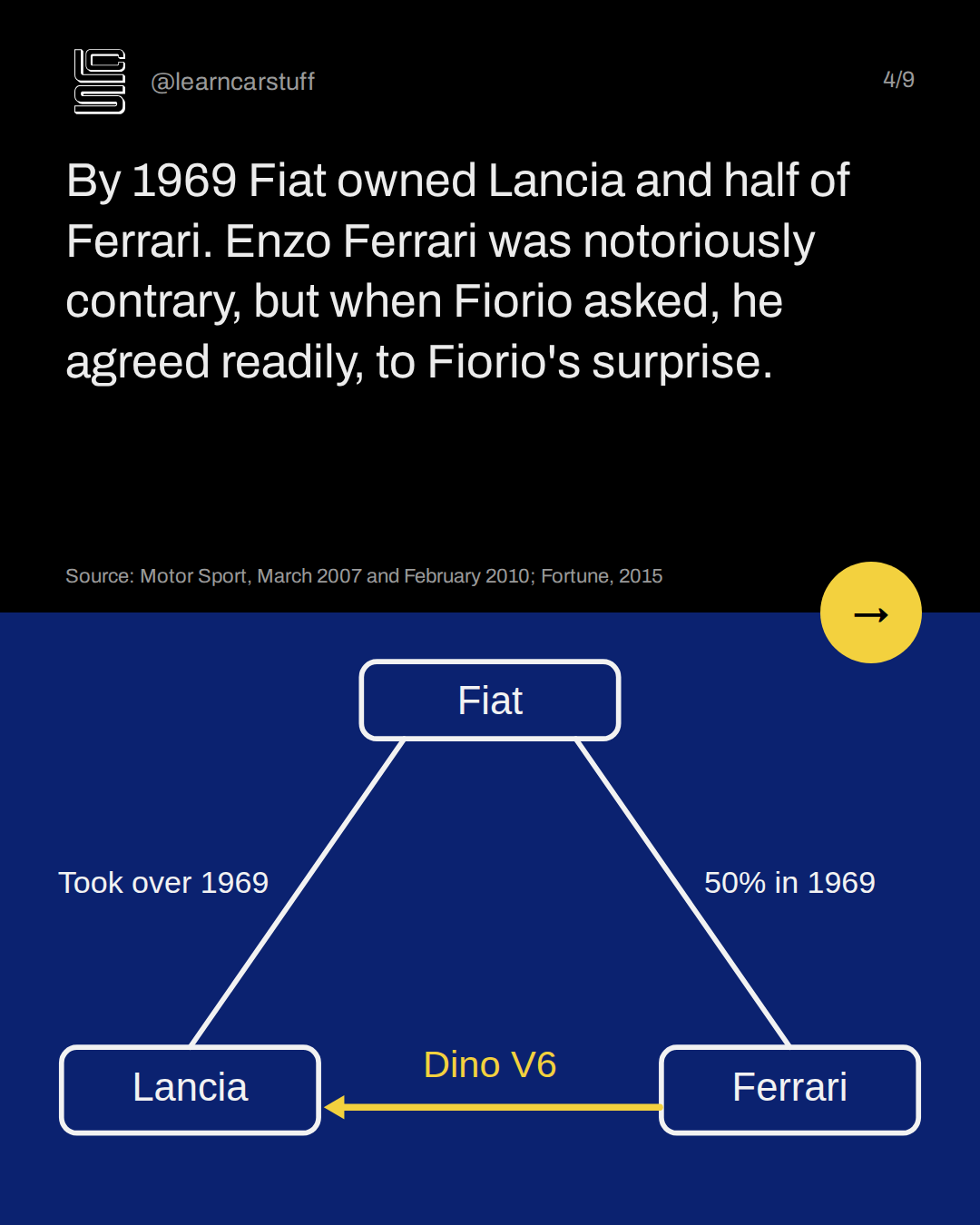
By 1969 Fiat owned Lancia and half of Ferrari. Enzo Ferrari was notoriously contrary, but when Fiorio asked, he agreed readily, to Fiorio's surprise.
Source: Motor Sport, March 2007 and February 2010; Fortune, 2015
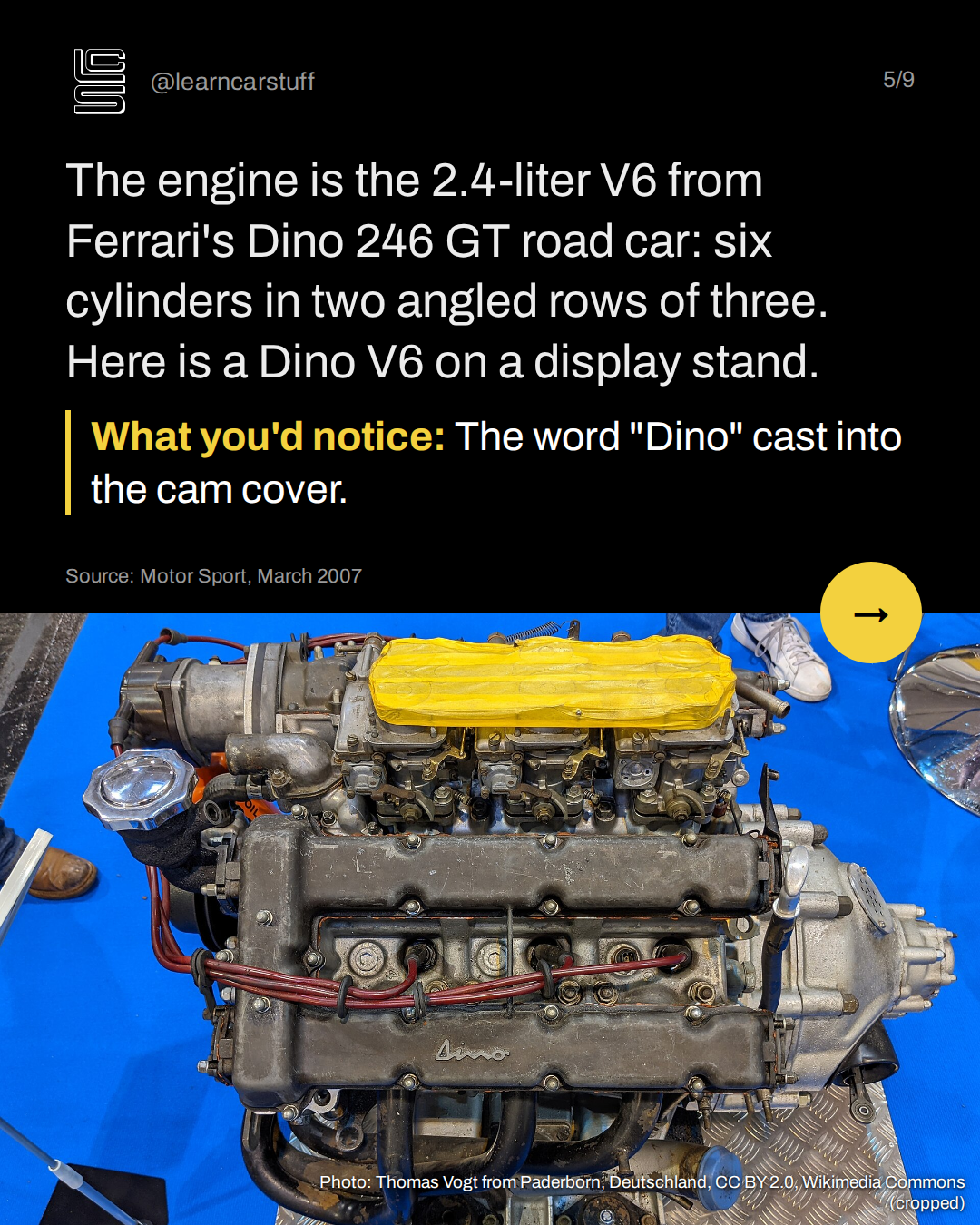
The engine is the 2.4-liter V6 from Ferrari's Dino 246 GT road car: six cylinders in two angled rows of three. Here is a Dino V6 on a display stand.
What you'd notice: The word "Dino" cast into the cam cover.
Source: Motor Sport, March 2007
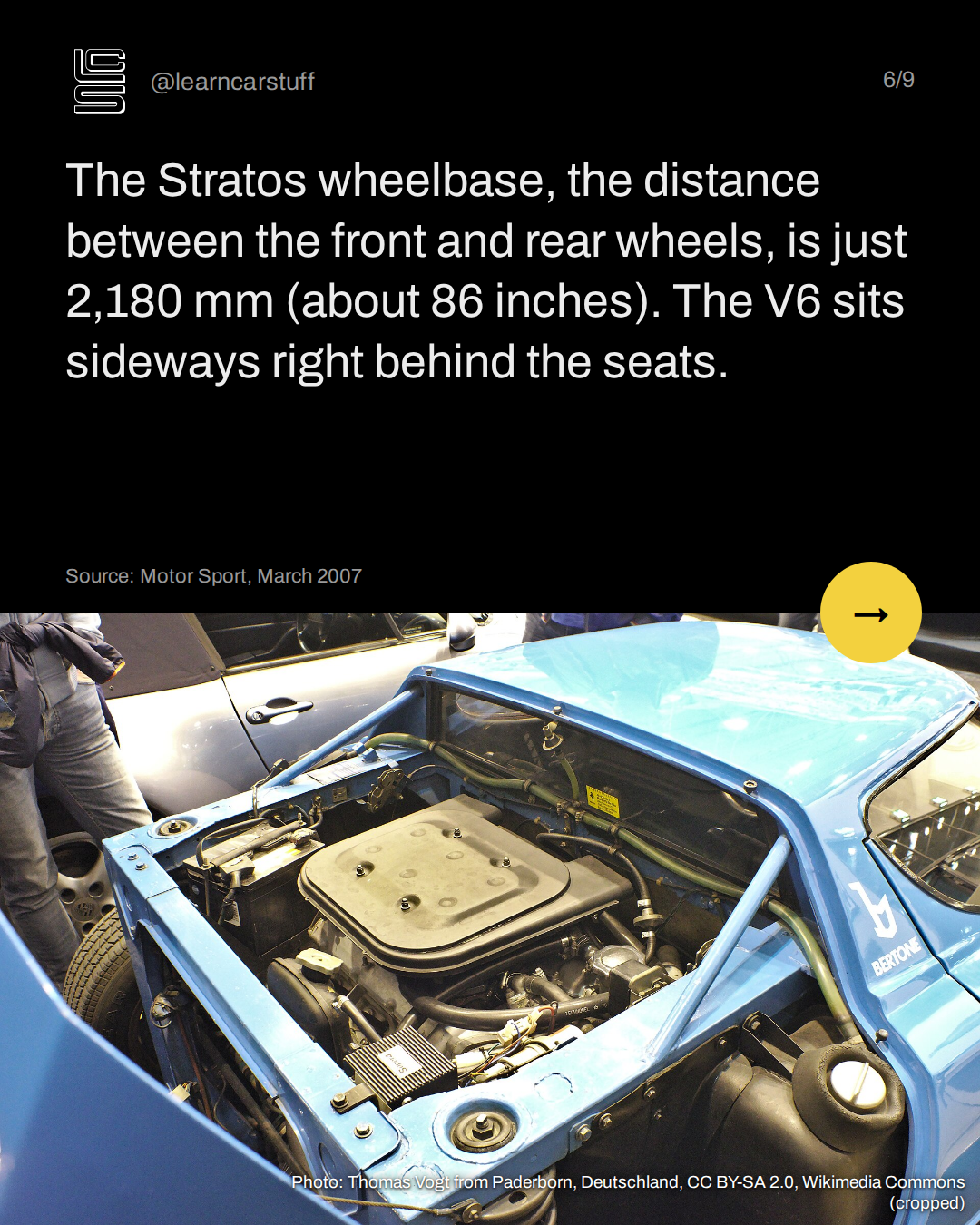
The Stratos wheelbase, the distance between the front and rear wheels, is just 2,180 mm (about 86 inches). The V6 sits sideways right behind the seats.
Source: Motor Sport, March 2007
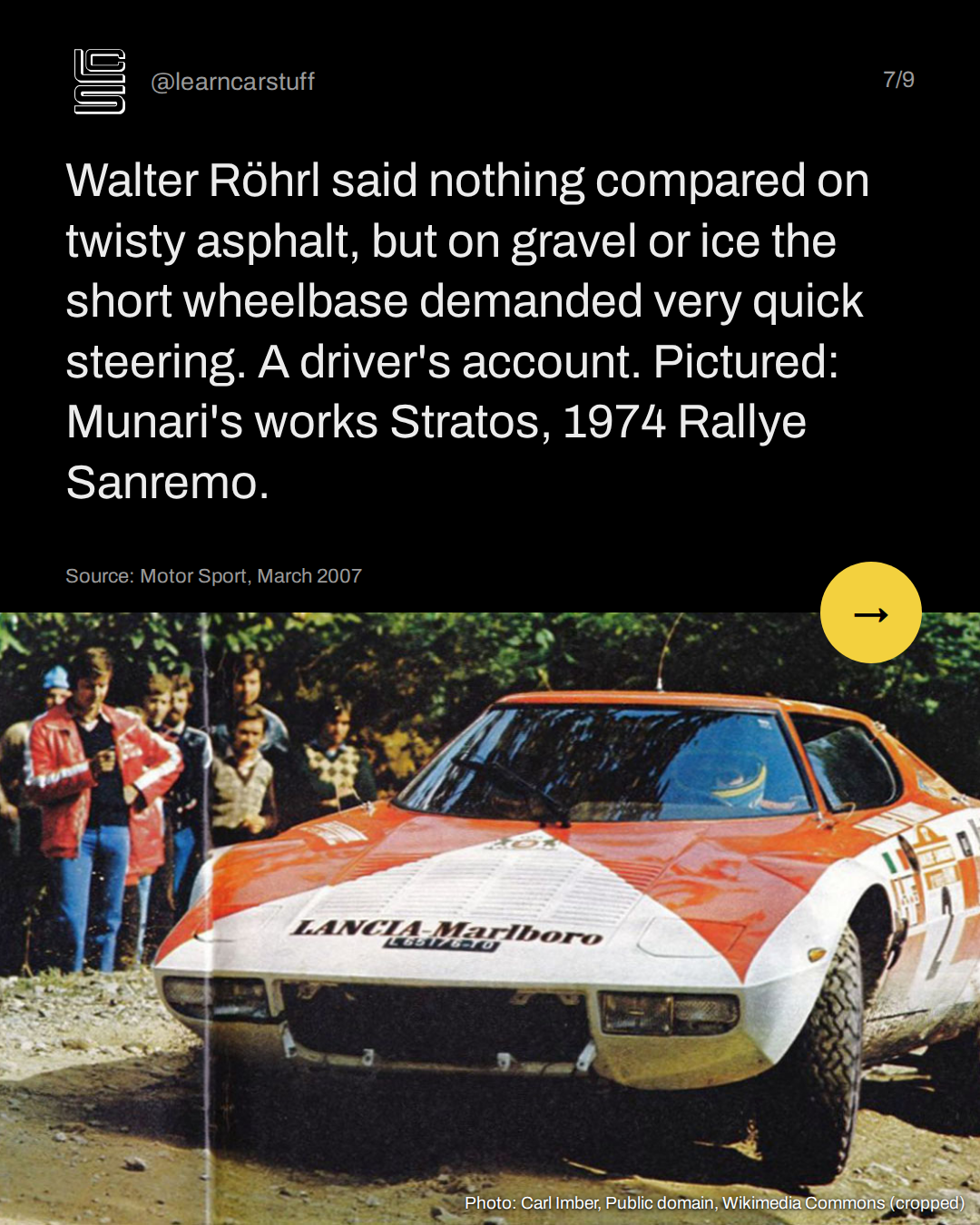
Walter Röhrl said nothing compared on twisty asphalt, but on gravel or ice the short wheelbase demanded very quick steering. A driver's account. Pictured: Munari's works Stratos, 1974 Rallye Sanremo.
Source: Motor Sport, March 2007
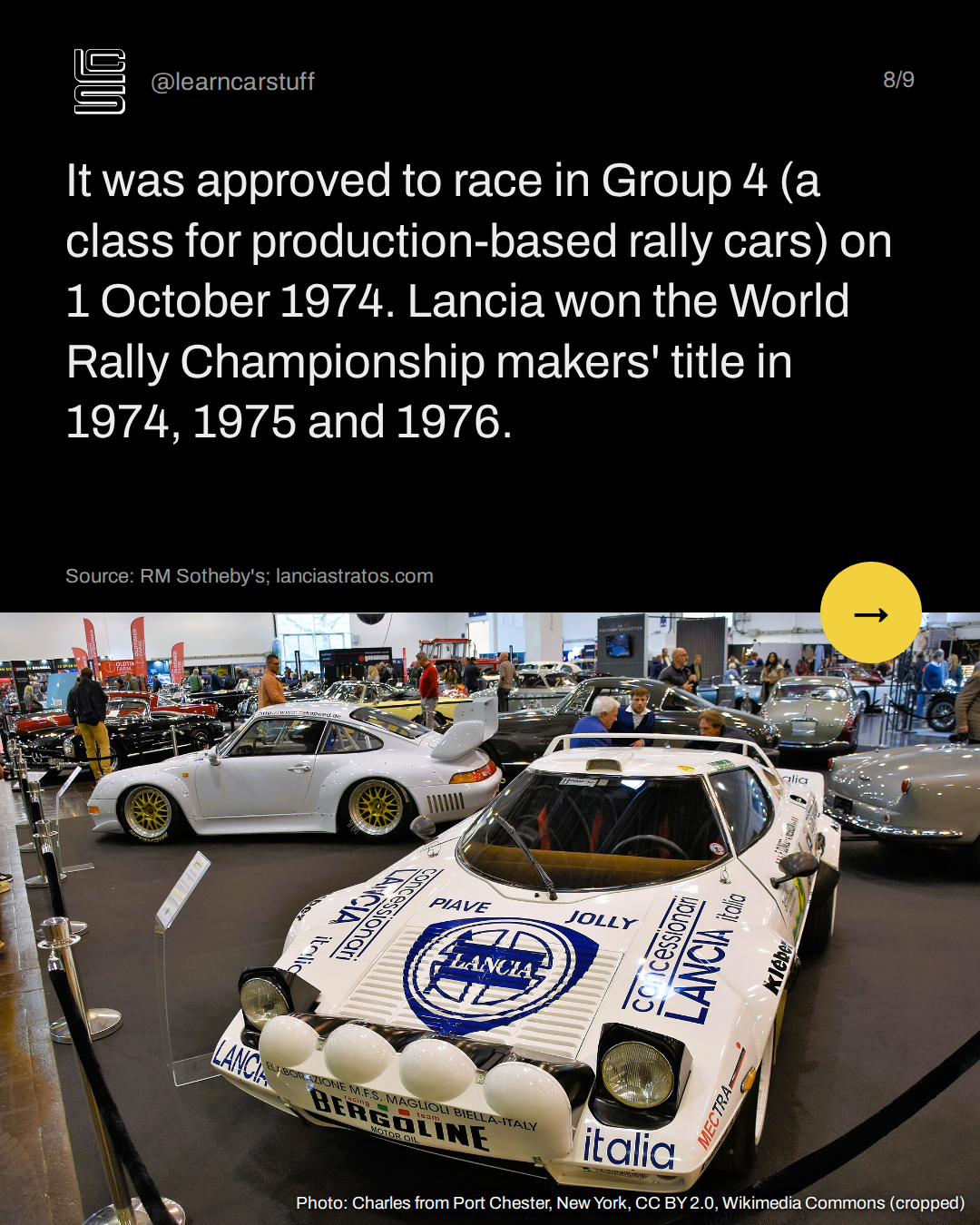
It was approved to race in Group 4 (a class for production-based rally cars) on 1 October 1974. Lancia won the World Rally Championship makers' title in 1974, 1975 and 1976.
Source: RM Sotheby's; lanciastratos.com
Sources and assumptions
- Motor Sport magazine, 'Profile: Lancia Stratos' (March 2007): The 1600cc Fulvia V4 lacked muscle; Fiorio wanted the 2418cc V6 from the Ferrari Dino 246 GT; Fiat absorbed Lancia in October 1969; Fiorio: Enzo never gave engines outside Ferrari, 'there is no proper engine in the Fiat group'; 2180mm wheelbase, transverse V6; Röhrl: nothing compared on twisty asphalt, but on gravel or ice the short wheelbase meant you had to be really fast; Group 4 homologation by 1 October 1974 (checked 2026-10-30)
- Motor Sport magazine, 'Lancia Stratos' (February 2010): Fiorio was smitten with the Dino's compact V6; Enzo agreed readily, to Fiorio's surprise; stories of the car being evil to drive because of too much power and a short wheelbase 'aren't strictly true'; Fiat's marketing people later preferred a Fiat product (checked 2026-10-30)
- RM Sotheby's, 1974 Lancia Stratos HF Stradale by Bertone (Monterey 2018): The rally car used a 2.4-liter Ferrari Dino V6 instead of the Zero's Fulvia drivetrain; the Stratos HF was shown at the Turin Motor Show in November 1971; only 183 were built by the end of 1974, but Group 4 homologation was confirmed on 1 October 1974; around 492 were built in total (checked 2026-10-30)
- Lancia Stratos registry history (lanciastratos.com): The Zero concept (Fulvia engine) shown in Turin in 1970; the 1971 Turin car had the Dino V6 mid-mounted; on 2 February 1972 Enzo Ferrari committed to 500 Dino engines, deal finalized 14 December 1972 after Fiat lifted its resistance; Bertone conceived it, Gandini designed the body, Fiorio championed it; WRC titles in 1974, 1975 and 1976; Group 4 on 1 October 1974 (checked 2026-10-30)
- Fortune, 'Fiat Ferrari IPO' (2015-10-12): Fiat has owned part of Ferrari since 1969, when it bought a 50% stake (checked 2026-10-30)
- Motor1.com Legends: 1974 Lancia Stratos: World Rally Championship titles in 1974, 1975 and 1976; deal struck with Ferrari to supply the Dino V6; road cars built to homologate the car (checked 2026-10-30)
Assumptions:
- 'World Rally Championship title' means the makers' (manufacturers') championship. There was no drivers' world championship until 1977.
- 'About 492 built' is RM Sotheby's figure ('somewhere around 492'). Exact counts vary by source, so the slide says 'about'.
- No horsepower figure is used: sources give 188, 190 or 195 hp for different variants and markets, so the brief's exact-variant rule rules them out.
- Enzo's attitude is reported differently. Fiorio, in Motor Sport, says he agreed on the spot; the registry says Fiat resisted until December 1972. Other web lore says Ferrari waited until Dino production ended; I couldn't verify that, so it's left out. The slide says Ferrari usually kept engines in-house and agreed after Fiorio's pitch.
- Handling claims are drivers' and journalists' accounts (Röhrl, Motor Sport), labeled as such, not measured data.
- The wheelbase of 2,180 mm (about 85.8 in) comes from Motor Sport's specs for the production Stratos.
Photos:
- Photo: Calreyn88, CC BY-SA 4.0, Wikimedia Commons (cropped)
- Photo: Guywelch2000, CC BY 4.0, Wikimedia Commons (cropped)
- Photo: Thomas Vogt from Paderborn, Deutschland, CC BY-SA 2.0, Wikimedia Commons (cropped)
- Photo: Thomas Vogt from Paderborn, Deutschland, CC BY 2.0, Wikimedia Commons (cropped)
- Photo: Carl Imber, Public domain, Wikimedia Commons (cropped)
- Photo: Charles from Port Chester, New York, CC BY 2.0, Wikimedia Commons (cropped)
The short version
- Fiat owned Lancia and half of Ferrari.
- Lancia needed more power than the Fulvia V4.
- Fiorio pitched Enzo Ferrari for the Dino V6.
- Three makers' titles followed, 1974 to 1976.