 Learn Car Stuff
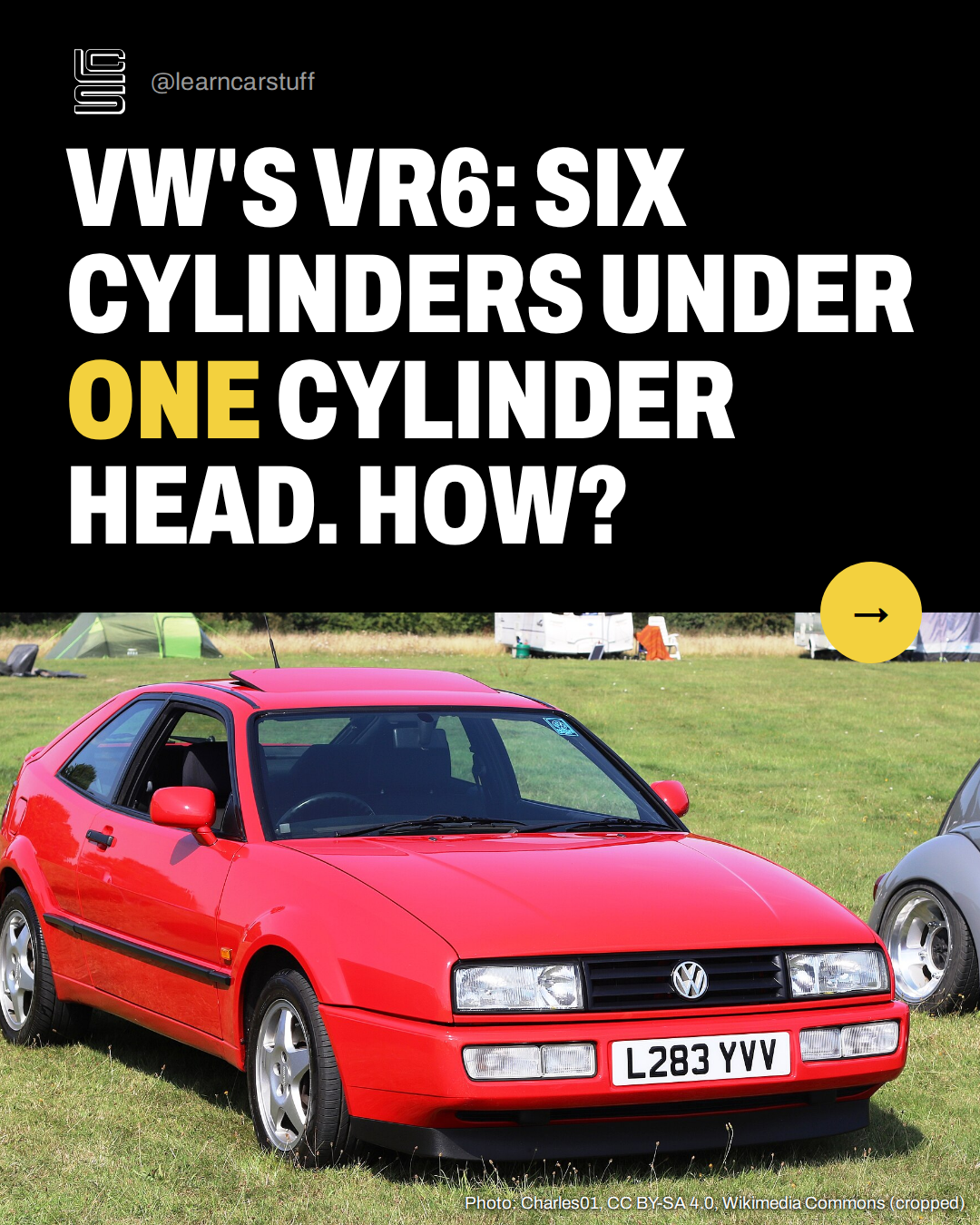
VW's VR6: six cylinders under one cylinder head. How?
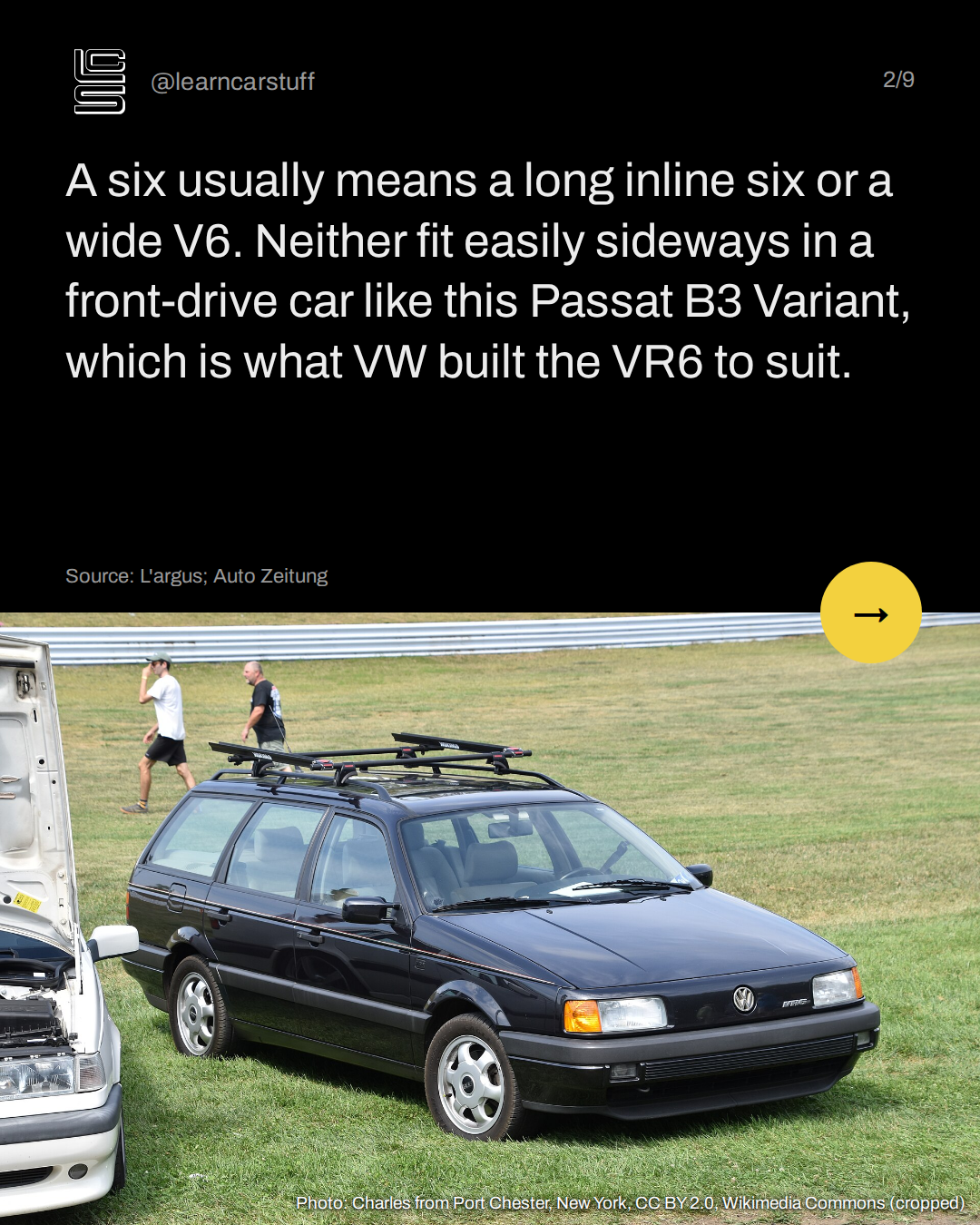
A six usually means a long inline six or a wide V6. Neither fit easily sideways in a front-drive car like this Passat B3 Variant, which is what VW built the VR6 to suit.
Source: L'argus; Auto Zeitung
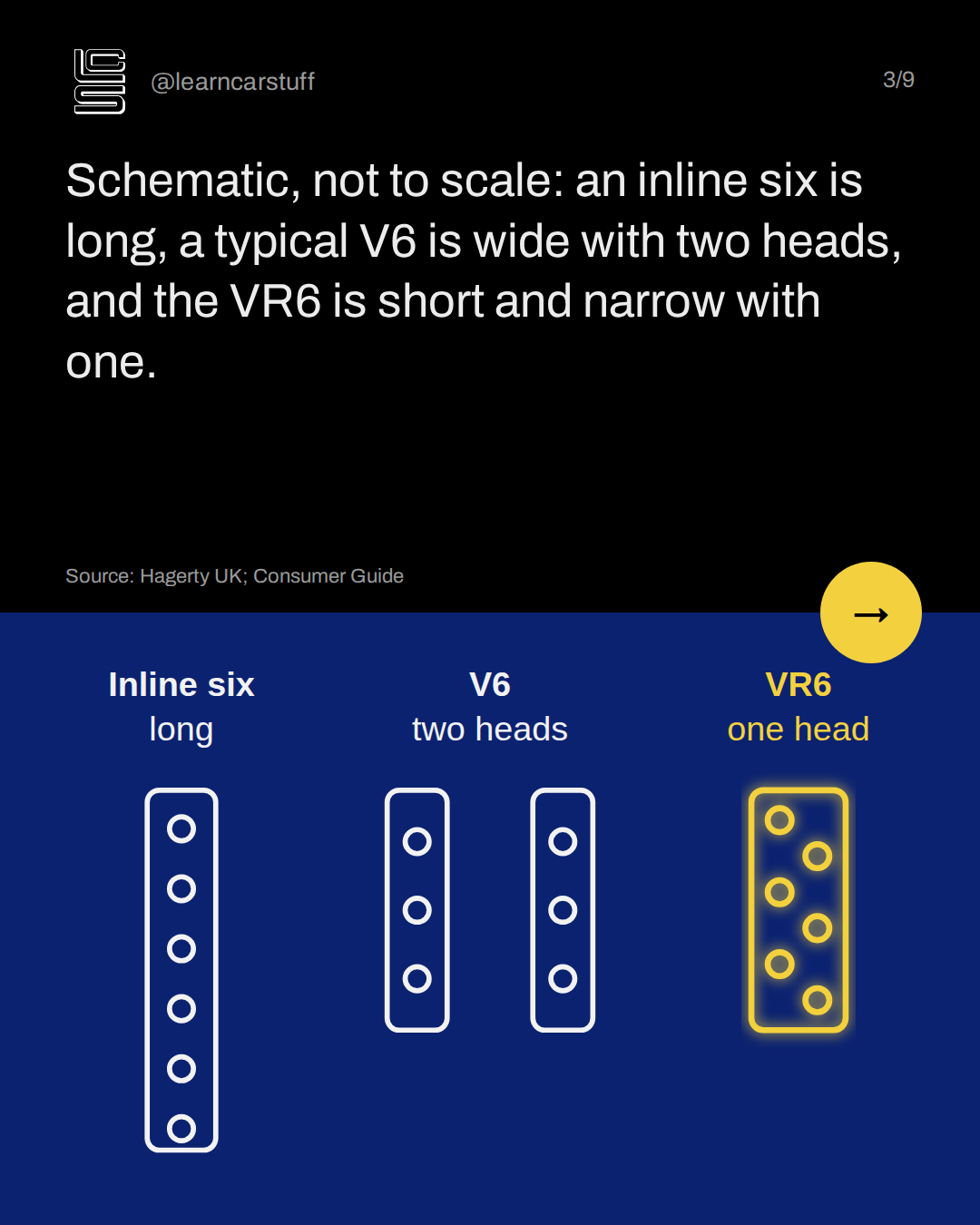
Schematic, not to scale: an inline six is long, a typical V6 is wide with two heads, and the VR6 is short and narrow with one.
Source: Hagerty UK; Consumer Guide
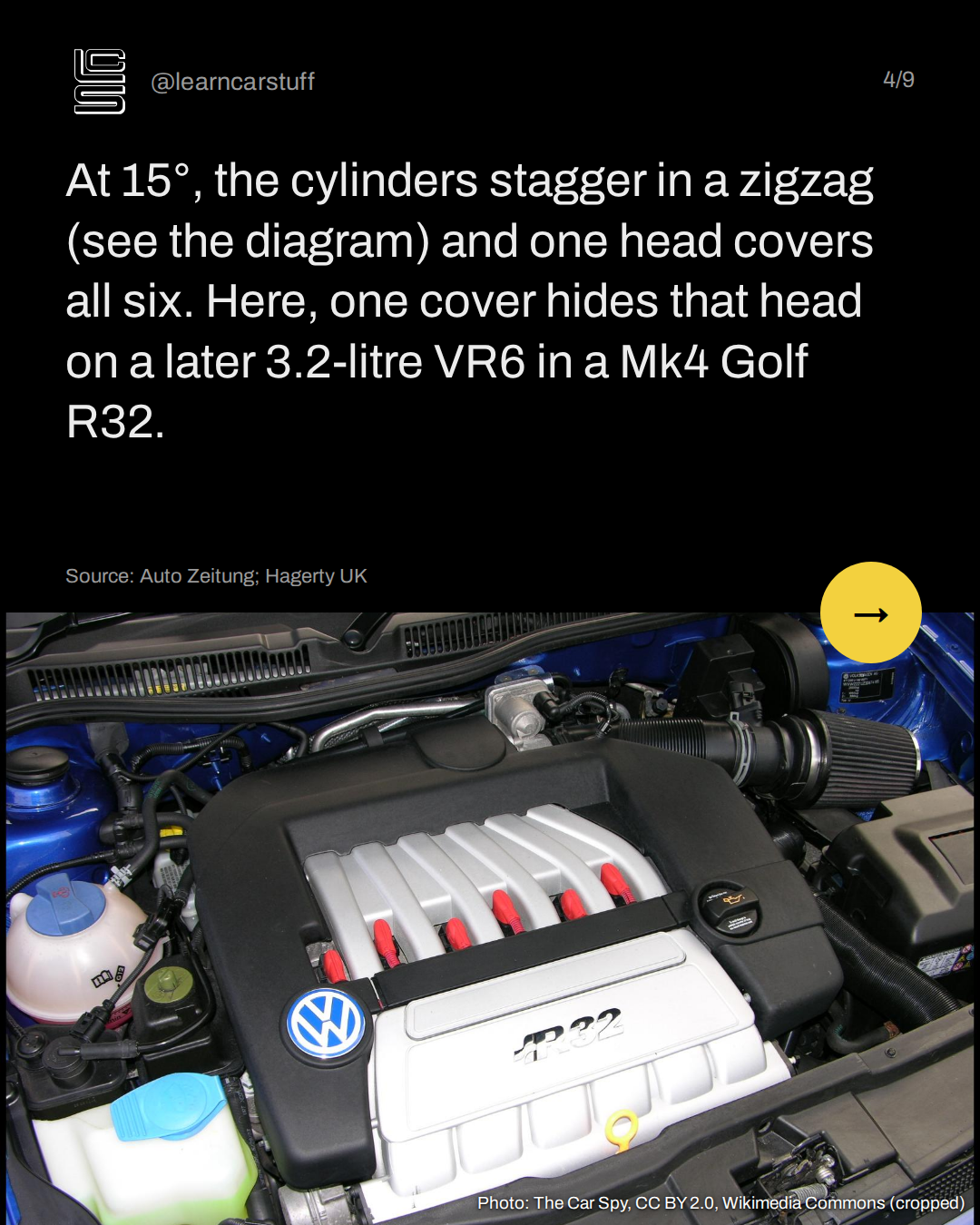
At 15°, the cylinders stagger in a zigzag (see the diagram) and one head covers all six. Here, one cover hides that head on a later 3.2-litre VR6 in a Mk4 Golf R32.
Source: Auto Zeitung; Hagerty UK
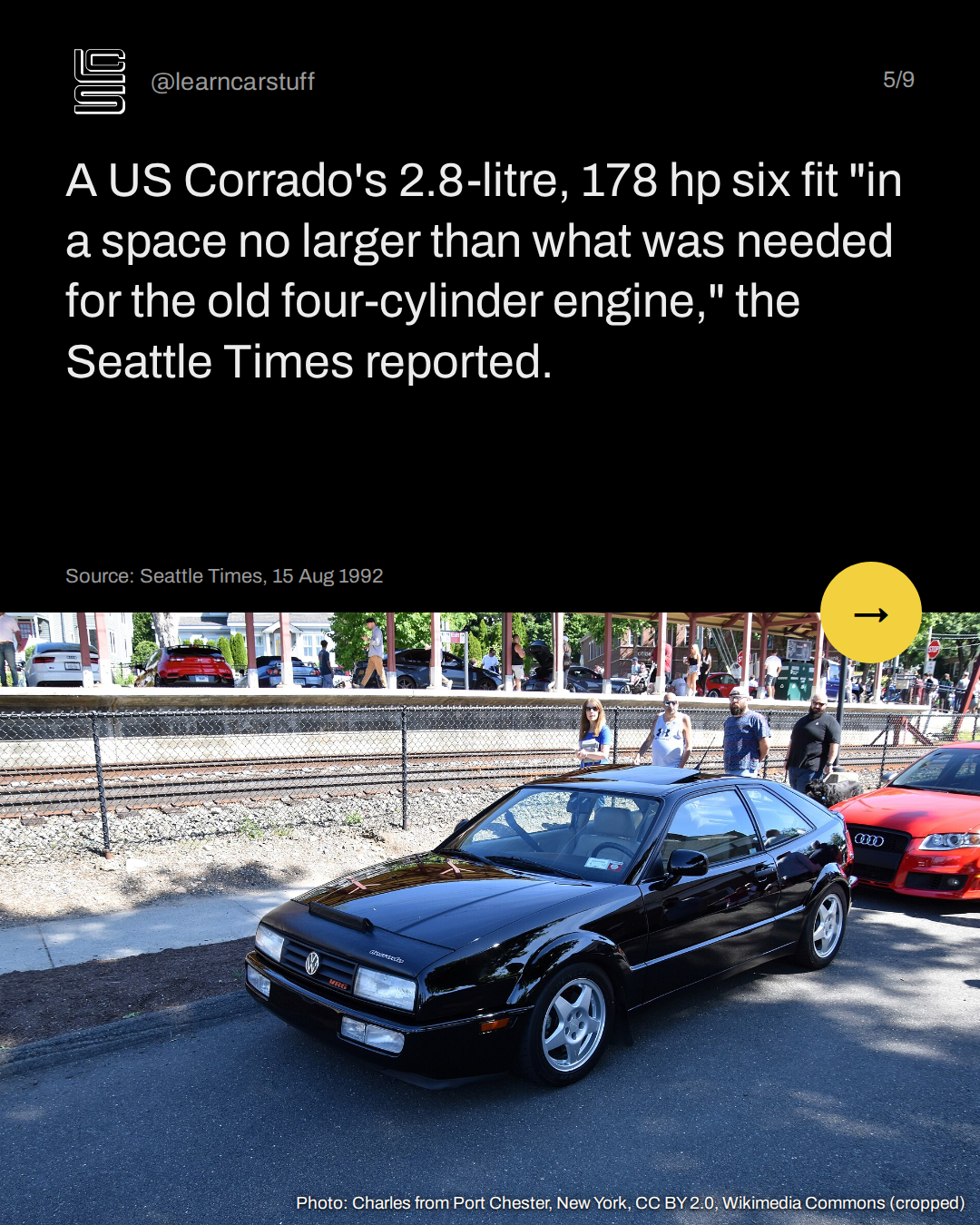
A US Corrado's 2.8-litre, 178 hp six fit "in a space no larger than what was needed for the old four-cylinder engine," the Seattle Times reported.
Source: Seattle Times, 15 Aug 1992
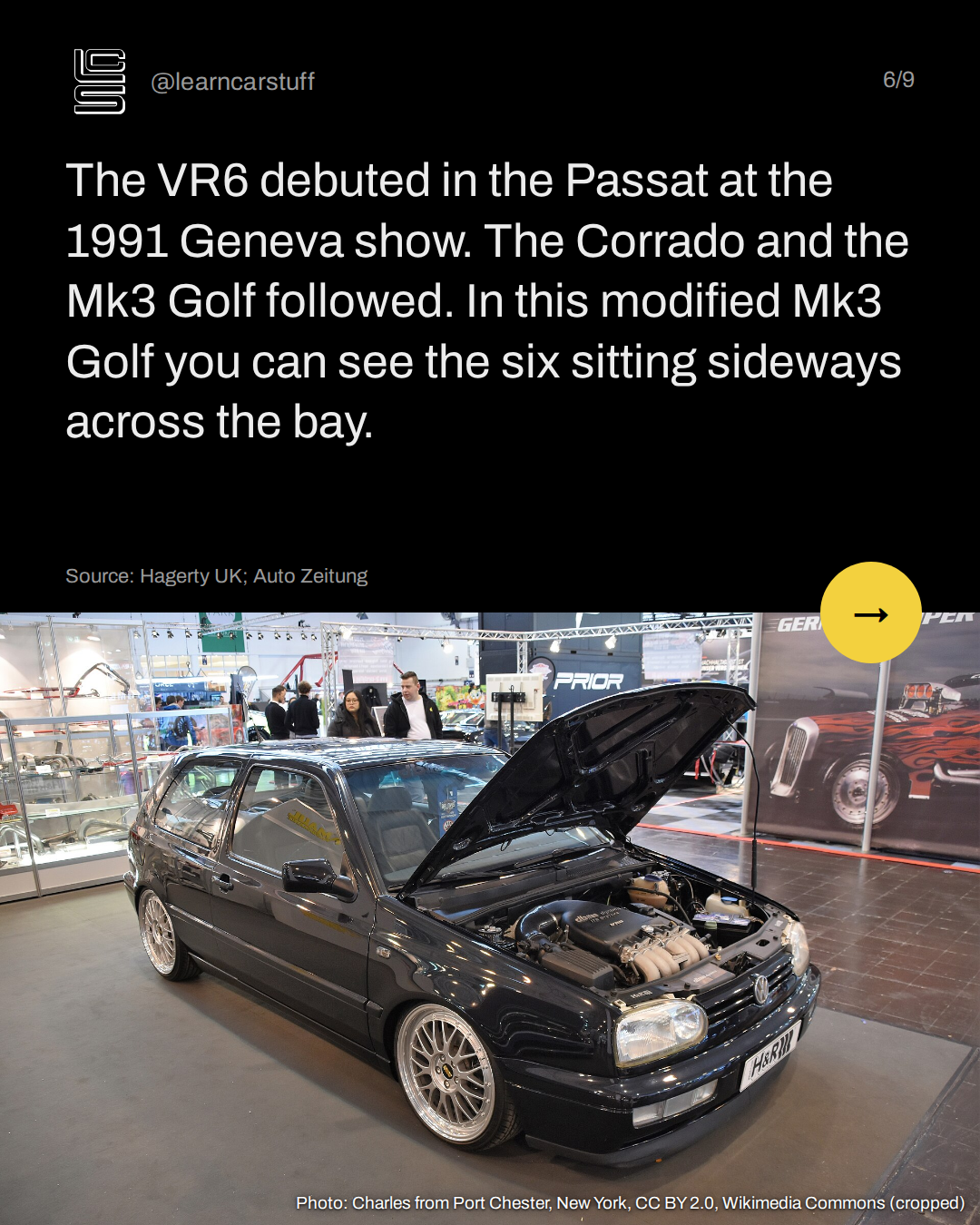
The VR6 debuted in the Passat at the 1991 Geneva show. The Corrado and the Mk3 Golf followed. In this modified Mk3 Golf you can see the six sitting sideways across the bay.
Source: Hagerty UK; Auto Zeitung
What does VR actually stand for?
VR is usually read as V-Motor plus Reihenmotor, German for "inline engine": a V and an inline at once. Others read the V as "verkürzt", shortened, which makes it a "shortened inline engine".
Source: The Autopian; Consumer Guide
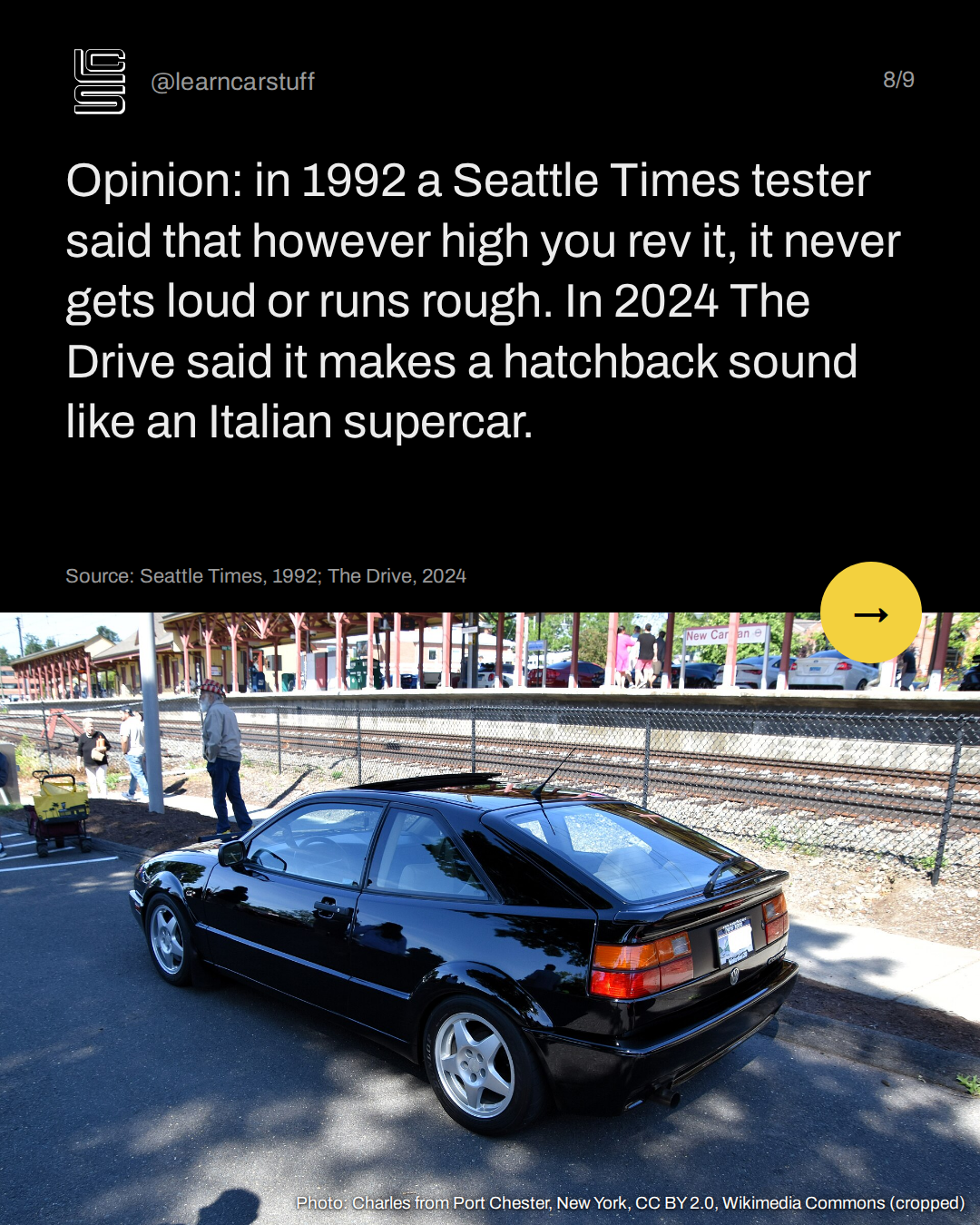
Opinion: in 1992 a Seattle Times tester said that however high you rev it, it never gets loud or runs rough. In 2024 The Drive said it makes a hatchback sound like an Italian supercar.
Source: Seattle Times, 1992; The Drive, 2024
Sources and assumptions
- Hagerty UK, 'Volkswagen builds the last VR6': Debut at the 1991 Geneva show, first in the Passat; banks 10.5 to 15 degrees apart and they share a head; much shorter than a straight six, longer than a straight four, narrower than a V6; early versions 12 valves and 2.8 litres, later 2.9, 3.2 and 3.6, 24-valve from 1999; nearly 1.87 million built; last one built 12 December 2024 (checked 2026-10-29)
- Seattle Times archive, 'Volkswagen Corrado -- New V-6 Engine Fulfills Promise Of This Sports Car' (15 Aug 1992): US Corrado: 2.8-litre, 178 hp, banks 15 degrees apart, one-piece cylinder head; installed 'in a space no larger than what was needed for the old four-cylinder engine'; 'never gets loud, runs rough or loses its composure' (checked 2026-10-29)
- Auto Zeitung, 'VR6-Motor von VW (1991): Anfang und Ende einer Legende': Only 15 degrees between banks, so a single cylinder head was enough; debut 1991; developed specifically for transverse installation; fit the engine bay of the Golf 3 and the Passat B3; 2.8 VR6 bore x stroke 81.0 x 90.3 mm; production ended 12 December 2024 (checked 2026-10-29)
- L'argus, 'Volkswagen. 30 ans de VR6, de la Golf à Bugatti': The 15-degree angle let both banks sit under one head in a transverse position; a conventional V6 or inline six did not fit the car's packaging; Golf VR6 and Corrado VR6 on sale from early 1992; narrow-angle idea tried before by Lancia (checked 2026-10-29)
- The Autopian, 'It's finally the end for Volkswagen's legendary VR6 engine': V = V-Motor, R = Reihenmotor (German for inline engine); one cylinder head for both banks; designed to fit V6 power in transverse bays sized for four-cylinders; crank arranged more like an inline six's so firing intervals stay even (checked 2026-10-29)
- Consumer Guide, 'What was the Volkswagen VR6?': Competing name explanation: 'verkürzt' (shortened) plus Reihenmotor; one head saved cost, weight and space; built for transverse mounting where a conventional V6 would not fit; debut in the 1991 Passat and the Corrado (checked 2026-10-29)
- The Drive, 'Pour one out for the VW VR6': Opinion on the sound: 'a plucky hatchback sounds like an Italian supercar'; nearly 1.87 million built; production ended 12 December 2024 (per VW communications manager Andreas G. Schleith) (checked 2026-10-29)
- Wikipedia, 'VR6 engine' (cross-check only, not cited on slides): Cross-check: firing order 1-5-3-6-2-4; 2.8 AAA (172 hp Europe) and 2.9 ABV (2,861 cc, Corrado and Passat Syncro); 3.2 in the Mk4 Golf R32; 3.6 FSI in the Passat R36 (checked 2026-10-29)
Assumptions:
- The diagram is schematic: relative length and width are drawn roughly (inline six longest, 60° V6 widest, VR6 short and narrow) and carry no millimetre figures.
- 'Fits where a four used to go' follows the 1992 Seattle Times wording for the US Corrado and Auto Zeitung's Golf 3 / Passat B3 statement; it is not a claim about every VR6 car.
- The R32 engine-bay photo shows a later 3.2-litre 24-valve VR6 (Mk4 Golf R32), used only to show the zigzag cylinder layout and never captioned as the original 2.8.
- Launch order: the Passat debuted the VR6 at Geneva in 1991 (Hagerty UK); Corrado and Golf VR6 sales started from about early 1992 (L'argus). Motor1 says it debuted in the Golf 3, which contradicts this, so Motor1 is not used.
- The European Corrado VR6 used a 2,861 cc (2.9-litre) version; the US Corrado SLC used the 2.8 with 178 hp. The Commons description for the SLC photos says '2.9 litre', which is wrong for a US car, so the slides should not quote it.
Photos:
- Photo: Charles01, CC BY-SA 4.0, Wikimedia Commons (cropped)
- Photo: Charles from Port Chester, New York, CC BY 2.0, Wikimedia Commons (cropped)
- Photo: Charles from Port Chester, New York, CC BY 2.0, Wikimedia Commons (cropped)
- Photo: Charles from Port Chester, New York, CC BY 2.0, Wikimedia Commons (cropped)
- Photo: Charles from Port Chester, New York, CC BY 2.0, Wikimedia Commons (cropped)
- Photo: The Car Spy, CC BY 2.0, Wikimedia Commons (cropped)
The short version
- Two banks, only 15° apart (original VR6)
- One cylinder head covers all six
- Built to sit sideways in front-drive cars
- A six where a four used to go