 Learn Car Stuff
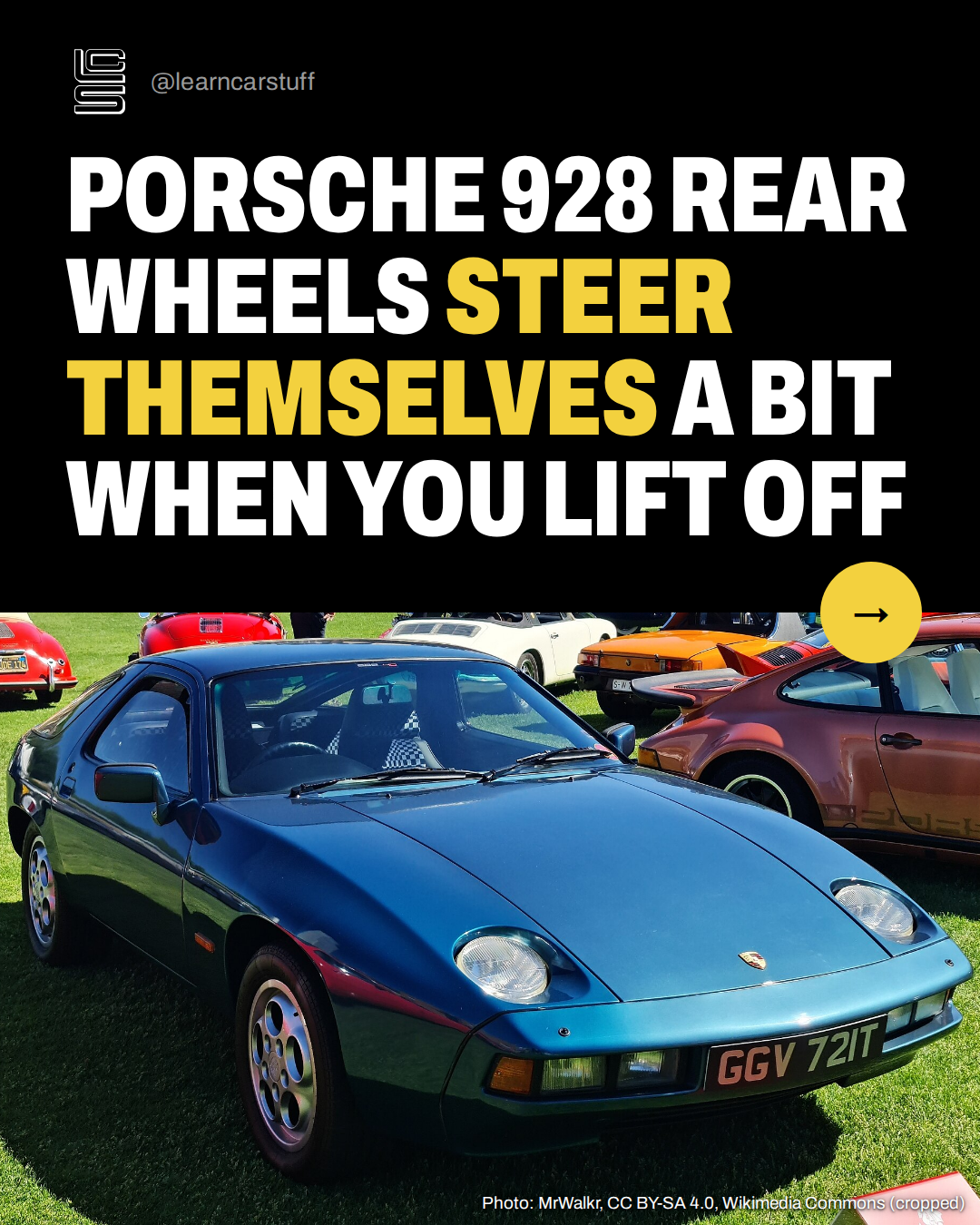
Porsche 928 rear wheels steer themselves a bit when you lift off
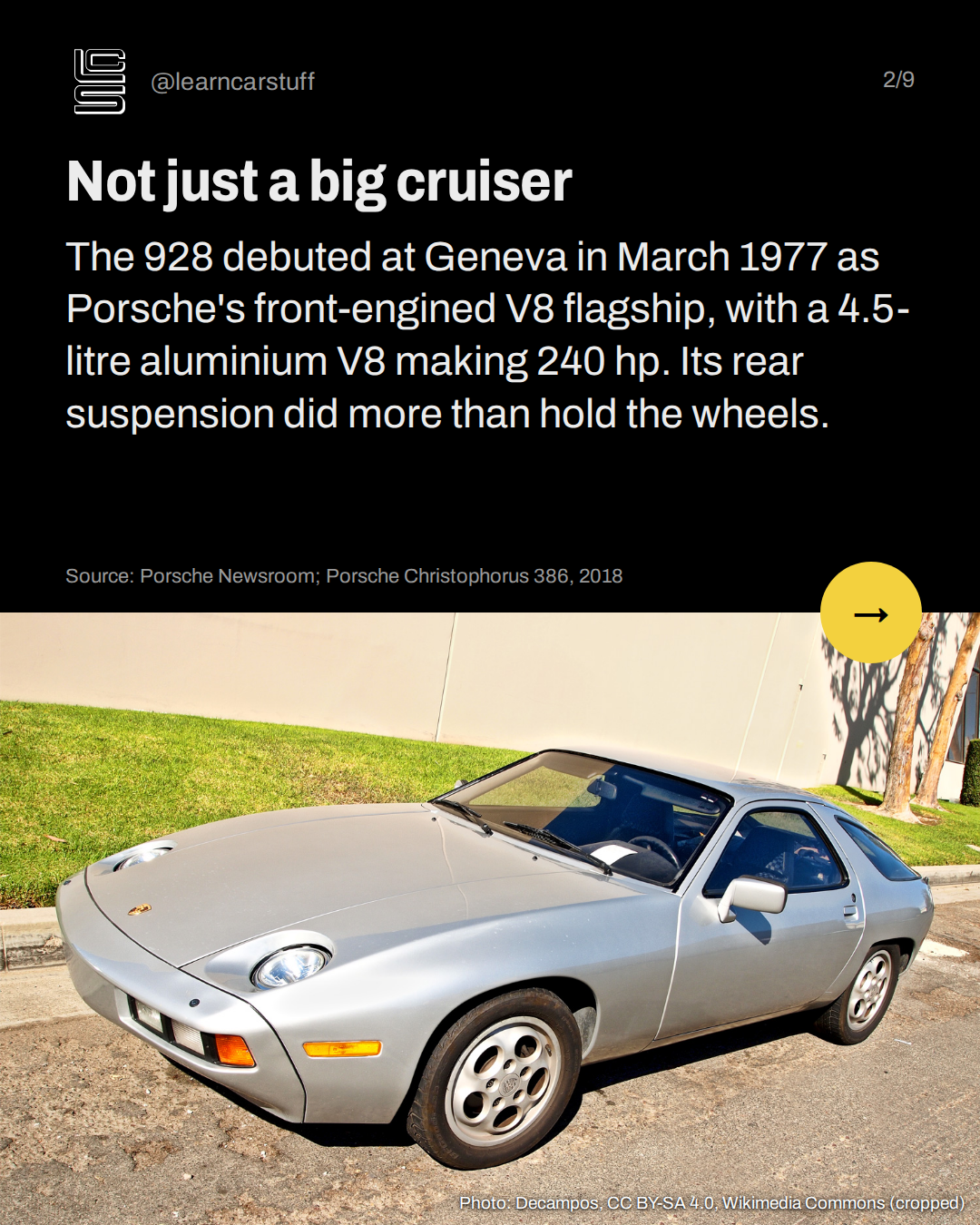
Not just a big cruiser
The 928 debuted at Geneva in March 1977 as Porsche's front-engined V8 flagship, with a 4.5-litre aluminium V8 making 240 hp. Its rear suspension did more than hold the wheels.
Source: Porsche Newsroom; Porsche Christophorus 386, 2018
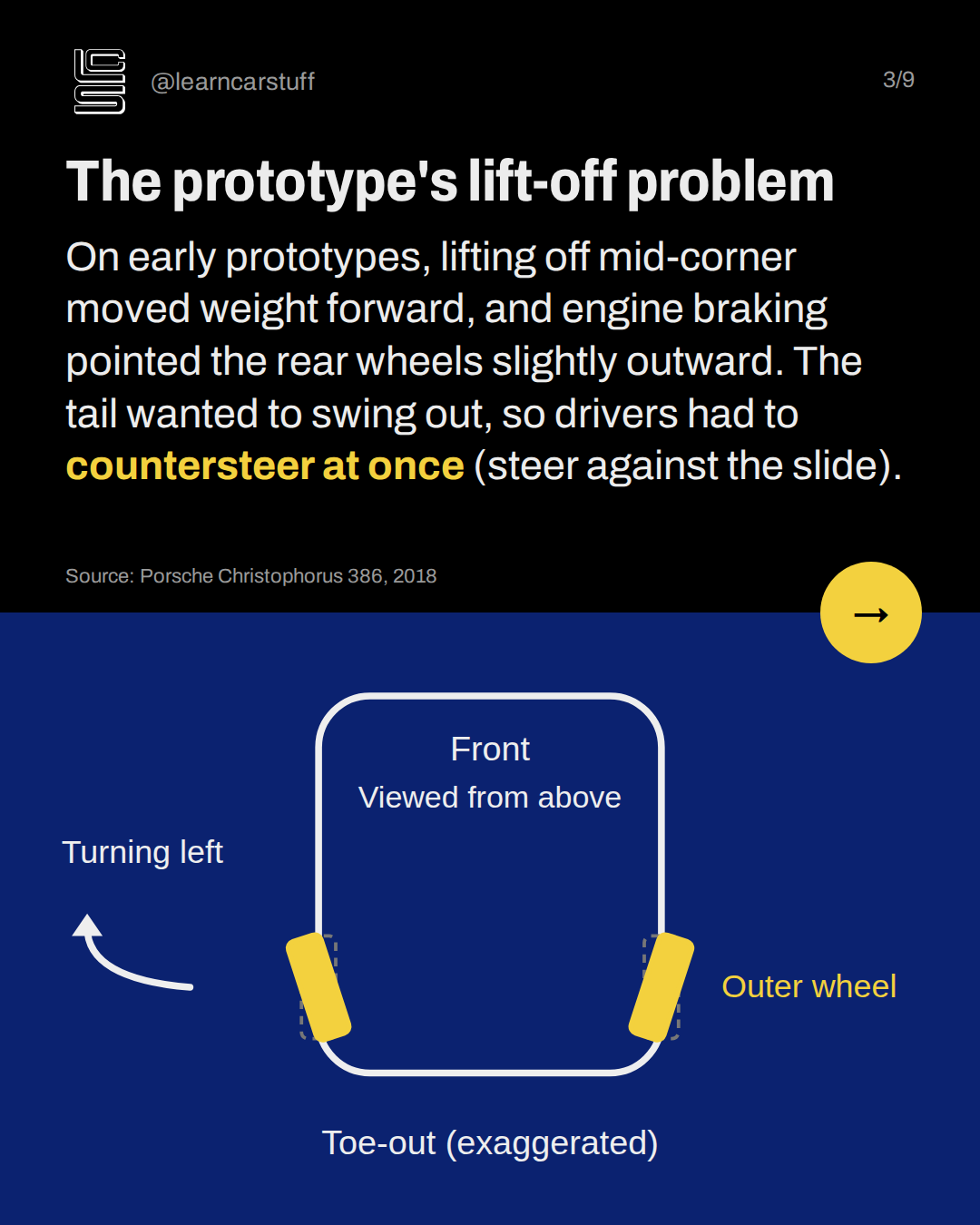
The prototype's lift-off problem
On early prototypes, lifting off mid-corner moved weight forward, and engine braking pointed the rear wheels slightly outward. The tail wanted to swing out, so drivers had to countersteer at once (steer against the slide).
Source: Porsche Christophorus 386, 2018
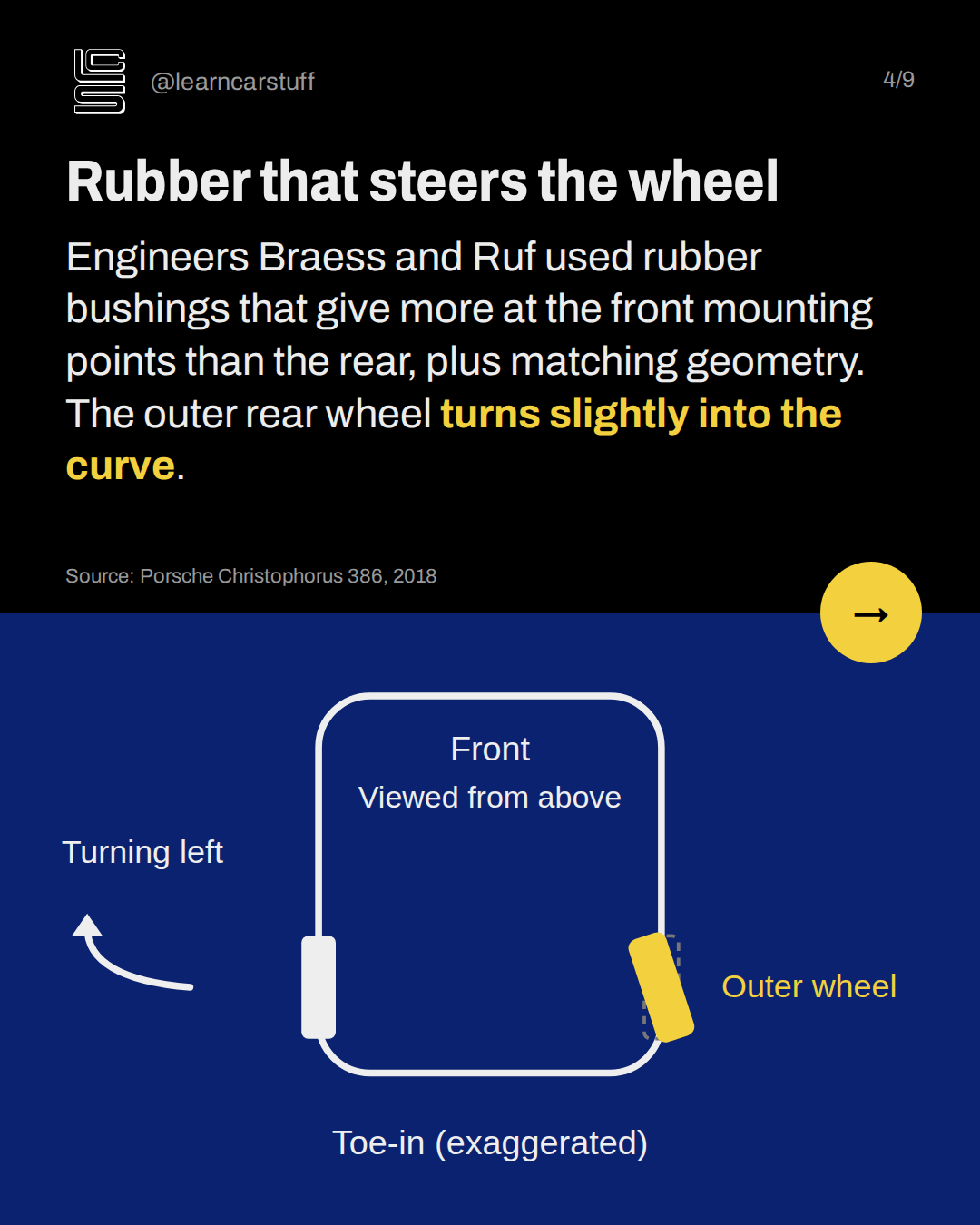
Rubber that steers the wheel
Engineers Braess and Ruf used rubber bushings that give more at the front mounting points than the rear, plus matching geometry. The outer rear wheel turns slightly into the curve.
Source: Porsche Christophorus 386, 2018
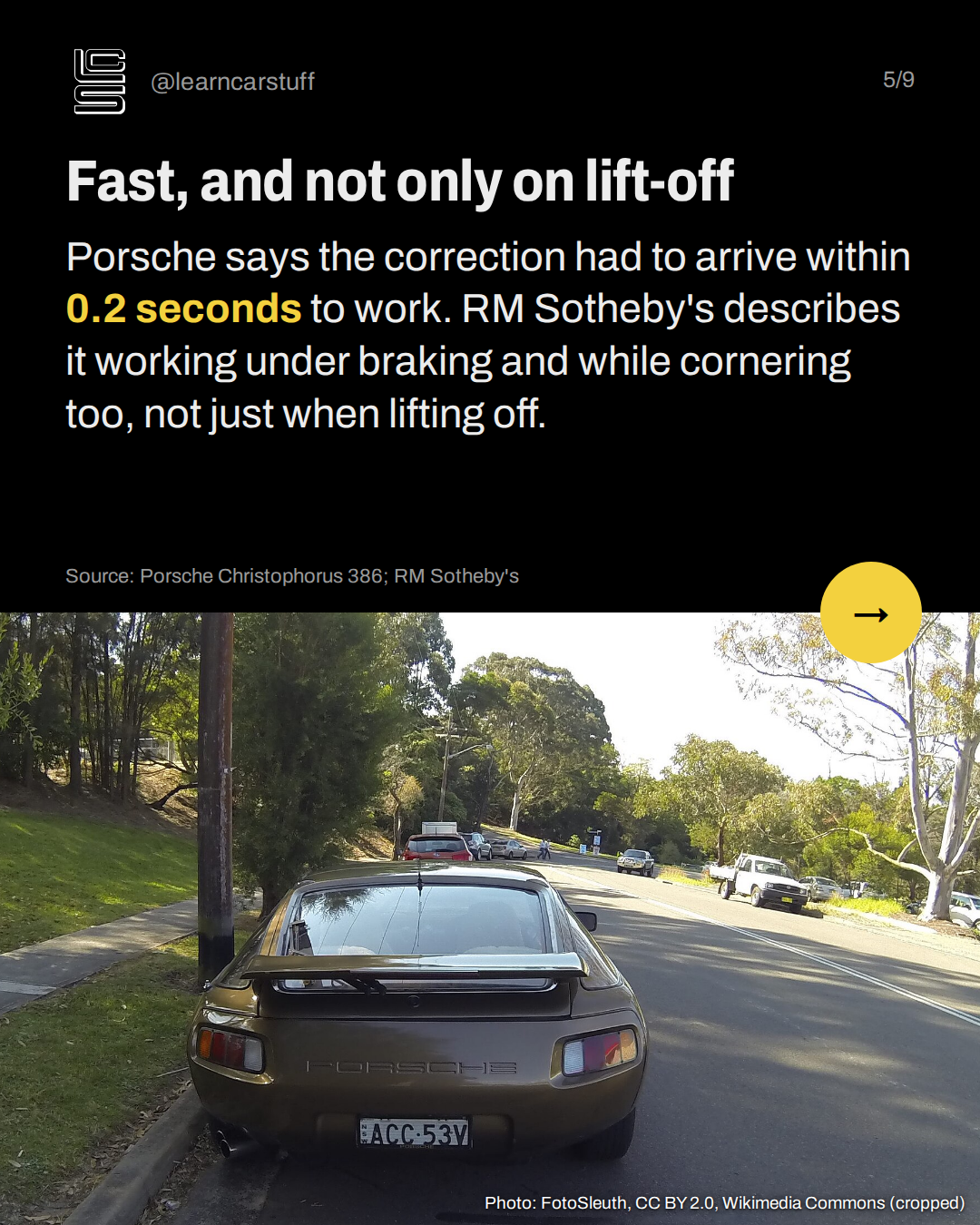
Fast, and not only on lift-off
Porsche says the correction had to arrive within 0.2 seconds to work. RM Sotheby's describes it working under braking and while cornering too, not just when lifting off.
Source: Porsche Christophorus 386; RM Sotheby's
A second steering wheel
Porsche tested it in an Opel Admiral fitted with 928 suspension parts. Manfred Bantle drove from the front while Walter Näher, in the back seat, simulated the toe changes with a second steering wheel.
Source: Porsche Christophorus 386, 2018
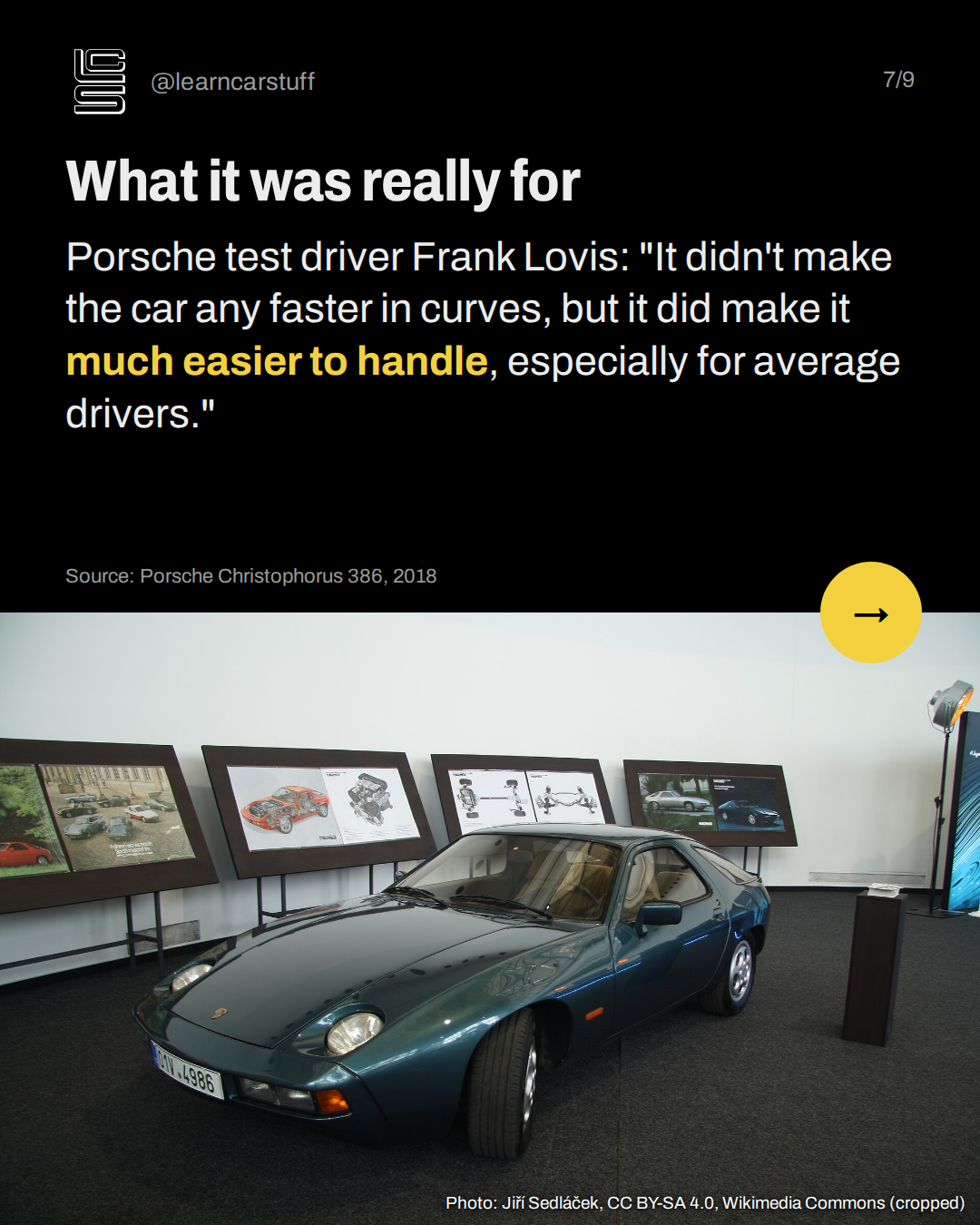
What it was really for
Porsche test driver Frank Lovis: "It didn't make the car any faster in curves, but it did make it much easier to handle, especially for average drivers."
Source: Porsche Christophorus 386, 2018
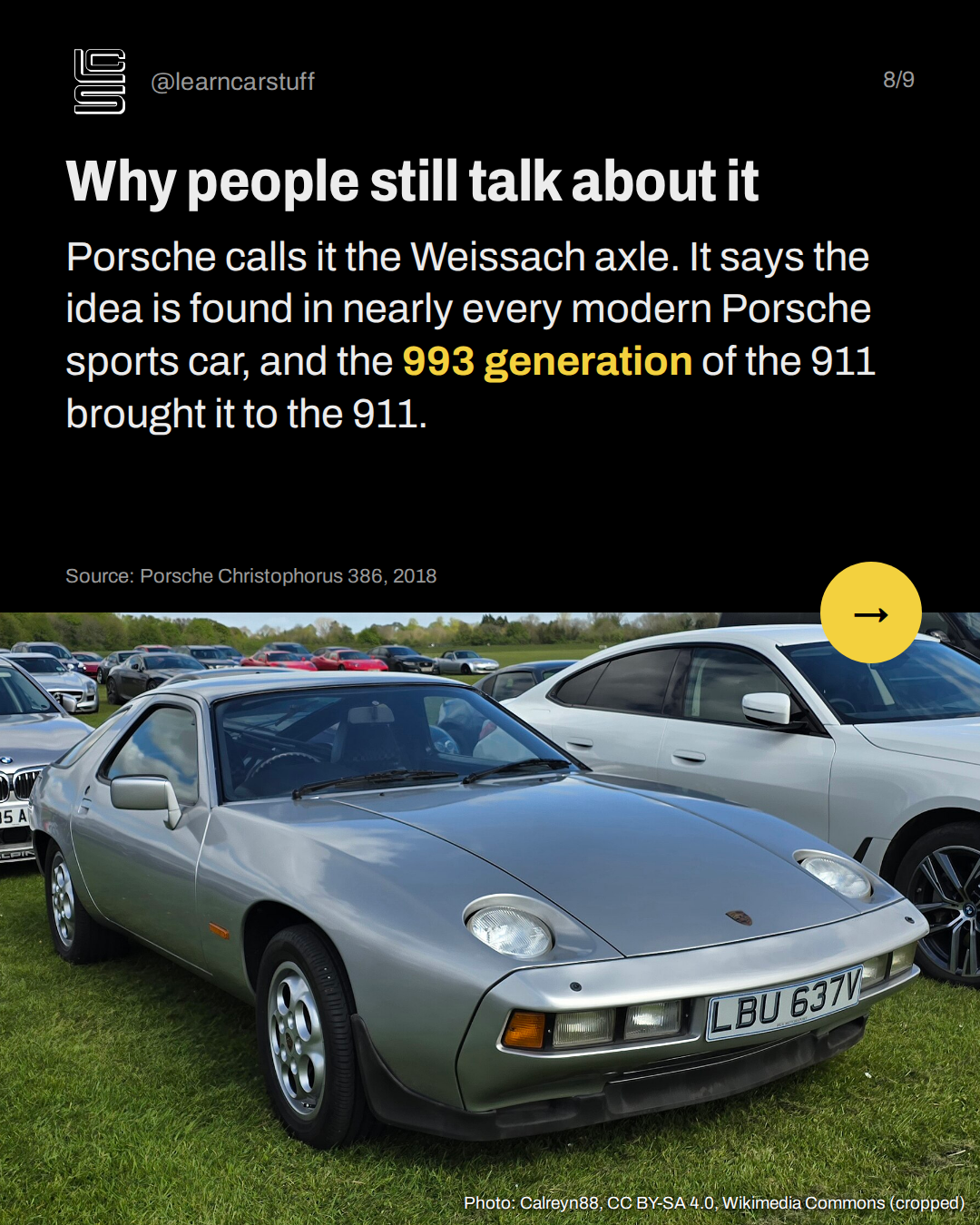
Why people still talk about it
Porsche calls it the Weissach axle. It says the idea is found in nearly every modern Porsche sports car, and the 993 generation of the 911 brought it to the 911.
Source: Porsche Christophorus 386, 2018
Sources and assumptions
- Porsche Christophorus 386: Dawn of a New Axle Era: Lift-off instability on the first 928 prototypes (weight moves forward, engine drag torque turns the rear wheels outward, drivers must countersteer). Braess and Ruf's elasto-kinematic fix: bushings compress more at the front points, giving toe-in. 'Within 0.2 seconds.' Opel Admiral with a second steering wheel in the back (Bantle driving, Näher in the back). Frank Lovis quote. 4.5-litre V8 with 240 hp. Principle in nearly every modern Porsche, 993 911 (checked 2026-10-28)
- Porsche Newsroom: Porsche 928 Weissach axle (same article): Same content as the Christophorus piece (0.2 seconds, Opel Admiral test car, Braess and Ruf, the 928 in 1977 as Porsche's first front-engine car, 4.5-litre V8 with 240 hp) (checked 2026-10-28)
- Porsche Newsroom press kit 'Forever Young. Celebrating Transaxle': Porsche 928: Debut at the Geneva show in March 1977. Car of the Year 1978, 'the only sports car ever so honoured'. Production ran to 1995, 61,056 cars built. 'Weissach passive steering rear axle', transaxle, water-cooled aluminium V8 (checked 2026-10-28)
- Porsche Christophorus 384: Porsche Takes the Plunge: 'A completely new passive-steering rear-wheel suspension: the Weissach axle.' Eleven 928s debuted at Geneva in March 1977. 4.5-litre aluminium V8. Production stopped in 1995 after 61,056 cars (checked 2026-10-28)
- RM Sotheby's, 1983 Porsche 928 S (lot description): 'The Weissach rear axle optimized rear-wheel alignment during deceleration, braking and while cornering': confirms braking as well as lift-off (checked 2026-10-28)
Assumptions:
- The timing comes from Porsche's own wording ('within 0.2 seconds'). RM Sotheby's and Wikipedia repeat an 'advertised .02 seconds', which conflicts with Porsche. Use only Porsche's 0.2 s, framed as the engineering target.
- The Weissach axle is passive: no motors or electronics. 'Steer themselves' means bushing and geometry movement, a small toe change, not real rear-wheel steering like later active systems.
- Porsche gives no toe angle in degrees, so no number appears on the slides and diagrams show the toe change exaggerated (label it 'exaggerated').
- The 240 hp is Porsche's figure for the original 1977 928 4.5-litre V8. Other markets and variants differ, so it is tied to the 1977 car only.
- The braking claim rests on RM Sotheby's (a credible auction house) as well as Porsche's lift-off description.
- Photos: p1/p2/p11 are labelled 1978 and 1980 928s. p8/p9 show a later 928 with a rear wing (928 S era, exact year unconfirmed). Captions say just 'Porsche 928' unless the year is in the file title.
Photos:
The short version
- Lifting off mid-corner upset early 928 prototypes
- Bushings that give more at the front turn the outer rear wheel into the curve
- Porsche's target was within 0.2 seconds
- It made the car easier to handle, not faster