 Learn Car Stuff
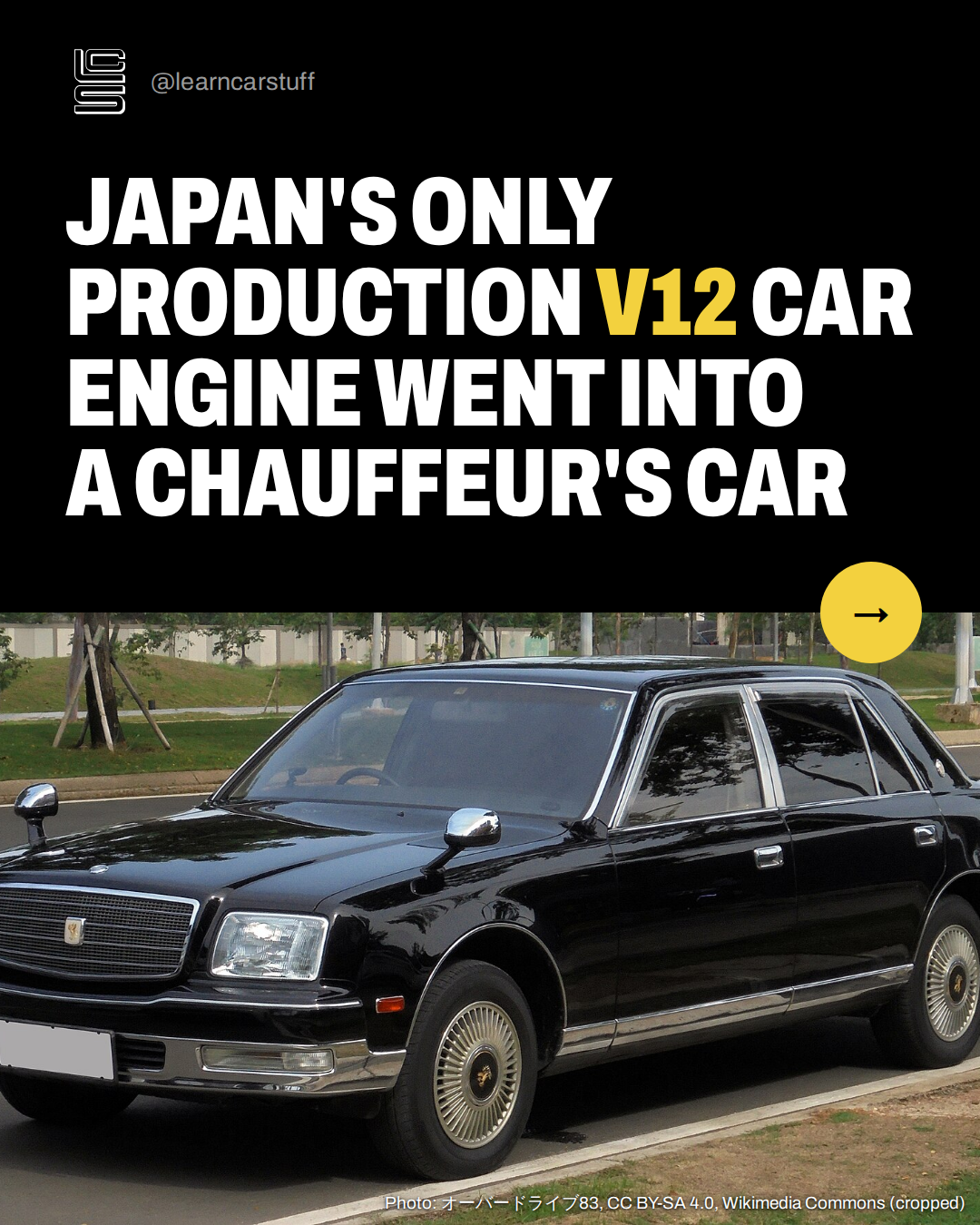
Japan's only production V12 car engine went into a chauffeur's car
A V12 that isn't a supercar
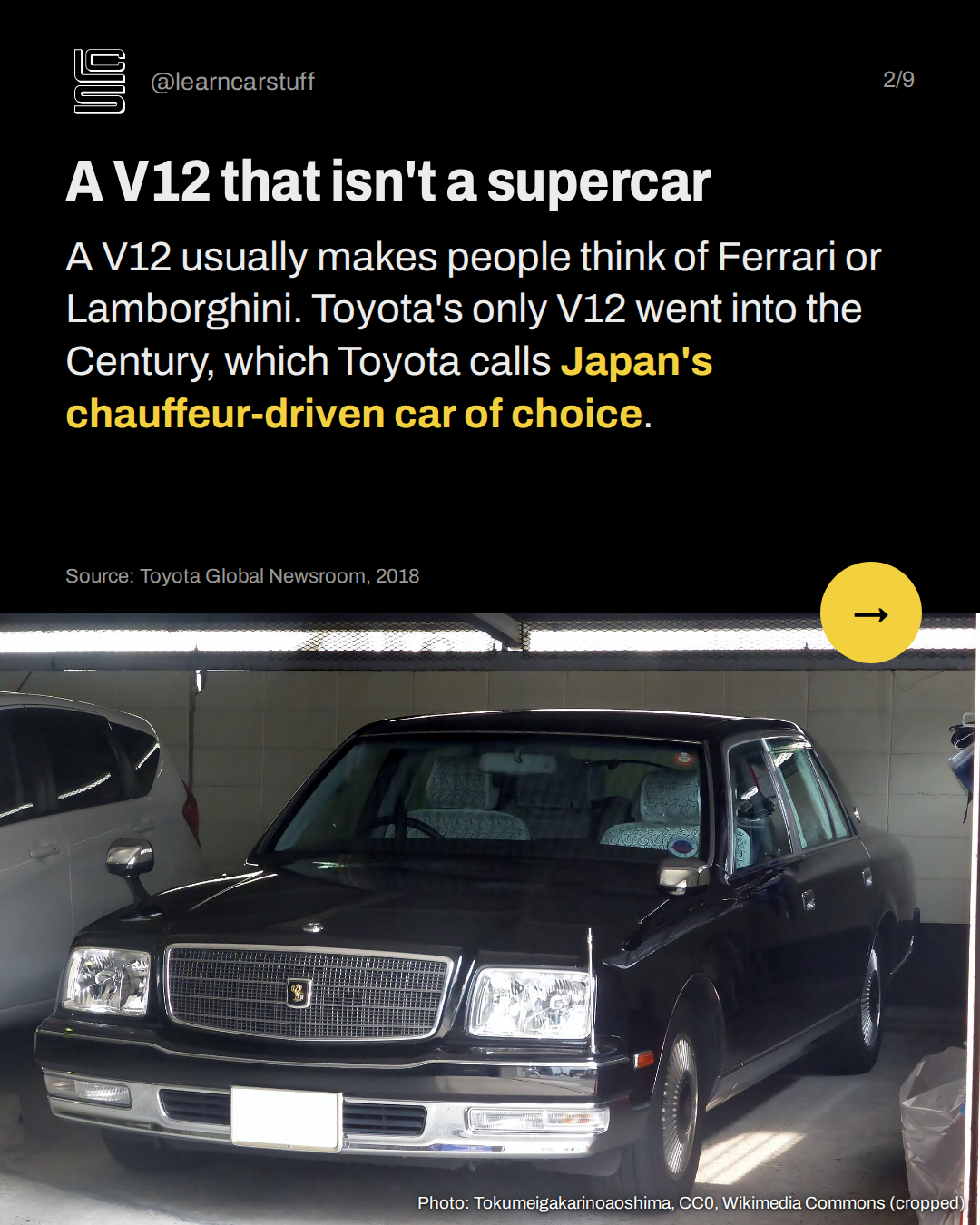
A V12 usually makes people think of Ferrari or Lamborghini. Toyota's only V12 went into the Century, which Toyota calls Japan's chauffeur-driven car of choice.
Source: Toyota Global Newsroom, 2018
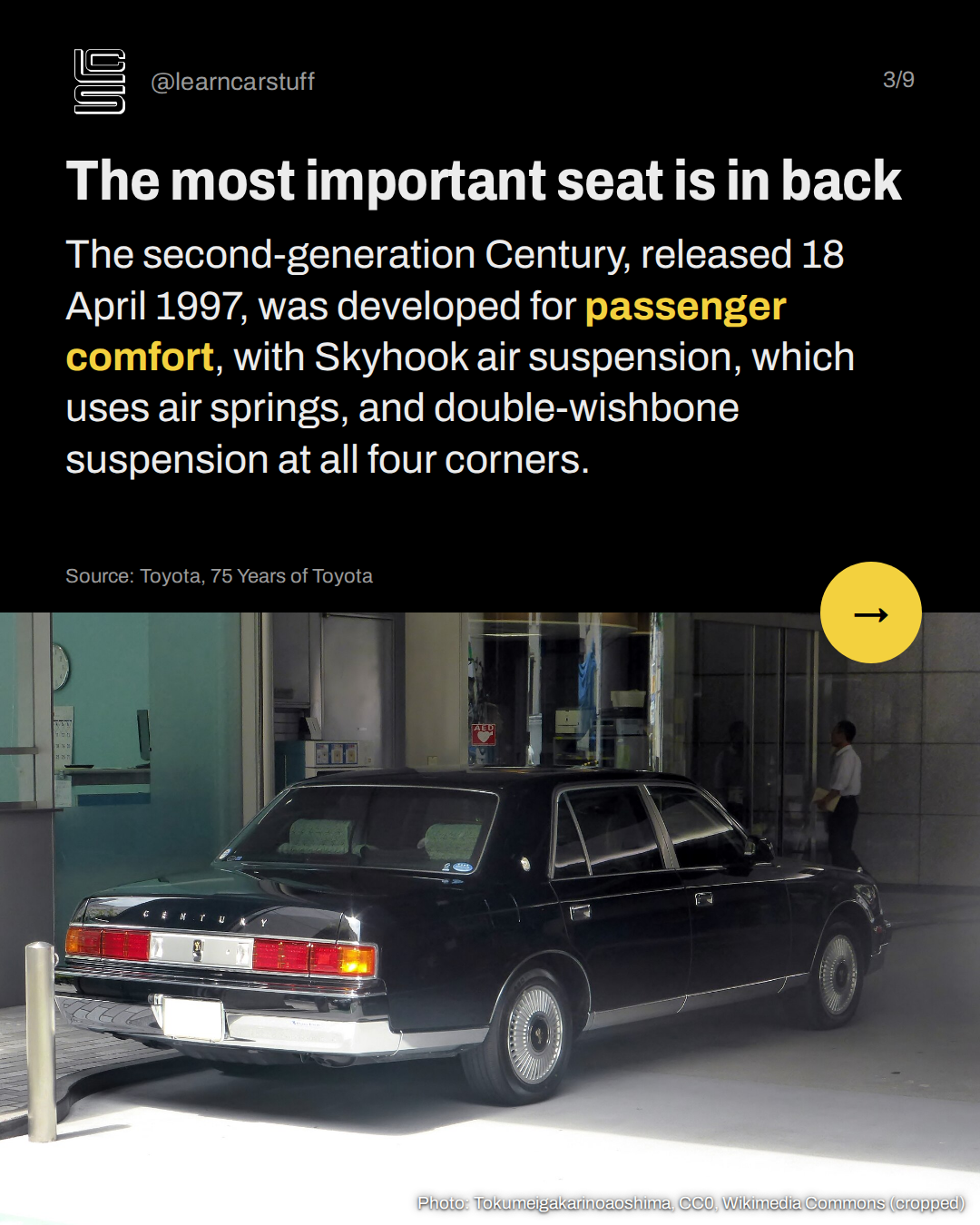
The most important seat is in back
The second-generation Century, released 18 April 1997, was developed for passenger comfort, with Skyhook air suspension, which uses air springs, and double-wishbone suspension at all four corners.
Source: Toyota, 75 Years of Toyota
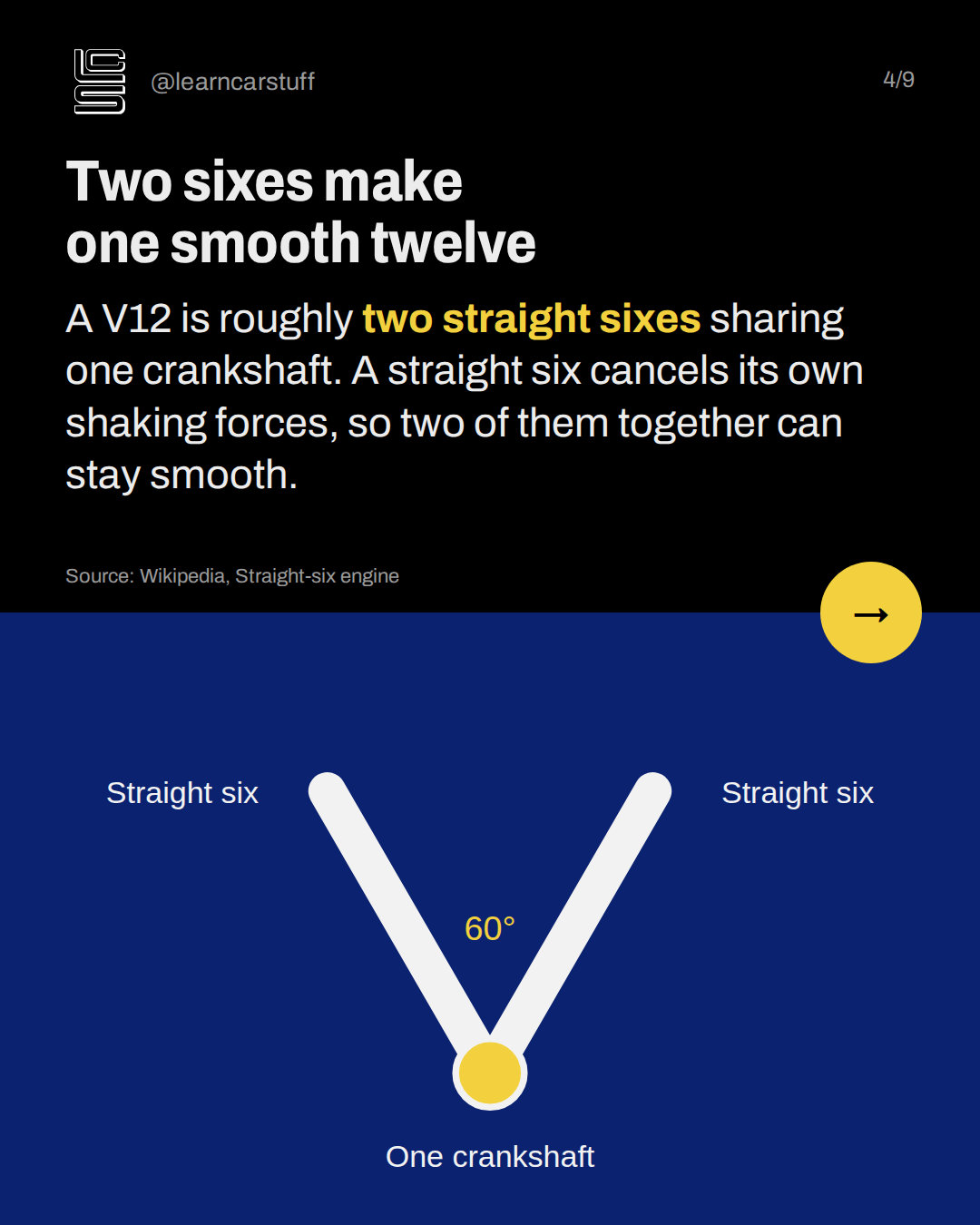
Two sixes make one smooth twelve
A V12 is roughly two straight sixes sharing one crankshaft. A straight six cancels its own shaking forces, so two of them together can stay smooth.
Source: Wikipedia, Straight-six engine
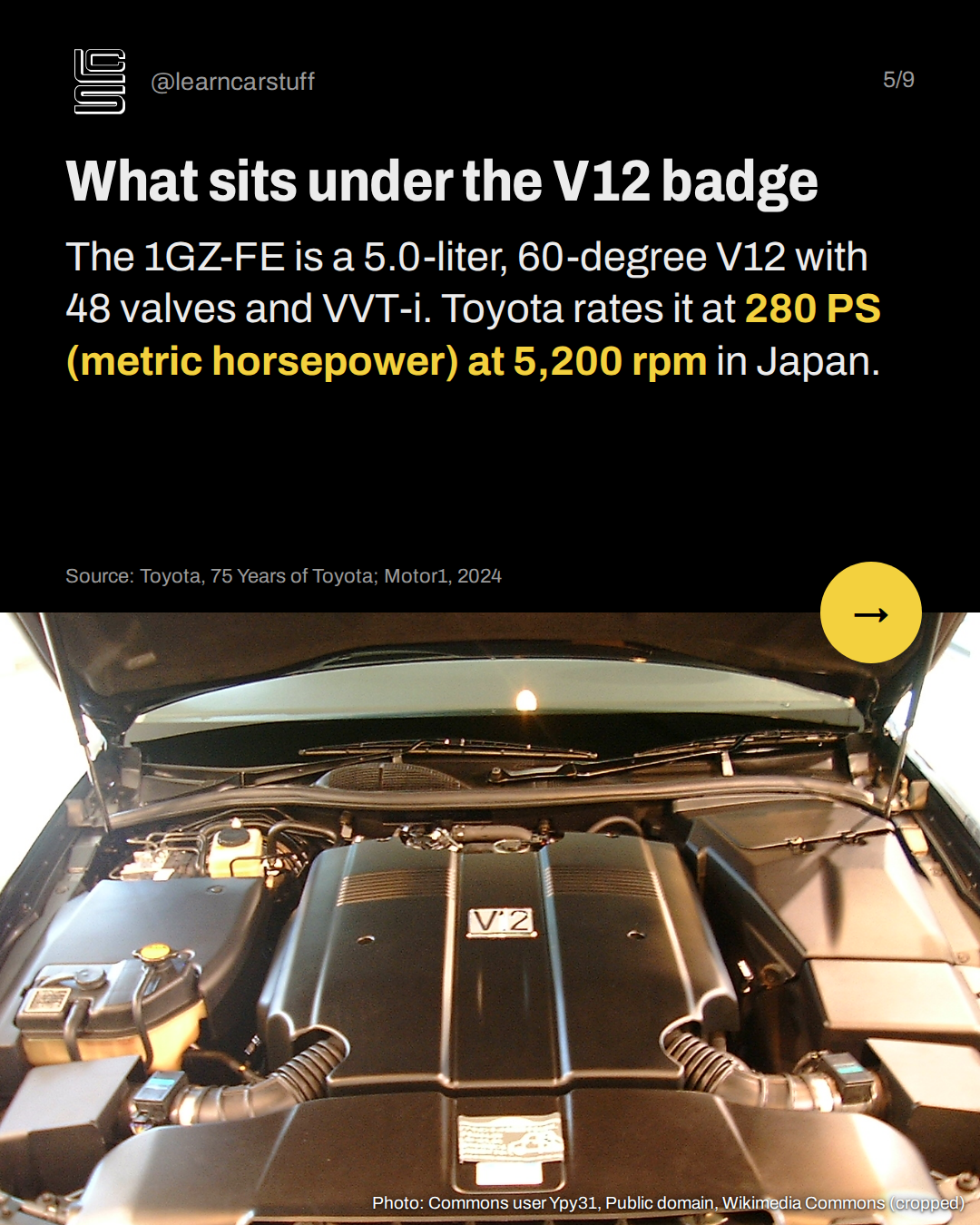
What sits under the V12 badge
The 1GZ-FE is a 5.0-liter, 60-degree V12 with 48 valves and VVT-i. Toyota rates it at 280 PS (metric horsepower) at 5,200 rpm in Japan.
Source: Toyota, 75 Years of Toyota; Motor1, 2024
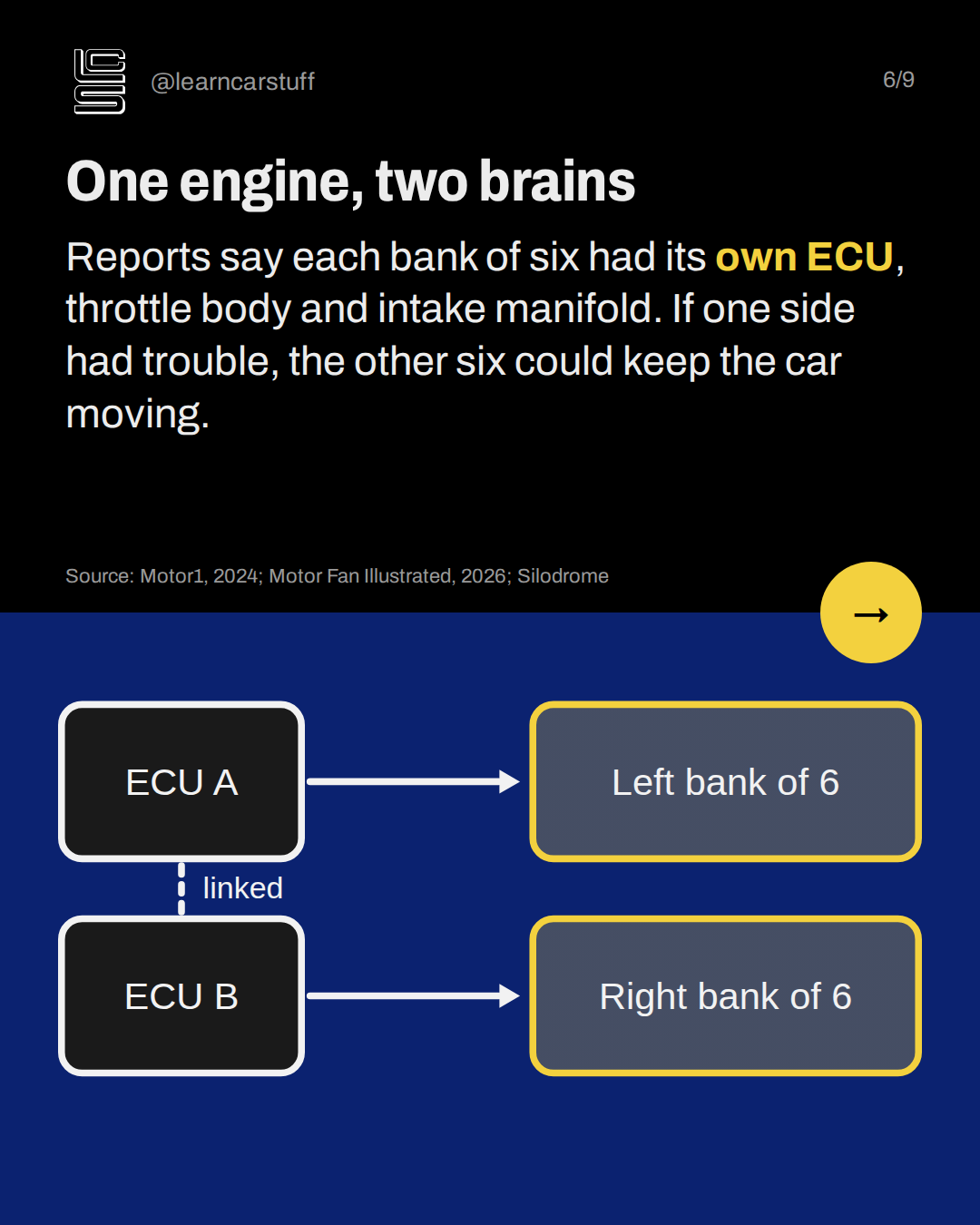
One engine, two brains
Reports say each bank of six had its own ECU, throttle body and intake manifold. If one side had trouble, the other six could keep the car moving.
Source: Motor1, 2024; Motor Fan Illustrated, 2026; Silodrome
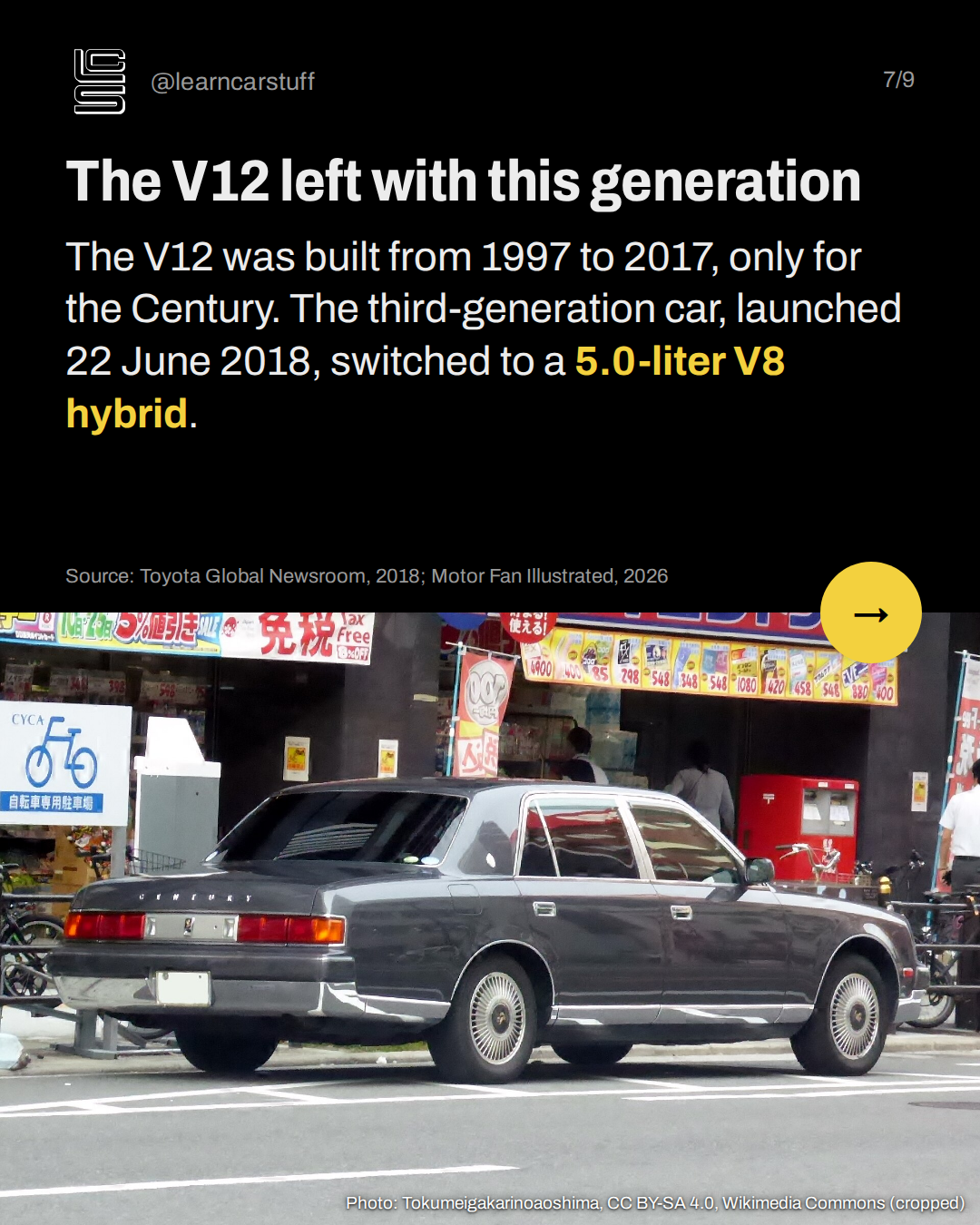
The V12 left with this generation
The V12 was built from 1997 to 2017, only for the Century. The third-generation car, launched 22 June 2018, switched to a 5.0-liter V8 hybrid.
Source: Toyota Global Newsroom, 2018; Motor Fan Illustrated, 2026
Smoothness over speed
Toyota's V12 was tuned for smoothness, with a reported backup bank, rather than top speed. Kuruma News names low vibration and smoothness as the engine's defining traits.
What you'd notice: Almost no vibration, which was the point.
Source: Kuruma News, 2026
Sources and assumptions
- Toyota Motor Corporation, 75 Years of Toyota: Vehicle Lineage, Century 2nd generation: Released 18 April 1997; model code GZG50; 1GZ-FE V12, DOHC 48 valves, VVT-i; 4,996 cc; 280 PS at 5,200 rpm; 'the first V12 for a Japanese passenger car'; Skyhook air suspension and 4-wheel double wishbones; focus on rear-seat comfort (checked 2026-10-28)
- Toyota Global Newsroom: Toyota Rolls Out First Fully Redesigned Century in 21 Years: Third-generation Century launched 22 June 2018 with a 5.0-liter V8 hybrid system; the Century 'has served as the chauffeur-driven model of choice for Japan' (checked 2026-10-28)
- Motor1.com, Christopher Smith, Toyota V12 engine cutaway (7 Nov 2024): Dual ECUs controlling individual throttle bodies and intake manifolds for each cylinder bank; the engine could run on one bank if something happened to the other; 60-degree V12; produced 1997–2017 only for the Century; the only production 12-cylinder from a mainstream Japanese automaker (checked 2026-10-28)
- Motor-Fan (Motor Fan Illustrated editorial department), on the 1GZ-FE (16 Apr 2026): If one bank's six cylinders has trouble, the remaining six can keep the car moving; many driving systems doubled up as backups; Japan's only production V12 passenger-car engine, used only in the Century 1997–2017; the 2018 third generation switched to a V8 hybrid (checked 2026-10-28)
- Kuruma News, Kondo Hideji (30 Jan 2026): A fail-safe structure lets the car run on the remaining six if one bank (six cylinders) has trouble; 280 PS; low vibration and smoothness as the engine's defining traits (checked 2026-10-28)
- Silodrome, Toyota Century 1GZ-FE V12: Two ECUs, one per bank, which can talk to each other; 295 lb-ft available from as low as 1,200 rpm (secondary; supports the low-rpm torque figure) (checked 2026-10-28)
- Wikipedia, Straight-six engine (engine balance section): A straight six has perfect primary and secondary balance; two straight sixes on a common crankshaft form a V12 (general physics framing only, said as 'roughly') (checked 2026-10-28)
Assumptions:
- The '400 N·m from about 1,200 rpm' figure comes from secondary sources (Silodrome/Hagerty via search, Motor1 says 'most of the power is available just above idle'). Use it only as 'from just above idle' unless worded as 'roughly'.
- The six-cylinder fallback is reported by Motor1 and two Japanese motoring outlets (Motor Fan Illustrated, Kuruma News). I didn't open a Toyota primary document that states it, so the slide should attribute it ('engineers designed it so...' / 'reports say'), and should not claim a range, speed or how often it was used.
- The balance explanation is simplified physics ('roughly two straight sixes on one crank'). It says nothing about firing-order specifics.
- 280 PS is the Japanese-market rating (Toyota). Export or other figures (295 bhp) differ by source and are left out.
- 'Only production V12' means a Japanese-built production passenger-car engine; race engines are excluded.
- The engine-bay photo is captioned 1GZ-FE on Commons and shows a 'V12' engine cover. Since the 1GZ-FE was only fitted to the Century, it shows a Century engine bay.
Photos:
- Photo: オーバードライブ83, CC BY-SA 4.0, Wikimedia Commons (cropped)
- Photo: Tokumeigakarinoaoshima, CC0, Wikimedia Commons (cropped)
- Photo: Tokumeigakarinoaoshima, CC0, Wikimedia Commons (cropped)
- Photo: Commons user Ypy31, Public domain, Wikimedia Commons (cropped)
- Photo: Tokumeigakarinoaoshima, CC BY-SA 4.0, Wikimedia Commons (cropped)
The short version
- Japan's only production V12 car engine was the Century's 1GZ-FE
- Roughly two straight sixes on one crankshaft
- Each bank reportedly had its own ECU
- Built for smoothness, not top speed