 Learn Car Stuff
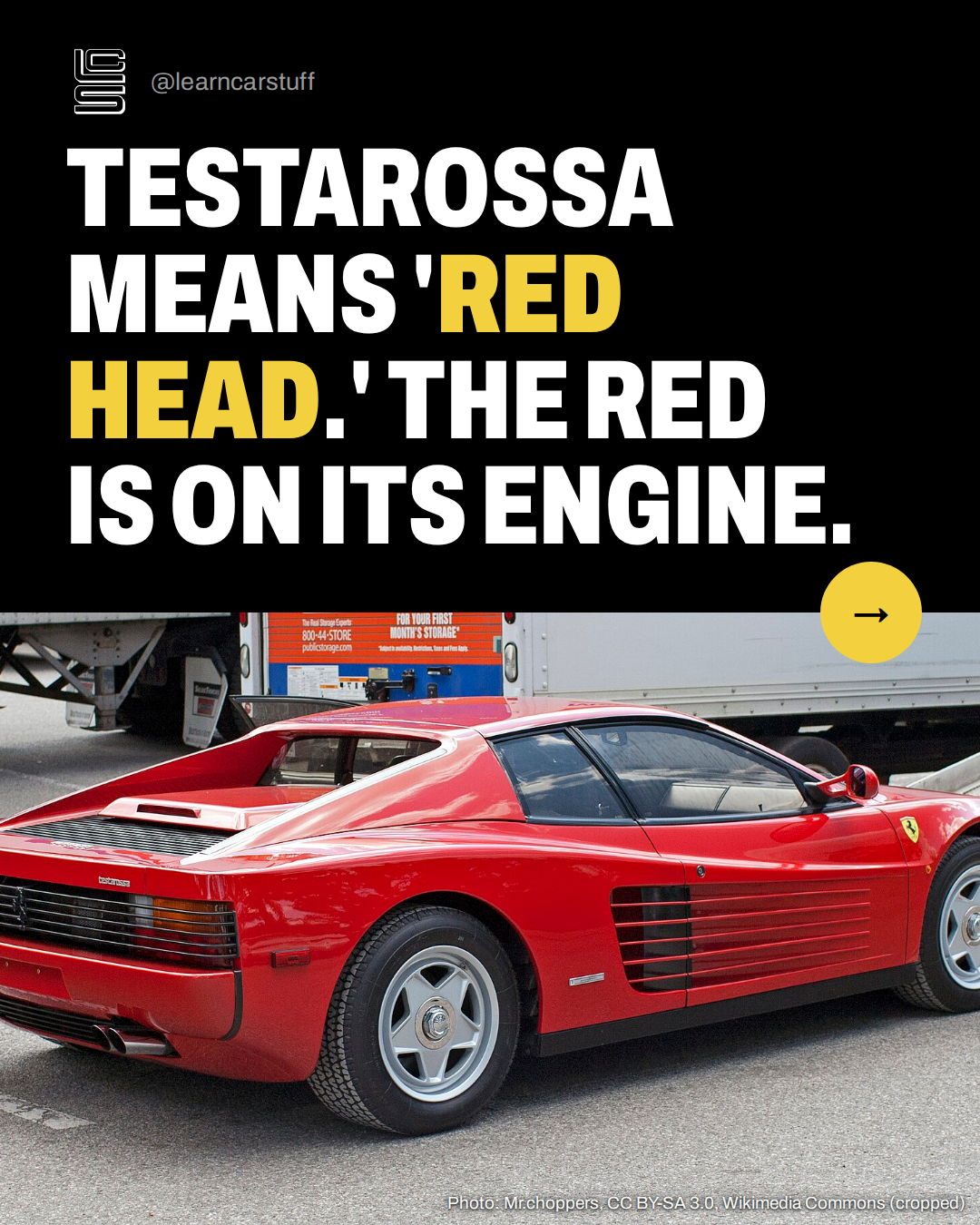
Testarossa means 'red head.' The red is on its engine.
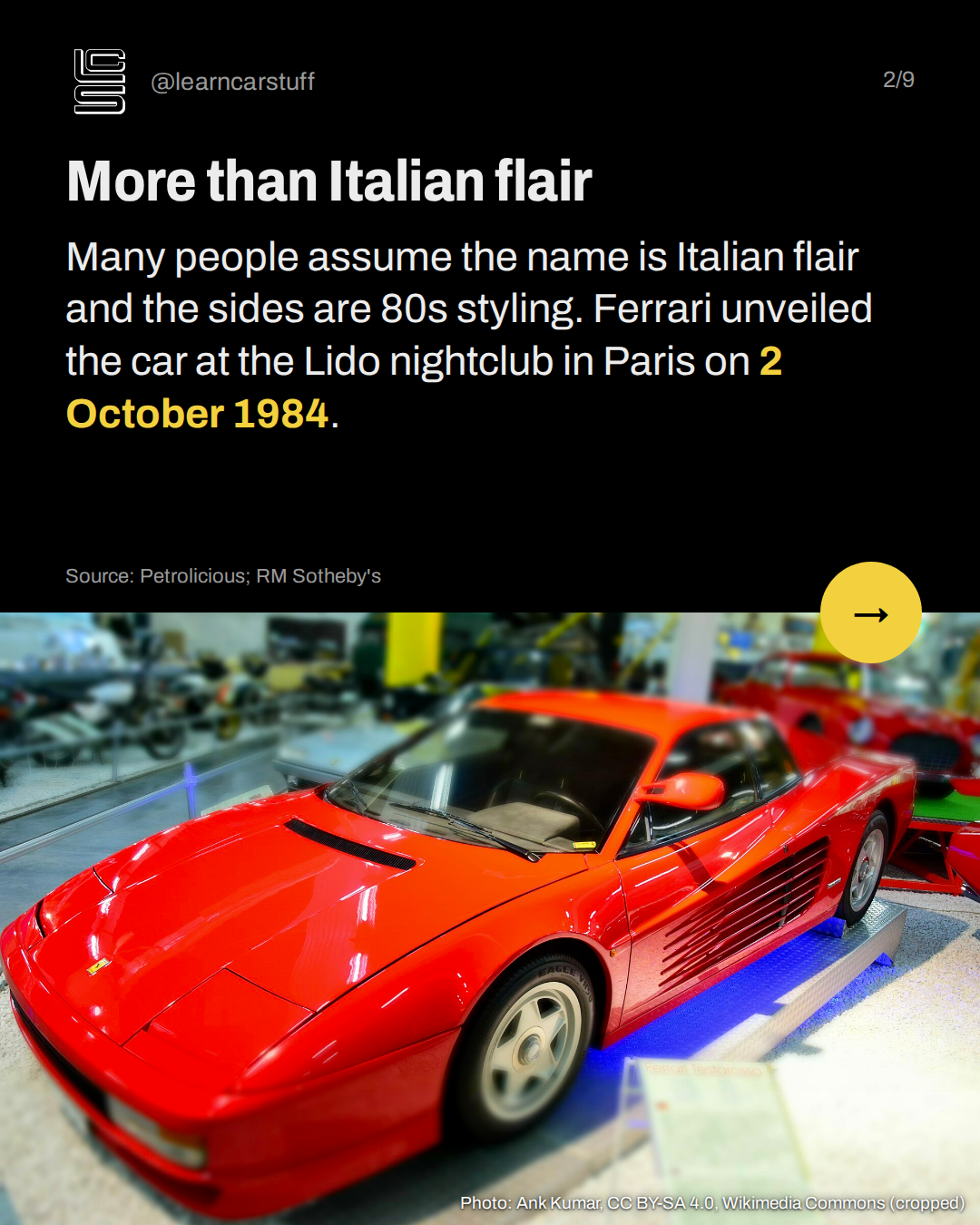
More than Italian flair
Many people assume the name is Italian flair and the sides are 80s styling. Ferrari unveiled the car at the Lido nightclub in Paris on 2 October 1984.
Source: Petrolicious; RM Sotheby's
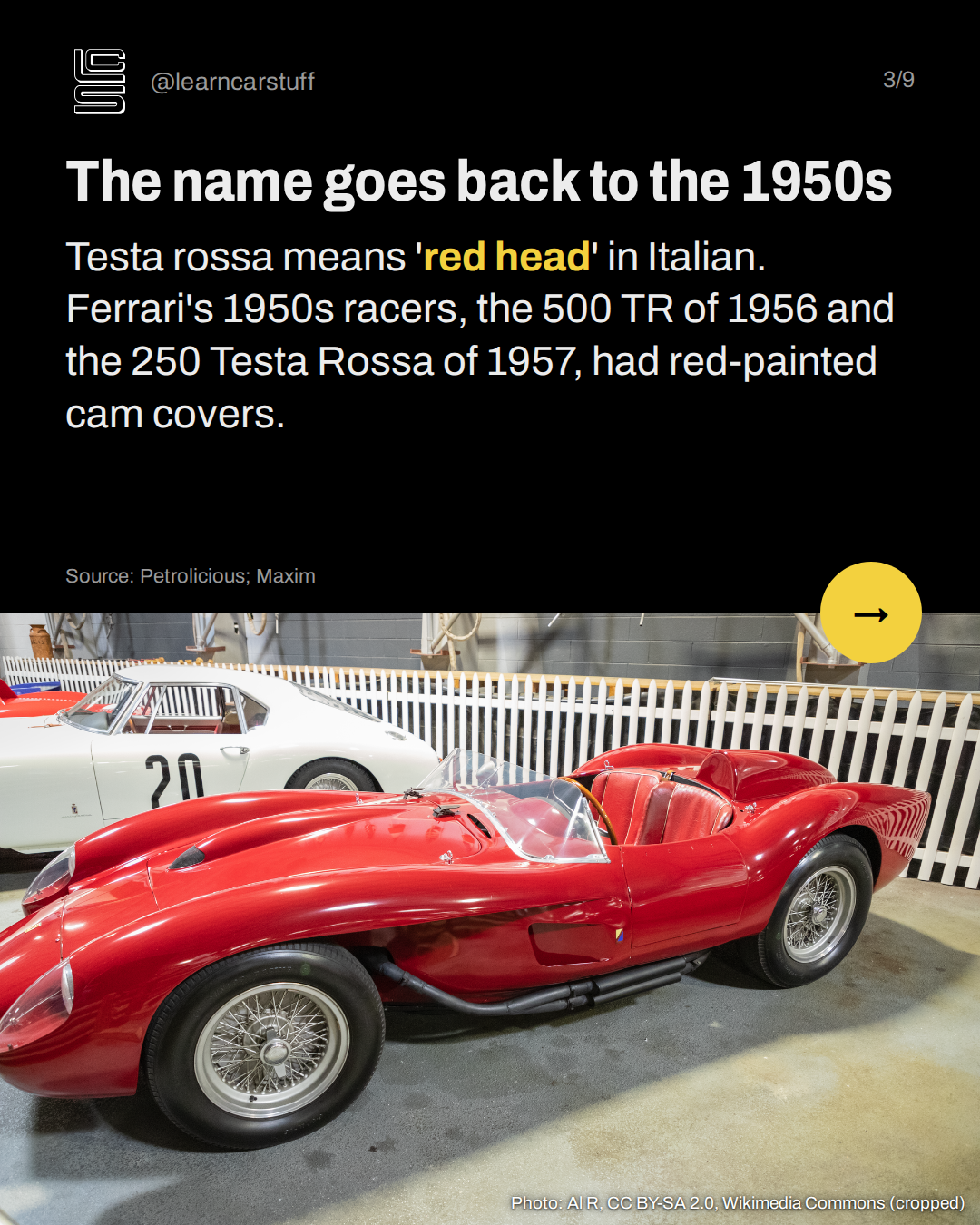
The name goes back to the 1950s
Testa rossa means 'red head' in Italian. Ferrari's 1950s racers, the 500 TR of 1956 and the 250 Testa Rossa of 1957, had red-painted cam covers.
Source: Petrolicious; Maxim
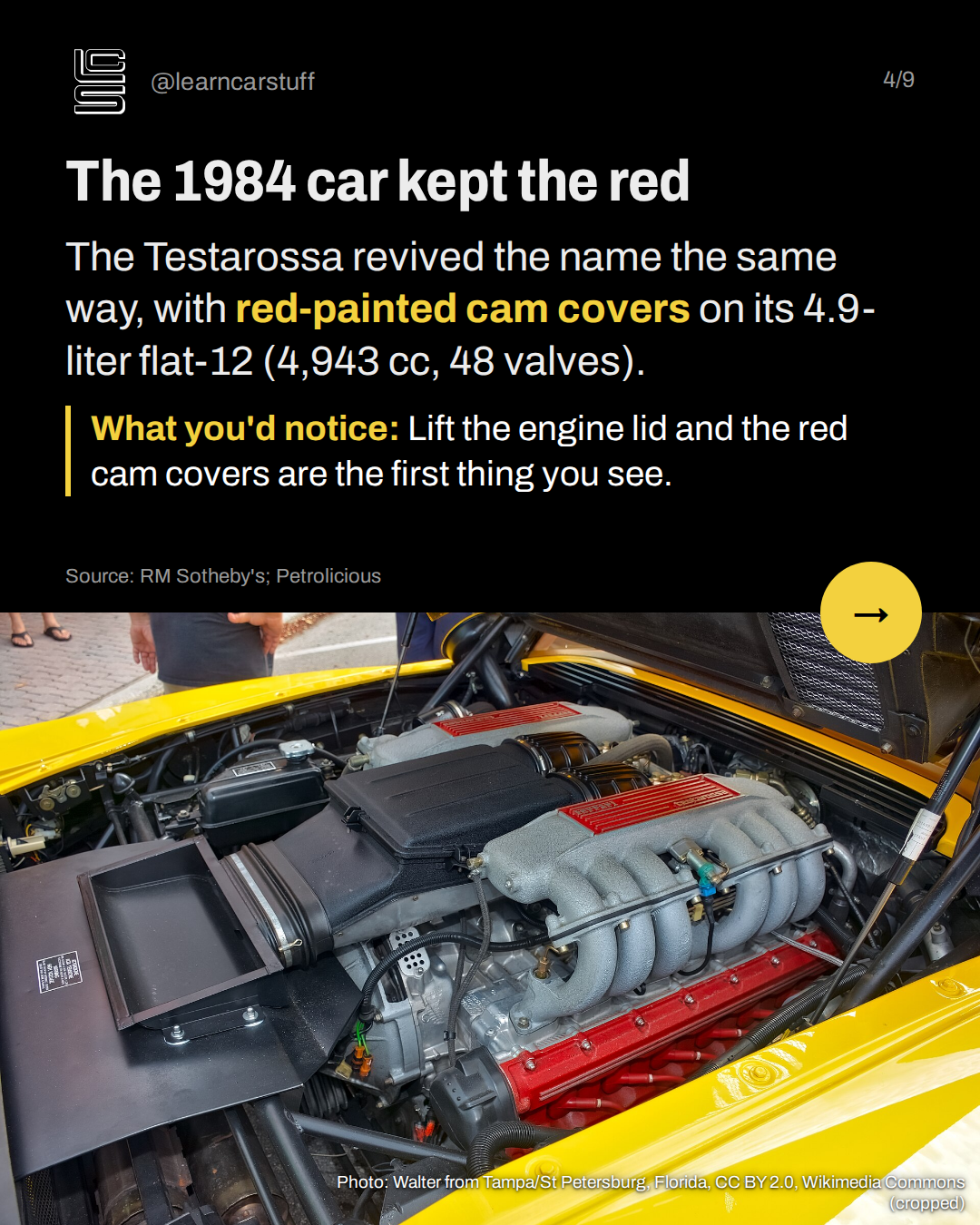
The 1984 car kept the red
The Testarossa revived the name the same way, with red-painted cam covers on its 4.9-liter flat-12 (4,943 cc, 48 valves).
What you'd notice: Lift the engine lid and the red cam covers are the first thing you see.
Source: RM Sotheby's; Petrolicious
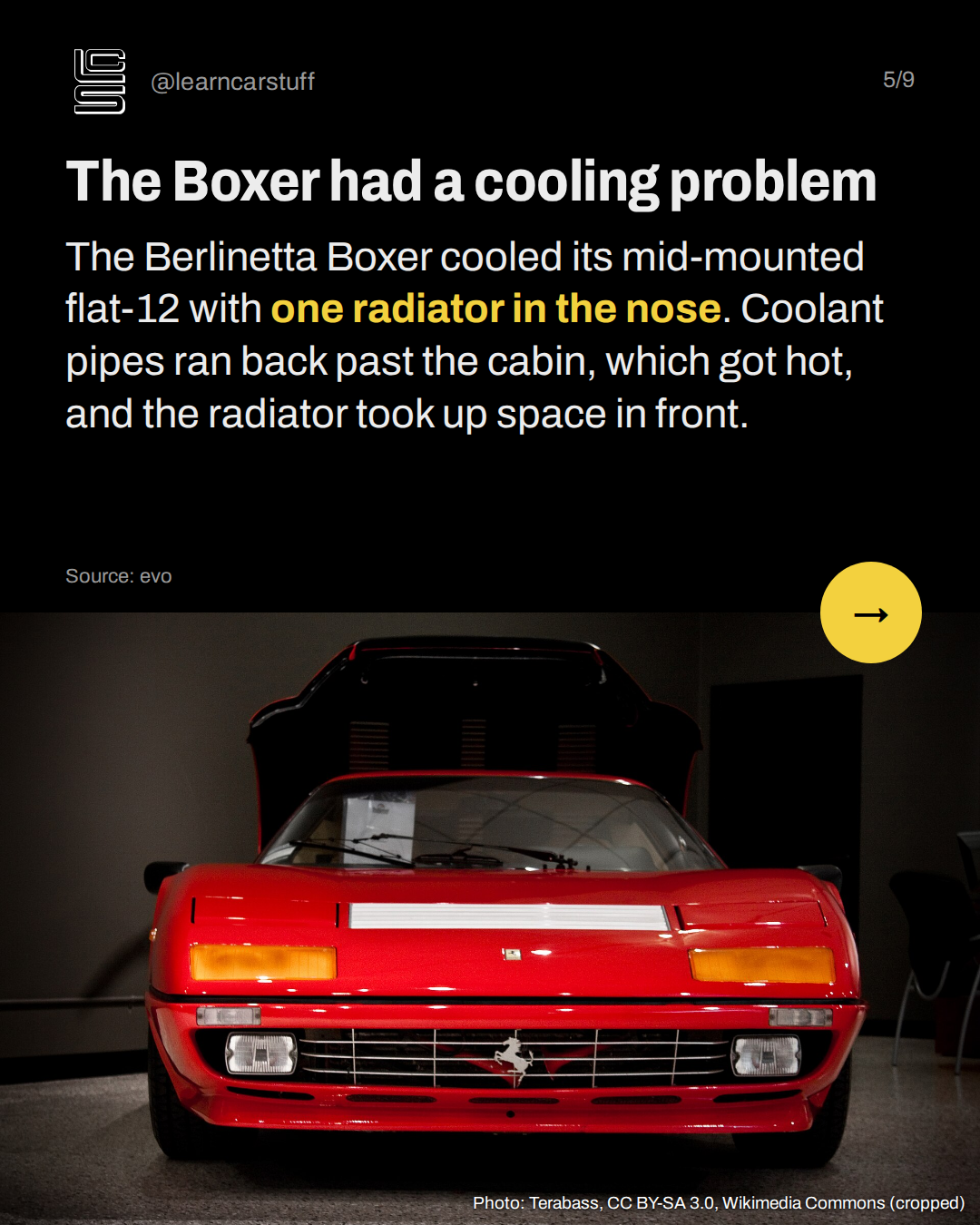
The Boxer had a cooling problem
The Berlinetta Boxer cooled its mid-mounted flat-12 with one radiator in the nose. Coolant pipes ran back past the cabin, which got hot, and the radiator took up space in front.
Source: evo
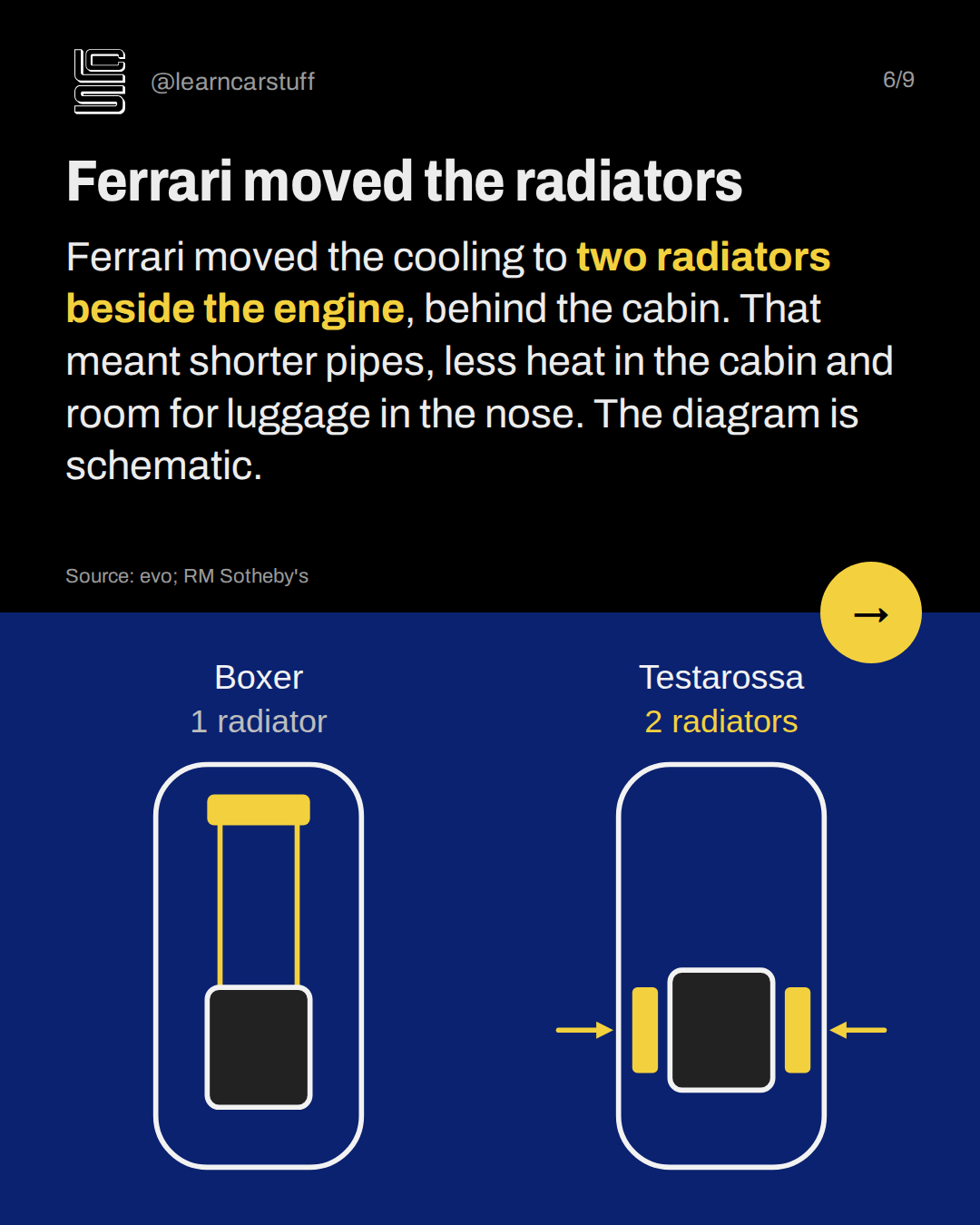
Ferrari moved the radiators
Ferrari moved the cooling to two radiators beside the engine, behind the cabin. That meant shorter pipes, less heat in the cabin and room for luggage in the nose. The diagram is schematic.
Source: evo; RM Sotheby's
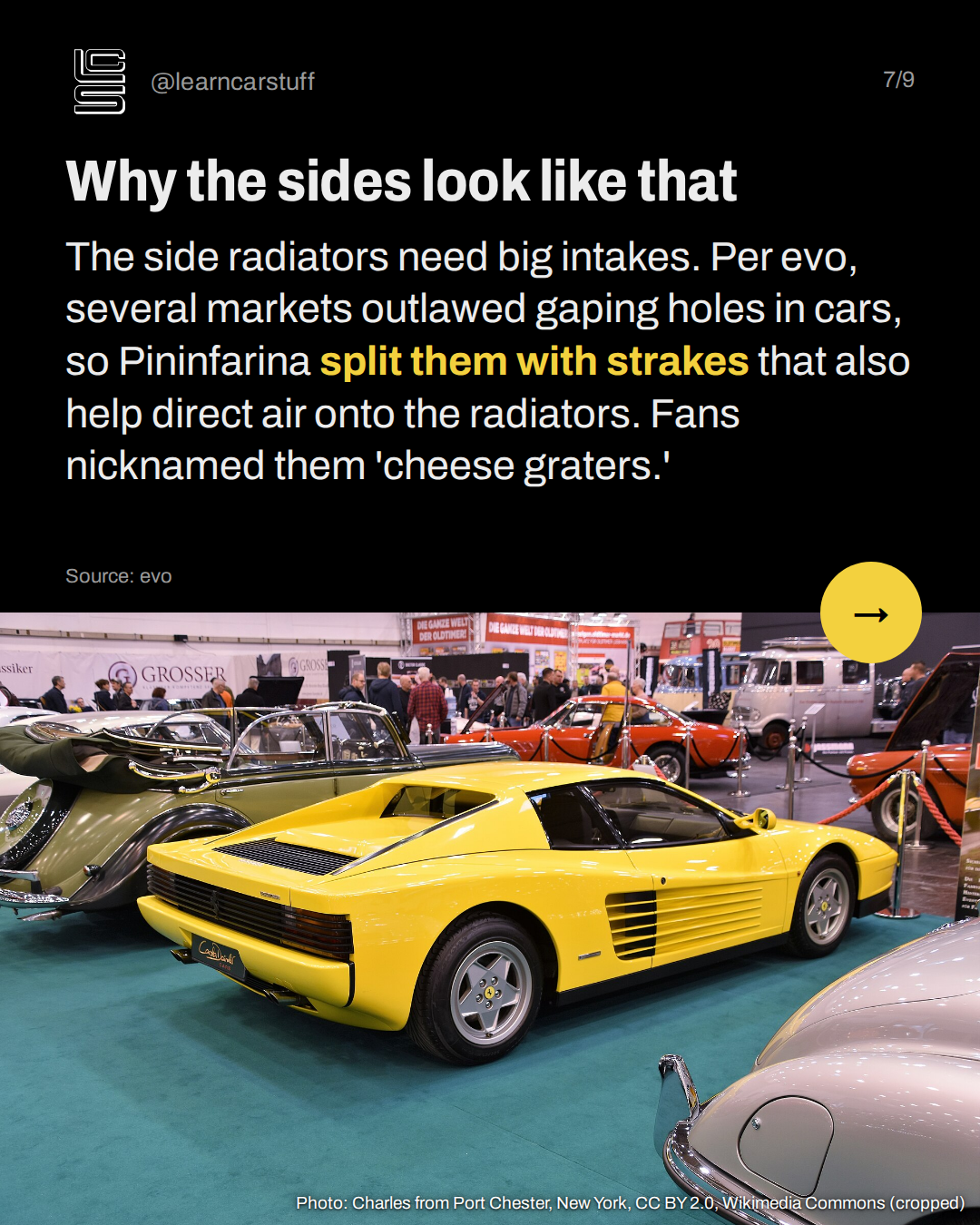
Why the sides look like that
The side radiators need big intakes. Per evo, several markets outlawed gaping holes in cars, so Pininfarina split them with strakes that also help direct air onto the radiators. Fans nicknamed them 'cheese graters.'
Source: evo
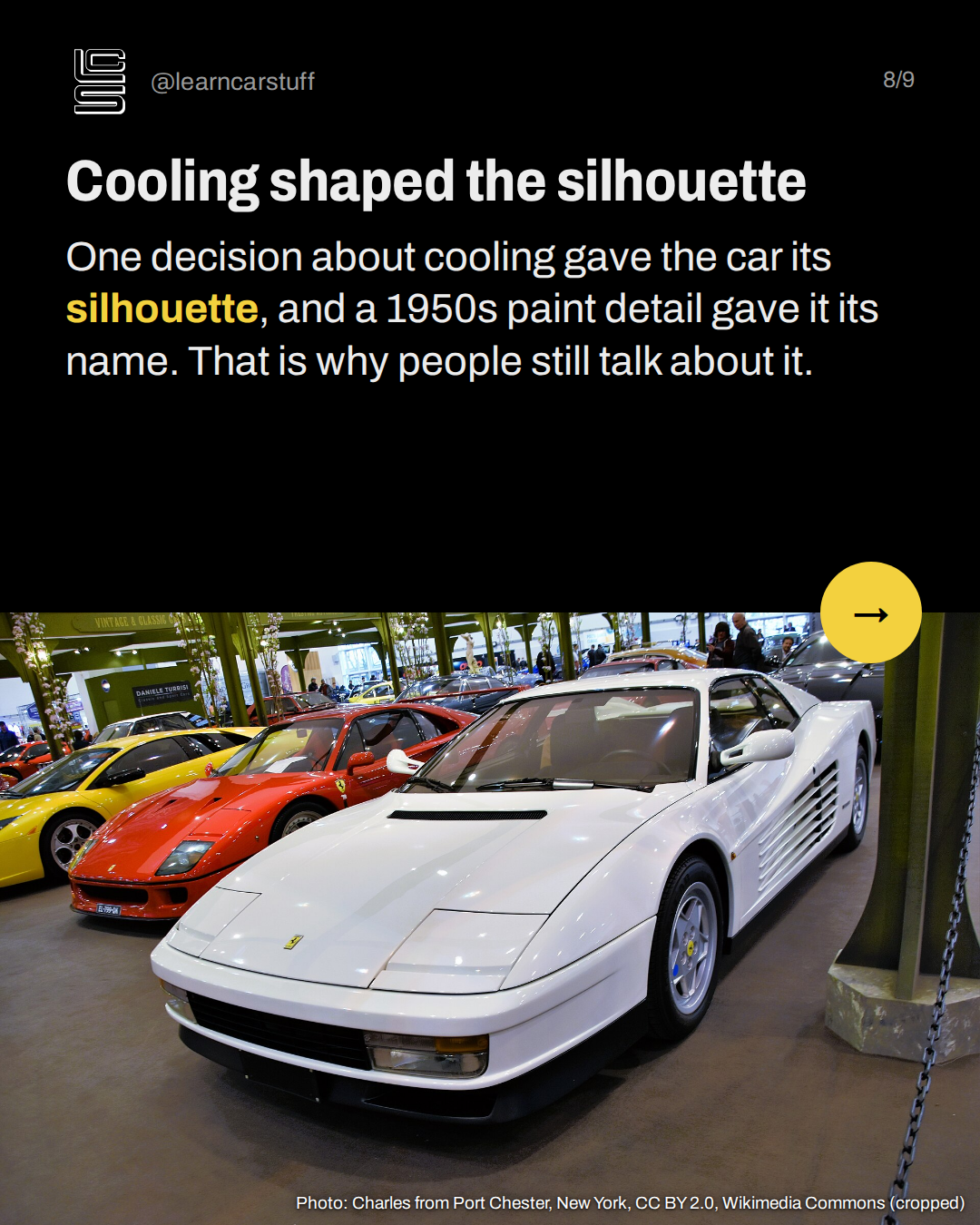
Cooling shaped the silhouette
One decision about cooling gave the car its silhouette, and a 1950s paint detail gave it its name. That is why people still talk about it.
Sources and assumptions
- evo: Ferrari Testarossa side strakes – the art of speed (1 Jul 2020): Boxer had a single front-mounted radiator causing cabin heating issues; Testarossa's twin radiators behind the cabin bulkhead needed a rearward flaring of the bodywork and two big vents; several markets outlawed gaping holes in cars, so the apertures were split by strakes; strakes also helped direct air onto the radiators; Pininfarina designed both cars; 'cheese graters' nickname (checked 2026-10-27)
- Maxim: Killer Redhead, a deep dive inside Ferrari's Testarossa badge (Nicolas Stecher, 8 Sep 2026): Testa Rossa = 'red head' from crimson-painted heads; 1956 500 TR came first, then the 250 Testa Rossa; Testarossa has a 4.9-liter flat-12 behind the cabin with a five-speed manual; the BBi's radiators were moved from the nose to the flanks; Fioravanti-led Pininfarina team drew the strakes (checked 2026-10-27)
- Petrolicious: The Ferrari Testarossa returned to its Paris roots for its 40th anniversary: Unveiled 2 October 1984 at the Lido nightclub on the Champs-Élysées; name is a callback to the 1957 250 Testa Rossa and means 'red head', referring to the red-painted cam covers on both cars (checked 2026-10-27)
- RM Sotheby's: 1990 Ferrari Testarossa (Dare to Dream Collection, lot 321): Name means 'redhead', a nod to the color of the cylinder heads on the 1950s 250 TR; rear-mounted radiators gave more cooling and more luggage space in front; strakes drew air into the radiator intakes; 48 valves; introduced at the 1984 Paris show as successor to the Berlinetta Boxer (checked 2026-10-27)
- RM Sotheby's: 1989 Ferrari Testarossa by Pininfarina (Monaco 2014, lot 166): Twin side-mounted radiators; side strakes to accommodate them; 4,943 cc DOHC flat-12; unveiled at the Lido in Paris and shown at the Paris Auto Show the next day (checked 2026-10-27)
Assumptions:
- The 'red' is described as red-painted cam covers (Petrolicious; visible in the 1990 engine photo). Some sources say 'cylinder heads' (Maxim, RM 1990). Slides say 'cam covers', the part you can see.
- The regulation reason for the strakes comes from evo ('in several of the markets ... gaping holes in cars were outlawed'). No specific country or rule was verified, so the slide attributes it and names no country.
- 'Less heat in the cabin' and 'luggage space in the nose' are framed as the reasons Ferrari moved the radiators, per evo and RM Sotheby's. I didn't open a Ferrari primary page: ferrari.com showed no text through the fetch tool.
- No power figure is used, because sources disagree (380 bhp US, 385 hp, 390 PS) and no exact variant/market source was opened.
- Radiator positions in the diagram are schematic ('roughly'), not to scale.
Photos:
- Photo: Mr.choppers, CC BY-SA 3.0, Wikimedia Commons (cropped)
- Photo: Walter from Tampa/St Petersburg, Florida, CC BY 2.0, Wikimedia Commons (cropped)
- Photo: Ank Kumar, CC BY-SA 4.0, Wikimedia Commons (cropped)
- Photo: Charles from Port Chester, New York, CC BY 2.0, Wikimedia Commons (cropped)
- Photo: Charles from Port Chester, New York, CC BY 2.0, Wikimedia Commons (cropped)
- Photo: Al R, CC BY-SA 2.0, Wikimedia Commons (cropped)
- Photo: Terabass, CC BY-SA 3.0, Wikimedia Commons (cropped)
The short version
- Testa rossa means red head.
- Red cam covers go back to Ferrari's 1950s racers.
- The Boxer had one front radiator.
- The Testarossa has two beside the engine.
- The strakes cover the intakes that feed them.