 Learn Car Stuff
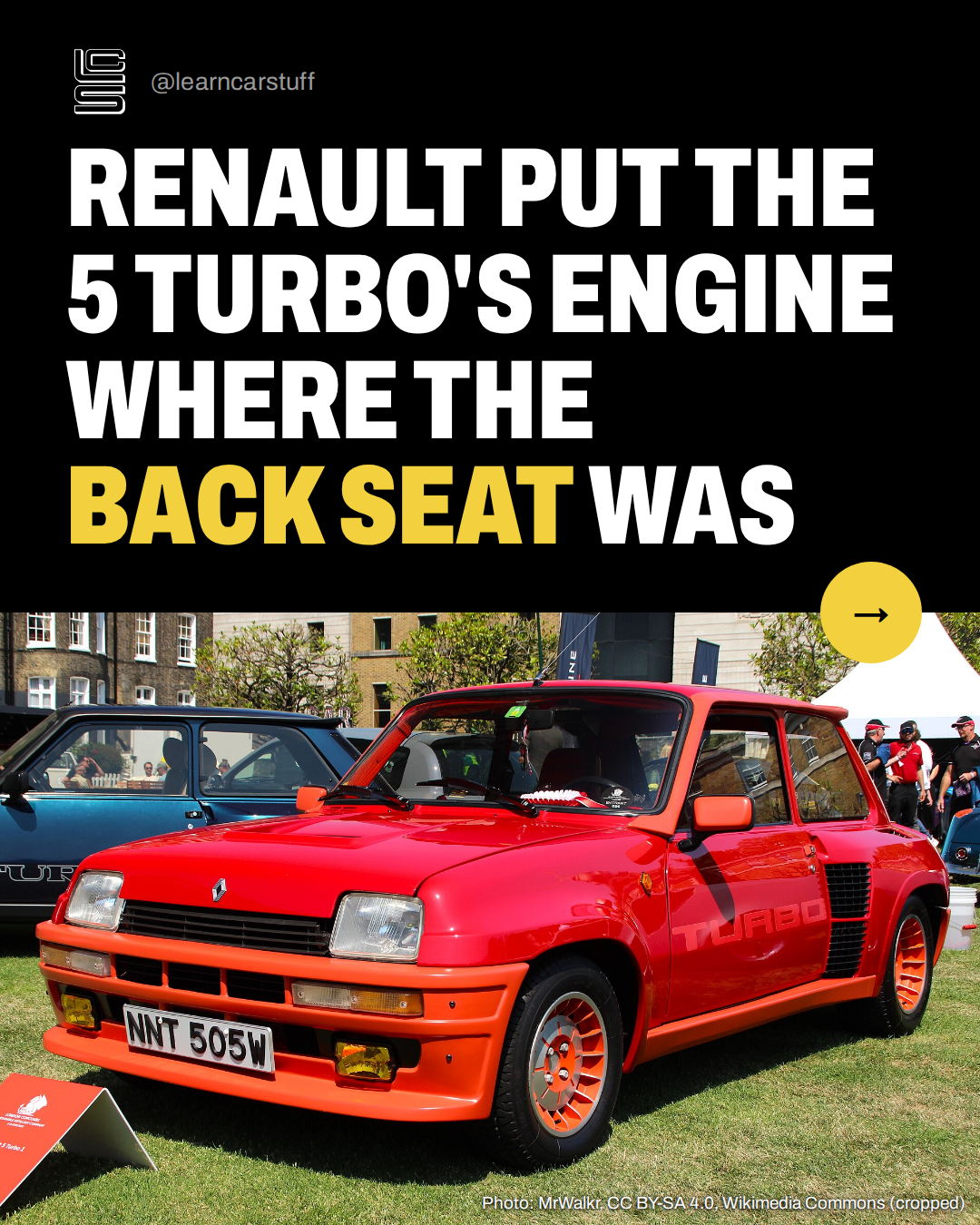
Renault put the 5 Turbo's engine where the back seat was
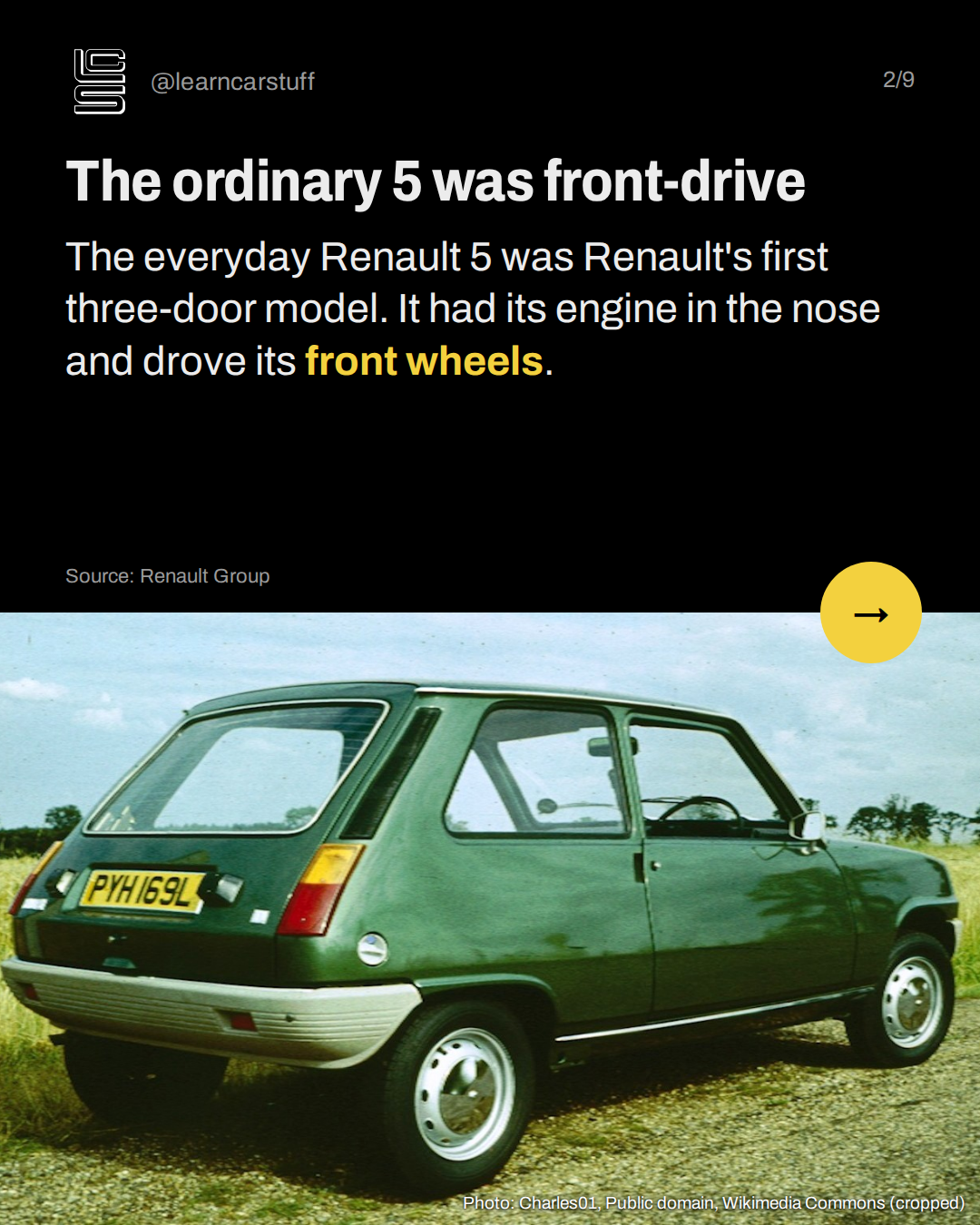
The ordinary 5 was front-drive
The everyday Renault 5 was Renault's first three-door model. It had its engine in the nose and drove its front wheels.
Source: Renault Group
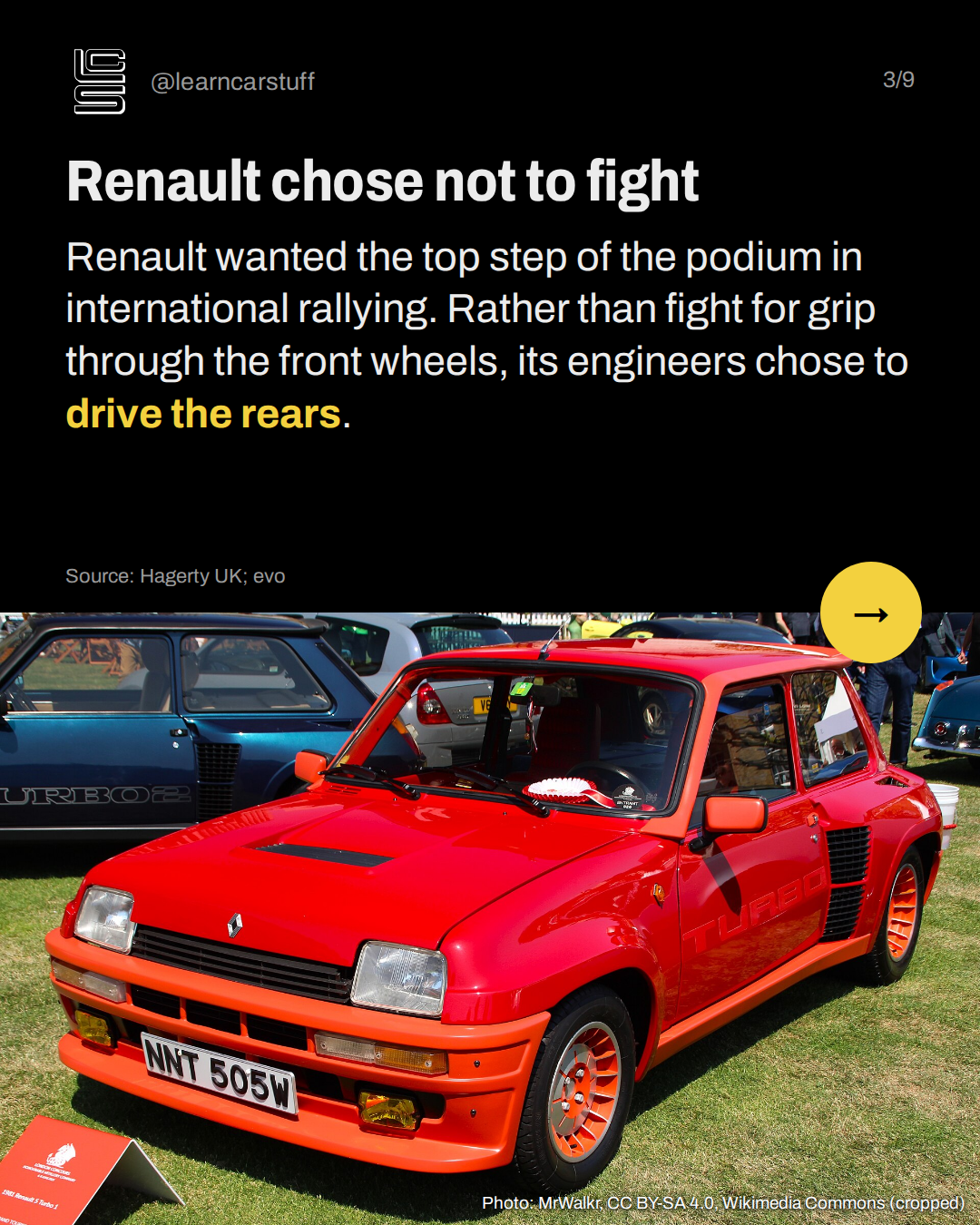
Renault chose not to fight
Renault wanted the top step of the podium in international rallying. Rather than fight for grip through the front wheels, its engineers chose to drive the rears.
Source: Hagerty UK; evo
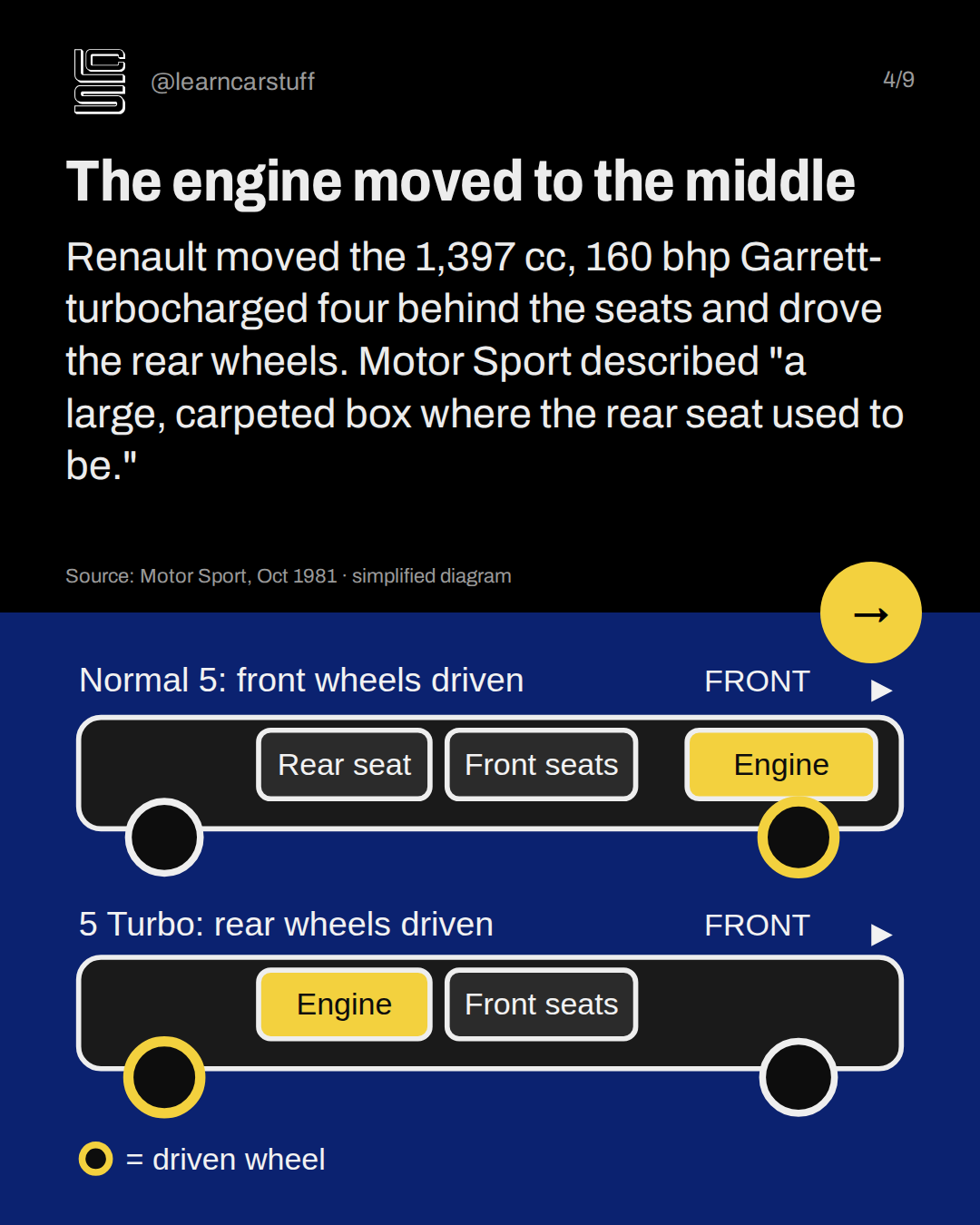
The engine moved to the middle
Renault moved the 1,397 cc, 160 bhp Garrett-turbocharged four behind the seats and drove the rear wheels. Motor Sport described "a large, carpeted box where the rear seat used to be."
Source: Motor Sport, Oct 1981 · simplified diagram
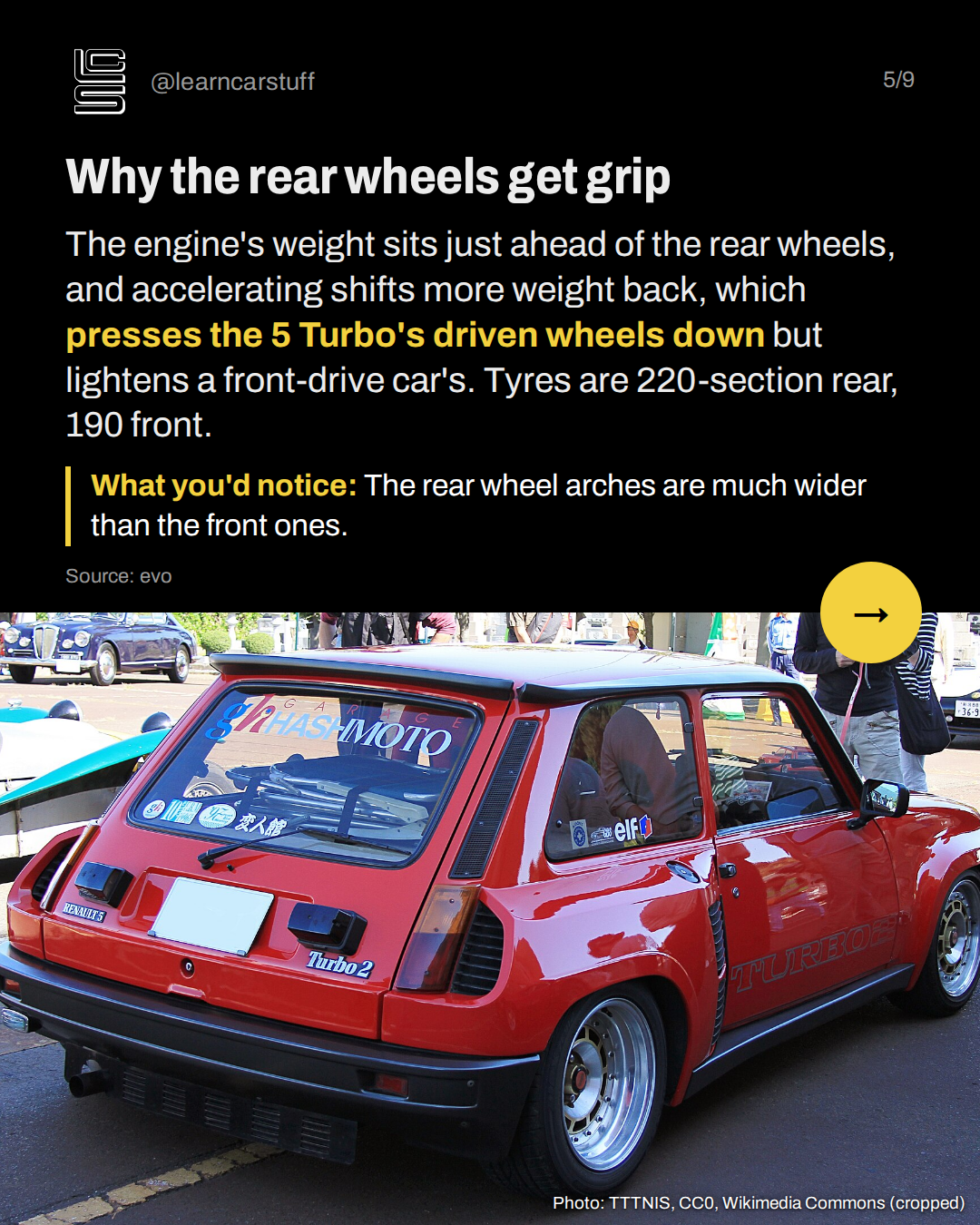
Why the rear wheels get grip
The engine's weight sits just ahead of the rear wheels, and accelerating shifts more weight back, which presses the 5 Turbo's driven wheels down but lightens a front-drive car's. Tyres are 220-section rear, 190 front.
What you'd notice: The rear wheel arches are much wider than the front ones.
Source: evo
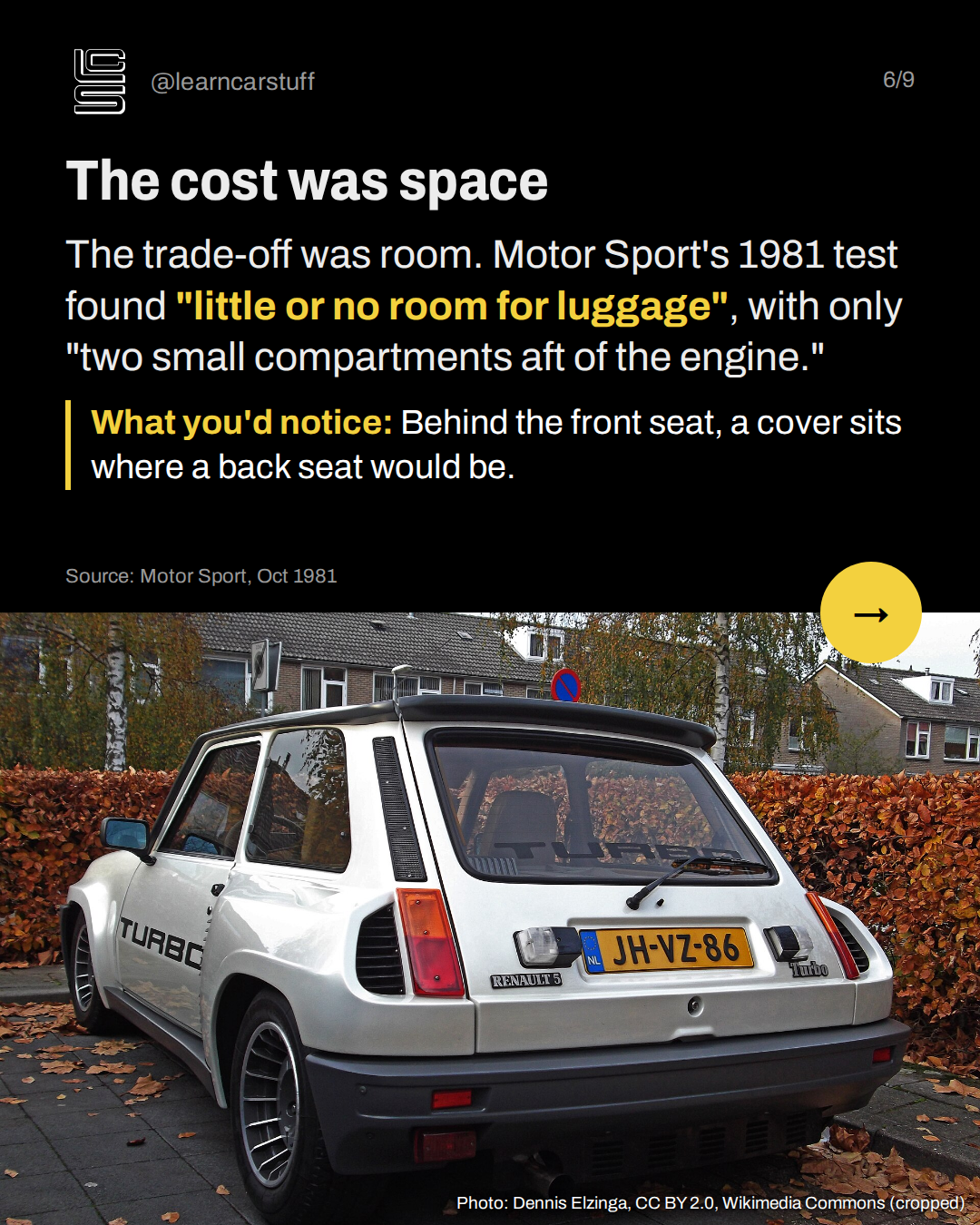
The cost was space
The trade-off was room. Motor Sport's 1981 test found "little or no room for luggage", with only "two small compartments aft of the engine."
What you'd notice: Behind the front seat, a cover sits where a back seat would be.
Source: Motor Sport, Oct 1981
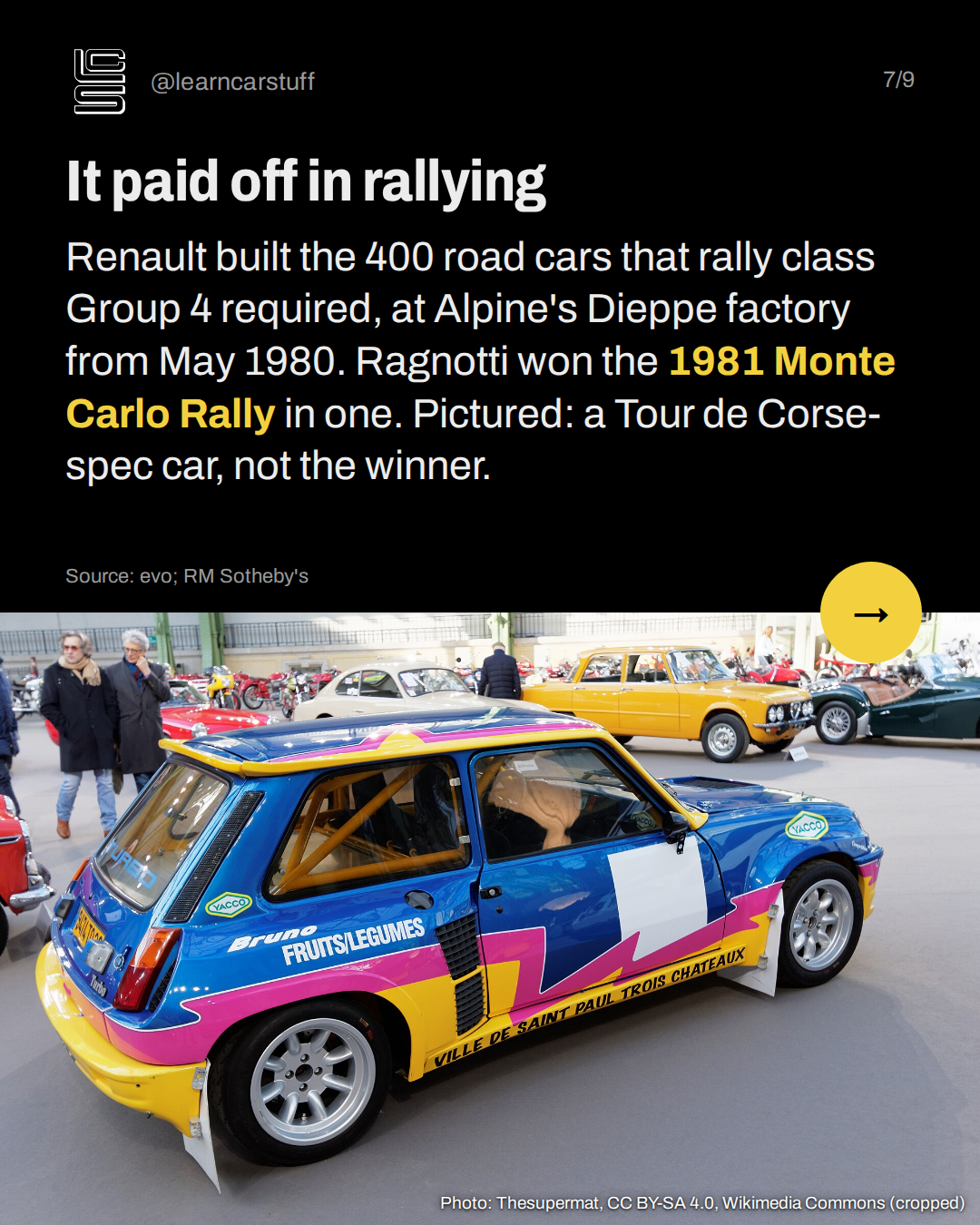
It paid off in rallying
Renault built the 400 road cars that rally class Group 4 required, at Alpine's Dieppe factory from May 1980. Ragnotti won the 1981 Monte Carlo Rally in one. Pictured: a Tour de Corse-spec car, not the winner.
Source: evo; RM Sotheby's
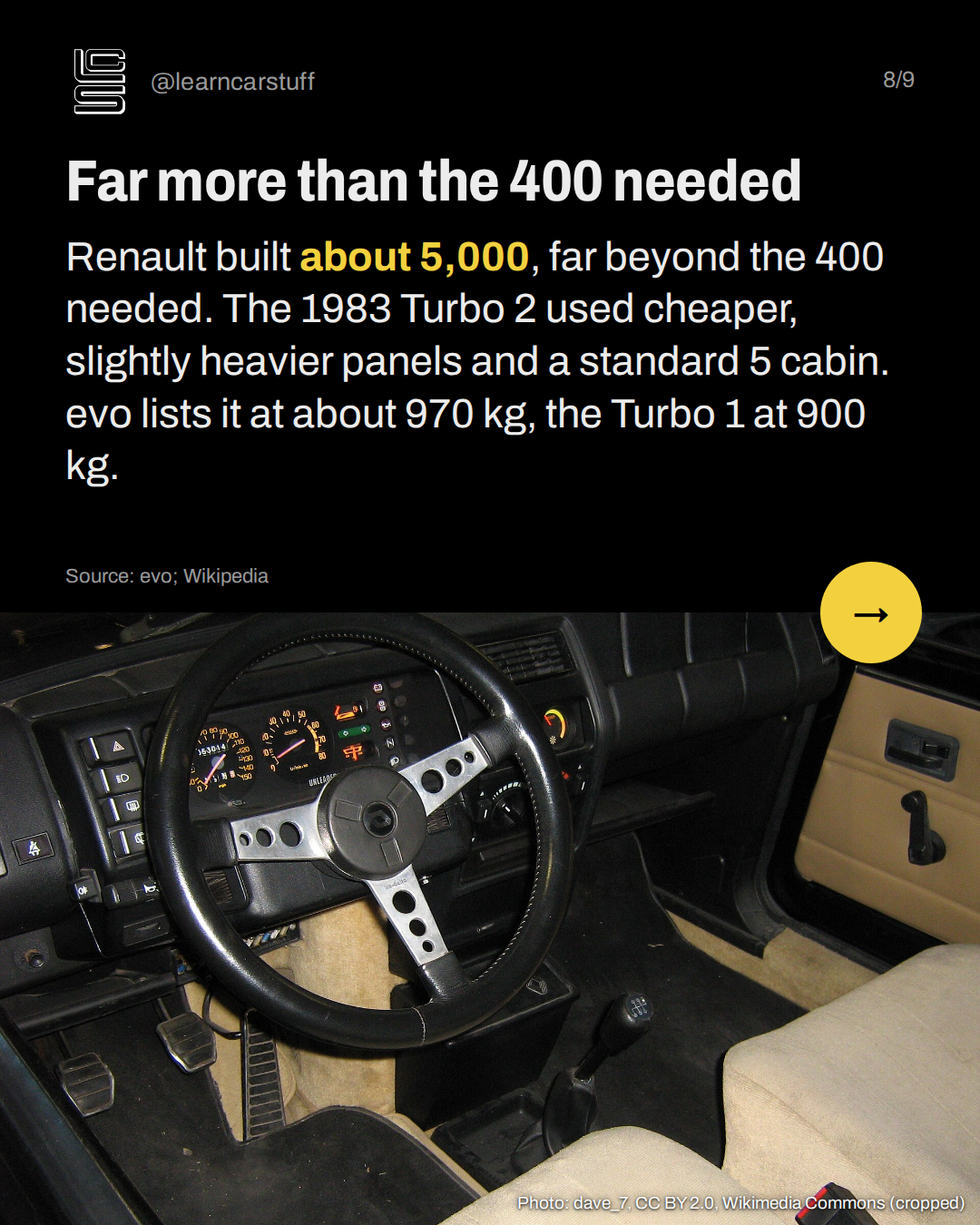
Far more than the 400 needed
Renault built about 5,000, far beyond the 400 needed. The 1983 Turbo 2 used cheaper, slightly heavier panels and a standard 5 cabin. evo lists it at about 970 kg, the Turbo 1 at 900 kg.
Source: evo; Wikipedia
Sources and assumptions
- Motor Sport magazine archive, 'Renault Rumblings', October 1981: 'Strictly a two seater, this mid-engined car has a large, carpeted box where the rear seat used to be'; 'little or no room for luggage, two small compartments aft of the engine'; 1,397 cc Bosch K-Jetronic fuel injected, Garrett turbocharged four-cylinder, 160 bhp at 6,000 rpm; kerb weight 2,137 lb; 0-60 mph in about 6.5 s; dry handling 'virtually neutral'; turbo lag can bring 'a sudden lump of power' in the wet (checked 2026-10-26)
- evo, 'Renault 5 Turbo: review, history and specs of an icon': 'Rather than fight with front-wheel drive, Renault's engineers dropped their 1.4-litre turbocharged engine between the rear wheels' in place of the rear seats; 160 bhp at 6,000 rpm and 163 lb ft at 3,250 rpm; Turbo 1 900 kg, Turbo 2 (1983) 970 kg with cheaper, slightly heavier panels and the cabin of a standard 5; tyres 190-section front and 220-section rear, a stagger to cope with the unusual weight distribution; a mid-corner throttle lift can wag the tail (checked 2026-10-26)
- evo, 'Renault 5 Turbo: Birth of an icon: 1980': The 1,397 cc engine from the Renault 5 Alpine, turbocharged from 93 bhp to 162 bhp, mounted centrally and driving the rear wheels; suspension parts from the Group 2 Renault 5 Alpine rally car and the Alpine A310; aluminium bonnet and doors; the 400 cars needed for Group 4 homologation built at the Alpine factory from May 1980; WRC debut at the 1980 Tour de Corse; first win at the 1981 Monte Carlo (checked 2026-10-26)
- Hagerty UK, 'The Renault R5 Turbo is smoking hot' (Revelations with Jason Cammisa): Renault moved the turbocharged engine 'to the back, where the back seats used to be'; the 5 Turbo was 'created to put Renault on the top step of podium in international rallying'; Renault sold thousands of them; the Turbo 2 lost exotic aluminium components (checked 2026-10-26)
- RM Sotheby's, 1980 Renault 5 Turbo Group 4 (lot, Monaco 2022): The homologation target of 400 production cars was met by the summer of 1980; the works car ran the 1980 Tour de Corse with Jean Ragnotti (checked 2026-10-26)
- Wikipedia, Renault 5 Turbo (secondary; used only for production totals and engine code): Rear mid-engine, rear-wheel drive; 1,397 cc Cléon-Fonte turbo four with a Garrett T3; total production 4,987 (1,820 Turbo 1, 3,167 Turbo 2), 1980 to 1984 at Alpine, Dieppe; 400 built for Group 4; Ragnotti won the 1981 Monte Carlo Rally (checked 2026-10-26)
- Renault Group, 'Renault 5, Supercar of the seventies and eighties': The ordinary Renault 5 was front-wheel drive, was 'Renault's first three-door model', had 782 cc and 956 cc engines at launch, and sold nearly 5.5 million by 1984 (checked 2026-10-26)
Assumptions:
- 'Where the back seat was' follows Motor Sport's 1981 wording ('where the rear seat used to be') and evo/Hagerty; the engine sits longitudinally ahead of the rear axle, behind the front seats.
- The weight-transfer explanation is general vehicle physics stated roughly. No verified front/rear weight percentage was found, so the post gives none.
- Power is quoted as 160 bhp (Motor Sport 1981 and evo); evo's feature quotes 162 bhp and Wikipedia quotes 160 PS. Use '160 bhp' and no more precision.
- Production totals (4,987: 1,820 Turbo 1, 3,167 Turbo 2) rely on Wikipedia, matched by Sports Car Market search results. Say 'about 5,000' if the reviewer wants a primary source.
- Wikipedia calls the 1981 Monte Carlo the car's first WRC outing, but evo and RM Sotheby's place its WRC debut at the 1980 Tour de Corse. Say only that it won the 1981 Monte Carlo Rally.
- The Turbo 1 vs Turbo 2 photo labels follow the Commons file names and the badges you can see ('Turbo 2' on the rear photos; the London Concours sign reads '1981 Renault 5 Turbo 1').
- Renault's own Renault Classic PDF and 'The Originals' museum page could not be opened (503 / binary PDF), so they are not cited.
Photos:
- Photo: MrWalkr, CC BY-SA 4.0, Wikimedia Commons (cropped)
- Photo: MrWalkr, CC BY-SA 4.0, Wikimedia Commons (cropped)
- Photo: Charles01, Public domain, Wikimedia Commons (cropped)
- Photo: TTTNIS, CC0, Wikimedia Commons (cropped)
- Photo: Dennis Elzinga, CC BY 2.0, Wikimedia Commons (cropped)
- Photo: Thesupermat, CC BY-SA 4.0, Wikimedia Commons (cropped)
- Photo: dave_7, CC BY 2.0, Wikimedia Commons (cropped)
The short version
- The ordinary 5 drove its front wheels.
- The Turbo put a 160 bhp engine behind the seats.
- It drove the rear wheels for more grip.
- The cost was luggage space.
- Renault built about 5,000 of them.