 Learn Car Stuff
The M1 missed its racing deadline, so BMW built a race series
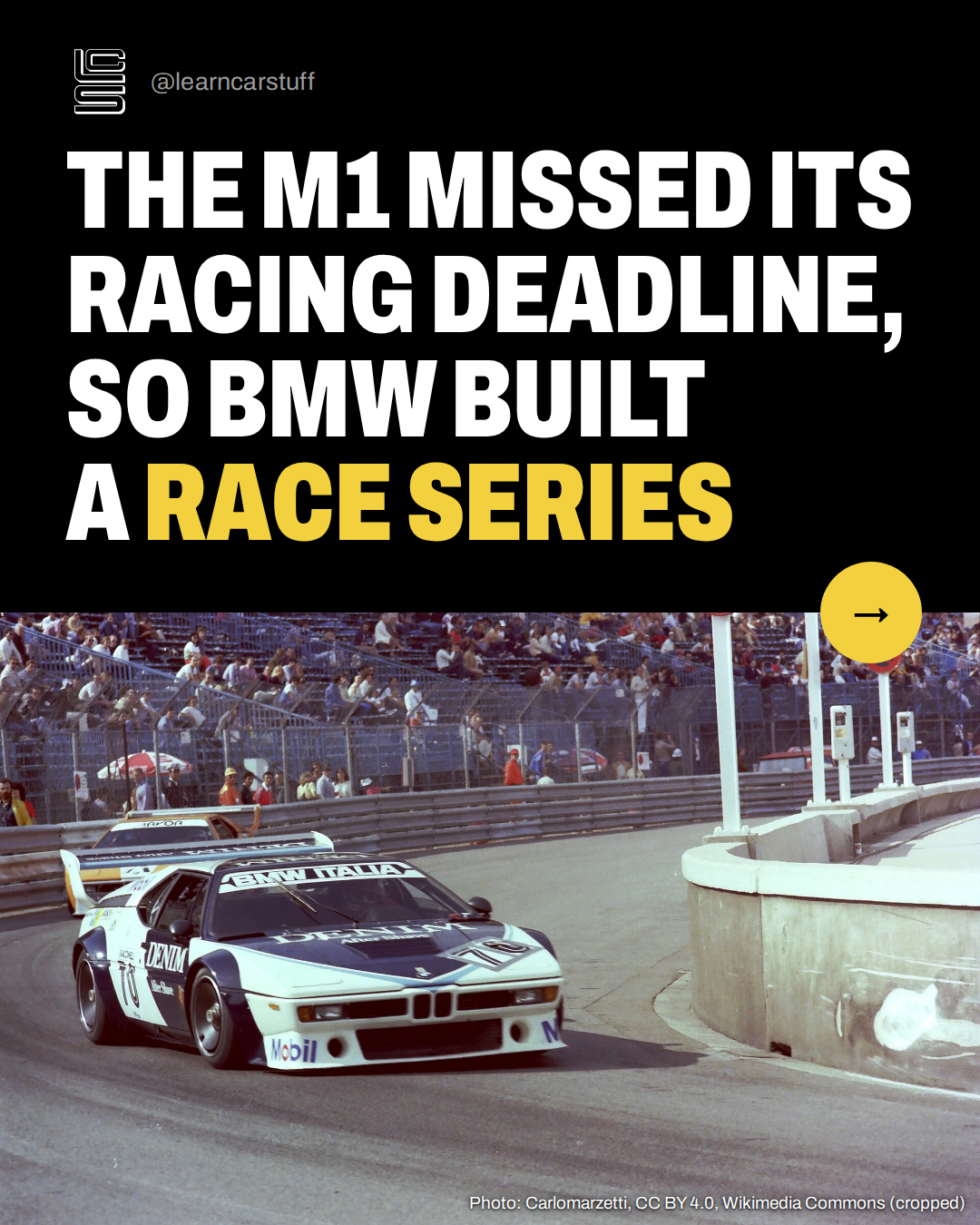
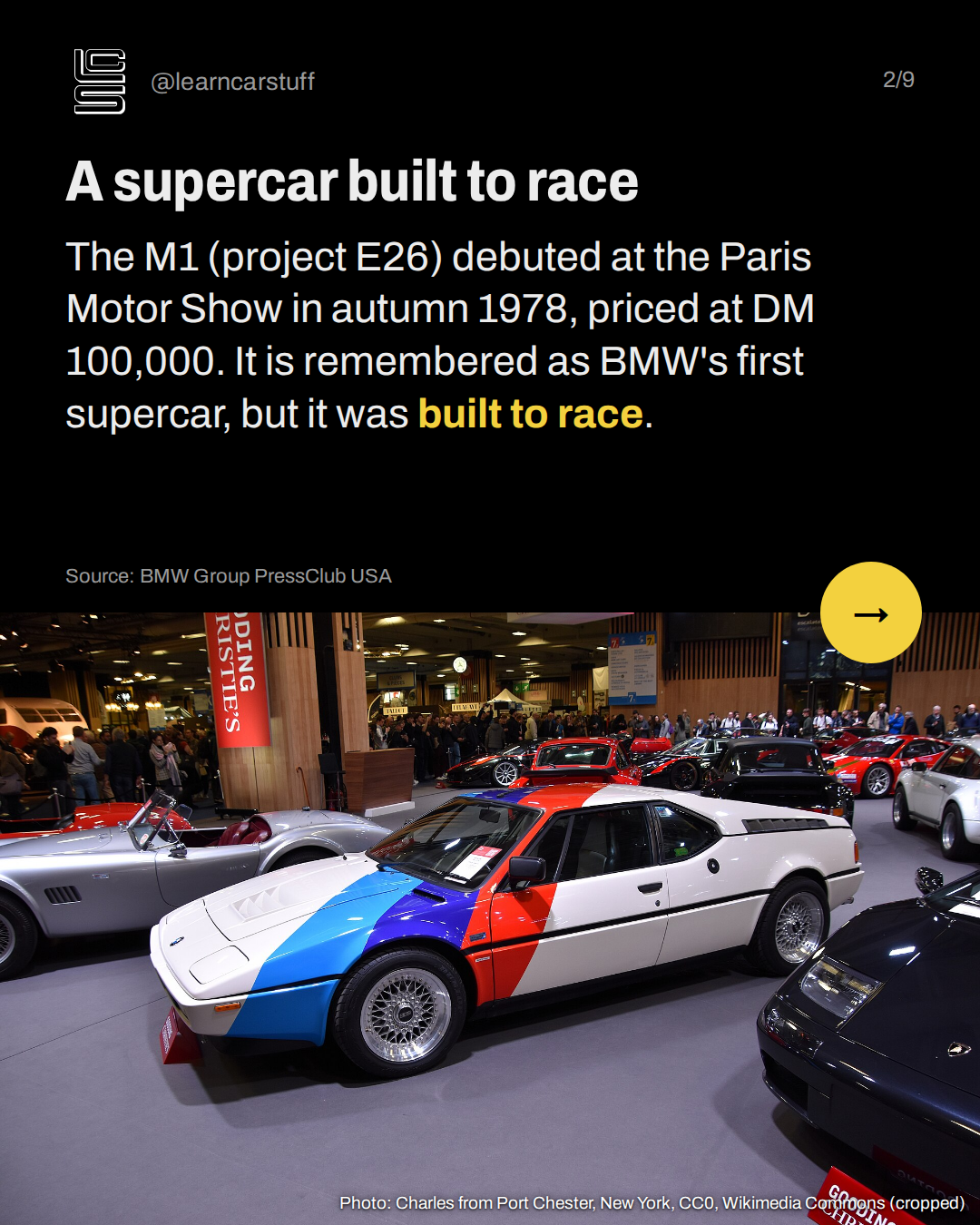
A supercar built to race
The M1 (project E26) debuted at the Paris Motor Show in autumn 1978, priced at DM 100,000. It is remembered as BMW's first supercar, but it was built to race.
Source: BMW Group PressClub USA
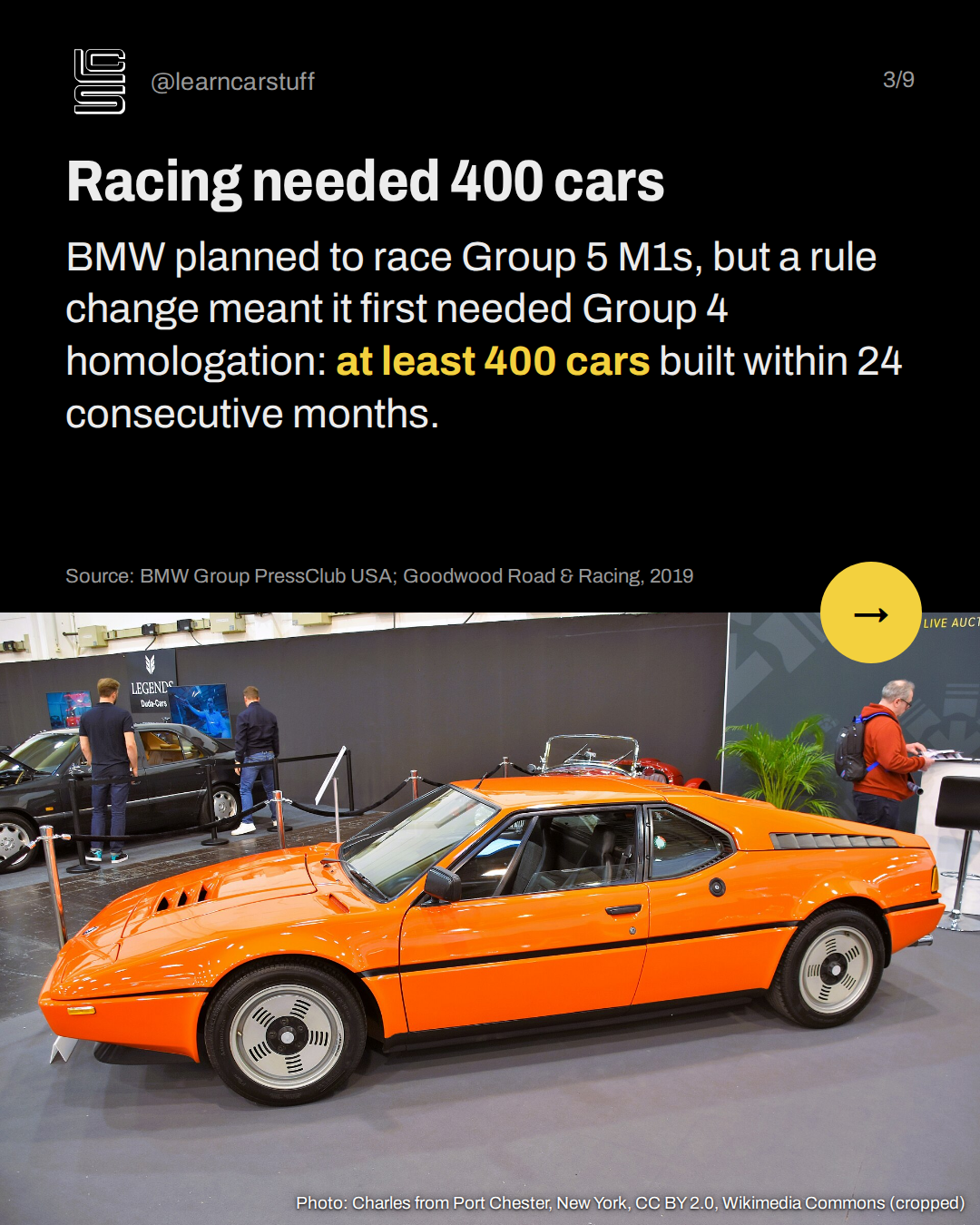
Racing needed 400 cars
BMW planned to race Group 5 M1s, but a rule change meant it first needed Group 4 homologation: at least 400 cars built within 24 consecutive months.
Source: BMW Group PressClub USA; Goodwood Road & Racing, 2019
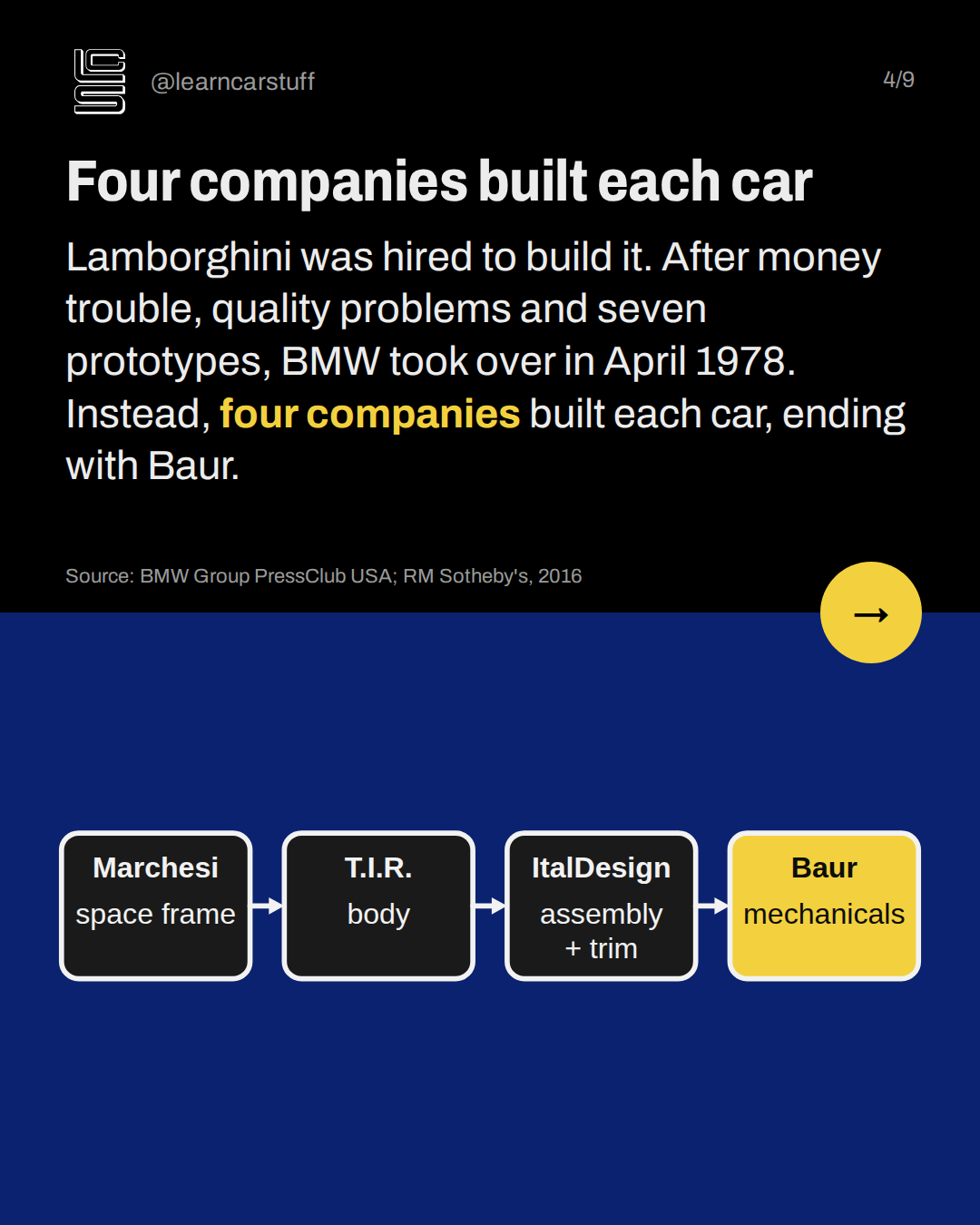
Four companies built each car
Lamborghini was hired to build it. After money trouble, quality problems and seven prototypes, BMW took over in April 1978. Instead, four companies built each car, ending with Baur.
Source: BMW Group PressClub USA; RM Sotheby's, 2016
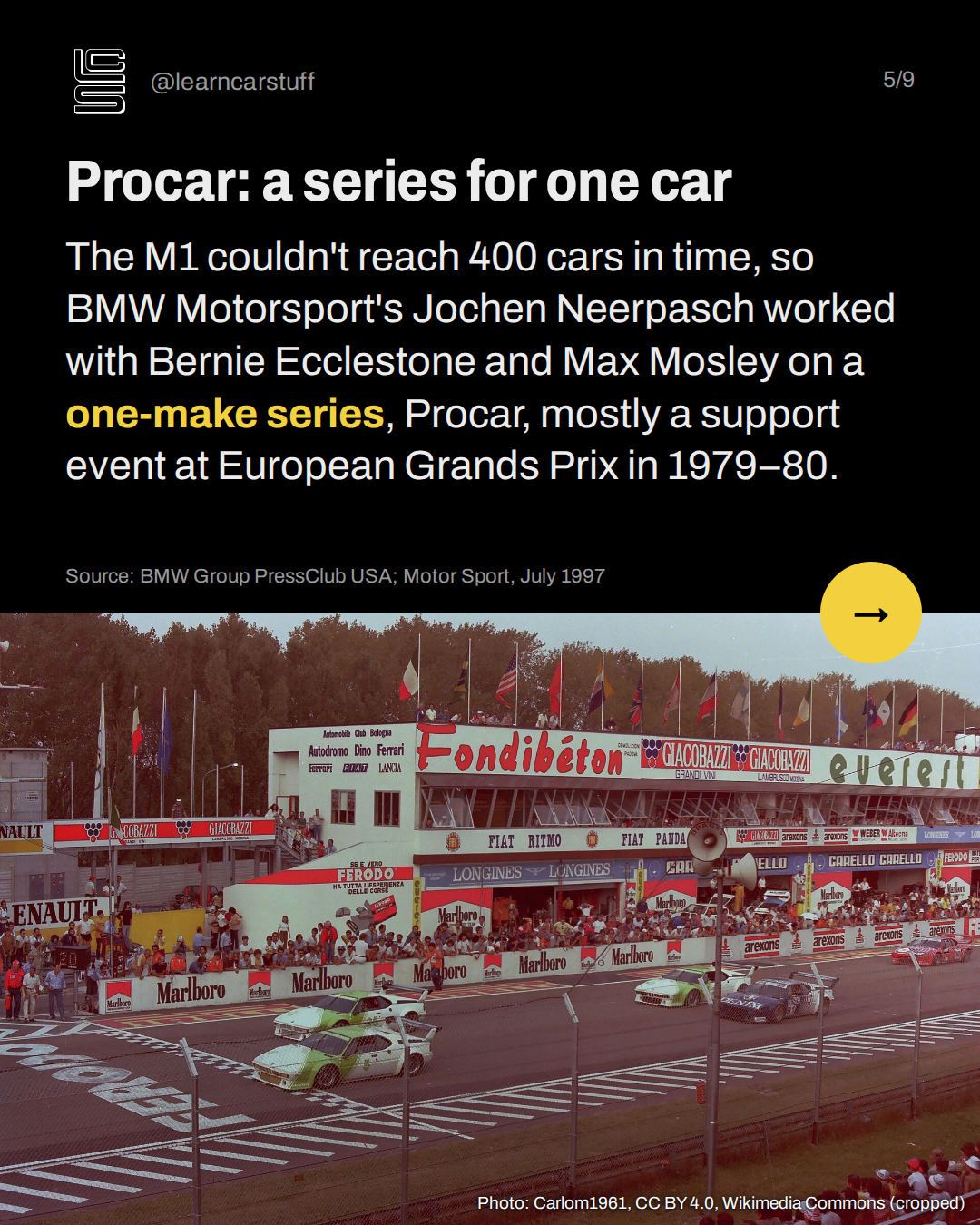
Procar: a series for one car
The M1 couldn't reach 400 cars in time, so BMW Motorsport's Jochen Neerpasch worked with Bernie Ecclestone and Max Mosley on a one-make series, Procar, mostly a support event at European Grands Prix in 1979–80.
Source: BMW Group PressClub USA; Motor Sport, July 1997
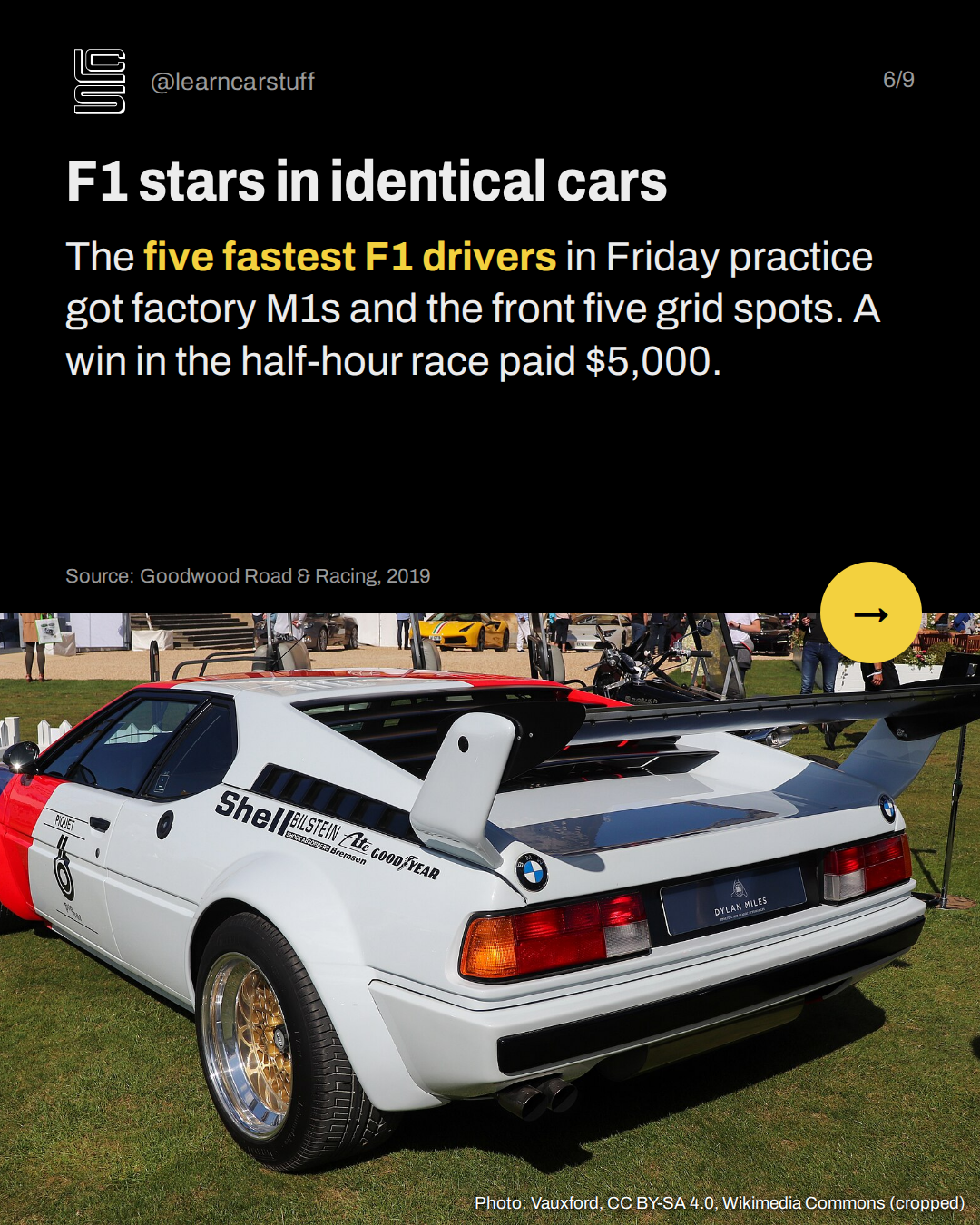
F1 stars in identical cars
The five fastest F1 drivers in Friday practice got factory M1s and the front five grid spots. A win in the half-hour race paid $5,000.
Source: Goodwood Road & Racing, 2019
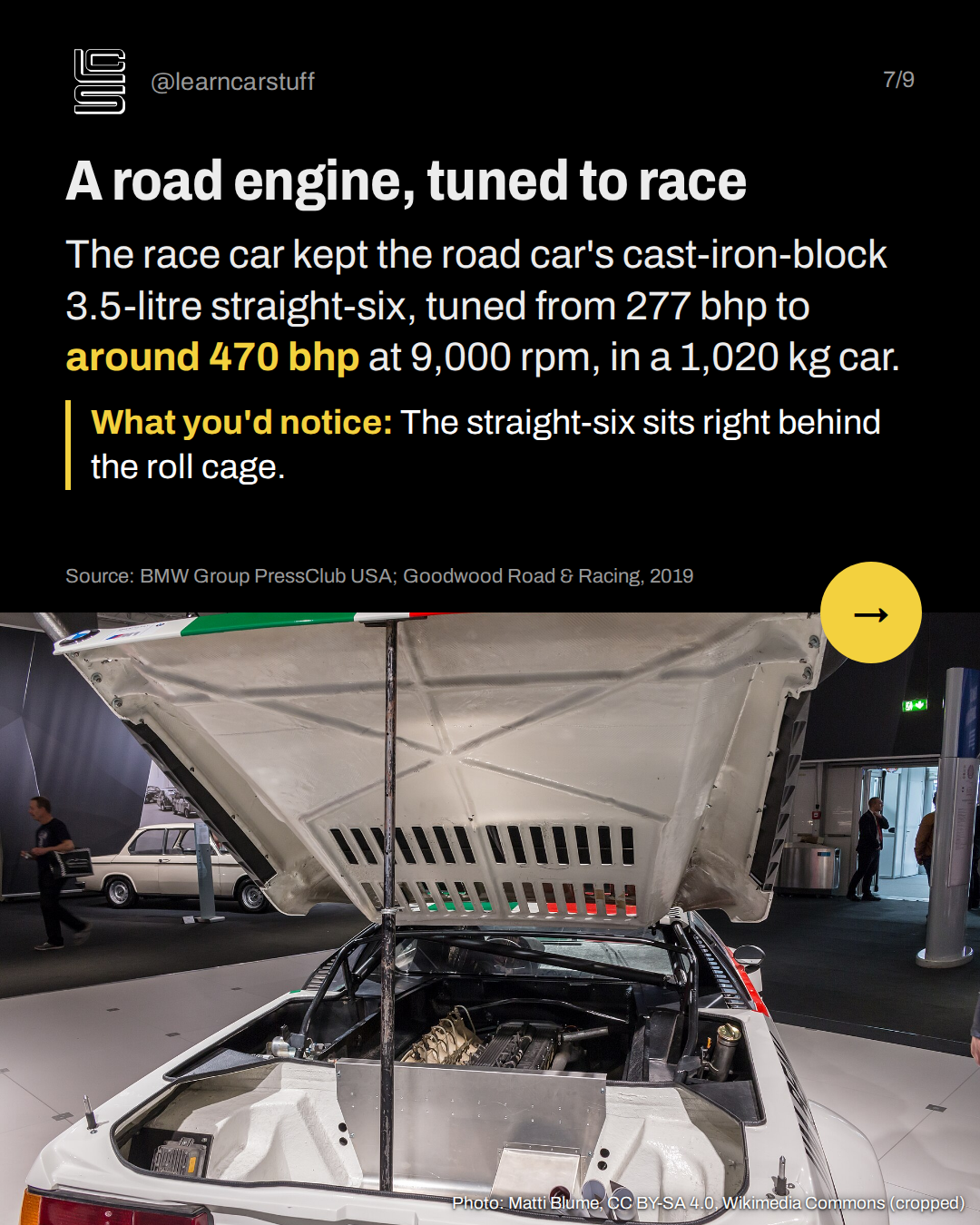
A road engine, tuned to race
The race car kept the road car's cast-iron-block 3.5-litre straight-six, tuned from 277 bhp to around 470 bhp at 9,000 rpm, in a 1,020 kg car.
What you'd notice: The straight-six sits right behind the roll cage.
Source: BMW Group PressClub USA; Goodwood Road & Racing, 2019
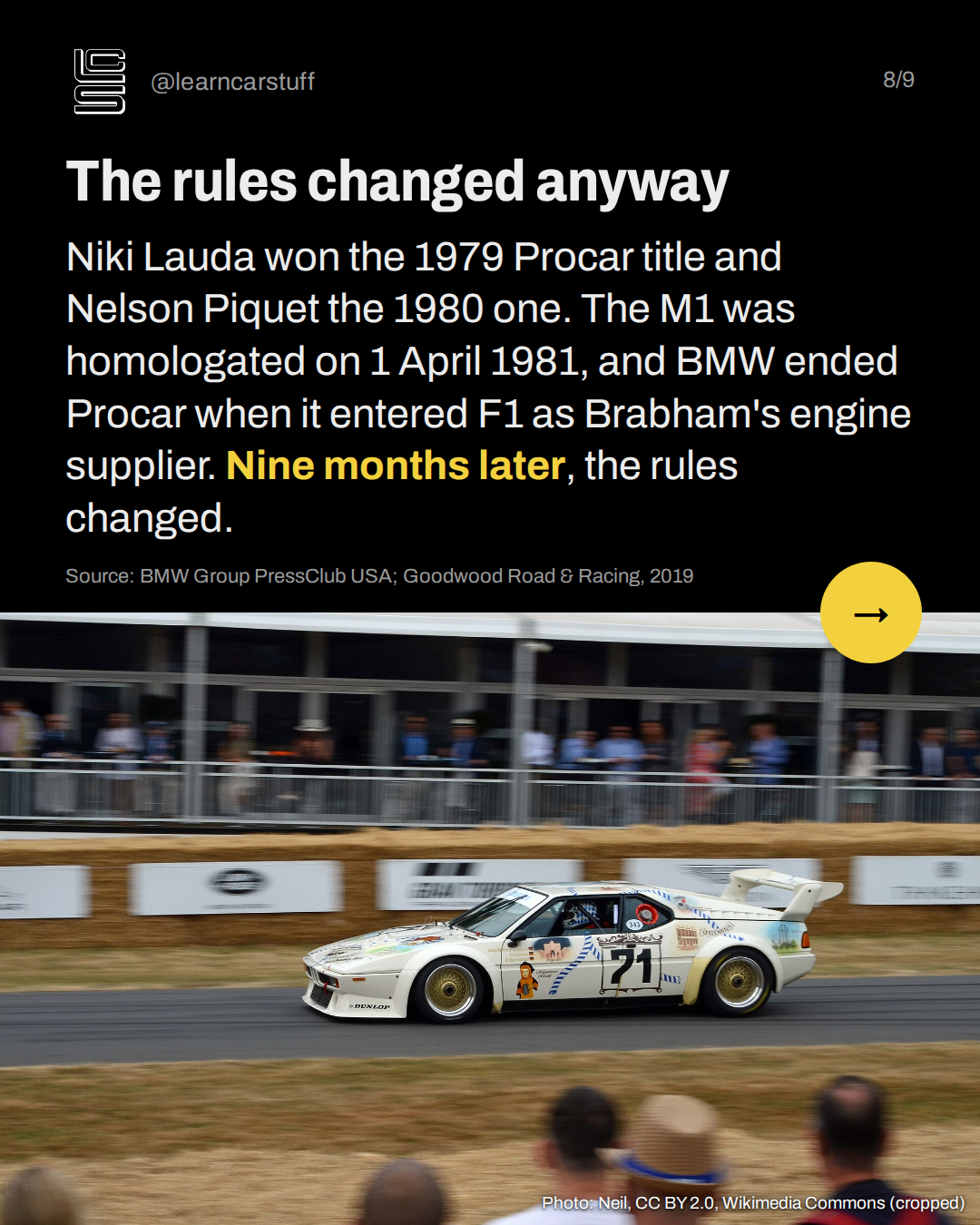
The rules changed anyway
Niki Lauda won the 1979 Procar title and Nelson Piquet the 1980 one. The M1 was homologated on 1 April 1981, and BMW ended Procar when it entered F1 as Brabham's engine supplier. Nine months later, the rules changed.
Source: BMW Group PressClub USA; Goodwood Road & Racing, 2019
Sources and assumptions
- BMW Group PressClub USA: Icons for connoisseurs: thirty years of the BMW M1: Lamborghini unable to assemble the car, so production went to Baur; build chain Marchesi (space frame), T.I.R. (body), ItalDesign (assembly + trim), Baur (mechanicals); Group 4 needed 400 units in 24 successive months; Procar created by Neerpasch, Ecclestone and Mosley, raced before European F1 GPs in 1979/80; the fastest five F1 drivers in Friday practice raced 15 touring car specialists; Procar engines 470–490 bhp, race car 1,020 kg; Lauda 1979 champion with three wins and one second in eight races; Piquet 1980 champion after winning the last three races; production ended 1981 at 445 units (399 road, 46 Procar); M88 3,453 cc, 204 kW/277 bhp at 6,500 rpm; homologated 1 April 1981, rules changed nine months later; Paris Motor Show autumn 1978; price DM 100,000 (checked 2026-10-26)
- Goodwood Road & Racing, Doug Nye: How the BMW M1 Procar Championship was born (2019-02-01): Lamborghini subcontracted to build M1s for homologation, but problems including product quality made BMW take the programme back in-house; BMW planned Group 5 M1s, but a rule change required 400 Group 4 M1s first; Neerpasch suggested the one-make series alongside the most prominent GP rounds; the five fastest F1 drivers from practice got factory cars and were guaranteed the top five grid positions; prize money $5,000/$3,000/$1,000 for a half-hour race; cast-iron-block 3.5-litre M88 tuned to around 470 bhp at 9,000 rpm; Elio de Angelis won the opening round at Zolder (checked 2026-10-26)
- RM Sotheby's, 1979 BMW M1 (Arizona 2016, lot 114): Lamborghini's already precarious financial situation worsened, and after seven prototypes BMW took over control of the project in April 1978; about 450 M1s built, about 50 of them racing cars (checked 2026-10-26)
- Goodwood Road & Racing: The BMW M1 Procar Championship saw the birth of an icon: Lauda first Procar champion 1979, Piquet 1980; five fastest drivers from Friday practice guaranteed a factory team place; BMW ended Procar when it entered F1 as Brabham's engine supplier in 1981; Group 4 homologation achieved in time for the 1981 World Sportscar Championship (checked 2026-10-26)
- Motor Sport magazine archive, July 1997: Procar, the ultimate one-make racer: Neerpasch worked with Mosley and Ecclestone to create Procar as a GP support event; 3.5-litre straight-six about 470 bhp; Lauda 1979, Piquet 1980 (checked 2026-10-26)
Assumptions:
- Production totals differ by source: BMW's own press release says 445 (399 road, 46 Procar), RM Sotheby's says about 450 (about 50 racing), and some photo captions say 460. Slides use BMW's 445 / 399 / 46 and say 'BMW's count'.
- Power for the Procar is 'around 470 bhp' (Goodwood, Motor Sport); BMW gives a 470–490 bhp range. Use 'around 470 bhp' and don't give a single exact figure.
- In 1980 the series also held some rounds that weren't at a Grand Prix (secondary sources), so describe Procar as 'mostly run before European Grands Prix' or as a 1979–80 GP support series, not 'only at Grands Prix'.
- Lamborghini's exit has two documented causes, money trouble (RM Sotheby's) and quality and production problems (Goodwood, BMW). Name both and don't single out one.
- Not every driver on the grid was in F1: only the five fastest F1 qualifiers got factory cars, racing against touring car and sports car specialists and privateers.
- The 'rules changed nine months later' wording is BMW's own. Don't name the new rule category, since the source doesn't.
Photos:
- Photo: Carlomarzetti, CC BY 4.0, Wikimedia Commons (cropped)
- Photo: Carlom1961, CC BY 4.0, Wikimedia Commons (cropped)
- Photo: Charles from Port Chester, New York, CC BY 2.0, Wikimedia Commons (cropped)
- Photo: Charles from Port Chester, New York, CC0, Wikimedia Commons (cropped)
- Photo: Matti Blume, CC BY-SA 4.0, Wikimedia Commons (cropped)
- Photo: Vauxford, CC BY-SA 4.0, Wikimedia Commons (cropped)
- Photo: Neil, CC BY 2.0, Wikimedia Commons (cropped)
The short version
- Group 4 needed 400 cars in 24 months
- BMW couldn't build them in time
- So it made Procar for the M1
- Lauda won in 1979, Piquet in 1980