 Learn Car Stuff
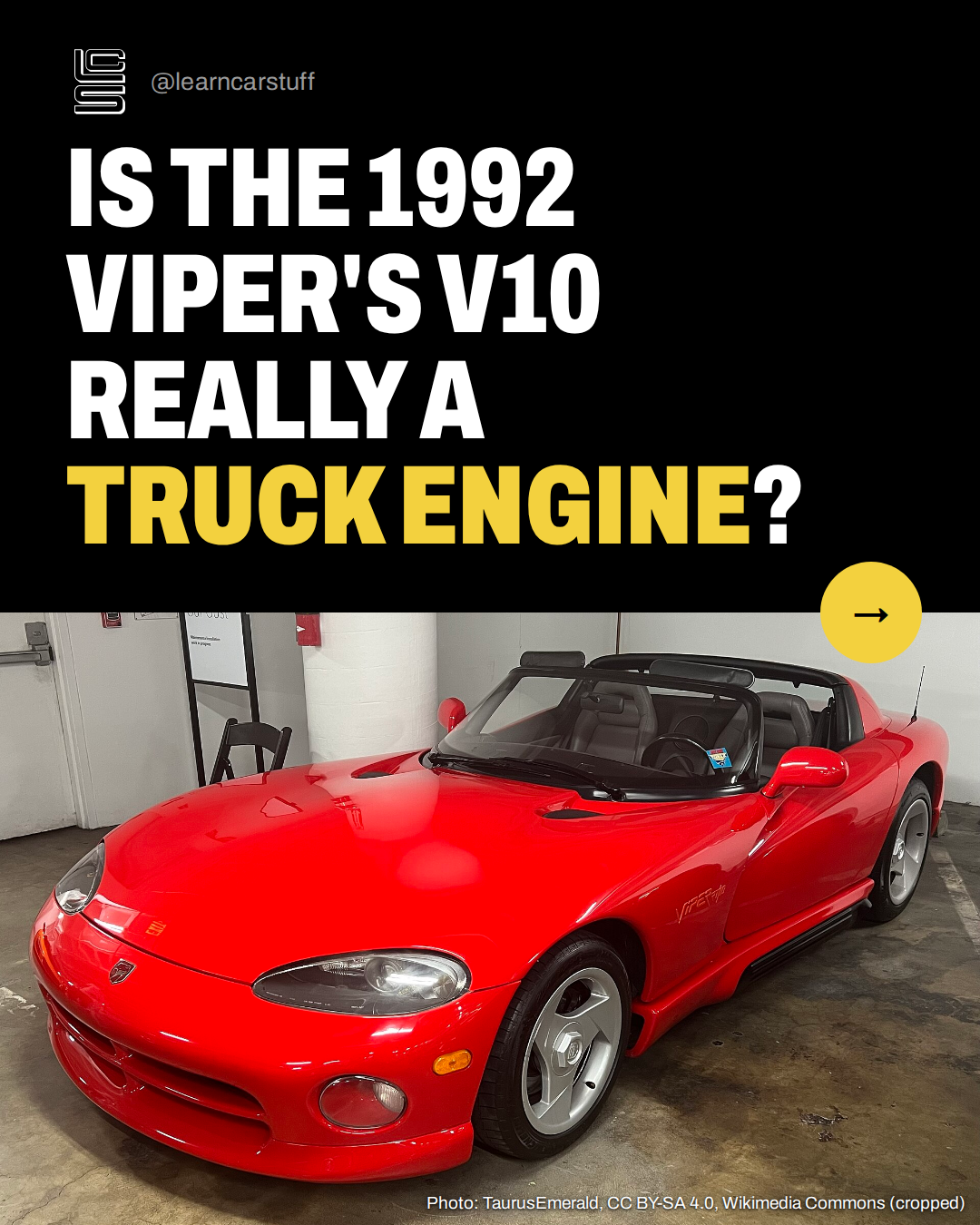
Is the 1992 Viper's V10 really a truck engine?
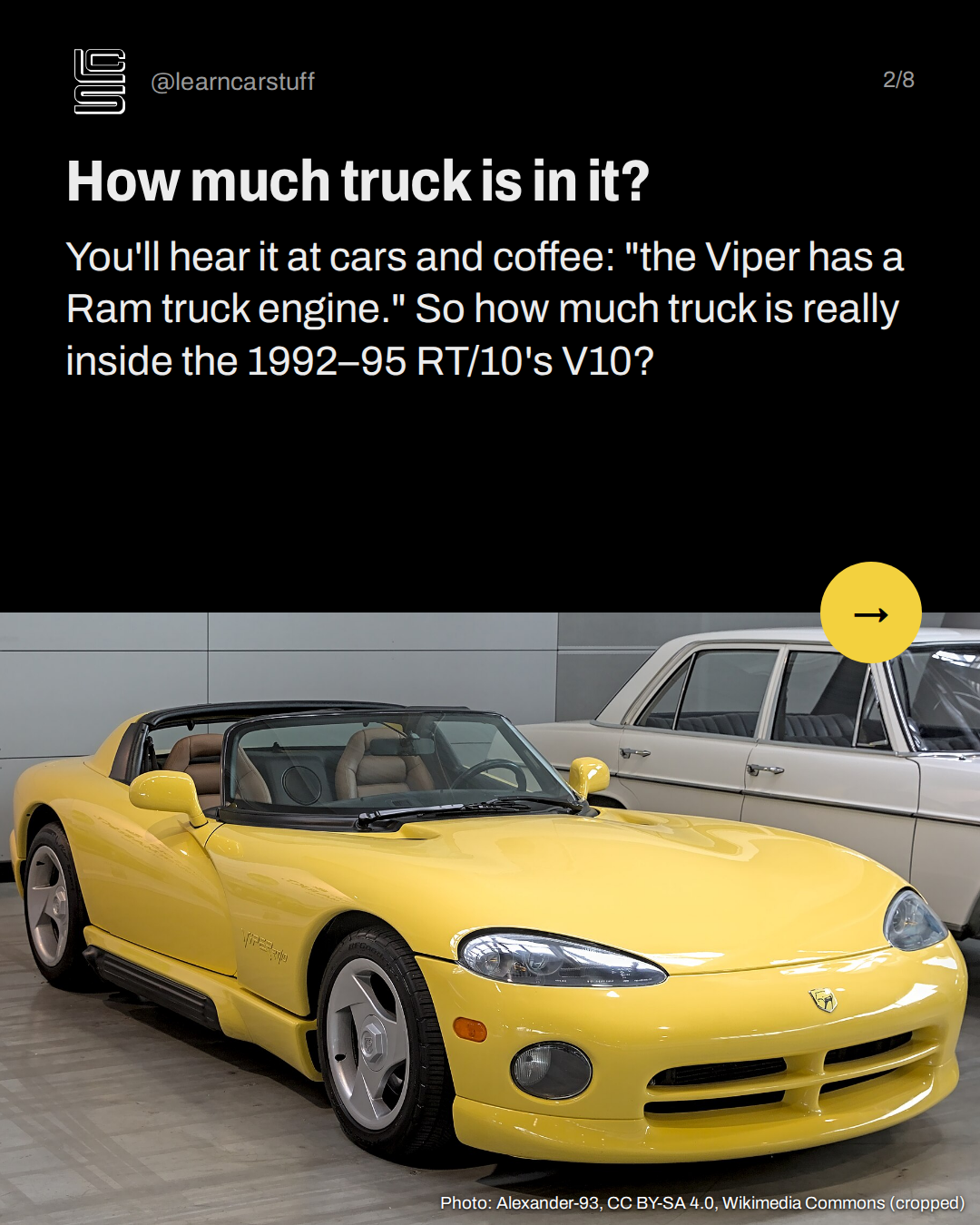
How much truck is in it?
You'll hear it at cars and coffee: "the Viper has a Ram truck engine." So how much truck is really inside the 1992–95 RT/10's V10?
Chrysler had a budget problem
Bob Lutz and Tom Gale started the Viper in 1988 as a modern Cobra. Chrysler had no large budget for a new engine, but it had a cast-iron V10 in development for heavy-duty Ram pickups.
Source: MotoIQ; Retro Rides
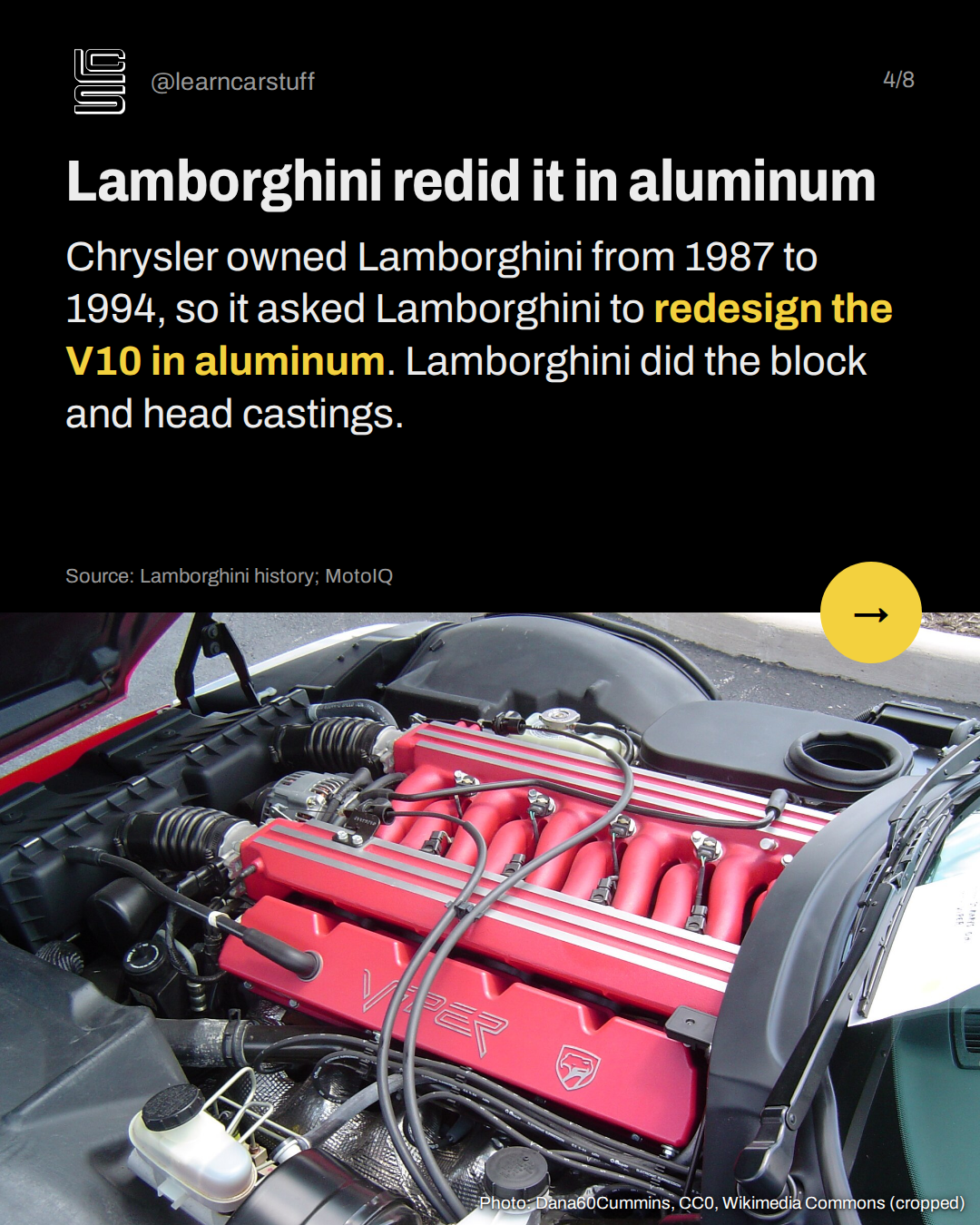
Lamborghini redid it in aluminum
Chrysler owned Lamborghini from 1987 to 1994, so it asked Lamborghini to redesign the V10 in aluminum. Lamborghini did the block and head castings.
Source: Lamborghini history; MotoIQ
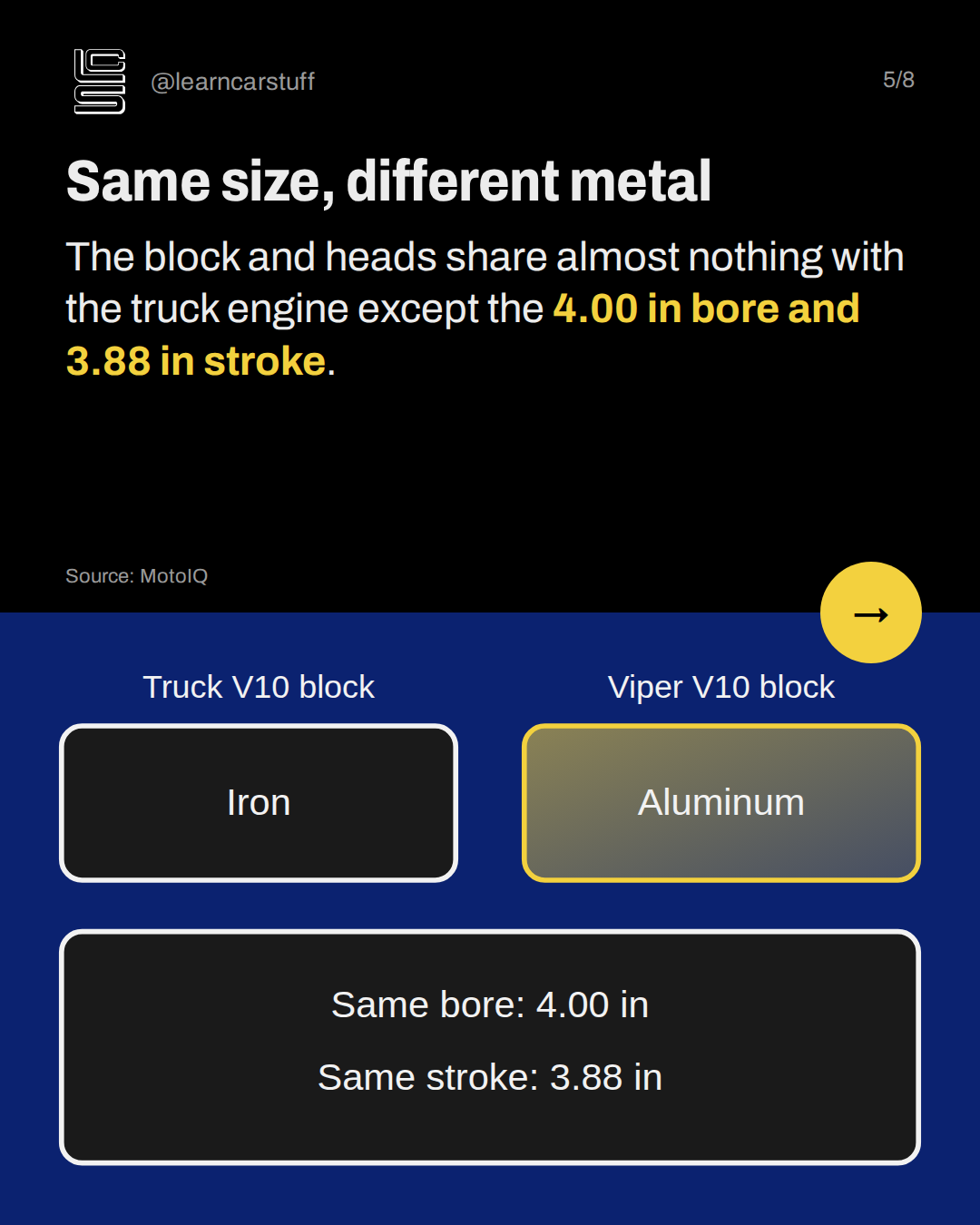
Same size, different metal
The block and heads share almost nothing with the truck engine except the 4.00 in bore and 3.88 in stroke.
Source: MotoIQ
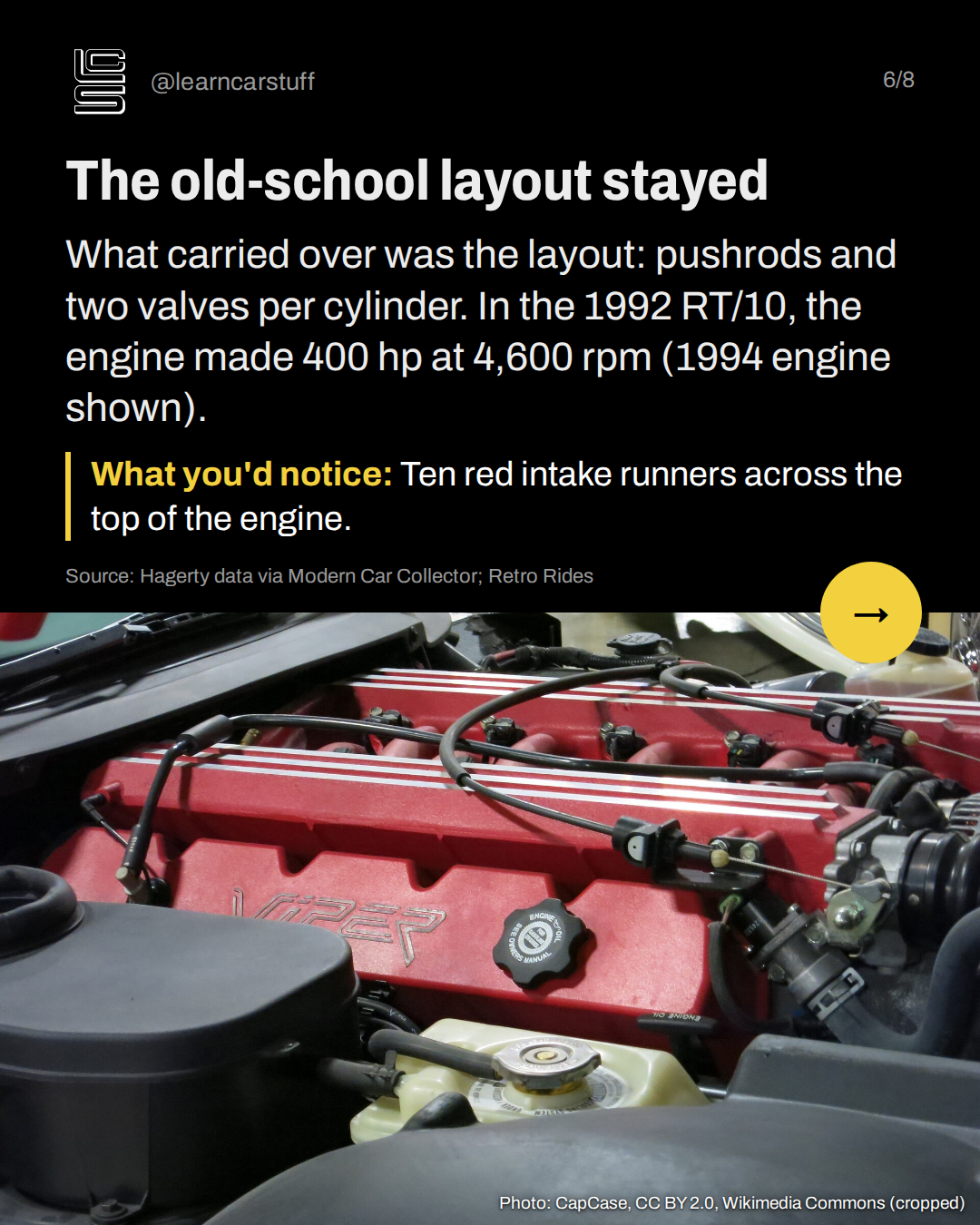
The old-school layout stayed
What carried over was the layout: pushrods and two valves per cylinder. In the 1992 RT/10, the engine made 400 hp at 4,600 rpm (1994 engine shown).
What you'd notice: Ten red intake runners across the top of the engine.
Source: Hagerty data via Modern Car Collector; Retro Rides
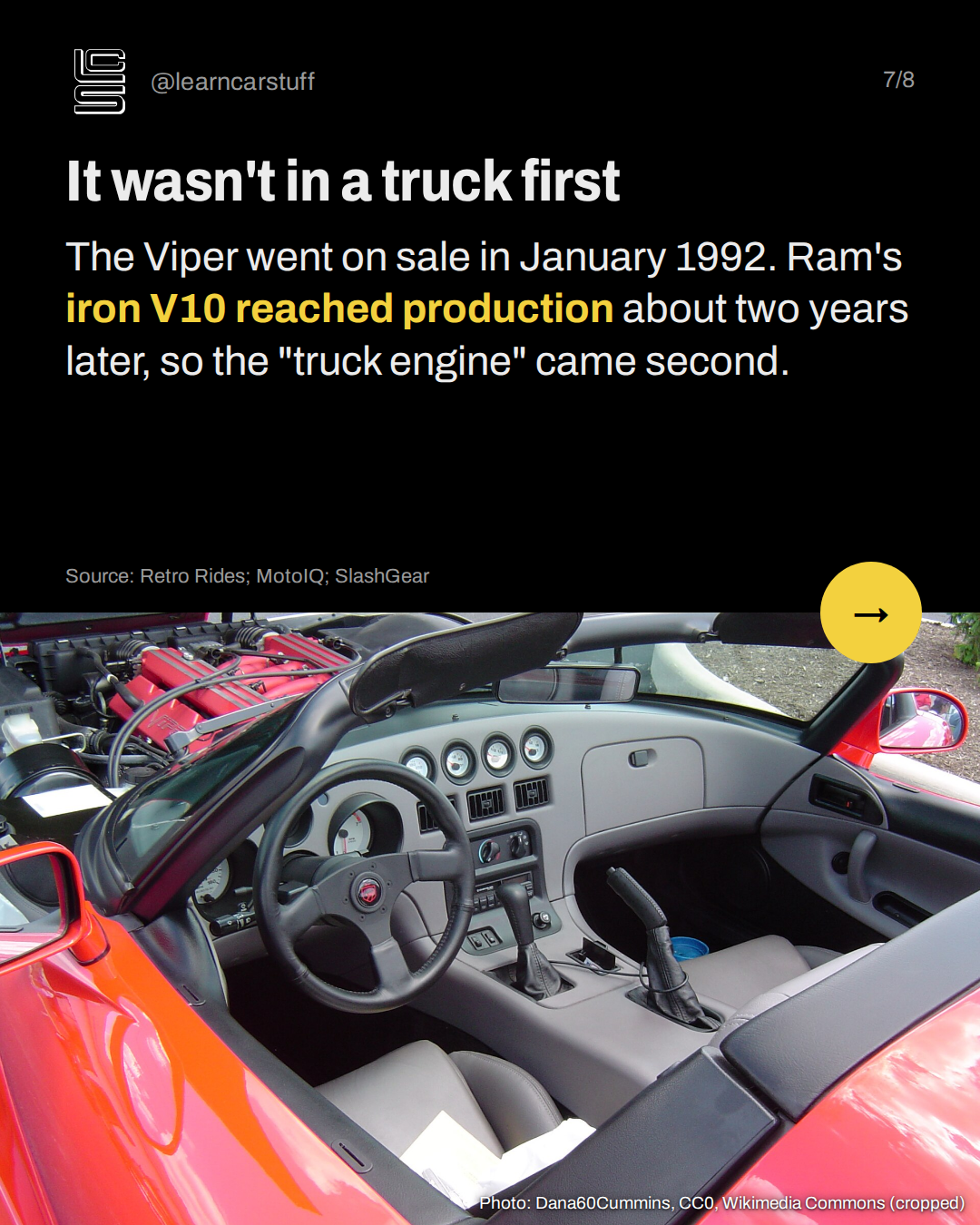
It wasn't in a truck first
The Viper went on sale in January 1992. Ram's iron V10 reached production about two years later, so the "truck engine" came second.
Source: Retro Rides; MotoIQ; SlashGear
Sources and assumptions
- MotoIQ, Project Viper GTS: Part 1 – Intro and History: Chrysler had no large budget for a new powertrain but had a cast-iron V10 in development for an upcoming Ram Heavy Duty; Lamborghini was responsible for the design, manufacturing and casting processes of the all-aluminum V10 and completely changed the design for aluminum; heads and block share virtually nothing with the truck engine beyond the 4.00 in bore and 3.88 in stroke; the Ram's cast-iron V10 entered production 2 years after the Viper (checked 2026-10-25)
- Modern Car Collector / Yahoo Autos, Dodge Viper RT/10 (1992–1995): Collector Spec Sheet (cites Hagerty data), published 2026-10-13: 8.0-liter (488 cu in) V10, aluminum block and heads, two valves per cylinder, pushrod; 400 hp; developed with help from Lamborghini; began as a Dodge truck engine concept before Chrysler asked Lamborghini to help design an aluminum block and heads; production 285 (1992), 1,043 (1993), 3,083 (1994), 1,577 (1995), 5,988 total; 1992 cars all red with gray interior (checked 2026-10-25)
- Automobili Lamborghini, History milestones: Chrysler, under CEO Lee Iacocca, acquired Lamborghini from the Mimran Group in 1987 and sold it to the Indonesian fund Megatech in 1994 (checked 2026-10-25)
- SlashGear, Here's What Made The Dodge Viper V10 Engine So Special (credits former Viper powertrain engineer Dick Winkles): The Viper's V10 predated the Ram truck V10s by two years; bespoke aluminum block with engineering help from Lamborghini, owned by Chrysler 1987–1994; first-gen 400 hp (checked 2026-10-25)
- Retro Rides, Rear View: 1992 Dodge Viper: Lutz–Gale conversation in early 1988; prototype at the January 1989 Detroit show; Lamborghini, then owned by Chrysler, did all the castings; aluminum vs cast iron saved some 75 kg (one account; not used on slides); 285 built in the first year; 4,600 rpm power peak (checked 2026-10-25)
- Wikipedia, Dodge Viper (SR I): Background only: project started 1988 when Lutz suggested a modern Cobra to Tom Gale; 1989 NAIAS concept; Team Viper under chief engineer Roy Sjoberg; sales began January 1992; 400 hp at 4,600 rpm (checked 2026-10-25)
- Wikipedia, Viper engine: Background only: 90-degree pushrod V10, 2 valves per cylinder; 7,990 cc; bore 4.00 in (101.6 mm), stroke 3.88 in (98.6 mm); first-gen 400 hp at 4,600 rpm (checked 2026-10-25)
Assumptions:
- 'Truck engine' here means the cast-iron 8.0 V10 Chrysler developed for heavy-duty Ram pickups (sold in Ram 2500/3500s); the post compares the 1992–95 Viper RT/10 engine with that engine only, not with later Viper generations.
- The 'about two years later' timing for the Ram V10 rests on MotoIQ and SlashGear (citing a Viper powertrain engineer), not on a Chrysler document; slides say 'about two years later' and give no exact Ram model year.
- Torque is left off the slides on purpose: Hagerty-based sources give 450 lb-ft, while Car and Driver and Wikipedia's SR I page give 465 lb-ft for the same engine.
- Engine weight and the iron-to-aluminum weight saving are left off the slides: the sources disagree (625, about 700 and 712 lb engine weight; roughly 75 kg or 160 lb saved).
- No source says why the pushrod, two-valve layout was kept. The post states only that it carried over and must not give a reason (such as packaging or hood height) as fact.
- The sequential vs group-fired injection difference comes from a Viper engineer's quote in Daniel F. Carney's book, which I saw only as a search snippet. If the writer uses it, it should be marked optional or dropped. It is not needed for the thesis.
Photos:
The fair version
- Same bore and stroke as the Ram V10
- Aluminum block and heads, redone by Lamborghini
- Pushrods and two valves carried over
- The Viper reached production first