 Learn Car Stuff
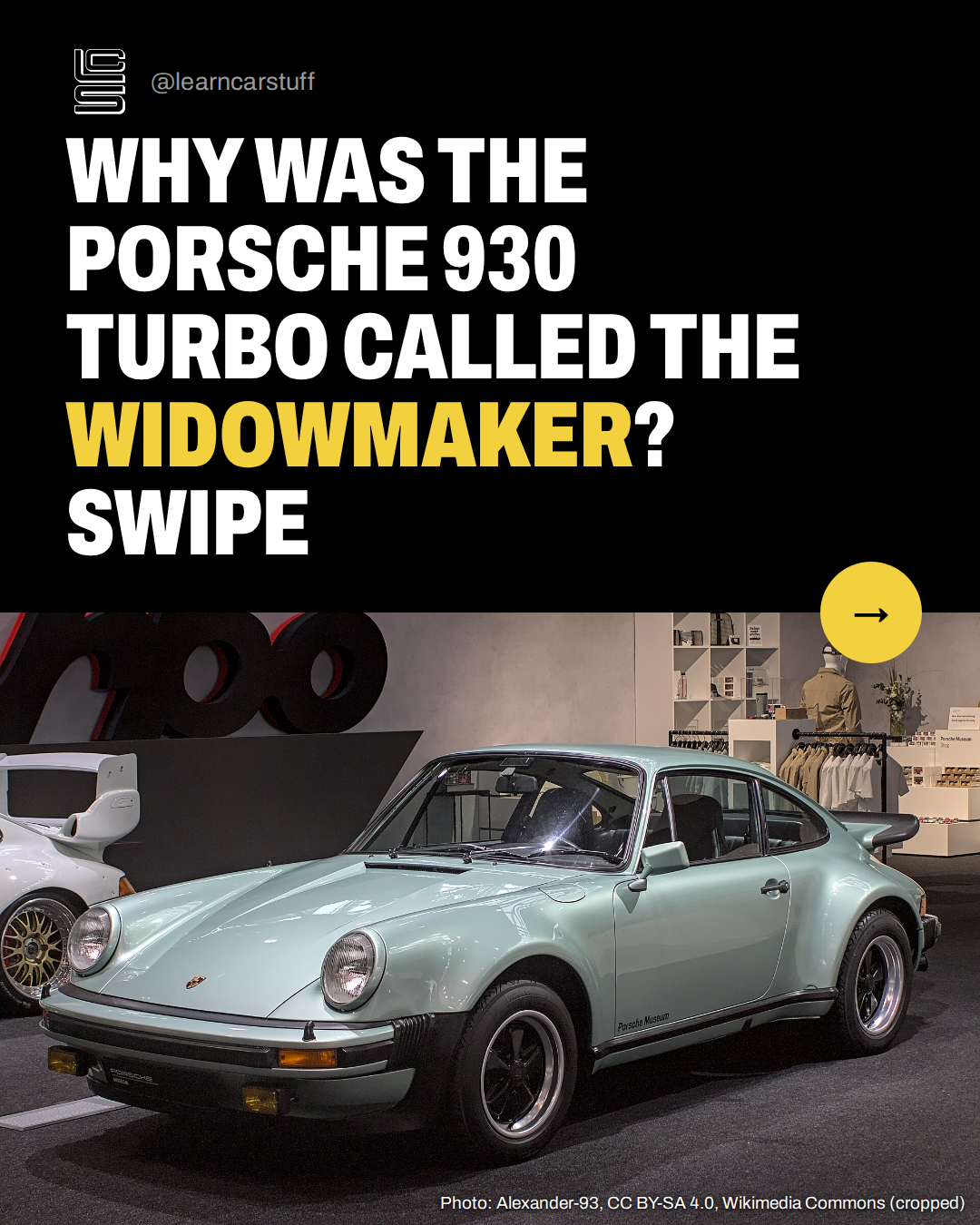
Why was the Porsche 930 Turbo called the widowmaker? SWIPE
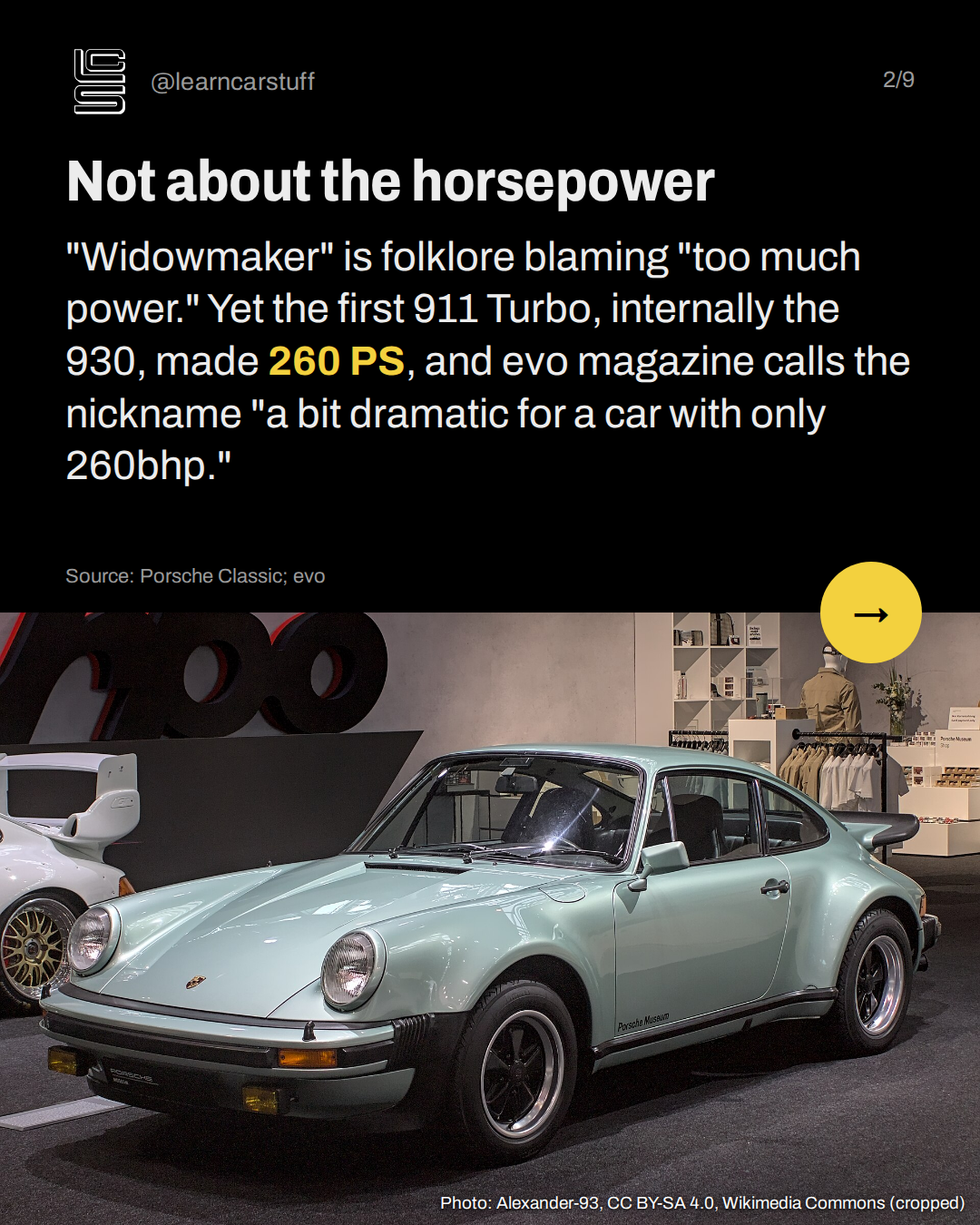
Not about the horsepower
"Widowmaker" is folklore blaming "too much power." Yet the first 911 Turbo, internally the 930, made 260 PS, and evo magazine calls the nickname "a bit dramatic for a car with only 260bhp."
Source: Porsche Classic; evo
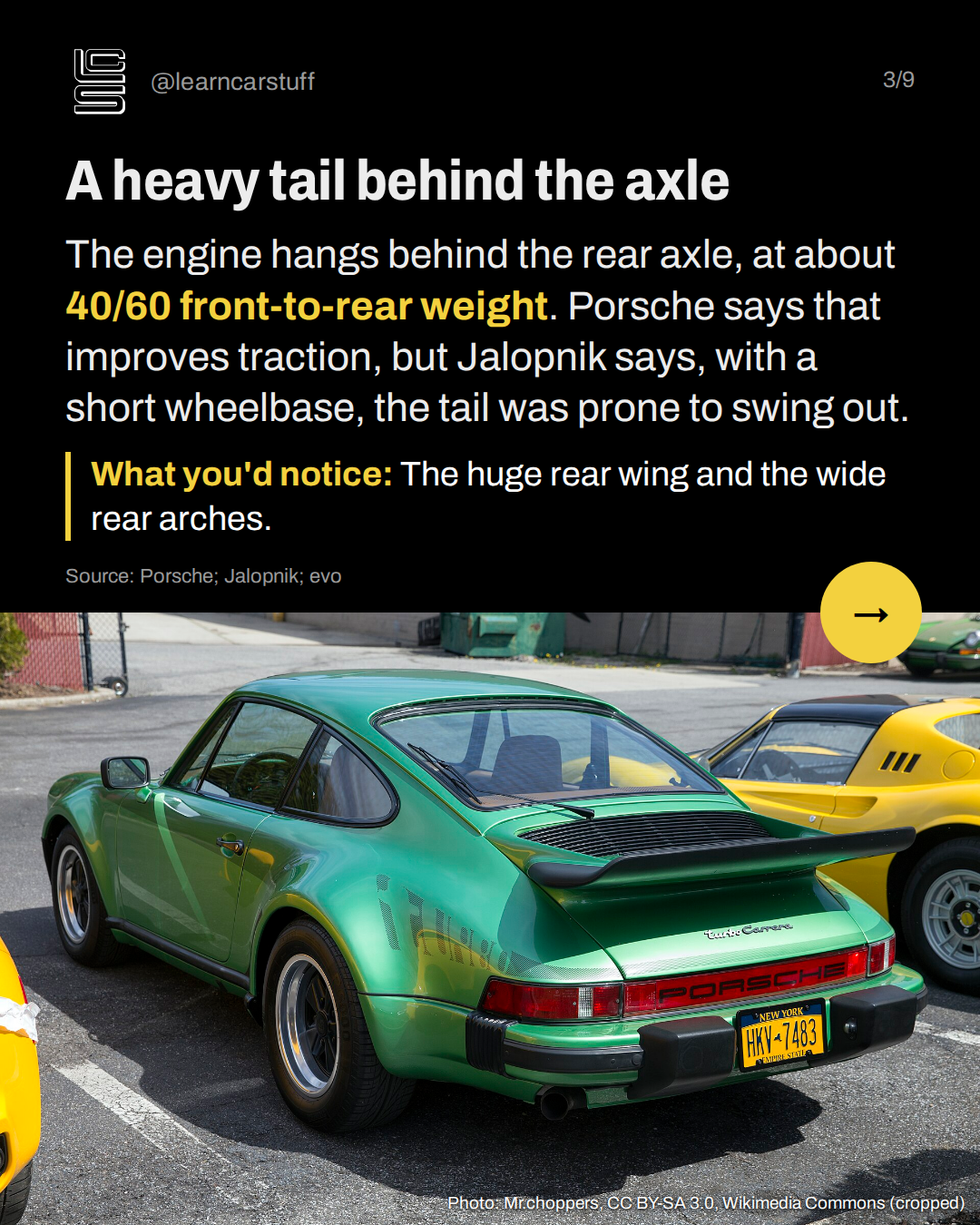
A heavy tail behind the axle
The engine hangs behind the rear axle, at about 40/60 front-to-rear weight. Porsche says that improves traction, but Jalopnik says, with a short wheelbase, the tail was prone to swing out.
What you'd notice: The huge rear wing and the wide rear arches.
Source: Porsche; Jalopnik; evo
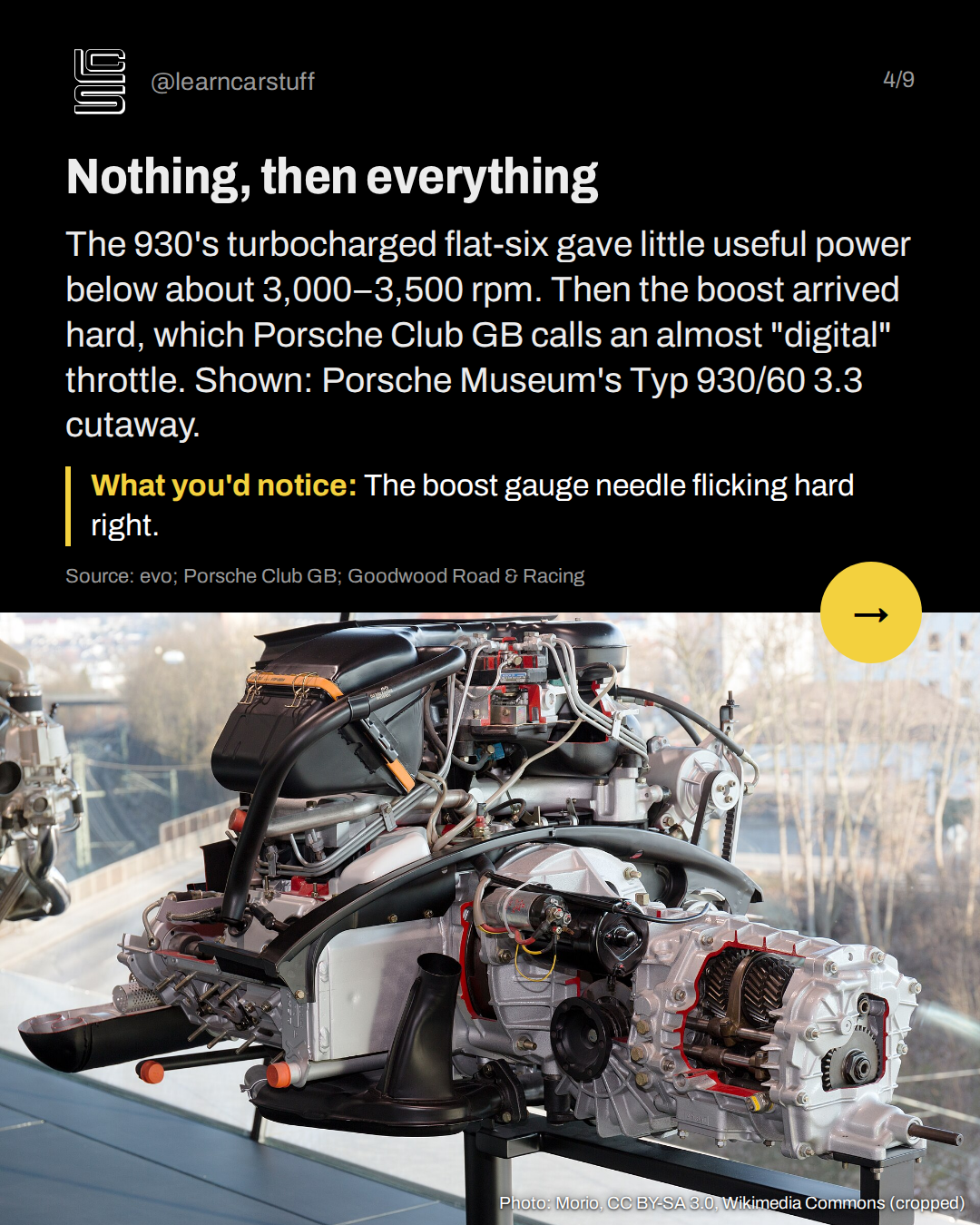
Nothing, then everything
The 930's turbocharged flat-six gave little useful power below about 3,000–3,500 rpm. Then the boost arrived hard, which Porsche Club GB calls an almost "digital" throttle. Shown: Porsche Museum's Typ 930/60 3.3 cutaway.
What you'd notice: The boost gauge needle flicking hard right.
Source: evo; Porsche Club GB; Goodwood Road & Racing
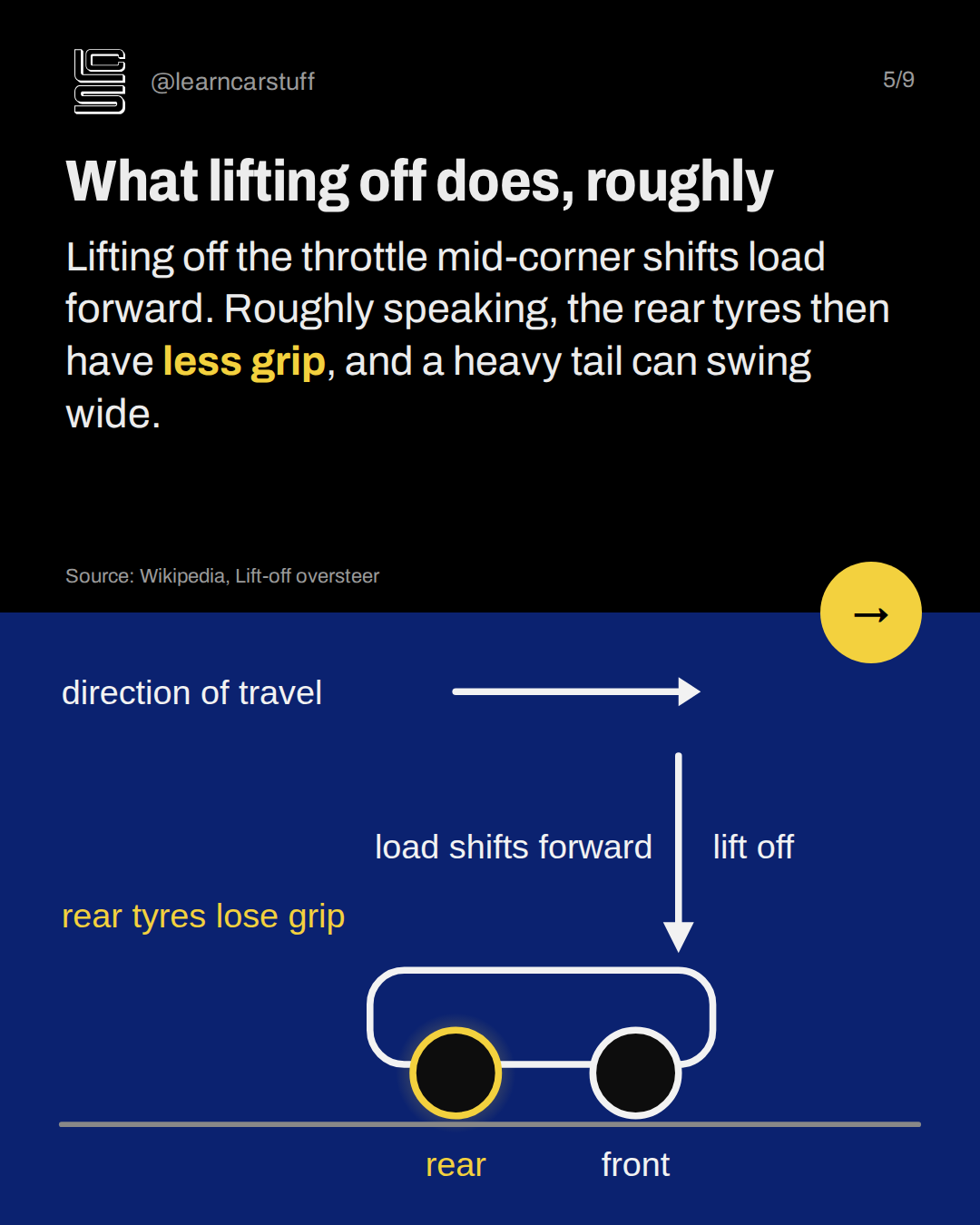
What lifting off does, roughly
Lifting off the throttle mid-corner shifts load forward. Roughly speaking, the rear tyres then have less grip, and a heavy tail can swing wide.
Source: Wikipedia, Lift-off oversteer
The instinct that backfires
Picture entering a bend off boost, then pressing the throttle at the apex. Boost arrives suddenly and the tail slides. Lifting is the instinct, but it roughly cuts rear grip further, just when the tail needs it.
Source: Jalopnik; evo; Wikipedia, Lift-off oversteer
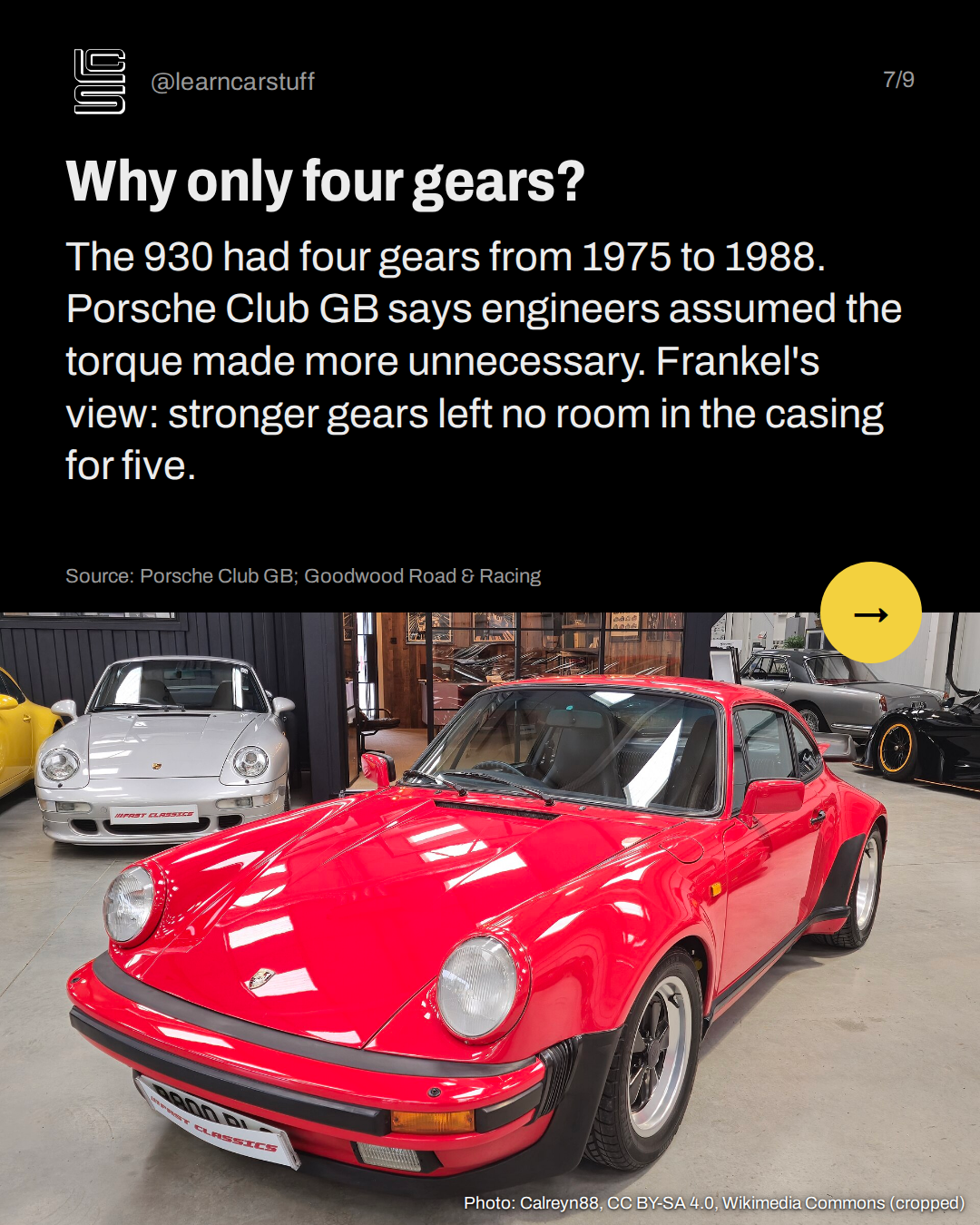
Why only four gears?
The 930 had four gears from 1975 to 1988. Porsche Club GB says engineers assumed the torque made more unnecessary. Frankel's view: stronger gears left no room in the casing for five.
Source: Porsche Club GB; Goodwood Road & Racing
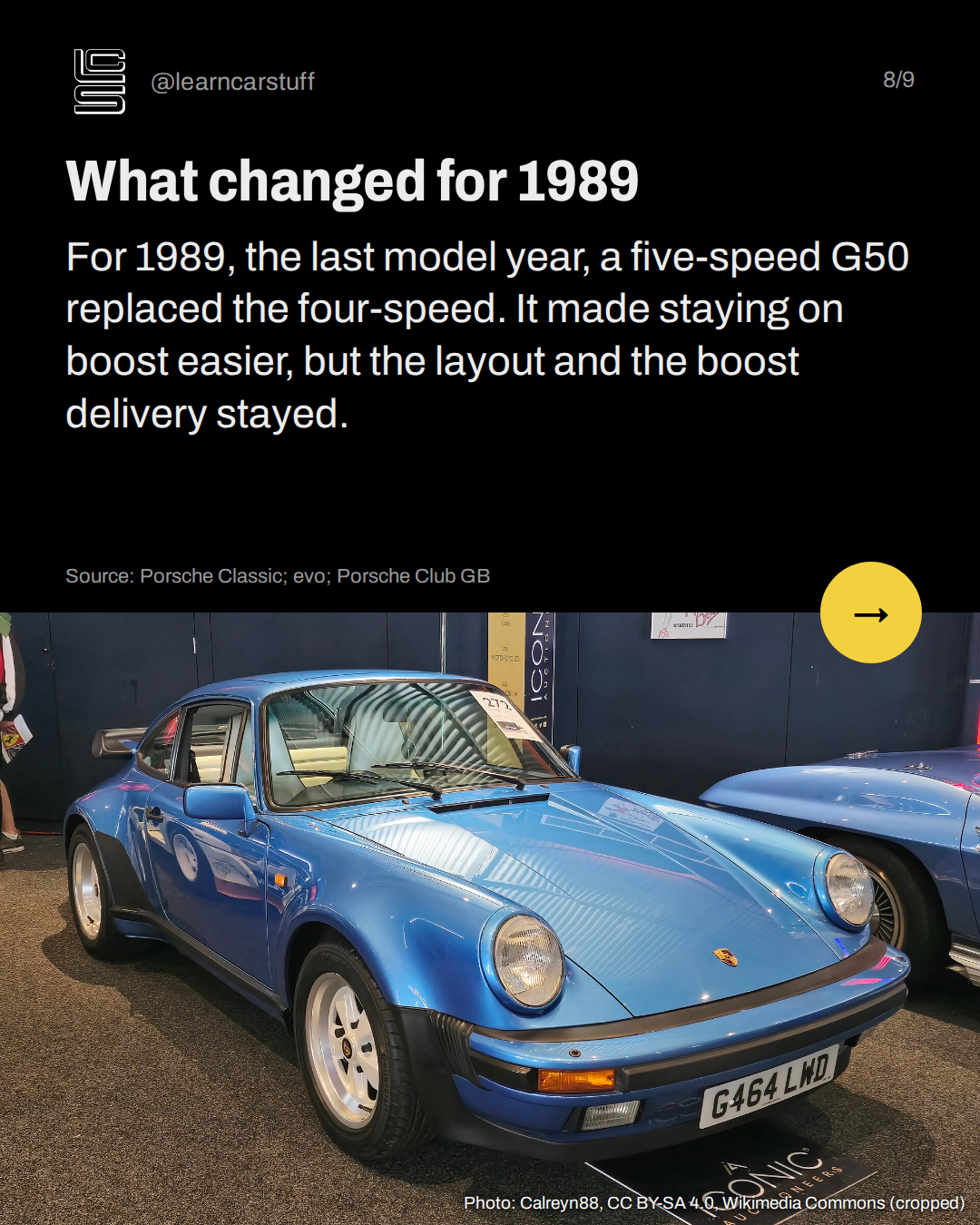
What changed for 1989
For 1989, the last model year, a five-speed G50 replaced the four-speed. It made staying on boost easier, but the layout and the boost delivery stayed.
Source: Porsche Classic; evo; Porsche Club GB
Sources and assumptions
- Porsche Classic: 911 Turbo (G-series model page): The 911 Turbo arrived in model year 1975. Model years 1975–77: 3.0 litres, 260 PS. Model years 1978–89: 3.3 litres, 300 PS. From model year 1978 a larger bonnet and rear wing housed the intercooler. In model year 1989 the four-speed manual was replaced with a five-speed. Targa and Cabriolet versions came from model year 1987. (checked 2026-10-25)
- Porsche Newsroom: Porsche celebrates '50 Years of Turbo' at the Retro Classics: Porsche presented the first series 911 Turbo at the 1974 Paris Motor Show, and the first model was 'called 930 in-house'. (checked 2026-10-25)
- evo: Porsche 911 Turbo (930) review, the original widowmaker driven again (John Barker and Richard Meaden): The widowmaker reputation exists, and evo calls it 'a bit dramatic for a car with only 260bhp'. The 1975 3.0 made 260bhp at 5,500 rpm and 253 lb ft at 4,000 rpm. 'Not much happens low down' until the tacho swings toward 3,000 rpm. Backing off when you come into a corner too hot 'wouldn't be ideal, particularly in the wet'. Four speeds, then a G50 five-speed in 1989. (checked 2026-10-25)
- Porsche Club GB: Porsche 911 (930) buyer's guide: An almost 'digital' throttle and enormous turbo lag, with little usable power below about 3,500 rpm. On the four-speed: 'The engineers simply assumed that with so much torque on tap once the turbocharger was spinning, drivers wouldn't need more.' On the 1989 five-speed: it 'offered more flexibility and made the car more accelerative'. 1978: 300bhp 3.3 (930/60) with intercooler and 917-derived brakes. (checked 2026-10-25)
- Goodwood Road & Racing: Andrew Frankel, A fond look back at the Porsche 930 Turbo: Frankel's interpretation that the gears had to be beefed up for the torque, leaving no room in the casing for five. The boost gauge 'flicks hard right' around 3,500 rpm. Driving approach 'even slower in, even faster out'. The 1978 air-to-air intercooler and 300 bhp. The G50 five-speed 'pretty much transformed the car'. (checked 2026-10-25)
- Jalopnik: Why The Porsche 930 Is Known As The Widowmaker (Chloe Clougher): The nickname is 'less about the 930's stats and more about how that power is delivered'. The car 'would come onto boost suddenly' and that power 'would swing the back out'. A roughly 40/60 front/rear weight distribution and a short wheelbase. (checked 2026-10-25)
- Wikipedia: Lift-off oversteer (general physics reference only): General mechanism: lifting off the throttle mid-corner shifts vertical load from the rear tyres to the front, which cuts rear grip and can make the car oversteer. More pronounced in rear-engined cars with a rearward centre of gravity, such as older 911s. (checked 2026-10-25)
- Porsche: Why is the Porsche 911 engine in the rear?: 'When the engine is fitted in the rear, traction is improved because the weight of the engine rests on the driven axle, especially in winter or low-traction conditions.' Dated 2 December 2025. Does not discuss oversteer or catching a slide. (checked 2026-10-25)
Assumptions:
- Power figures (260 PS for 3.0, 300 PS for 3.3) are Porsche's own ratings. US-market cars were rated differently, but no primary source for US figures was opened, so slides should not give a US number.
- 'Typ 930' is Porsche's in-house name. Porsche marketed the car as the 911 Turbo, and early US cars wore 'Turbo Carrera' badges (seen on photo r1).
- The 40/60 weight split is Jalopnik's approximate figure. Present it as 'about 40/60'.
- The boost threshold varies by source (evo: about 3,000 rpm; Porsche Club GB and Frankel: about 3,500 rpm). Use 'about 3,000–3,500 rpm'.
- Who coined 'widowmaker' and when is not documented in any source opened. It is folklore and a reputation, not an official name. No accident or fatality statistics were verified, so slides must not claim any.
- The lift-off oversteer diagram is qualitative. Write 'roughly', with no exact load percentages.
- Why the car had a four-speed is presented two ways: Porsche Club GB's 'engineers assumed the torque made more gears unnecessary' and Frankel's interpretation that there was no room for five beefed-up gears. Label the second as his view.
- The four-speed ran from model year 1975 to 1988. Model year 1989 got the five-speed, which evo and Goodwood name as the G50. Porsche's page only says 'five-speed'.
Photos:
The short version
- The nickname is folklore, the cause is real.
- 260 PS wasn't the scary part.
- Boost arrived suddenly in a tail-heavy car.
- Lifting mid-corner could take grip away.