 Learn Car Stuff
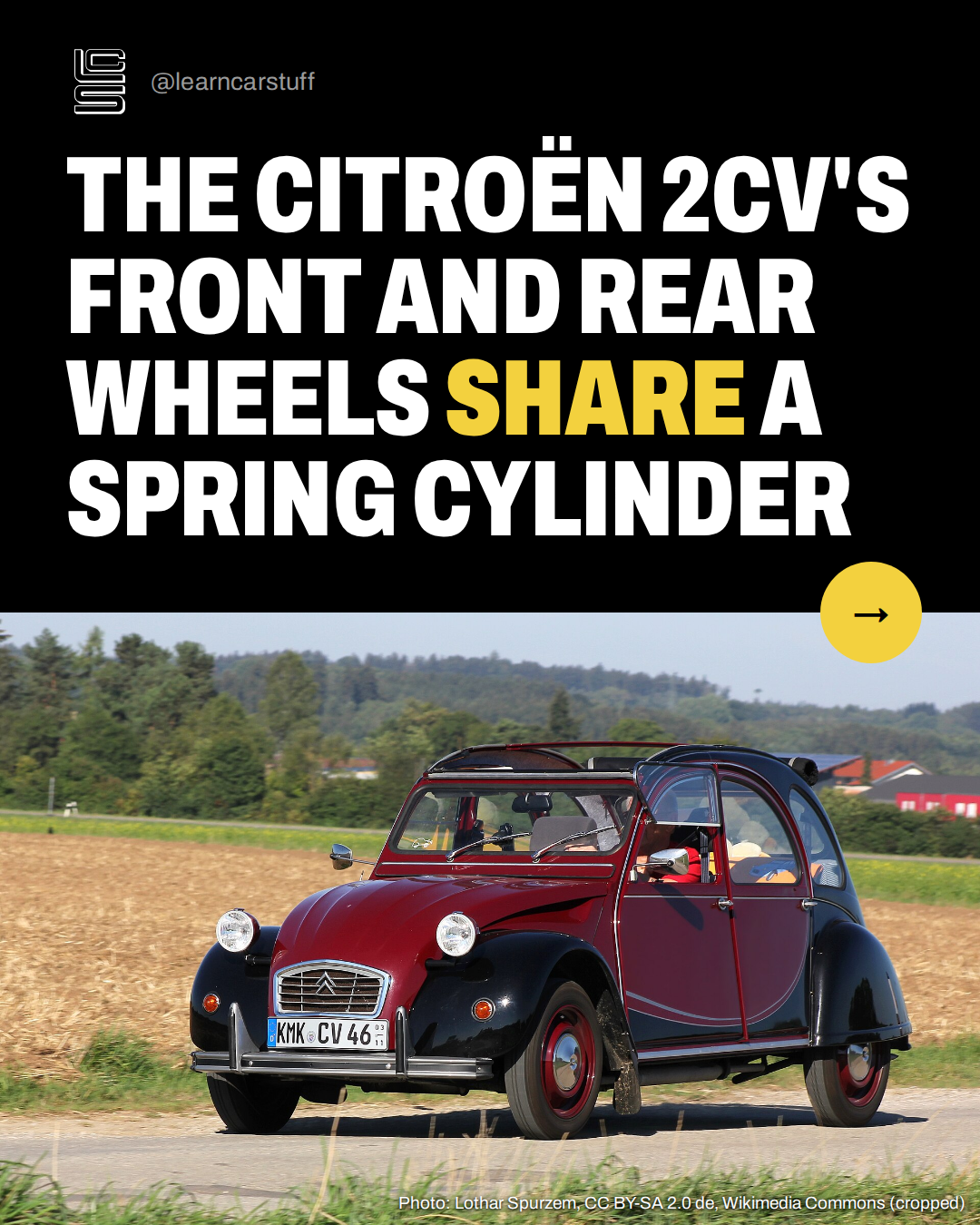
The Citroën 2CV's front and rear wheels share a spring cylinder
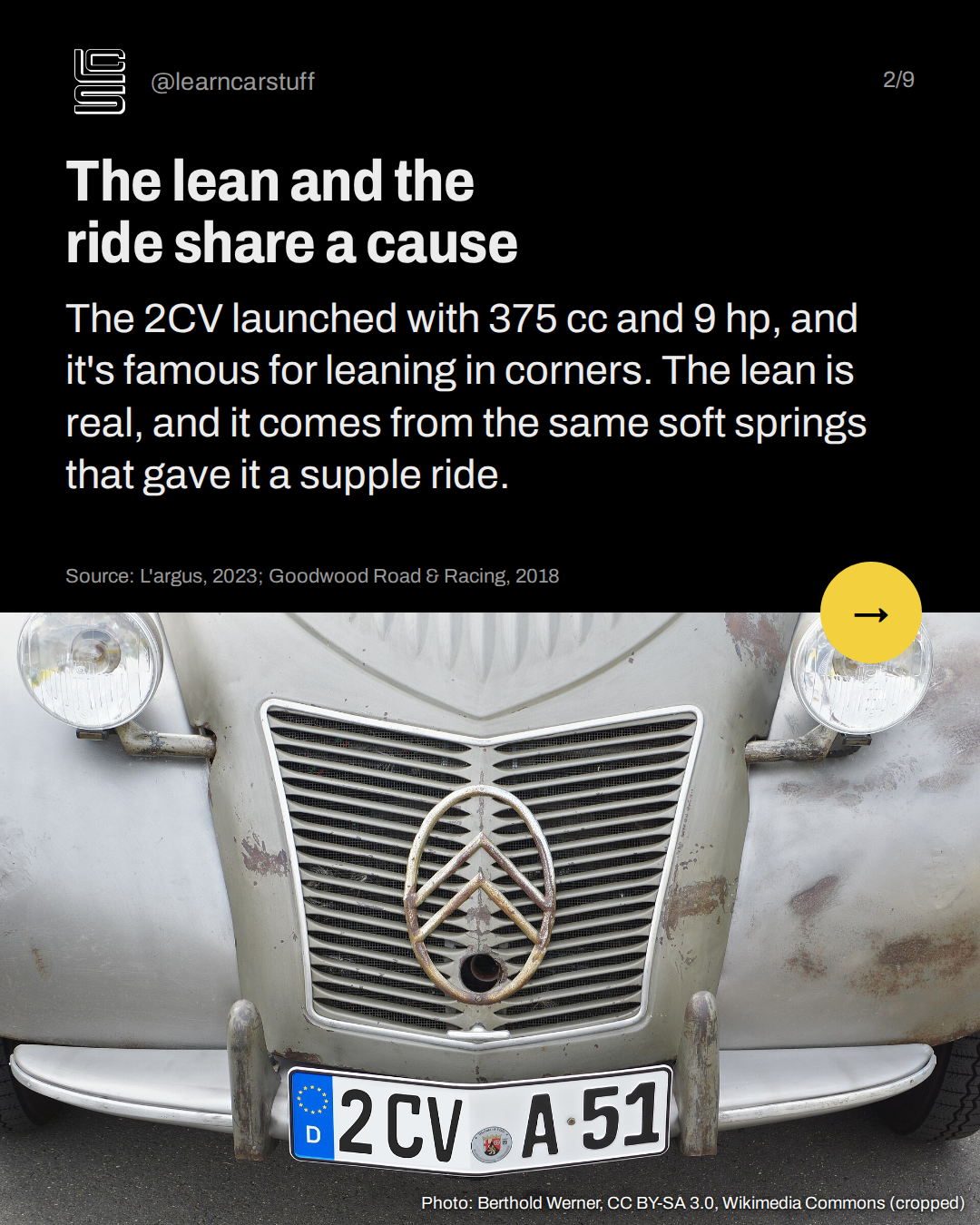
The lean and the ride share a cause
The 2CV launched with 375 cc and 9 hp, and it's famous for leaning in corners. The lean is real, and it comes from the same soft springs that gave it a supple ride.
Source: L'argus, 2023; Goodwood Road & Racing, 2018
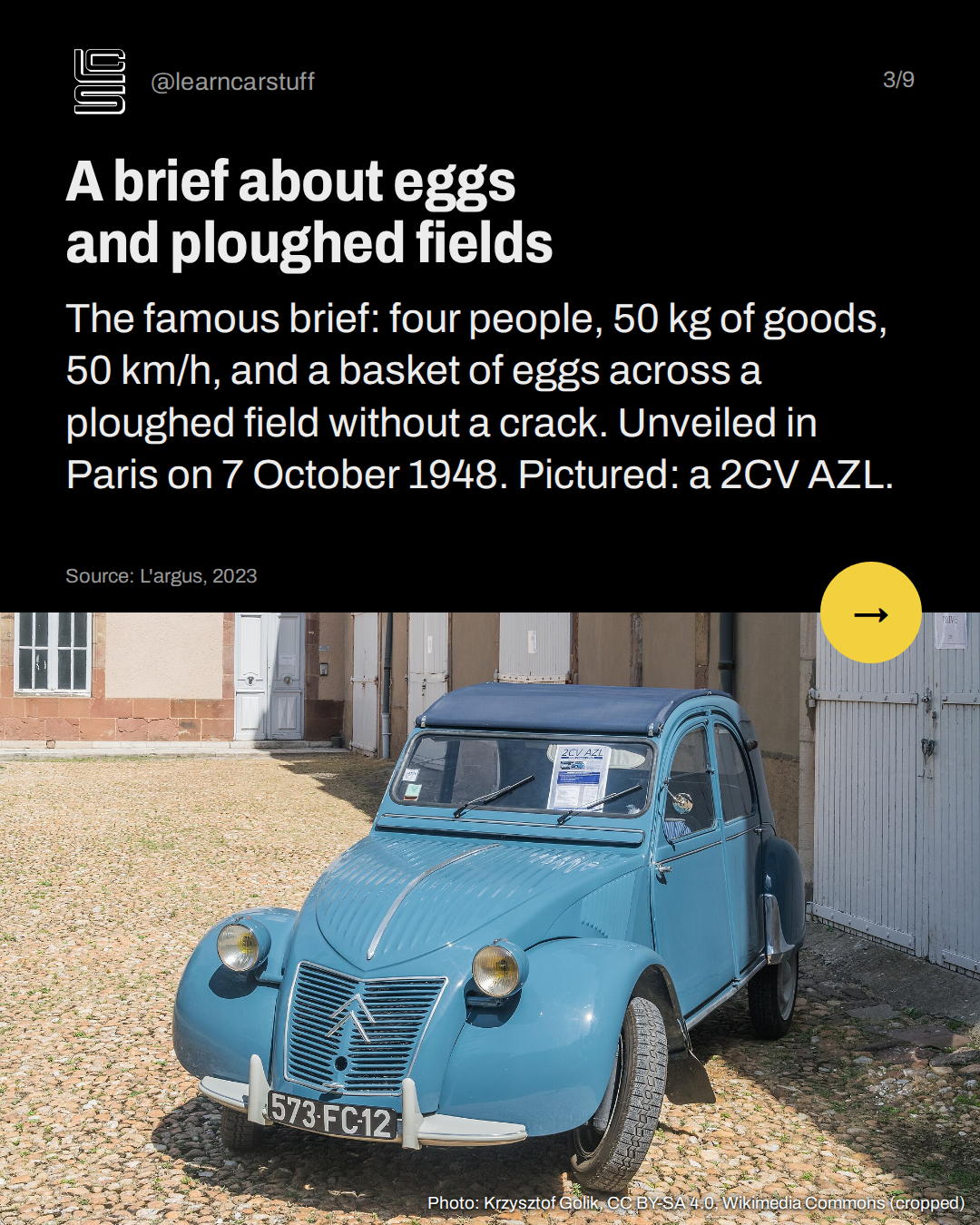
A brief about eggs and ploughed fields
The famous brief: four people, 50 kg of goods, 50 km/h, and a basket of eggs across a ploughed field without a crack. Unveiled in Paris on 7 October 1948. Pictured: a 2CV AZL.
Source: L'argus, 2023
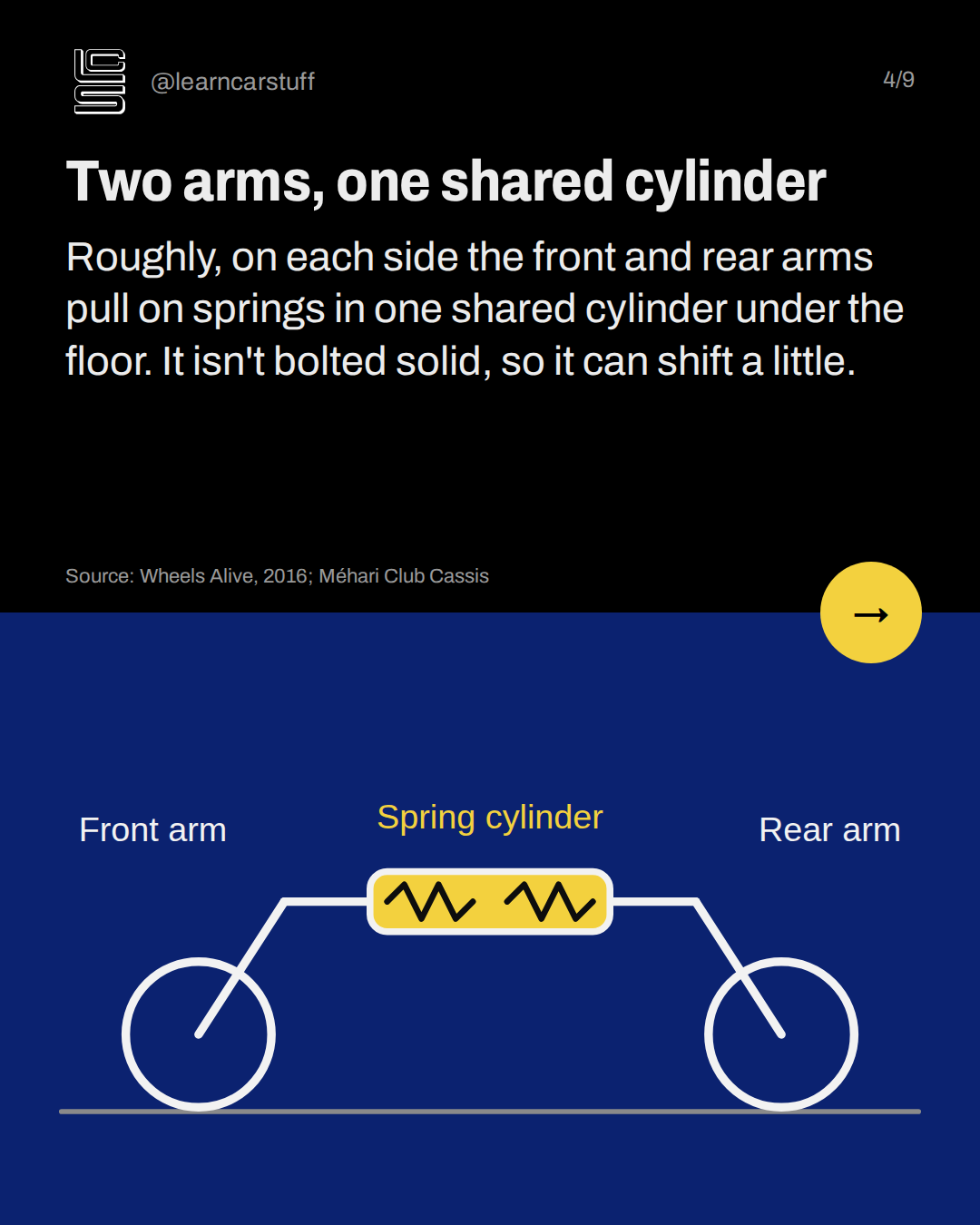
Two arms, one shared cylinder
Roughly, on each side the front and rear arms pull on springs in one shared cylinder under the floor. It isn't bolted solid, so it can shift a little.
Source: Wheels Alive, 2016; Méhari Club Cassis
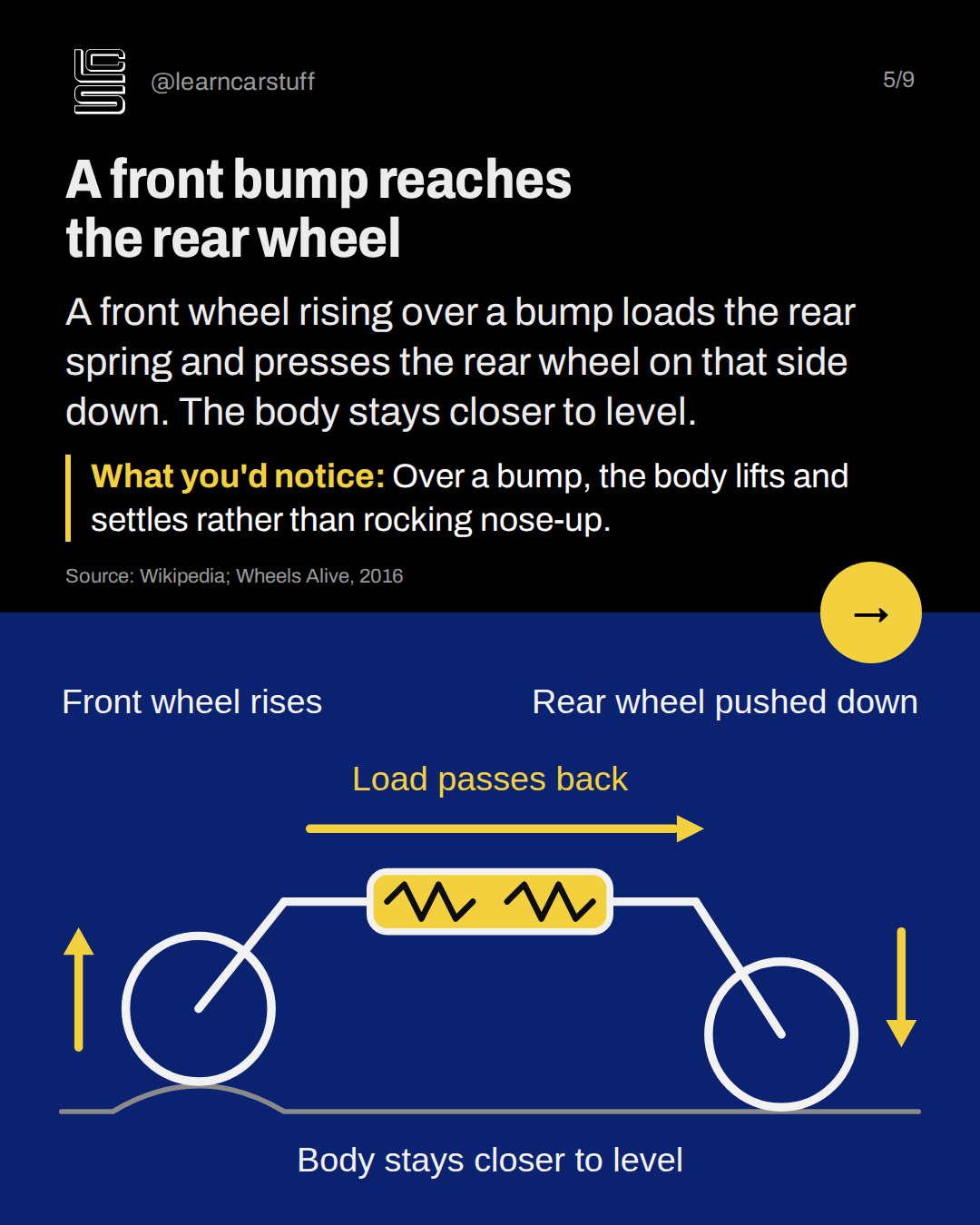
A front bump reaches the rear wheel
A front wheel rising over a bump loads the rear spring and presses the rear wheel on that side down. The body stays closer to level.
What you'd notice: Over a bump, the body lifts and settles rather than rocking nose-up.
Source: Wikipedia; Wheels Alive, 2016
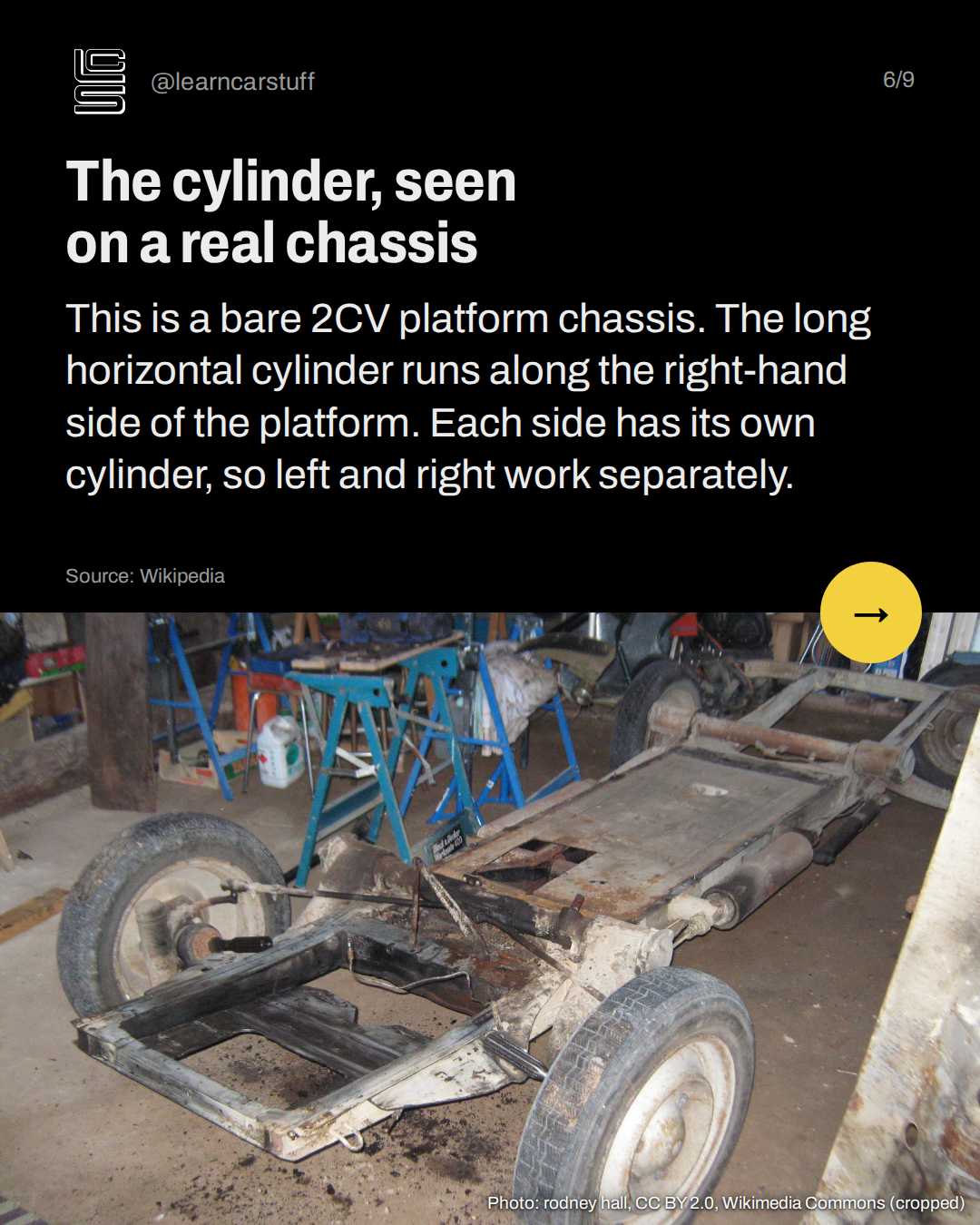
The cylinder, seen on a real chassis
This is a bare 2CV platform chassis. The long horizontal cylinder runs along the right-hand side of the platform. Each side has its own cylinder, so left and right work separately.
Source: Wikipedia
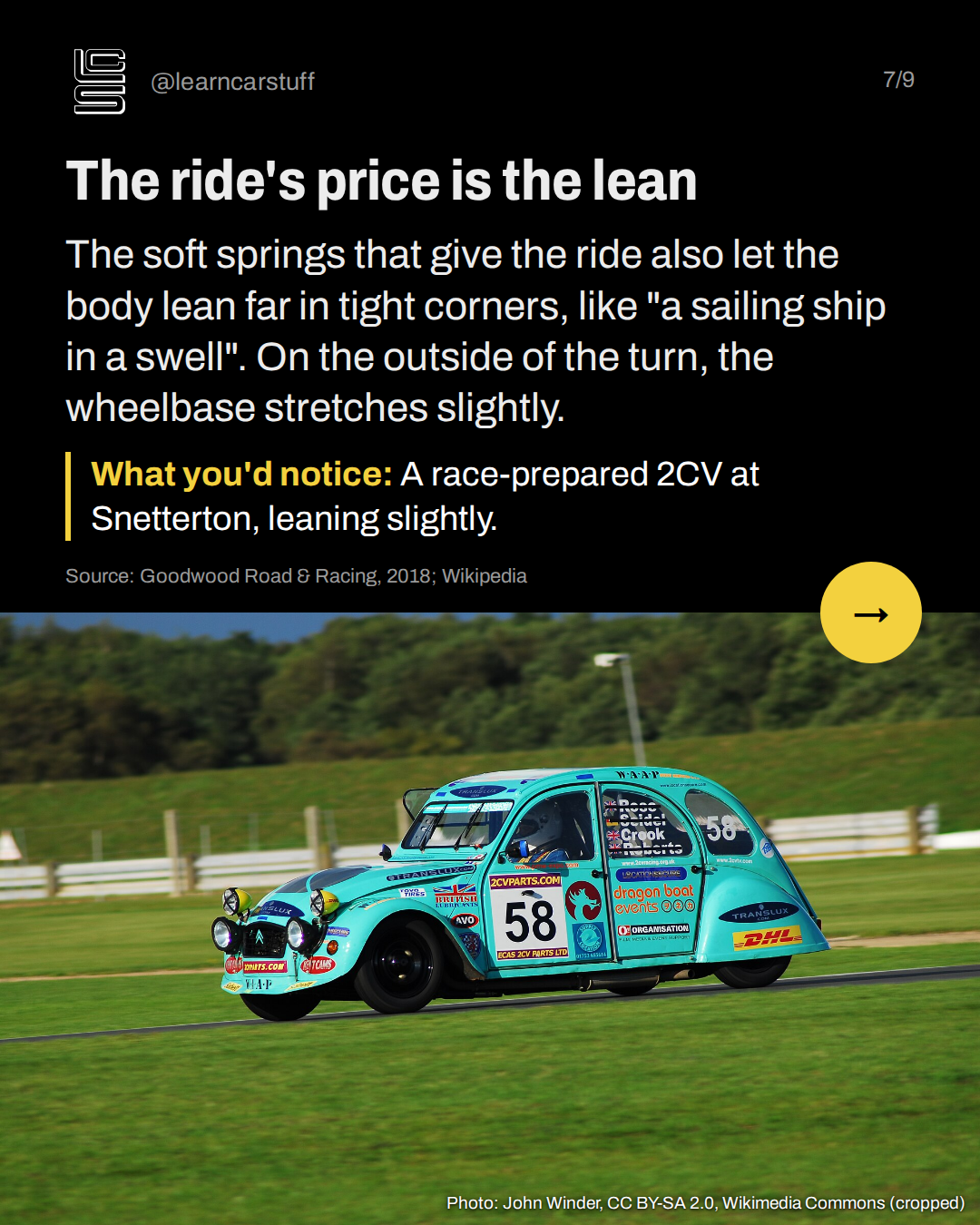
The ride's price is the lean
The soft springs that give the ride also let the body lean far in tight corners, like "a sailing ship in a swell". On the outside of the turn, the wheelbase stretches slightly.
What you'd notice: A race-prepared 2CV at Snetterton, leaning slightly.
Source: Goodwood Road & Racing, 2018; Wikipedia
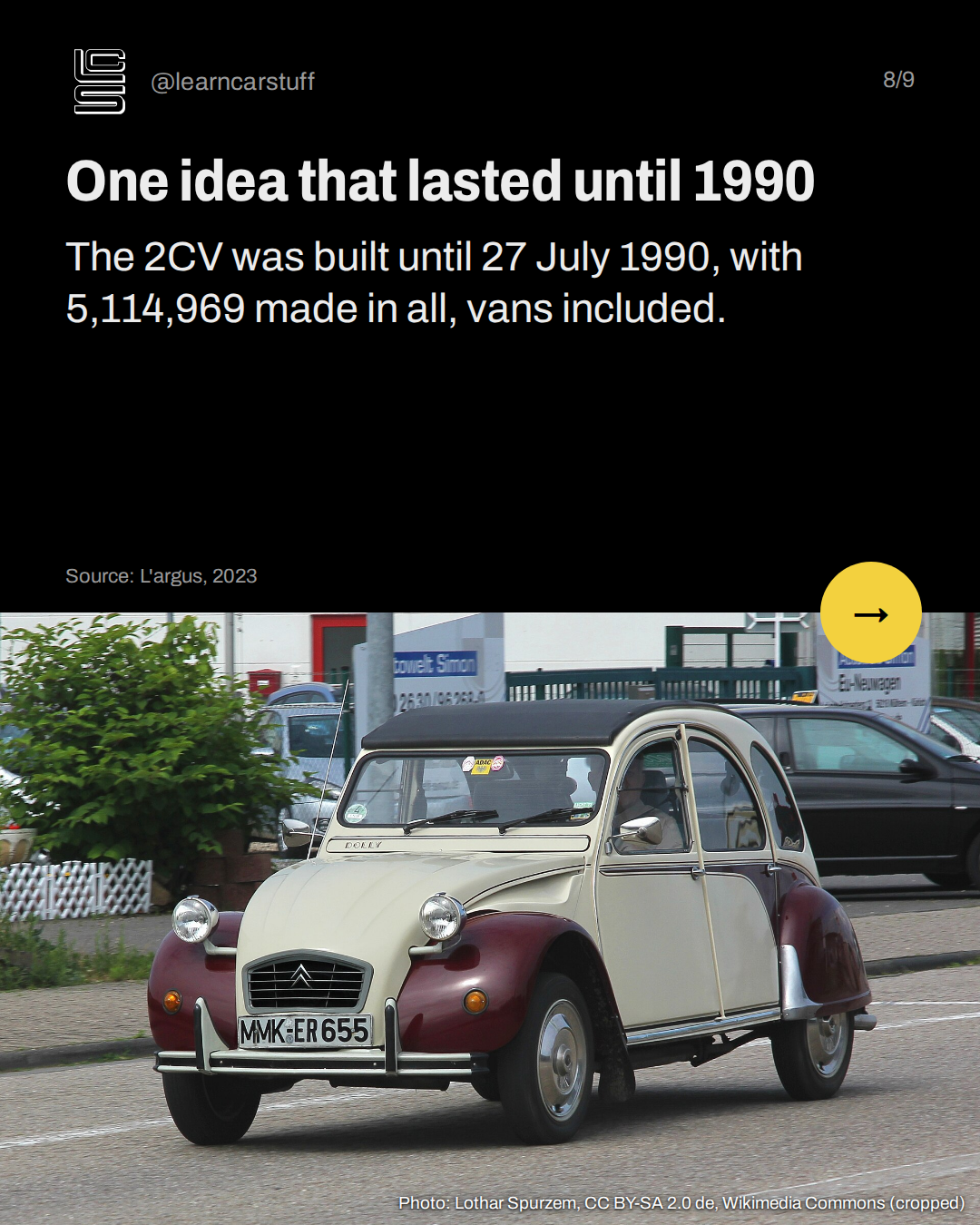
One idea that lasted until 1990
The 2CV was built until 27 July 1990, with 5,114,969 made in all, vans included.
Source: L'argus, 2023
Sources and assumptions
- Wikipedia: Citroën 2CV (suspension section, citing Citroën technical histories): Two horizontal suspension cylinders, one on each side of the platform chassis; front spring compression pulls the rear wheel down on the same side via the rear spring assembly, keeping the body level front to rear; outside wheelbase grows and inside shrinks in a corner; designed by Alphonse Forceau, refined by Marcel Chinon; unveiled at the Paris Salon on 7 October 1948; last car (a Charleston) built at Mangualde on 27 July 1990; 3,867,932 saloons (checked 2026-10-24)
- Wheels Alive, 'Citroën's innovative new suspension system', Dave Randle, 6 June 2016: Leading arm at the front, trailing arm at the rear, each acting on a horizontal connecting rod; on each side the two rods meet inside a cylinder with two coil springs; a front-wheel shock is passed to the rear through the cylinder's tendency to move toward the rear (checked 2026-10-24)
- Méhari Club Cassis, 'The revolutionary suspension of the 2CV': The suspension pots are not fixed to the frame; they are mounted on two springs, so they can move horizontally (checked 2026-10-24)
- Octane, 'Citroën 2CV buying guide, history and model review', Matthew Hayward, 27 March 2026: TPV origin and 'umbrella on wheels' brief for farmers on rough terrain; 2CV emerged in 1948, production ended in 1990; fully independent suspension with interconnected horizontal coil springs and long travel giving a supple ride (checked 2026-10-24)
- L'argus, 'Citroën 2CV (1948). La Deuche fête ses 75 ans', Maxime Kossmann, 1 October 2023: Presented 7 October 1948 at the Paris Salon; brief of four people and 50 kg of luggage at 50 km/h; suspension meant to cross a ploughed field with a basket of eggs without breaking one; 375 cc air-cooled flat-twin, 9 hp; last car built 27 July 1990; 5,114,969 2CVs in total including 1,246,335 vans (checked 2026-10-24)
- Goodwood Road & Racing, 'Axon's Automotive Anorak: Keeping it on the level', Gary Axon, 25 May 2018: The 2CV's notoriously soft suspension rolls 'like a sailing ship in a swell' in tight corners; the 1950 aftermarket 'Suspension Federspiel' made it lean into corners like a motorcycle, worked, but was expensive and little adopted (checked 2026-10-24)
- Hagerty UK, 'Buying guide: Citroën 2CV', Alisdair Suttie, 15 March 2023: Revealed at the 1948 Paris Salon; all-independent suspension for a famously supple ride; engines of 375 cc (9 bhp), 425 cc (12 bhp) and 602 cc (checked 2026-10-24)
- Autozine, 'Citroen 2CV (1948)': Front fore-aft arms and rear trailing arms interconnected by horizontal coil springs to stabilise the car over a ridge; supple ride that let the car cross fields (its wording 'rear wheels raised' is loose; the record follows Wikipedia/Wheels Alive) (checked 2026-10-24)
Assumptions:
- The mechanism diagram is a simplified side view of one side of the car. Real geometry (lever ratios, cylinder mounting springs, bump stops) is left out, and the direction of the effect is described in words the sources support: a front bump loads the rear spring and presses the rear wheel down, so the body pitches less.
- How much the rear responds depends on spring preload, the cylinder's mounting springs and the dampers; the post says 'closer to level', never 'perfectly level'.
- The eggs-in-a-ploughed-field line is the brief as Citroën history retells it; present it as the famous brief, not as a measured test.
- The lean is attributed to the soft, long-travel springs the ride needed (Goodwood: notoriously soft, rolls like a ship). The post does not claim the front-rear interconnection itself causes the roll.
- Damper details changed over the years (friction/inertia dampers early, hydraulic later per the Méhari Club); the post leaves dampers out rather than naming one version.
- Production totals: 5,114,969 including vans (L'argus); saloons alone 3,867,932 (Wikipedia). Use the figure with its label.
Photos:
- Photo: rodney hall, CC BY 2.0, Wikimedia Commons (cropped)
- Photo: John Winder, CC BY-SA 2.0, Wikimedia Commons (cropped)
- Photo: Lothar Spurzem, CC BY-SA 2.0 de, Wikimedia Commons (cropped)
- Photo: Berthold Werner, CC BY-SA 3.0, Wikimedia Commons (cropped)
- Photo: Krzysztof Golik, CC BY-SA 4.0, Wikimedia Commons (cropped)
- Photo: Lothar Spurzem, CC BY-SA 2.0 de, Wikimedia Commons (cropped)
The short version
- Front and rear springs share a cylinder
- A front bump presses the rear wheel down
- So the body stays closer to level
- The soft springs also mean a big lean in corners