 Learn Car Stuff
The Shelby Cobra started life as a polite British roadster
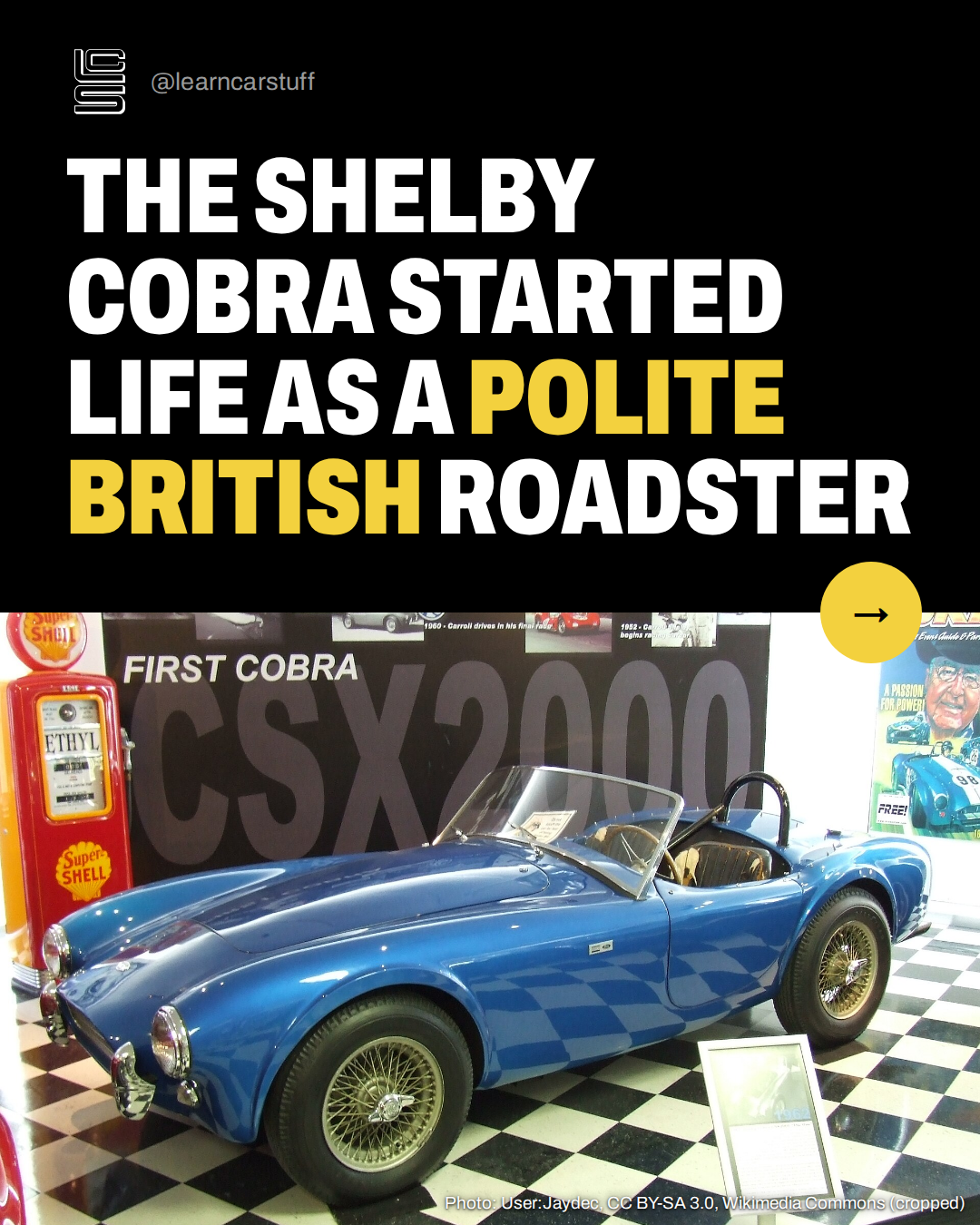
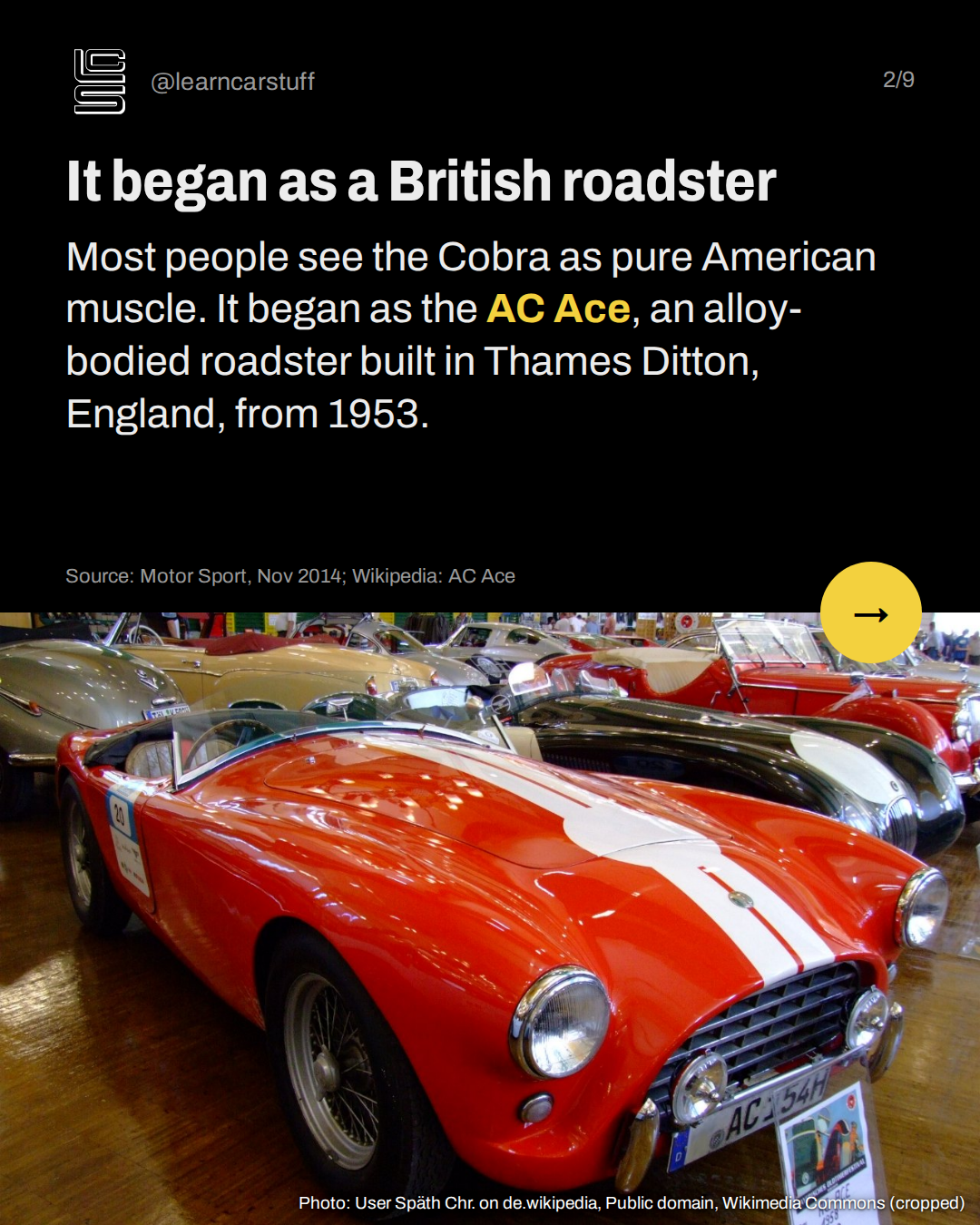
It began as a British roadster
Most people see the Cobra as pure American muscle. It began as the AC Ace, an alloy-bodied roadster built in Thames Ditton, England, from 1953.
Source: Motor Sport, Nov 2014; Wikipedia: AC Ace
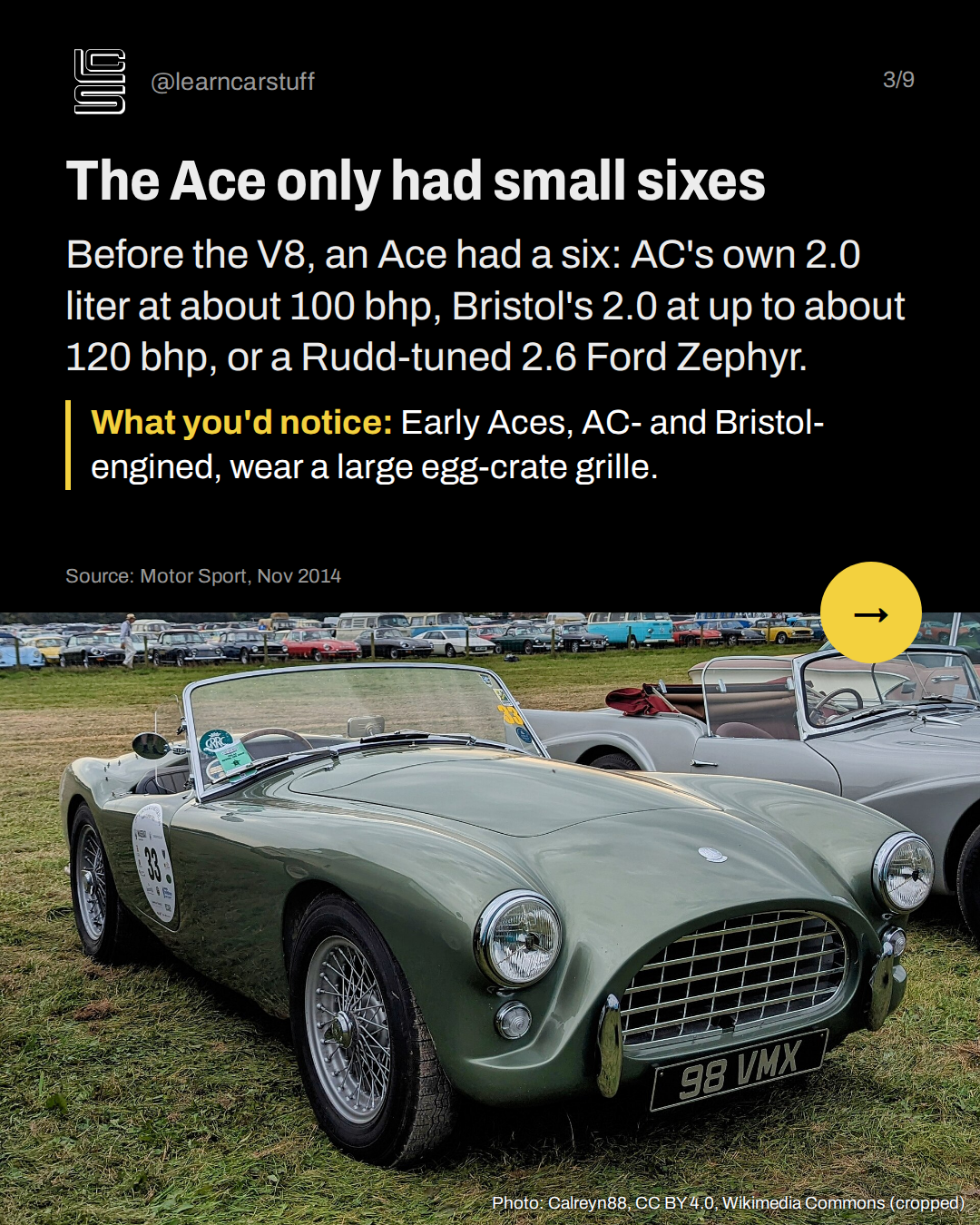
The Ace only had small sixes
Before the V8, an Ace had a six: AC's own 2.0 liter at about 100 bhp, Bristol's 2.0 at up to about 120 bhp, or a Rudd-tuned 2.6 Ford Zephyr.
What you'd notice: Early Aces, AC- and Bristol-engined, wear a large egg-crate grille.
Source: Motor Sport, Nov 2014
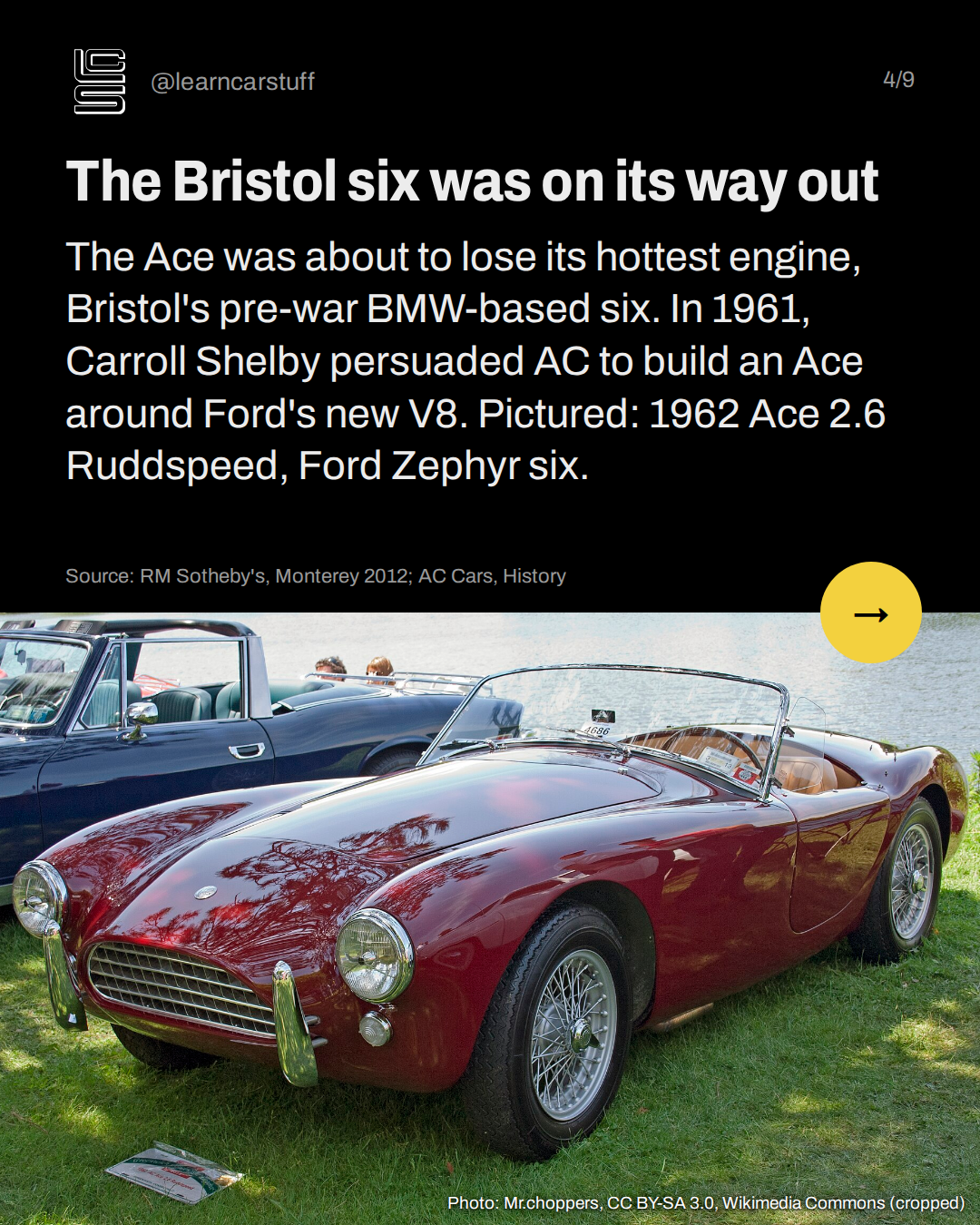
The Bristol six was on its way out
The Ace was about to lose its hottest engine, Bristol's pre-war BMW-based six. In 1961, Carroll Shelby persuaded AC to build an Ace around Ford's new V8. Pictured: 1962 Ace 2.6 Ruddspeed, Ford Zephyr six.
Source: RM Sotheby's, Monterey 2012; AC Cars, History
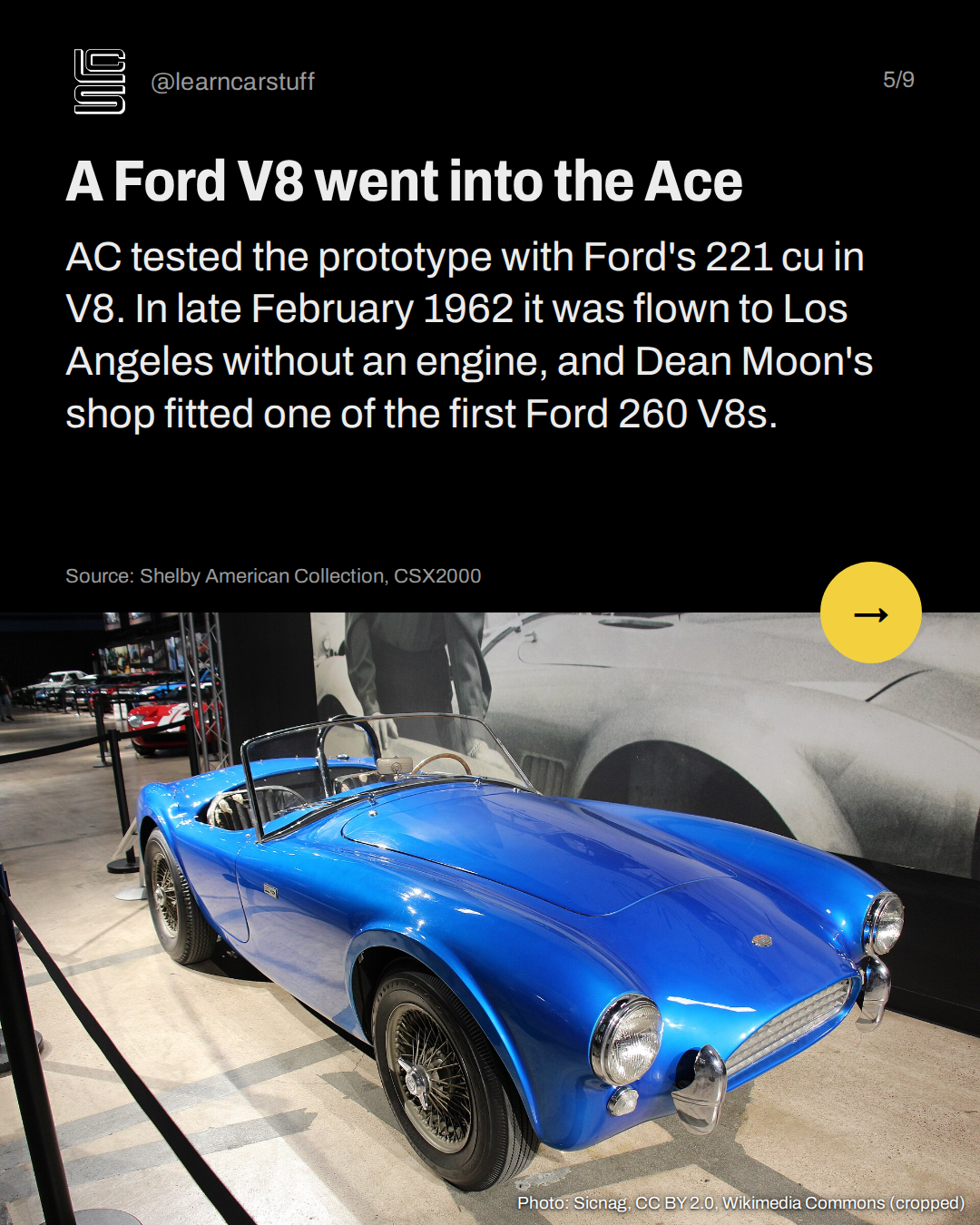
A Ford V8 went into the Ace
AC tested the prototype with Ford's 221 cu in V8. In late February 1962 it was flown to Los Angeles without an engine, and Dean Moon's shop fitted one of the first Ford 260 V8s.
Source: Shelby American Collection, CSX2000
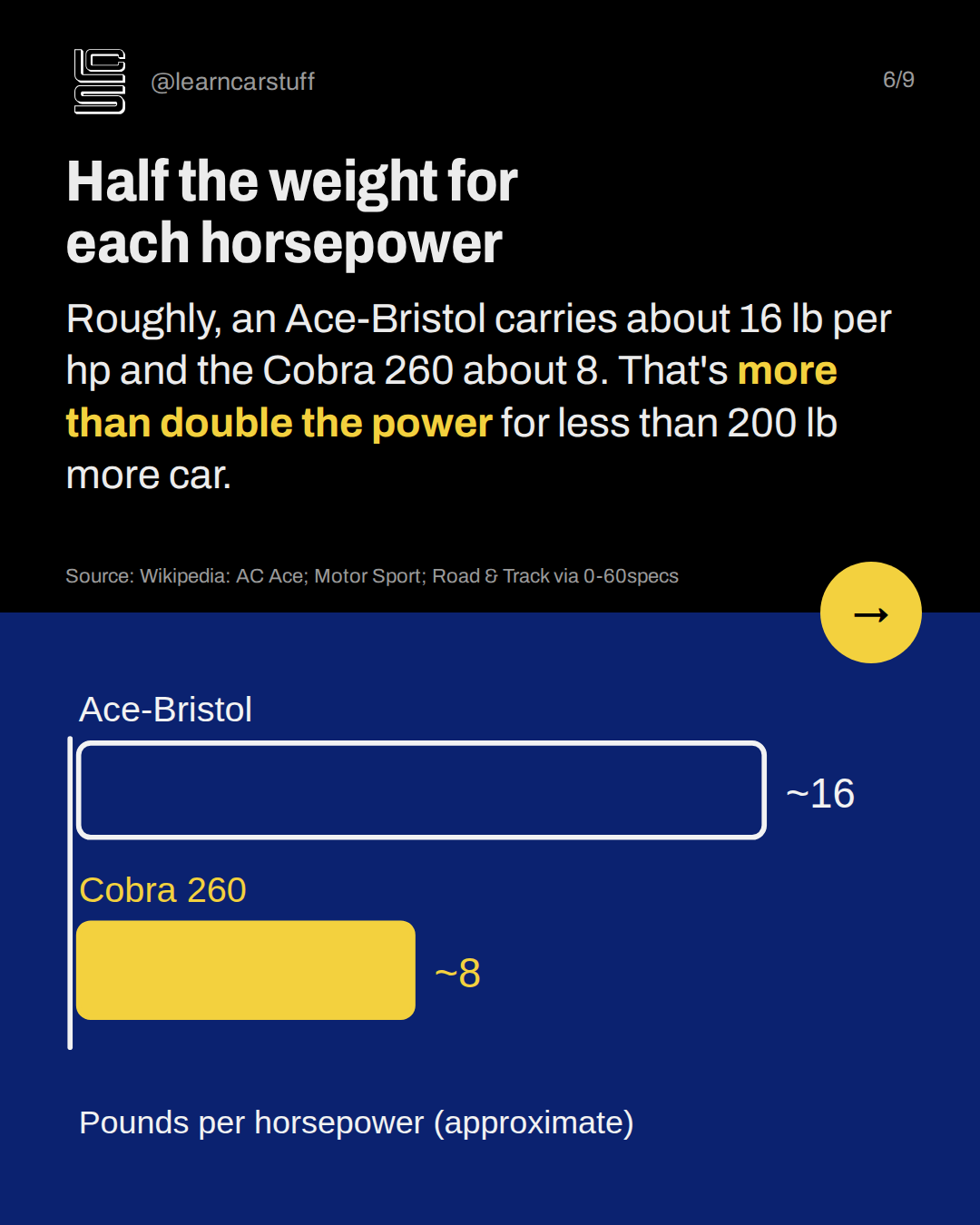
Half the weight for each horsepower
Roughly, an Ace-Bristol carries about 16 lb per hp and the Cobra 260 about 8. That's more than double the power for less than 200 lb more car.
Source: Wikipedia: AC Ace; Motor Sport; Road & Track via 0-60specs
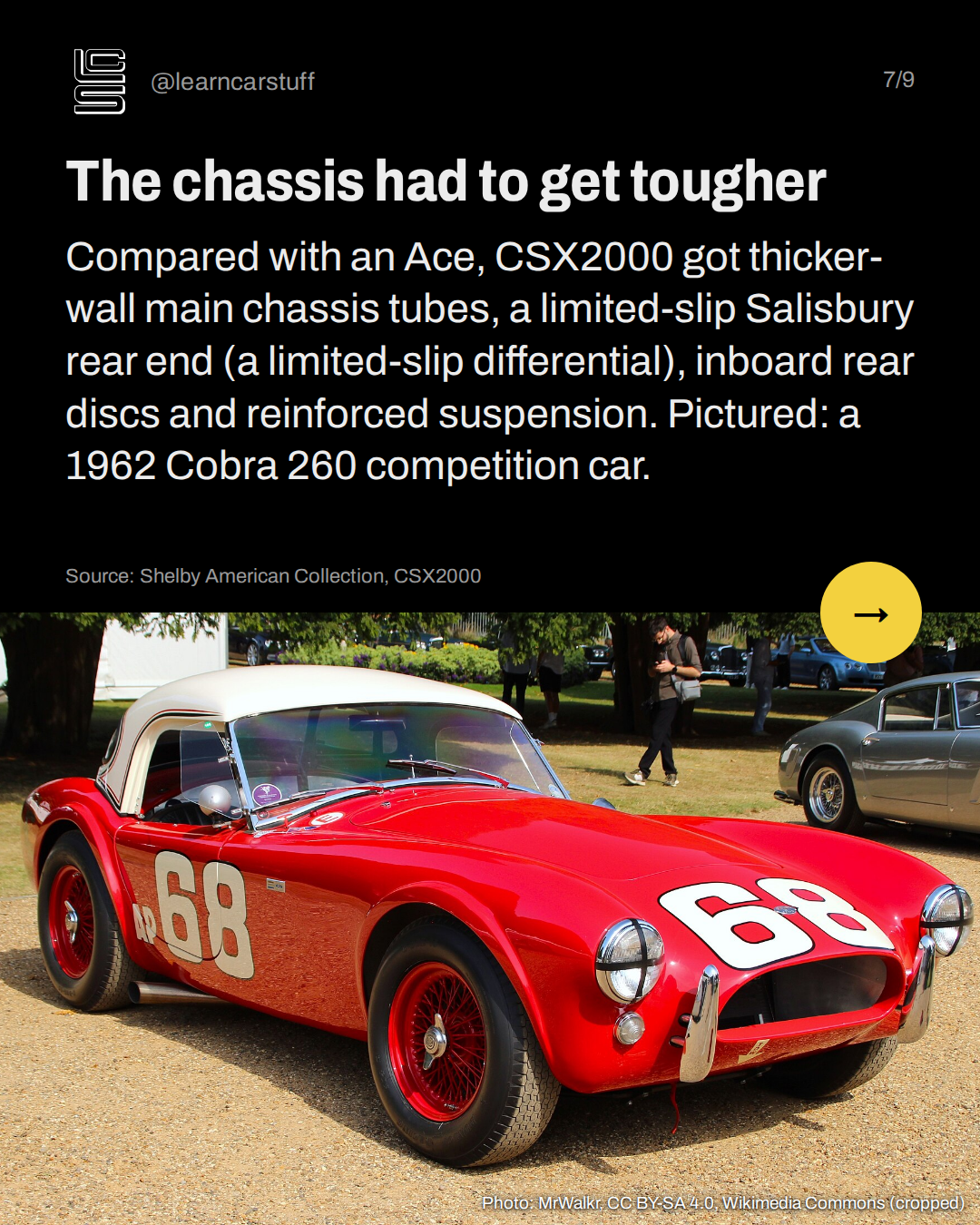
The chassis had to get tougher
Compared with an Ace, CSX2000 got thicker-wall main chassis tubes, a limited-slip Salisbury rear end (a limited-slip differential), inboard rear discs and reinforced suspension. Pictured: a 1962 Cobra 260 competition car.
Source: Shelby American Collection, CSX2000
Why both countries claim it
AC built the car in Thames Ditton; Ford supplied the V8. An English chassis, an American engine. Road & Track, 1962: 0–60 in 4.2 s. Only about 75 Cobras got the 260 before the bigger 289 cu in V8.
Source: RM Sotheby's, Monterey 2012; Shelby American Collection
Sources and assumptions
- Shelby American Collection: 1962 CSX2000 260 Cobra Roadster: CSX2000 was the only prototype, built by AC Cars in Thames Ditton by modifying an AC Ace with Shelby's input; tested at MIRA with the new Ford Fairlane 221 CID V8; finished late February 1962 and air-freighted to LAX without engine or gearbox; Dean Moon's shop in Santa Fe Springs fitted a 4-speed and one of the first Ford 260 CID V8s; limited-slip Salisbury rear end, inboard rear disc brakes, reinforced suspension, thicker-wall main chassis tubes and a 'general beefing-up through-out' beyond Ace specification; 260 hp; first public appearance at the April 1962 New York Auto Show (checked 2026-10-24)
- Motor Sport magazine, 'When they were new: AC Ace' (November 2014): The Ace started with AC's 2-litre six; the Bristol six with up to 120 bhp arrived in 1956; the Ford Zephyr 2.6 came in 1961, Ken Rudd offering tunes from 120 bhp (three SUs) to 170 bhp (triple Webers); the Zephyr is only 40 lb heavier than the Bristol; chassis of two large-diameter tubes with subframes for transverse leaf spring and wishbone suspension; designed mainly by John Tojeiro; built 1953–1963 (checked 2026-10-24)
- RM Sotheby's, 1963 Shelby 289 Cobra (Monterey 2012, lot 189): The Tojeiro-designed Ace was about to lose its hottest engine, the 2-litre pre-war BMW six that Bristol built under license; Ford engineer Dave Evans offered Shelby 260 cu in high-performance engines; 260 hp 260 cu in V8 with Borg-Warner four-speed; 0–60 in 4.2 s, 13.8 s quarter mile at 112 mph, 153 mph top speed; the first 75 cars had the 260 before the 289 (checked 2026-10-24)
- Wikipedia: AC Ace: AC engine 100 bhp; Bristol 120 bhp from 1956; Ruddspeed 2.6 up to 170 bhp from 1961; curb weight 1,920 lb (871 kg); about 220 AC-engined Aces and 466 Ace-Bristols built; tubular ladder frame with all-independent transverse leaf spring suspension and alloy body (checked 2026-10-24)
- Wikipedia: AC Cobra: The Ace used three straight-sixes (AC Light Six, Bristol six derived from the pre-war BMW 328 engine, Ford Zephyr 2.6); 3-inch main chassis tubes; Ford supplied 221 cu in V8s in September 1961; AC called the prototype the 'AC Ace 3.6'; Mark II rack-and-pinion change in late 1962 still used transverse leaf springs (checked 2026-10-24)
- 0-60specs: AC Cobra 0-60 times (citing Road & Track): Road & Track figures for the 1962 Cobra 260: 4.2 s 0–60, 13.8 s at 112 mph, 260 hp; lists 2,100 lb curb weight (another summary of the same test quotes 2,020 lb), so the weight is given as approximate (checked 2026-10-24)
- Supercars.net: 1962 AC-Shelby Cobra Prototype (quoting Carroll Shelby): Shelby quote: 'We strengthened the chassis tubes, we had to put different spindles and hub carriers on it, we had to put a different rearend in it.' This is a weaker secondary source, so use it only as an attributed quote (checked 2026-10-24)
- AC Cars: History (manufacturer timeline): 'In 1961 Carroll Shelby, having noticed the racing success of the AC Ace from 1957, negotiates with AC Cars the design and manufacture of a vehicle to be powered by the new engine.' Gives no month (checked 2026-10-24)
Assumptions:
- Power-to-weight uses the Ace-Bristol at about 120 bhp (Motor Sport: 'up to 120bhp'; other sources give 105 to 130 depending on tune) and about 1,920 lb (Wikipedia AC Ace curb weight).
- Cobra 260 weight is about 2,020 lb (Road & Track 1962 test as quoted); other summaries say 2,100 lb. Either way the result is roughly half the weight per horsepower (49% to 58%).
- The 260 hp Cobra figure is the period rating quoted for the Shelby-supplied high-performance 260; a stock Ford 260 made less.
- 'About 75' Cobra 260s comes from RM Sotheby's ('the first 75'); exact counts vary by registry definition.
Photos:
- Photo: User:Jaydec, CC BY-SA 3.0, Wikimedia Commons (cropped)
- Photo: Sicnag, CC BY 2.0, Wikimedia Commons (cropped)
- Photo: User Späth Chr. on de.wikipedia, Public domain, Wikimedia Commons (cropped)
- Photo: Calreyn88, CC BY 4.0, Wikimedia Commons (cropped)
- Photo: Mr.choppers, CC BY-SA 3.0, Wikimedia Commons (cropped)
- Photo: MrWalkr, CC BY-SA 4.0, Wikimedia Commons (cropped)
The short version
- The first Cobra was an AC Ace
- Aces only had small sixes
- The 260 V8 more than doubled an Ace-Bristol's power
- AC had to thicken the chassis