 Learn Car Stuff
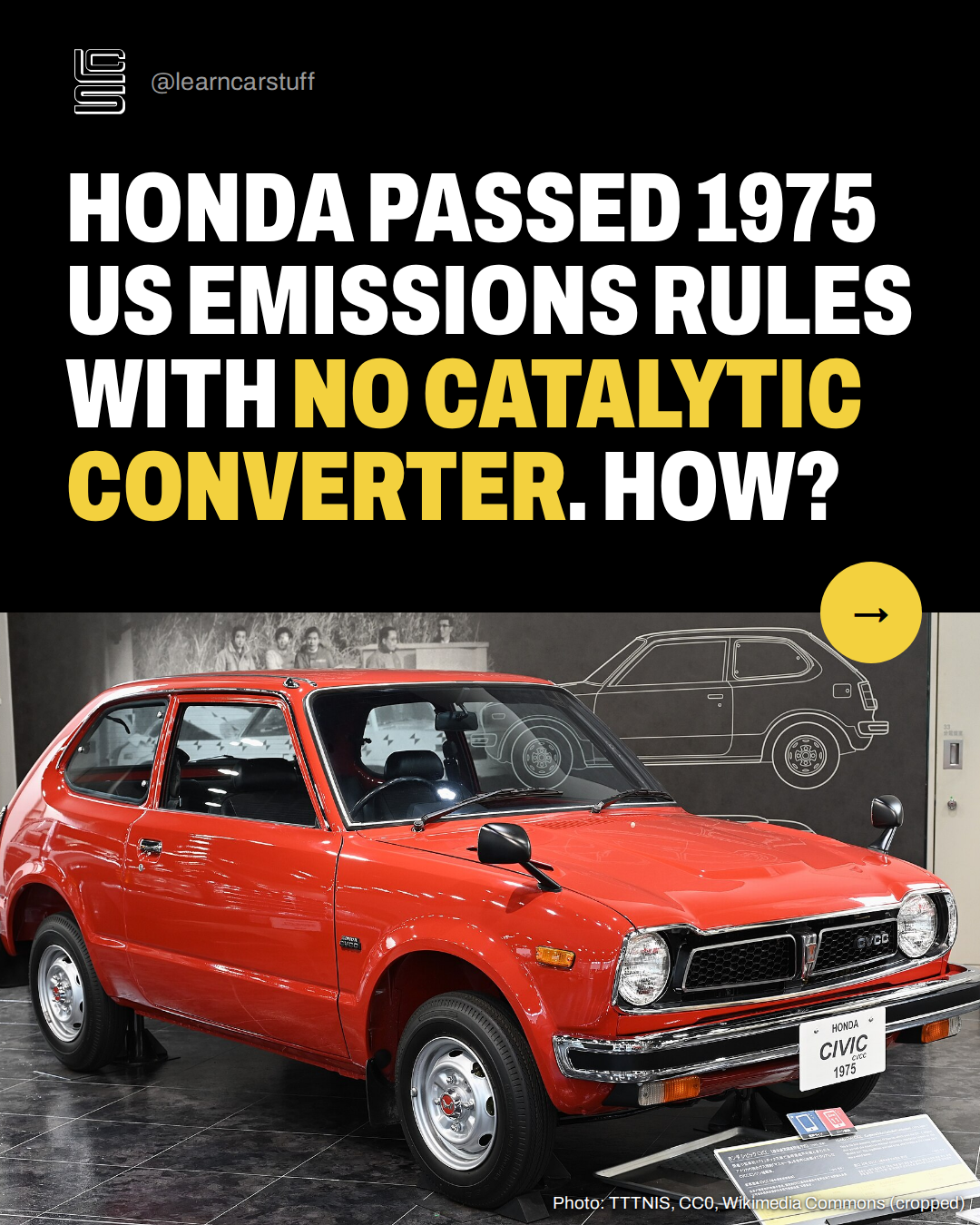
Honda passed 1975 US emissions rules with no catalytic converter. How?
Rivals cleaned up after the engine
Most rivals fixed 1975 exhaust after it left the engine, with a catalytic converter. GM alone put 5,000 people to work on converters. Lead ruins a catalyst, so those cars needed unleaded fuel.
Source: Science History Institute; US EIA
A rule described as unachievable
The 1970 Clean Air Act, the Muskie Act, demanded that 1975 cars emit one-tenth the carbon monoxide (CO) and unburned fuel (HC) of then-current models. EPA later delayed the full limits.
Source: Honda Global; JSME Heritage No. 6
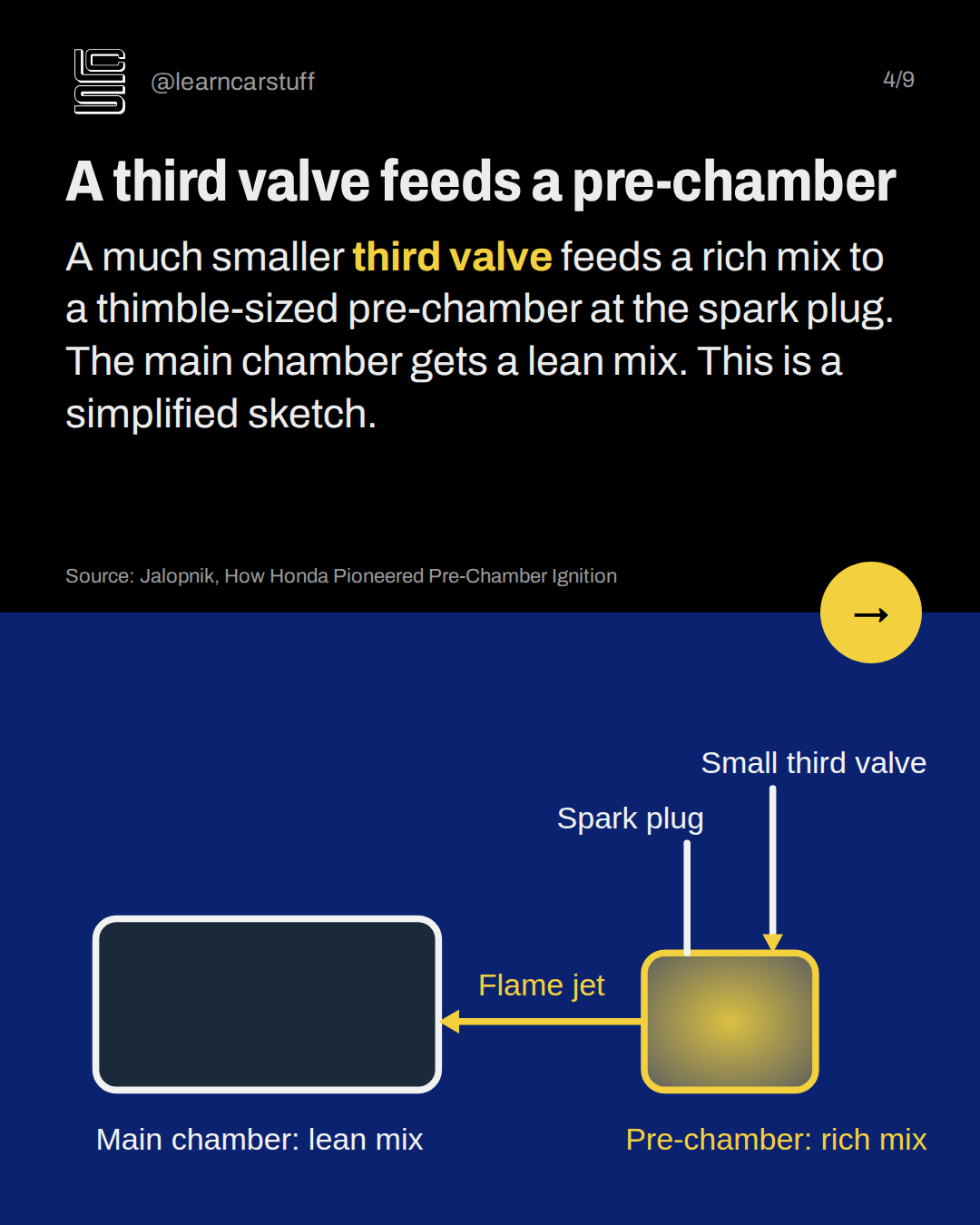
A third valve feeds a pre-chamber
A much smaller third valve feeds a rich mix to a thimble-sized pre-chamber at the spark plug. The main chamber gets a lean mix. This is a simplified sketch.
Source: Jalopnik, How Honda Pioneered Pre-Chamber Ignition
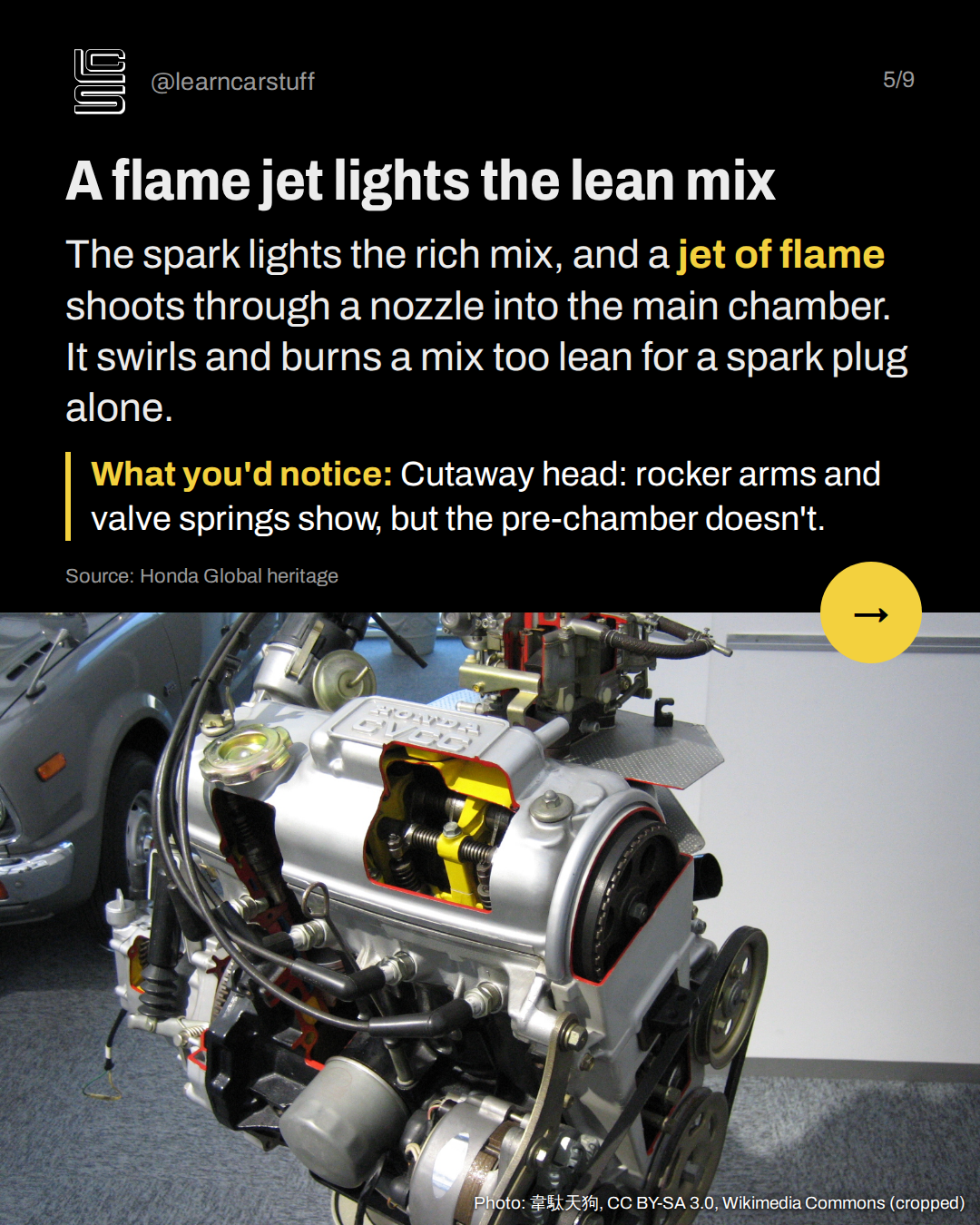
A flame jet lights the lean mix
The spark lights the rich mix, and a jet of flame shoots through a nozzle into the main chamber. It swirls and burns a mix too lean for a spark plug alone.
What you'd notice: Cutaway head: rocker arms and valve springs show, but the pre-chamber doesn't.
Source: Honda Global heritage
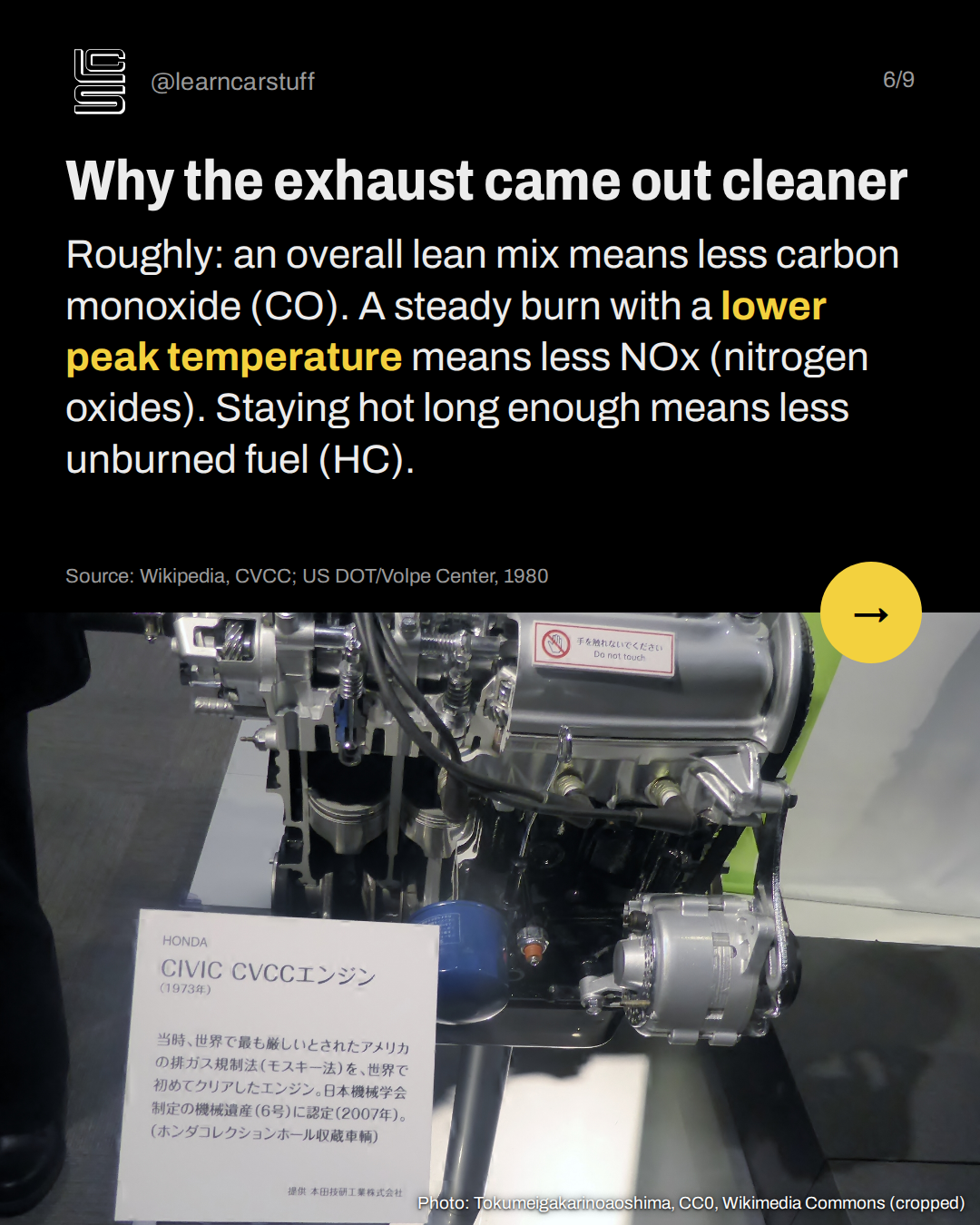
Why the exhaust came out cleaner
Roughly: an overall lean mix means less carbon monoxide (CO). A steady burn with a lower peak temperature means less NOx (nitrogen oxides). Staying hot long enough means less unburned fuel (HC).
Source: Wikipedia, CVCC; US DOT/Volpe Center, 1980
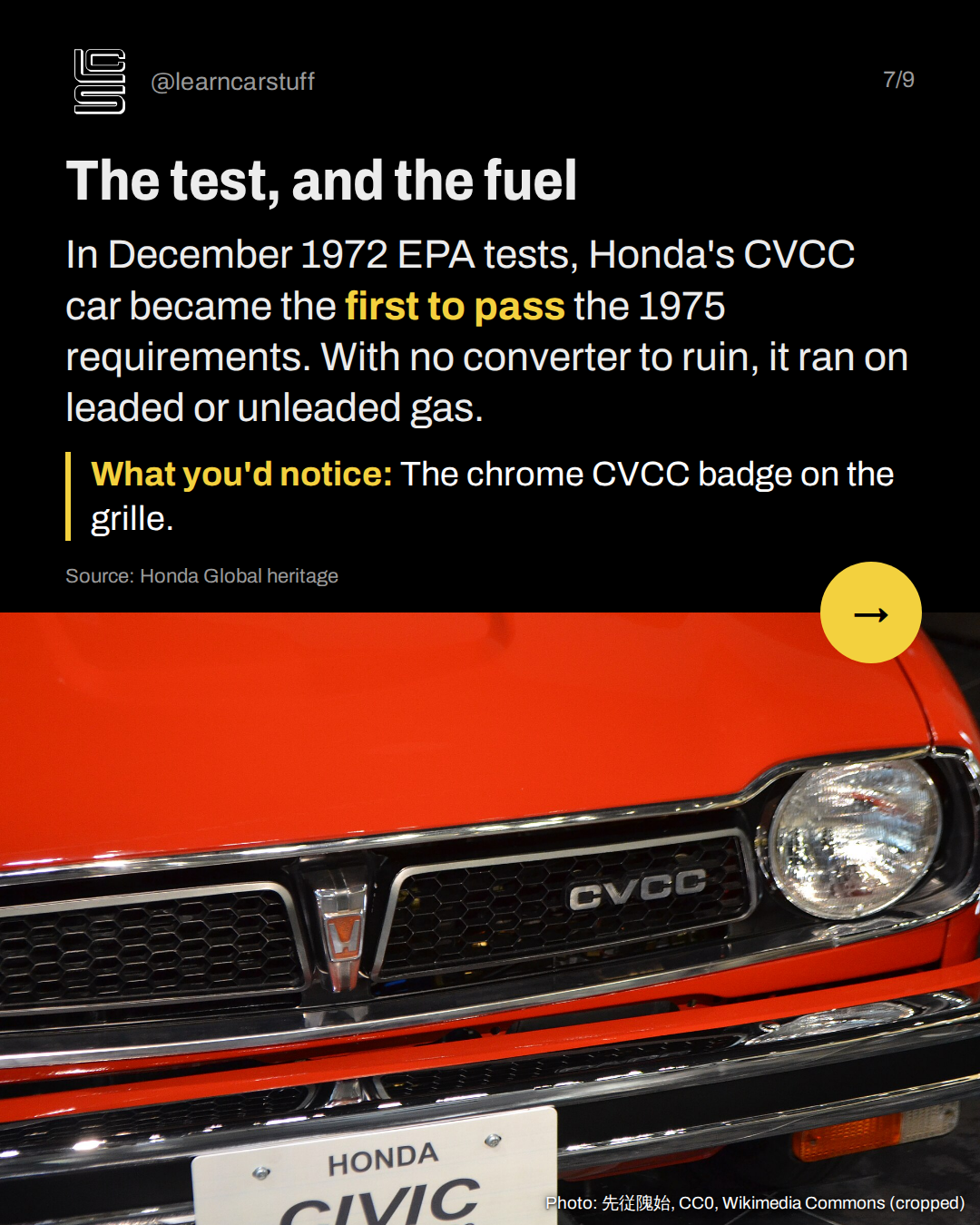
The test, and the fuel
In December 1972 EPA tests, Honda's CVCC car became the first to pass the 1975 requirements. With no converter to ruin, it ran on leaded or unleaded gas.
What you'd notice: The chrome CVCC badge on the grille.
Source: Honda Global heritage
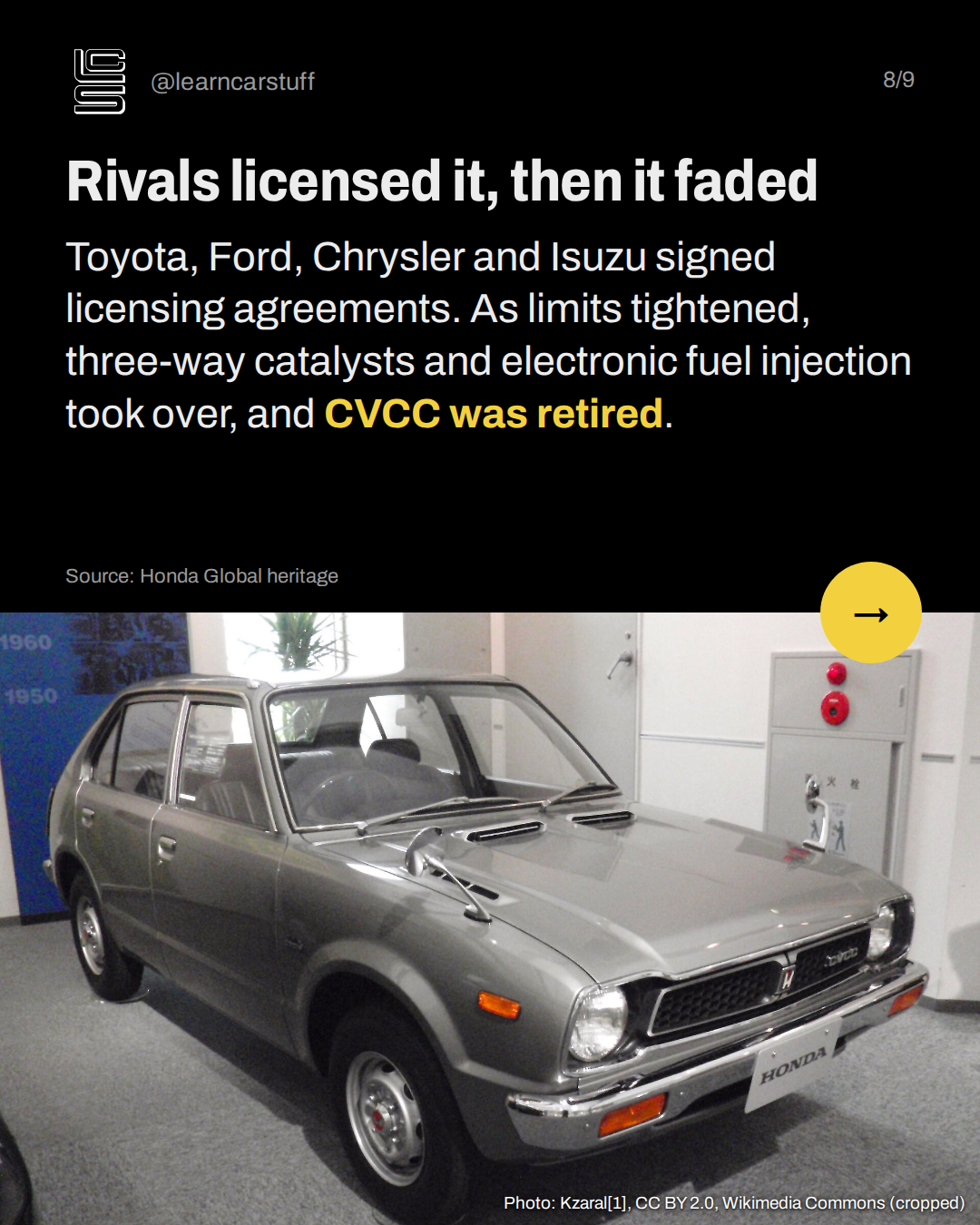
Rivals licensed it, then it faded
Toyota, Ford, Chrysler and Isuzu signed licensing agreements. As limits tightened, three-way catalysts and electronic fuel injection took over, and CVCC was retired.
Source: Honda Global heritage
Sources and assumptions
- Honda Global heritage: Introducing the CVCC / 1972: Two combustion chambers (main and auxiliary); a jet of flame from the prechamber through a nozzle creates the swirl in the main chamber; lean combustion; met the standards without a catalytic converter; 1970 Clean Air Act targets (one-tenth CO and HC for 1975, NOx for 1976); EPA testing 7–14 December 1972, first to pass the 1975 requirements; Civic launch in Japan on 12 July 1973 and in the US for the 1975 model year; runs on leaded or unleaded fuel while catalyst cars needed unleaded; licensing by Toyota, Ford, Chrysler and Isuzu; later superseded by the three-way catalyst and electronic fuel injection (checked 2026-10-23)
- Honda Global: Trajectory of Challenges, 1970s history digest: The Clean Air Act of 1970 is commonly known as the Muskie Act; the CVCC engine complied with its emission standards; Civic CVCC launched in 1973; the comprehensive US patent on the CVCC principle was published in 1975 (checked 2026-10-23)
- Jalopnik: How Honda Pioneered Pre-Chamber Ignition Long Before Formula 1: Three-valve design: two conventional valves plus a much smaller intake valve feeding the pre-chamber that holds the spark plug; the carburetor delivers a rich mixture to the thimble-sized pre-chamber and a lean mixture to the main chamber; the flame exits through a flame hole; passed EPA tests without a catalytic converter (checked 2026-10-23)
- Wikipedia: CVCC (used only for the mechanism detail and as a cross-check): Rich mixture in the pre-chamber and lean mixture in the main chamber; overall leanness limits CO, a slow and cool burn limits NOx, and a long enough burn keeps HC low; a smaller auxiliary inlet valve; licensed to Toyota, Ford, Chrysler and Isuzu (checked 2026-10-23)
- JSME Mechanical Engineering Heritage No. 6: Honda CVCC Engine: First in the world to clear the Muskie Act emission regulation, which was described as unachievable; auxiliary combustion chambers with their own valves; cut harmful exhaust without a catalyst; kept at the Honda Collection Hall, Motegi (checked 2026-10-23)
- Science History Institute, Distillations: Clean Machine: 1975-model US cars such as the 1975 Buick Regal carried catalytic converters; General Motors put 5,000 people to work on catalytic converters; three-way converters came next (checked 2026-10-23)
- US Energy Information Administration: Gasoline and the environment, leaded gasoline: Leaded gasoline damages catalytic converters, so leaded gas was banned for vehicles from model year 1975 on (that is, for catalyst-equipped cars) (checked 2026-10-23)
- Audrain Automobile Museum: 1975 Honda Civic CVCC: The 1975 Civic CVCC met the EPA standards without a catalytic converter; 1.5-liter inline-four CVCC engine (checked 2026-10-23)
- US DOT / Volpe Center report: Honda Motor Company's CVCC Engine (Abernathy and Ronan, 1980): The CVCC was lower in CO, HC and NOx and higher in fuel economy than contemporary conventional engines of similar output (checked 2026-10-23)
Assumptions:
- '1975 emissions requirements' means the US standards Honda says its car passed in the EPA tests of December 1972. EPA later delayed the full statutory standards, so the copy should say 'passed the 1975 requirements' (Honda's wording) and never claim a precise g/mile figure.
- 'Rivals used catalytic converters' is a general statement about 1975 US cars (GM's effort, catalyst cars needing unleaded fuel). It does not claim that every 1975 car had one; Honda itself is the counterexample.
- The EPA test car of December 1972 is called 'Honda's CVCC car'; no source opened names the exact body it used.
- The museum car in photos p1–p7 is a 1975 Civic CVCC on display at the Toyota Automobile Museum, labeled '1975 CVCC' on its placard. It is a right-hand-drive Japanese-market car, so slides should say '1975 Honda Civic CVCC', not 'US-market'.
- The power figure is left out on purpose: sources disagree (52 vs 53 hp) and the post doesn't need it.
Photos:
The short version
- Rivals cleaned exhaust after the engine.
- Honda's CVCC cleaned it inside the cylinder.
- A rich pre-chamber lit a lean main charge.
- No converter meant leaded or unleaded fuel.