 Learn Car Stuff
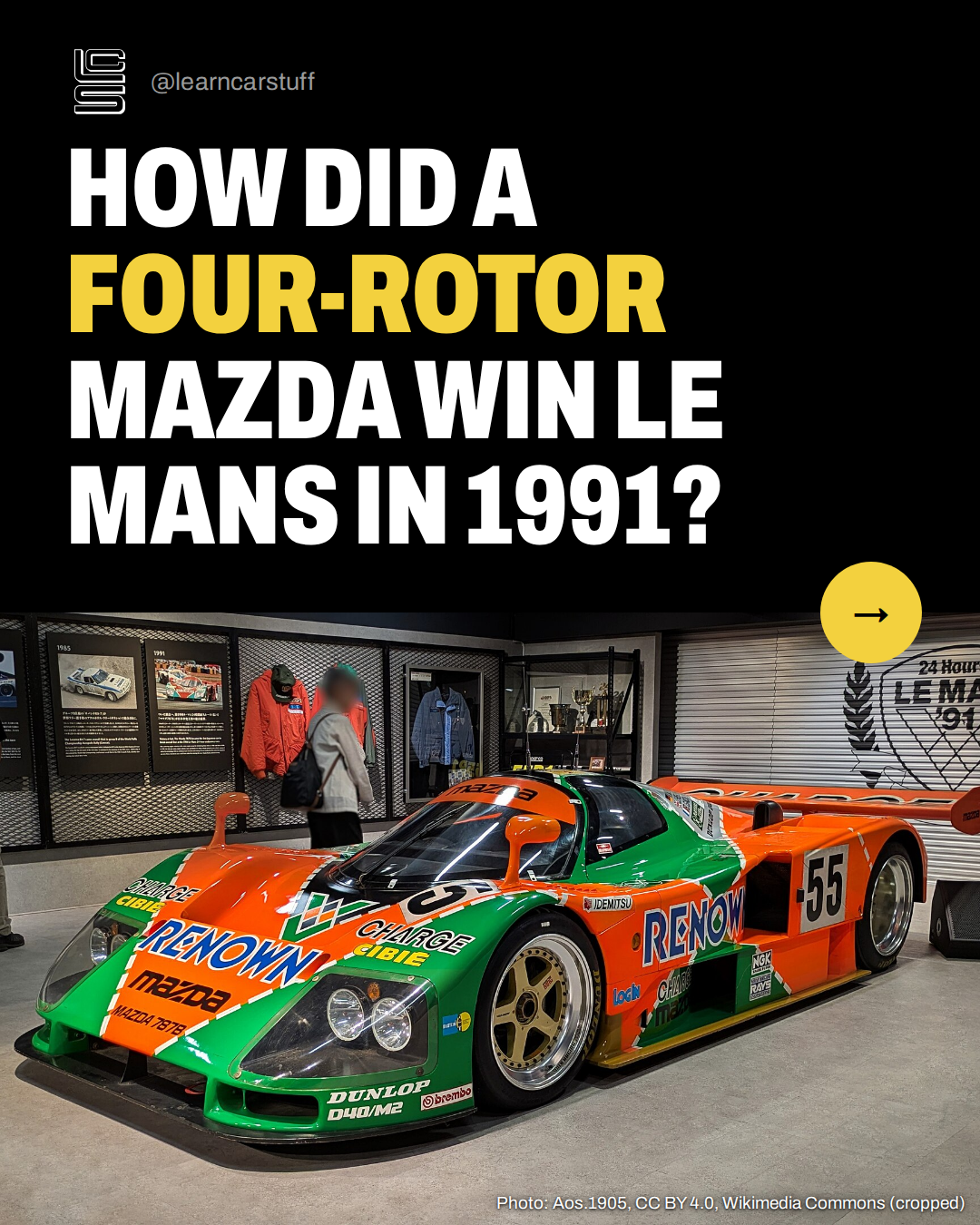
How did a four-rotor Mazda win Le Mans in 1991?
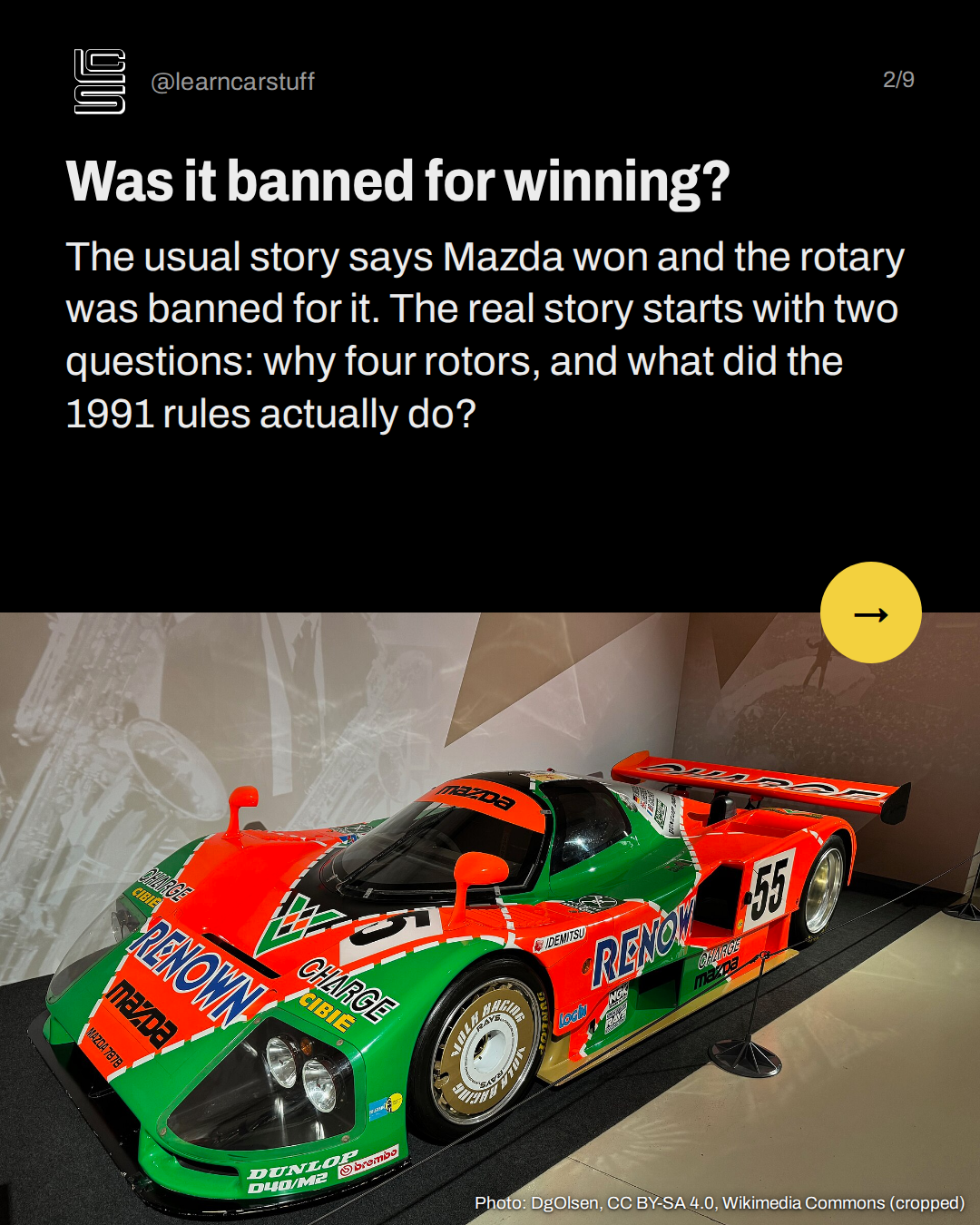
Was it banned for winning?
The usual story says Mazda won and the rotary was banned for it. The real story starts with two questions: why four rotors, and what did the 1991 rules actually do?
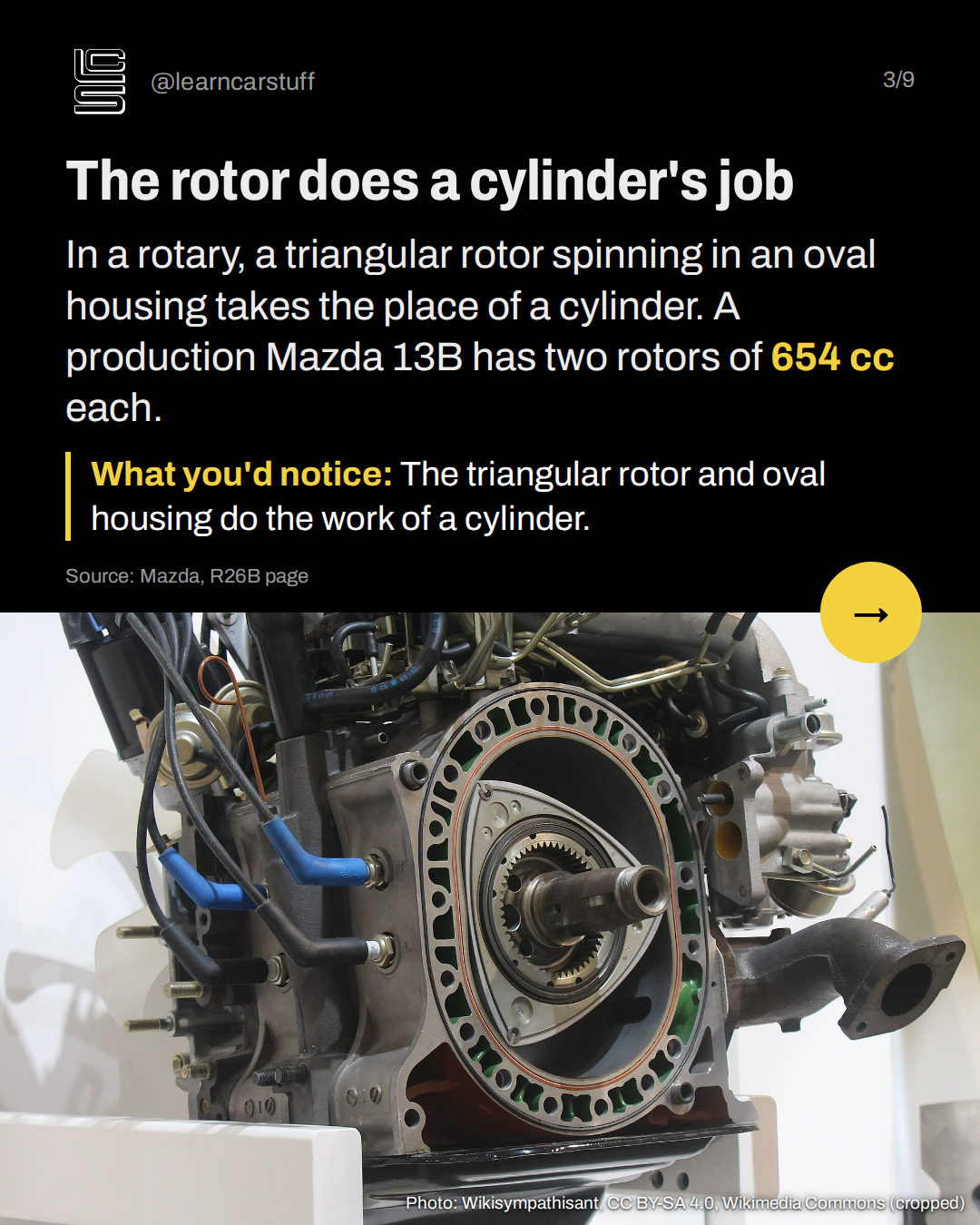
The rotor does a cylinder's job
In a rotary, a triangular rotor spinning in an oval housing takes the place of a cylinder. A production Mazda 13B has two rotors of 654 cc each.
What you'd notice: The triangular rotor and oval housing do the work of a cylinder.
Source: Mazda, R26B page
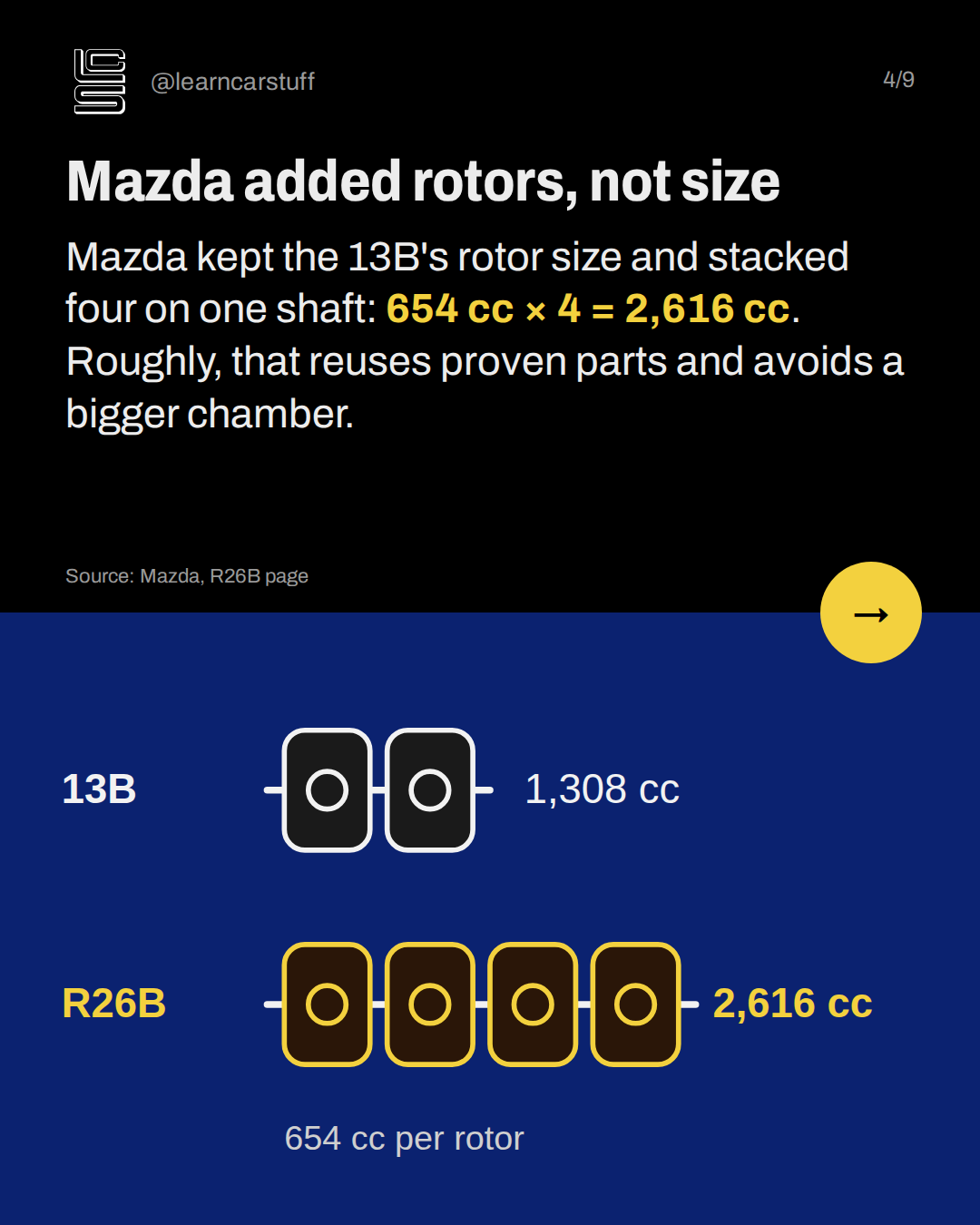
Mazda added rotors, not size
Mazda kept the 13B's rotor size and stacked four on one shaft: 654 cc × 4 = 2,616 cc. Roughly, that reuses proven parts and avoids a bigger chamber.
Source: Mazda, R26B page
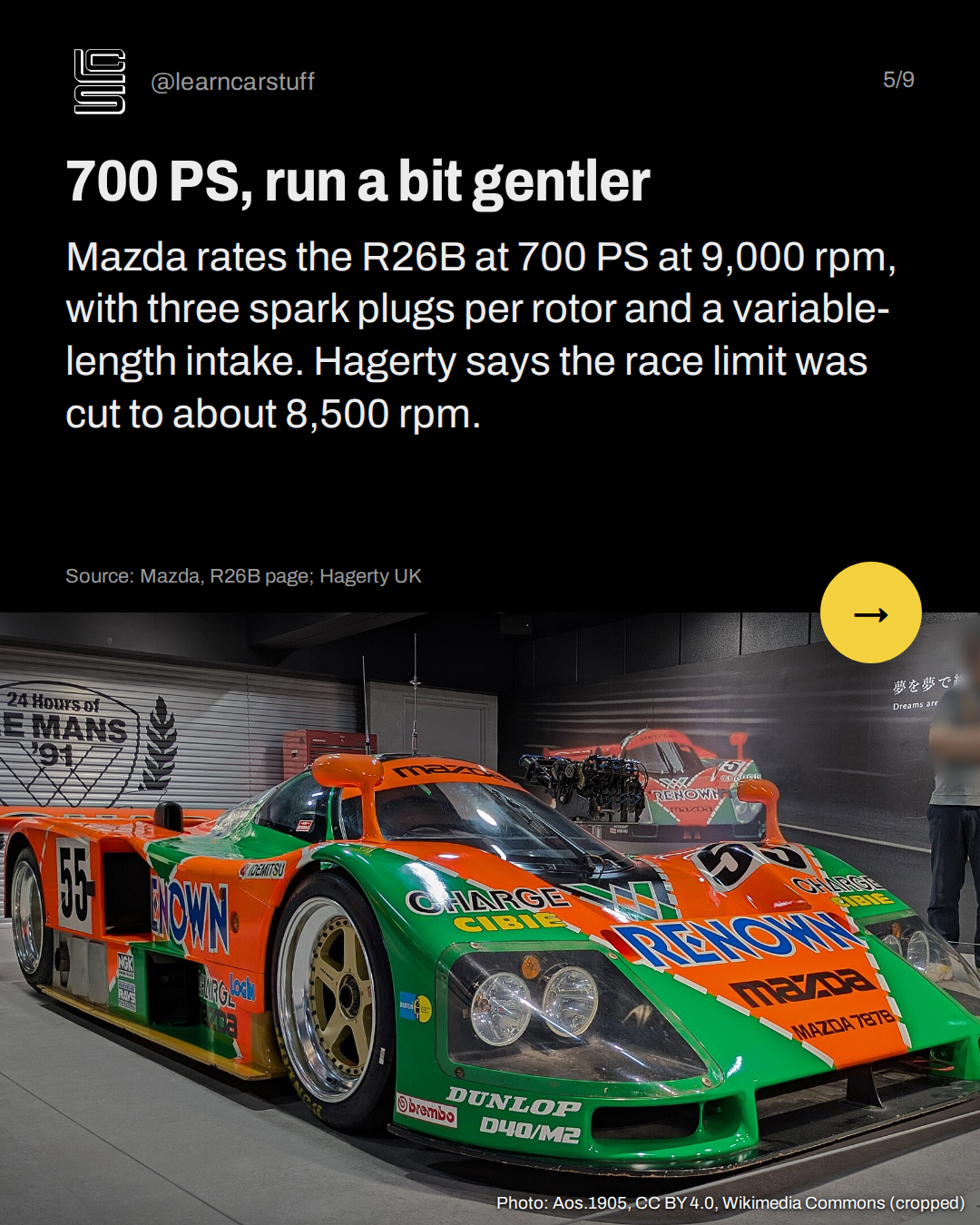
700 PS, run a bit gentler
Mazda rates the R26B at 700 PS at 9,000 rpm, with three spark plugs per rotor and a variable-length intake. Hagerty says the race limit was cut to about 8,500 rpm.
Source: Mazda, R26B page; Hagerty UK
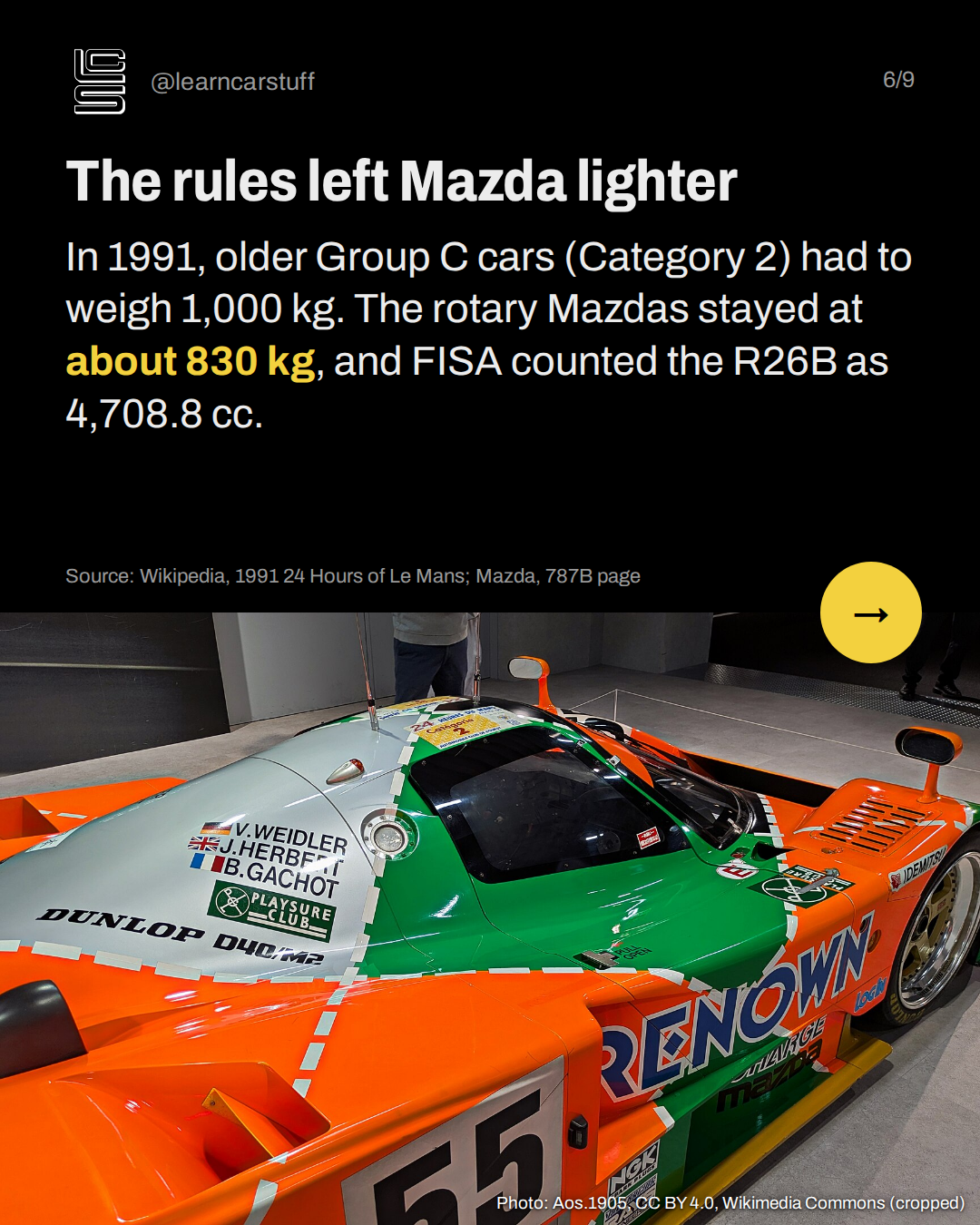
The rules left Mazda lighter
In 1991, older Group C cars (Category 2) had to weigh 1,000 kg. The rotary Mazdas stayed at about 830 kg, and FISA counted the R26B as 4,708.8 cc.
Source: Wikipedia, 1991 24 Hours of Le Mans; Mazda, 787B page
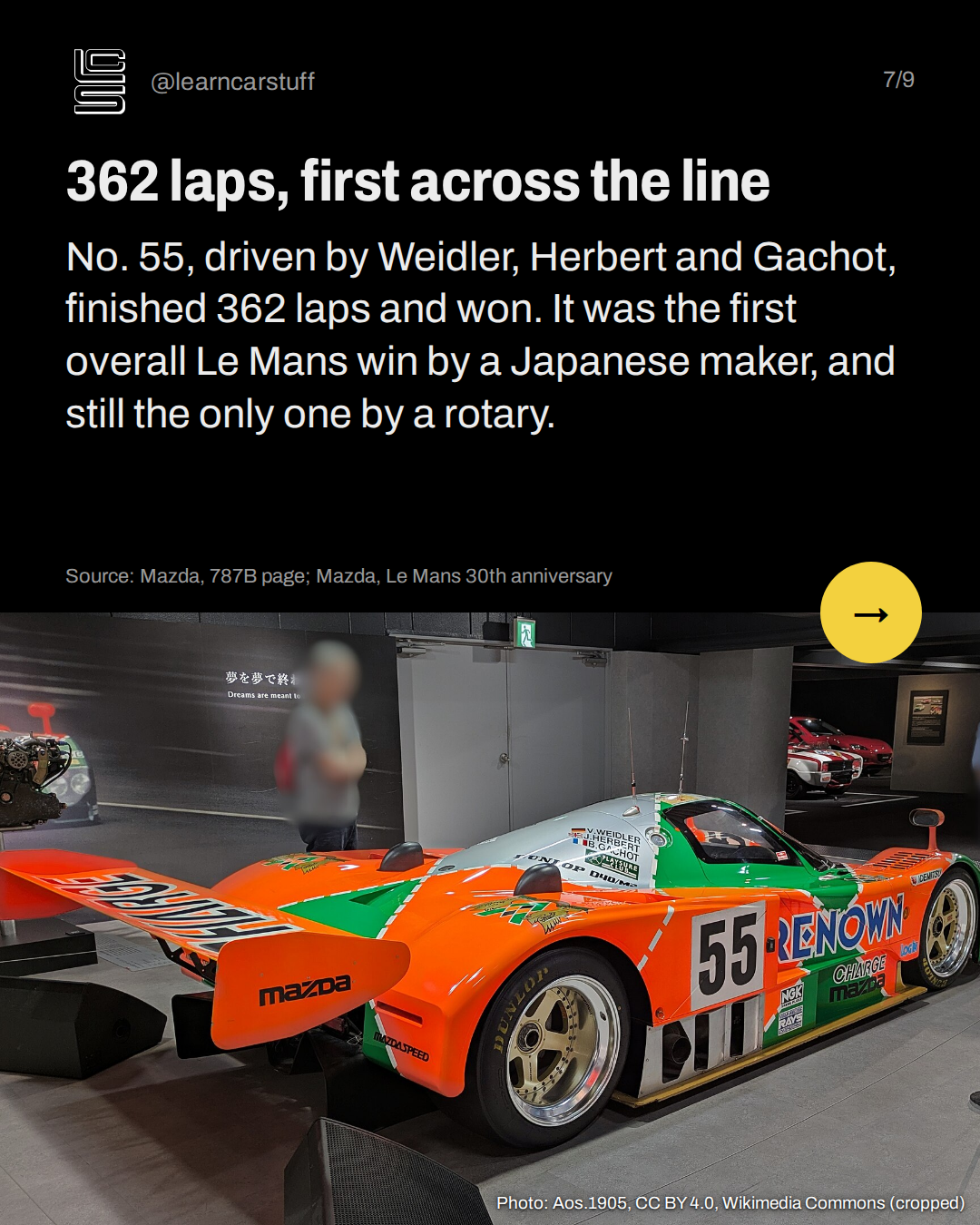
362 laps, first across the line
No. 55, driven by Weidler, Herbert and Gachot, finished 362 laps and won. It was the first overall Le Mans win by a Japanese maker, and still the only one by a rotary.
Source: Mazda, 787B page; Mazda, Le Mans 30th anniversary
The rule came before the win
The rule shutting rotaries out was written before the win, not because of it. Mazda's own 1992 entry, the MX-R01, used a 3.5-litre V10.
Source: Mazda, Le Mans history; Jalopnik
Sources and assumptions
- Mazda, Le Mans 30th anniversary page: First Japanese manufacturer and first rotary engine manufacturer to win Le Mans overall (1991); 830 kg lightweight body; four-rotor engine, 700 PS maximum; drivers Weidler/Herbert/Gachot; four sequential rotor housings using the 13B's rotor shape; peripheral ports, three-plug ignition, linear variable intake (checked 2026-10-22)
- Mazda, Mazda 787B page: R26B 4-rotor 654cc x 4 (FISA reciprocating equivalent 4,708.8cc); chassis 787B-002, car No. 55, 362 laps (about 4,923 km) at the 59th 24 Hours of Le Mans (checked 2026-10-22)
- Mazda, Transformation of the Racing Rotary Engine (R26B): R26B 654cc x 4, 700 PS @ 9,000 rpm, 62 kg-m @ 6,500 rpm; 13B = 654cc x 2 (1973 Luce); 3- and 4-rotor engines used the same dimensions and shapes as 13B components; three-plug ignition; variable-length intake; Mazda's account of a rule change shutting out rotary cars, with old-spec cars allowed under transitional rules (checked 2026-10-22)
- Mazda, Le Mans history page: 1992 entry: Mazda MX-R01 (two cars), Group C, 3.5 litre V10 (MV10) (checked 2026-10-22)
- Hagerty UK, Freeze Frame: rotary revolution at 1991's Le Mans: 3.5-litre NA formula in 1991; Mazda not subject to the piston cars' weight penalty, ran at 830 kg; race rev limit 9,000 rpm (~700 bhp), cut to 8,500 rpm (~650 bhp) for the 1991 race (checked 2026-10-22)
- Wikipedia, 1991 24 Hours of Le Mans: Category 1: 3.5-litre non-turbo piston engines, 750 kg minimum; Category 2: older Group C cars, minimum raised 100 kg to 1,000 kg, rotary Mazdas exempt (about 830 kg) (checked 2026-10-22)
- Wikipedia, Mazda 787B: R26B 2,616 cc, rotor 15 mm eccentricity x 105 mm radius x 80 mm width; 830 kg vs 1,000 kg C2 minimum; only win by a non-reciprocating engine; Japanese-manufacturer win unmatched until Toyota in 2018 (checked 2026-10-22)
- Mazda patent US8220435B2 (Google Patents): Mazda engineers link rotor breadth to flame speed: a breadth of 76 mm or less prevents a drop in flame propagation speed across the rotor (checked 2026-10-22)
- Wikipedia, Kudzu DG-3: A Mazda-rotary Kudzu DG-3 raced at Le Mans in 1995 in the WSC class (7th overall, 3rd in class): rotaries came back, not as overall contenders (checked 2026-10-22)
- Jalopnik, How Mazda Was Allowed To Race At Le Mans With A Banned Rotary Engine In 1991: Mazdaspeed's Takayoshi Ohashi got a FISA amendment letting the 787B run without the extra weight rivals had to add; the ban was already set before the win (checked 2026-10-22)
Assumptions:
- Power is Mazda's 700 PS @ 9,000 rpm spec; Hagerty reports the 1991 race rev limit was lowered to about 8,500 rpm (~650 bhp), so race-day output was likely below 700.
- Weight: Mazda's 30th-anniversary page says 830 kg; the 787B page's wording is 'over 830/839 kg'. Use 'about 830 kg'.
- The reason for stacking rotors is inferred from Mazda's statement that multi-rotor engines reused 13B dimensions and parts, plus Mazda's patent on rotor breadth and flame speed. Mazda does not state a single official reason, so slides say 'roughly' and present it as engineering logic, not a quote.
- The 'rotaries banned from 1992' claim is about overall contention in the top prototype class. Rotary cars raced at Le Mans in lower classes later (Kudzu DG-3 in 1995).
- Distance: Mazda says about 4,923 km and Wikipedia says 4,932.2 km. Use laps (362), not km.
Photos:
- Photo: Aos.1905, CC BY 4.0, Wikimedia Commons (cropped)
- Photo: Aos.1905, CC BY 4.0, Wikimedia Commons (cropped)
- Photo: Aos.1905, CC BY 4.0, Wikimedia Commons (cropped)
- Photo: DgOlsen, CC BY-SA 4.0, Wikimedia Commons (cropped)
- Photo: Aos.1905, CC BY 4.0, Wikimedia Commons (cropped)
- Photo: Wikisympathisant, CC BY-SA 4.0, Wikimedia Commons (cropped)
The short version
- Mazda stacked four 654 cc rotors.
- That made 2,616 cc from proven 13B-size parts.
- The 1991 rules kept it at about 830 kg.
- The rotary rule was set before the win.