 Learn Car Stuff
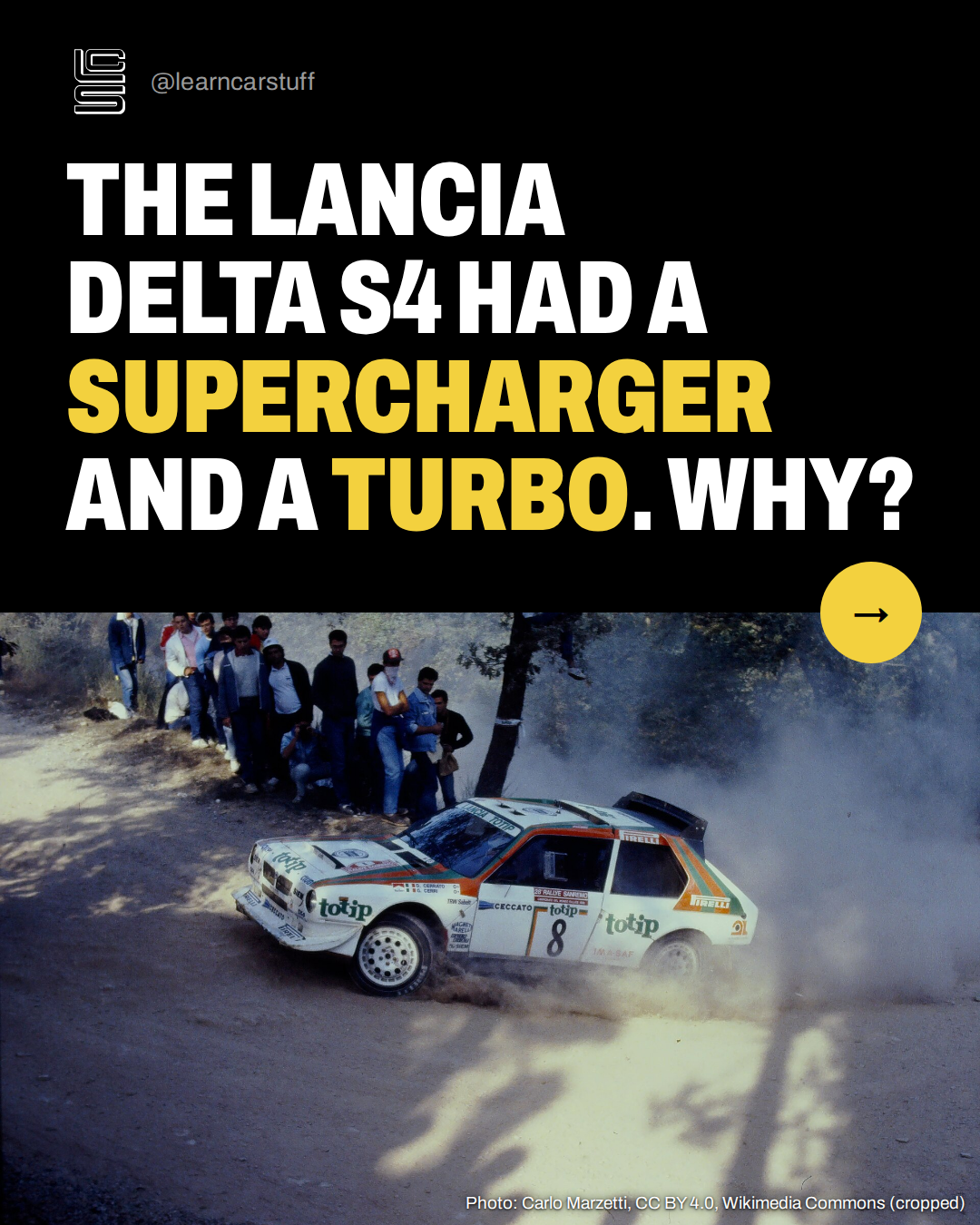
The Lancia Delta S4 had a supercharger and a turbo. Why?
The usual either/or
Most people treat it as a choice. A turbo can lag at low revs, while a crank-driven supercharger gives boost early but adds drag at the top end. The S4 refused to choose.
Source: Motor Sport magazine, Feb 1985
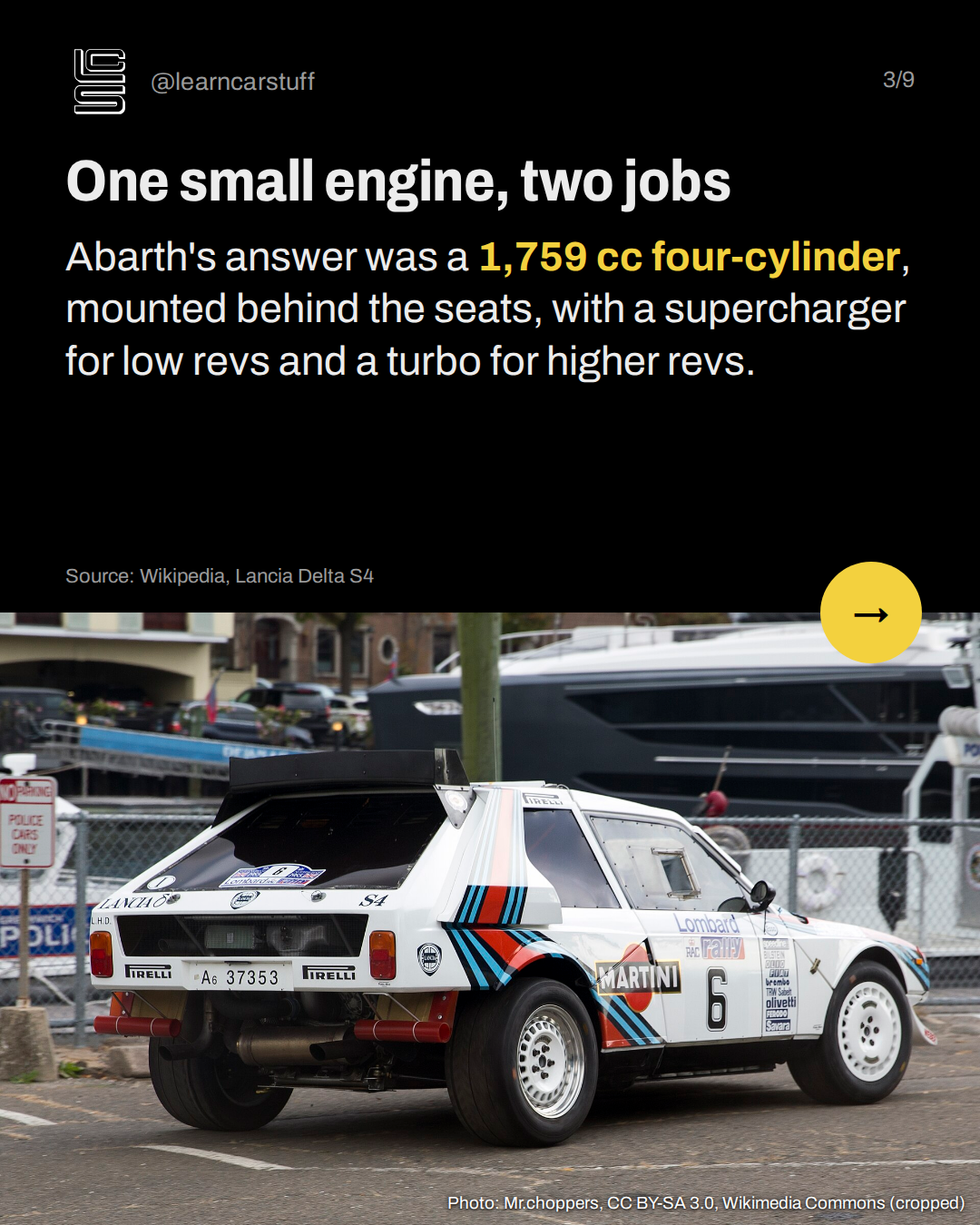
One small engine, two jobs
Abarth's answer was a 1,759 cc four-cylinder, mounted behind the seats, with a supercharger for low revs and a turbo for higher revs.
Source: Wikipedia, Lancia Delta S4
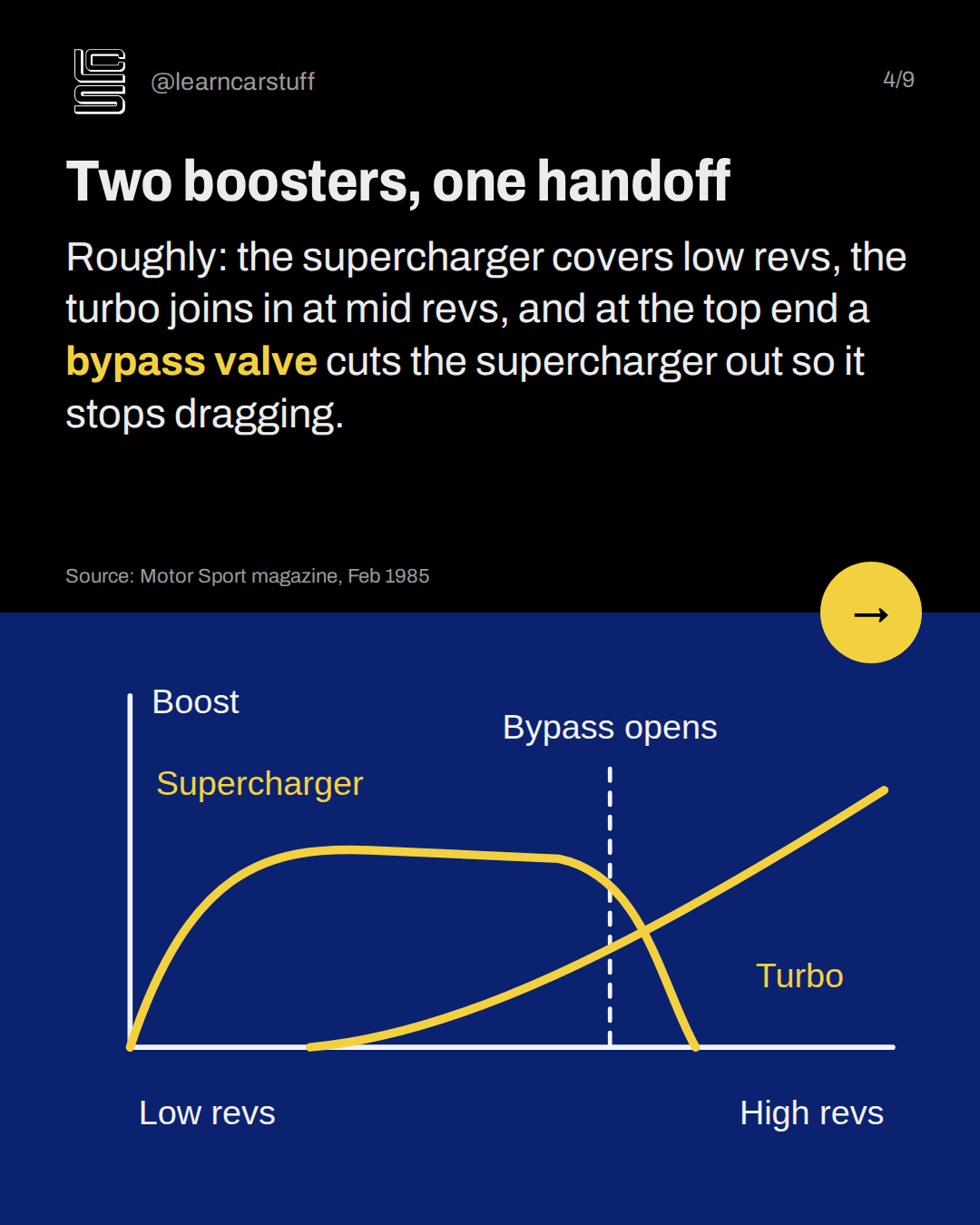
Two boosters, one handoff
Roughly: the supercharger covers low revs, the turbo joins in at mid revs, and at the top end a bypass valve cuts the supercharger out so it stops dragging.
Source: Motor Sport magazine, Feb 1985
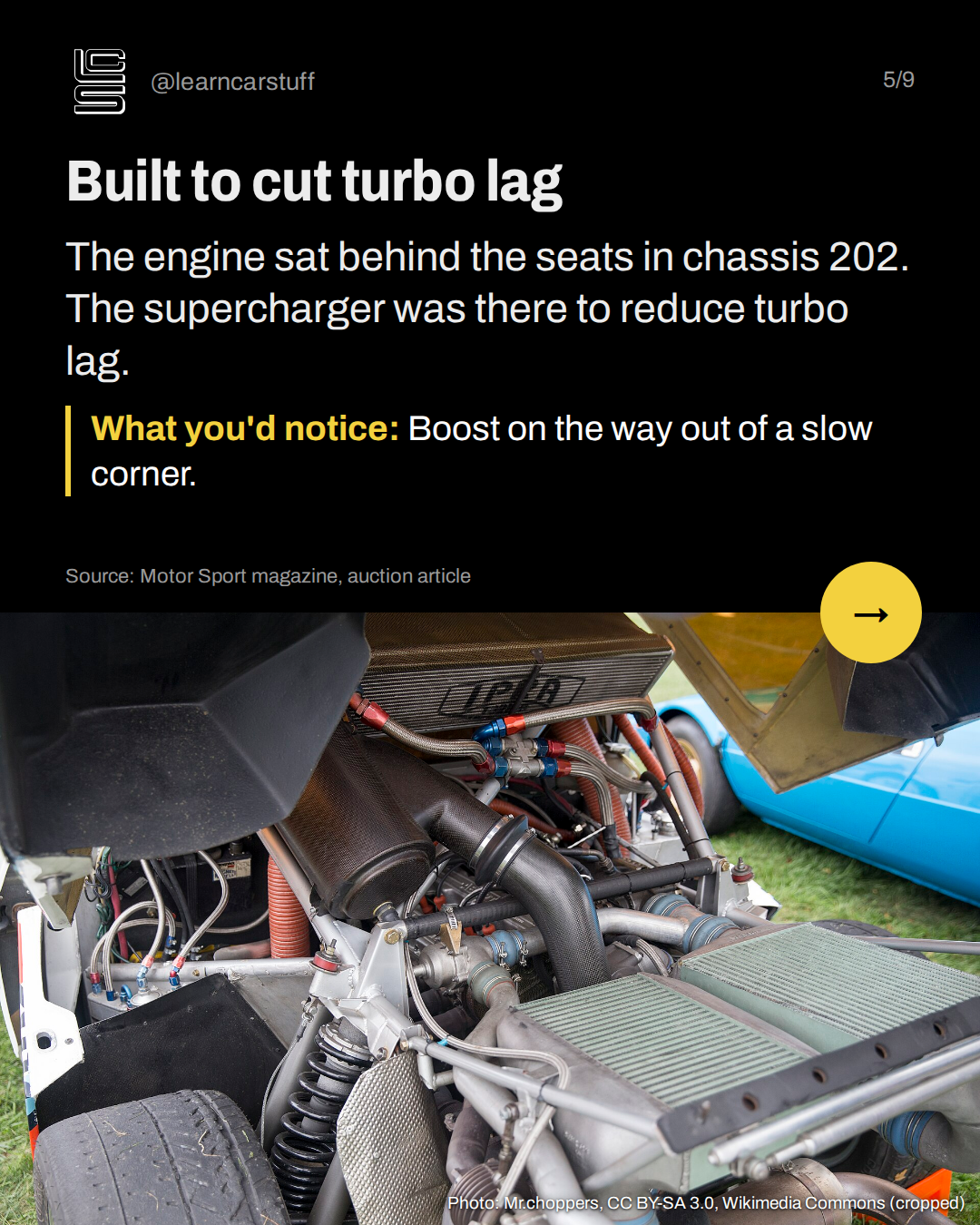
Built to cut turbo lag
The engine sat behind the seats in chassis 202. The supercharger was there to reduce turbo lag.
What you'd notice: Boost on the way out of a slow corner.
Source: Motor Sport magazine, auction article
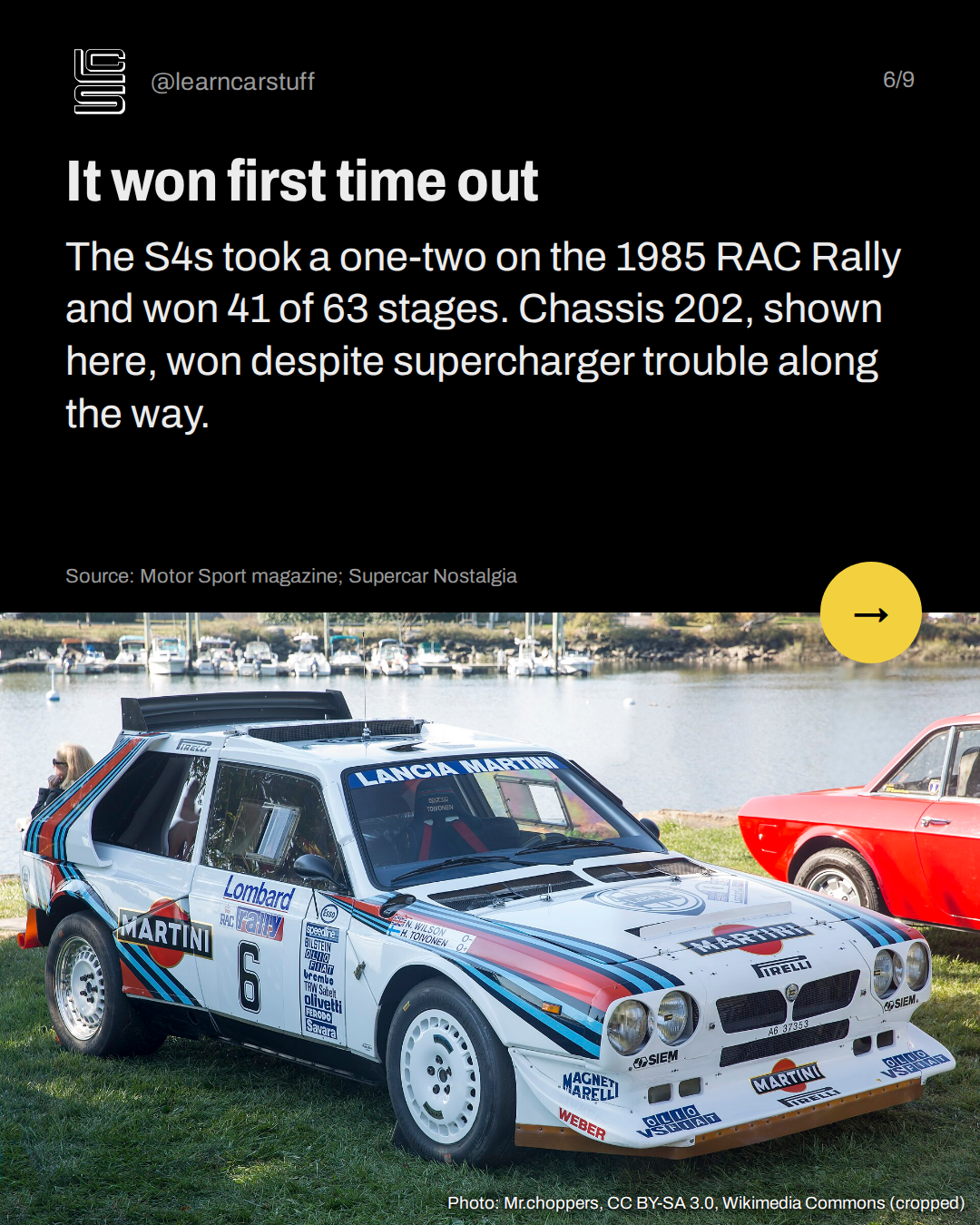
It won first time out
The S4s took a one-two on the 1985 RAC Rally and won 41 of 63 stages. Chassis 202, shown here, won despite supercharger trouble along the way.
Source: Motor Sport magazine; Supercar Nostalgia
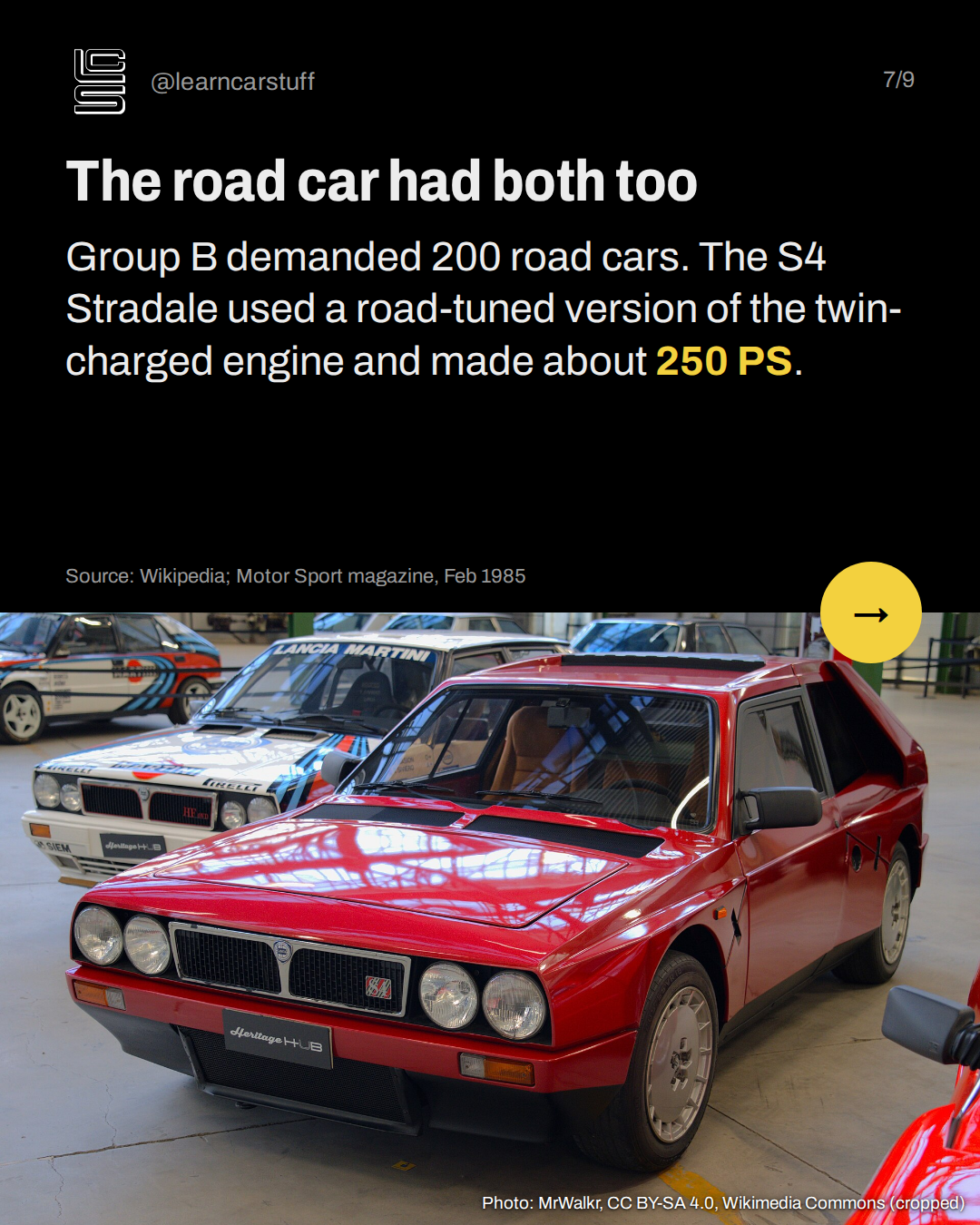
The road car had both too
Group B demanded 200 road cars. The S4 Stradale used a road-tuned version of the twin-charged engine and made about 250 PS.
Source: Wikipedia; Motor Sport magazine, Feb 1985
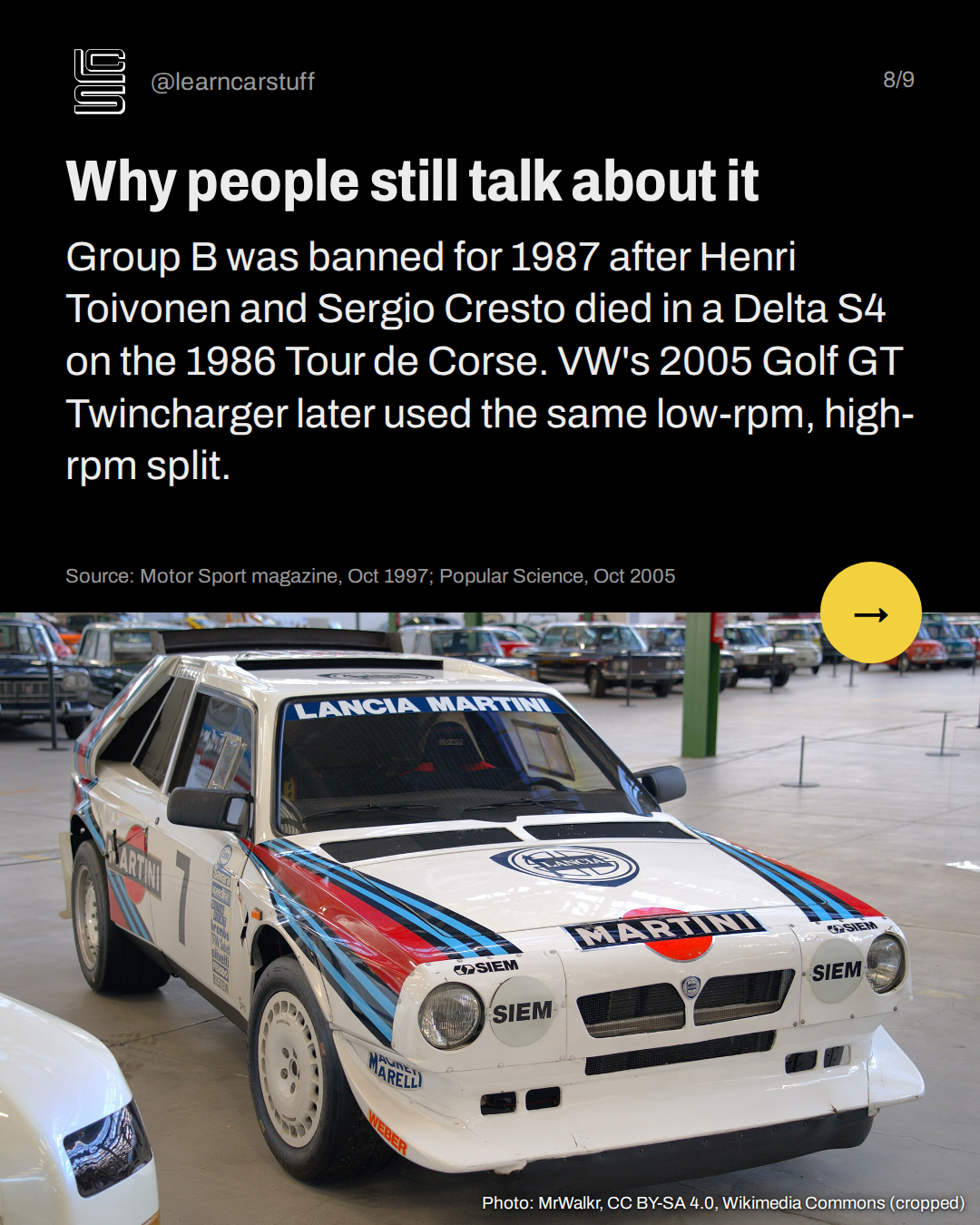
Why people still talk about it
Group B was banned for 1987 after Henri Toivonen and Sergio Cresto died in a Delta S4 on the 1986 Tour de Corse. VW's 2005 Golf GT Twincharger later used the same low-rpm, high-rpm split.
Source: Motor Sport magazine, Oct 1997; Popular Science, Oct 2005
Sources and assumptions
- Motor Sport magazine archive, 'Lancia joins 4wd club' (February 1985): Abarth all-alloy engine with both a Volumex supercharger and a KKK turbocharger; 1.76 litres; crank-driven supercharger gives boost at low engine speeds, supplemented by the turbo at medium revs; at the top end a bypass valve cuts out the supercharger and eliminates its drag; 200 examples needed for homologation; claimed more than 400 bhp at 8,000 rpm and 290 lb ft at 5,000 rpm (pre-homologation claim) (checked 2026-10-21)
- Wikipedia, Lancia Delta S4: 1,759 cc DOHC 16-valve inline-four, longitudinally mid-mounted; Abarth Volumex R18 supercharger plus KKK 27 turbocharger, supercharger for low-range boost and turbo at higher rpm; Stradale 250 PS at 6,750 rpm; first win at the 1985 RAC Rally (Toivonen/Wilson); competed 1985–86 before Group B was abolished (checked 2026-10-21)
- Autozine, Lancia Delta S4 (1985): 1,759 cc; once the turbo got running, a bypass valve relieved the supercharger so it was deactivated; road cars had 250 hp; won its debut at the 1985 RAC Rally; Toivonen's Tour de Corse crash led to the end of Group B (checked 2026-10-21)
- Motor Sport magazine archive, 'Delta Bravo' (October 1997): Supercharger for low-end power and KKK turbo for high-rev grunt; S4 took a one-two on the November 1985 RAC Rally with Toivonen; Group B was banned for the 1987 season after Toivonen's fatal Tour de Corse crash and the Portugal spectator accident (checked 2026-10-21)
- Motor Sport magazine, RAC Rally-winning Lancia Delta S4 auction article: Turbocharged engine also supercharged to reduce turbo lag; 1985 RAC one-two in which the two cars won 41 of the event's 63 special stages; Group B banned after Toivonen and co-driver Sergio Cresto died on the 1986 Tour of Corsica (checked 2026-10-21)
- Supercar Nostalgia, Martini Racing Lancia Delta S4 'Corsa' chassis 202: Chassis 202 was Toivonen/Wilson's car for the 1985 RAC Rally (24–28 November), which they won; registration A6 37353; supercharger and electrical trouble during the event; later a T-car for the 1986 Monte Carlo Rally (checked 2026-10-21)
- Popular Science, 'The Turbo- and Supercharged Car' (October 2005): VW's 1.4-liter twincharger Golf GT (fall 2005, Europe): supercharger boosts low-rpm torque and the turbo takes over at high revs (checked 2026-10-21)
Assumptions:
- The boost-vs-rpm diagram is qualitative: no boost pressures or handoff rpm were verified, so the axes carry no numbers and the diagram is labeled 'roughly'.
- The air-path order (whether the turbo compressor feeds the supercharger or the other way round) was not verified, so no slide may show or state it.
- Rally power figures vary by source and year (Motor Sport 1985 claimed more than 400 bhp, Supercar Nostalgia says 430 bhp in 1985 gravel trim, Motor Sport 1997 says 500 bhp). If power appears at all, it's 'over 400 bhp, later about 500 by period accounts', never one exact number.
- The Stradale's ~250 PS is a road tune of the same twin-charged engine type (Wikipedia, Autozine). Its exact build count is disputed (200 required; Wikipedia says fewer than 100 may have been built), so say '200 required for homologation', not '200 built'.
- 'Twin-charging' isn't claimed as a world first: no strong source confirmed it.
Photos:
- Photo: Mr.choppers, CC BY-SA 3.0, Wikimedia Commons (cropped)
- Photo: Mr.choppers, CC BY-SA 3.0, Wikimedia Commons (cropped)
- Photo: Mr.choppers, CC BY-SA 3.0, Wikimedia Commons (cropped)
- Photo: Carlo Marzetti, CC BY 4.0, Wikimedia Commons (cropped)
- Photo: MrWalkr, CC BY-SA 4.0, Wikimedia Commons (cropped)
- Photo: MrWalkr, CC BY-SA 4.0, Wikimedia Commons (cropped)
The short version
- The S4 had a supercharger and a turbo.
- The supercharger helped at low revs.
- The turbo took over higher up.
- A bypass valve cut out the supercharger's drag.
- VW used the same idea in 2005.