 Learn Car Stuff
The Mercedes W124's one wiper stretches toward the corners. Why?

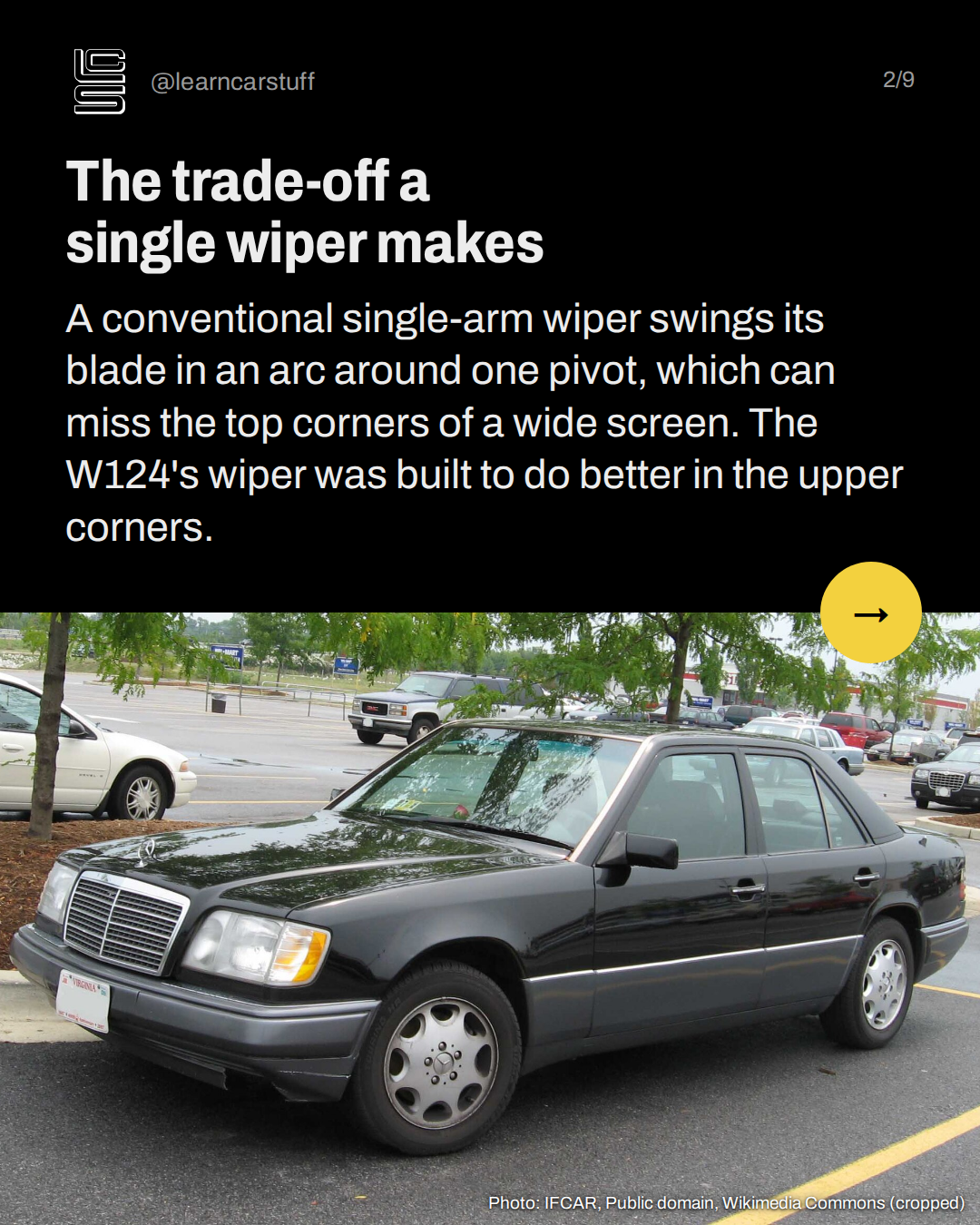
The trade-off a single wiper makes
A conventional single-arm wiper swings its blade in an arc around one pivot, which can miss the top corners of a wide screen. The W124's wiper was built to do better in the upper corners.
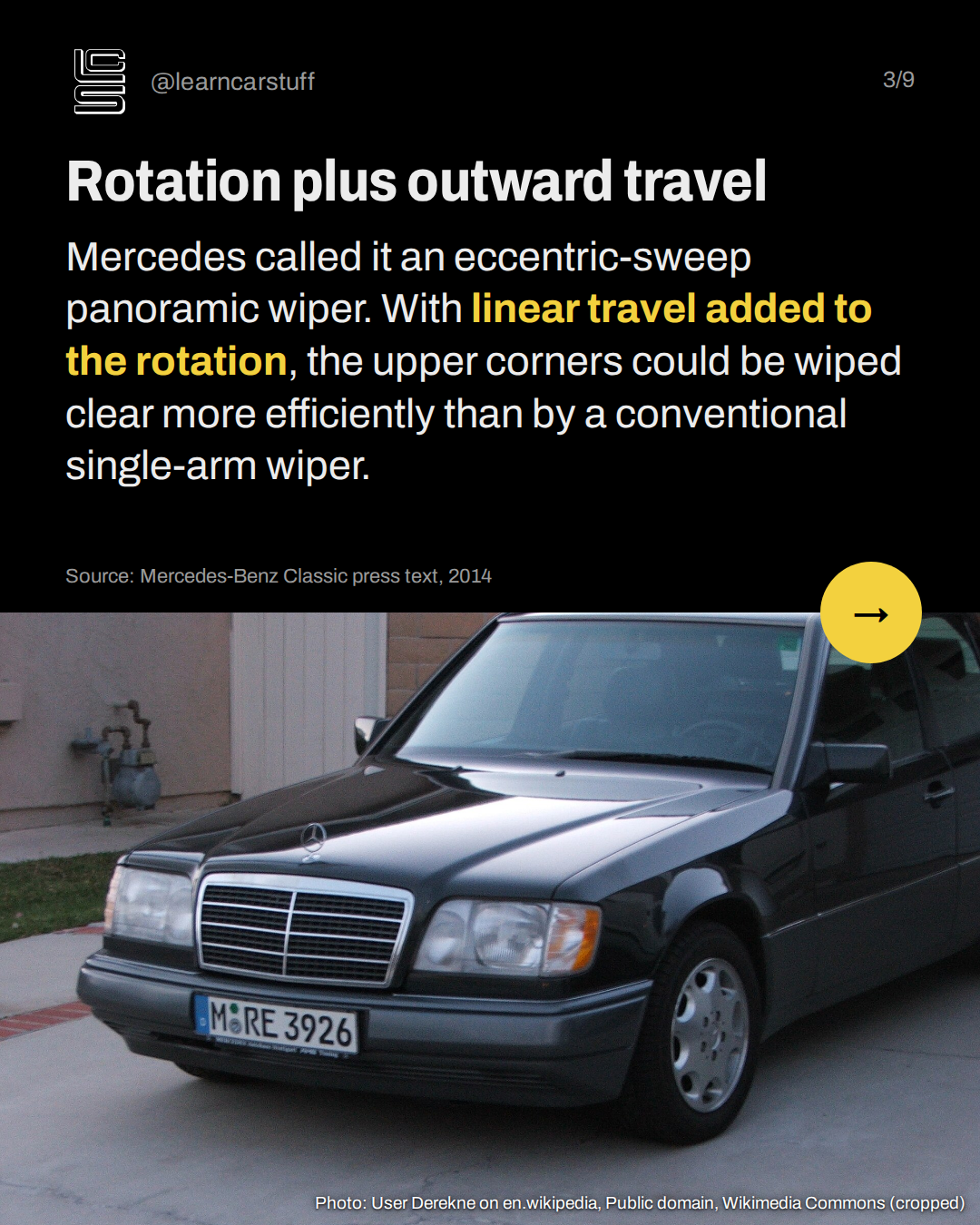
Rotation plus outward travel
Mercedes called it an eccentric-sweep panoramic wiper. With linear travel added to the rotation, the upper corners could be wiped clear more efficiently than by a conventional single-arm wiper.
Source: Mercedes-Benz Classic press text, 2014
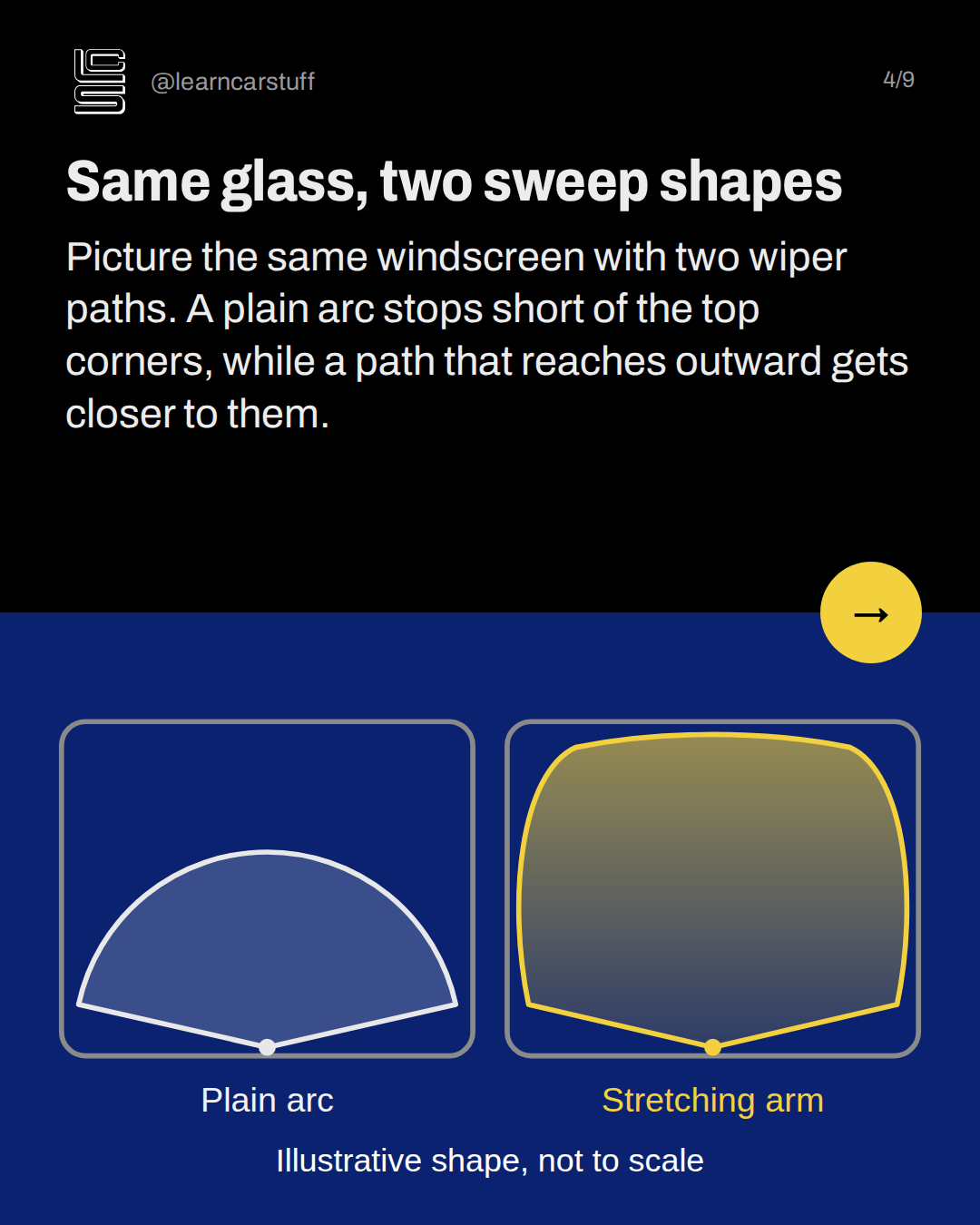
Same glass, two sweep shapes
Picture the same windscreen with two wiper paths. A plain arc stops short of the top corners, while a path that reaches outward gets closer to them.
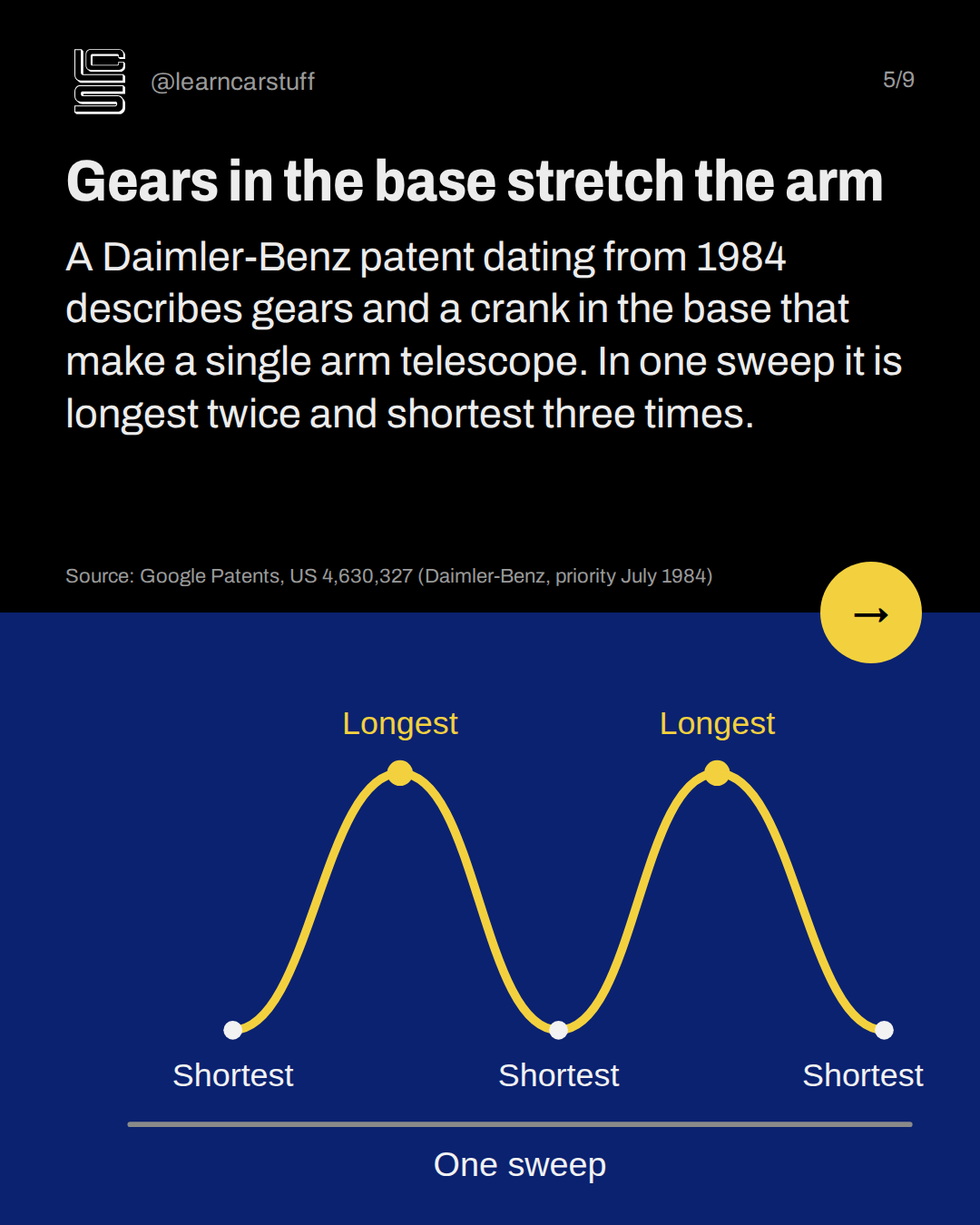
Gears in the base stretch the arm
A Daimler-Benz patent dating from 1984 describes gears and a crank in the base that make a single arm telescope. In one sweep it is longest twice and shortest three times.
Source: Google Patents, US 4,630,327 (Daimler-Benz, priority July 1984)
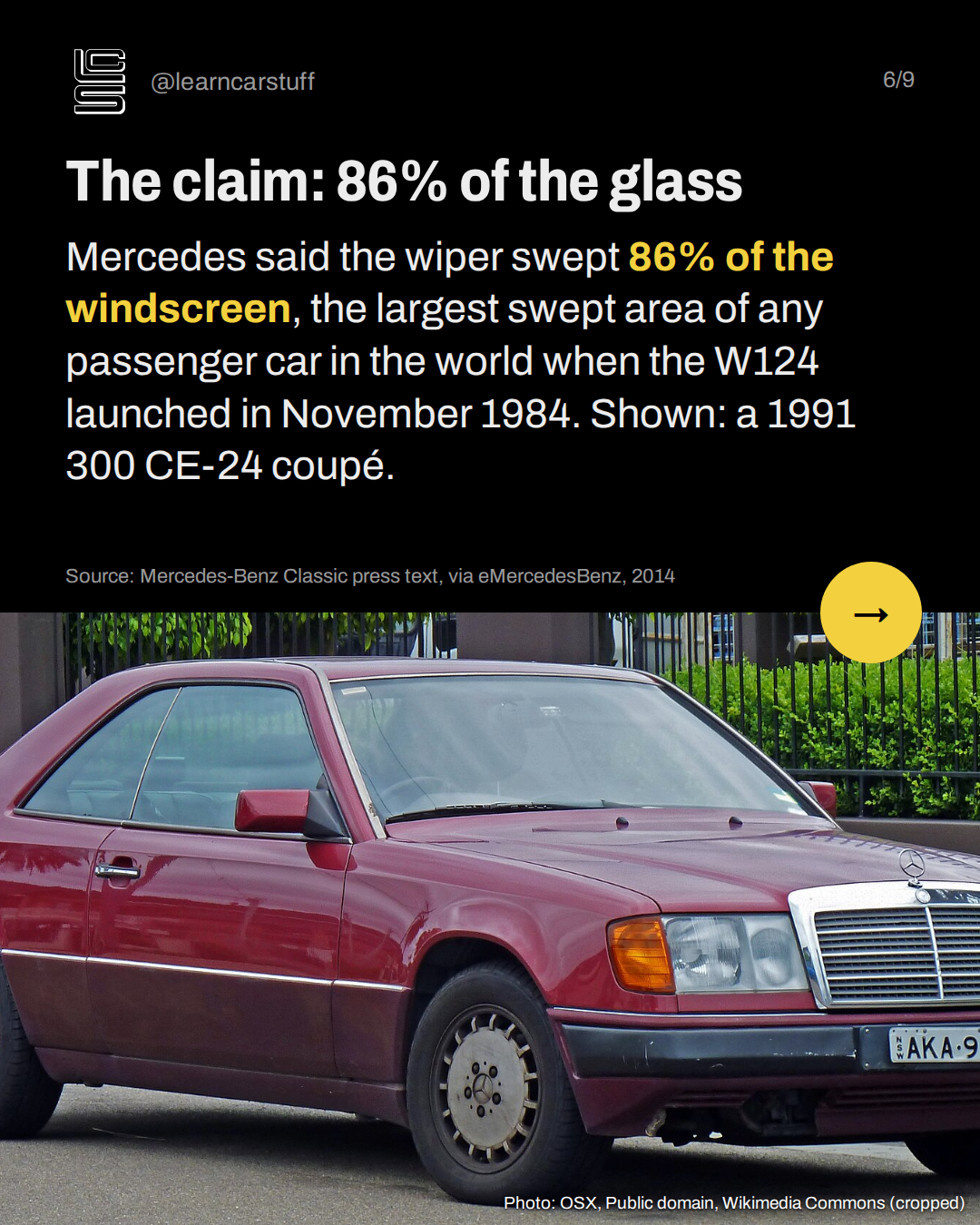
The claim: 86% of the glass
Mercedes said the wiper swept 86% of the windscreen, the largest swept area of any passenger car in the world when the W124 launched in November 1984. Shown: a 1991 300 CE-24 coupé.
Source: Mercedes-Benz Classic press text, via eMercedesBenz, 2014
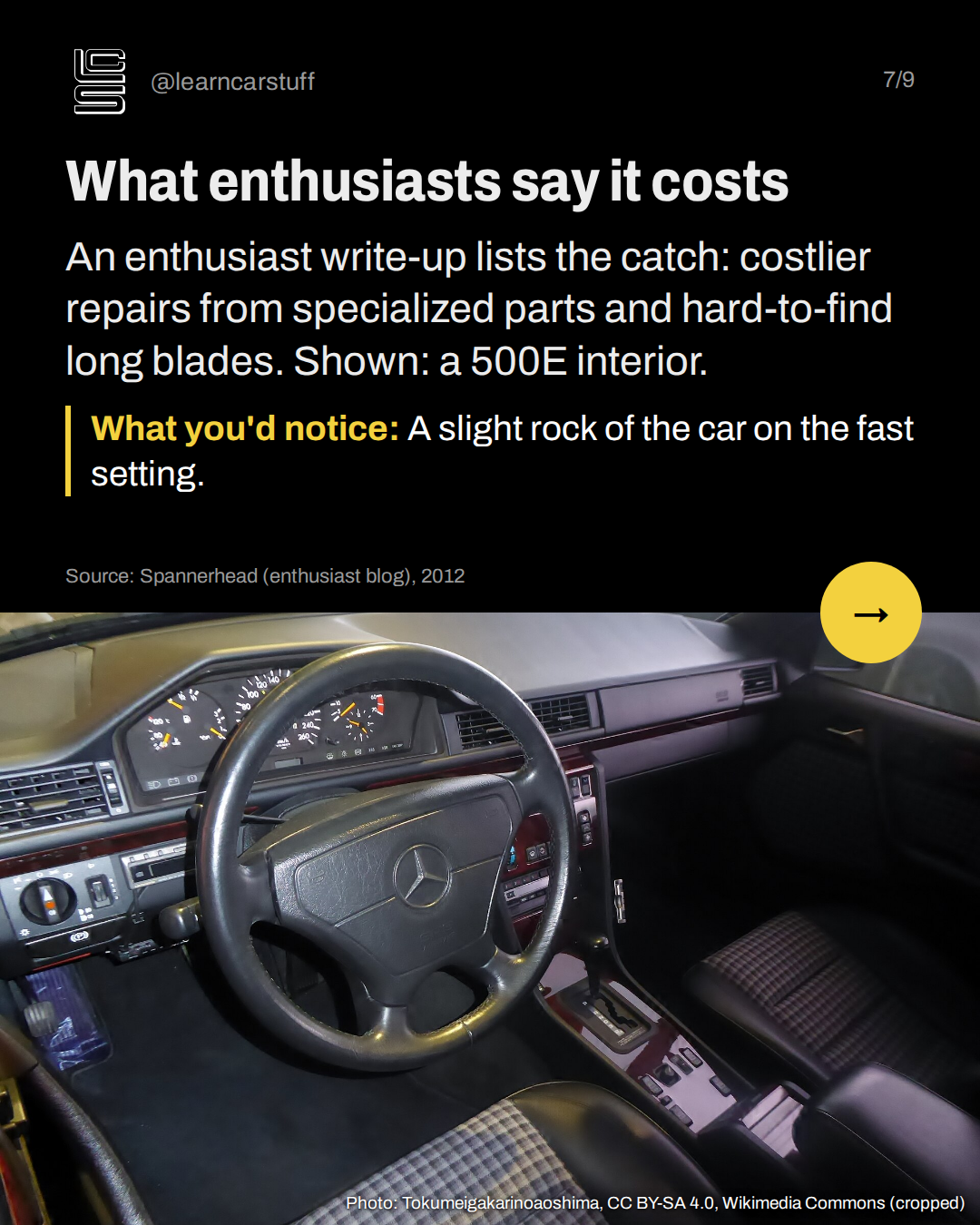
What enthusiasts say it costs
An enthusiast write-up lists the catch: costlier repairs from specialized parts and hard-to-find long blades. Shown: a 500E interior.
What you'd notice: A slight rock of the car on the fast setting.
Source: Spannerhead (enthusiast blog), 2012
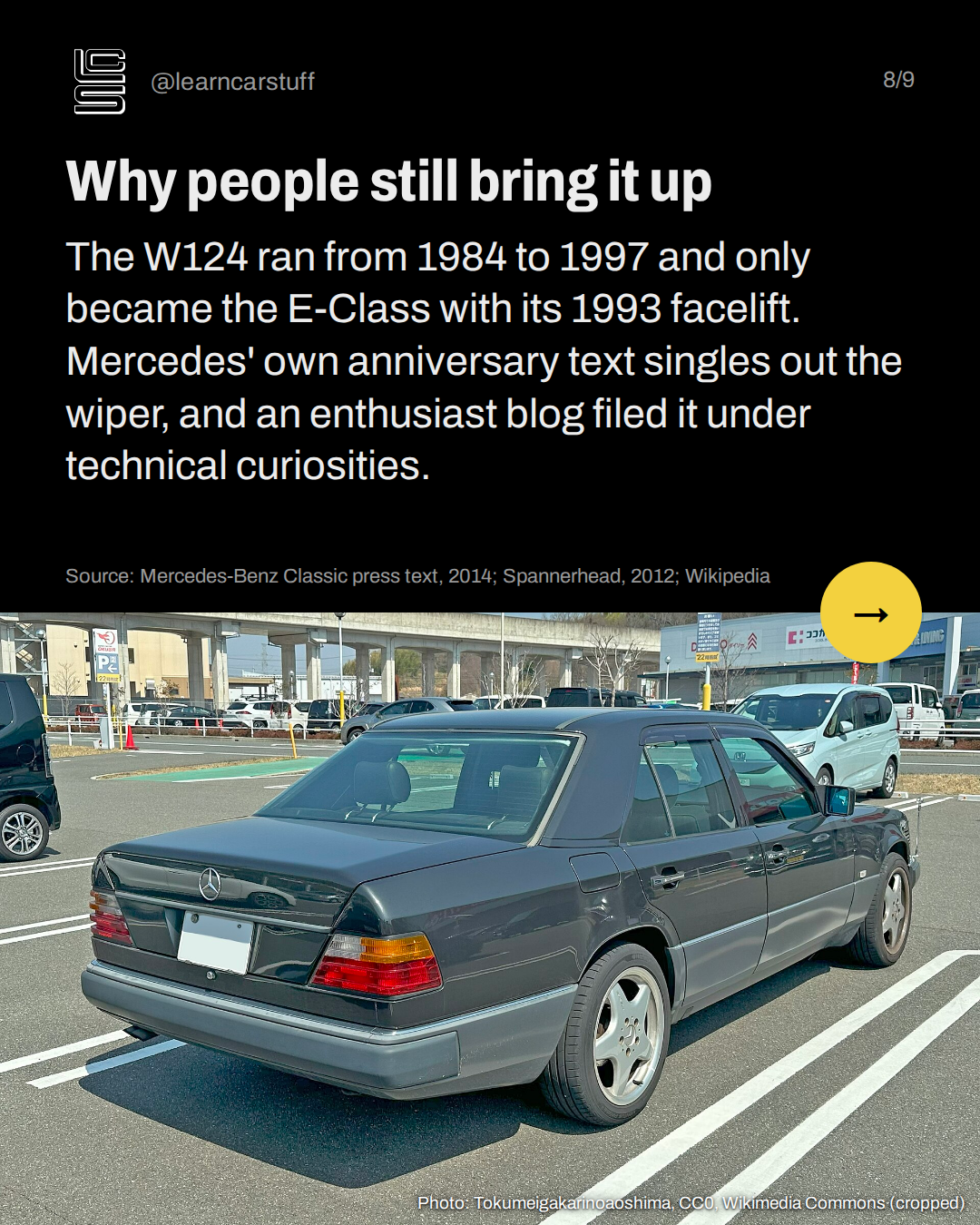
Why people still bring it up
The W124 ran from 1984 to 1997 and only became the E-Class with its 1993 facelift. Mercedes' own anniversary text singles out the wiper, and an enthusiast blog filed it under technical curiosities.
Source: Mercedes-Benz Classic press text, 2014; Spannerhead, 2012; Wikipedia
Sources and assumptions
- eMercedesBenz, 'Mercedes-Benz 124 series' (30-year anniversary text, reproduced Mercedes-Benz Classic press material, 2014): 'It swept 86 per cent of the windscreen – at the time the largest swept area of any passenger car in the world'; the 124 series premiered in November 1984; Cd 0.29–0.30 at launch; production 1984–1997, over 2.7 million built (checked 2026-10-20)
- Global Brands Magazine, '30 years of the 124 series: exemplary for aerodynamics, lightweight construction and safety' (reproduces Daimler / Mercedes-Benz Classic press text): The 'eccentric-sweep panoramic windscreen wiper' swept 86 per cent of the windscreen; 'Thanks to linear travel added to the rotational movement, the upper corners of the windscreen could be wiped clear more efficiently than by a conventional single-arm wiper.' (checked 2026-10-20)
- 500SEC.com, 'Mercedes-Benz 124 series: An automotive milestone becomes a Young Classic' (reprint of Mercedes-Benz press material): 'The eccentric-sweep panoramic windscreen wiper made its debut in the W 124. This cleaned 86 percent of the windscreen – the largest swept area for any passenger car worldwide at the time of the launch of the W 124.' (checked 2026-10-20)
- Google Patents, US4630327A 'Single-arm windshield wiper for motor vehicles', Daimler-Benz AG: Daimler-Benz patent, priority 28 July 1984: a single telescoping wiper arm whose effective length varies during the sweep, driven by internal gear rims, pinions and a crank; three length minima and two length maxima per sweep (checked 2026-10-20)
- Wikipedia, Mercedes-Benz W124: Single wiper with an eccentric mechanism at its base extending reach to the top corners; press launch 26 November 1984 in Seville; August 1993 facelift when the W124 series became the E-Class (checked 2026-10-20)
- Spannerhead, 'Technical Curiosities: Mercedes' Monoblade Wiper' (enthusiast blog, 2012): Owner-reported drawbacks: more expensive to produce and repair because of specialized parts, long replacement blades hard to find, slight rocking motion of the car at high wiper speed; a cam-type device moved the arm away from the pivot twice per sweep, retracting it in between (checked 2026-10-20)
Assumptions:
- The 86% figure is Mercedes' own claim, quoted from Mercedes-Benz Classic press material reproduced on three sites; the original page on the Mercedes-Benz public archive (mercedes-benz-publicarchive.com) returned 403 and was not opened, so slides attribute the number to Mercedes.
- The Daimler-Benz patent US4630327A (priority July 1984) is taken as describing the wiper type used on the W124; the patent itself doesn't name the W124, so the slide says 'a Daimler-Benz patent filed in 1984 describes', not 'the W124's exact part'.
- No measured swept-area figure for a plain single-arm wiper on the W124 screen was found, so the comparison diagram is a labelled, illustrative shape with no percentage for the plain arc.
- Drawbacks (repair cost, long blades, rocking) come from an enthusiast blog and are labelled as owner reports.
- Whether the W201 190 had the eccentric wiper before the W124 is disputed in secondary sources; the post makes no 'first car' claim beyond Mercedes' 'made its debut in the W 124' wording, and preferably avoids it.
Photos:
- Photo: Tokumeigakarinoaoshima, CC0, Wikimedia Commons (cropped)
- Photo: Tokumeigakarinoaoshima, CC0, Wikimedia Commons (cropped)
- Photo: Tokumeigakarinoaoshima, CC BY-SA 4.0, Wikimedia Commons (cropped)
- Photo: User Derekne on en.wikipedia, Public domain, Wikimedia Commons (cropped)
- Photo: IFCAR, Public domain, Wikimedia Commons (cropped)
- Photo: OSX, Public domain, Wikimedia Commons (cropped)
The short version
- The arm slides outward as it sweeps.
- A 1984 Daimler-Benz patent shows gears and a crank doing it.
- Mercedes claimed 86% of the windscreen swept.
- An enthusiast blog lists costlier repairs.