 Learn Car Stuff
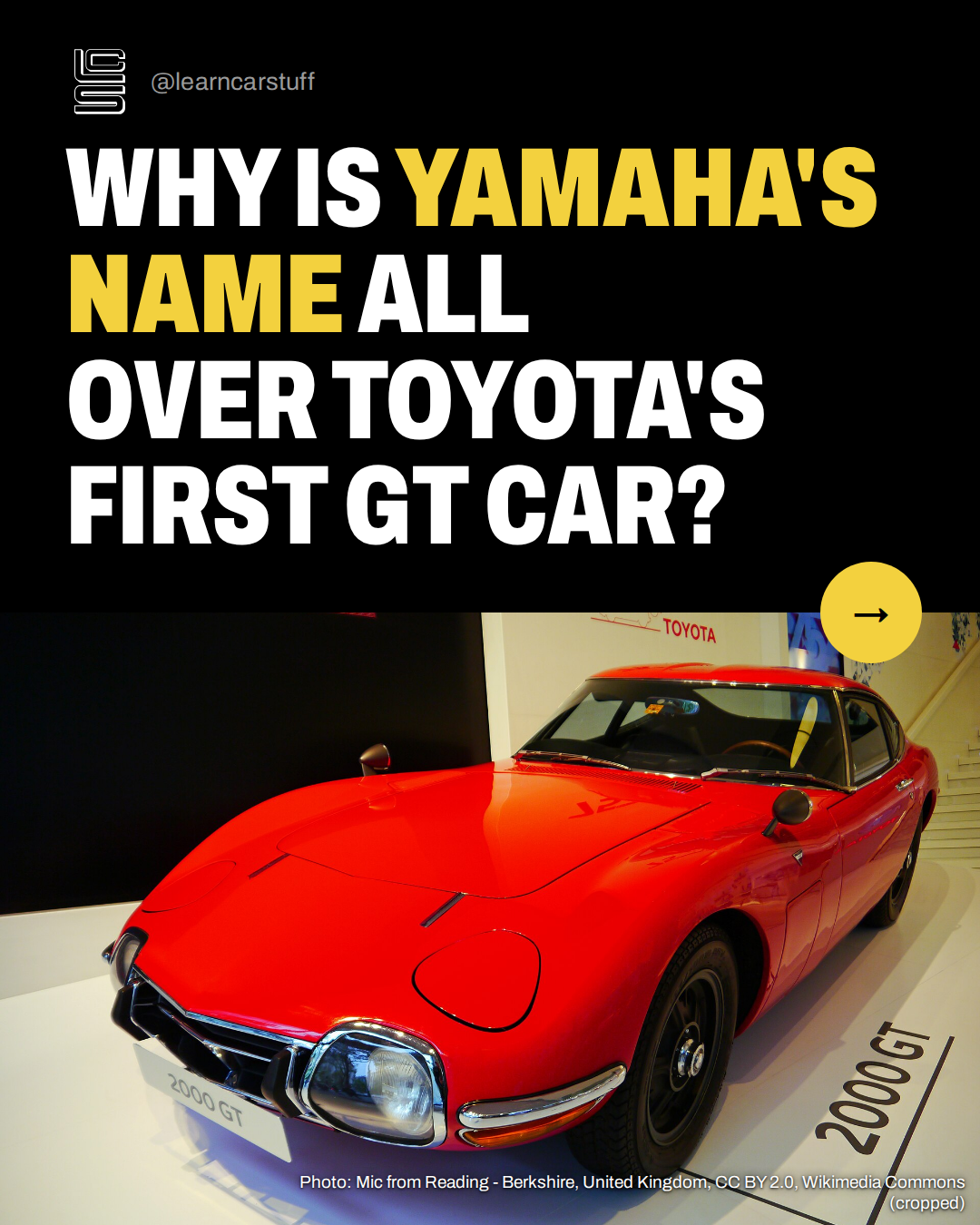
Why is Yamaha's name all over Toyota's first GT car?
Not just the Bond Toyota
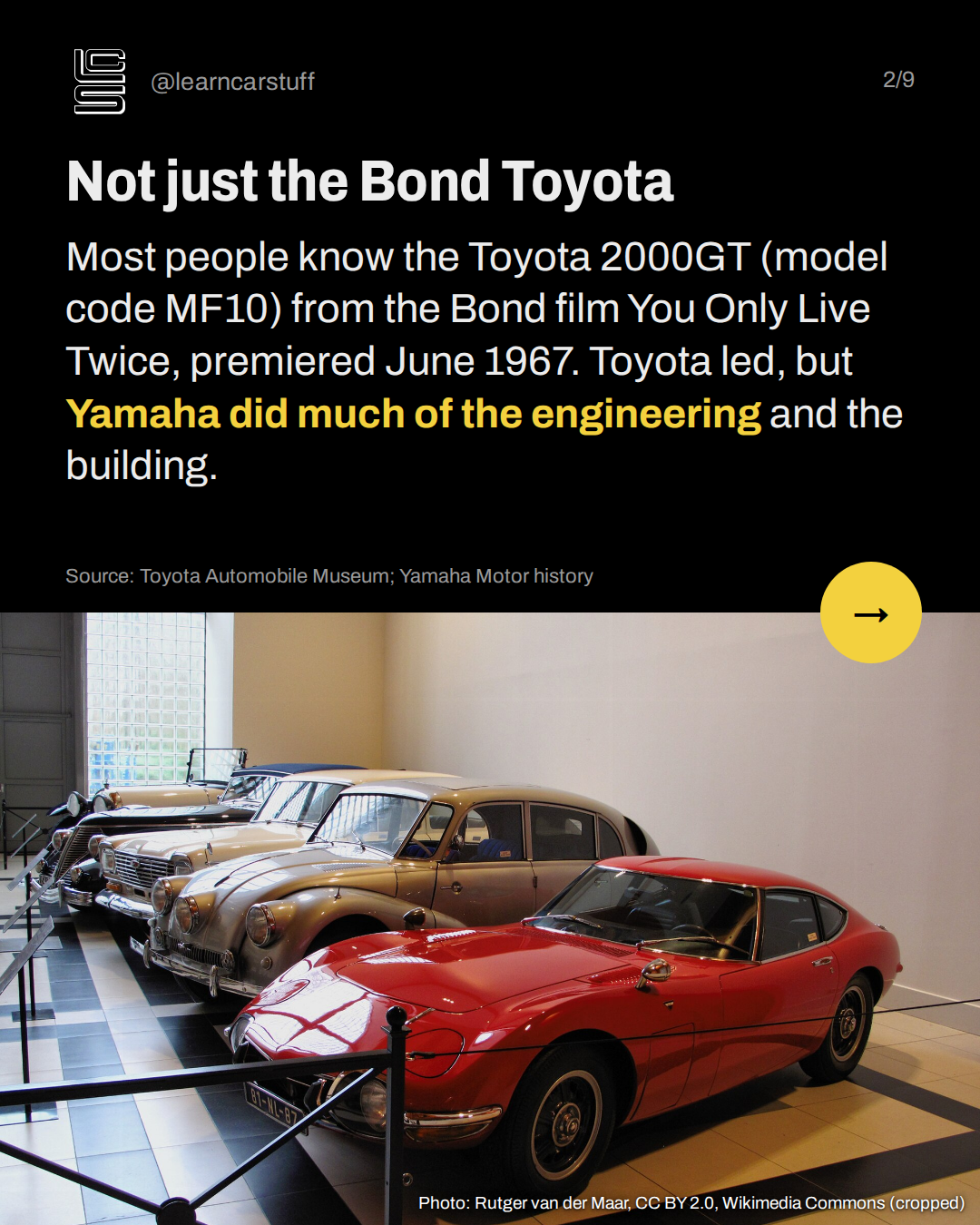
Most people know the Toyota 2000GT (model code MF10) from the Bond film You Only Live Twice, premiered June 1967. Toyota led, but Yamaha did much of the engineering and the building.
Source: Toyota Automobile Museum; Yamaha Motor history
Yamaha came to Toyota first
Yamaha had dropped a GT-car project with Nissan. In autumn 1964, its president, Kawakami, visited Toyota, which happened to be planning one. They signed the formal agreement on 8 September 1965.
Source: Toyota Automobile Museum; Yamaha Motor history
A Crown engine with a new head
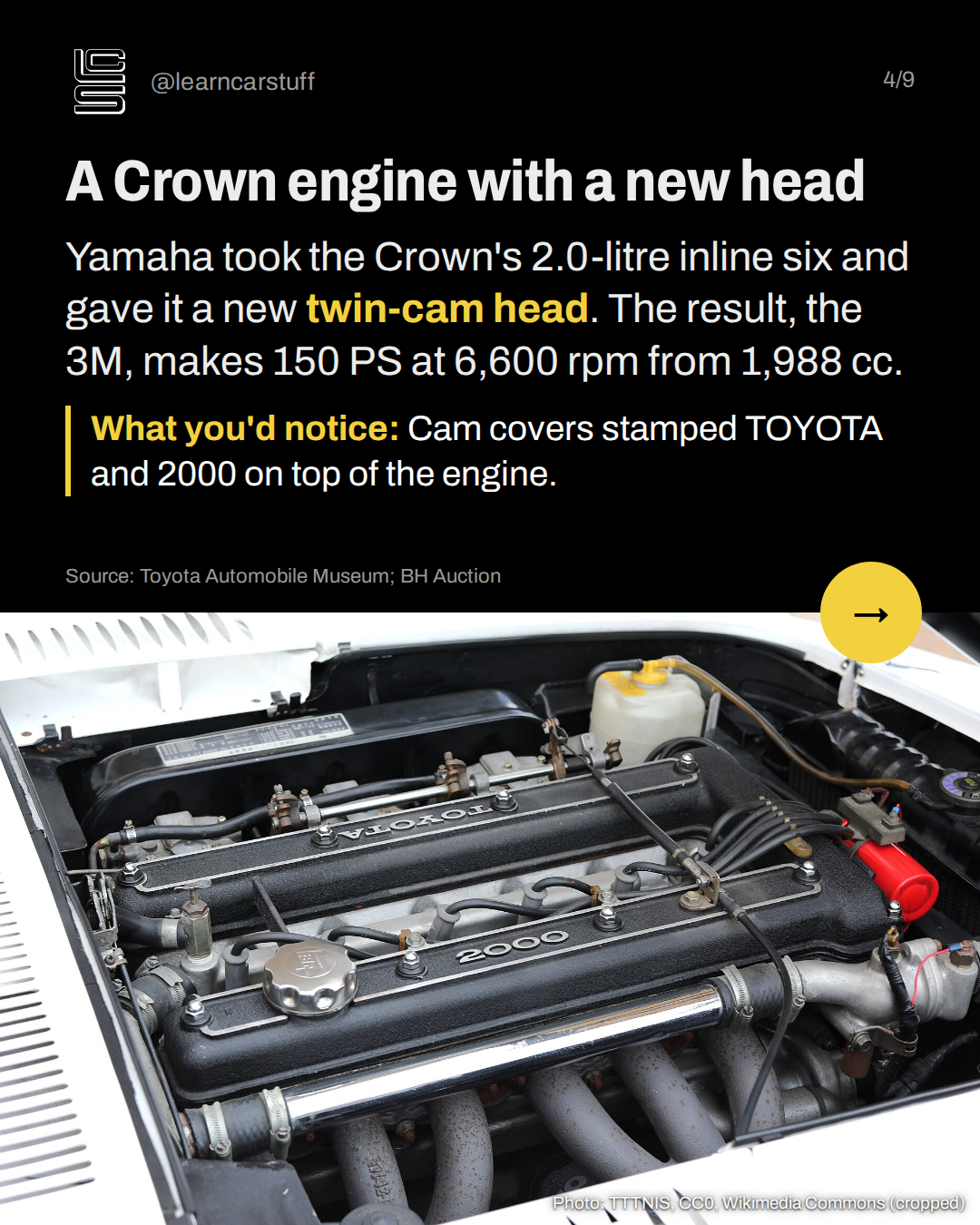
Yamaha took the Crown's 2.0-litre inline six and gave it a new twin-cam head. The result, the 3M, makes 150 PS at 6,600 rpm from 1,988 cc.
What you'd notice: Cam covers stamped TOYOTA and 2000 on top of the engine.
Source: Toyota Automobile Museum; BH Auction
Who did what
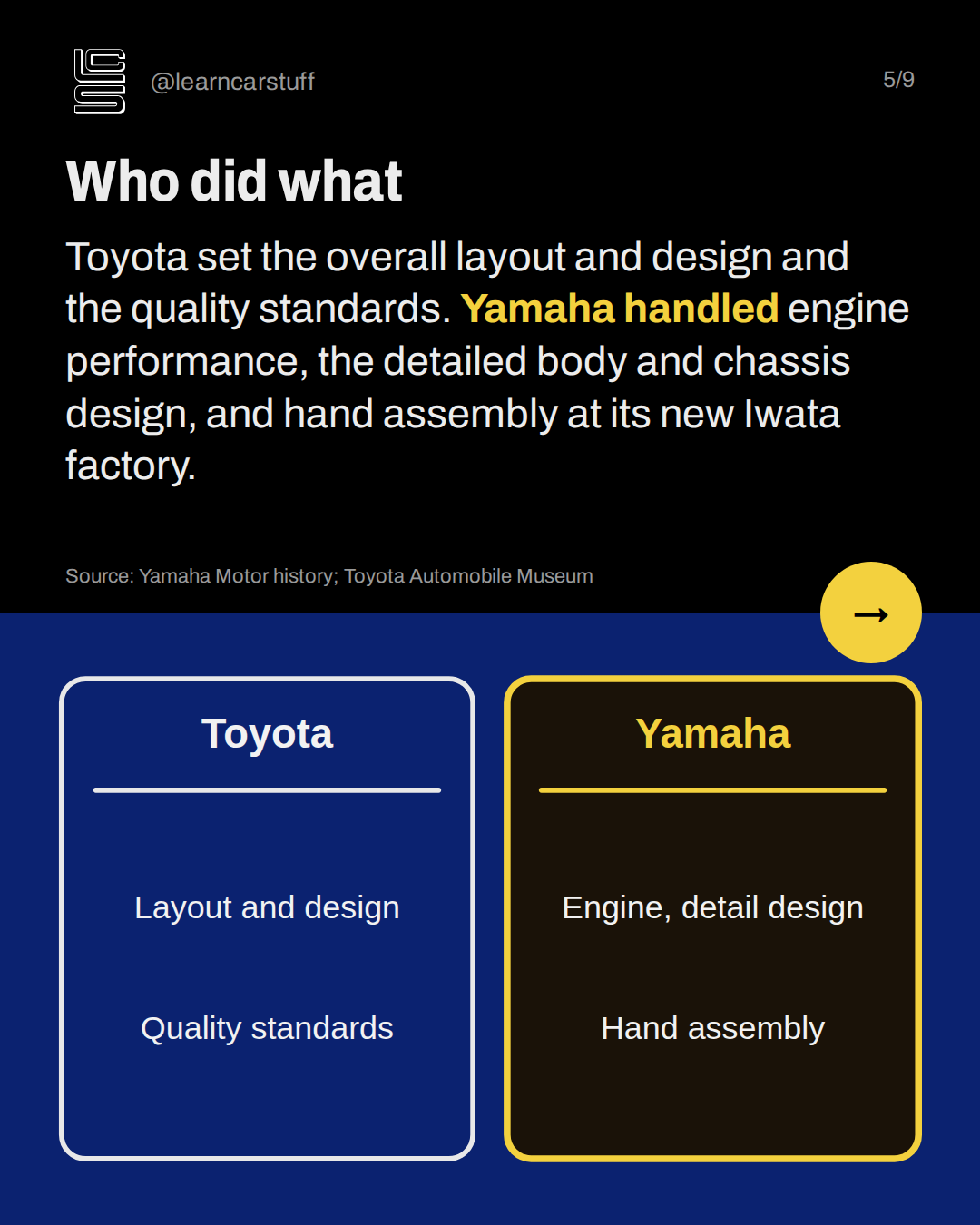
Toyota set the overall layout and design and the quality standards. Yamaha handled engine performance, the detailed body and chassis design, and hand assembly at its new Iwata factory.
Source: Yamaha Motor history; Toyota Automobile Museum
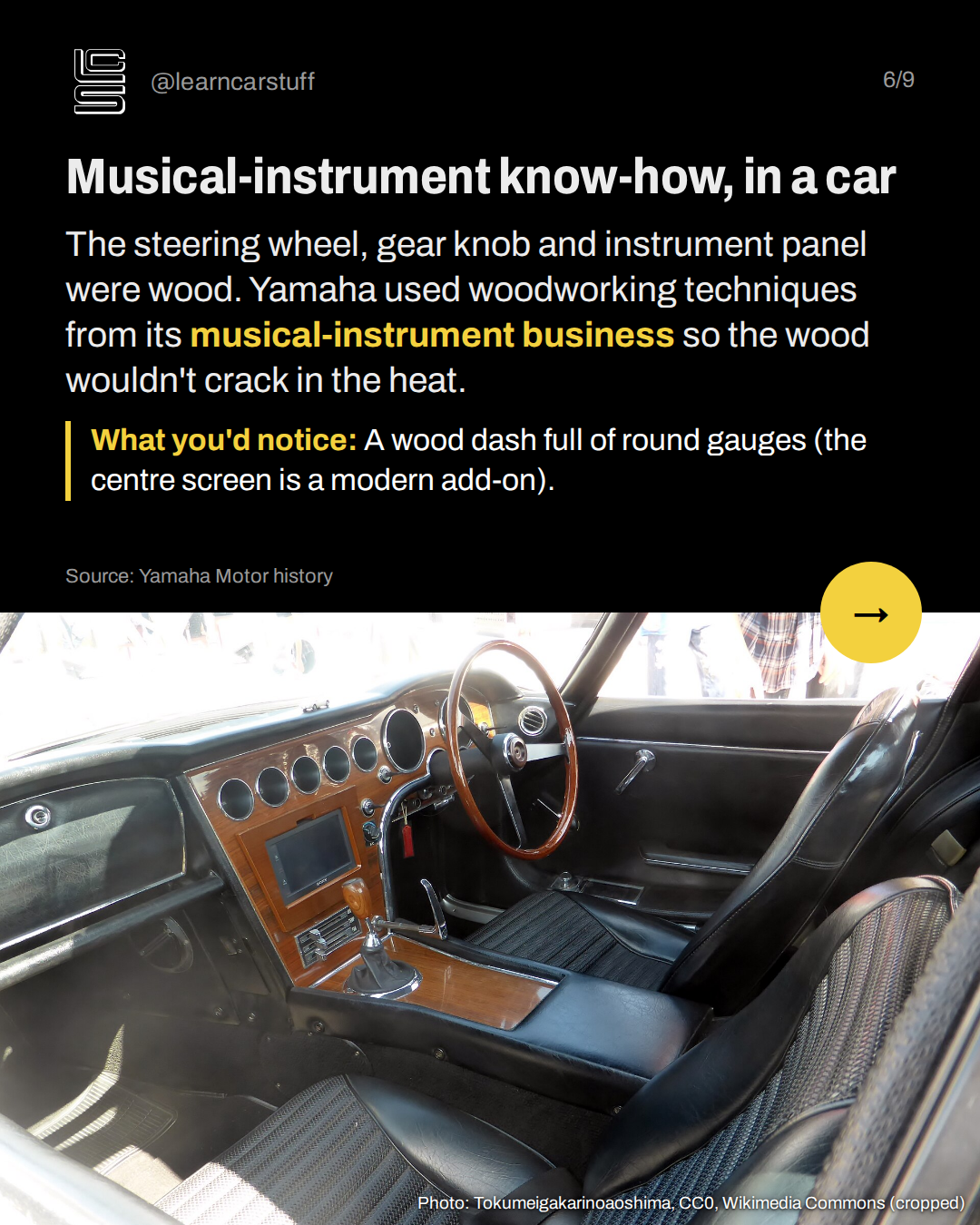
Musical-instrument know-how, in a car
The steering wheel, gear knob and instrument panel were wood. Yamaha used woodworking techniques from its musical-instrument business so the wood wouldn't crack in the heat.
What you'd notice: A wood dash full of round gauges (the centre screen is a modern add-on).
Source: Yamaha Motor history
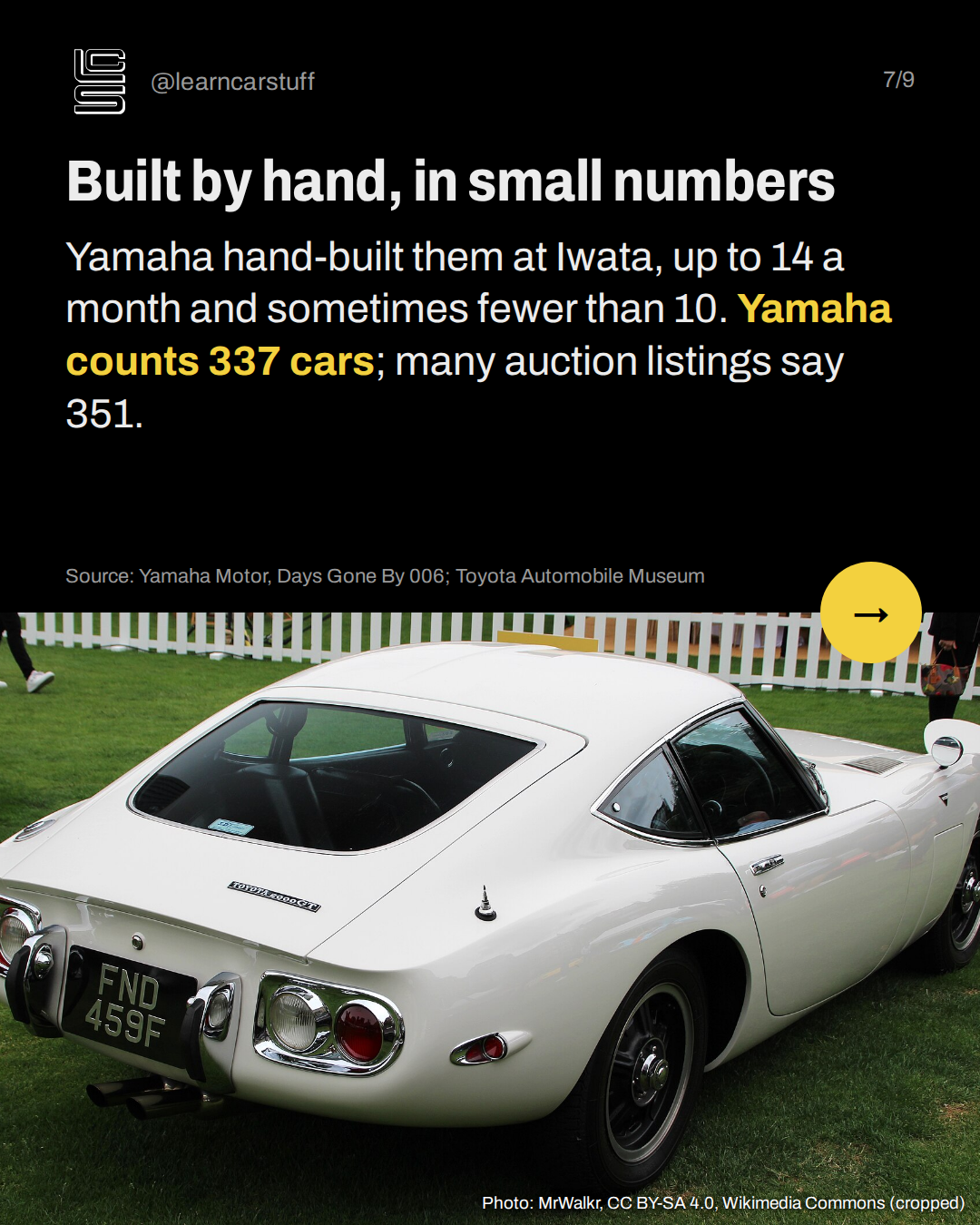
Built by hand, in small numbers
Yamaha hand-built them at Iwata, up to 14 a month and sometimes fewer than 10. Yamaha counts 337 cars; many auction listings say 351.
Source: Yamaha Motor, Days Gone By 006; Toyota Automobile Museum
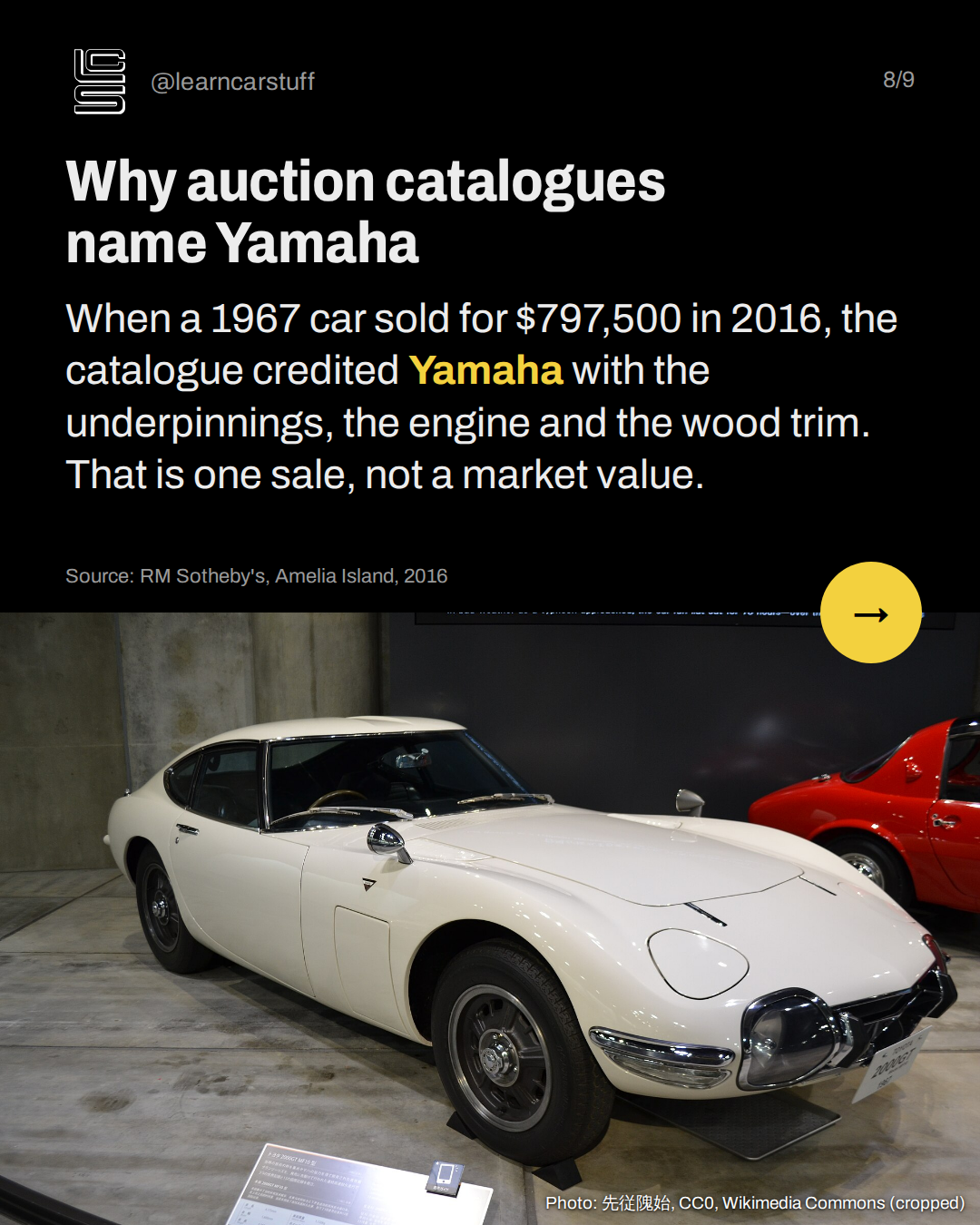
Why auction catalogues name Yamaha
When a 1967 car sold for $797,500 in 2016, the catalogue credited Yamaha with the underpinnings, the engine and the wood trim. That is one sale, not a market value.
Source: RM Sotheby's, Amelia Island, 2016
Sources and assumptions
- Yamaha Motor Co., Ltd. – History stories: Toyota 2000GT (story 0012): Agreement signed 8 Sept 1965, joint development already started Dec 1964; Toyota did overall layout/design and basic parameters, Yamaha engine performance and detailed body and chassis design; Crown (Toyopet Crown) 2000 cc inline six converted to DOHC; production at the new Iwata Factory, each car assembled by hand; first market-ready car Feb 1967; steering wheel, gear knob and instrument panel of wood using woodworking techniques from Yamaha's musical-instrument business to prevent cracking from heat (checked 2026-10-19)
- Yamaha Motor Co., Ltd. – Days Gone By 006 (Toyota 2000GT): Planning began Oct 1964, first prototype Aug 1965; 337 vehicles built in total, 218 sold in Japan and 102 overseas mostly in the US; domestic dealer price 2,373,000 yen; 3rd at the 3rd Japanese Grand Prix May 1966; three world records and thirteen 2,000cc class international records; each car hand-built by a small team; 'Yamaha's business partnership with Toyota continues to this day' on engines (checked 2026-10-19)
- Toyota Automobile Museum – Online Magazine STORIES: Toyota 2000GT: Collaboration began with a visit to Toyota by then-President Kawakami in autumn 1964 to discuss joint development, as Toyota was coincidentally planning the GT car; Yamaha had earlier abandoned a GT car development project with Nissan; Toyota core staff stationed within Yamaha; DOHC 1988 cc inline six, 150 HP, converted from the Crown M-type engine with Yamaha's technical strength; monthly production up to 14, sometimes under 10; production ended 1970; 337 sold; speed trials 1–3 Oct 1966 with three world and 13 international records; release May 1967; Bond film premiere June 1967; Yamaha-made wood steering wheel (checked 2026-10-19)
- BH Auction – 1969 Toyota 2000GT MF12L lot: Crown type-M 2000cc inline-6 mated to a newly developed Yamaha DOHC head, named type-3M, 150 PS @ 6,600 rpm; three Solex carburettors; MF10 is the standard model code (checked 2026-10-19)
- RM Sotheby's – 1967 Toyota 2000GT, Amelia Island 2016, lot 175: Sold for $797,500; catalogue credits Yamaha with the underpinnings, the engine and the wood trim (from its piano division); quotes 351 built; 1,988 cc DOHC inline six, 150 hp, five-speed manual (checked 2026-10-19)
Assumptions:
- 'Toyota's first supercar' is the common framing used for the 2000GT (Toyota's own museum and press describe it as its first GT/sports flagship); the slides should say 'first supercar' only as the popular label, or 'Toyota's first GT car'.
- The idea queue framed it as 'Toyota turned to Yamaha'; Toyota's museum and Yamaha say the reverse: Yamaha's president approached Toyota. The post uses the sourced version.
- Production count: Yamaha and Toyota's museum both say 337; RM Sotheby's and many listings say 351. The 351 figure is commonly understood to include prototypes and pre-production cars, but no primary source opened here confirms that breakdown, so the slide should only say 'Yamaha counts 337; many auction listings say 351'.
- 218 + 102 = 320, not 337; Yamaha's page does not explain the remaining 17 (likely test, record and prototype cars). Do not present the split as adding up to 337.
- The '$797,500' is one car at one auction (RM Sotheby's, Amelia Island, March 2016), not a market value.
- The 'piano division' wood is RM Sotheby's wording; Yamaha's own wording is 'woodworking techniques developed in Yamaha's musical instrument business'. Use Yamaha's wording on the slide.
- The 3M code and 6,600 rpm come from an auction-house catalogue (BH Auction), not a Toyota/Yamaha page; Toyota's museum confirms 1,988 cc DOHC 150 HP from the Crown M engine.
- No detail of the Nissan project (car name, designer) is claimed; only that Yamaha had abandoned a GT car project with Nissan, per Toyota's museum.
Photos:
- Photo: 先従隗始, CC0, Wikimedia Commons (cropped)
- Photo: Mic from Reading - Berkshire, United Kingdom, CC BY 2.0, Wikimedia Commons (cropped)
- Photo: Rutger van der Maar, CC BY 2.0, Wikimedia Commons (cropped)
- Photo: MrWalkr, CC BY-SA 4.0, Wikimedia Commons (cropped)
- Photo: TTTNIS, CC0, Wikimedia Commons (cropped)
- Photo: Tokumeigakarinoaoshima, CC0, Wikimedia Commons (cropped)
The short version
- Yamaha approached Toyota, not the reverse.
- Toyota set the layout; Yamaha did the detail work.
- Crown six plus Yamaha twin-cam head: 150 PS.
- Hand-built at Iwata; Yamaha counts 337 cars.