 Learn Car Stuff
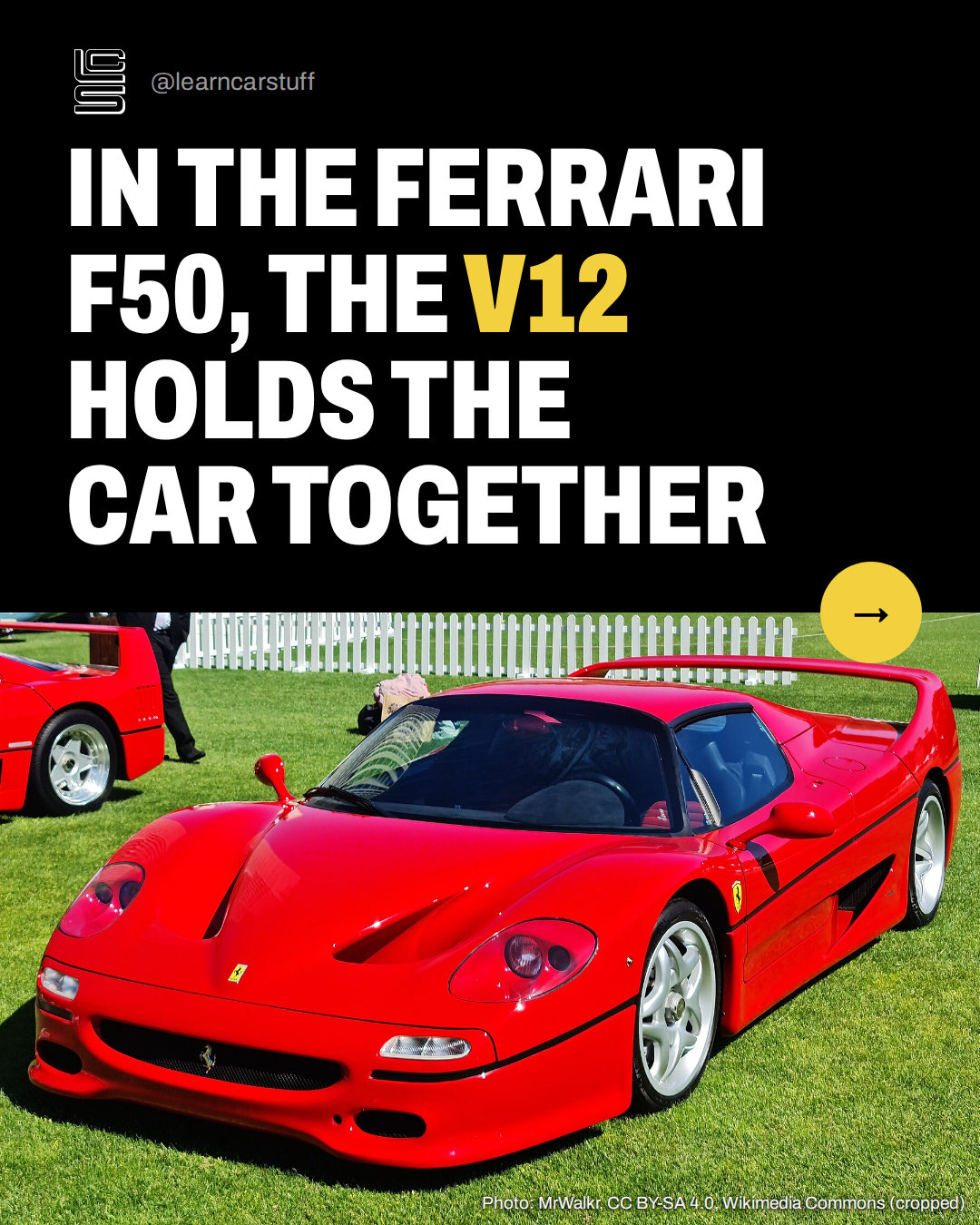
In the Ferrari F50, the V12 holds the car together
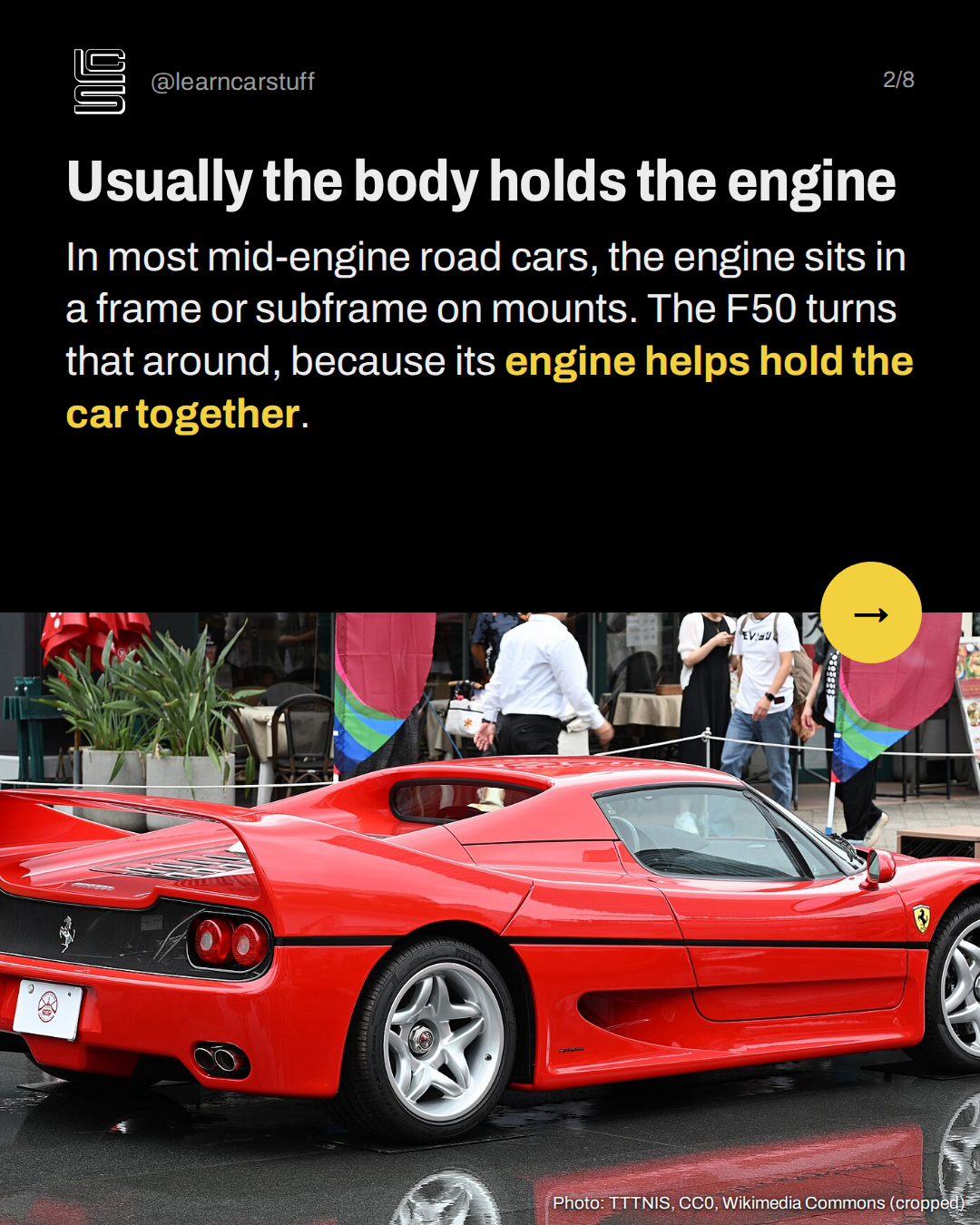
Usually the body holds the engine
In most mid-engine road cars, the engine sits in a frame or subframe on mounts. The F50 turns that around, because its engine helps hold the car together.
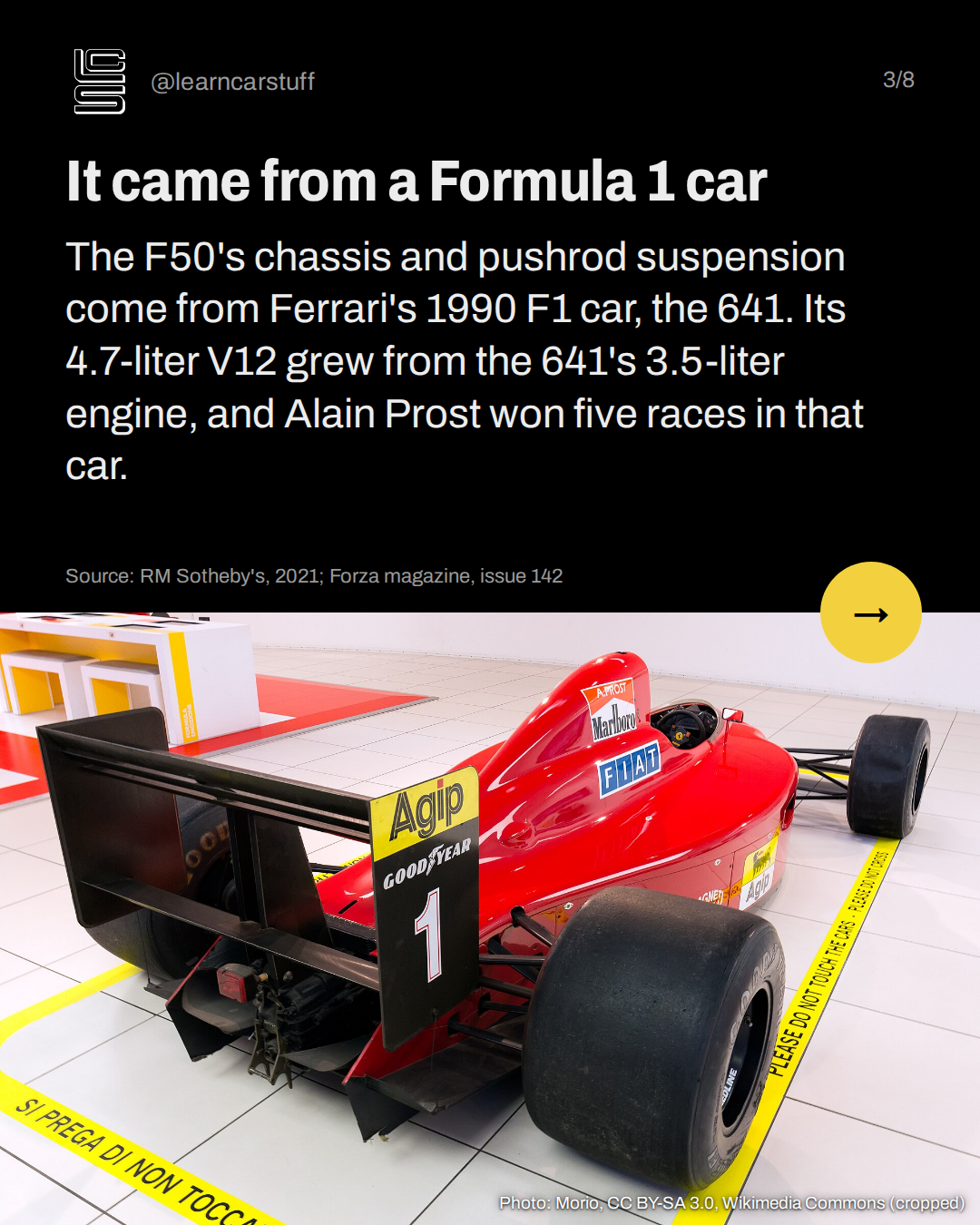
It came from a Formula 1 car
The F50's chassis and pushrod suspension come from Ferrari's 1990 F1 car, the 641. Its 4.7-liter V12 grew from the 641's 3.5-liter engine, and Alain Prost won five races in that car.
Source: RM Sotheby's, 2021; Forza magazine, issue 142
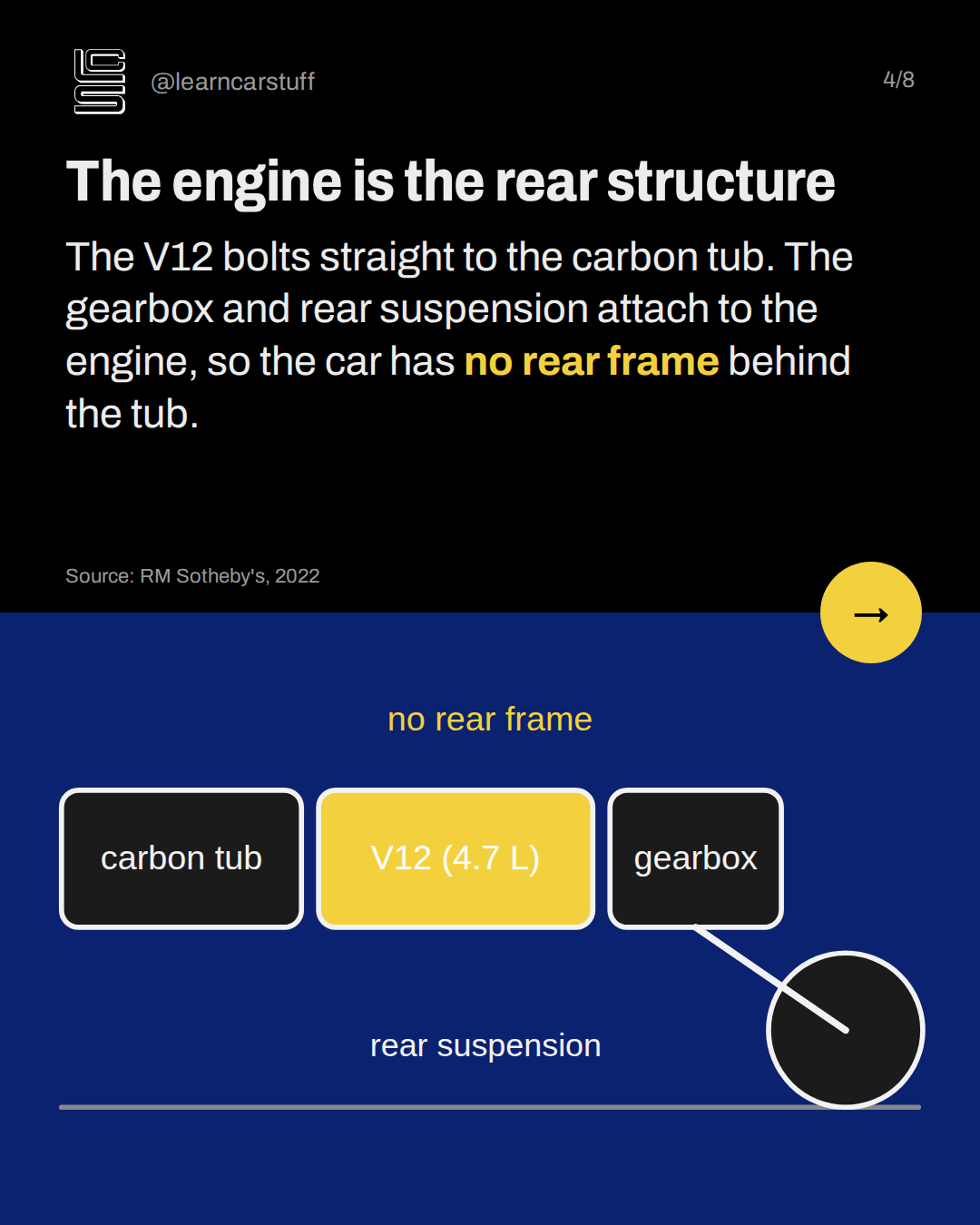
The engine is the rear structure
The V12 bolts straight to the carbon tub. The gearbox and rear suspension attach to the engine, so the car has no rear frame behind the tub.
Source: RM Sotheby's, 2022
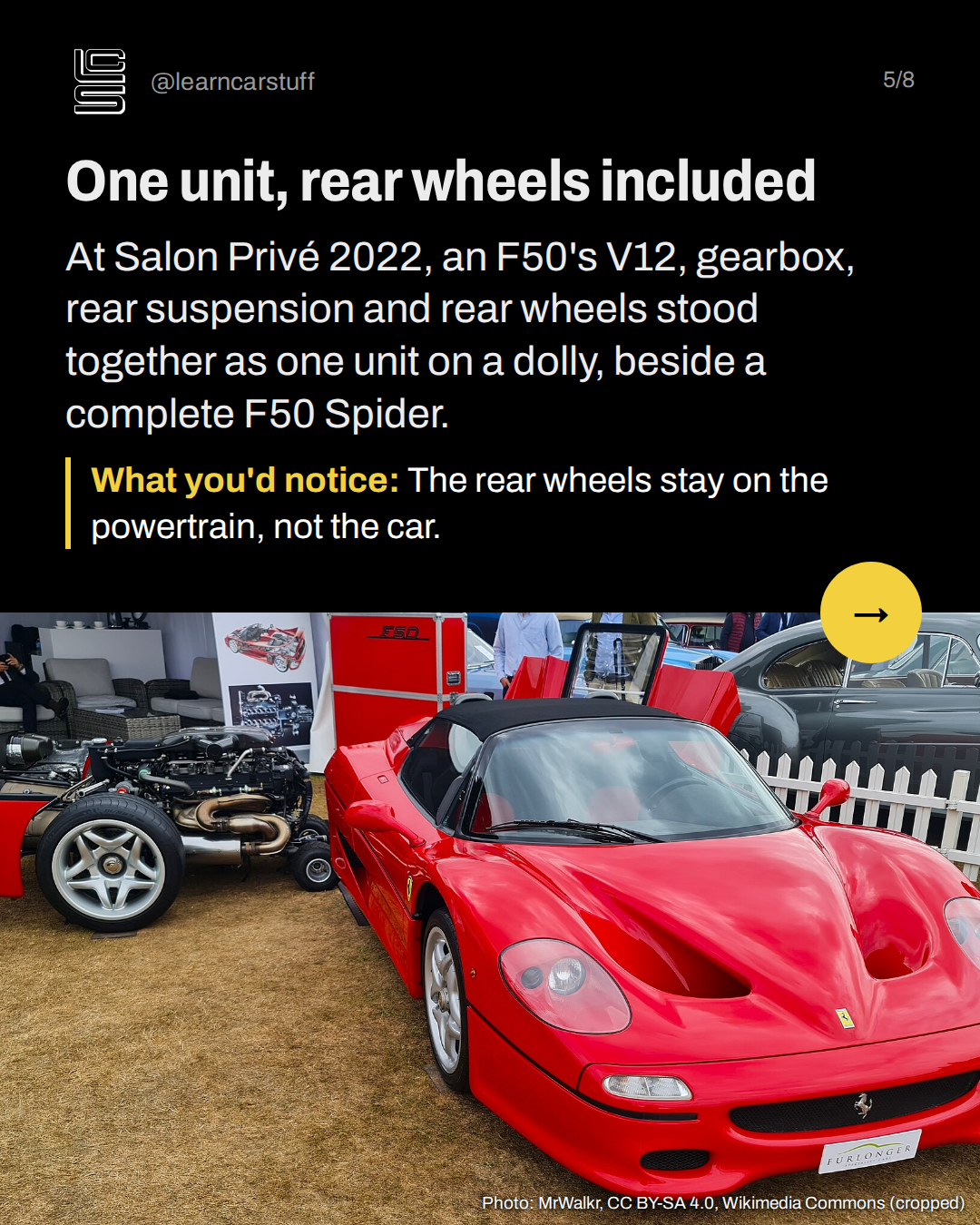
One unit, rear wheels included
At Salon Privé 2022, an F50's V12, gearbox, rear suspension and rear wheels stood together as one unit on a dolly, beside a complete F50 Spider.
What you'd notice: The rear wheels stay on the powertrain, not the car.
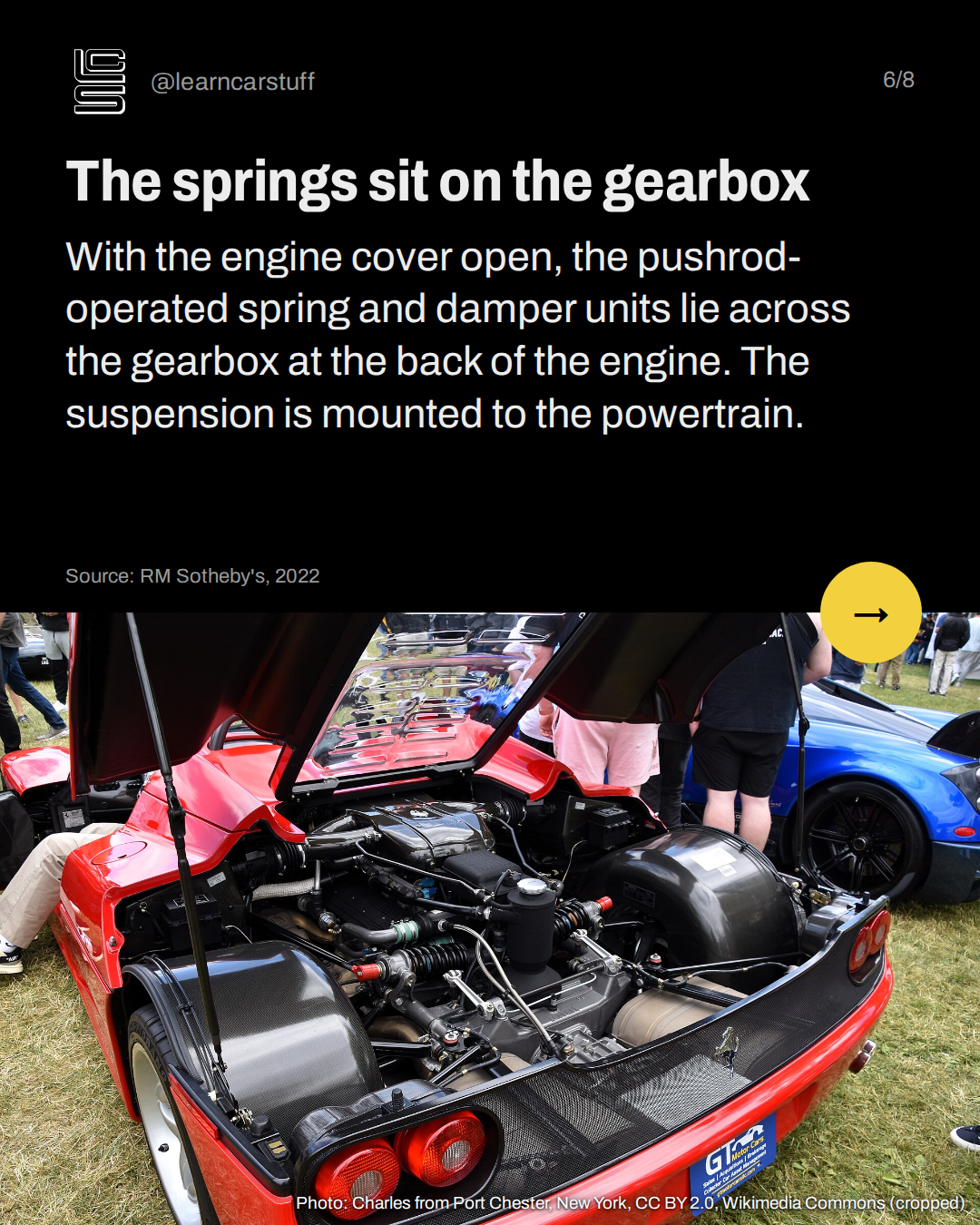
The springs sit on the gearbox
With the engine cover open, the pushrod-operated spring and damper units lie across the gearbox at the back of the engine. The suspension is mounted to the powertrain.
Source: RM Sotheby's, 2022
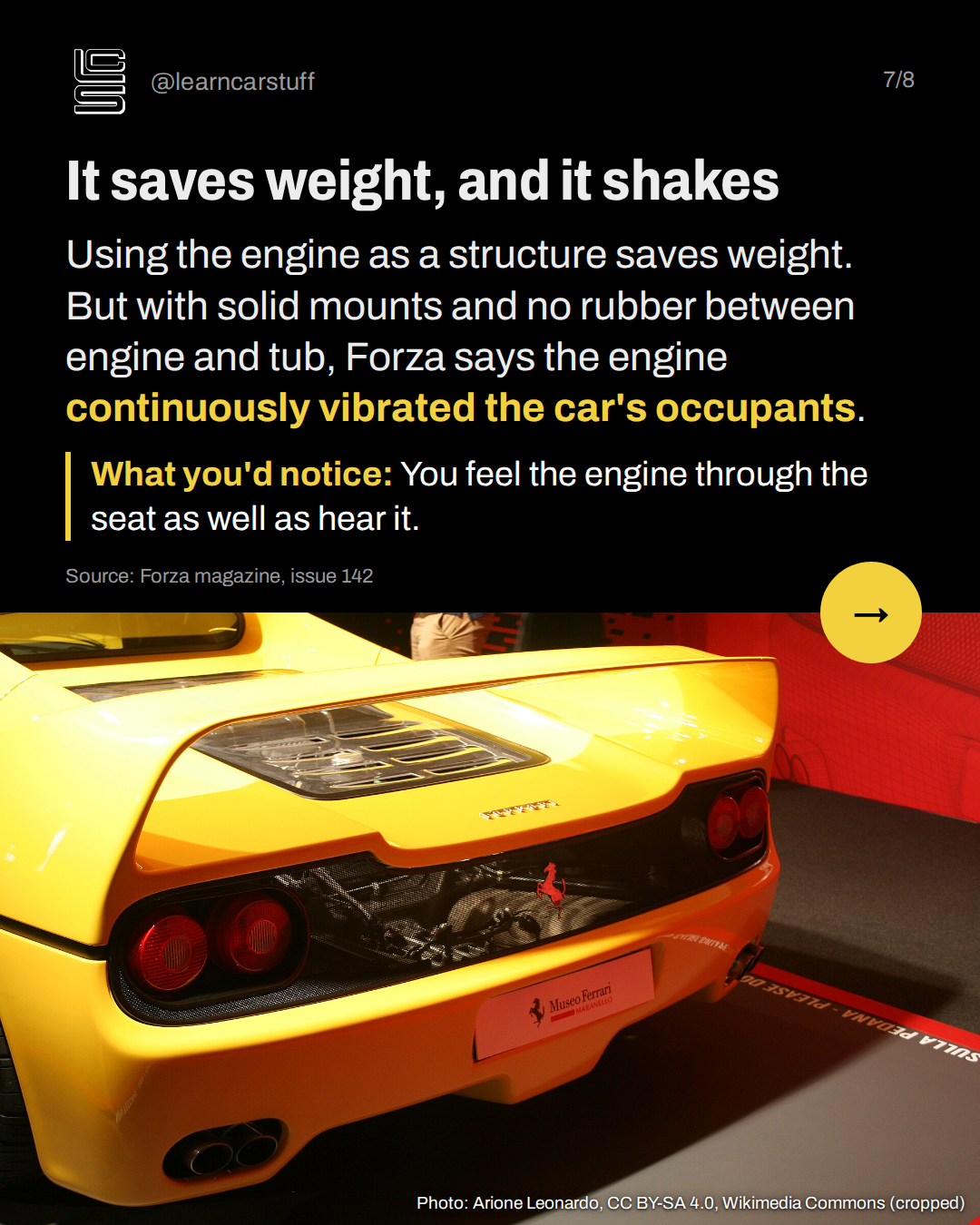
It saves weight, and it shakes
Using the engine as a structure saves weight. But with solid mounts and no rubber between engine and tub, Forza says the engine continuously vibrated the car's occupants.
What you'd notice: You feel the engine through the seat as well as hear it.
Source: Forza magazine, issue 142
Sources and assumptions
- RM Sotheby's, 1997 Ferrari F50 (lot r0042, London 2022): F130B 4,699 cc engine developed from the 3.5-litre F1 V12; 513 hp at 8,500 rpm, 347 lb-ft; 'the F50 power unit was a load-bearing element to which the six-speed manual transmission and rear suspension were directly attached'; carbon-fibre monocoque by Cytec Aerospace replacing the spaceframe of earlier Ferraris; pushrod double wishbones with inboard springs; 349 regular production cars (checked 2026-10-18)
- RM Sotheby's, 1995 Ferrari F50 (lot r0073, Amelia Island 2021): 65-degree V12 placed just ahead of the rear axle; 'Solid mounts held the race-derived 4.7-liter V-12 into the car'; V12 closely related to the engine of Alain Prost's Ferrari 641 that won five races in 1990; carbon tub; six-speed longitudinal manual; 349 built, 55 for the US market (checked 2026-10-18)
- Forza magazine, issue 142 'Flashback' (F50): 'the F50's engine was a stressed member, i.e., it's bolted directly to the chassis at one end and supports the rear suspension at the other'; chassis and pushrod suspension based on the 1990 641 F1; 520 hp at 8,500 rpm; 'the direct-mounted engine continuously vibrated the car's occupants'; 349 built; unveiled at the 1995 Geneva show (checked 2026-10-18)
- web-cars.com F50 chassis page (enthusiast reference, secondary): 'the engine is part of the chassis structure; the front portion of the car is attached to the front of the engine and the rear suspension and transmission is attached to the rear of the engine'; 'Using the engine block as a stressed member saves weight'; carbon chassis weighs 102 kg (checked 2026-10-18)
- Autozine, Ferrari F50 (1995) archive (secondary): The stressed-member layout 'transferred a great deal of vibration and resonance into the carbon-fiber cockpit, which would be tolerable by race car standard but not for a road car' (checked 2026-10-18)
Assumptions:
- 'Most mid-engine road cars mount the engine in a frame or subframe on mounts' is a general statement about common practice, not a claim about any one named car; keep it general.
- Power is quoted as about 513 hp (RM Sotheby's), the same as Forza's '520' metric horsepower (PS); give it as 'about 513 hp' or '520 PS', never both as different figures.
- The 641 (also called F1-90) is the 1990 F1 car; the F50 V12 is 'derived from' or 'closely related to' its 3.5-liter V12, not the same engine.
- No weight-saving figure (kg) is recorded: no source gives one for the stressed-member layout itself. Say 'saves weight' only.
- The claim that the Enzo dropped the layout appears only on Autozine and is not verified: do not use it.
- The nodular cast-iron block claim appears only on web-cars and is not verified: do not use it.
Photos:
- Photo: MrWalkr, CC BY-SA 4.0, Wikimedia Commons (cropped)
- Photo: MrWalkr, CC BY-SA 4.0, Wikimedia Commons (cropped)
- Photo: Charles from Port Chester, New York, CC BY 2.0, Wikimedia Commons (cropped)
- Photo: Arione Leonardo, CC BY-SA 4.0, Wikimedia Commons (cropped)
- Photo: TTTNIS, CC0, Wikimedia Commons (cropped)
- Photo: Morio, CC BY-SA 3.0, Wikimedia Commons (cropped)
The short version
- The F50's V12 bolts straight to the carbon tub
- Gearbox and rear suspension hang off the engine
- The layout traces back to Ferrari's 1990 F1 car
- It saves weight, but vibration reaches the cabin