 Learn Car Stuff
Why does the first Prius push air back out of its cylinders?
Low on paper, odd by design
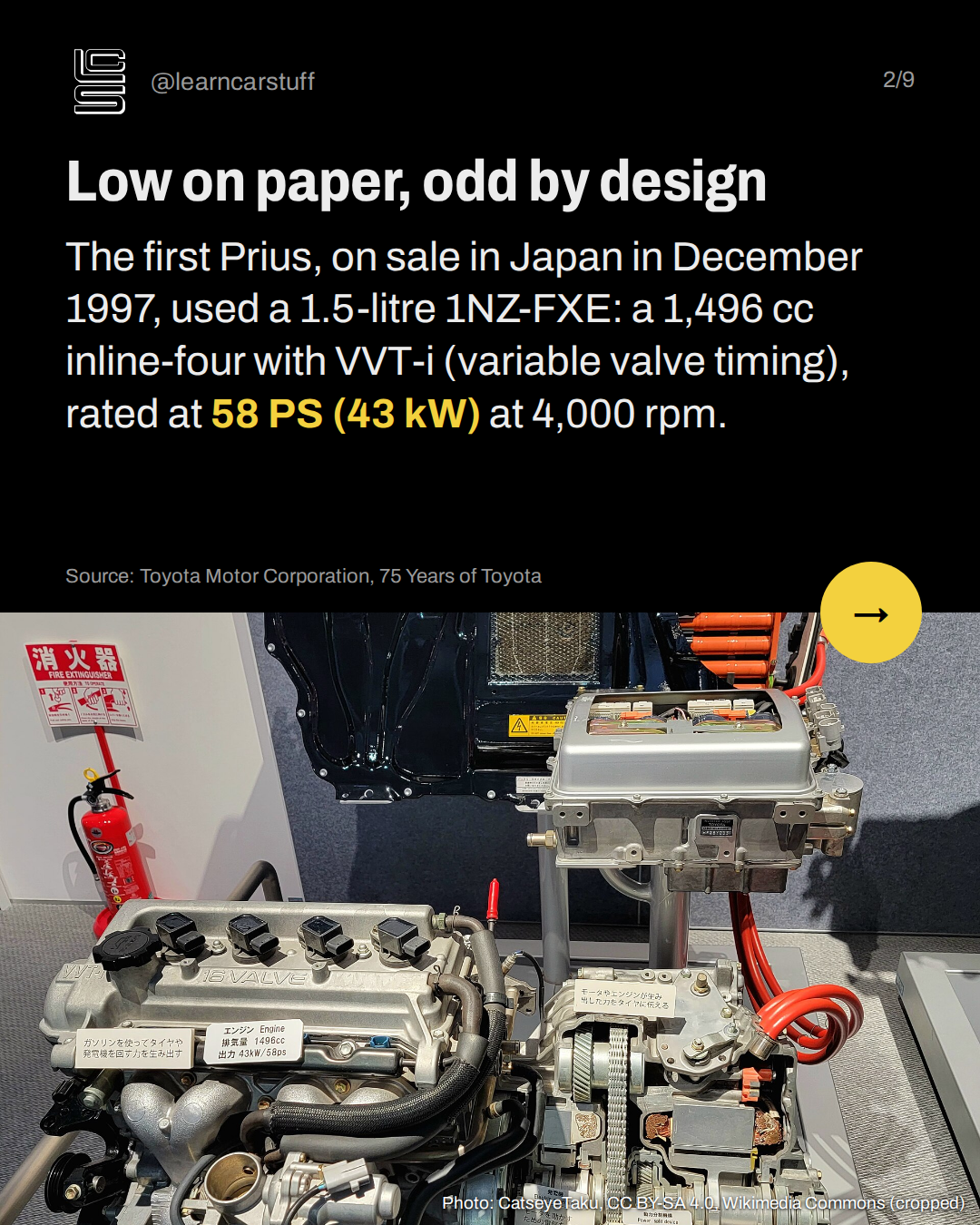
The first Prius, on sale in Japan in December 1997, used a 1.5-litre 1NZ-FXE: a 1,496 cc inline-four with VVT-i (variable valve timing), rated at 58 PS (43 kW) at 4,000 rpm.
Source: Toyota Motor Corporation, 75 Years of Toyota
A normal engine can't expand more
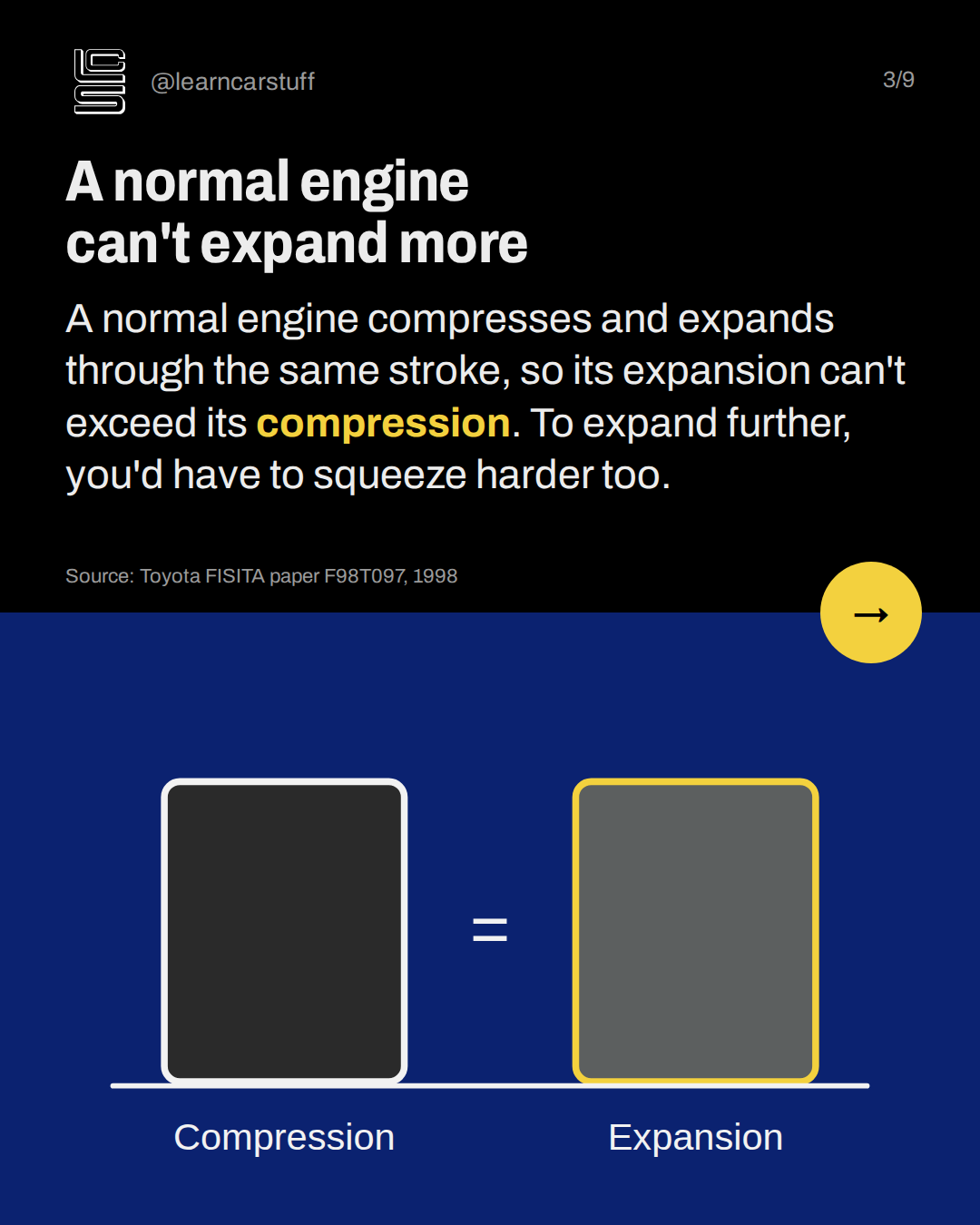
A normal engine compresses and expands through the same stroke, so its expansion can't exceed its compression. To expand further, you'd have to squeeze harder too.
Source: Toyota FISITA paper F98T097, 1998
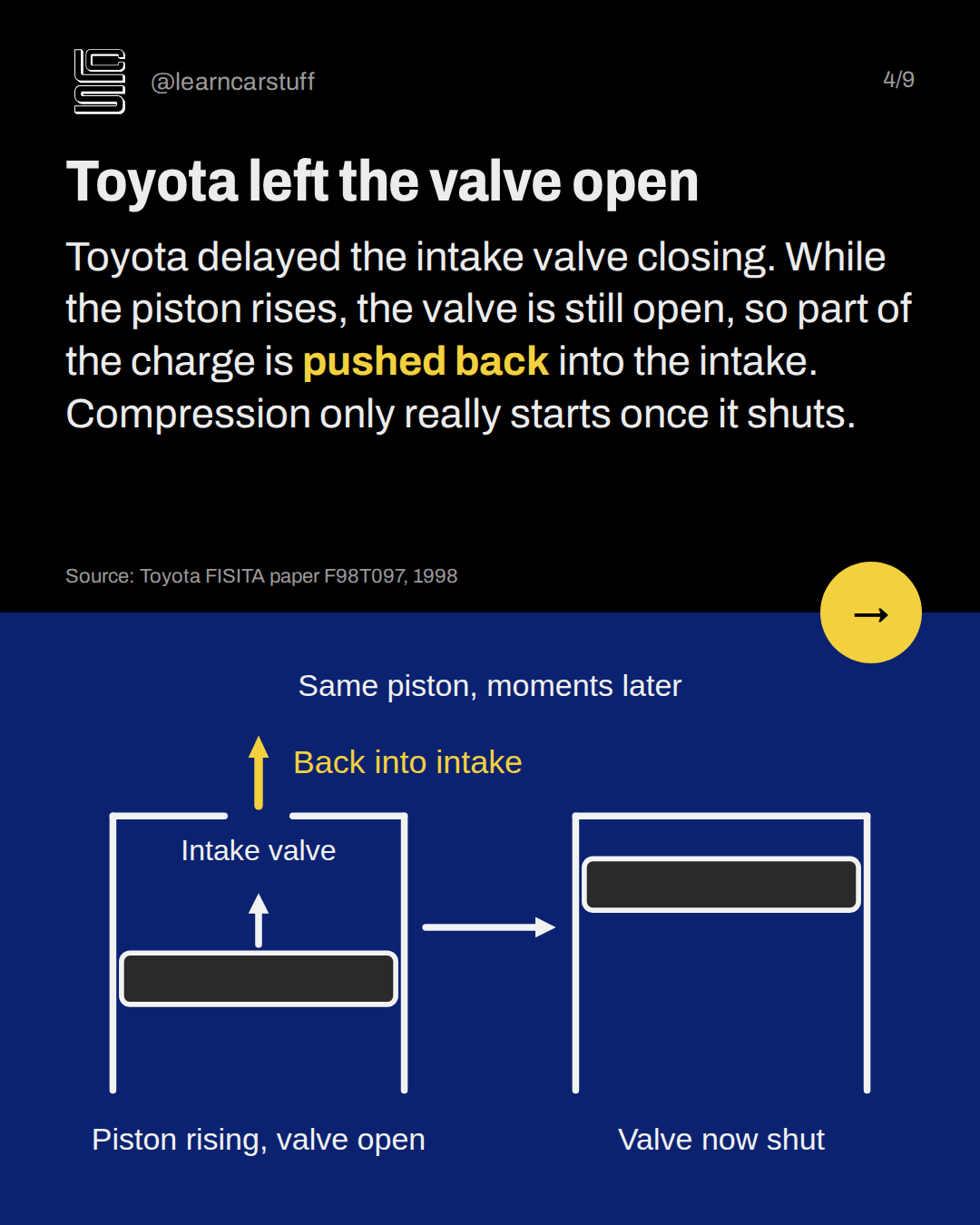
Toyota left the valve open
Toyota delayed the intake valve closing. While the piston rises, the valve is still open, so part of the charge is pushed back into the intake. Compression only really starts once it shuts.
Source: Toyota FISITA paper F98T097, 1998
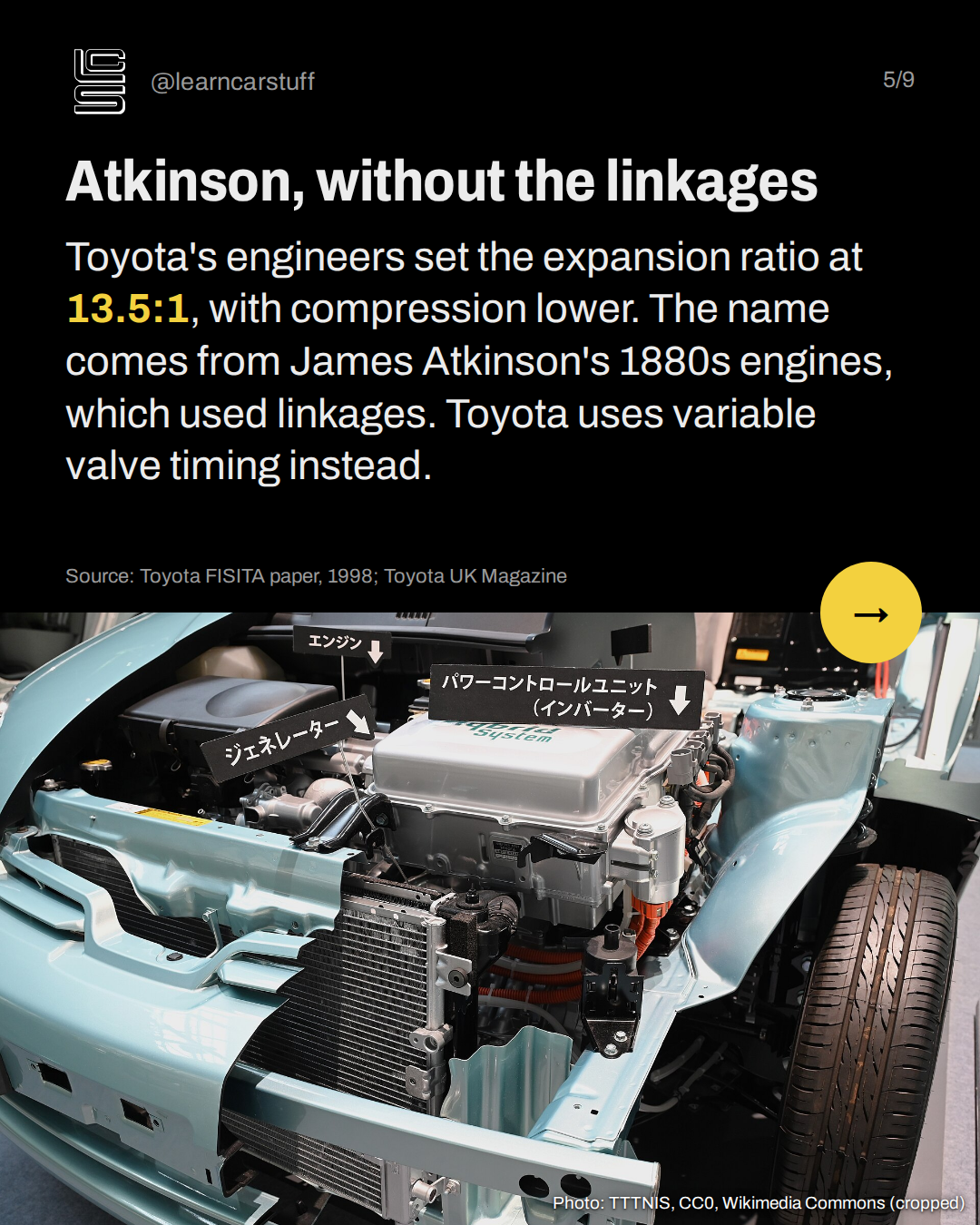
Atkinson, without the linkages
Toyota's engineers set the expansion ratio at 13.5:1, with compression lower. The name comes from James Atkinson's 1880s engines, which used linkages. Toyota uses variable valve timing instead.
Source: Toyota FISITA paper, 1998; Toyota UK Magazine
What the efficiency works out to
Toyota's best fuel use is better than 230 g per kWh. A kWh is 3,600 kJ, so 3,600 ÷ (230 g × 43.4 kJ/g) means at least roughly 36% of the fuel's energy becomes work at best.
Source: Toyota FISITA paper, 1998; GREET 1.8d.1 (Argonne)
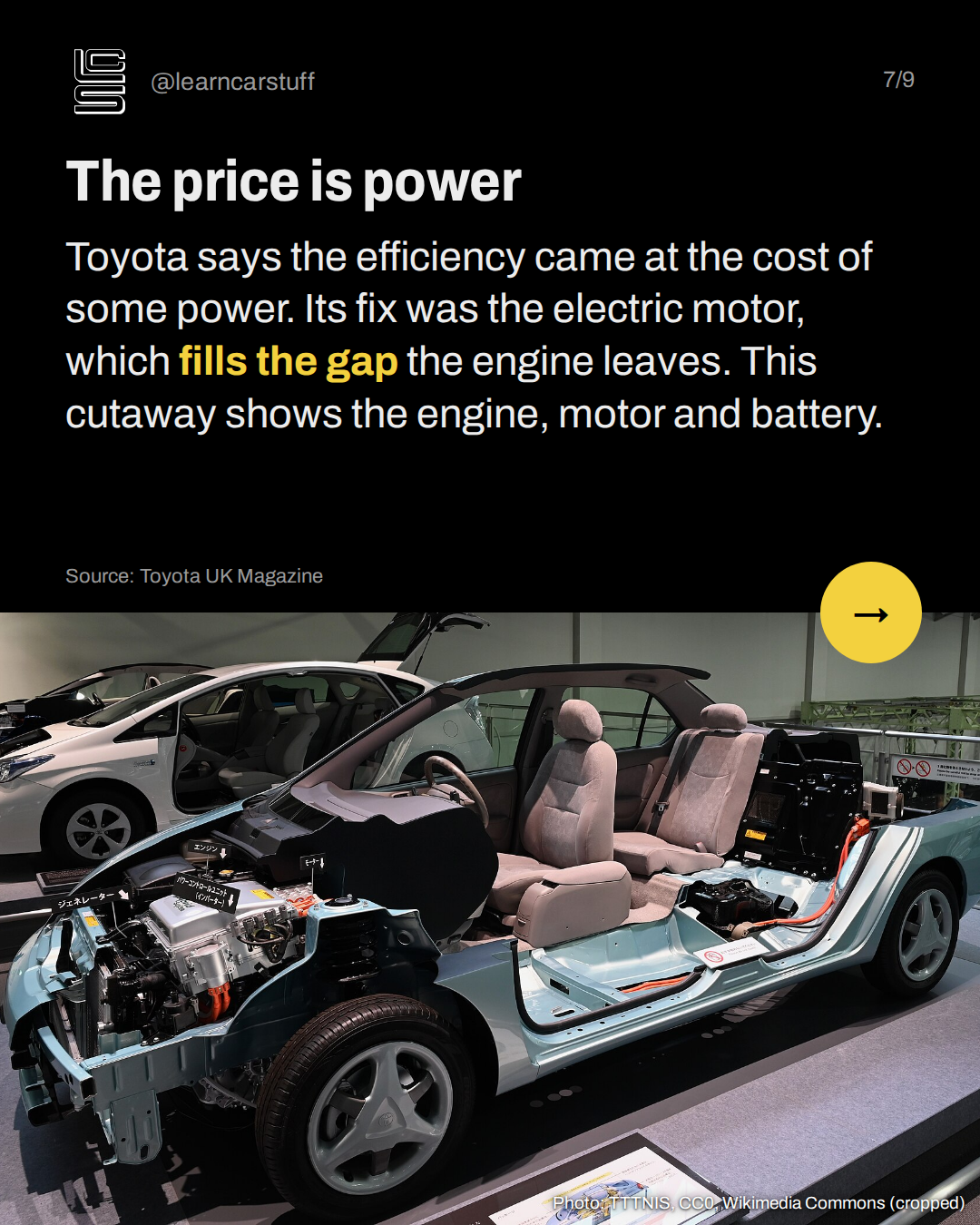
The price is power
Toyota says the efficiency came at the cost of some power. Its fix was the electric motor, which fills the gap the engine leaves. This cutaway shows the engine, motor and battery.
Source: Toyota UK Magazine
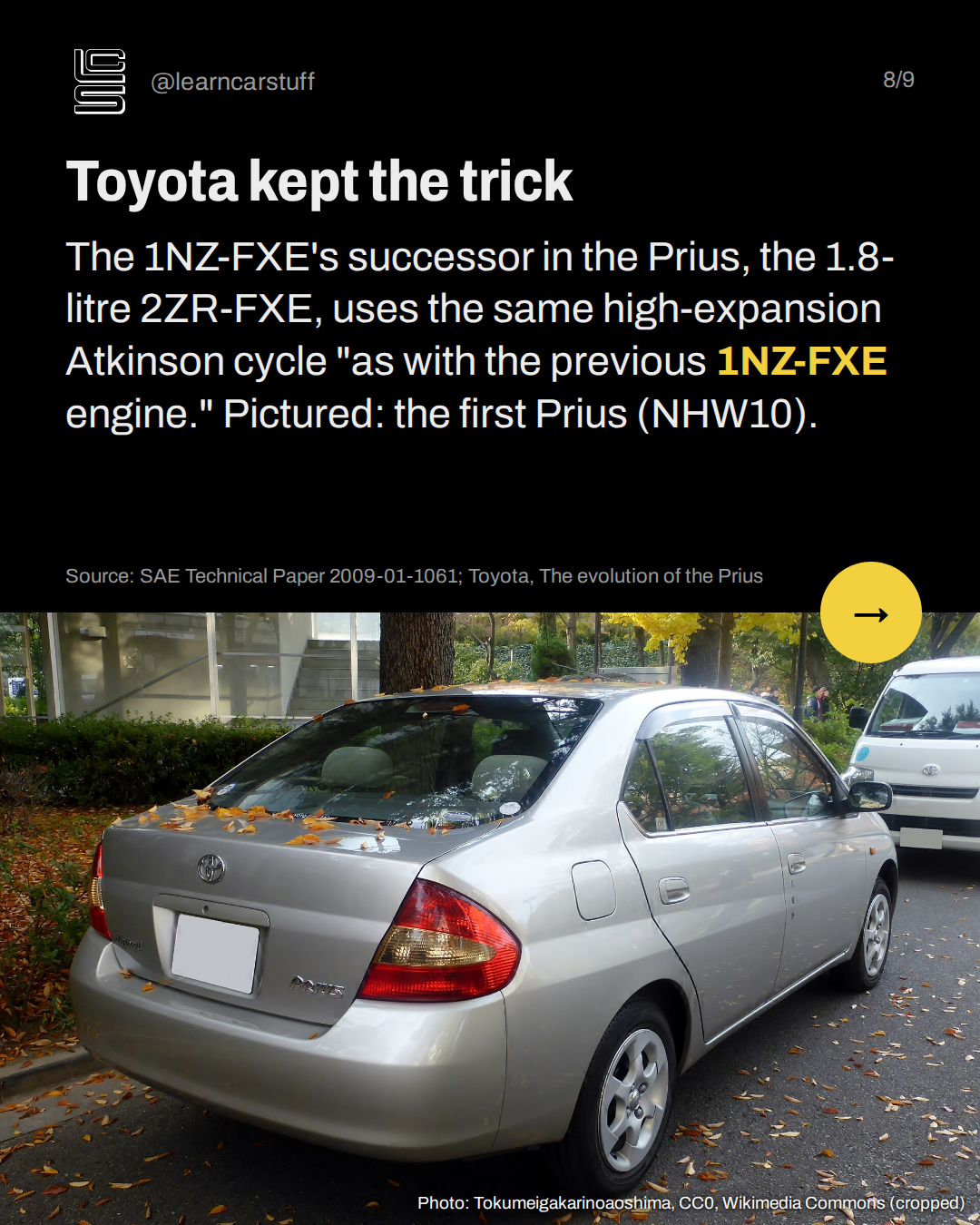
Toyota kept the trick
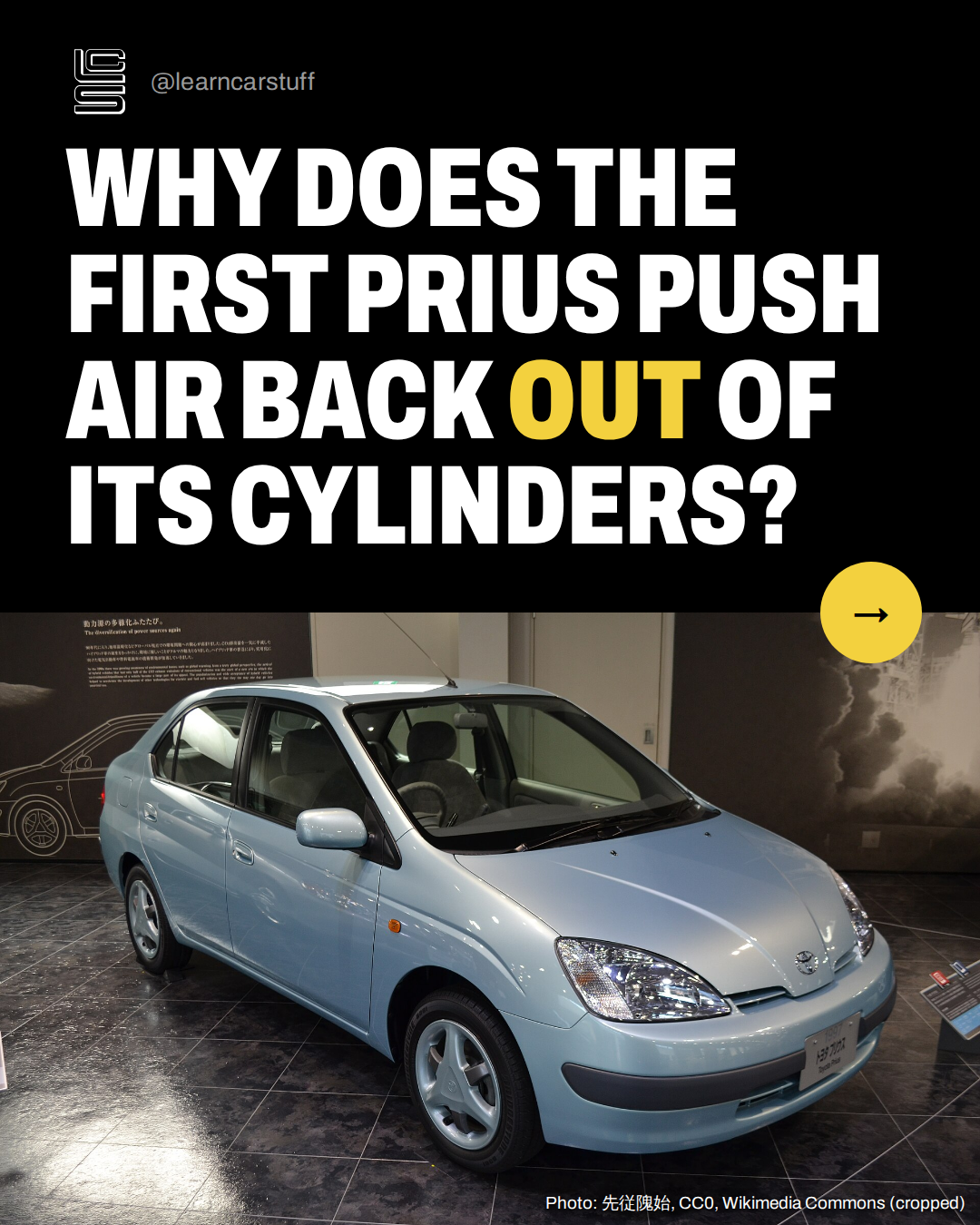
The 1NZ-FXE's successor in the Prius, the 1.8-litre 2ZR-FXE, uses the same high-expansion Atkinson cycle "as with the previous 1NZ-FXE engine." Pictured: the first Prius (NHW10).
Source: SAE Technical Paper 2009-01-1061; Toyota, The evolution of the Prius
Sources and assumptions
- Takaoka, Tada, Hirose, Nouno, Sasaki, Ueda (Toyota Motor Corporation), 'Super High Efficient Gasoline Engine for the Toyota Hybrid System', FISITA World Automotive Congress, Paris, September 1998 (paper F98T097), abstract: Toyota's own engineers: the Toyota Hybrid System engine delays intake valve closing to separate the compression and expansion ratios, so the expansion ratio can be set to 13.5:1. BSFC better than 230 g/kWh. (checked 2026-10-17)
- Toyota Motor Corporation, '75 Years of Toyota' vehicle lineage: Prius 1st generation (released 1997-12-10): First Prius released December 10, 1997. Engine 1NZ-FXE, water-cooled inline-4 DOHC, transverse, 1,496 cm³, 58 PS at 4,000 rpm. Model HK-NHW10. 'Specially designed VVT-i 1.5-liter gasoline engine' paired with an electric motor. (checked 2026-10-17)
- Toyota UK Magazine, 'Why does Toyota use Atkinson cycle engines?' (Joe Clifford, 14 Jan 2015, updated 26 Jul 2024): Toyota achieves the Atkinson cycle's key feature, delayed closing of the intake valve during the compression stroke, through variable valve timing (hydraulic camshaft phasing) rather than mechanical linkages. The efficiency 'could only be achieved at the cost of some power'. An electric motor assisting the petrol engine addressed the power shortfall. The engine was used in the 1997 Prius. NOTE: the article misprints the engine code as 1NR-FXE; do not cite the code from it. (checked 2026-10-17)
- Kawamoto, Naiki, Kawai, Shikida, Tomatsuri (Toyota Motor Corporation), 'Development of New 1.8-Liter Engine for Hybrid Vehicles', SAE Technical Paper 2009-01-1061, abstract: The 2ZR-FXE hybrid engine uses 'the high-expansion ratio cycle "Atkinson cycle"' for thermal efficiency, 'as with the previous 1NZ-FXE engine'. Confirms Toyota itself calls the 1NZ-FXE an Atkinson-cycle (high-expansion-ratio) engine and carried the idea forward. (checked 2026-10-17)
- GREET 1.8d.1 (Argonne National Laboratory) via Biomass Energy Data Book 2011, Appendix A, 'Lower and Higher Heating Values of Gas, Liquid and Solid Fuels' (hosted by University of Illinois NPRE 470): Conventional gasoline lower heating value 43.448 MJ/kg (used to convert 230 g/kWh BSFC into an efficiency of about 36%). (checked 2026-10-17)
- Autozine, 'Toyota Prius (1997)' classic car archive: Secondary support for the first Prius's 1.5-litre 16-valve Atkinson-cycle engine (58 hp) and its electric motor of about 30 kW. Matches the Toyota museum placard visible in the 1NZ-FXE photo (motor 30kW/41ps). (checked 2026-10-17)
- Toyota Motor Corporation, 'The evolution of the Prius' (Prius 20th anniversary, Aug. 04, 2017), Toyota Motor Corporation Official Global Website: For the third-generation Prius: 'The THS engine was increased in size from 1.5 liters to 1.8 liters.' Together with SAE 2009-01-1061, this shows the 1.8-litre 2ZR-FXE followed the 1.5-litre 1NZ-FXE in the Prius. The page does not name the engine code. (checked 2026-10-17)
Assumptions:
- All engine numbers refer to the first-generation Prius (NHW10, Japan, December 1997) and its 1NZ-FXE as described by Toyota's 1998 FISITA paper. Later NHW11 and NHW20 versions of the 1NZ-FXE have different ratings (for example 76 hp in the 2004–09 US car) and must not be mixed in.
- The 13.5:1 figure is Toyota's stated EXPANSION ratio. No primary Toyota source in this record gives an exact effective compression ratio, so slides must say compression is 'lower than' expansion and give no number for it.
- The efficiency calculation uses BSFC = 230 g/kWh (Toyota says 'better than', so ~36% is a floor at the engine's best operating point, not an average while driving) and gasoline LHV 43.448 MJ/kg (US conventional gasoline per GREET; Japanese fuel differs slightly). 3,600 kJ/kWh ÷ (230 g/kWh × 43.448 kJ/g) = 3,600 ÷ 9,993 ≈ 0.360.
- Motor output 30 kW comes from the Toyota-supplied museum placard visible in the photo File:初代プリウス1NZ-FXE 豊田産業技術記念館.jpg and from Autozine, not from a Toyota press document. Present it as 'about 30 kW' or leave it out.
- The James Atkinson history (1880s engines with a longer expansion than intake/compression stroke through mechanical linkages) is general background from secondary sources. Keep it to one line without patent dates or engine names.
- 'Pushed back into the intake' describes the mechanism of late intake valve closing (charge displaced back out while the valve is still open during the piston's upstroke), as Toyota's paper and Toyota UK describe it in terms of delayed intake closing.
Photos:
The short version
- The 1NZ-FXE closes its intake valves late.
- Part of the charge is pushed back into the intake.
- Expansion is 13.5:1; compression is lower.
- Less power, and the electric motor covers it.