 Learn Car Stuff
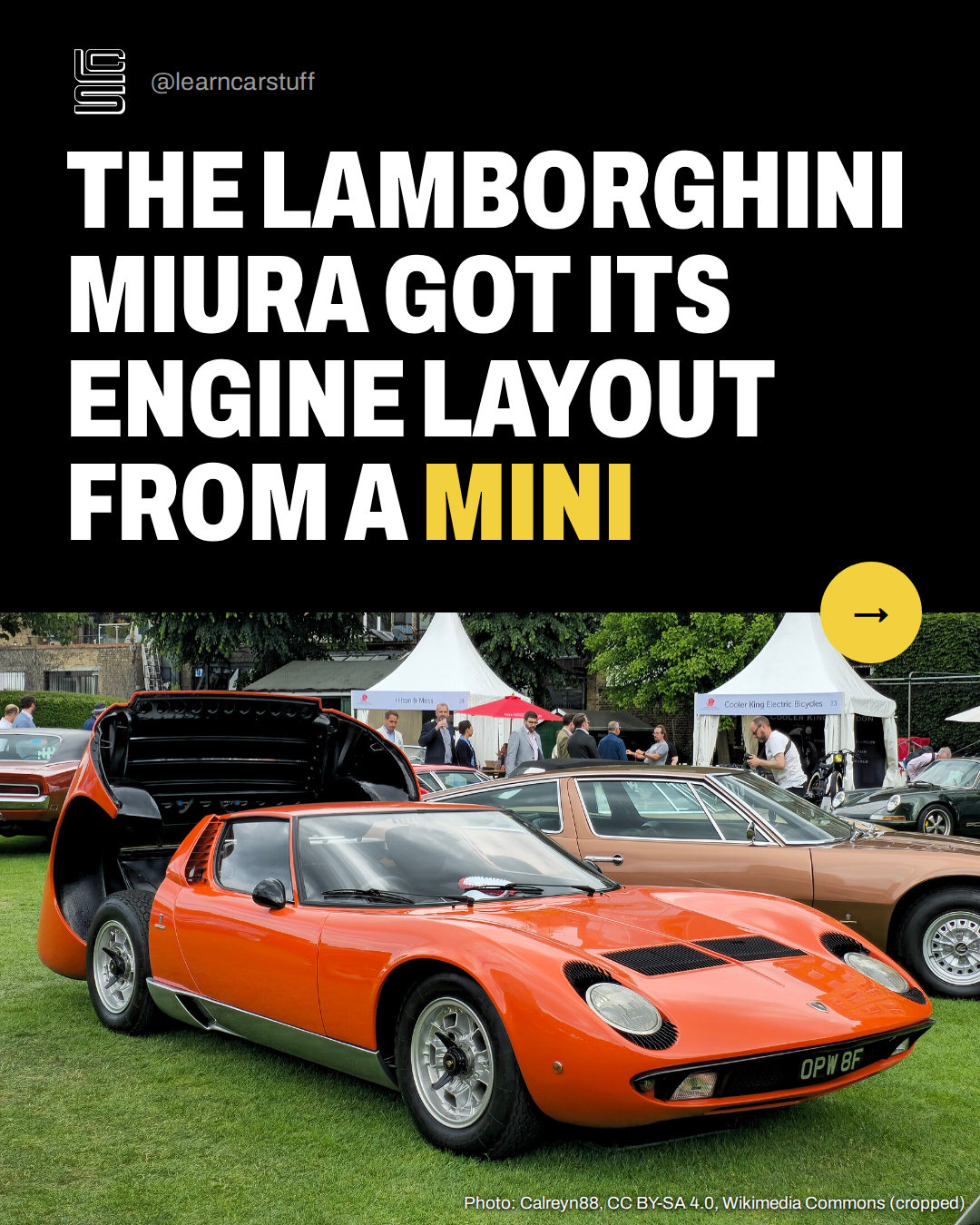
The Lamborghini Miura got its engine layout from a Mini
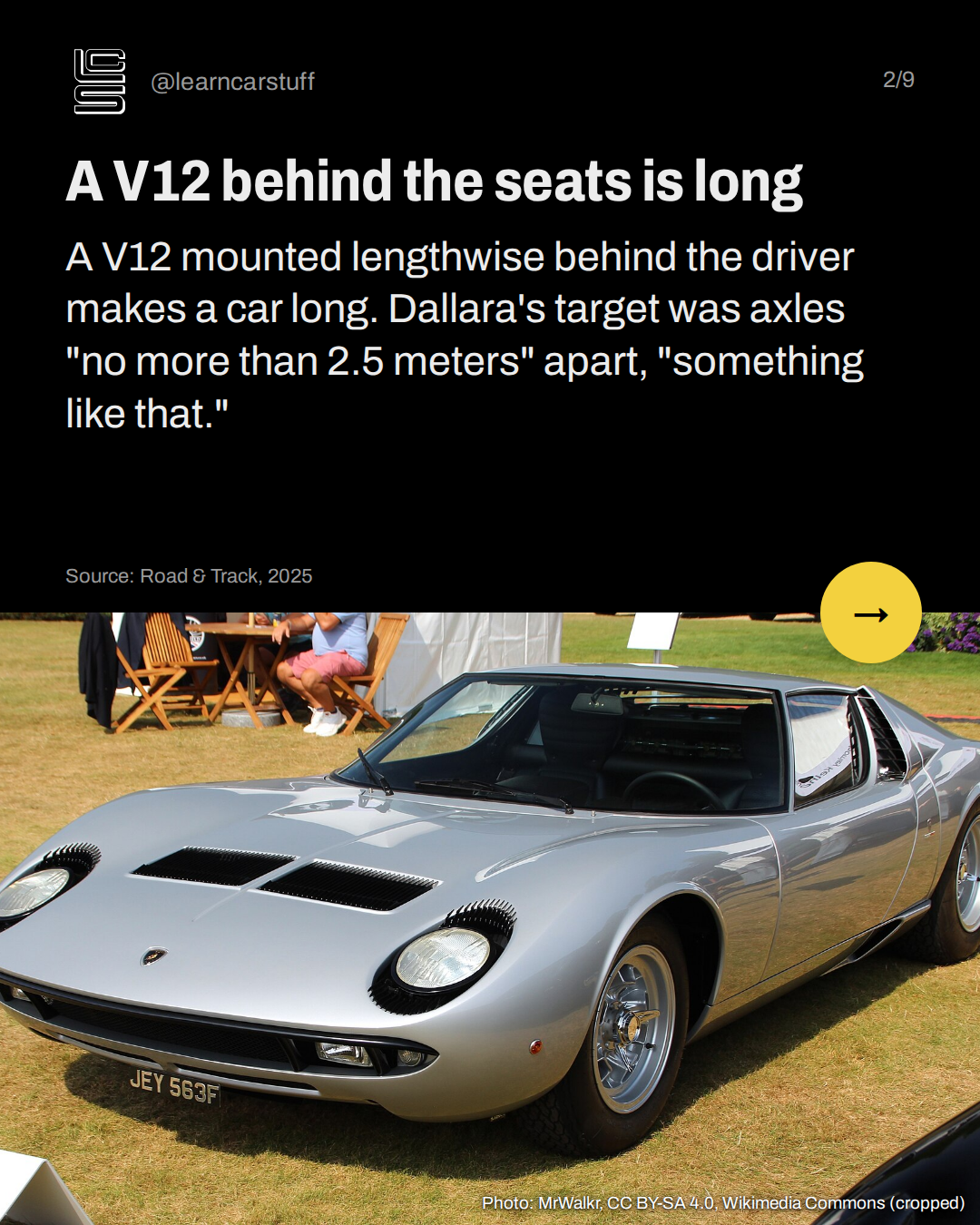
A V12 behind the seats is long
A V12 mounted lengthwise behind the driver makes a car long. Dallara's target was axles "no more than 2.5 meters" apart, "something like that."
Source: Road & Track, 2025
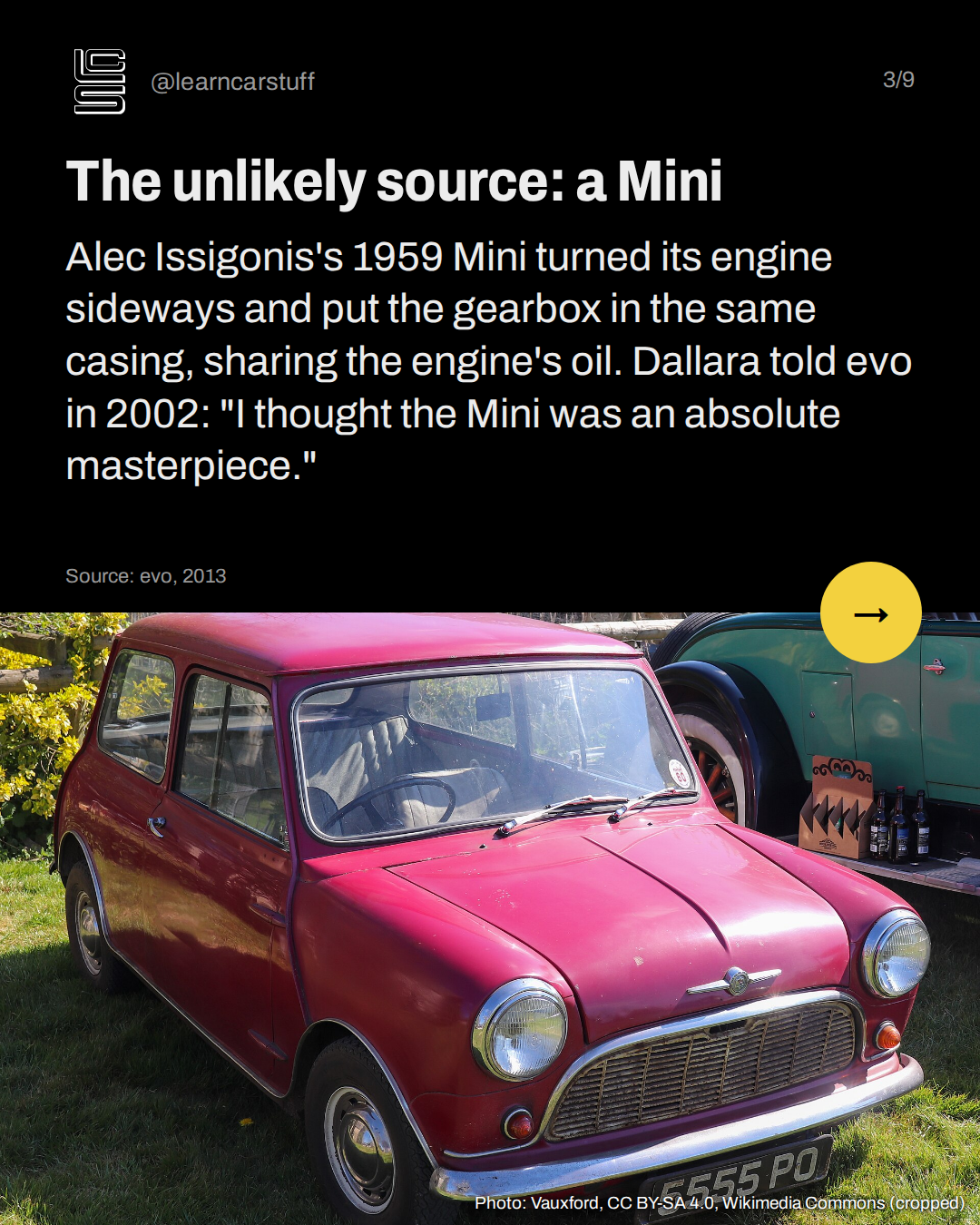
The unlikely source: a Mini
Alec Issigonis's 1959 Mini turned its engine sideways and put the gearbox in the same casing, sharing the engine's oil. Dallara told evo in 2002: "I thought the Mini was an absolute masterpiece."
Source: evo, 2013
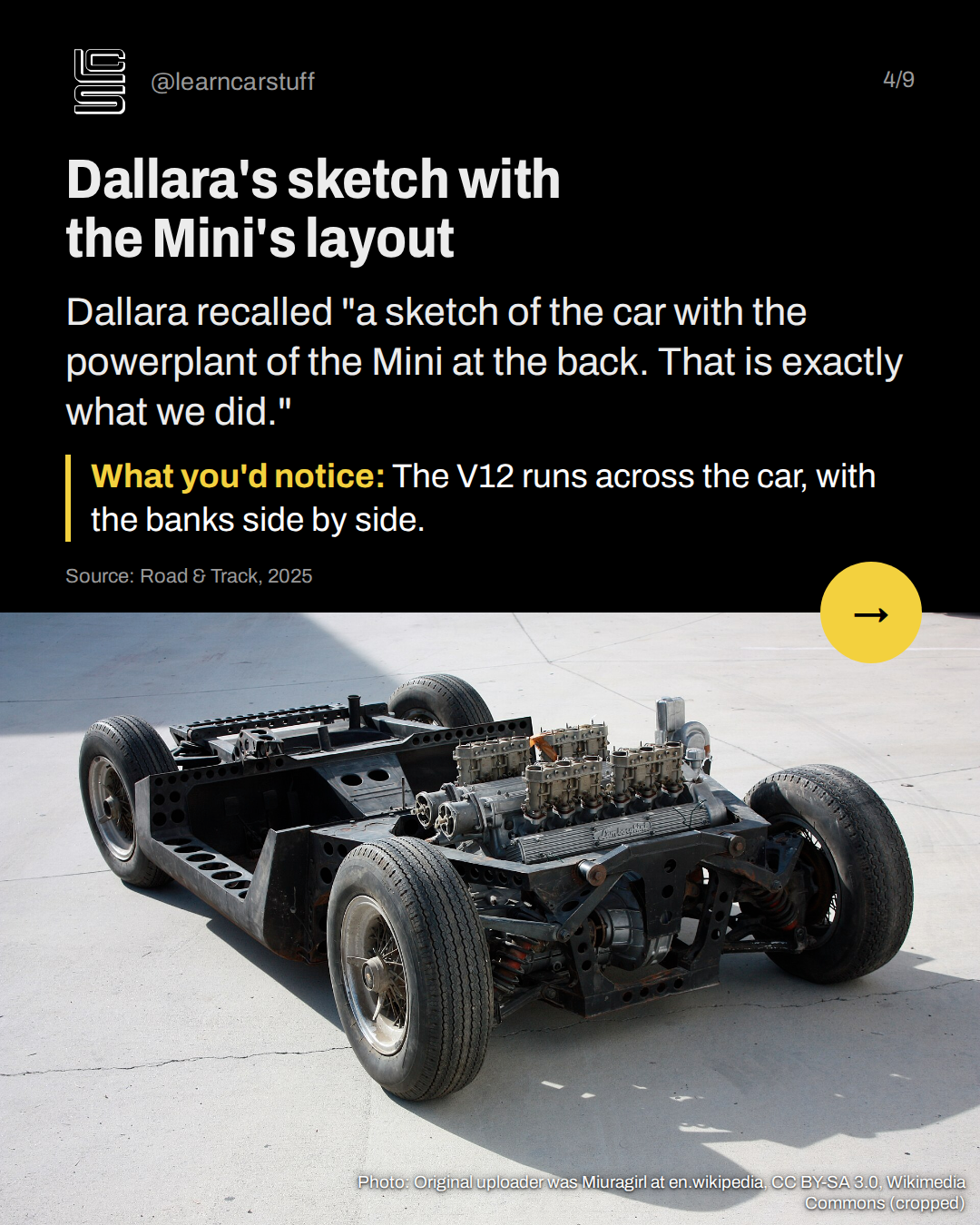
Dallara's sketch with the Mini's layout
Dallara recalled "a sketch of the car with the powerplant of the Mini at the back. That is exactly what we did."
What you'd notice: The V12 runs across the car, with the banks side by side.
Source: Road & Track, 2025
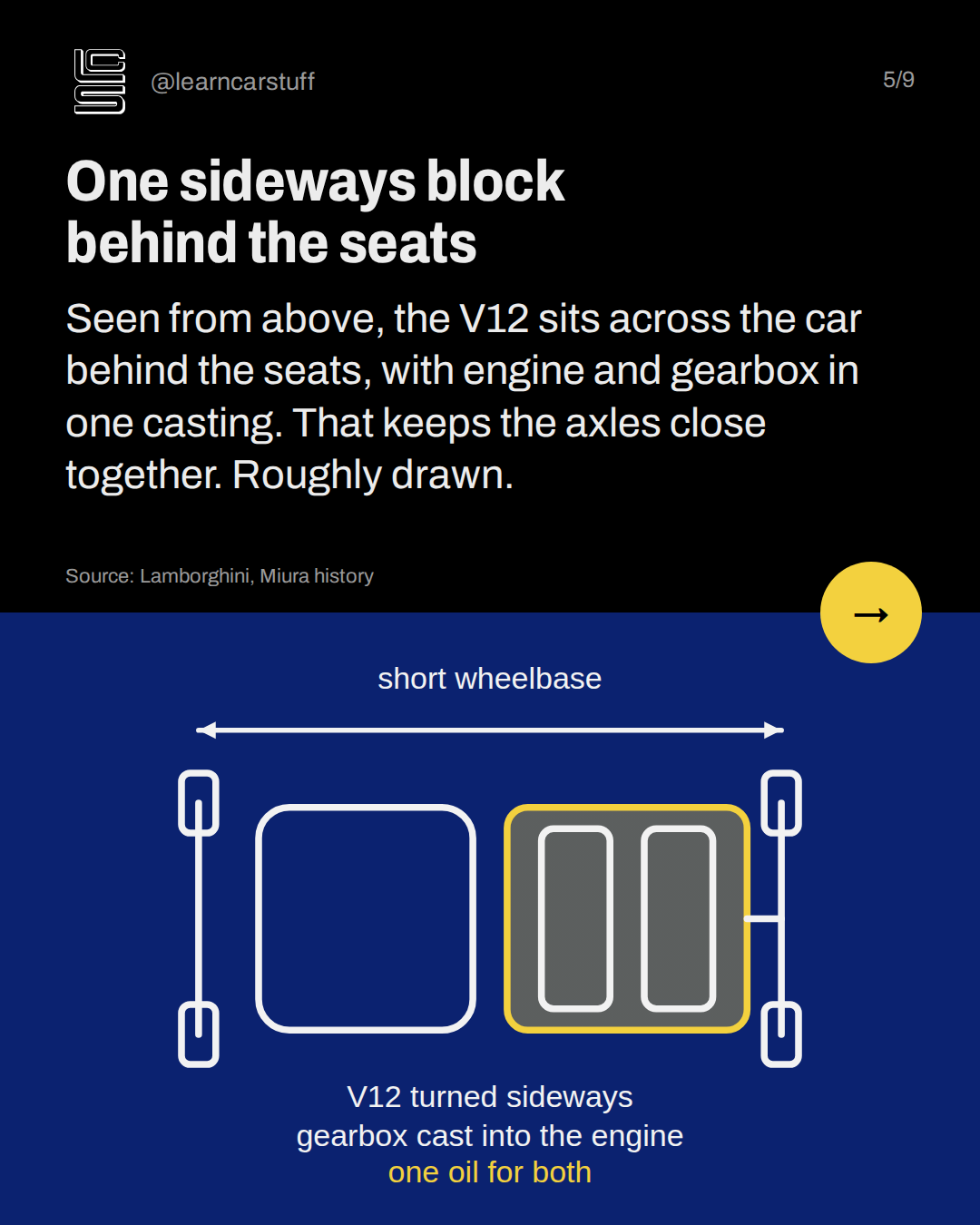
One sideways block behind the seats
Seen from above, the V12 sits across the car behind the seats, with engine and gearbox in one casting. That keeps the axles close together. Roughly drawn.
Source: Lamborghini, Miura history
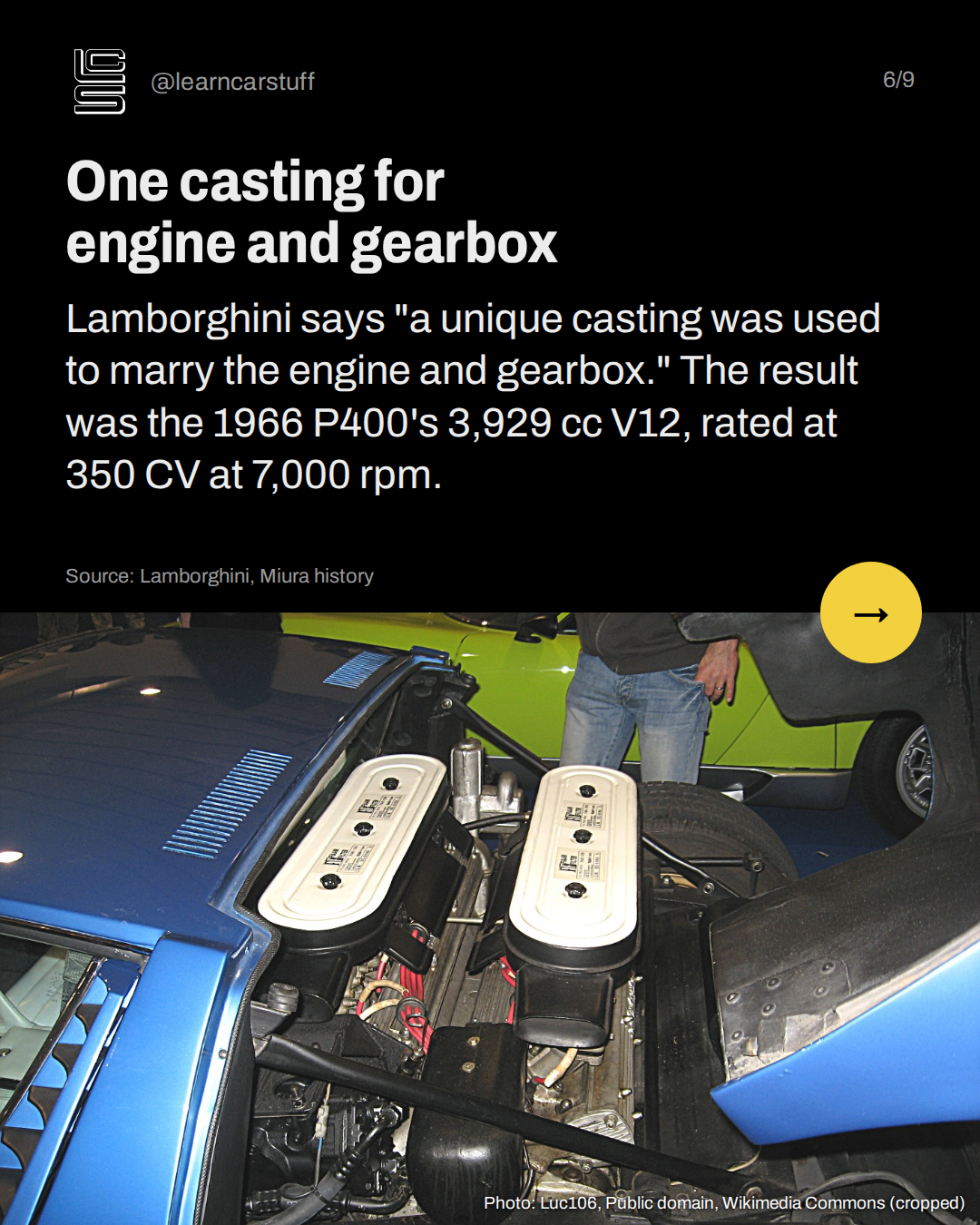
One casting for engine and gearbox
Lamborghini says "a unique casting was used to marry the engine and gearbox." The result was the 1966 P400's 3,929 cc V12, rated at 350 CV at 7,000 rpm.
Source: Lamborghini, Miura history
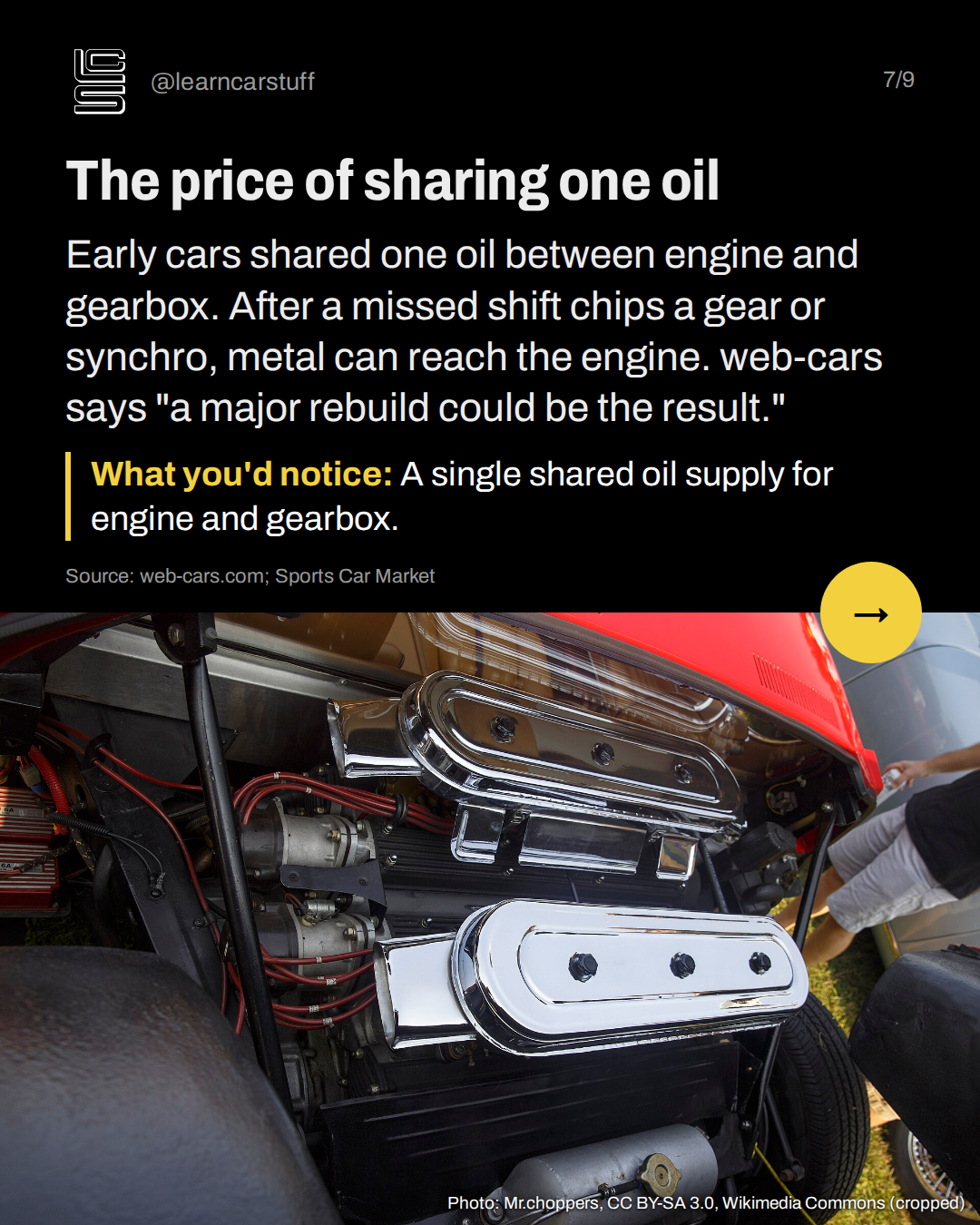
The price of sharing one oil
Early cars shared one oil between engine and gearbox. After a missed shift chips a gear or synchro, metal can reach the engine. web-cars says "a major rebuild could be the result."
What you'd notice: A single shared oil supply for engine and gearbox.
Source: web-cars.com; Sports Car Market
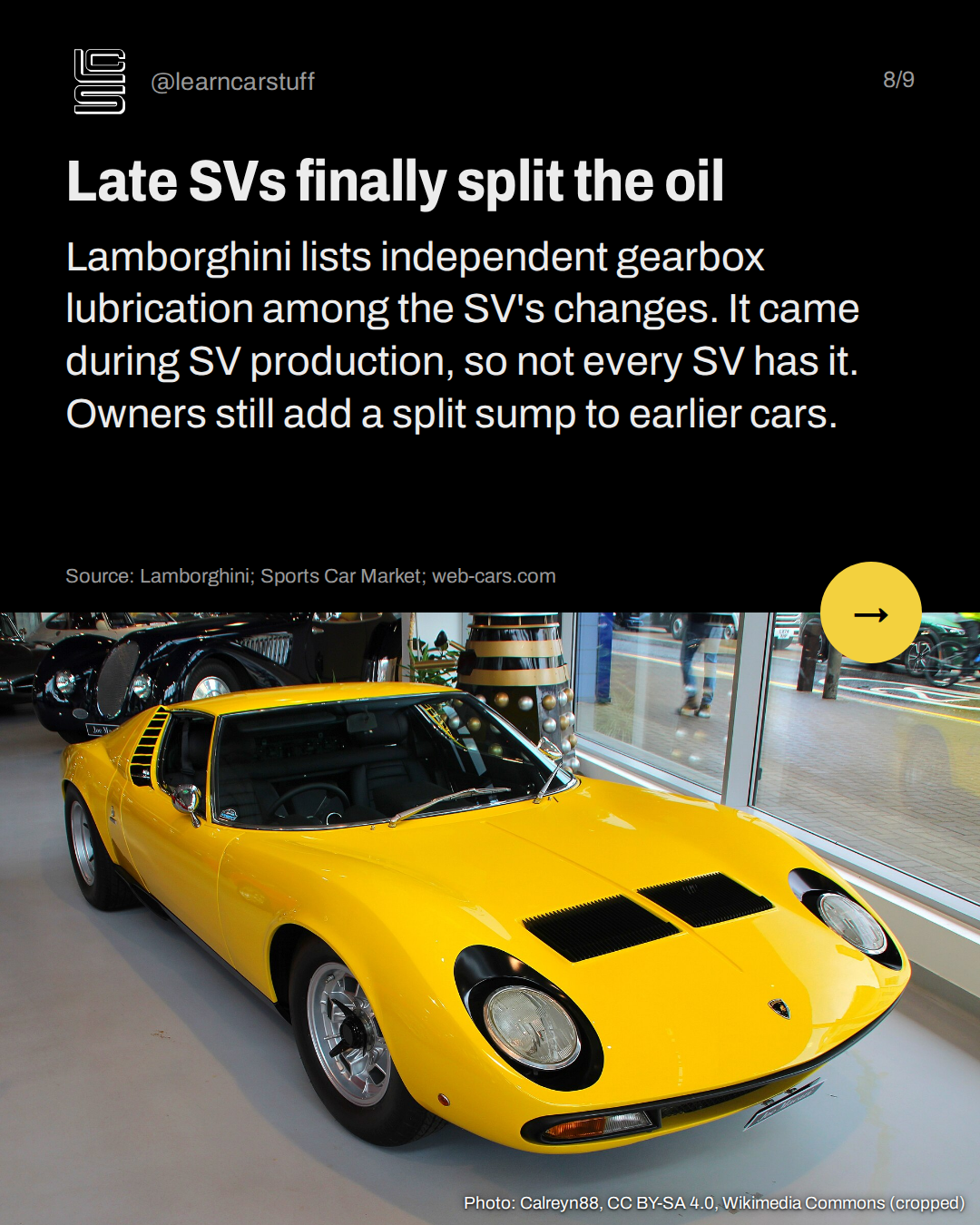
Late SVs finally split the oil
Lamborghini lists independent gearbox lubrication among the SV's changes. It came during SV production, so not every SV has it. Owners still add a split sump to earlier cars.
Source: Lamborghini; Sports Car Market; web-cars.com
Sources and assumptions
- Lamborghini: Miura history page: V12 transversely mid-mounted; 'a unique casting was used to marry the engine and gearbox'; P400 350 CV at 7,000 rpm, P400 S 370 CV at 7,700 rpm, SV 385 CV at 7,850 rpm; production P400 1966–68 265, P400 S 1969–71 338, SV 1971–73 150; SV got 'independent gearbox lubrication system' and lost the headlight eyelashes (checked 2026-10-17)
- Lamborghini media (via conceptcarz reprint, 2 June 2022): Miura, the world's first production car with a transverse central-rear V12: Young engineers Giampaolo Dallara and Paolo Stanzani handled the technical side; 4-litre 60° V12 with four Weber 40 IDL 3L carburettors; 350/370/385 CV for P400/P400S/P400SV (checked 2026-10-17)
- Road & Track (Mike Duff, 7 Aug 2025), syndicated on Yahoo Autos: How Giampaolo Dallara Engineered the Lamborghini Miura: Dallara: 'I hope at Lamborghini there is still a sketch of the car with the powerplant of the Mini at the back. That is exactly what we did.'; the solution came from the Mini's transverse layout; wheelbase 'no more than 2.5 meters, something like that'; rolling chassis shown first at the 1965 Turin show (checked 2026-10-17)
- evo: A-Z Supercars: Lamborghini Miura (Ian Eveleigh, 27 Aug 2013): Dallara and Stanzani drew the initial plans in their spare time in summer 1965; engine mounted transversely behind the cabin to keep the wheelbase short; 'space-saving shared lubrication system for the engine and gearbox, just like in the contemporary Mini'; Dallara told evo in 2002 'I thought the Mini was an absolute masterpiece'; bare chassis at Turin late 1965, unveiled Geneva 1966 (checked 2026-10-17)
- Bonhams: 1967 Lamborghini Miura P400 chassis 3057: V12 'with an integrated gearbox, inspired by Alec Issigonis' Austin Mini'; bare rolling chassis shown at the 1965 Turin Motor Show; SV-specification oil system could be fitted to earlier cars (checked 2026-10-17)
- web-cars.com Miura engine page: Engine and transmission cast as one piece; both shared the same oil; a chipped gear or synchro from a missed shift reaching the engine could mean 'a major rebuild'; about half of SVs late in production had a split sump (checked 2026-10-17)
- Sports Car Market: Lamborghini Miura knowledge base: Engine, gearbox and differential shared a common oil supply on early cars; gearbox contaminants could circulate through the engine; later SVs adopted split-sump lubrication, and the change happened during production, so not every SV has it (checked 2026-10-17)
- Goodwood Insurance buyer's guide: Lamborghini Miura (Rachel Roberts, 2 July 2025): Transverse V12 used an integrated crankcase and gearbox arrangement 'just like the original Mini'; final SV had a segregated oil system (checked 2026-10-17)
- BMW Group PressClub: MINI, a brief global history: The Mini's masterstroke was putting the gearbox in the sump of the transverse engine (from the 2026-10-15-b record) (checked 2026-10-17)
Assumptions:
- 'Copied the Mini' means the layout idea: a transverse engine with the gearbox in the same casting and shared oil. The Mini's gearbox sits under its engine, and no source opened gives the Miura gearbox's exact position, so the slides and diagram must not claim the two are identical inside.
- The 2.5 m wheelbase is Dallara's recalled target ('something like that'), not a spec-sheet figure; quote it as his words.
- Power figures are Lamborghini's own CV ratings (P400 350 CV at 7,000 rpm). Goodwood's 395 PS for the SV is not used.
- Split sump: Lamborghini lists independent gearbox lubrication as an SV change; Sports Car Market and web-cars say it arrived partway through SV production (web-cars: about half of SVs). Say 'late SVs' and 'not every SV'.
- The p6 chassis is identified as the 1965 Turin show chassis only by its Commons file title; it was photographed in 2008 at a restoration shop. Caption it as 'the bare Miura chassis', with Turin attributed to the file record if used.
- Mini photos show a 1959 Morris Mini-Minor and a British Motor Museum cutaway of unstated year.
Photos:
- Photo: Calreyn88, CC BY-SA 4.0, Wikimedia Commons (cropped)
- Photo: MrWalkr, CC BY-SA 4.0, Wikimedia Commons (cropped)
- Photo: Original uploader was Miuragirl at en.wikipedia, CC BY-SA 3.0, Wikimedia Commons (cropped)
- Photo: Mr.choppers, CC BY-SA 3.0, Wikimedia Commons (cropped)
- Photo: Luc106, Public domain, Wikimedia Commons (cropped)
- Photo: Calreyn88, CC BY-SA 4.0, Wikimedia Commons (cropped)
- Photo: Vauxford, CC BY-SA 4.0, Wikimedia Commons (cropped)
The short version
- The Miura's V12 sits sideways behind the seats
- Dallara took the Mini's layout idea
- Engine and gearbox shared one oil
- Late SVs finally split the gearbox oil