 Learn Car Stuff
Why did the first Honda Insight hide its rear wheels?

Light was only half the plan
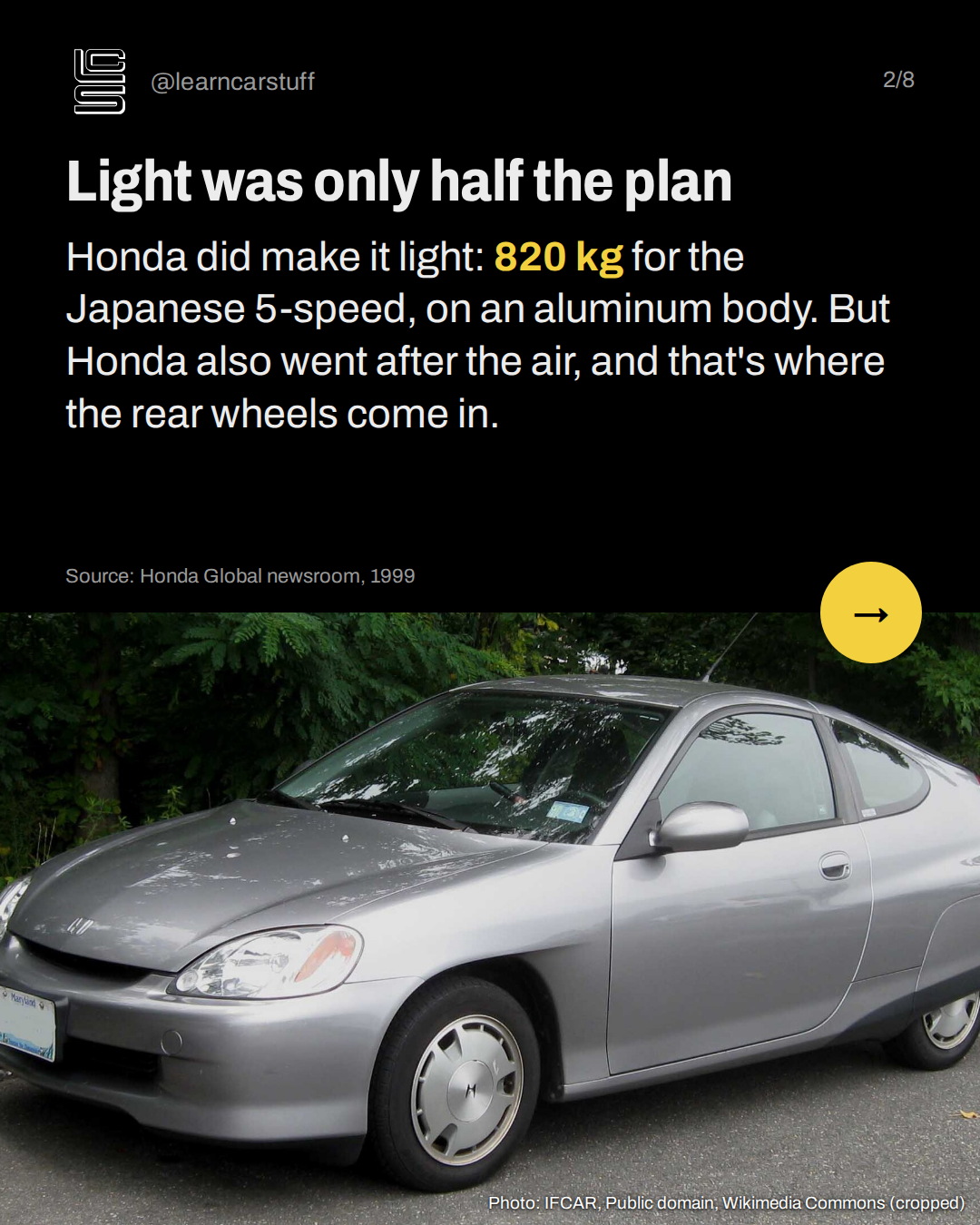
Honda did make it light: 820 kg for the Japanese 5-speed, on an aluminum body. But Honda also went after the air, and that's where the rear wheels come in.
Source: Honda Global newsroom, 1999
The skirts were part of a package
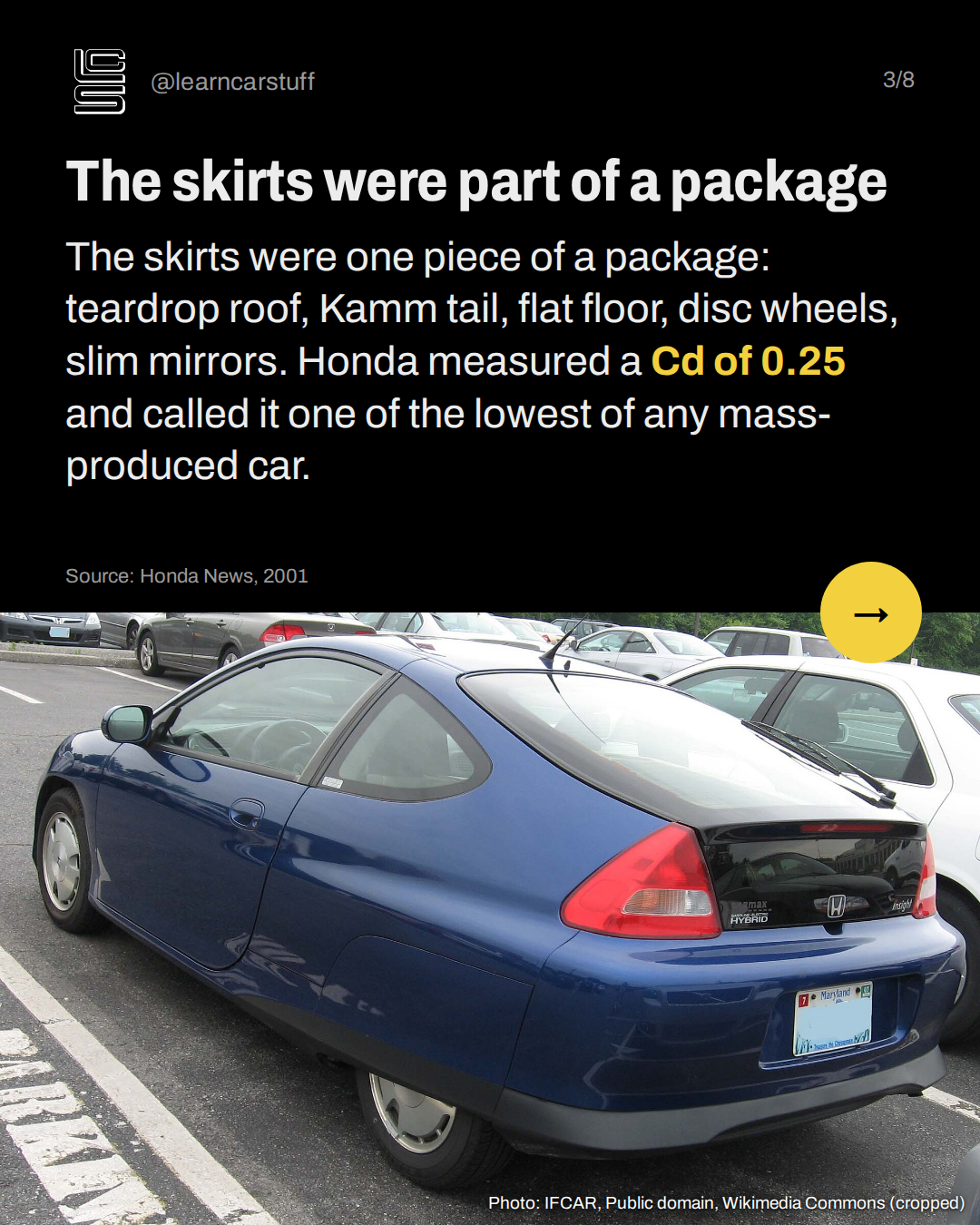
The skirts were one piece of a package: teardrop roof, Kamm tail, flat floor, disc wheels, slim mirrors. Honda measured a Cd of 0.25 and called it one of the lowest of any mass-produced car.
Source: Honda News, 2001
Why only the rear wheels
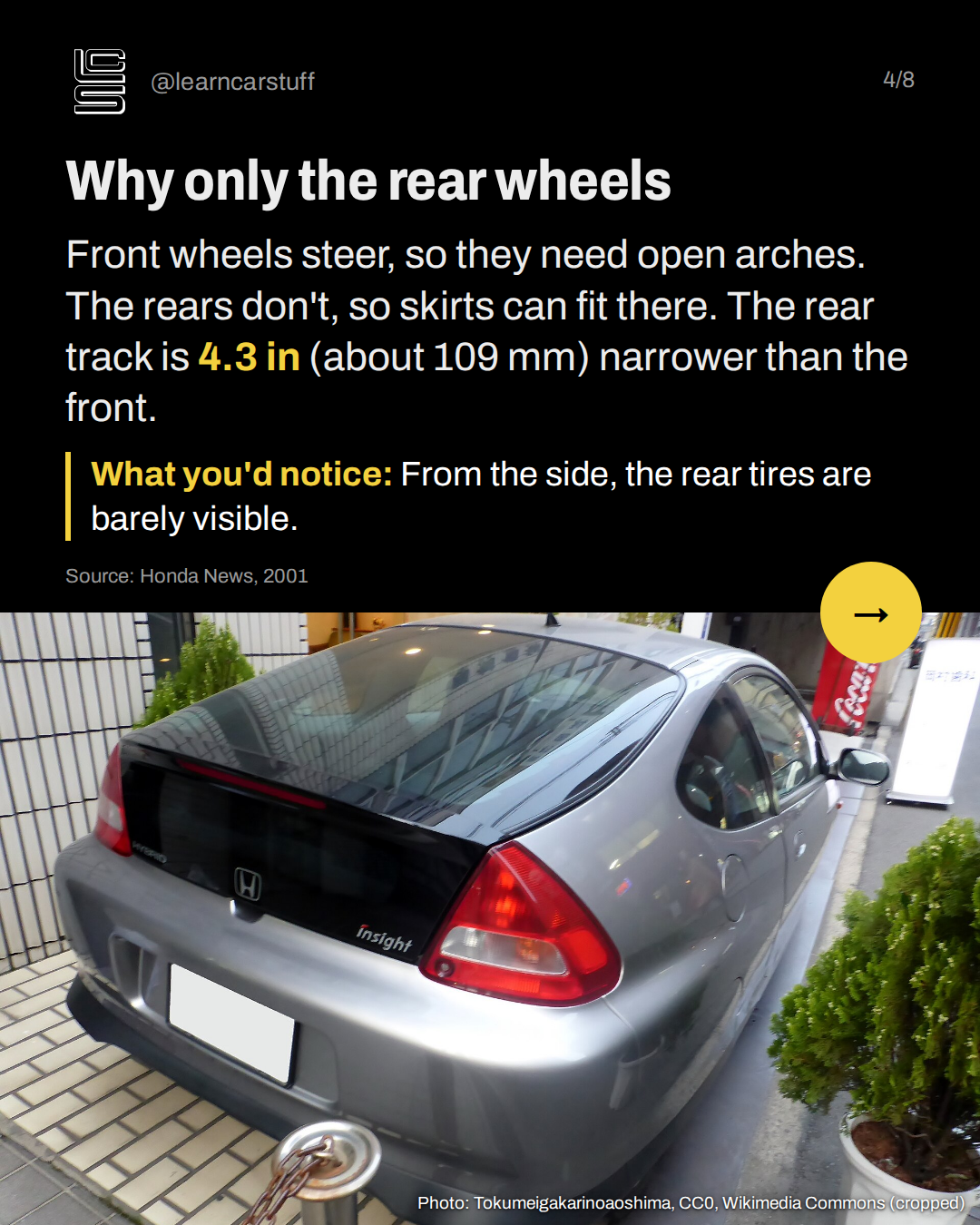
Front wheels steer, so they need open arches. The rears don't, so skirts can fit there. The rear track is 4.3 in (about 109 mm) narrower than the front.
What you'd notice: From the side, the rear tires are barely visible.
Source: Honda News, 2001
Air drag grows with speed squared
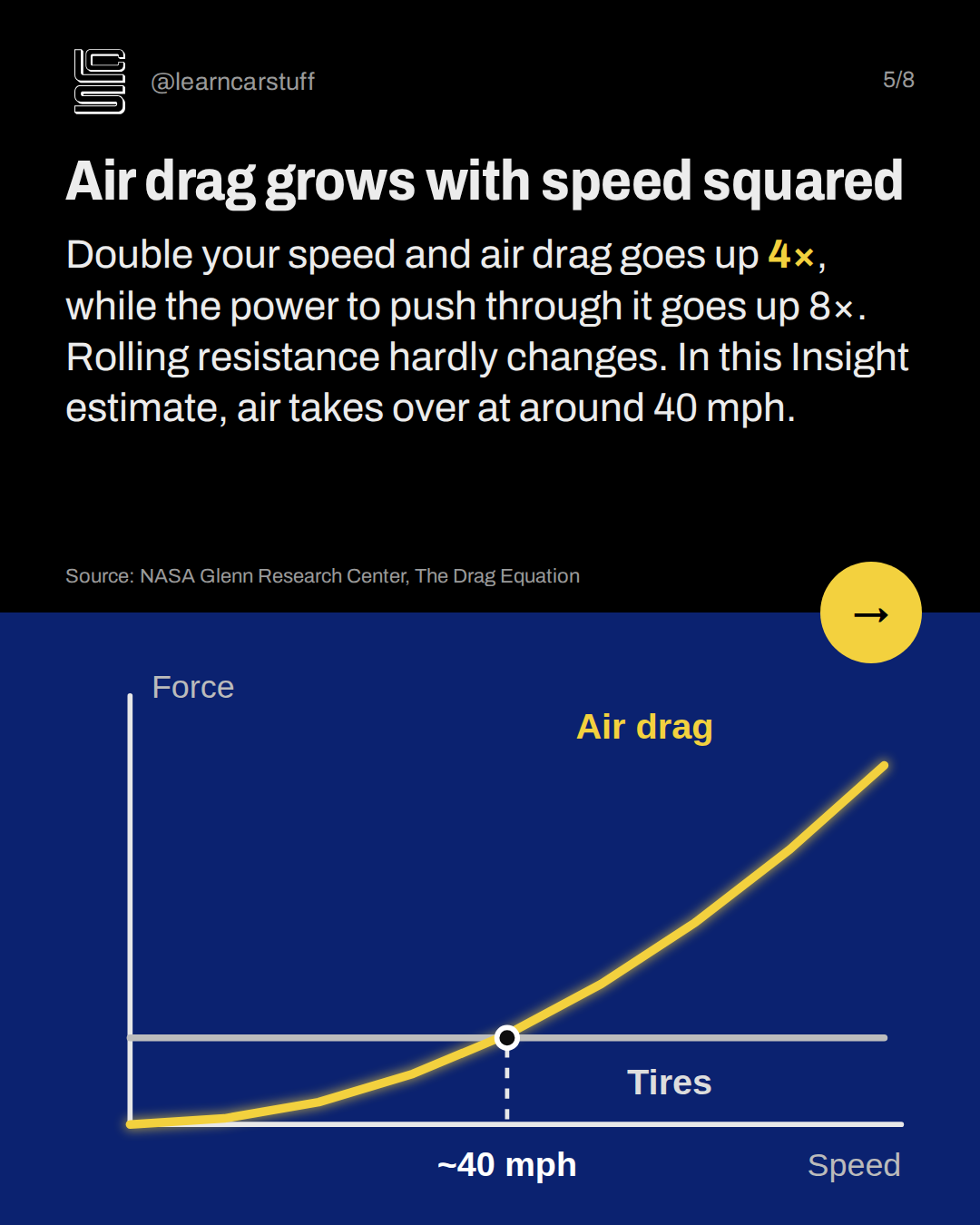
Double your speed and air drag goes up 4×, while the power to push through it goes up 8×. Rolling resistance hardly changes. In this Insight estimate, air takes over at around 40 mph.
Source: NASA Glenn Research Center, The Drag Equation
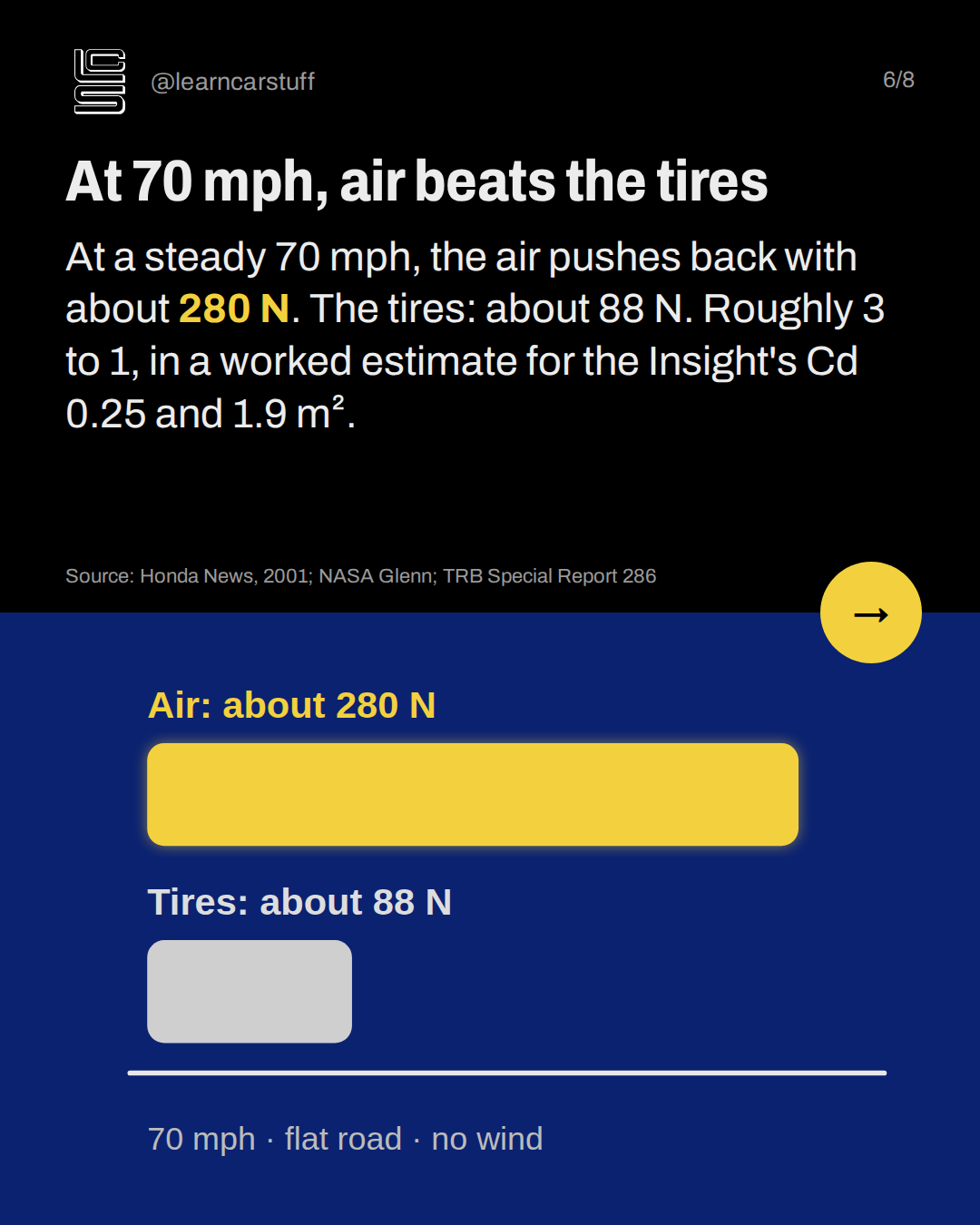
At 70 mph, air beats the tires
At a steady 70 mph, the air pushes back with about 280 N. The tires: about 88 N. Roughly 3 to 1, in a worked estimate for the Insight's Cd 0.25 and 1.9 m².
Source: Honda News, 2001; NASA Glenn; TRB Special Report 286
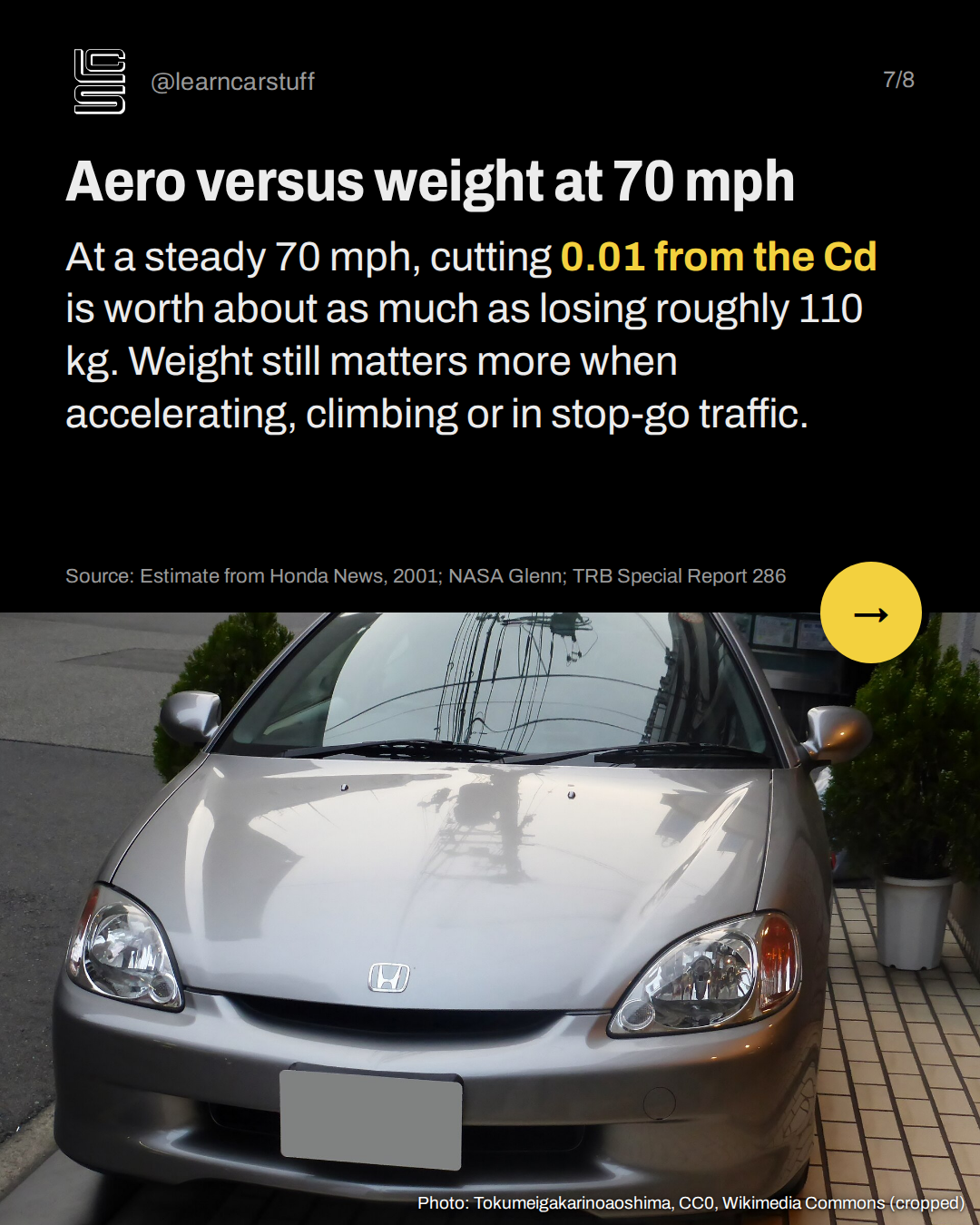
Aero versus weight at 70 mph
At a steady 70 mph, cutting 0.01 from the Cd is worth about as much as losing roughly 110 kg. Weight still matters more when accelerating, climbing or in stop-go traffic.
Source: Estimate from Honda News, 2001; NASA Glenn; TRB Special Report 286
Sources and assumptions
- Honda Global newsroom: INSIGHT launch release, 6 September 1999: Insight introduced 6 Sep 1999; Cd 0.25 (in-house test data), described as world-leading for a mass-produced vehicle; 820 kg (5MT model); 1.0-liter lean-burn VTEC engine; aluminum body ~40% lighter; on sale in Japan 1 Nov 1999, other markets from end of 1999; 35 km/L 10-15 mode (5MT) (checked 2026-10-16)
- Honda News (American Honda): Honda Insight Body and Interior (release dated 21 Feb 2001): Cd 0.25, 'one of the lowest of any mass-produced automobile in the world'; rear fender skirts and disc-shaped alloy wheels smooth airflow around the wheel openings; rear track 4.3 in narrower than the front; tapered teardrop roofline, Kamm back, flat underbody, low-drag mirrors, strakes; frontal area approx. 1.9 m²; Honda's statement that drag rises steeply with speed at highway speeds (checked 2026-10-16)
- NASA Glenn Research Center: The Drag Equation: D = Cd × ρ × V² × A / 2: drag scales with Cd, air density, reference area and the square of velocity (checked 2026-10-16)
- Transportation Research Board Special Report 286, Tires and Passenger Vehicle Fuel Economy (National Academies, 2006): Most new passenger tires have rolling resistance coefficients from 0.007 to 0.014 (SAE J1269/J2452) (checked 2026-10-16)
- US EPA / DOE fueleconomy.gov: 2000 Honda Insight: 2000 Honda Insight 1.0 L 3-cyl manual 5-speed: 49 city / 61 highway / 53 combined mpg (current EPA method) (checked 2026-10-16)
- Carscoops: Honda's 70 MPG fuel economy rating still reigns supreme after 25 years (Dec 2024, reporting Honda's 25th-anniversary statement): US launch December 1999; first mass-production hybrid sold in the US; original EPA label 61 city / 70 highway (pre-2008 method). Secondary source: use only with the attribution 'Honda says' (checked 2026-10-16)
Assumptions:
- Worked numbers use the Insight's published Cd 0.25 and frontal area of about 1.9 m² (Honda), air density 1.2 kg/m³ (sea level, about 20 °C), and a steady 70 mph (31.3 m/s) on a flat road with no wind.
- Mass 900 kg = Honda's 820 kg (Japanese 5MT) plus an 80 kg driver. The US curb weight is a little higher (about 1,850–1,880 lb), which changes the rolling figure by only a few percent.
- Rolling resistance coefficient 0.010, the middle of TRB's 0.007–0.014 range for new passenger tires. The Insight's low-rolling-resistance tires were likely at the lower end, which would make air an even bigger share.
- Drivetrain losses, accessory loads and the hybrid system are ignored. These are road-load forces at the wheels, not fuel use.
- 'Why only the rear wheels' is engineering reasoning (front wheels steer and need arch clearance), not a quoted Honda statement. Phrase it as the reason rear skirts are possible, not as Honda's words.
- Honda's 'rises exponentially' wording is not used. The physics is drag force ∝ speed² and power ∝ speed³.
Photos:
The short version
- Honda covered the rear wheels to cut drag
- Cd 0.25 was Honda's own measurement
- Air drag grows with speed squared
- Our 70 mph estimate: air beat tires roughly 3:1