 Learn Car Stuff
Why every C8 Corvette Stingray has a dry sump

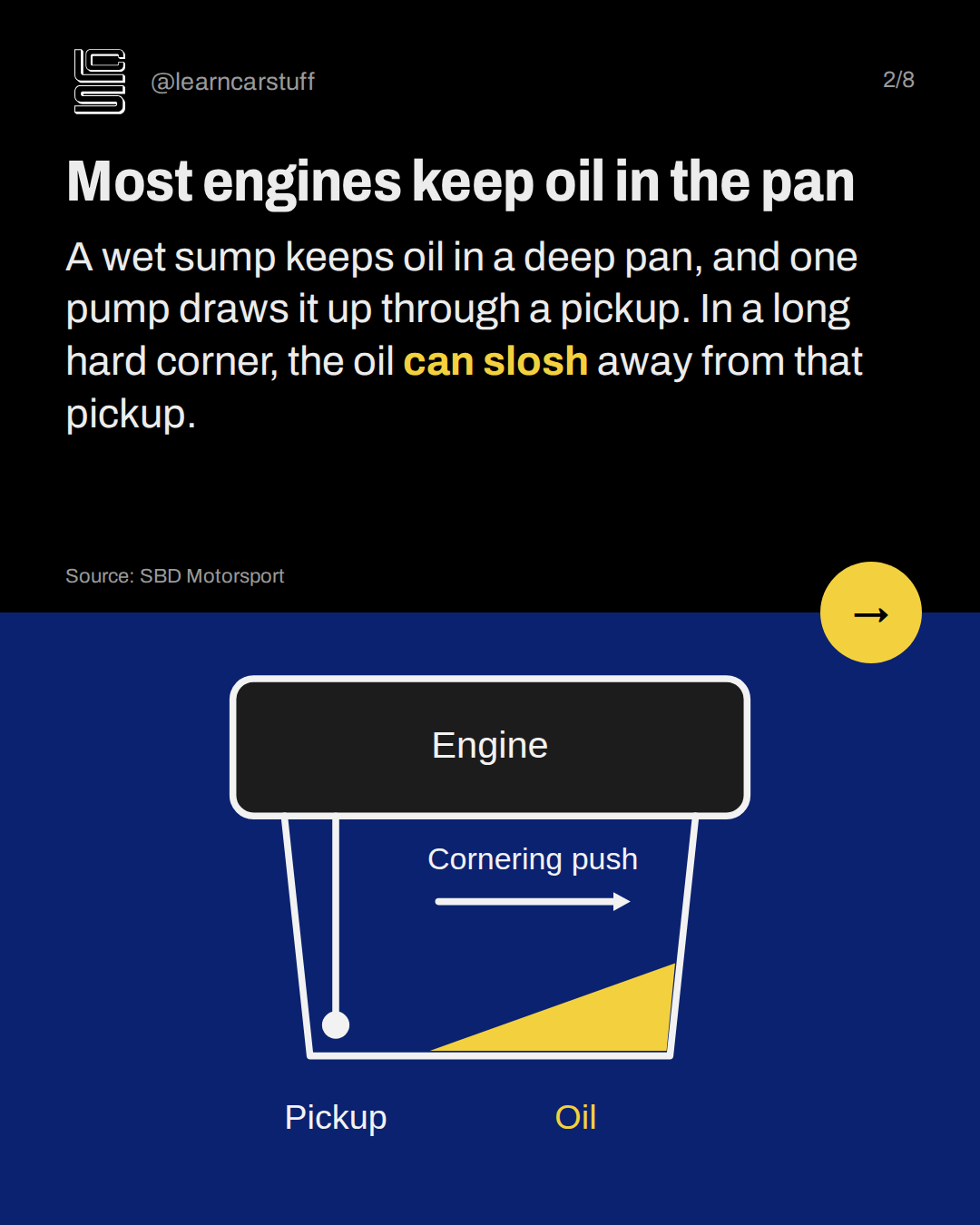
Most engines keep oil in the pan
A wet sump keeps oil in a deep pan, and one pump draws it up through a pickup. In a long hard corner, the oil can slosh away from that pickup.
Source: SBD Motorsport
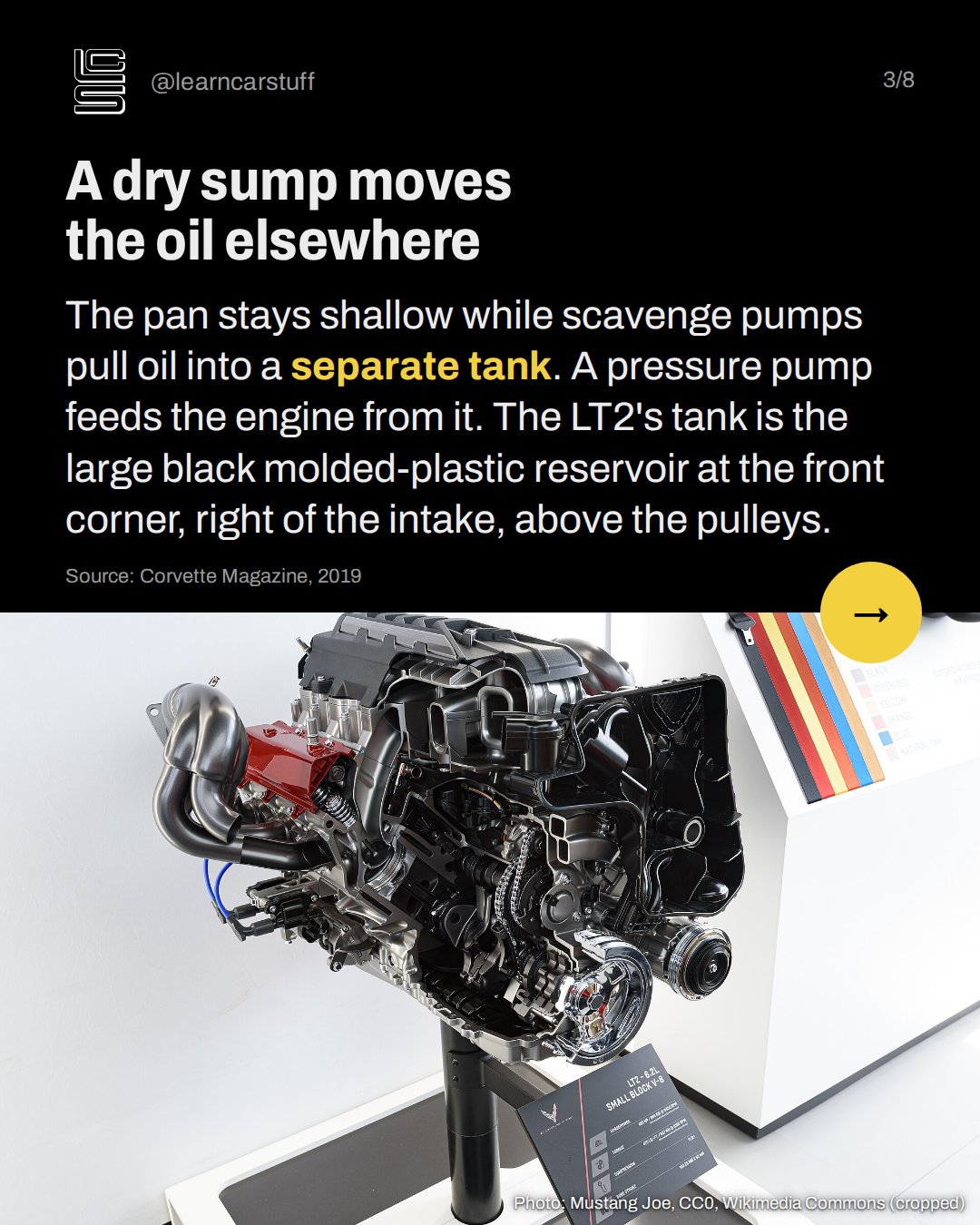
A dry sump moves the oil elsewhere
The pan stays shallow while scavenge pumps pull oil into a separate tank. A pressure pump feeds the engine from it. The LT2's tank is the large black molded-plastic reservoir at the front corner, right of the intake, above the pulleys.
Source: Corvette Magazine, 2019

Three scavenge pumps, standard
GM says the LT2 has three scavenge pumps and keeps the oil supply coming past 1g in all directions. That's GM's claim, not an independent test.
Source: Chevrolet press release, Nov 2019
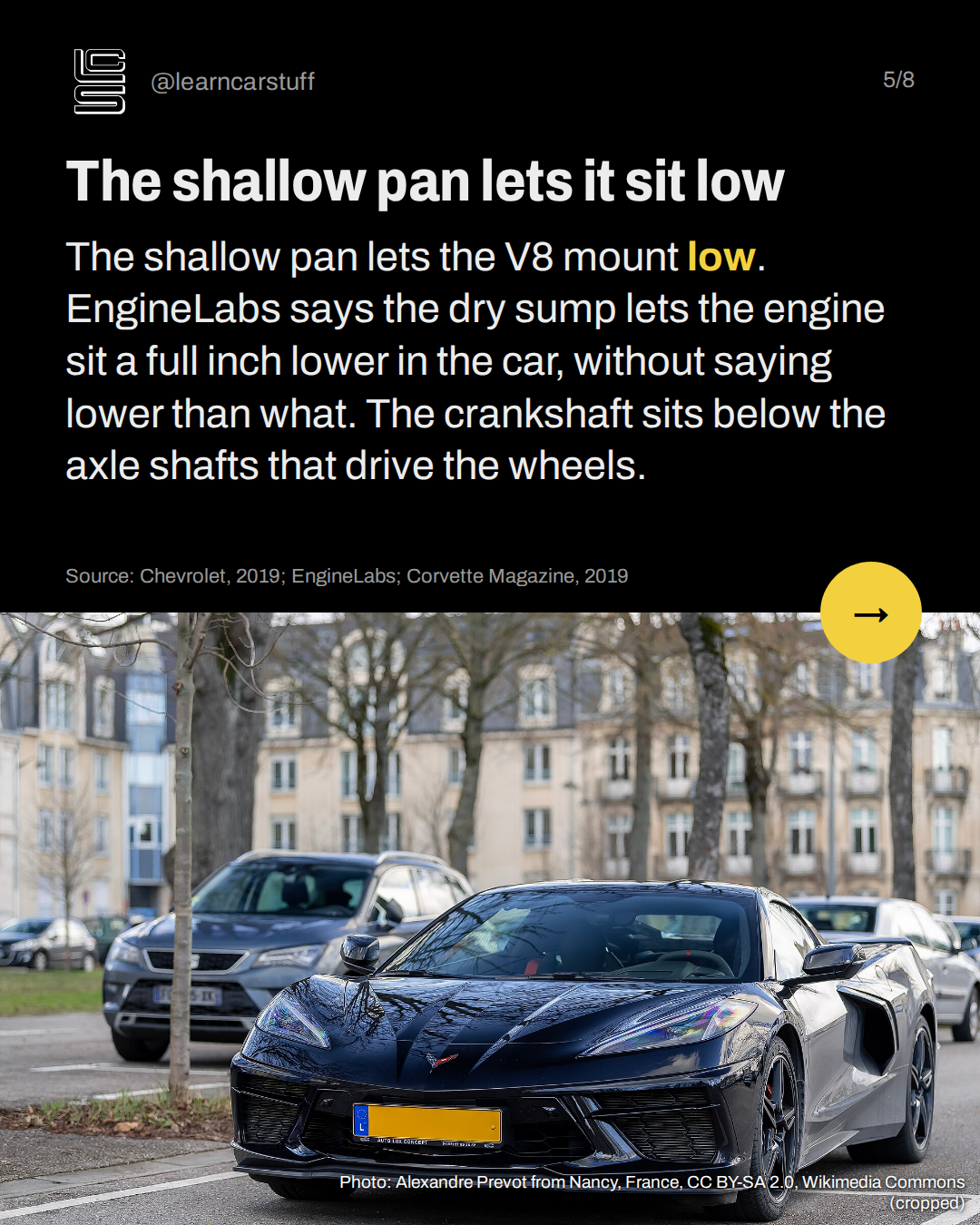
The shallow pan lets it sit low
The shallow pan lets the V8 mount low. EngineLabs says the dry sump lets the engine sit a full inch lower in the car, without saying lower than what. The crankshaft sits below the axle shafts that drive the wheels.
Source: Chevrolet, 2019; EngineLabs; Corvette Magazine, 2019
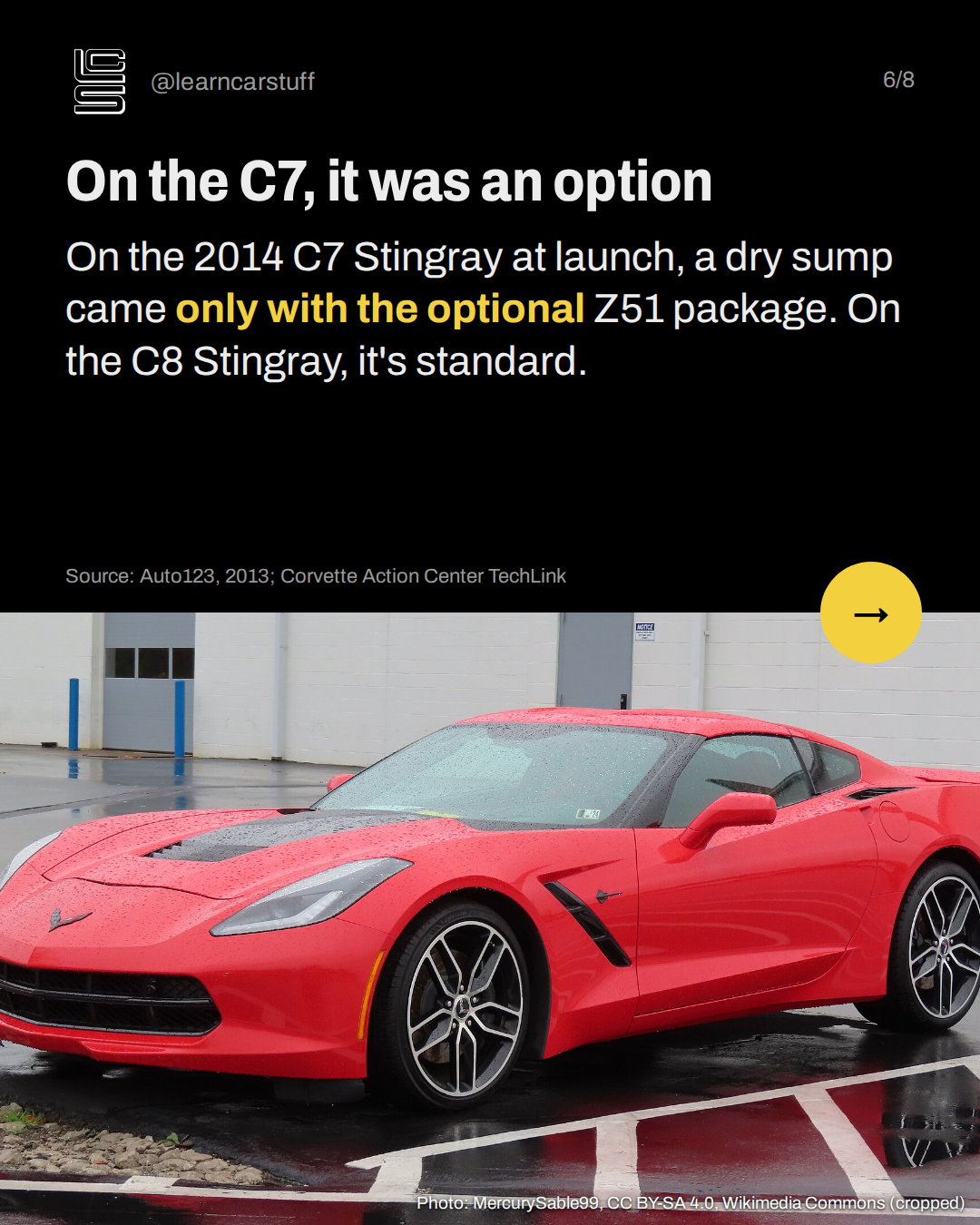
On the C7, it was an option
On the 2014 C7 Stingray at launch, a dry sump came only with the optional Z51 package. On the C8 Stingray, it's standard.
Source: Auto123, 2013; Corvette Action Center TechLink
The old design trapped oil in the block
With Corvette's previous dry-sump design, up to three quarts of oil could get trapped in the block. The LT2 adds a third scavenge pump in the engine's valley to pull it out.
Source: Corvette Magazine, 2019
Sources and assumptions
- Chevrolet press release 'Chevrolet confirms 2020 Stingray quickest in its history' (6 Nov 2019), reprinted by Automotive World: 'The standard engine-mounted dry sump oil system boasts three scavenge pumps'; supply 'even at lateral acceleration levels exceeding 1g in all directions'; 'very low-profile oil pan… allows the engine to be mounted low in the vehicle for a low centre of gravity'; LT2 SAE-certified at 495 hp / 470 lb-ft (with performance exhaust) (checked 2026-10-15)
- Corvette Magazine, 'Inside the LT2', Don Sherman, Issue 134 (7 Nov 2019): Dry sump added to reduce oil starvation in flat-out track use; up to three quarts could be trapped in the block; a cam-driven scavenge pump in the valley plus two crank-driven scavenge pumps in the shallow aluminium pan and a two-stage pressure pump; molded-plastic reservoir bolted to the block's left-front corner; crankshaft centerline below the transaxle half-shaft axis (checked 2026-10-15)
- EngineLabs, 'The New 2020 Corvette LT2 Engine — More Of The Same, But Different': Dry sump lets the engine sit a full inch lower; 490 hp @ 6,450 rpm / 465 lb-ft @ 5,150 standard exhaust, 495 hp / 470 lb-ft with the Z51 performance exhaust; 7.5 quarts 0W-40 dexos (checked 2026-10-15)
- Auto123, '2014 Chevrolet Corvette Stingray preview', Justin Pritchard (9 Apr 2013): On the 2014 C7 Stingray, the dry-sump oiling system came as part of the optional Z51 Performance Package (with an eLSD and brake, differential and transmission cooling) (checked 2026-10-15)
- Supercars.net, 'Stingray returns: 2014 Chevrolet Corvette' (17 Jan 2013, based on Chevrolet's launch release): 'Track-capable Z51 Performance Package including: an electronic limited-slip differential, dry-sump oiling system, integral brake, differential and transmission cooling' (checked 2026-10-15)
- Corvette Action Center, 2014 Corvette TechLink article (GM dealer TechLink reprint): 'Z51 Performance Package models use the dry sump oil system' (C7), meaning non-Z51 C7 Stingrays did not (checked 2026-10-15)
- SBD Motorsport, 'Advantages of dry sump over wet sump': General mechanism: wet-sump oil (a thin 1–3 inch layer) sloshes in corners and threatens pump supply; a dry sump scavenges the pan into a tall tank that feeds a pressure stage; lets the engine be mounted low (checked 2026-10-15)
Assumptions:
- '$2,800' is the Z51 package's 2014 launch price as quoted in contemporary coverage of Chevrolet's release (search summary). Drop it if the writer can't cite it; the option status itself is verified.
- 'About an inch lower' comes from EngineLabs, not a GM document. GM itself says only 'mounted low… for a low centre of gravity'.
- The 1g claim is GM's own wording ('exceeding 1g in all directions'), not an independent test.
- The wet-sump slosh mechanism is general engineering (SBD Motorsport). It says oil starvation can happen in long hard corners, not that it happens on every wet-sump car.
- Whether the C8 is the first base Corvette ever with a standard dry sump was not verified. Say 'C7 Stingray: optional (Z51); C8 Stingray: standard', not 'a first'.
Photos:
- Photo: Don DeBold, CC BY 2.0, Wikimedia Commons (cropped)
- Photo: Mustang Joe, CC0, Wikimedia Commons (cropped)
- Photo: OWS Photography, CC BY 4.0, Wikimedia Commons (cropped)
- Photo: Alexandre Prevot from Nancy, France, CC BY-SA 2.0, Wikimedia Commons (cropped)
- Photo: MercurySable99, CC BY-SA 4.0, Wikimedia Commons (cropped)
The short version
- A wet sump can slosh oil away.
- A dry sump pumps oil to a separate tank.
- The C8 Stingray's LT2 has one as standard.
- On the 2014 C7 Stingray, it needed Z51.