 Learn Car Stuff
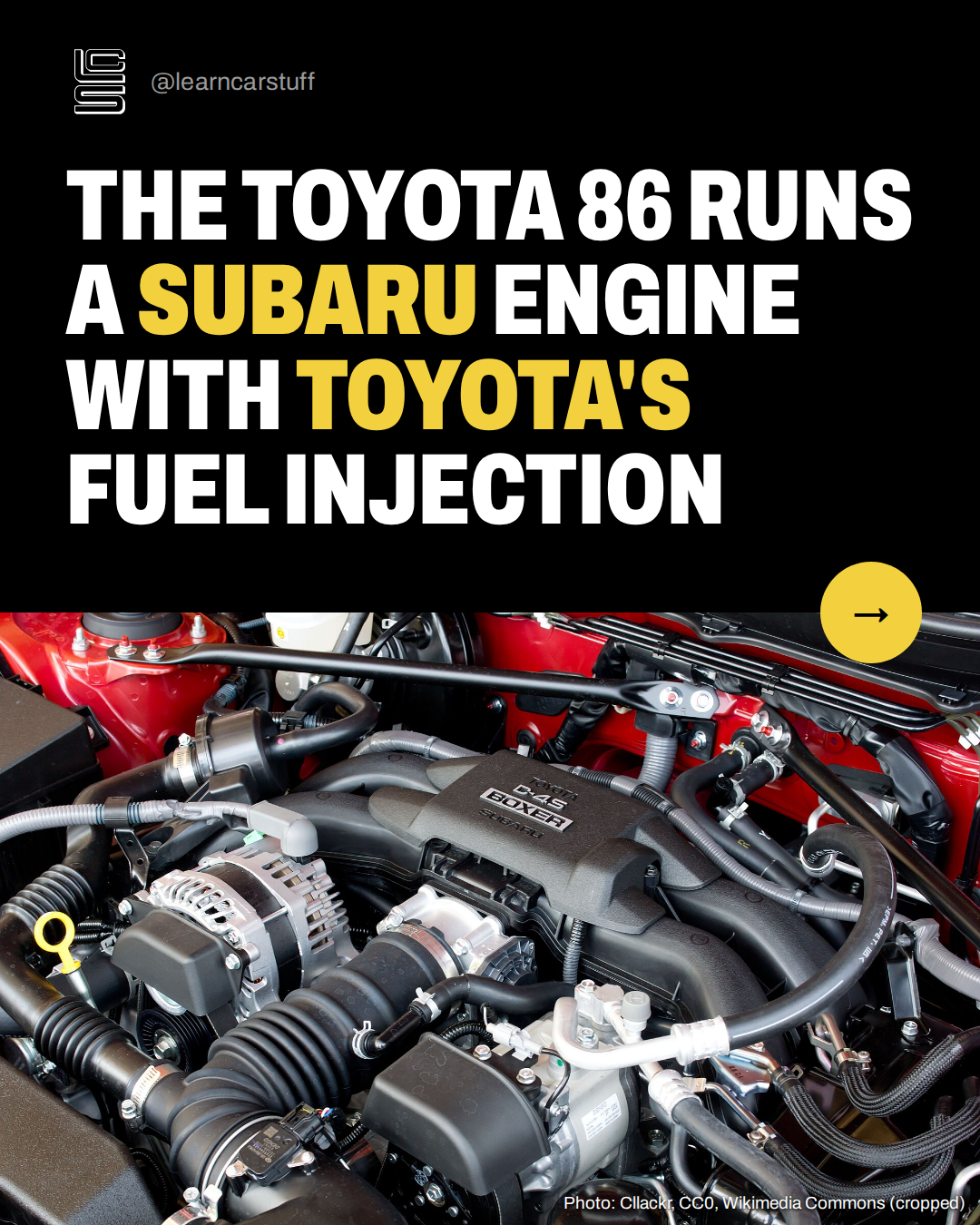
The Toyota 86 runs a Subaru engine with Toyota's fuel injection
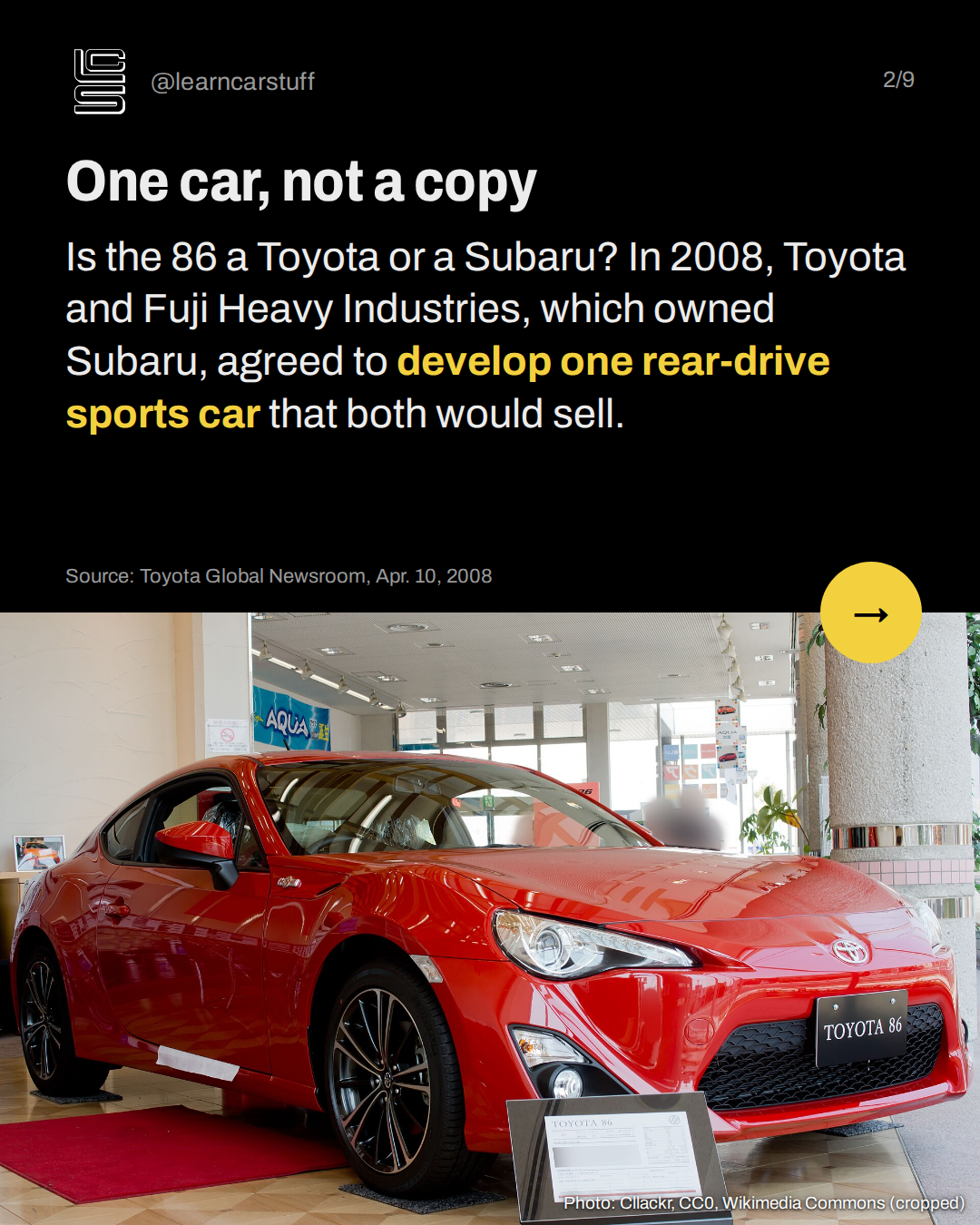
One car, not a copy
Is the 86 a Toyota or a Subaru? In 2008, Toyota and Fuji Heavy Industries, which owned Subaru, agreed to develop one rear-drive sports car that both would sell.
Source: Toyota Global Newsroom, Apr. 10, 2008
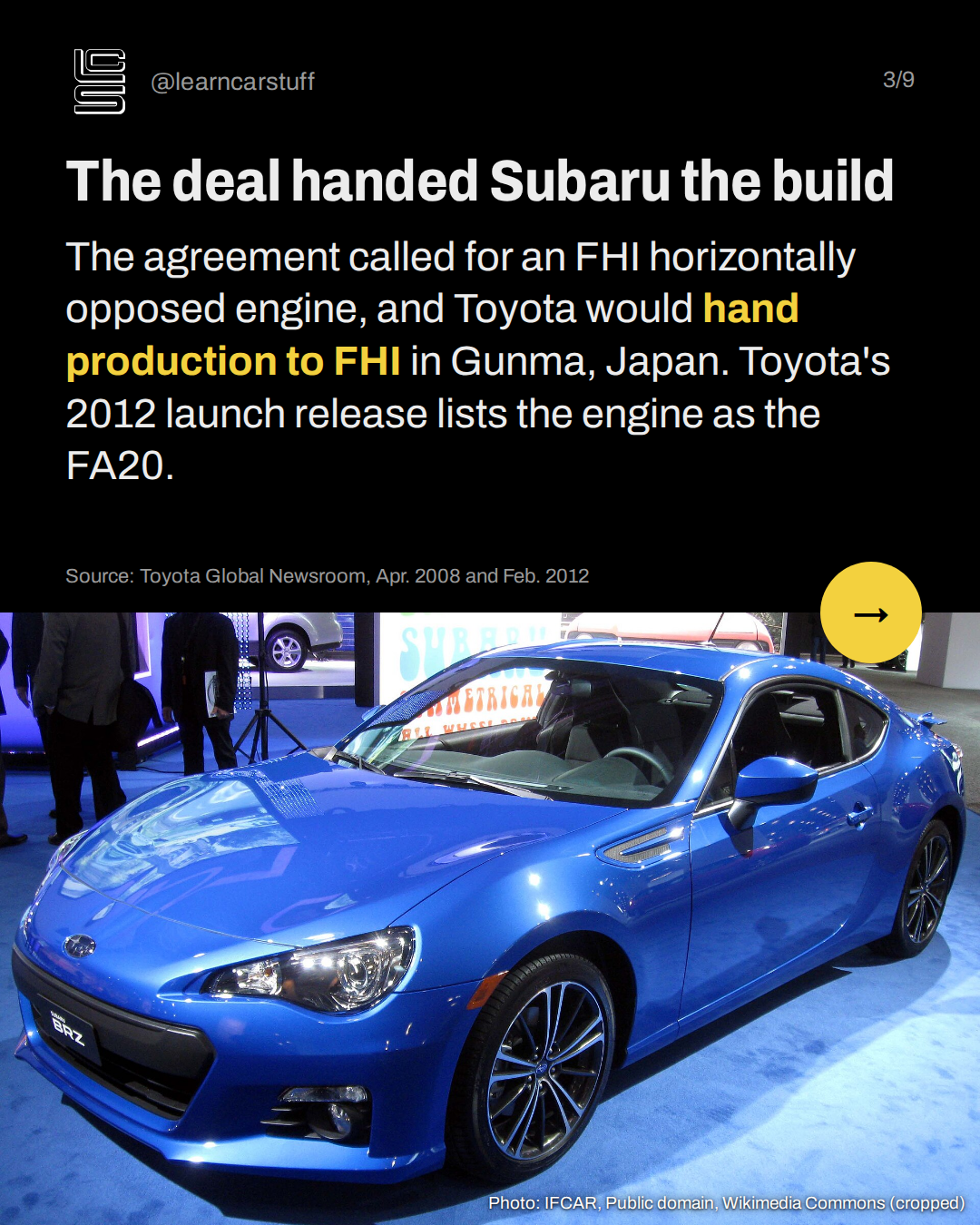
The deal handed Subaru the build
The agreement called for an FHI horizontally opposed engine, and Toyota would hand production to FHI in Gunma, Japan. Toyota's 2012 launch release lists the engine as the FA20.
Source: Toyota Global Newsroom, Apr. 2008 and Feb. 2012
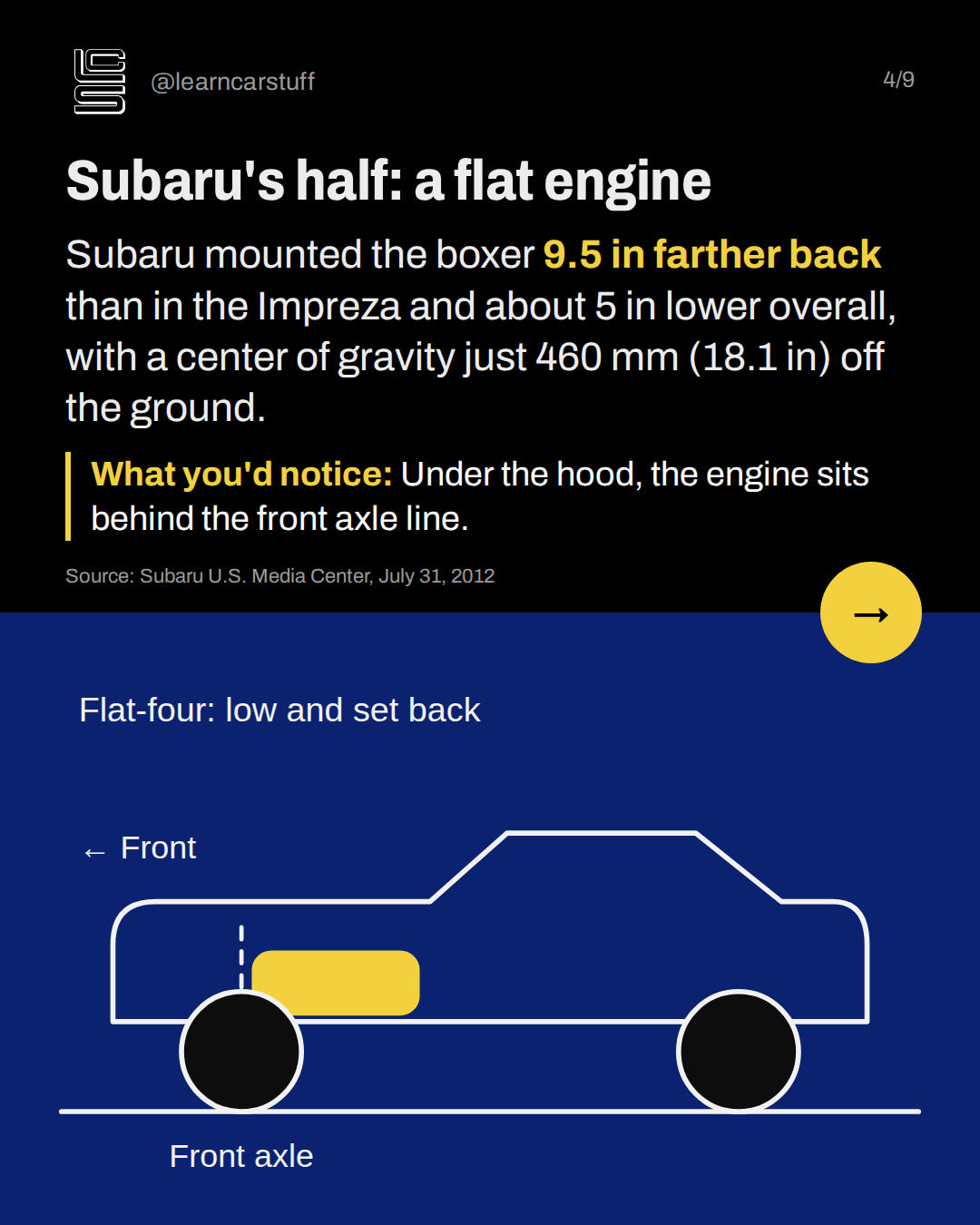
Subaru's half: a flat engine
Subaru mounted the boxer 9.5 in farther back than in the Impreza and about 5 in lower overall, with a center of gravity just 460 mm (18.1 in) off the ground.
What you'd notice: Under the hood, the engine sits behind the front axle line.
Source: Subaru U.S. Media Center, July 31, 2012
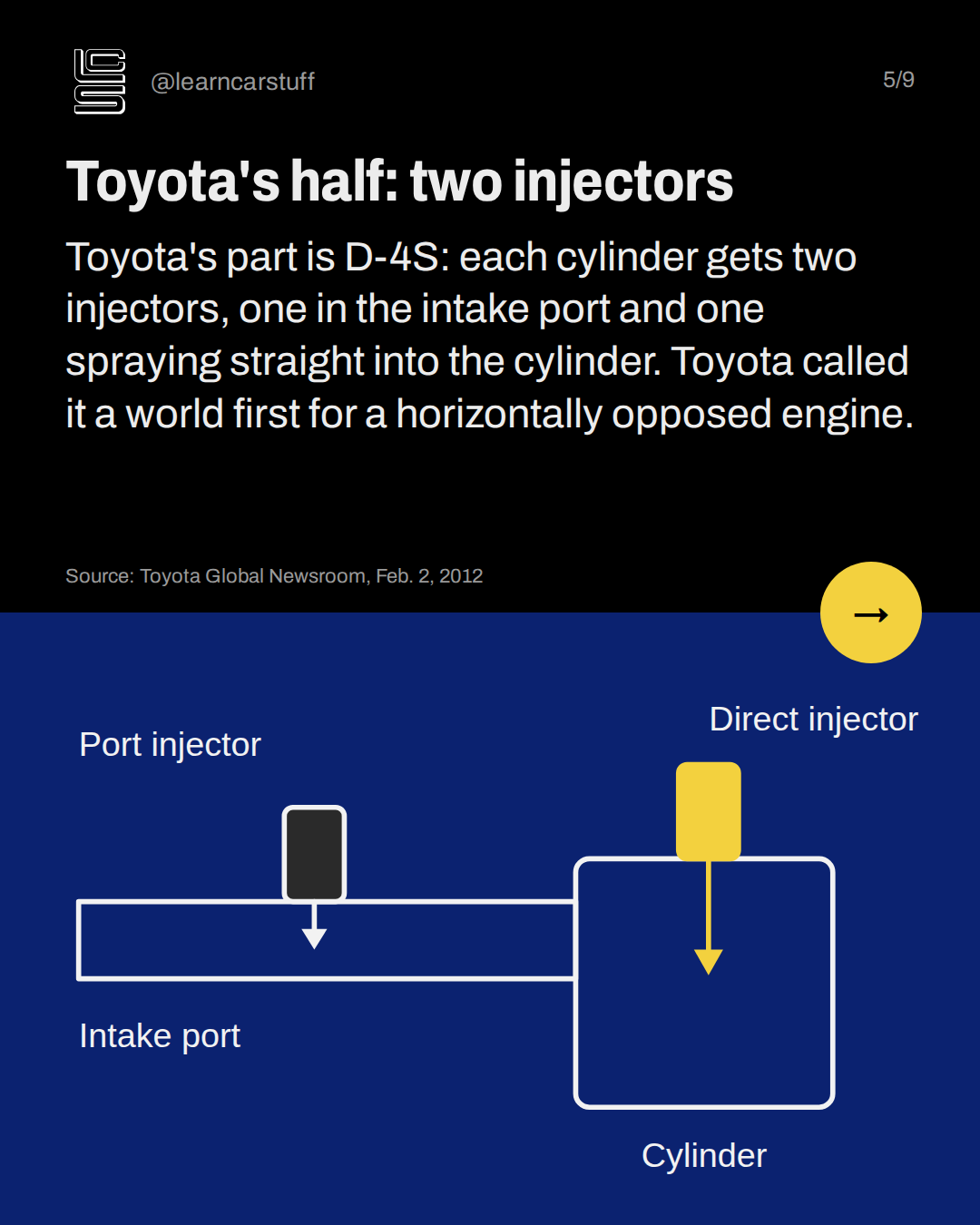
Toyota's half: two injectors
Toyota's part is D-4S: each cylinder gets two injectors, one in the intake port and one spraying straight into the cylinder. Toyota called it a world first for a horizontally opposed engine.
Source: Toyota Global Newsroom, Feb. 2, 2012
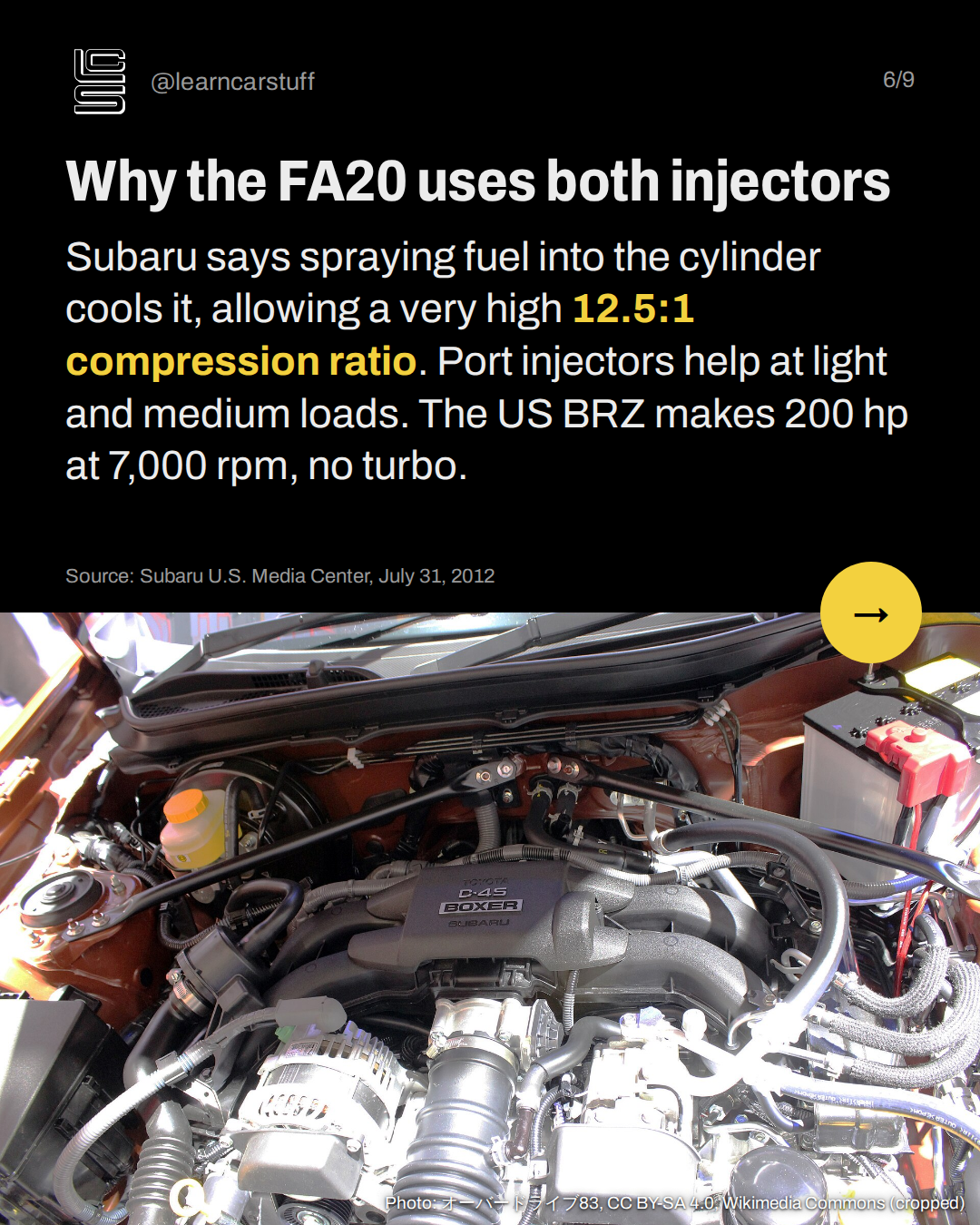
Why the FA20 uses both injectors
Subaru says spraying fuel into the cylinder cools it, allowing a very high 12.5:1 compression ratio. Port injectors help at light and medium loads. The US BRZ makes 200 hp at 7,000 rpm, no turbo.
Source: Subaru U.S. Media Center, July 31, 2012
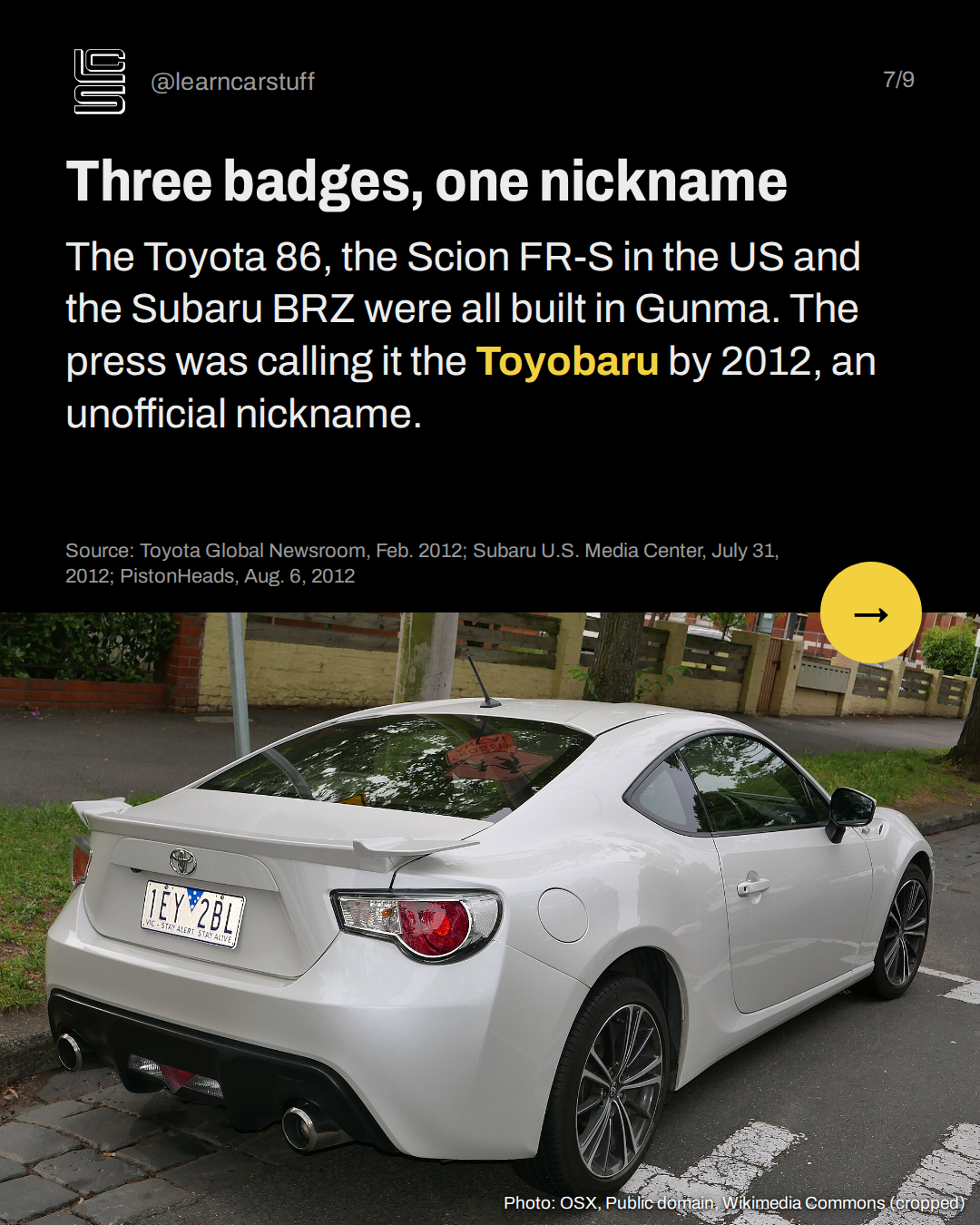
Three badges, one nickname
The Toyota 86, the Scion FR-S in the US and the Subaru BRZ were all built in Gunma. The press was calling it the Toyobaru by 2012, an unofficial nickname.
Source: Toyota Global Newsroom, Feb. 2012; Subaru U.S. Media Center, July 31, 2012; PistonHeads, Aug. 6, 2012
Where the name 86 comes from
Toyota named the car after the 1983–87 AE86 Corolla Levin and Sprinter Trueno. The bore and stroke also happen to measure 86.0 mm, though Toyota doesn't give that as the reason.
Source: Toyota Global Newsroom, Feb. 2, 2012
Sources and assumptions
- Toyota Global Newsroom: TMC, Daihatsu and FHI agree to expand collaboration (Apr. 10, 2008): TMC and FHI agreed to jointly develop a compact rear-wheel-drive sports car marketed by both, powered by 'an FHI core-technology horizontally-opposed engine'; production at a new plant at FHI's Gunma Manufacturing Division; 'TMC will consign production to FHI'; target end of 2011 (checked 2026-10-15)
- Toyota Global Newsroom: TMC to Launch Compact Sports Car '86' in Japan in April (Feb. 2, 2012): Engine listed as 'FA20 (2-liter)'; 'world's first horizontally opposed D-4S (direct injection four-stroke gasoline engine, superior version) engine installed front mid-ship'; 200 PS; center of gravity 460 mm; assembly plant 'Main Plant, Gunma Manufacturing Division, Fuji Heavy Industries Ltd.'; named after the AE86 Corolla Levin/Sprinter Trueno (1983-1987) (checked 2026-10-15)
- Toyota Global Newsroom: TMC to Exhibit '86' Sports Car at Tokyo Motor Show (Nov. 27, 2011): World's first horizontally opposed D-4S engine 'created by combining Subaru's engine technology with Toyota's cutting-edge D-4S direct injection technology'; developed with Fuji Heavy Industries (owners of the Subaru brand); 12.5 compression; 200 PS; 86 x 86 bore/stroke (checked 2026-10-15)
- Subaru U.S. Media Center: Subaru unveils Subaru BRZ (Nov. 28, 2011): BRZ 'developed as a joint-project between Subaru and Toyota Motor Corporation'; 'Toyota's direct injection and port injection technology D-4S was incorporated in the BRZ's power unit'; 2.0 L, 86 x 86 mm, 200 PS/200 hp, 205 Nm/151 lb-ft; boxer positioned lower than in other Subaru models (checked 2026-10-15)
- Subaru U.S. Media Center: 2013 Subaru BRZ marks return of the pure sports car (July 31, 2012): FA-series 2.0 L boxer engineered specifically for the BRZ and not shared with other Subaru models; combines direct and port injection; direct injection 'provides a cooling effect in the cylinders. That enables use of a very high 12.5:1 compression ratio'; 'In light- and medium-load conditions, the port fuel injectors help produce precise combustion'; 200 hp @ 7,000 rpm, 151 lb-ft @ 6,400 rpm, 7,400 rpm redline; engine 9.5 in farther back than in the Impreza and about 5 in lower overall; CG 18.1 in; built at Subaru's Gunma, Japan plant (checked 2026-10-15)
- Toyota Pressroom (US): 2013 Scion FR-S brings the sport back to the car (Nov. 30, 2011): US version sold as the Scion FR-S; joint development combining 'Subaru's newly developed horizontally opposed engine and Toyota's cutting edge D-4S injection system that incorporates both direct and port injection'; 12.5:1; 200 hp, 151 lb-ft; 1,998 cc; boxer mounted mid-ship and extremely low; 53:47 front-to-rear weight (checked 2026-10-15)
- Toyota UK Media: More passion, more fun: Toyota recaptures the joy of driving (GT 86, 27 Nov 2011): Engine is 'the result of a joint Toyota and Subaru development programme'; separate twin injectors for direct and port injection; 1,998 cc, 12.5:1; equal bore and stroke of 86.0 mm; centre of gravity 460 mm; 53:47; 197 bhp (UK rating) at 7,000 rpm; inspired by the AE86 (checked 2026-10-15)
- PistonHeads: Toyota GT 86 meets Toyota Sports 800 (Dan Trent, 6 Aug 2012): The press used the 'Toyobaru' nickname by 2012: 'the car formerly known as the Toyobaru' (checked 2026-10-15)
- Subaru U.S. Media Center: Subaru BRZ's FA20 Boxer engine named Ward's 10 Best (Dec. 13, 2012): FA20 named to Ward's 2013 10 Best Engines; square 86 x 86 mm; combined with Toyota's direct and port injection; 100 PS per liter without a turbo (checked 2026-10-15)
Assumptions:
- The post covers the first generation (2012 launch: Toyota 86/GT86, Scion FR-S, Subaru BRZ). The 2021-on GR86/BRZ uses a different 2.4 L engine and is out of scope.
- Power is quoted per market: 200 PS (Japan), 200 hp and 151 lb-ft (US FR-S/BRZ), 197 bhp (UK GT 86 rating). Slides use the US figures and say so.
- The 7,400 rpm redline and the 6,400 rpm torque peak come from Subaru's US 2013 BRZ release. Toyota's FR-S release gives torque at 6,600 rpm, so the slide should quote one source's figure and name it.
- The detailed D-4S strategy (exactly which injector runs at which speed and load) varies between secondary sources. The post states only what Subaru's release says: direct injection cools the cylinder and allows 12.5:1, and port injectors help at light and medium loads.
- The 'Toyobaru' nickname is fan and press slang, not an official name. The record proves it was in print by Aug 2012.
- Toyota's release names the AE86 as the source of the '86' name. The 86.0 mm bore and stroke is a matching fact, not a stated reason for the name.
Photos:
The short version
- One car, built at Subaru's Gunma plant
- Subaru's FA20 flat-four sits low and far back
- Toyota's D-4S gives each cylinder two injectors
- Subaru says direct injection allows 12.5:1 compression