 Learn Car Stuff
Why the original Mini's gearbox lives in its oil sump

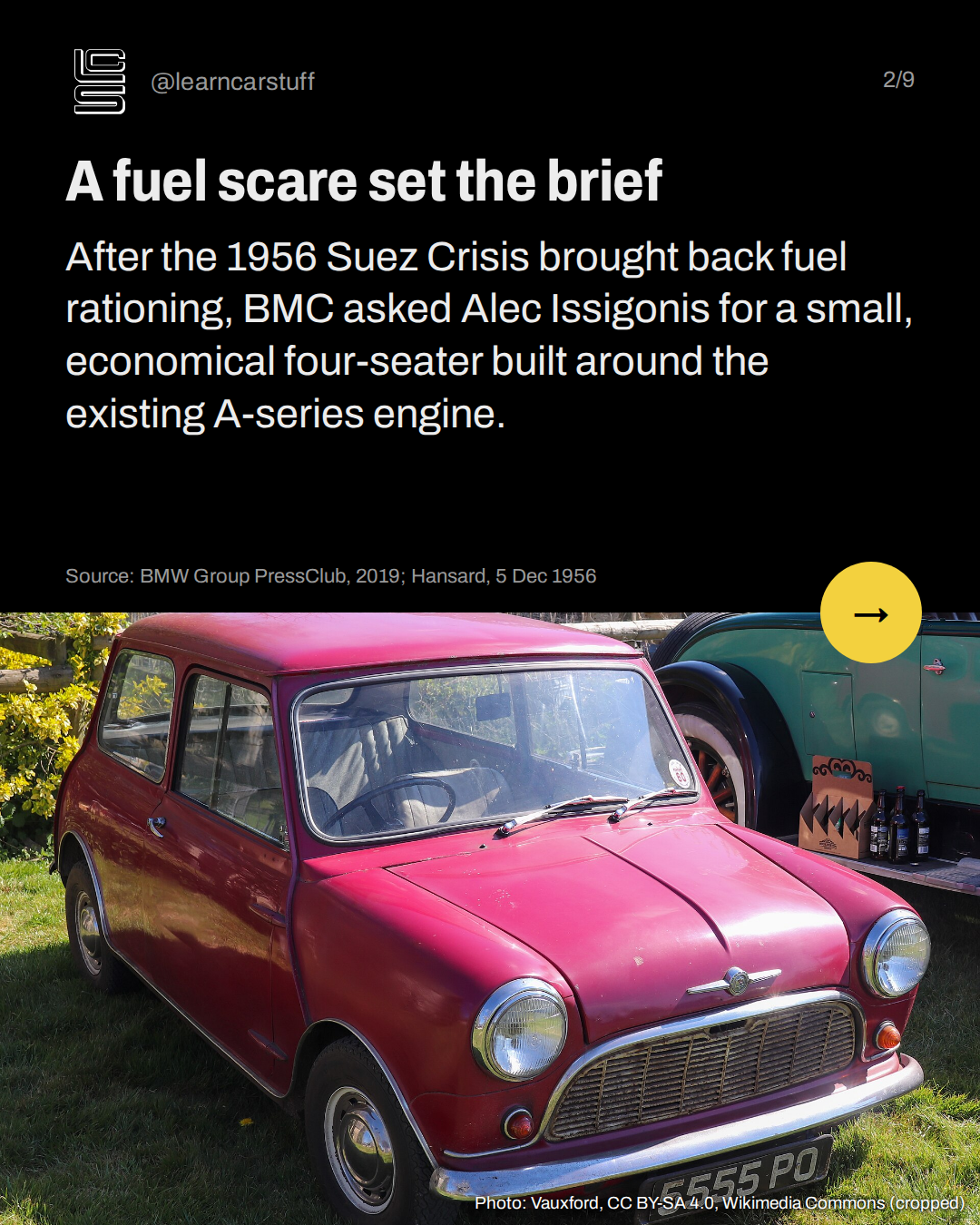
A fuel scare set the brief
After the 1956 Suez Crisis brought back fuel rationing, BMC asked Alec Issigonis for a small, economical four-seater built around the existing A-series engine.
Source: BMW Group PressClub, 2019; Hansard, 5 Dec 1956
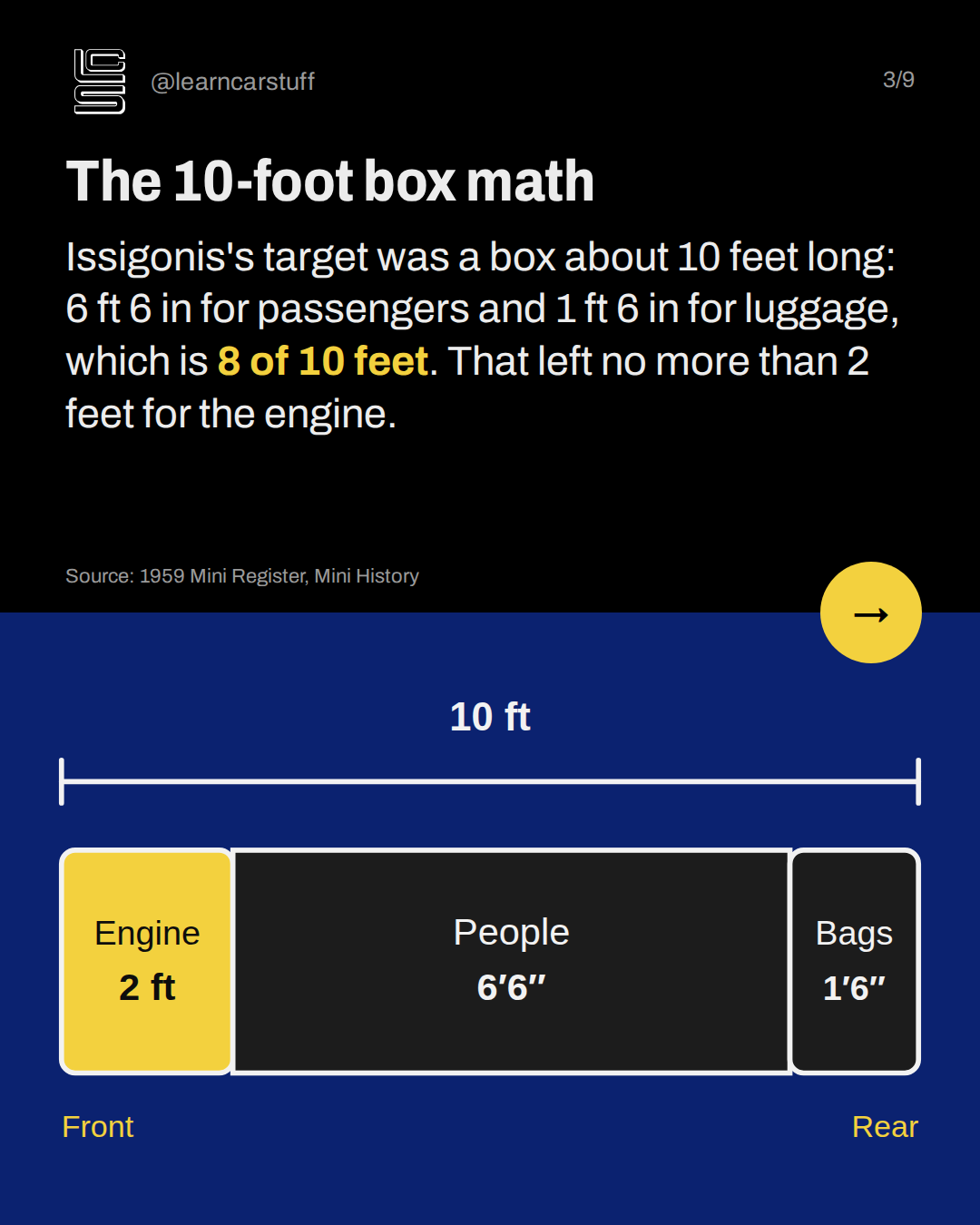
The 10-foot box math
Issigonis's target was a box about 10 feet long: 6 ft 6 in for passengers and 1 ft 6 in for luggage, which is 8 of 10 feet. That left no more than 2 feet for the engine.
Source: 1959 Mini Register, Mini History
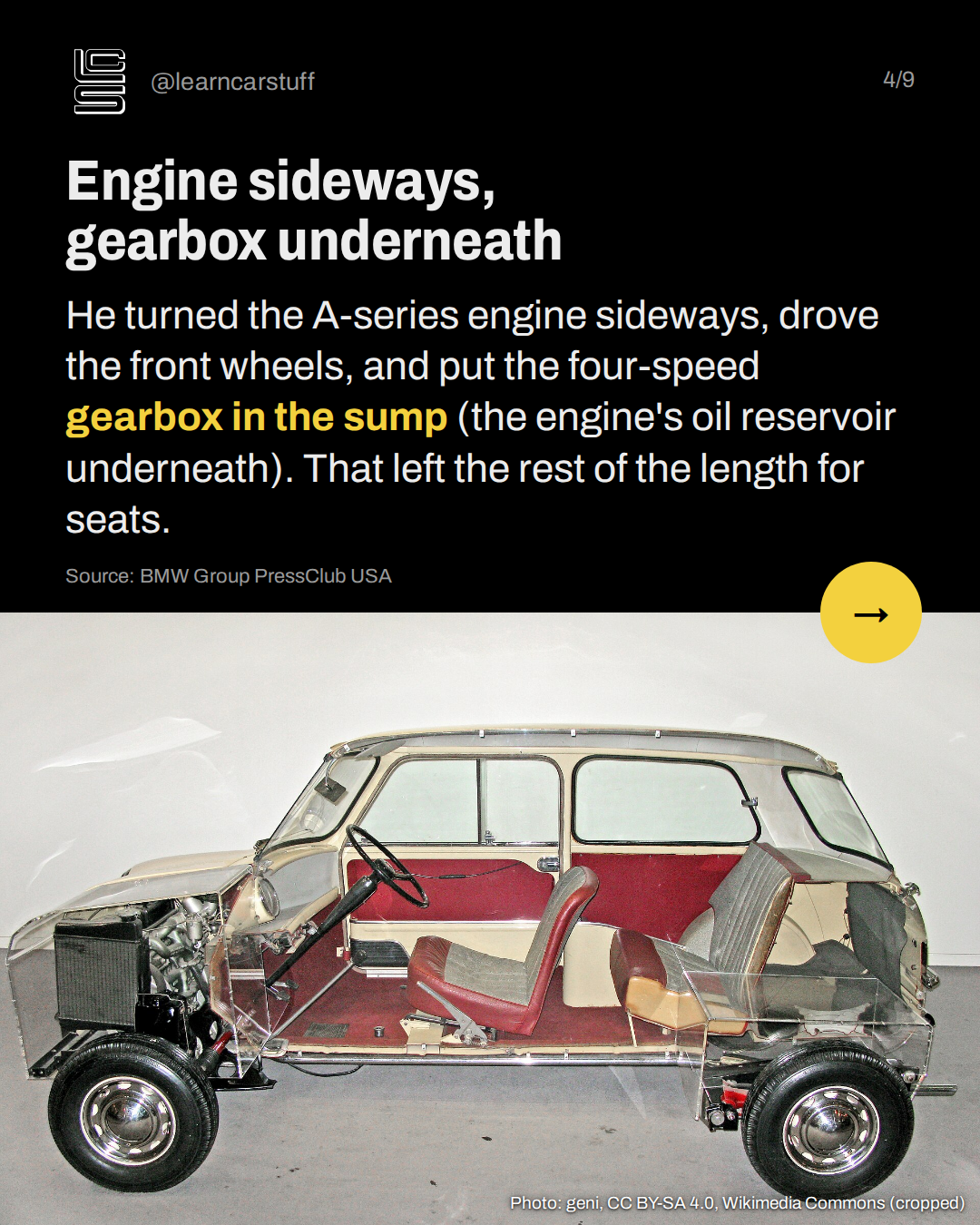
Engine sideways, gearbox underneath
He turned the A-series engine sideways, drove the front wheels, and put the four-speed gearbox in the sump (the engine's oil reservoir underneath). That left the rest of the length for seats.
Source: BMW Group PressClub USA
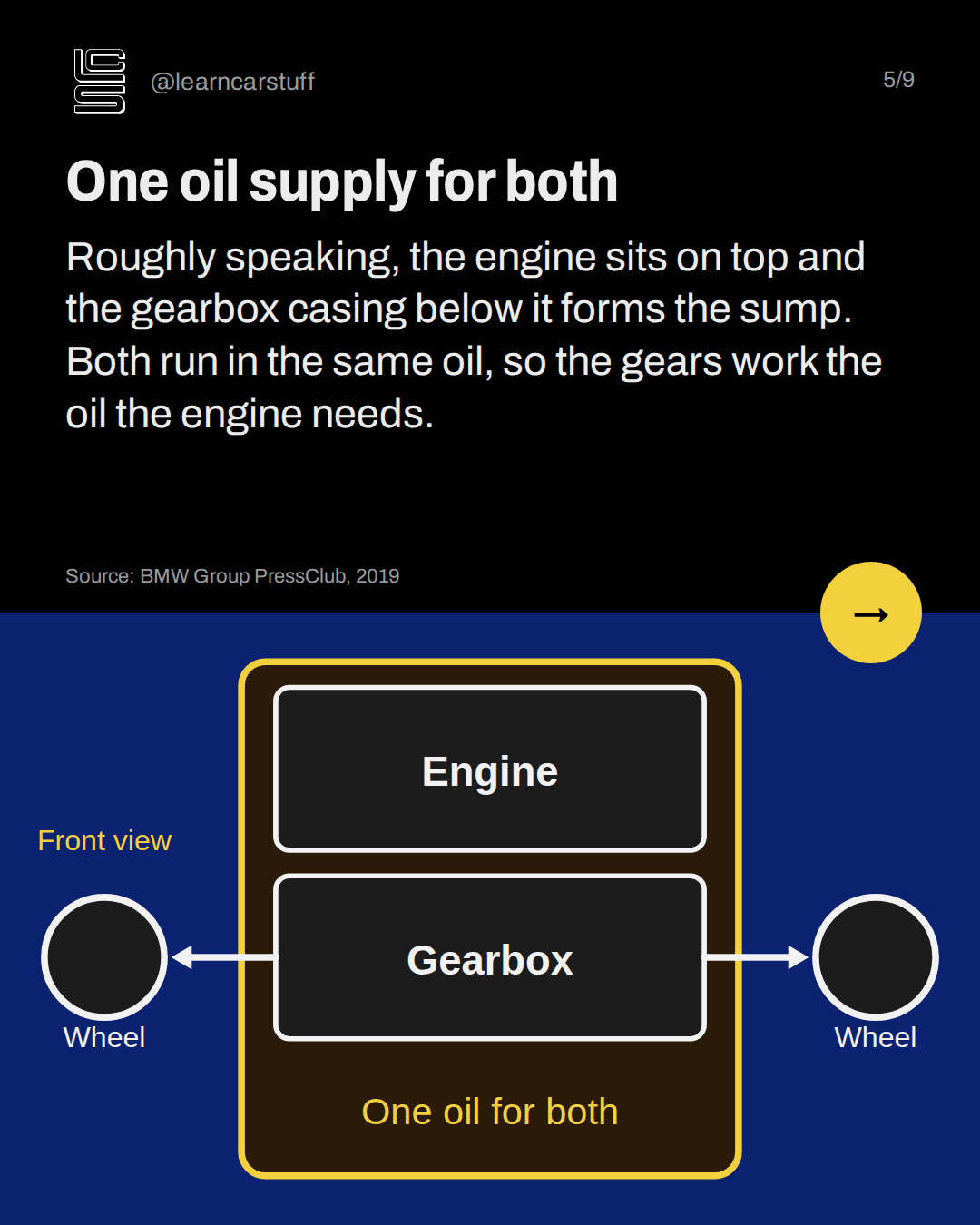
One oil supply for both
Roughly speaking, the engine sits on top and the gearbox casing below it forms the sump. Both run in the same oil, so the gears work the oil the engine needs.
Source: BMW Group PressClub, 2019
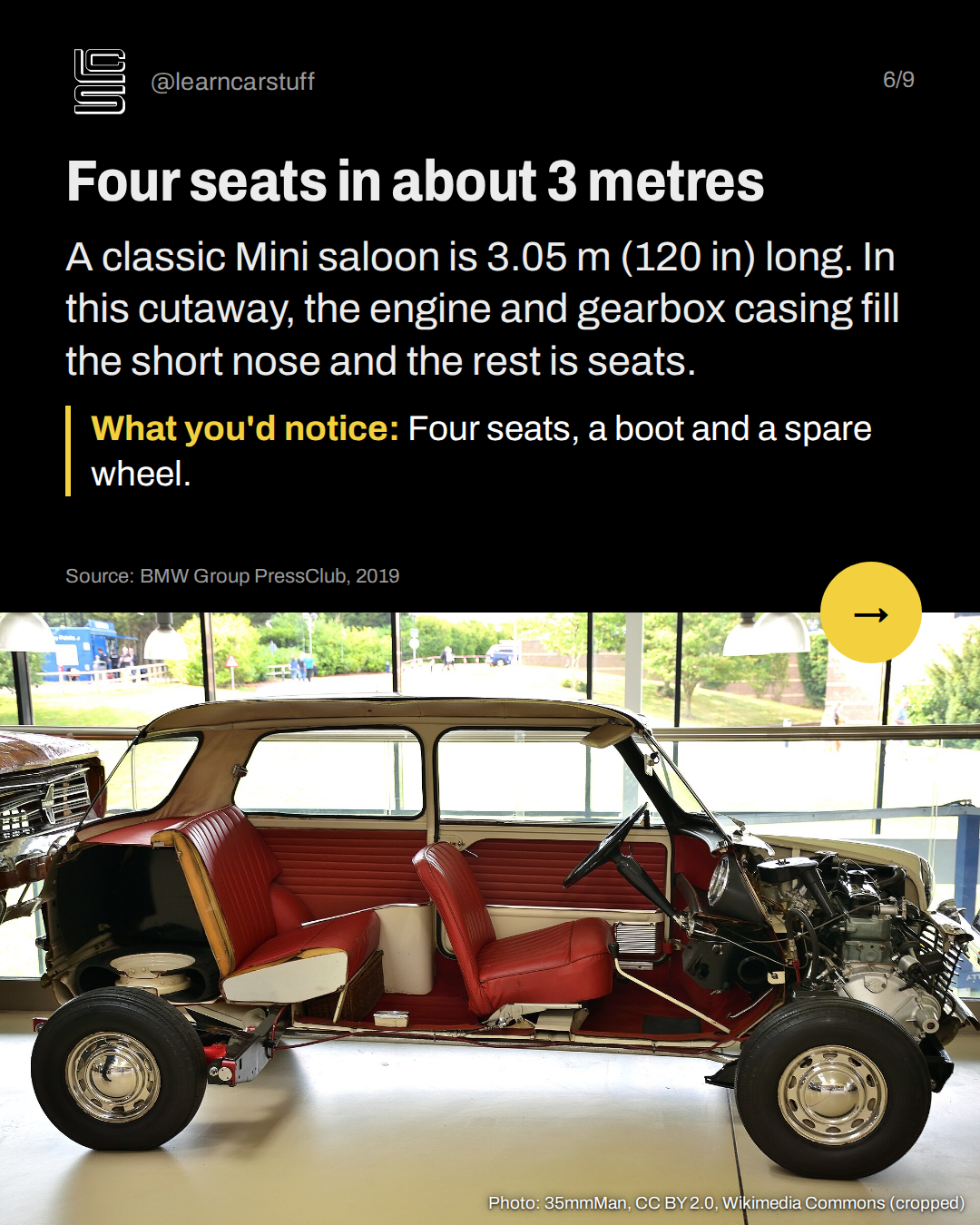
Four seats in about 3 metres
A classic Mini saloon is 3.05 m (120 in) long. In this cutaway, the engine and gearbox casing fill the short nose and the rest is seats.
What you'd notice: Four seats, a boot and a spare wheel.
Source: BMW Group PressClub, 2019
The catch is the oil
The gears work the engine's oil, so classic Mini buying guides say to change it at least every 6,000 miles; every 3,000 is better. Fiat's Dante Giacosa later put the gearbox beside the engine instead.
Source: Motorious, 2017; Driven to Write, 2023
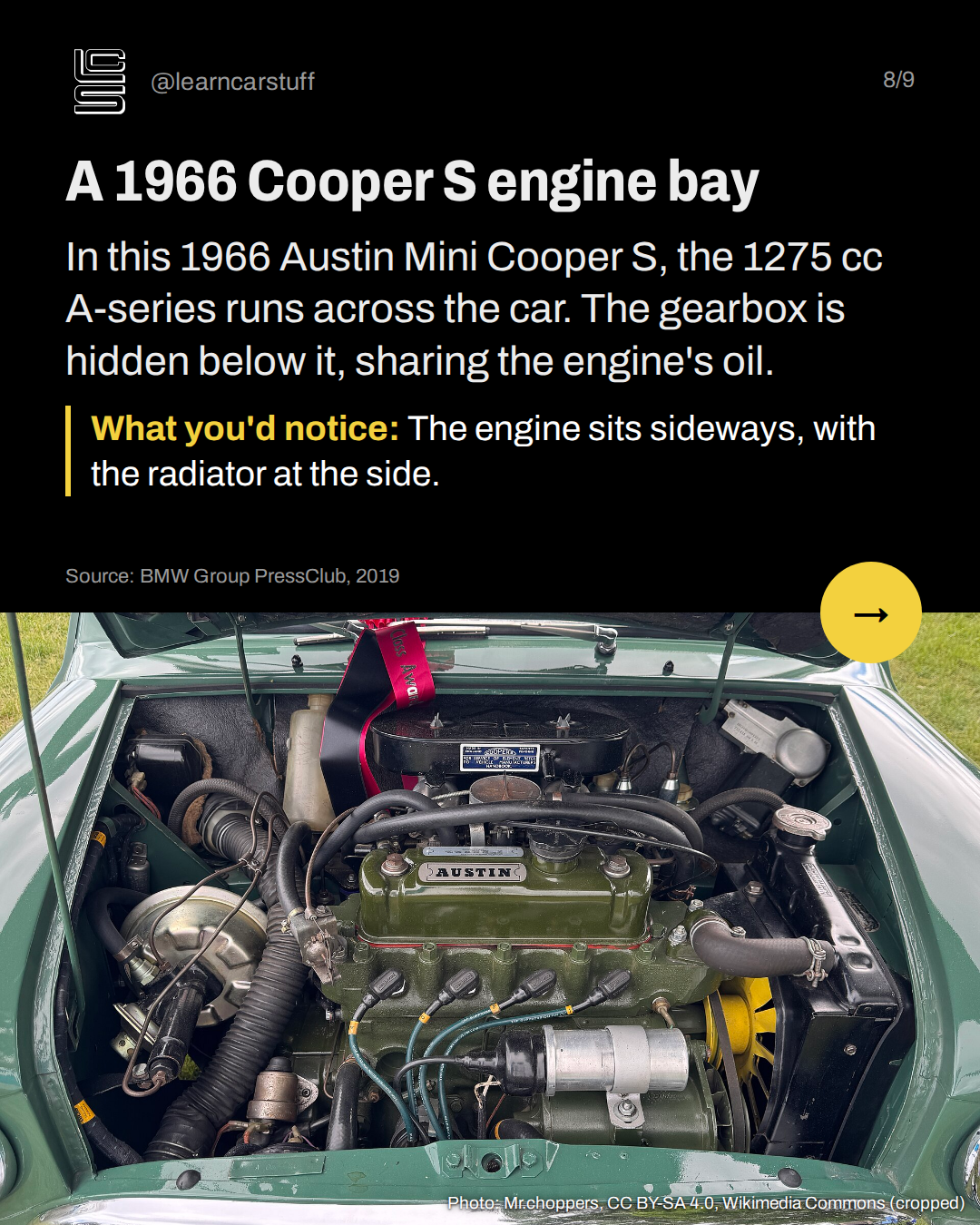
A 1966 Cooper S engine bay
In this 1966 Austin Mini Cooper S, the 1275 cc A-series runs across the car. The gearbox is hidden below it, sharing the engine's oil.
What you'd notice: The engine sits sideways, with the radiator at the side.
Source: BMW Group PressClub, 2019
Sources and assumptions
- BMW Group PressClub New Zealand, '1959 – 2019: Sixty years of MINI': Suez Crisis of 1956 prompted the brief; front-wheel drive with the engine fitted crosswise; four-speed manual gearbox beneath the engine with a shared oil circuit; 80 per cent of the space for passengers and luggage; 3.05 m long; launched 26 August 1959; 848 cc, 34 hp; ten-inch wheels; production ended in 2000 after more than 5.3 million units (checked 2026-10-14)
- BMW Group PressClub USA, 'MINI: a brief global history of the world's most loved car': 'The masterstroke that made this engine installation possible was the idea of putting the gearbox in the sump of the engine'; the brief required the existing A-series engine; 'a box, little more than 10 feet by 4 feet by 4 feet'; 848cc 34bhp standard engine (checked 2026-10-14)
- 1959 Mini Register, 'Mini History': ADO 15 code (XC9003 became the basis of ADO 15 in March 1957); Issigonis's box of 10 ft x 4 ft x 4 ft with 6 ft 6 in passenger space, 1 ft 6 in luggage and not more than 2 ft for the engine; gearbox placed underneath the engine; prototype engine rotated 180 degrees after carburettor icing, needing a third transfer gear (checked 2026-10-14)
- Motorious, 'How To Buy The Perfect Classic Mini' (2017-10-23): 'Because the gearbox shares its oil with the engine the lubricant should be replaced regularly; at least every 6,000 miles, but every 3,000 miles is even better' (checked 2026-10-14)
- Driven to Write, 'Dante's Peak (Part One)' (Fiat 128), 2023-04-24: Giacosa addressed the refinement, gearchange quality and servicing difficulties of Issigonis's gearbox-in-sump layout by fitting a compact gearbox alongside the transverse engine; this remains the industry standard (checked 2026-10-14)
- Motor Sport magazine archive, 'Another look at the Issigonis Minis' (August 1965): Period road test describing the combined 'sump/gearbox' oil supply of a Cooper S (checked 2026-10-14)
- Hansard (UK Parliament), House of Lords debate 'Petrol Rationing', 5 December 1956, Series 5 Vol. 200 cc. 770-804: Petrol rationing in Britain began on 17 December 1956 ('they are desperately afraid that on December 17 they will not have enough petrol to meet the demand of their coupon customers'). It was caused by Suez: 'The effect of the closing of the Suez Canal and the Iraq Petroleum Company's pipeline is that we shall get only some 50 per cent. of the oil from the Middle East'. It was a return of rationing: 'It is much more severe than, in fact, it was at the end of the last period of rationing in 1950' (Earl of Selkirk). (checked 2026-10-14)
Assumptions:
- The 80% figure is BMW/MINI's own heritage claim; the 8 ft of 10 ft arithmetic uses Issigonis's design-brief box from the 1959 Mini Register history and shows where a round 80% comes from. It is a target split, not a measurement of the production car.
- 'Beneath the engine' follows BMW's wording; the gearbox is in a casing that forms the engine's sump, so 'in the sump, below the engine' is the safe phrasing.
- The oil-change interval is buying-guide advice for owners today, not a BMC factory schedule.
- The Fiat comparison is the view of an enthusiast publication (Driven to Write), framed as the layout most front-drive cars later adopted, not as a direct Mini vs 128 test.
- The cutaway photos show classic Minis of unstated model years; captions should say 'classic Mini cutaway', not '1959'. The engine-bay photo is a 1966 Austin Mini Cooper S with the 1275 cc A-series, not the 848 cc 1959 engine.
Photos:
The short version
- A fuel scare set the small-car brief.
- Target: 8 of 10 feet for people and luggage.
- Engine sideways, gearbox in the sump.
- The price: one oil supply for both.