 Learn Car Stuff
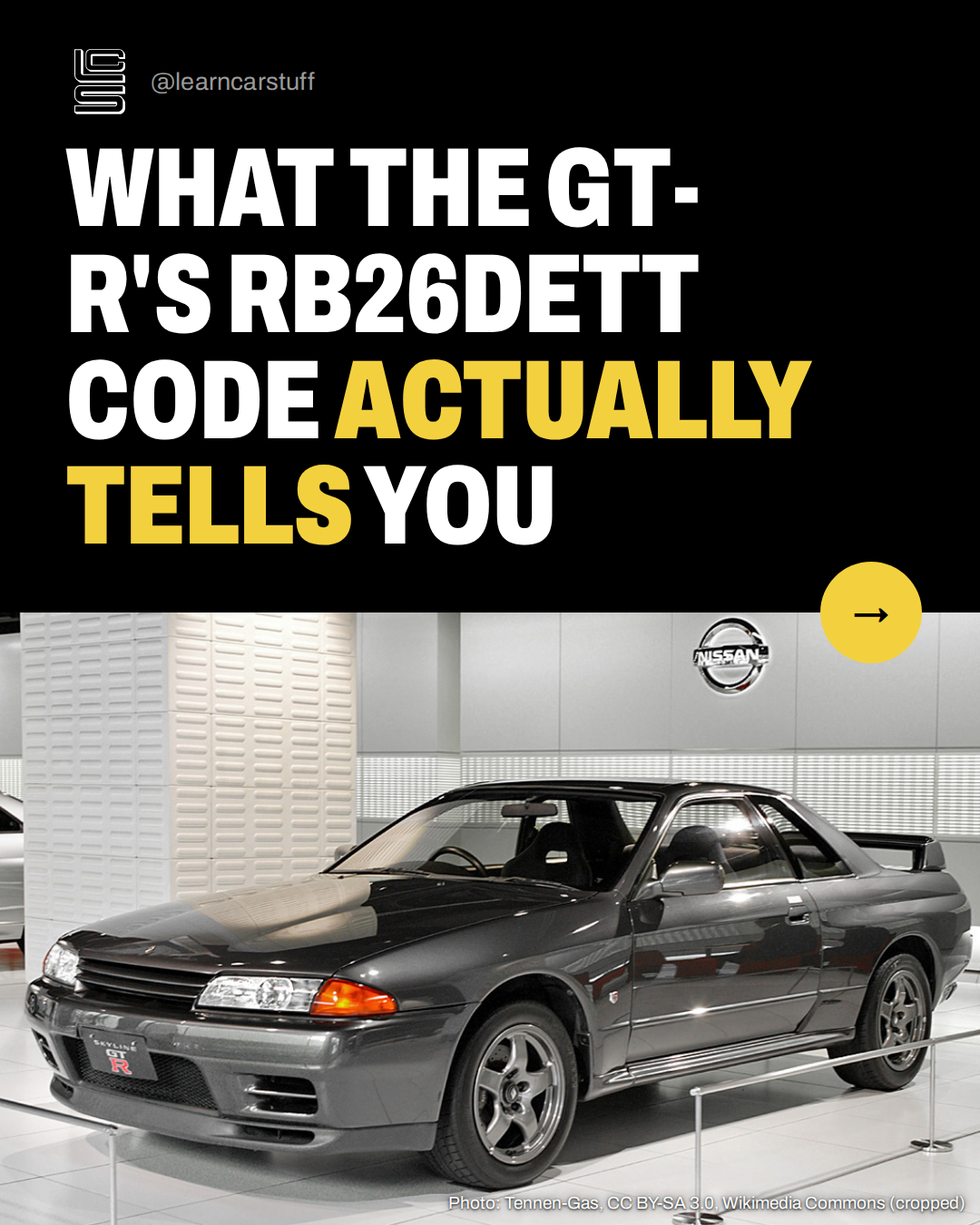
What the GT-R's RB26DETT code actually tells you
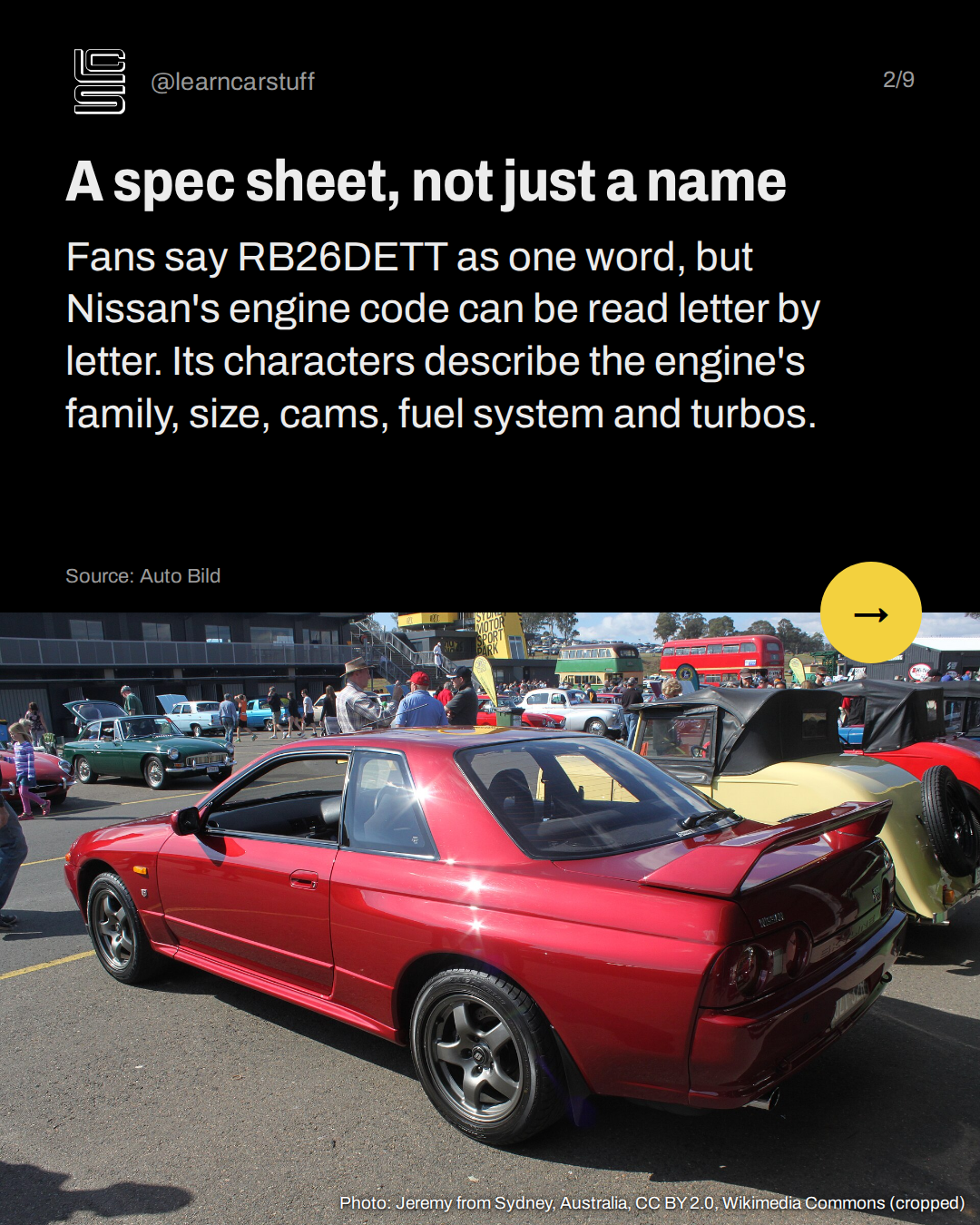
A spec sheet, not just a name
Fans say RB26DETT as one word, but Nissan's engine code can be read letter by letter. Its characters describe the engine's family, size, cams, fuel system and turbos.
Source: Auto Bild
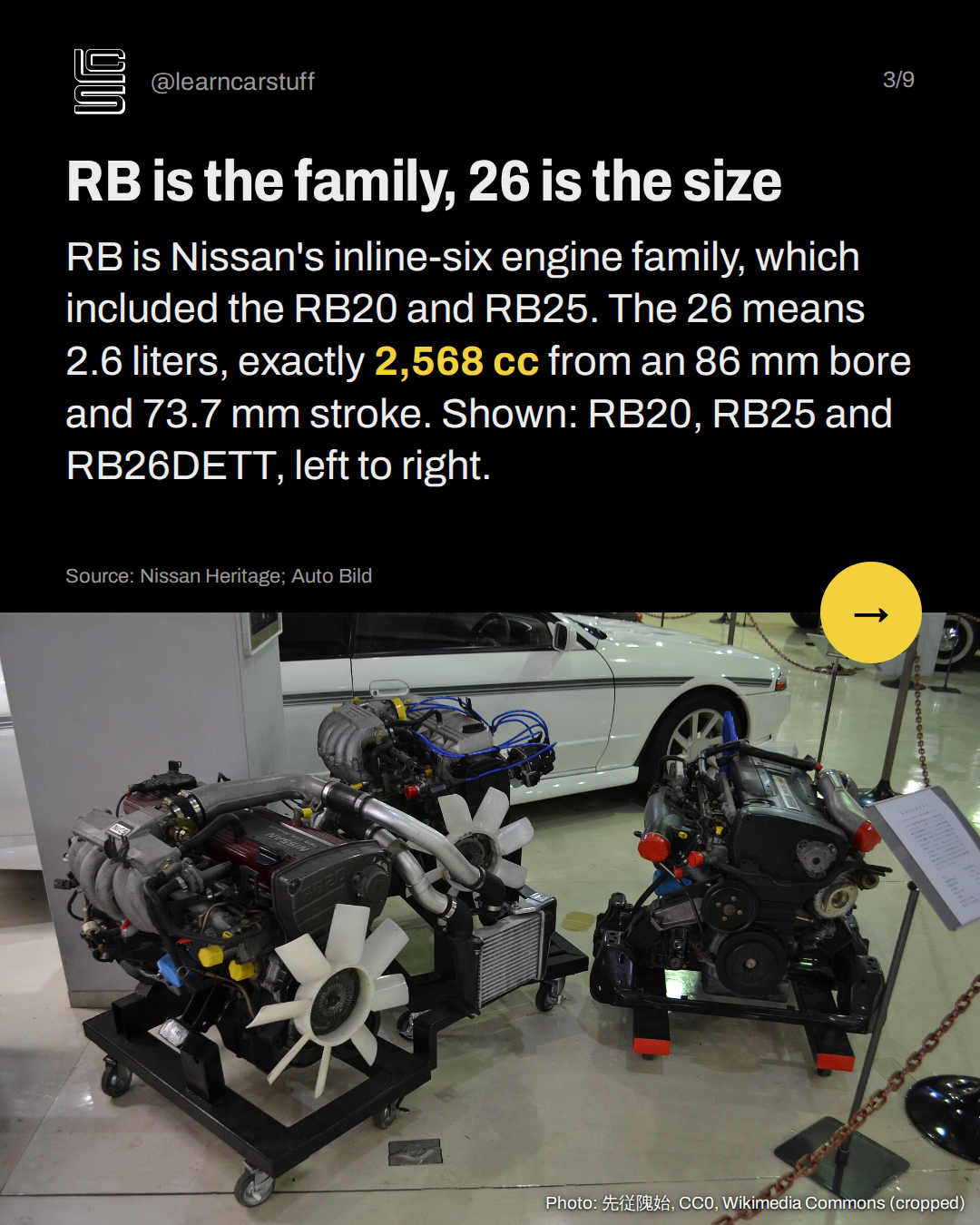
RB is the family, 26 is the size
RB is Nissan's inline-six engine family, which included the RB20 and RB25. The 26 means 2.6 liters, exactly 2,568 cc from an 86 mm bore and 73.7 mm stroke. Shown: RB20, RB25 and RB26DETT, left to right.
Source: Nissan Heritage; Auto Bild
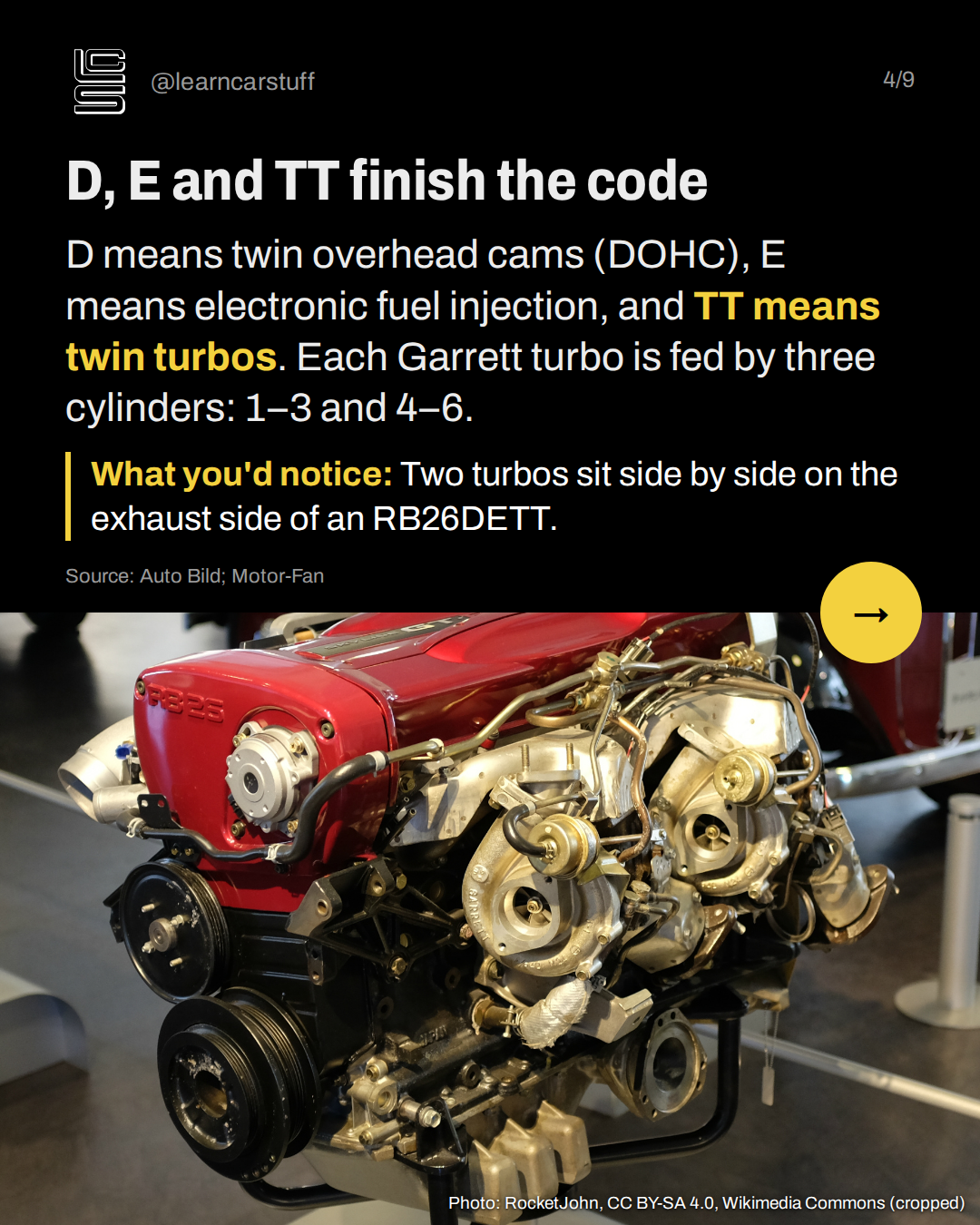
D, E and TT finish the code
D means twin overhead cams (DOHC), E means electronic fuel injection, and TT means twin turbos. Each Garrett turbo is fed by three cylinders: 1–3 and 4–6.
What you'd notice: Two turbos sit side by side on the exhaust side of an RB26DETT.
Source: Auto Bild; Motor-Fan
The rulebook set the size
Nissan designed the RB26DETT for Group A racing. Group A counted a turbo engine as 1.7 times its real size and put the car in the class for that bigger number.
Source: Best Car Web; FIA Appendix J, 1990
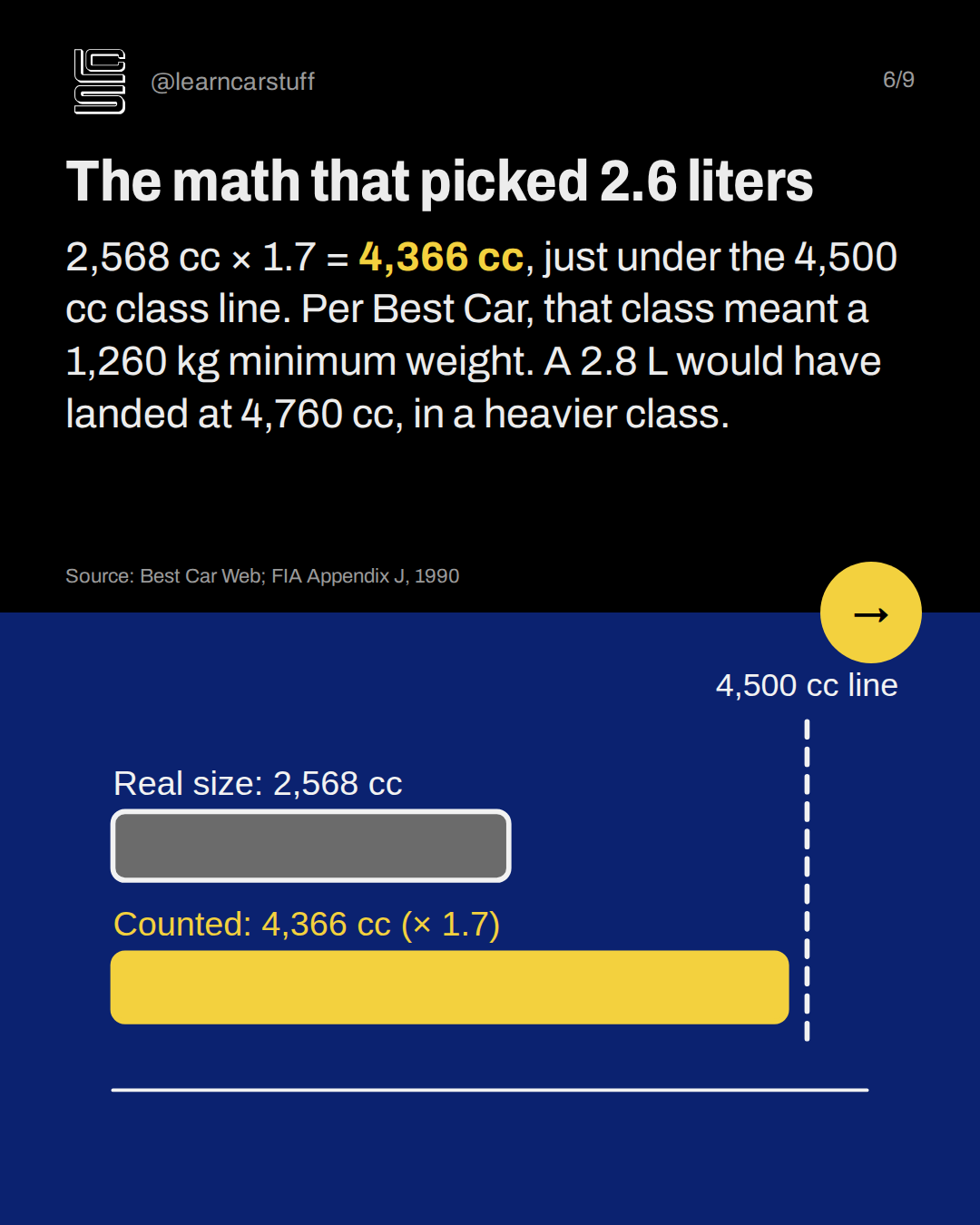
The math that picked 2.6 liters
2,568 cc × 1.7 = 4,366 cc, just under the 4,500 cc class line. Per Best Car, that class meant a 1,260 kg minimum weight. A 2.8 L would have landed at 4,760 cc, in a heavier class.
Source: Best Car Web; FIA Appendix J, 1990
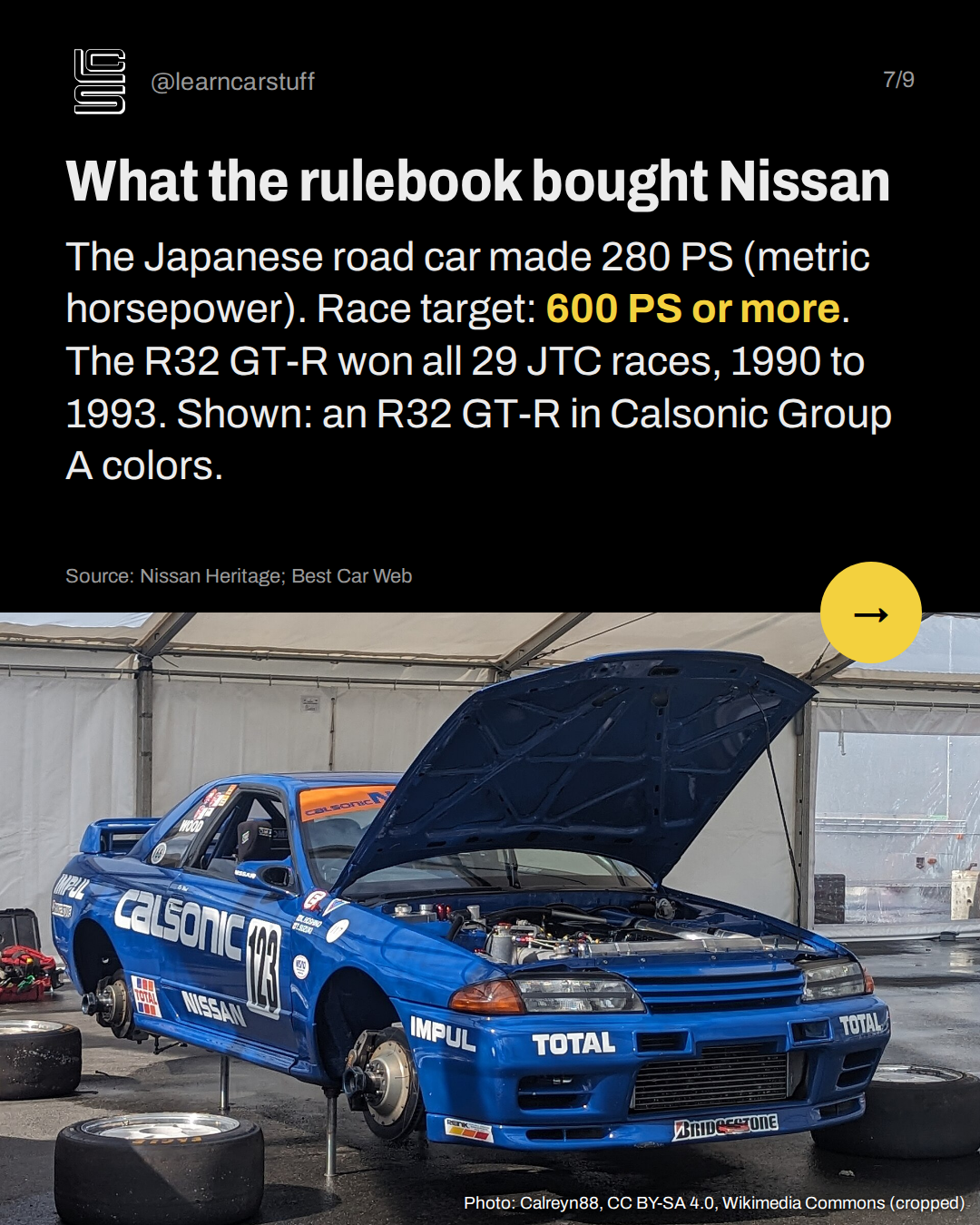
What the rulebook bought Nissan
The Japanese road car made 280 PS (metric horsepower). Race target: 600 PS or more. The R32 GT-R won all 29 JTC races, 1990 to 1993. Shown: an R32 GT-R in Calsonic Group A colors.
Source: Nissan Heritage; Best Car Web
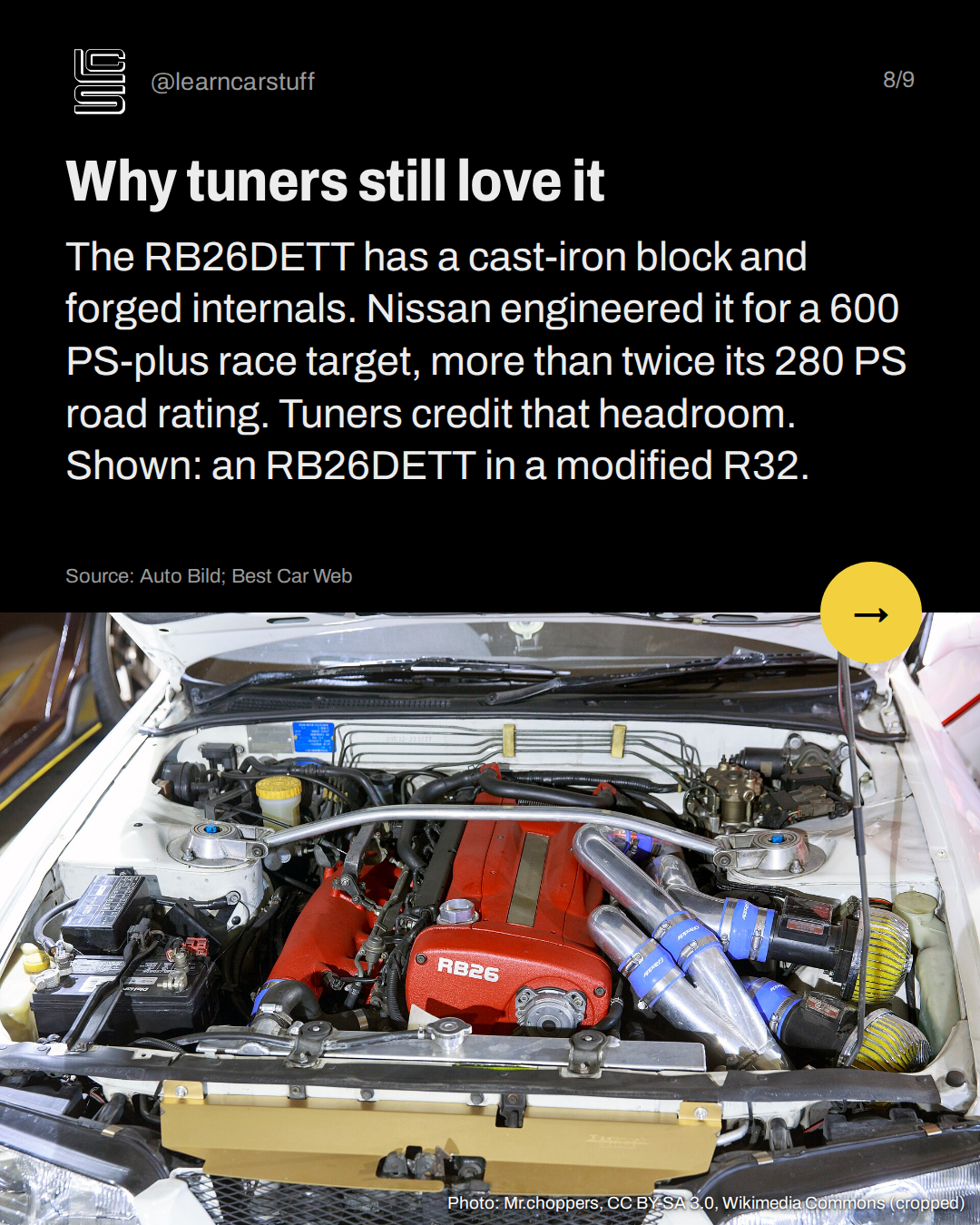
Why tuners still love it
The RB26DETT has a cast-iron block and forged internals. Nissan engineered it for a 600 PS-plus race target, more than twice its 280 PS road rating. Tuners credit that headroom. Shown: an RB26DETT in a modified R32.
Source: Auto Bild; Best Car Web
Sources and assumptions
- Nissan Heritage Collection: Nissan Skyline GT-R (1989: BNR32): Model code BNR32, introduced May 1989; engine RB26DETT, inline 6-cyl DOHC, 2,568 cc, twin turbo; 206 kW (280 PS)/6,800 rpm; 353 N·m (36 kgm)/4,400 rpm (checked 2026-10-14)
- Nissan Heritage short story: Skyline GT-R in Group A: All Japan Touring Car Championship was run to Group A; the R32 GT-R won all 29 races of the four series 1990–1993; Group A was replaced by Super Touring in 1994 (checked 2026-10-14)
- Auto Bild: RB26DETT Reihensechser im Skyline GT-R R32, R33, R34: Code meaning: RB = engine series, 26 = 2.6 L, D = DOHC, E = electronic injection, TT = twin turbo; 2,568 cc; 86 mm bore × 73.7 mm stroke; cast-iron block, forged internals; six individual throttle bodies; early cars used plain-bearing Garrett T25 turbos with ceramic turbine wheels; R34 got ball-bearing T28s (checked 2026-10-14)
- Best Car Web (Kodansha): 日産RB26DETTをいまこそ振り返る: 2,568 cc was set by Group A class weight/performance; a turbo factor of 1.7 put it in the 4,500 cc class; that class's minimum weight was 1,260 kg and allowed 11-inch tyres; target race power was 600 PS or more (checked 2026-10-14)
- Motor-Fan: RB26DETT technical article: Twin-turbo system feeds cylinders 1–3 and 4–6 to separate Garrett turbos; production turbos had ceramic turbines for response, race versions metal turbines; Group A did not allow turbo size changes (checked 2026-10-14)
- GT-R USA blog: Nothing Came Close: The Group A BNR32 Nissan Skyline GT-R: Group A multiplied turbo displacement by 1.7, putting the 2.6 L RB26DETT in the 4.0–4.5 L class; a 2.8 L would have moved it to a heavier class (about 80 kg more minimum weight); 29 wins from 29 races (checked 2026-10-14)
- FIA historic database: Appendix J 1990 (search result excerpt; the full PDF exceeded the fetch size limit): 'In case of supercharging, the nominal cylinder-capacity will be multiplied by 1.7 and the car will pass into the class corresponding to the fictive volume thus obtained'; class over 4,000 up to 4,500 cm³ exists (checked 2026-10-14)
Assumptions:
- The '2.8 L' alternative is a hypothetical comparison: 2,800 × 1.7 = 4,760 cc lands in the next class up. Its weight penalty (~80 kg) is from the GT-R USA blog only; say 'heavier minimum weight' without a kg figure unless attributed.
- The 1,260 kg minimum weight and 11-inch tyre allowance come from Best Car Web; the FIA's printed Group A weight tables changed over the years, so attribute the figure or present it as the JTC-era figure Nissan worked to.
- 'RB' is given only as Nissan's engine family name. The common 'Response Balance' expansion appears only on an unsourced Japanese consumer site (car-me.jp); do not state it as fact. If used at all, label it as fan lore.
- The ceramic turbine wheels and T25 turbos describe the R32 (and R33) road car; the R34 used T28s. Don't generalise to every RB26.
- The 600+ PS figure is Nissan's race target as reported by Best Car, not a measured output of any one car.
- The 280 PS figure is the official Japanese rating (Nissan); any 'real' crank output above that is folklore and not used.
- Photo of red-covered RB26DETT at the Nissan Engine Museum is probably a later (R33/R34-era) engine; caption it as 'an RB26DETT', not 'the R32's engine'.
Photos:
- Photo: Tennen-Gas, CC BY-SA 3.0, Wikimedia Commons (cropped)
- Photo: Jeremy from Sydney, Australia, CC BY 2.0, Wikimedia Commons (cropped)
- Photo: 先従隗始, CC0, Wikimedia Commons (cropped)
- Photo: RocketJohn, CC BY-SA 4.0, Wikimedia Commons (cropped)
- Photo: Calreyn88, CC BY-SA 4.0, Wikimedia Commons (cropped)
- Photo: Mr.choppers, CC BY-SA 3.0, Wikimedia Commons (cropped)
The short version
- RB is the engine family.
- 26 means 2.6 liters, or 2,568 cc.
- D, E and TT: cams, injection, twin turbos.
- Group A's ×1.7 turbo rule set the size.