 Learn Car Stuff
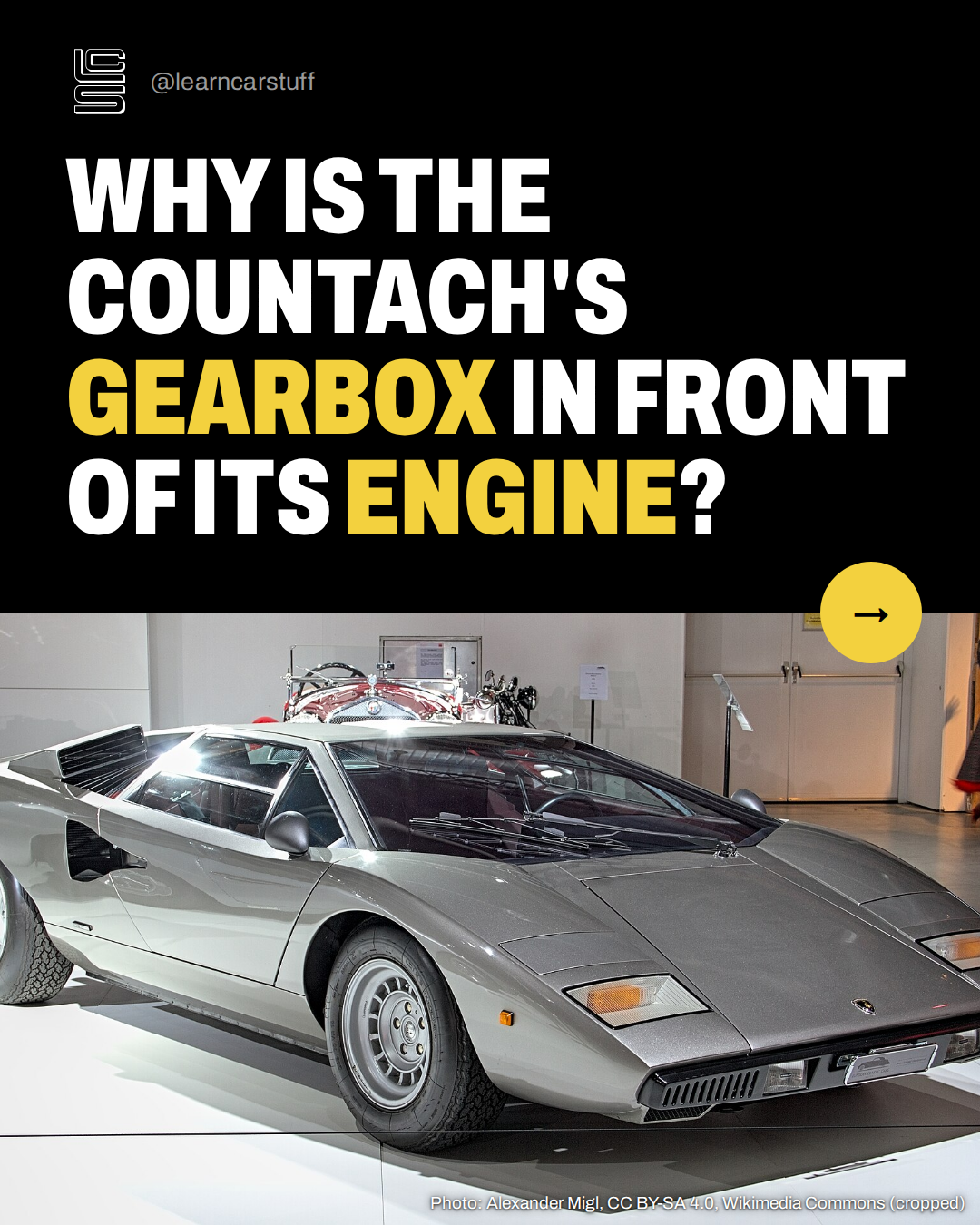
Why is the Countach's gearbox in front of its engine?
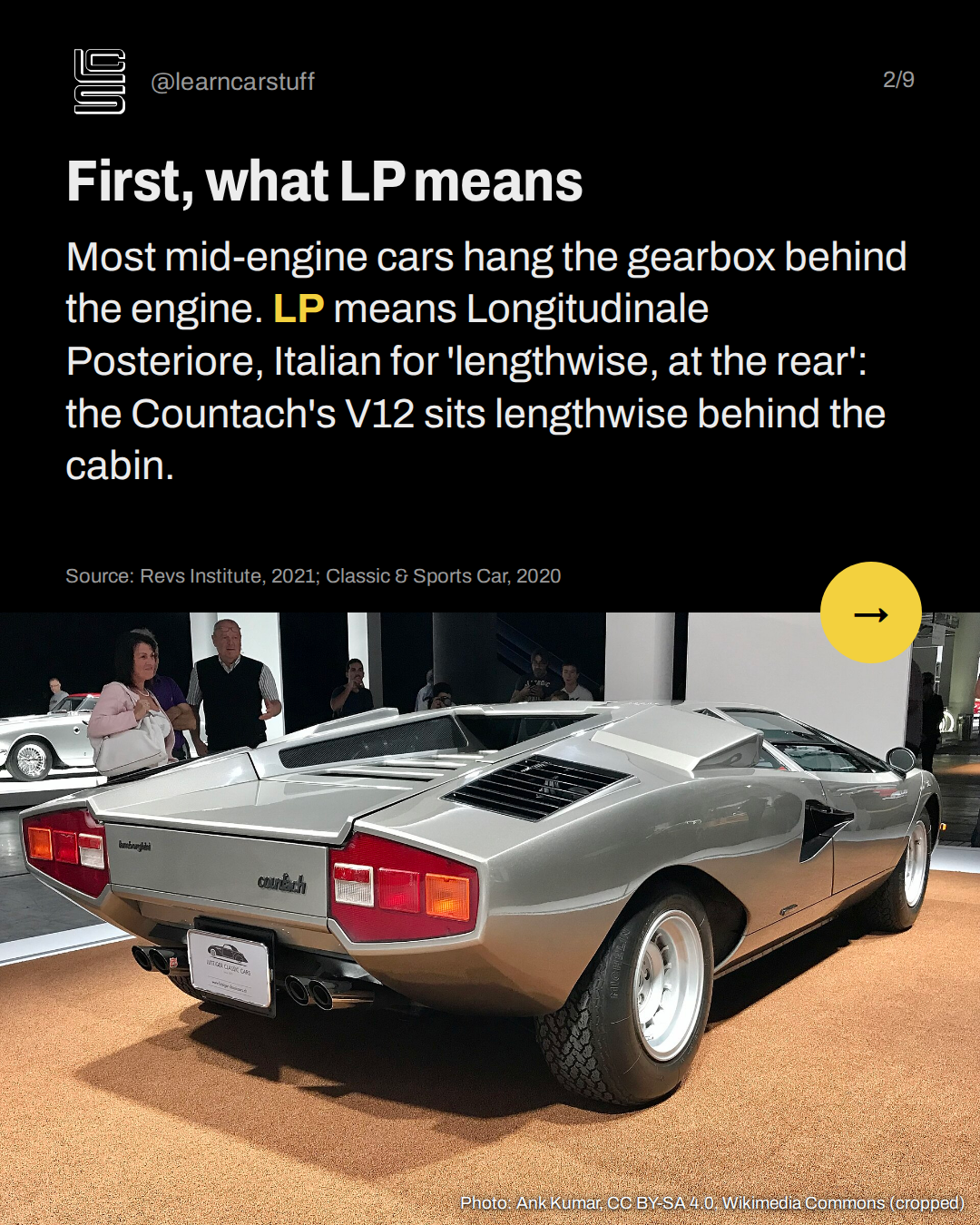
First, what LP means
Most mid-engine cars hang the gearbox behind the engine. LP means Longitudinale Posteriore, Italian for 'lengthwise, at the rear': the Countach's V12 sits lengthwise behind the cabin.
Source: Revs Institute, 2021; Classic & Sports Car, 2020
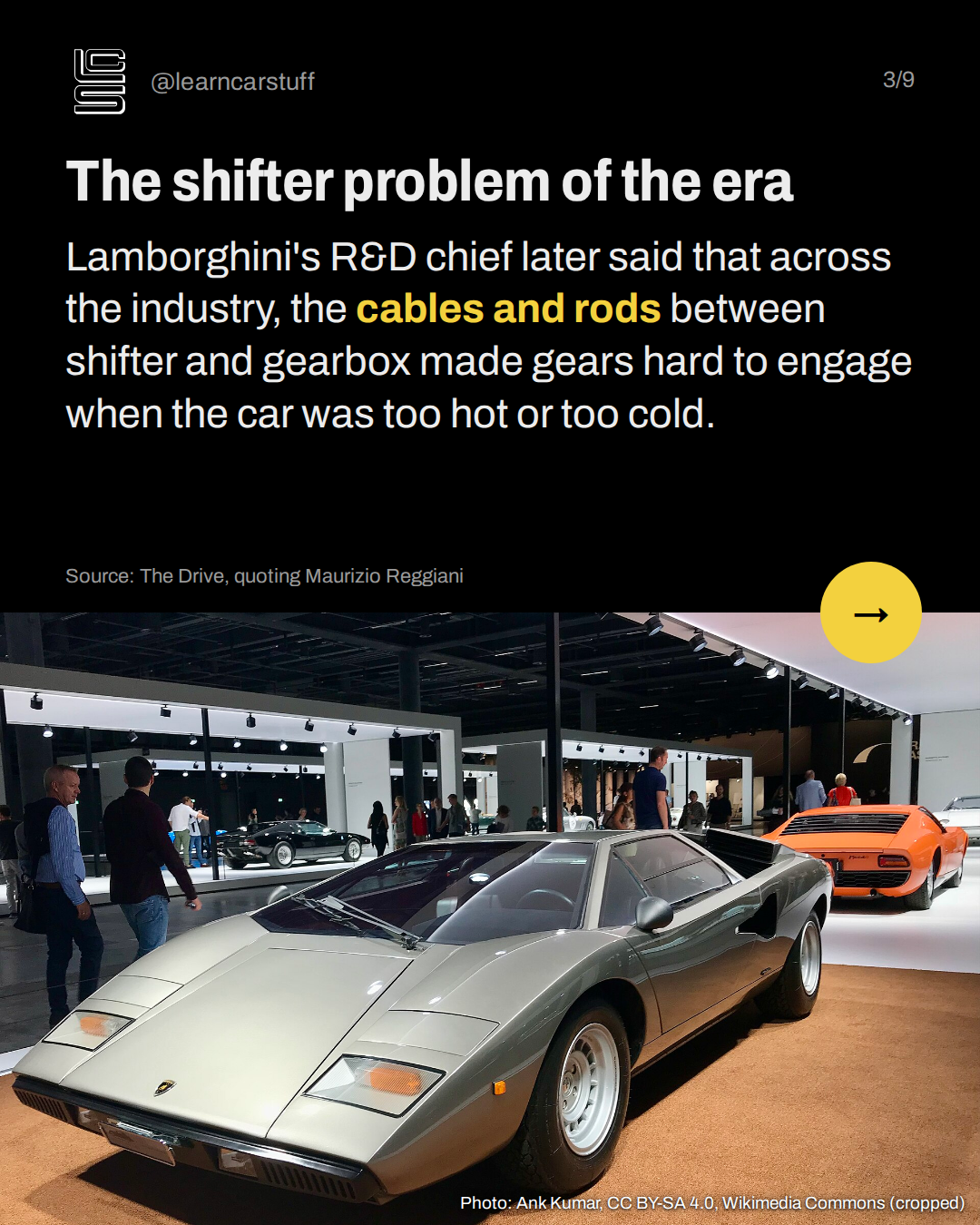
The shifter problem of the era
Lamborghini's R&D chief later said that across the industry, the cables and rods between shifter and gearbox made gears hard to engage when the car was too hot or too cold.
Source: The Drive, quoting Maurizio Reggiani
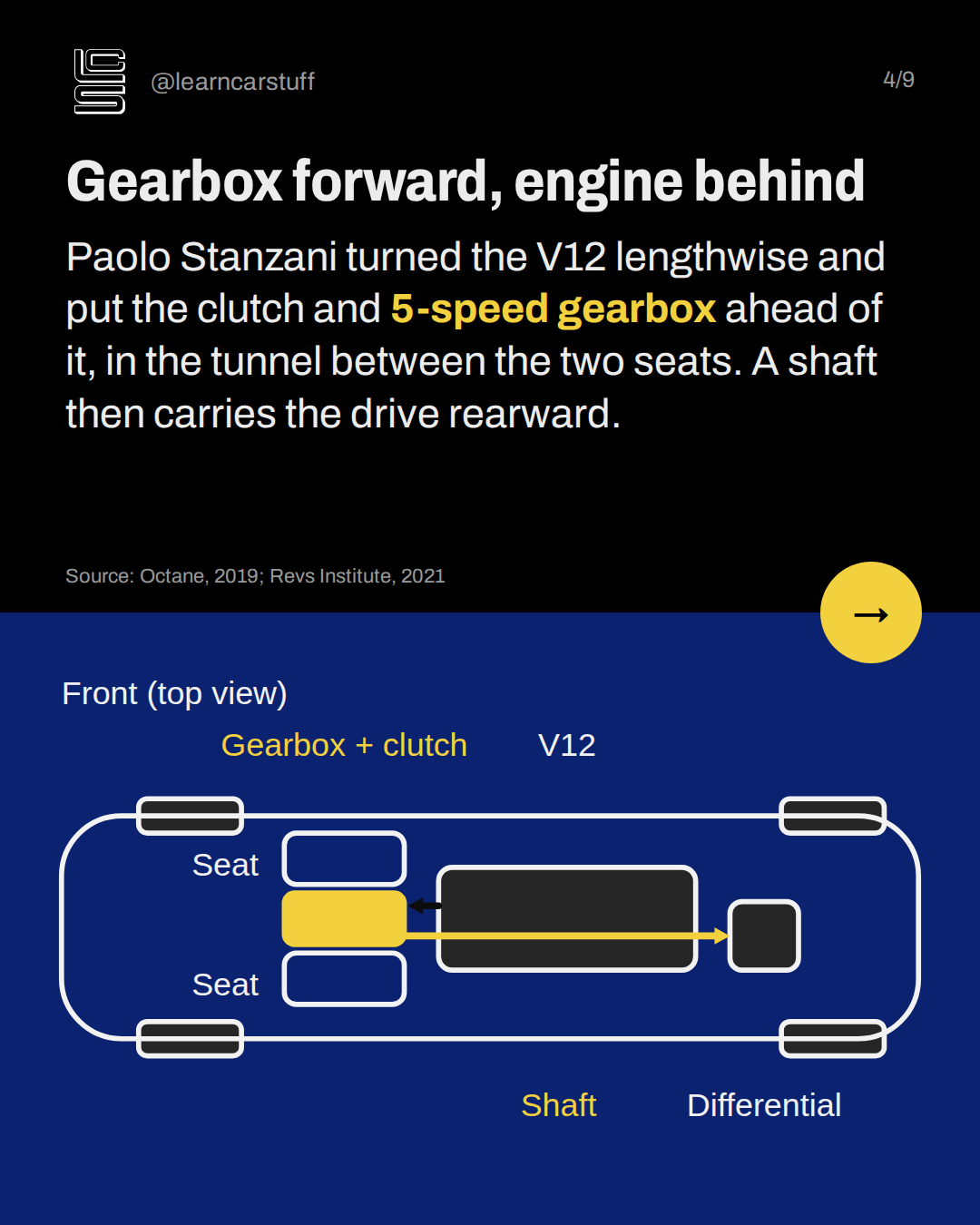
Gearbox forward, engine behind
Paolo Stanzani turned the V12 lengthwise and put the clutch and 5-speed gearbox ahead of it, in the tunnel between the two seats. A shaft then carries the drive rearward.
Source: Octane, 2019; Revs Institute, 2021
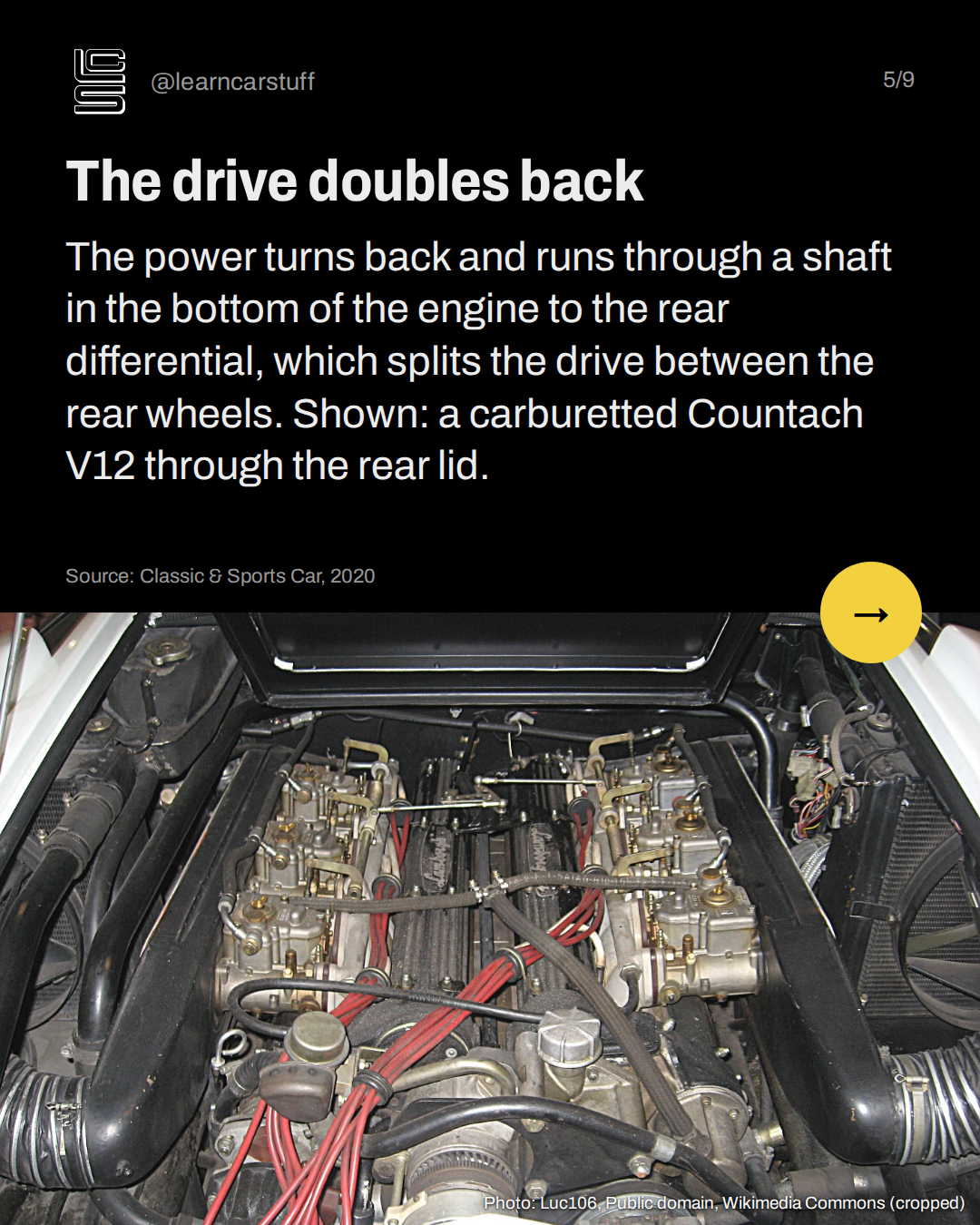
The drive doubles back
The power turns back and runs through a shaft in the bottom of the engine to the rear differential, which splits the drive between the rear wheels. Shown: a carburetted Countach V12 through the rear lid.
Source: Classic & Sports Car, 2020
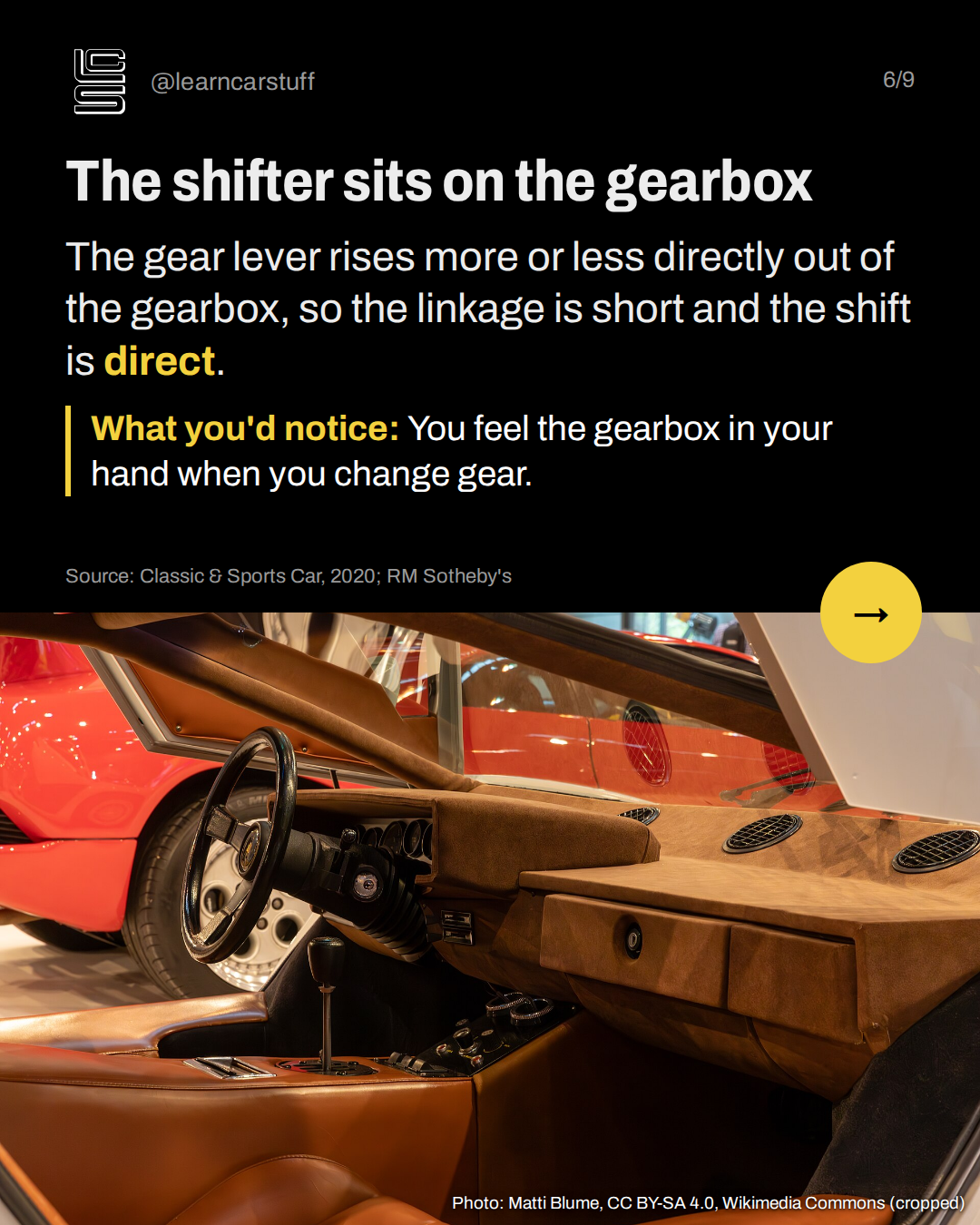
The shifter sits on the gearbox
The gear lever rises more or less directly out of the gearbox, so the linkage is short and the shift is direct.
What you'd notice: You feel the gearbox in your hand when you change gear.
Source: Classic & Sports Car, 2020; RM Sotheby's
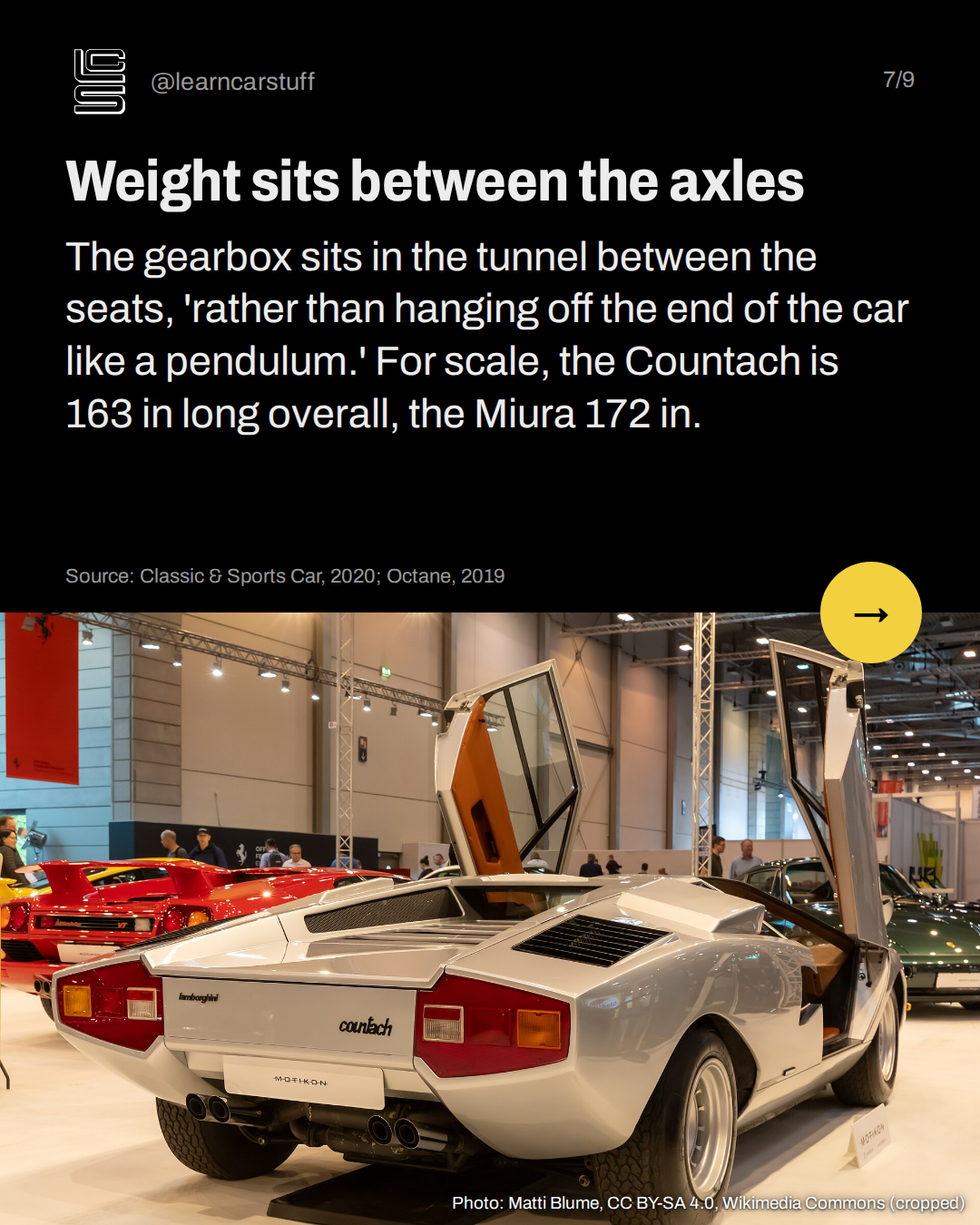
Weight sits between the axles
The gearbox sits in the tunnel between the seats, 'rather than hanging off the end of the car like a pendulum.' For scale, the Countach is 163 in long overall, the Miura 172 in.
Source: Classic & Sports Car, 2020; Octane, 2019
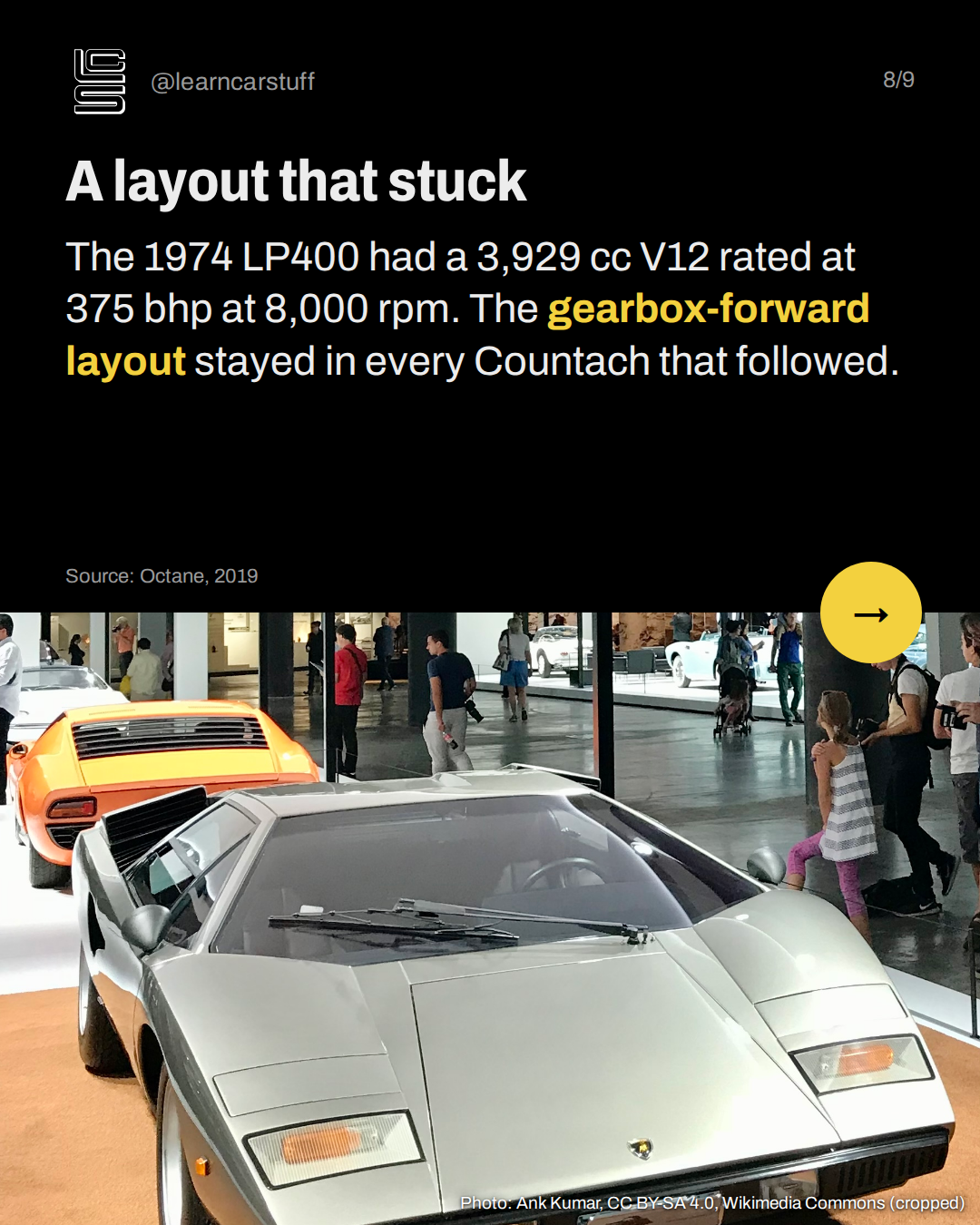
A layout that stuck
The 1974 LP400 had a 3,929 cc V12 rated at 375 bhp at 8,000 rpm. The gearbox-forward layout stayed in every Countach that followed.
Source: Octane, 2019
Sources and assumptions
- Octane Magazine, Harry Metcalfe, 'Lamborghini Countach LP400 – Driving Gandini's masterpiece' (Octane 190, Apr 2019; online 17 May 2024): Stanzani (chief engineer after Dallara left in 1968) turned the Miura's transverse V12 through 90 degrees and bolted the gearbox to the front of it, down the backbone of the car between the two seats; result: direct gearbox operation and better weight distribution. LP400: 3,929 cc V12, 375 bhp at 8,000 rpm, 266 lb ft at 5,500 rpm, 1,370 kg; Countach 163 in long vs Miura 172 in; both 42 in tall (checked 2026-10-13)
- Revs Institute, Wouter Melissen, 'Lamborghini Countach – fifty years on, Gandini's marvel still astonishes' (2021): Stanzani started developing a new chassis in 1970; internal Project 112; replacement for the Miura; gearbox placed ahead of the engine underneath the transmission tunnel; rear wheels driven by a shaft running through the V12's engine block; LP = Longitudinale Posteriore; LP500 prototype shown at Geneva (1971); LP400 production from 1974 with the 4.0-litre engine; Countach built until 1989/1990 (checked 2026-10-13)
- The Drive, Ronan Glon, '1990 Lamborghini Countach review' (updated 21 Dec 2021), quoting Maurizio Reggiani, then head of Lamborghini R&D: Reggiani: 'In 1971, there were no robotized or electronic gearboxes. Most carmakers used either cables or rods that went from the shifter to the transmission and it was often very difficult to engage a gear if the car was too hot or too cold. Our engineers figured out that they could solve this problem by putting the gearbox in a position where they could link it directly to the shifter.' LP = longitudinale posteriore vs the Miura's transverse V12; gated 5-speed shifter with dog-leg pattern (checked 2026-10-13)
- Classic & Sports Car, Steve Cropley, 'Why the allure of the Countach is much more than skin deep' (7 Jul 2020): Stanzani mounted the Miura-derived 60-degree V12 'back-to-front'; the end-on gearbox 'sits more or less under the driver's left elbow rather than hanging off the end of the car like a pendulum'; the gearbox output 'turns through 180 degrees and runs back through the engine's crankcase to a diff just behind the engine'; the gated gearchange sprouts more or less directly out of the box, 'which you feel when you change gears' (checked 2026-10-13)
- RM Sotheby's, 1979 Lamborghini Countach LP400 S Series I lot description (Abu Dhabi 2019): Stanzani's team mid-mounted the transmission by moving the output shaft to the front of the engine; propshaft ran through the engine's oil sump to a rear differential; kept mass in the centre of the car for stability; shortened the gear linkage, improving its action (checked 2026-10-13)
Assumptions:
- 'Paolo Stanzani's layout' credits the chief engineer as all sources do; the wider team and Ferruccio Lamborghini were also involved.
- The Reggiani quote describes the general shifter-linkage problem of the era and Lamborghini's reasoning; it doesn't quantify how bad the Miura's own linkage was. The post must not invent Miura shift-quality claims beyond 'a long remote linkage'.
- Specs (3,929 cc, 375 bhp at 8,000 rpm) are Octane's figures for the original LP400; Wikipedia gives 375 PS / 370 hp, so use '375 bhp' only with LP400 named.
- Length comparison 163 in vs 172 in (Octane) is overall length; it is NOT a wheelbase claim. The queue's 'kept the wheelbase short' angle is dropped because no strong source states it.
- No weight-distribution percentage is used; the only source for 43/57 was a weak secondary page.
- The engine-bay photo p11 shows a carburetted Countach V12, variant not stated; caption it as 'a Countach V12', not 'LP400'.
- End of Countach production: Revs says 'until 1989'; the 25th Anniversary ran into 1990 per common record. Safer slide wording: 'every Countach that followed', with no end year.
Photos:
- Photo: Alexander Migl, CC BY-SA 4.0, Wikimedia Commons (cropped)
- Photo: Matti Blume, CC BY-SA 4.0, Wikimedia Commons (cropped)
- Photo: Matti Blume, CC BY-SA 4.0, Wikimedia Commons (cropped)
- Photo: Ank Kumar, CC BY-SA 4.0, Wikimedia Commons (cropped)
- Photo: Ank Kumar, CC BY-SA 4.0, Wikimedia Commons (cropped)
- Photo: Ank Kumar, CC BY-SA 4.0, Wikimedia Commons (cropped)
- Photo: Luc106, Public domain, Wikimedia Commons (cropped)
The short version
- LP means lengthwise, at the rear
- The gearbox sits ahead of the V12
- A shaft runs through the engine's bottom
- The shifter links almost directly to the gearbox