 Learn Car Stuff
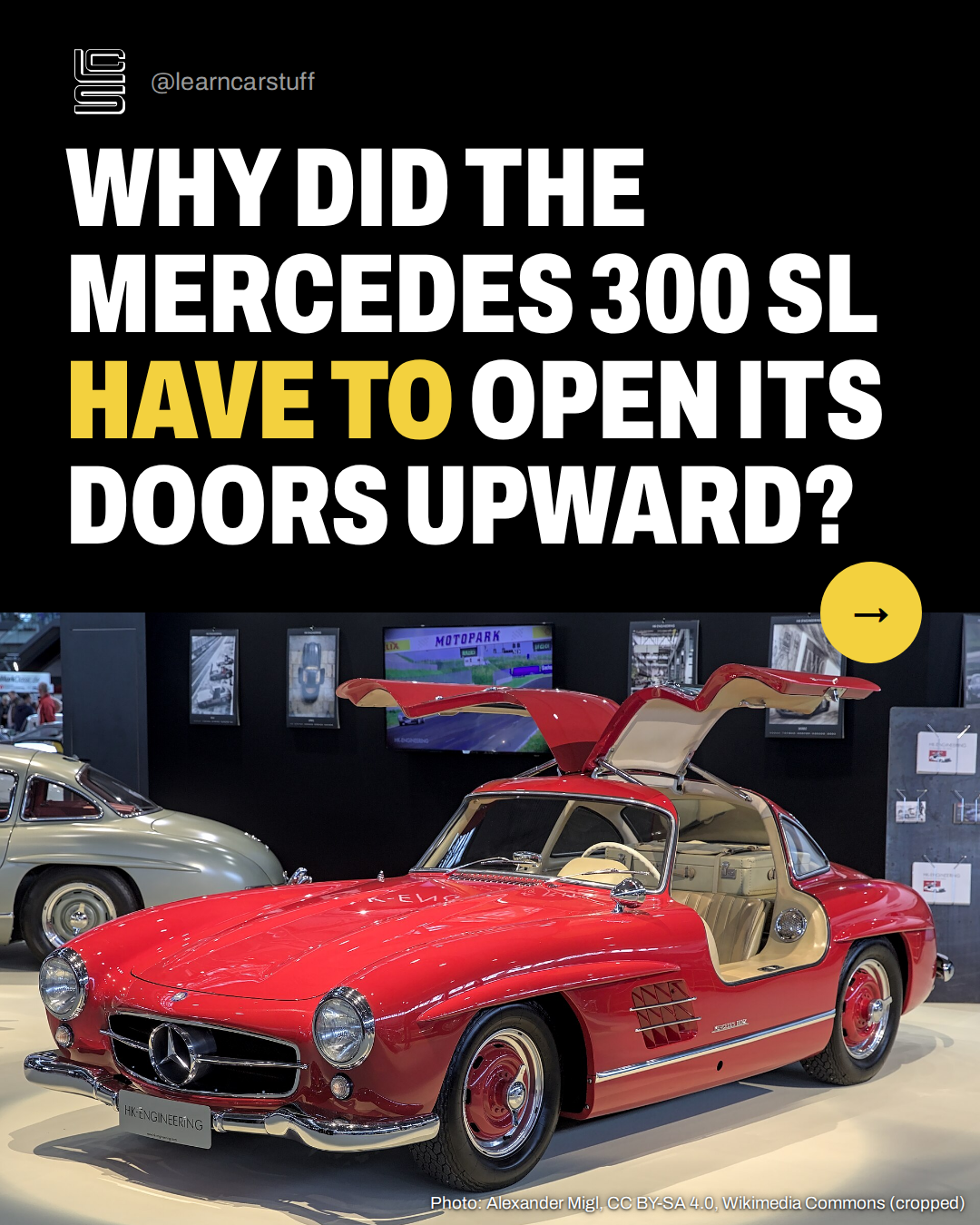
Why did the Mercedes 300 SL have to open its doors upward?
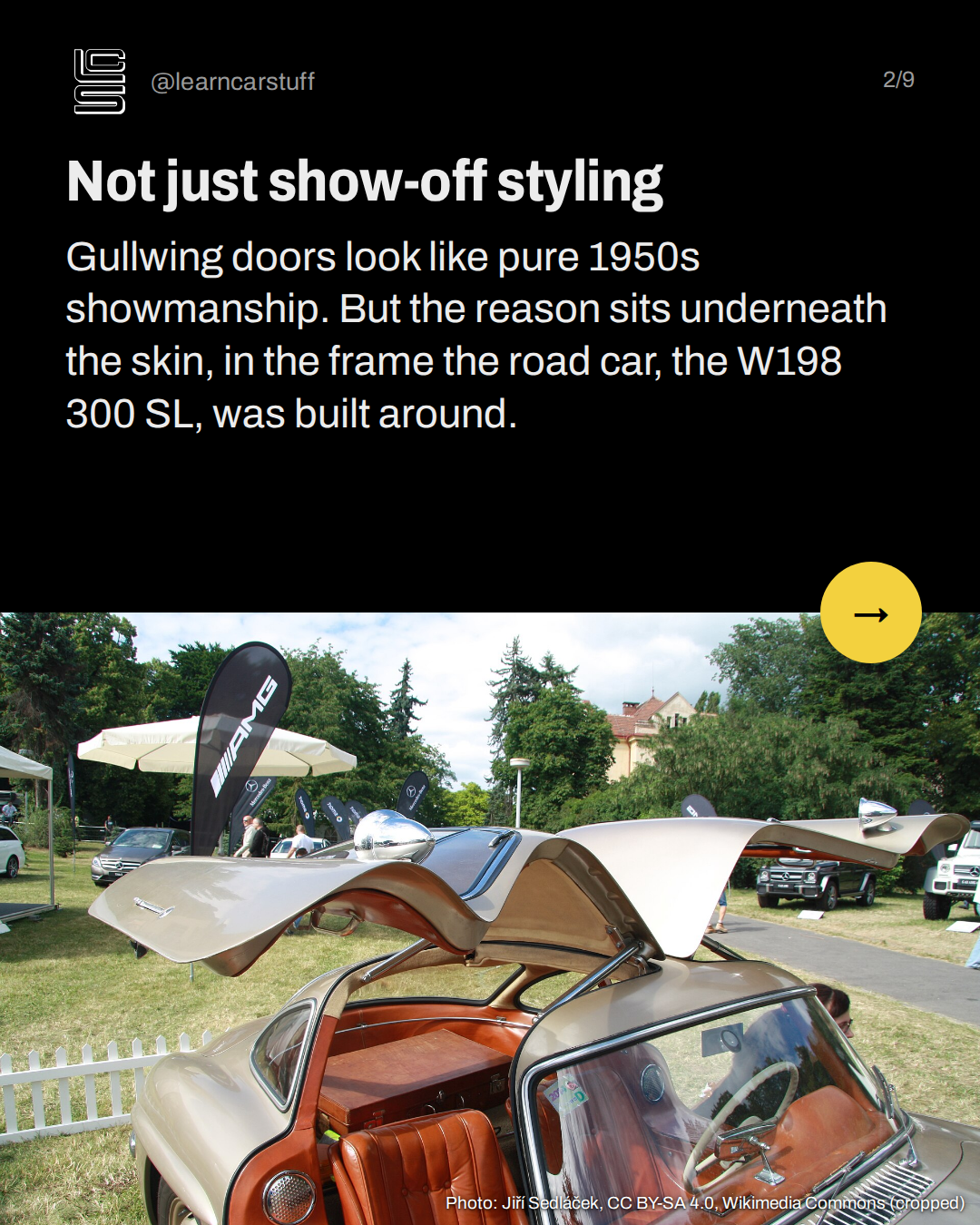
Not just show-off styling
Gullwing doors look like pure 1950s showmanship. But the reason sits underneath the skin, in the frame the road car, the W198 300 SL, was built around.
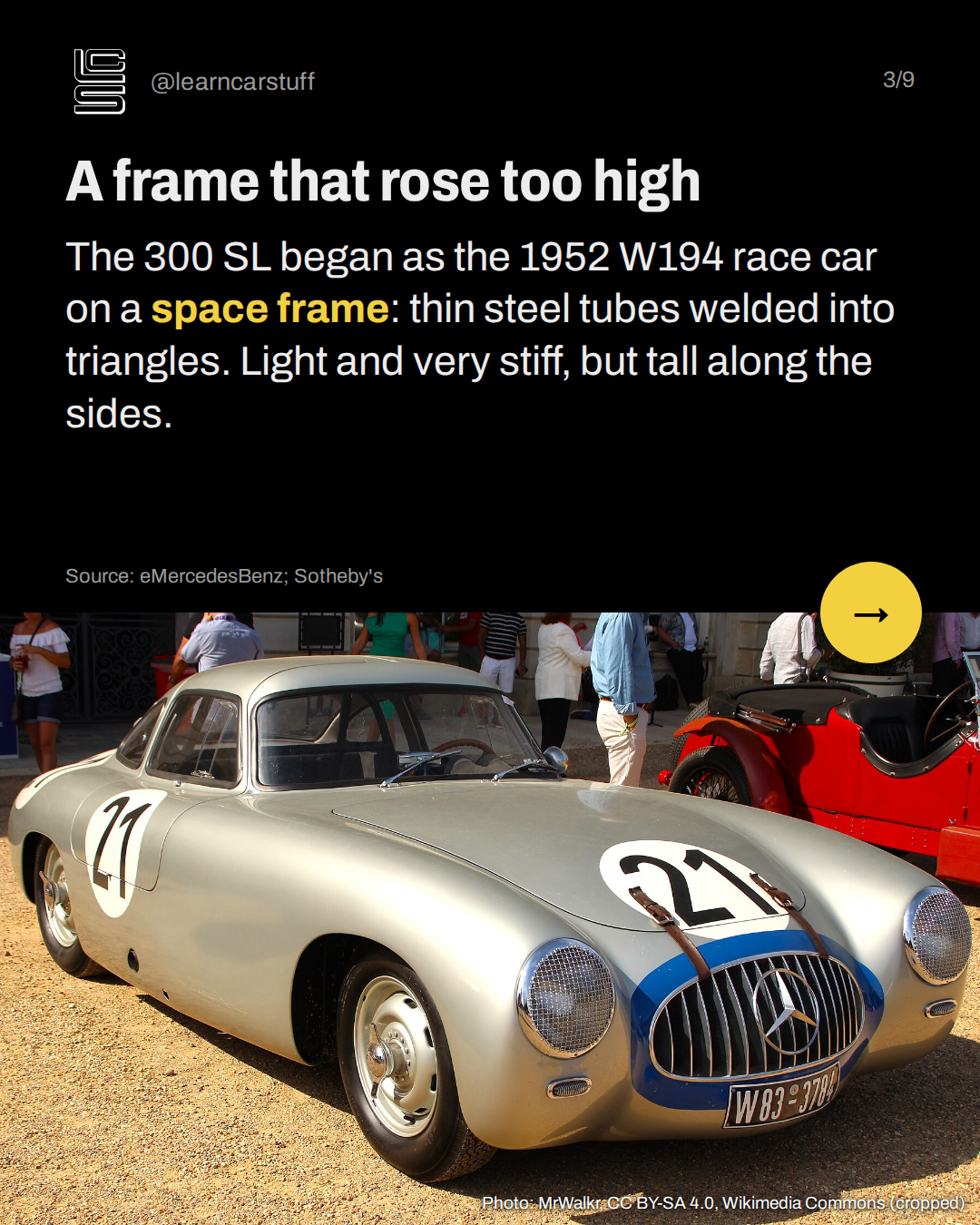
A frame that rose too high
The 300 SL began as the 1952 W194 race car on a space frame: thin steel tubes welded into triangles. Light and very stiff, but tall along the sides.
Source: eMercedesBenz; Sotheby's
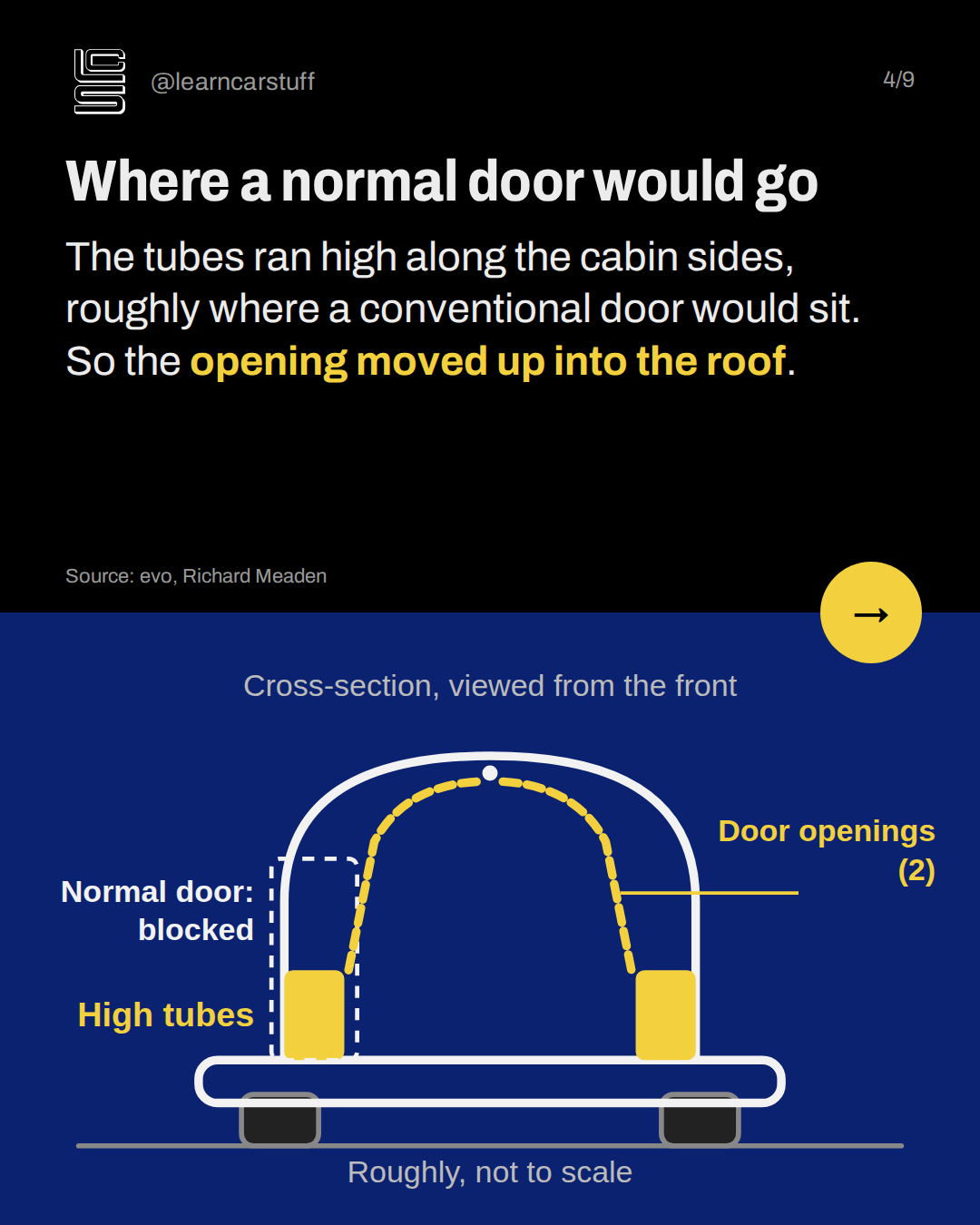
Where a normal door would go
The tubes ran high along the cabin sides, roughly where a conventional door would sit. So the opening moved up into the roof.
Source: evo, Richard Meaden
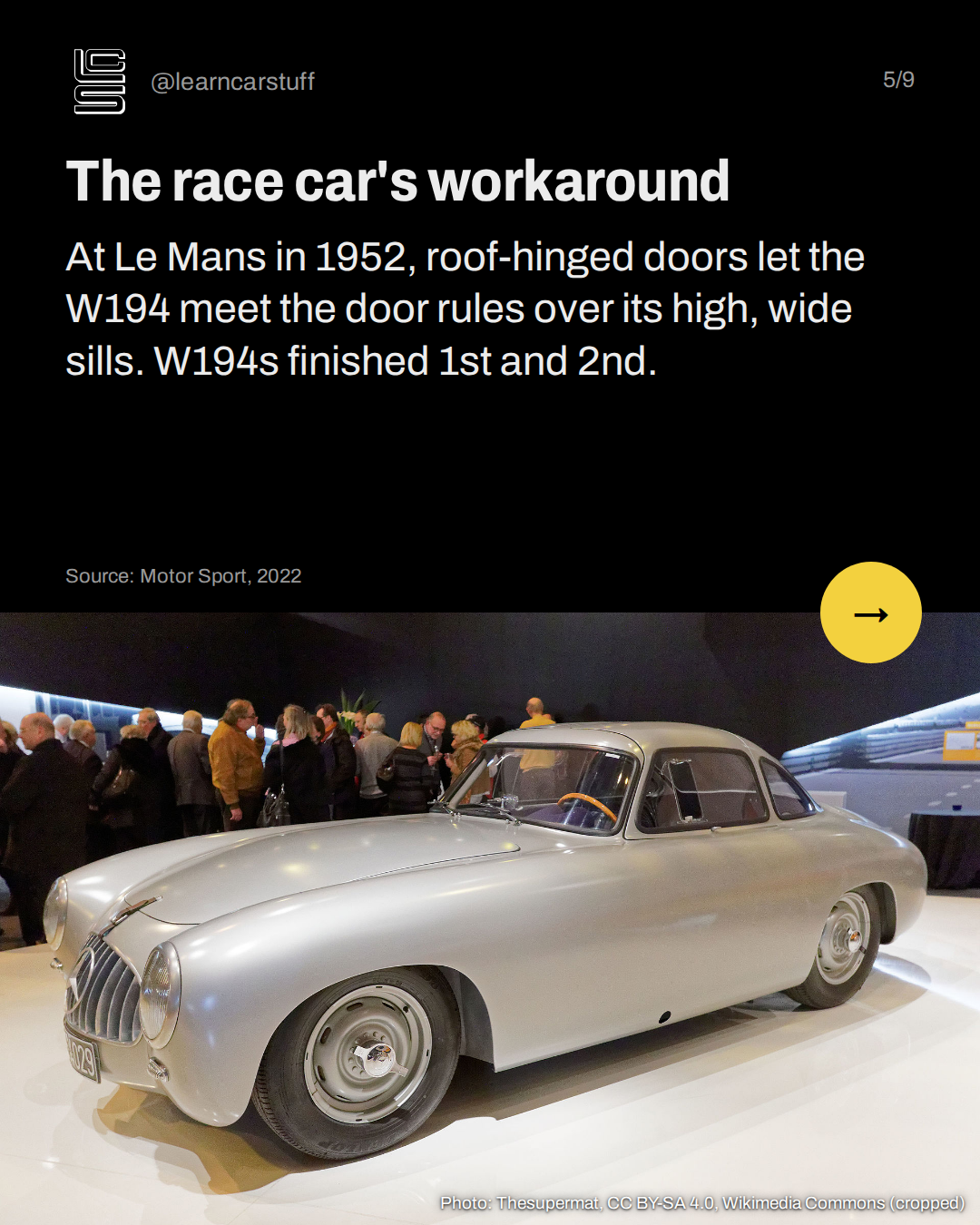
The race car's workaround
At Le Mans in 1952, roof-hinged doors let the W194 meet the door rules over its high, wide sills. W194s finished 1st and 2nd.
Source: Motor Sport, 2022
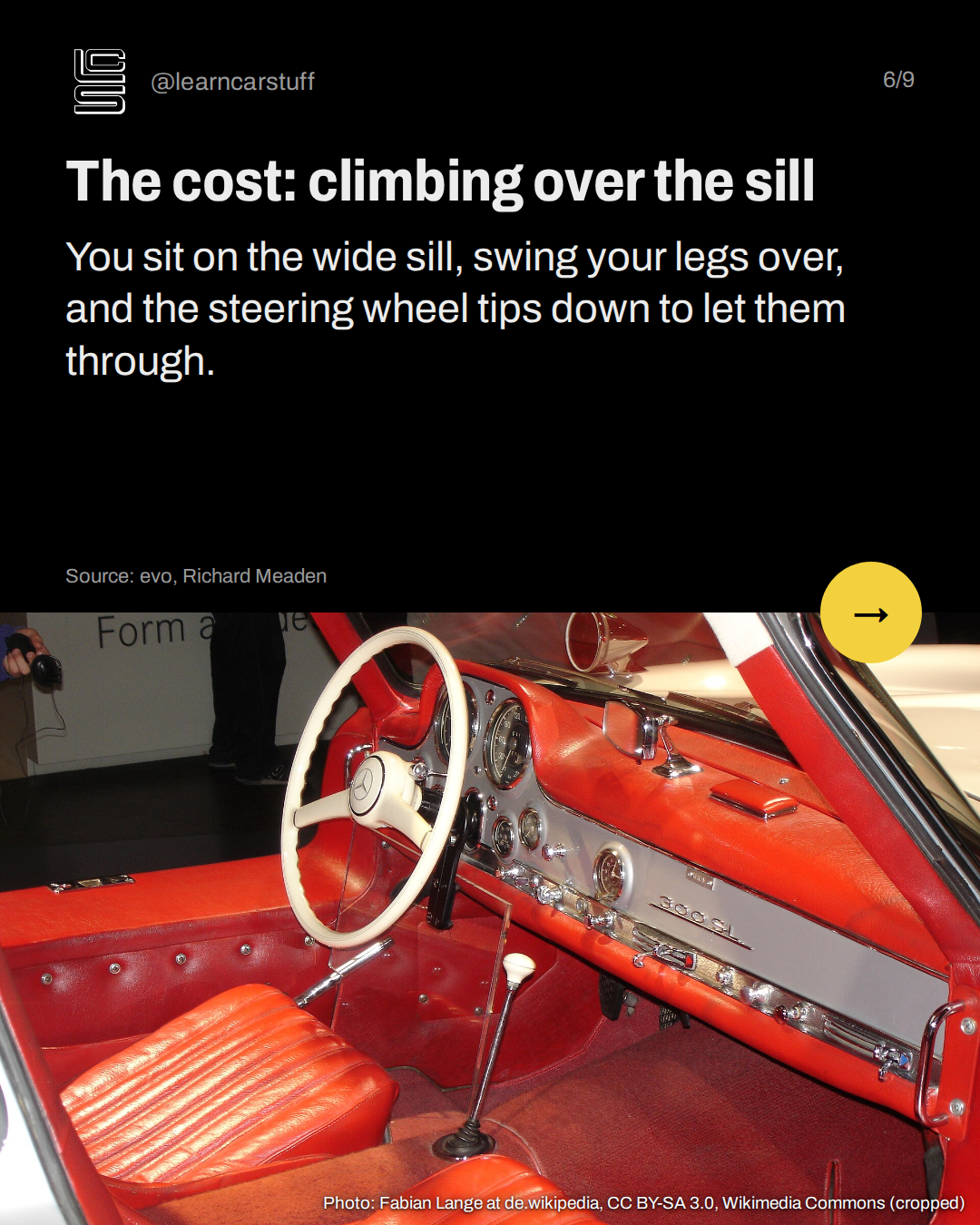
The cost: climbing over the sill
You sit on the wide sill, swing your legs over, and the steering wheel tips down to let them through.
Source: evo, Richard Meaden
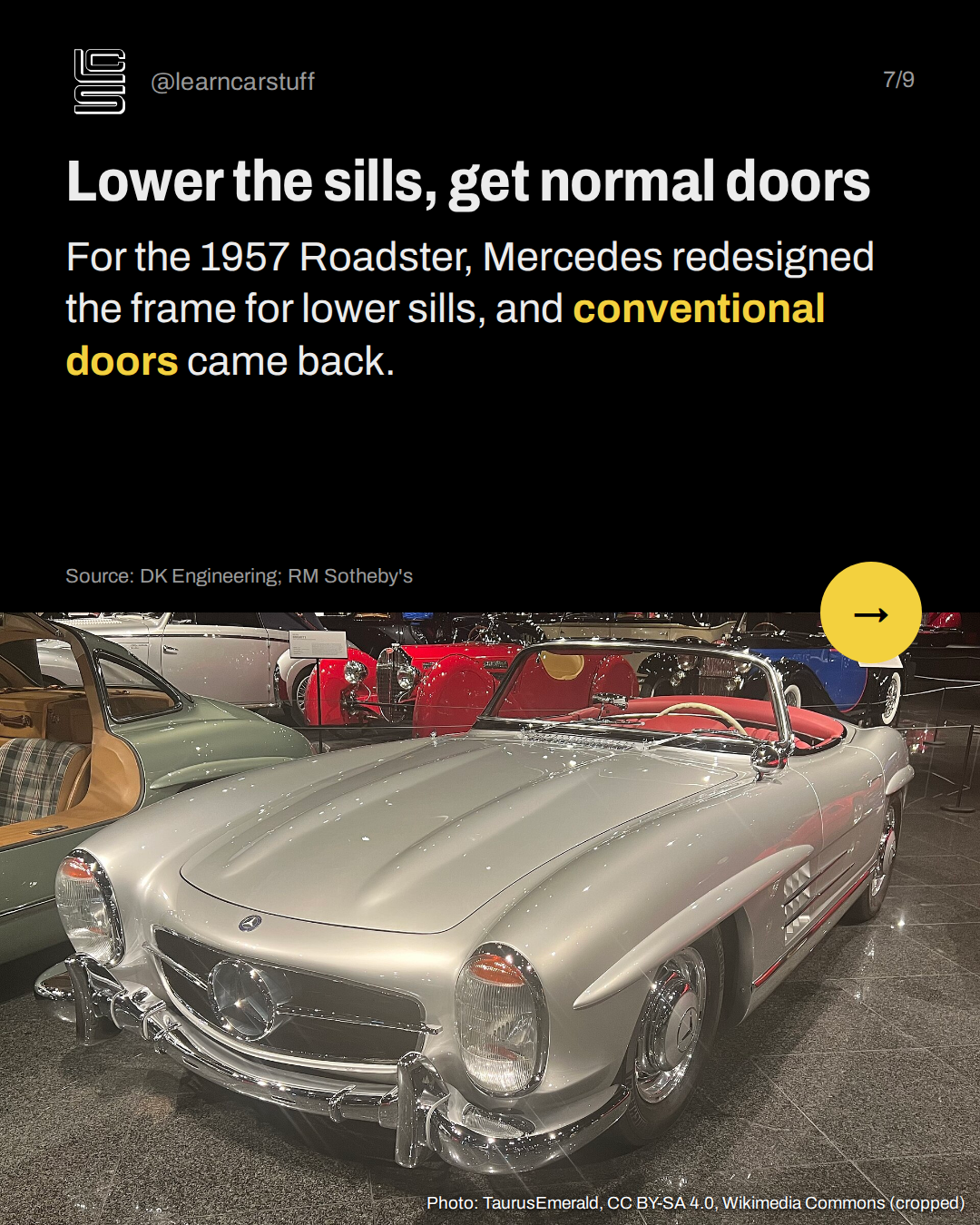
Lower the sills, get normal doors
For the 1957 Roadster, Mercedes redesigned the frame for lower sills, and conventional doors came back.
Source: DK Engineering; RM Sotheby's
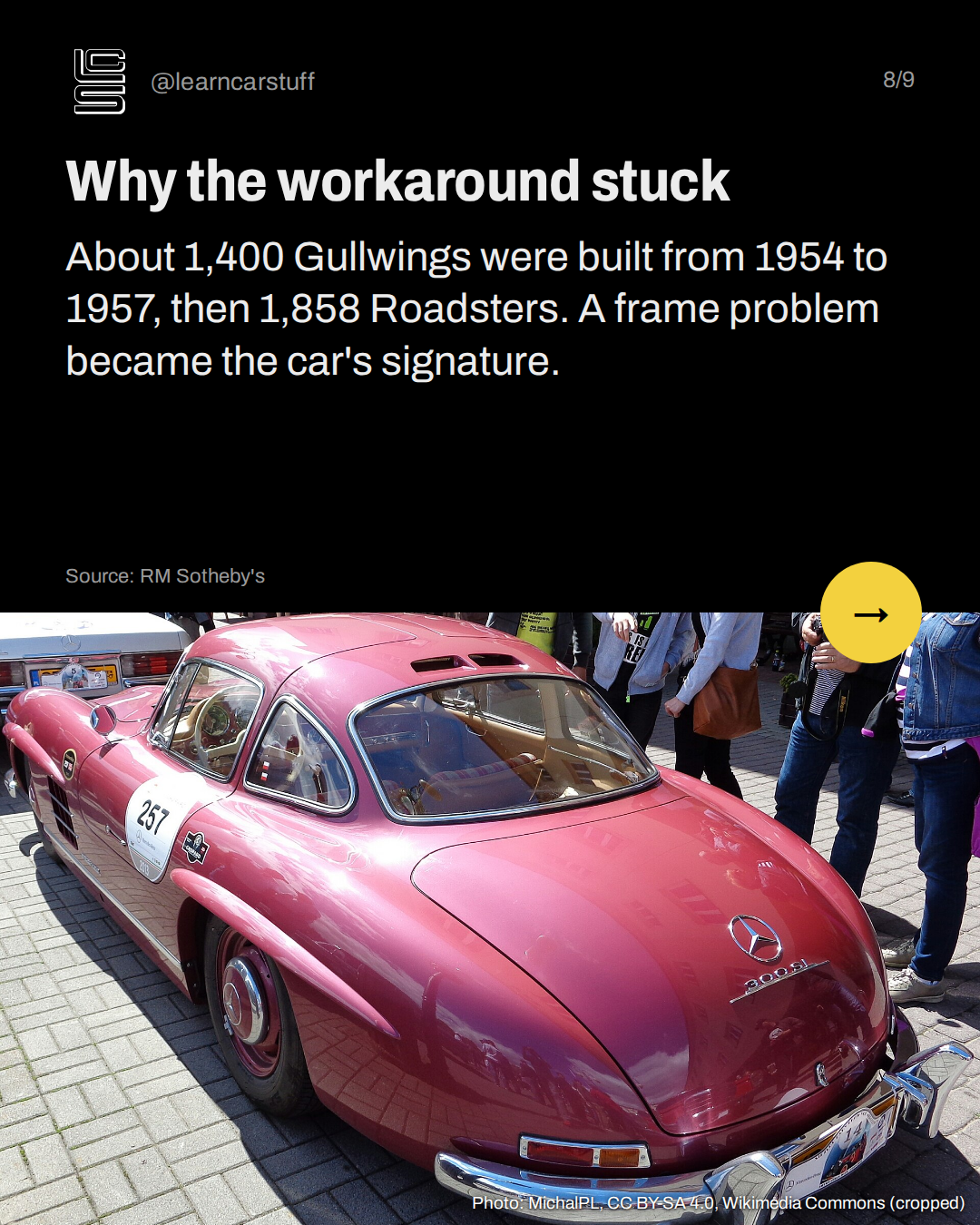
Why the workaround stuck
About 1,400 Gullwings were built from 1954 to 1957, then 1,858 Roadsters. A frame problem became the car's signature.
Source: RM Sotheby's
Sources and assumptions
- evo: Mercedes-Benz 300 SL Gullwing (1954-1957) review, Richard Meaden: Tubular space frame was 'responsible for the adoption of the famous roof-hinged gullwing doors, as it was not possible to incorporate conventional doors in the high-sided tubular structure'; to climb in you sit on the high, wide sill; the steering wheel hinges downwards for clearance; 215 bhp (checked 2026-10-12)
- Sotheby's: Everything You Need to Know about the Mercedes-Benz 300 SL Gullwing (Will Sabel Courtney, 2025-07-22): The high door sills created by the tubular spaceframe made conventional doors impractical; the steering wheel could pivot to ease entry; W194 race car of 1952 preceded the W198; production version debuted in New York in February 1954; Max Hoffman pushed for the road car (checked 2026-10-12)
- RM Sotheby's: 1957 Mercedes-Benz 300 SL Roadster (lot r353): 'The configuration of the space frame prevented low sills, so hallmark gullwing doors, pivoting upward, were adopted'; for the Roadster 'the chassis [was] redesigned to accommodate more conventional doors'; introduced at the 1957 Geneva Salon; 1,858 Roadsters built; 1,400 coupés sold 1954-1957 (checked 2026-10-12)
- DK Engineering: Mercedes-Benz 300 SL Roadster (1957): For the Roadster 'the spaceframe was redesigned to permit lower sills for improved access'; built with conventional doors; first shown at the Geneva Salon in 1957; low-pivot swing axles (checked 2026-10-12)
- Motor Sport: 1952 Le Mans 24 Hours: only Mercedes had luck left in the tank (Andrew Frankel, 2022-05-25): W194 300 SL gullwing doors were 'the most elegant way imaginable of meeting door aperture regulations with the high, wide sills required to bequeath sufficient structural strength to its spidery tubular frame'; 1952 Le Mans 1st Lang/Riess, 2nd Helfrich/Niedermayr (checked 2026-10-12)
- eMercedesBenz: Mercedes-Benz History: The Mercedes-Benz 300 SL (2010-03-17): Thin tubes welded into triangles gave the frame high torsional stiffness; the frame rose 'much further than usual up the sides of the vehicle, making it impossible to fit conventional doors'; the steering wheel could be folded down; unveiled February 1954; about 1,400 Gullwings (checked 2026-10-12)
Assumptions:
- Mercedes-Benz's own pages (mercedes-benz.com milestones, group.mercedes-benz.com, mercedes-benz-publicarchive.com, media.mbusa.com) all returned 403/404 to the fetch tool, so none of them was opened. The slides must NOT say 'Mercedes states' or quote Mercedes. Attribute to the opened sources (evo, Sotheby's, RM Sotheby's, Motor Sport).
- No sill height in mm or inches was found in any opened source, so describe the sill as 'high and wide' and never give a number.
- Frame weight figures conflict between sources (50, 70 and 82 kg), so leave frame weight off the slides.
- Gullwing production is given as 1,400 (RM Sotheby's, eMercedesBenz) and 1,408 (Sotheby's). Use 'about 1,400'.
- Power figures differ by source and rating (215 bhp in evo, 212 hp in Sotheby's), and the post doesn't need them. Leave them off unless the writer cites evo's '215 bhp' with its source.
- The Roadster's frame change is described as 'redesigned to permit lower sills' (DK Engineering) and 'chassis redesigned to accommodate more conventional doors' (RM). Don't add detail beyond that.
- Le Mans door rule: Motor Sport says the doors met 'door aperture regulations'. The often-told story that the first W194s had window-only hatches and were changed for Le Mans was not verified, so leave it out.
Photos:
- Photo: Alexander Migl, CC BY-SA 4.0, Wikimedia Commons (cropped)
- Photo: Jiří Sedláček, CC BY-SA 4.0, Wikimedia Commons (cropped)
- Photo: MrWalkr, CC BY-SA 4.0, Wikimedia Commons (cropped)
- Photo: Thesupermat, CC BY-SA 4.0, Wikimedia Commons (cropped)
- Photo: Fabian Lange at de.wikipedia, CC BY-SA 3.0, Wikimedia Commons (cropped)
- Photo: TaurusEmerald, CC BY-SA 4.0, Wikimedia Commons (cropped)
- Photo: MichalPL, CC BY-SA 4.0, Wikimedia Commons (cropped)
The short version
- The 300 SL's space frame ran high.
- Normal doors wouldn't fit.
- So the doors moved into the roof.
- The 1957 Roadster lowered the sills.