 Learn Car Stuff
Why do Mopar fans call a Chrysler V8 a Hemi?
Hemi describes a shape
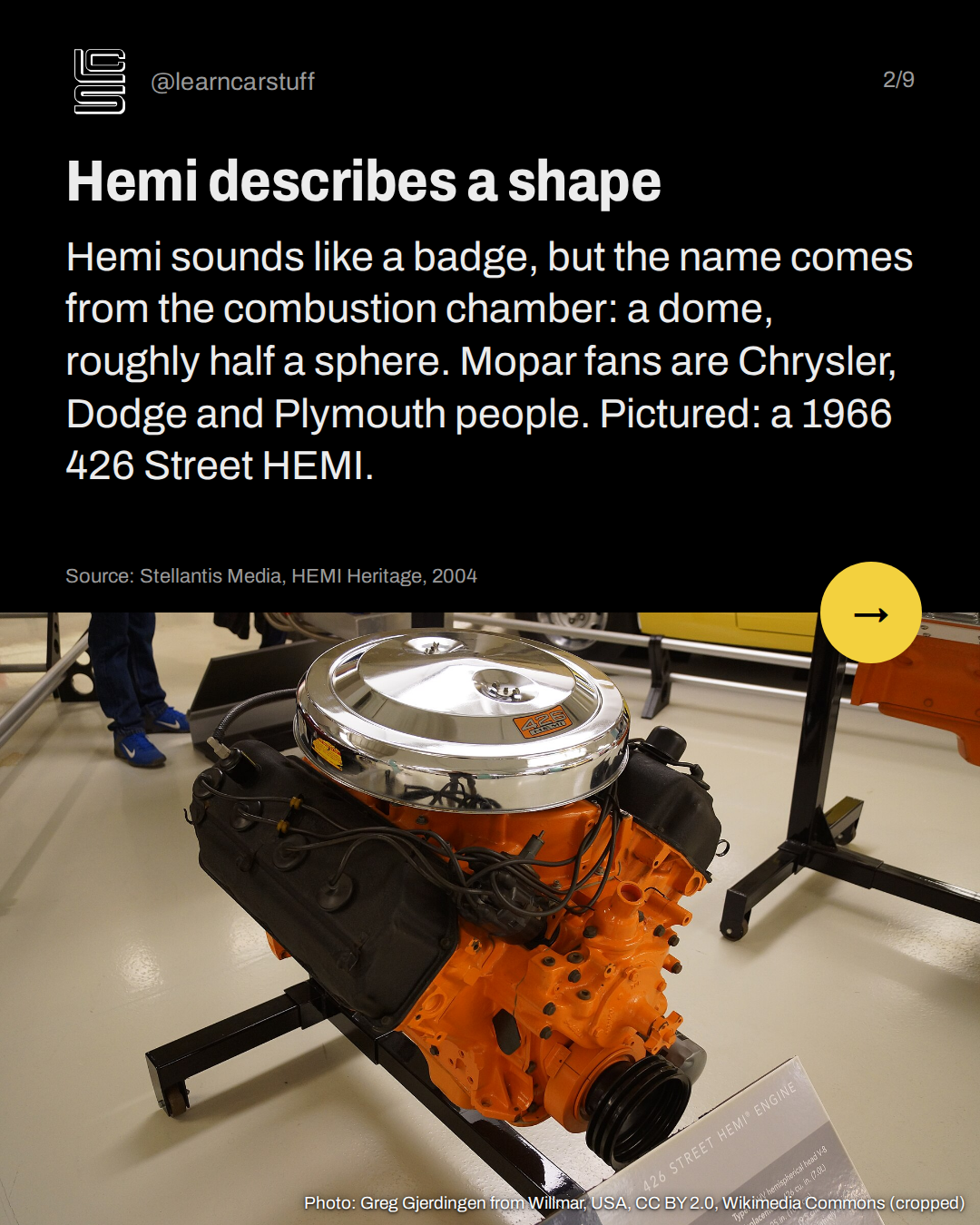
Hemi sounds like a badge, but the name comes from the combustion chamber: a dome, roughly half a sphere. Mopar fans are Chrysler, Dodge and Plymouth people. Pictured: a 1966 426 Street HEMI.
Source: Stellantis Media, HEMI Heritage, 2004
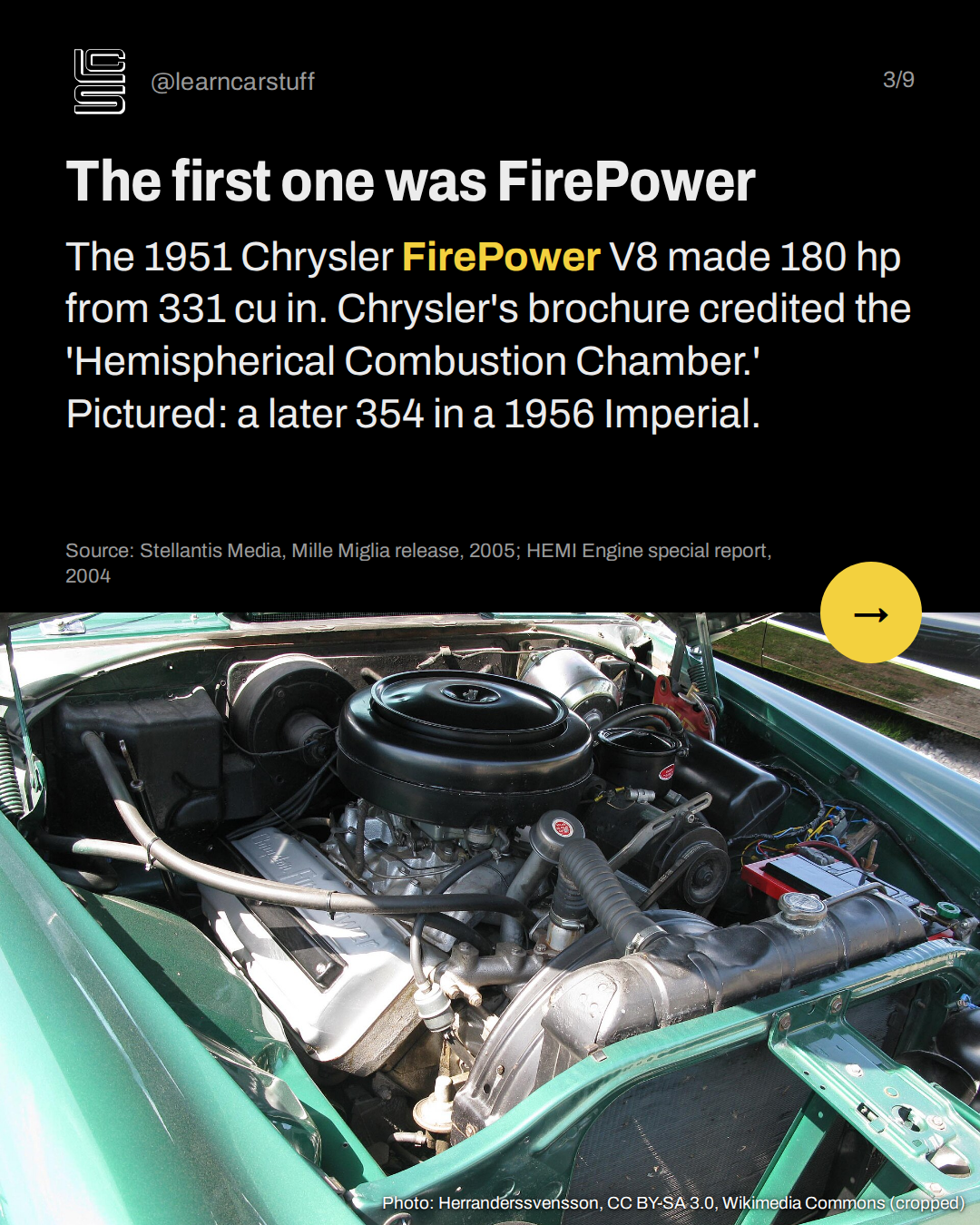
The first one was FirePower
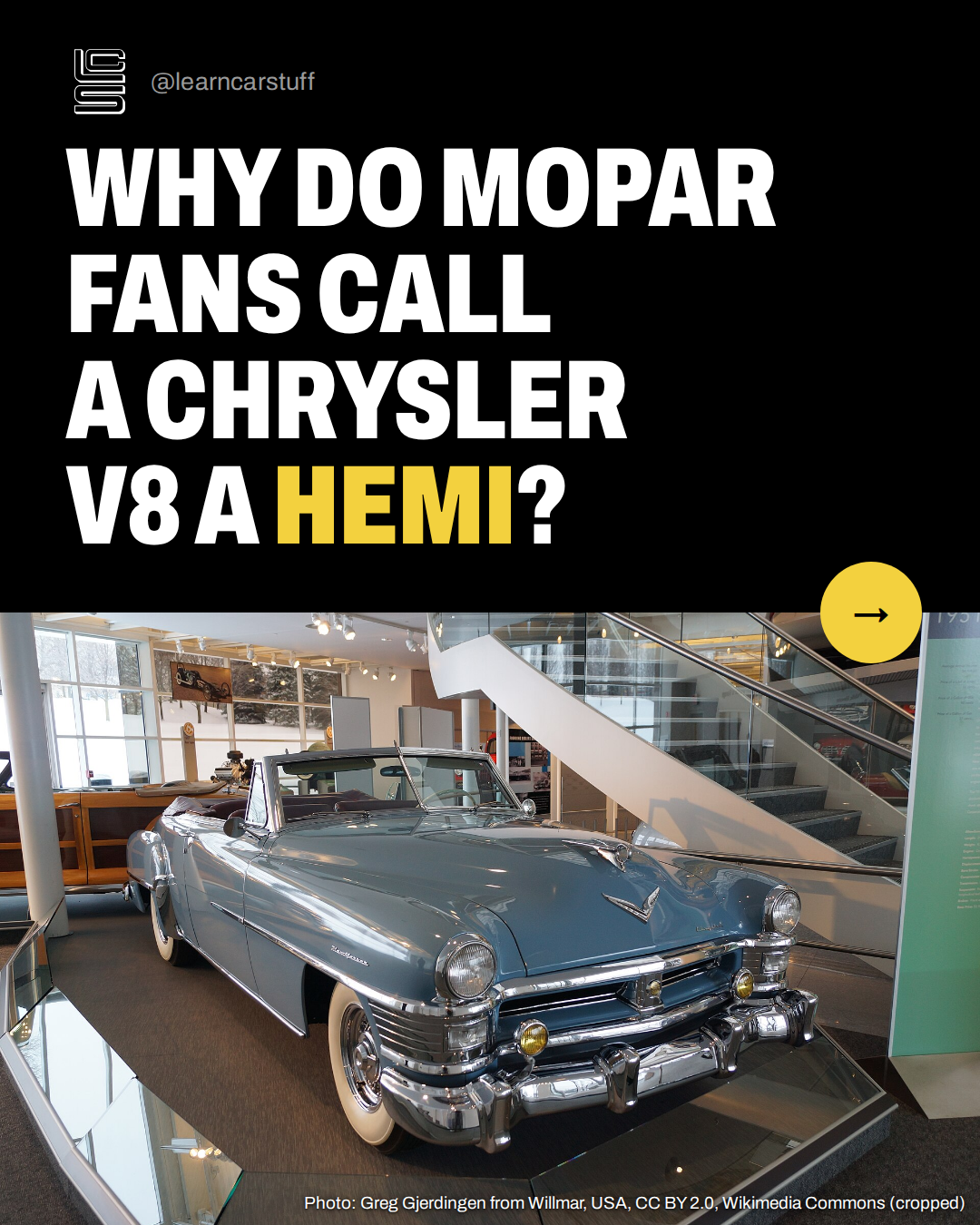
The 1951 Chrysler FirePower V8 made 180 hp from 331 cu in. Chrysler's brochure credited the 'Hemispherical Combustion Chamber.' Pictured: a later 354 in a 1956 Imperial.
Source: Stellantis Media, Mille Miglia release, 2005; HEMI Engine special report, 2004
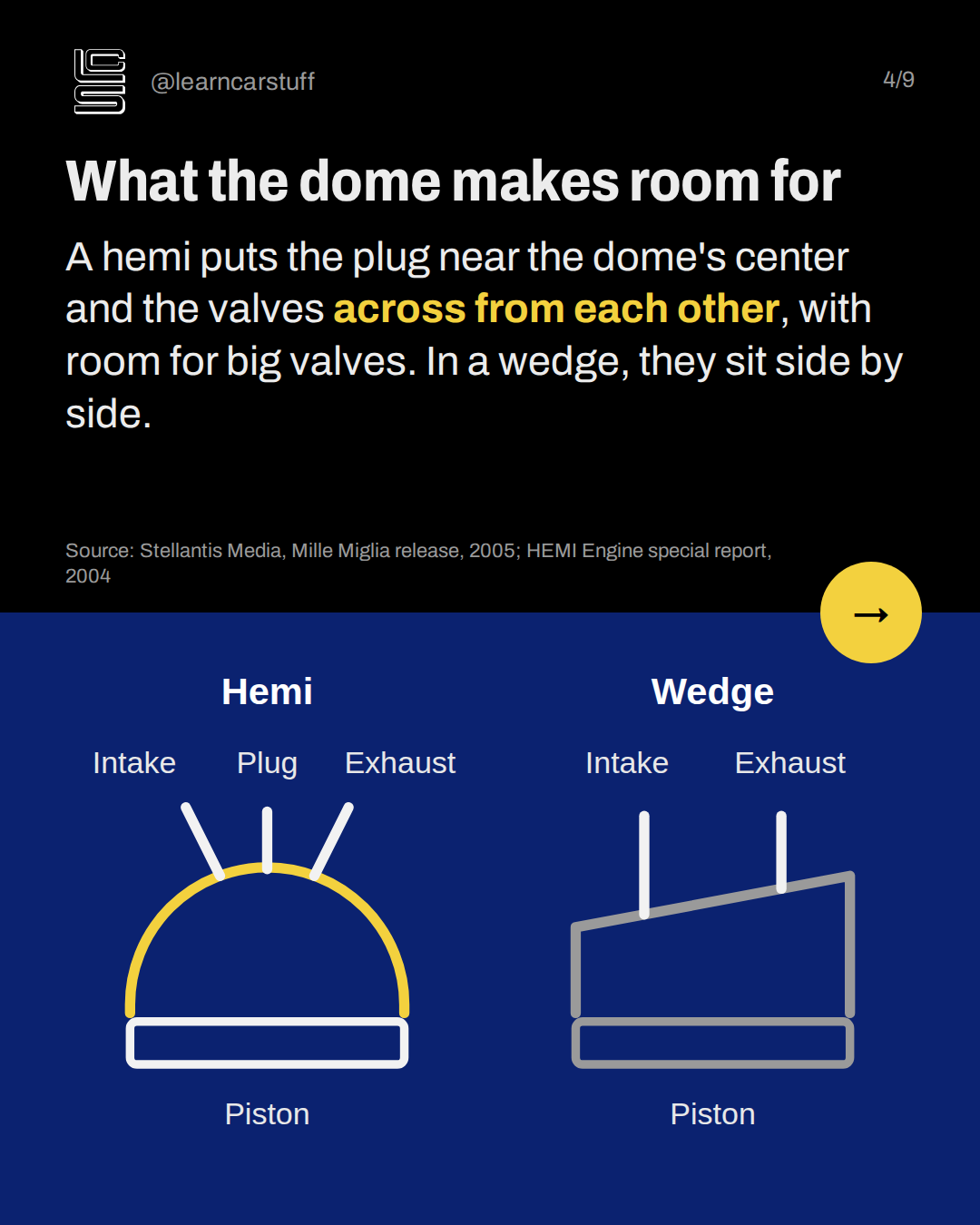
What the dome makes room for
A hemi puts the plug near the dome's center and the valves across from each other, with room for big valves. In a wedge, they sit side by side.
Source: Stellantis Media, Mille Miglia release, 2005; HEMI Engine special report, 2004
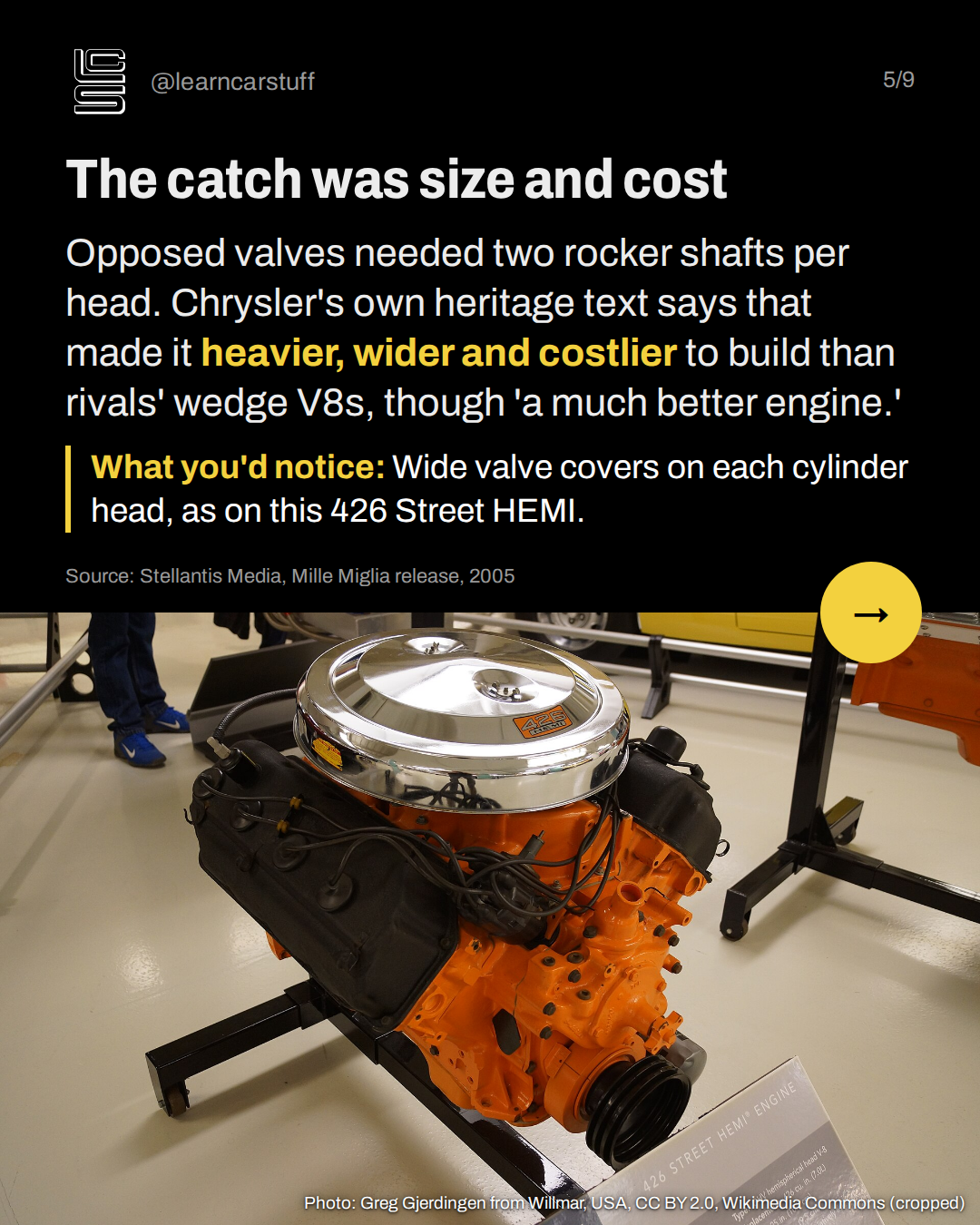
The catch was size and cost
Opposed valves needed two rocker shafts per head. Chrysler's own heritage text says that made it heavier, wider and costlier to build than rivals' wedge V8s, though 'a much better engine.'
What you'd notice: Wide valve covers on each cylinder head, as on this 426 Street HEMI.
Source: Stellantis Media, Mille Miglia release, 2005
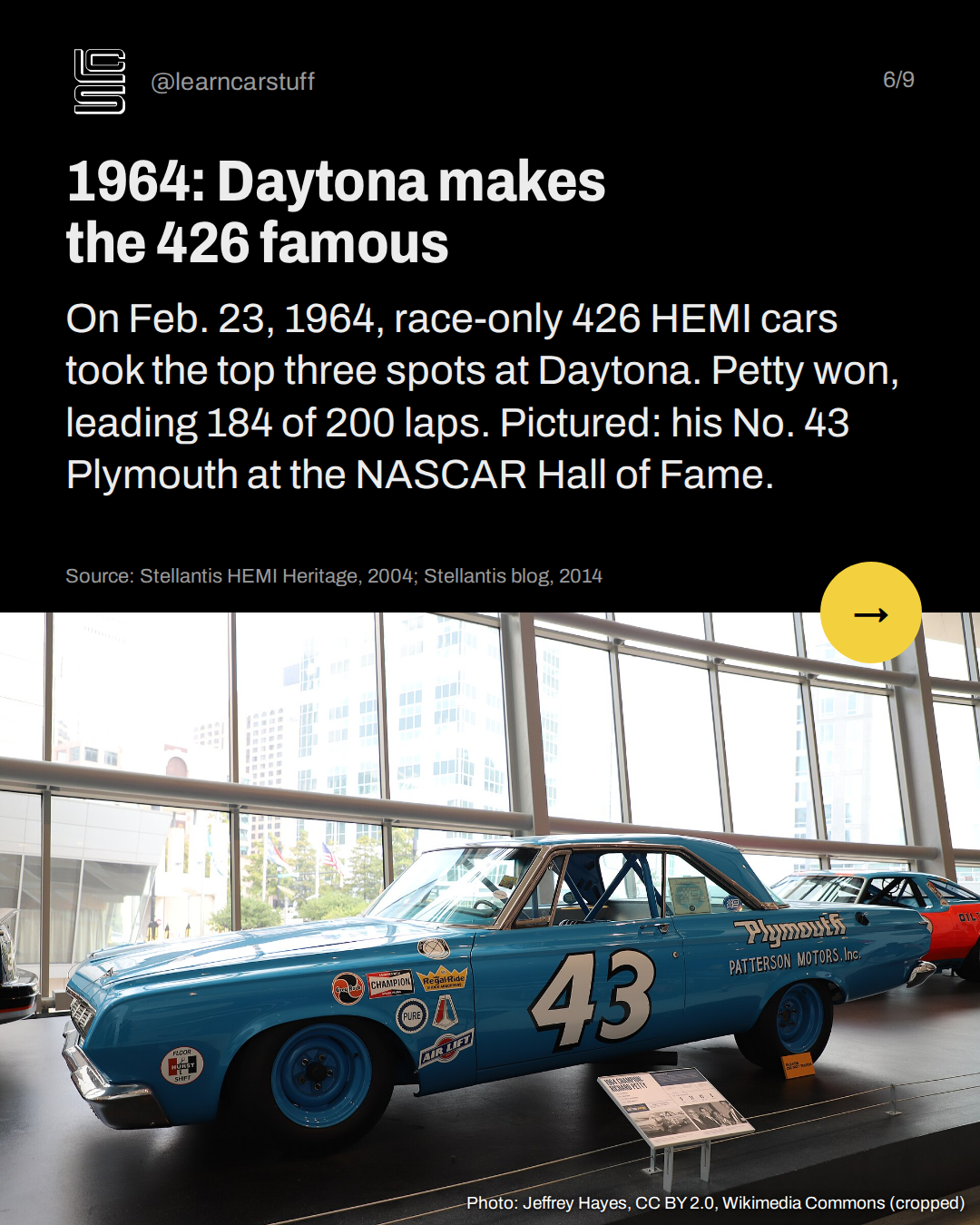
1964: Daytona makes the 426 famous
On Feb. 23, 1964, race-only 426 HEMI cars took the top three spots at Daytona. Petty won, leading 184 of 200 laps. Pictured: his No. 43 Plymouth at the NASCAR Hall of Fame.
Source: Stellantis HEMI Heritage, 2004; Stellantis blog, 2014
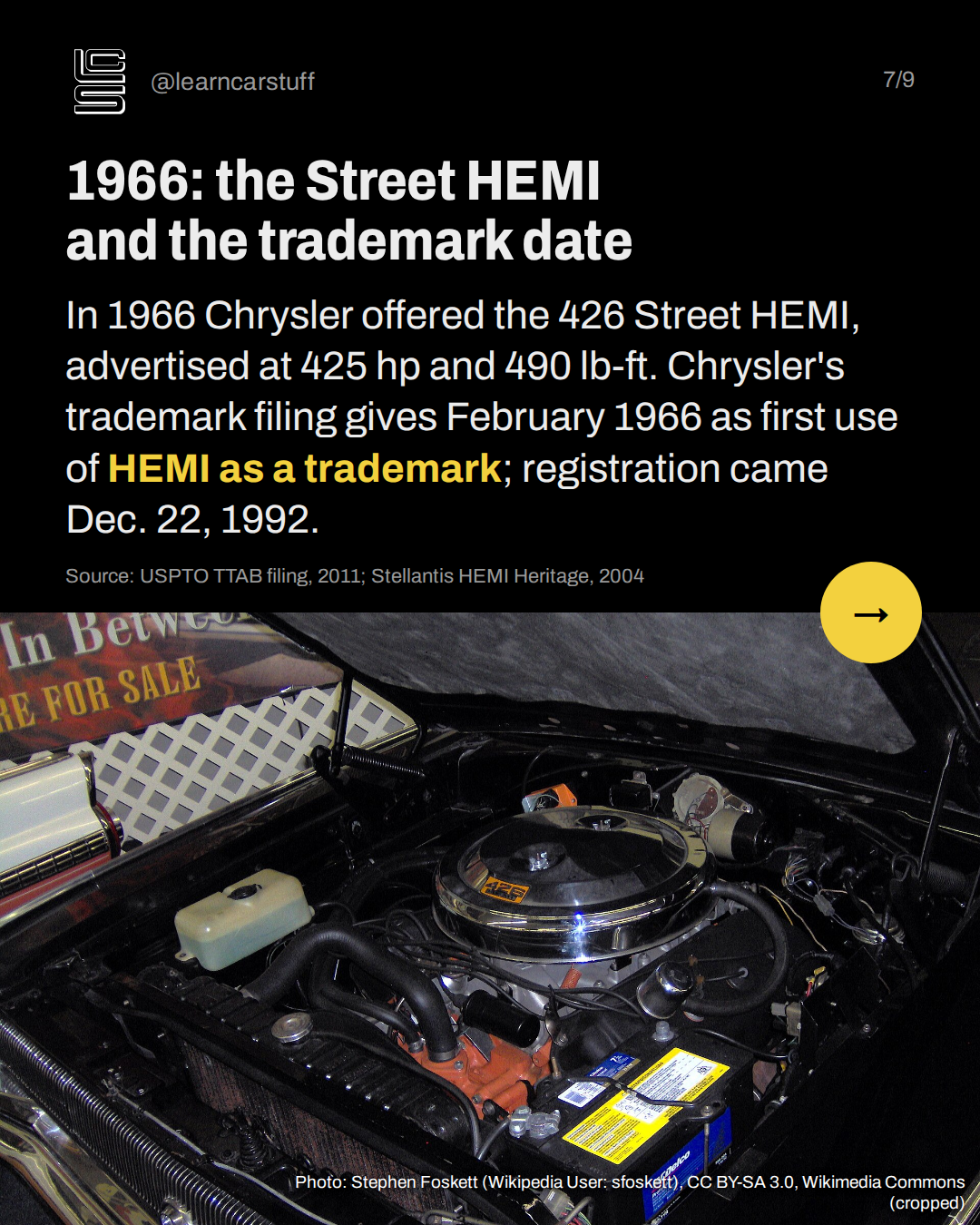
1966: the Street HEMI and the trademark date
In 1966 Chrysler offered the 426 Street HEMI, advertised at 425 hp and 490 lb-ft. Chrysler's trademark filing gives February 1966 as first use of HEMI as a trademark; registration came Dec. 22, 1992.
Source: USPTO TTAB filing, 2011; Stellantis HEMI Heritage, 2004
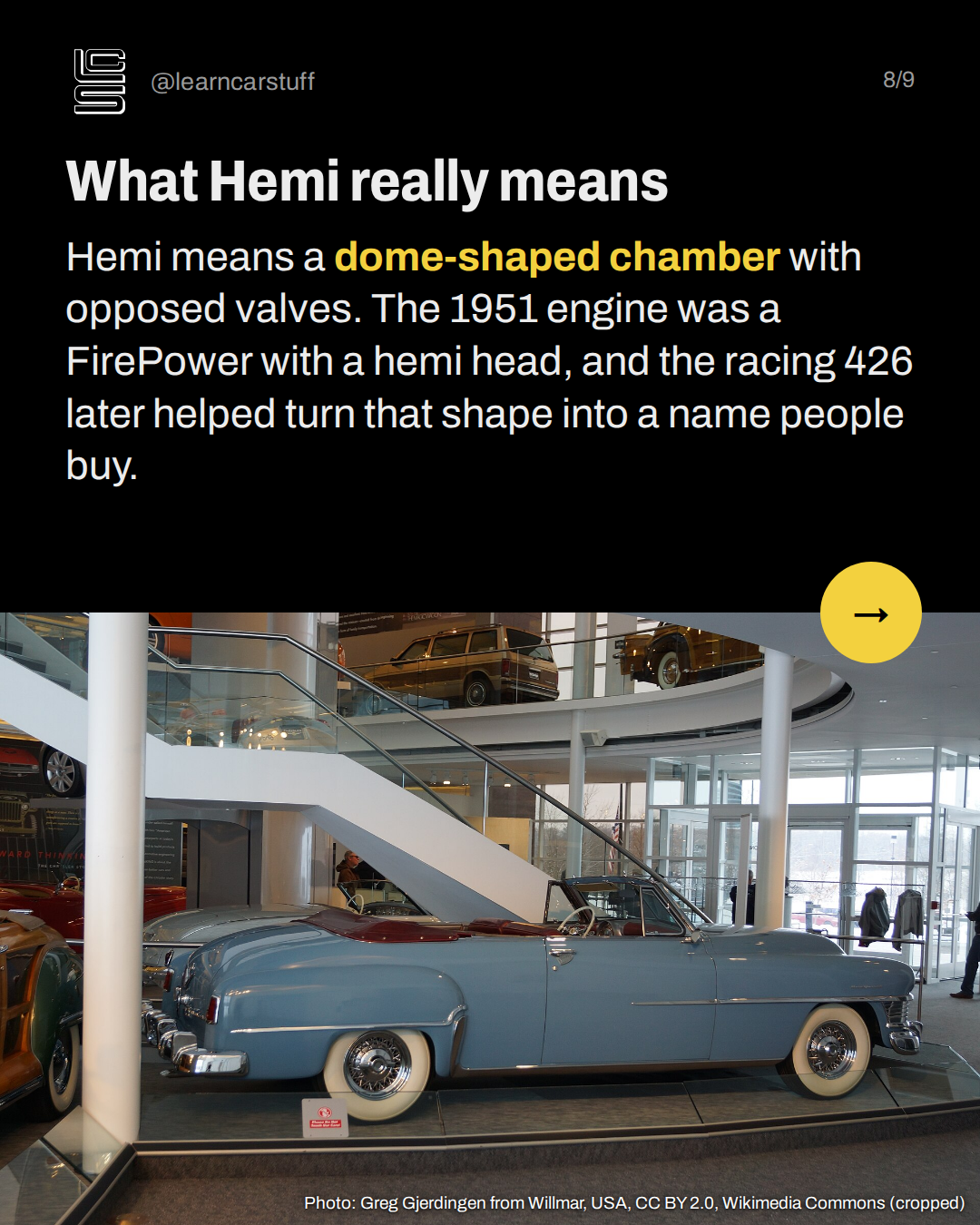
What Hemi really means
Hemi means a dome-shaped chamber with opposed valves. The 1951 engine was a FirePower with a hemi head, and the racing 426 later helped turn that shape into a name people buy.
Sources and assumptions
- Stellantis Media: Two Vintage Chrysler Vehicles to Race in Italy's Historic Mille Miglia (May 17, 2005): 1951 'Firepower' OHV V-8: 331 cu in / 5.4 L, 180 hp at 4,000 rpm; first of Chrysler's HEMI engines, introduced 1951; replaced the L-head straight eight used since 1930; central plug with opposed, inclined valves; two rocker shafts with angled pushrods; 'heavier and wider and rather more expensive to build than the OHV wedge design used by Chrysler's competition, it was a much better engine'; quotes original Chrysler materials: 'The secret of the FirePower engine lies in the Hemispherical Combustion Chamber' (checked 2026-10-12)
- Stellantis Media: HEMI Heritage (June 9, 2004): 1951 HEMI V-8 at 180 hp; engines named 'Firepower', 'Fire-dome' and 'Red Ram' across divisions; 'nearly centrally located spark plug in a hemispherically shaped combustion chamber gave the classic HEMI engine its name'; Feb. 23, 1964 426 HEMI cars swept the Daytona 500, 1st-2nd-3rd; 1966 street HEMI offered; advertised 425 hp and 490 lb-ft; 'many drivers claim the output was closer to 500 hp'; street HEMI ended in 1971 (checked 2026-10-12)
- Stellantis Media: Special Report: HEMI Engine (June 9, 2004): Debuted 1951 as the FirePower engine; large valves across from each other, central plug; quote 'The secret of the FirePower engine lies in the Hemispherical Combustion Chamber, developed and perfected by Chrysler Engineers' (checked 2026-10-12)
- Stellantis blog: 426 HEMI and Petty, two legends born in Daytona (Dale Jewett, Feb. 21, 2014): 426 HEMI debuted at Daytona 1964 as a pure racing engine; Petty won by a lap and 9 seconds over Jimmy Pardue, led 184 of 200 laps, record average 154.334 mph; NASCAR rule changes later forced a street version (checked 2026-10-12)
- Stellantis Media: Mopar to Celebrate 50th Anniversary of the Iconic 426 HEMI in 2014 (Jan. 8, 2014): Gen II 426 Race HEMI introduced at the February 1964 Daytona 500, Petty winning in his Plymouth; 'Street' HEMI introduced 1966; 'elephant' moniker from the engine's imposing size; original hemispherical design introduced for passenger cars in 1951 (checked 2026-10-12)
- USPTO TTAB, Chrysler Group LLC Notice of Opposition vs. Foose 'HEMISFEAR' (ESTTA408637, May 11, 2011): HEMI word mark Reg. No. 1741153, applied April 8, 1991, registered Dec. 22, 1992, for automobiles/trucks and their engines; first use and first use in commerce 1966/02; Chrysler states it has used the HEMI mark continuously in commerce since 1966 (checked 2026-10-12)
- Engine Labs: Hemi History, 10 Facts About Chrysler's Early Gen-1 Hemi Engines (Brendan Baker, Aug. 18, 2022): 331 at 180 hp at 4,000 rpm; valves 1.81 in intake and 1.50 in exhaust; crossflow head; 'Gen-II 426 engines were the first to be officially called Hemis, and Chrysler trademarked the name' (secondary) (checked 2026-10-12)
- Jalopnik: Chrysler FirePower, The History Of The First HEMI Engine: 'It wasn't even called HEMI at first, instead it was given the name FirePower'; Chrysler's chambers were a smaller dome than a true hemisphere (secondary) (checked 2026-10-12)
Assumptions:
- 'Not sold as a Hemi' rests on Chrysler's 1951 FirePower name (Stellantis) and Chrysler's own trademark filing listing February 1966 as first use of HEMI as a mark. Period ads and press may still have used 'hemi' informally as a description; the slides must say Chrysler didn't use it as the product name, not that nobody said the word.
- When enthusiasts first started saying 'Hemi' is not verified. Don't date it.
- The chamber is roughly hemispherical (Jalopnik notes a smaller dome than a true half-sphere), so say 'dome-shaped, roughly half a sphere'.
- The 331/180 hp figures apply to the 1951 Chrysler FirePower only. DeSoto (FireDome) and Dodge (Red Ram) hemis had different displacements and outputs.
- Valve sizes (1.81/1.50 in) come from Engine Labs (secondary). Use them only on the diagram as the 1951 331's figures, or drop them.
- The 425 hp / 490 lb-ft are Chrysler's advertised figures for the 1966+ street HEMI. Stellantis itself notes many drivers claim closer to 500 hp; label that as a claim.
- The end year of the first-generation FirePower differs between sources (1958 vs 1959), so the slides avoid giving it.
- The NASCAR Hall of Fame car is shown as 'Petty's No. 43 1964 Plymouth as displayed at the NASCAR Hall of Fame'. Don't claim it is the exact Daytona-winning chassis.
Photos:
- Photo: Greg Gjerdingen from Willmar, USA, CC BY 2.0, Wikimedia Commons (cropped)
- Photo: Greg Gjerdingen from Willmar, USA, CC BY 2.0, Wikimedia Commons (cropped)
- Photo: Herranderssvensson, CC BY-SA 3.0, Wikimedia Commons (cropped)
- Photo: Greg Gjerdingen from Willmar, USA, CC BY 2.0, Wikimedia Commons (cropped)
- Photo: Stephen Foskett (Wikipedia User: sfoskett), CC BY-SA 3.0, Wikimedia Commons (cropped)
- Photo: Jeffrey Hayes, CC BY 2.0, Wikimedia Commons (cropped)
The short version
- Hemi names a dome-shaped chamber.
- Chrysler's 1951 V8 was called FirePower.
- Racing made the shape famous in 1964.
- February 1966: Chrysler's trademark filing dates HEMI's first use as a trademark.
- Chrysler registered the mark in 1992.