 Learn Car Stuff
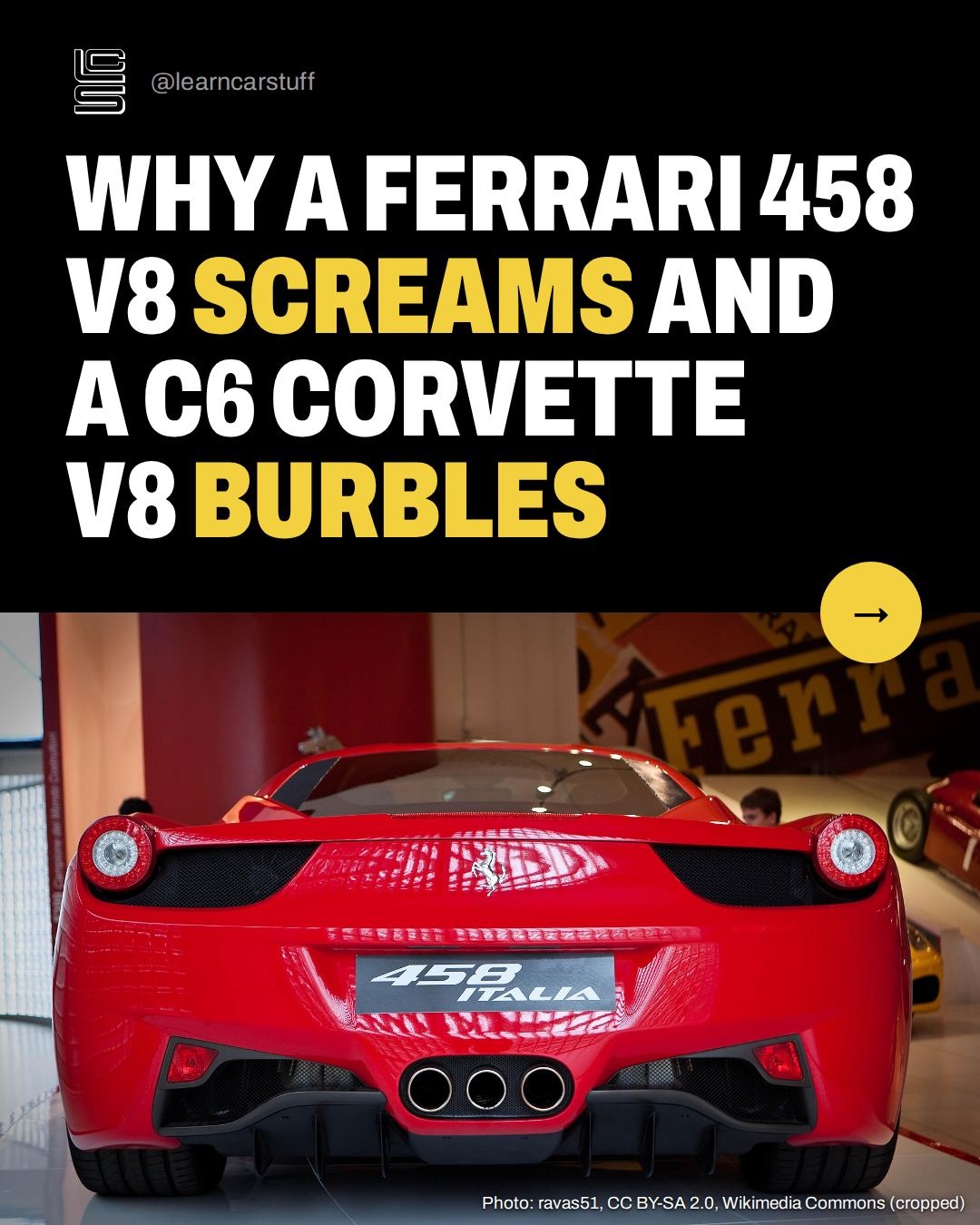
Why a Ferrari 458 V8 screams and a C6 Corvette V8 burbles
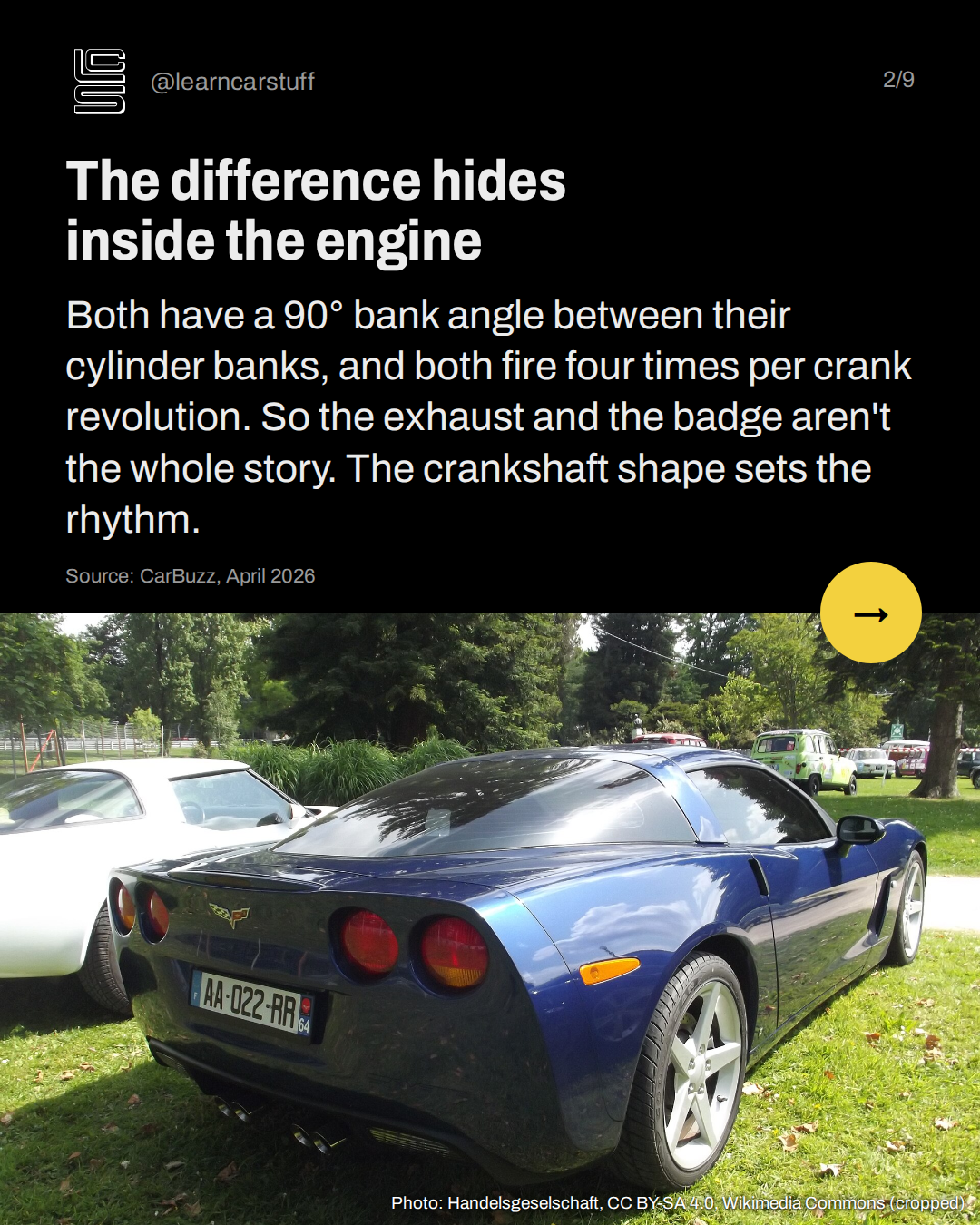
The difference hides inside the engine
Both have a 90° bank angle between their cylinder banks, and both fire four times per crank revolution. So the exhaust and the badge aren't the whole story. The crankshaft shape sets the rhythm.
Source: CarBuzz, April 2026
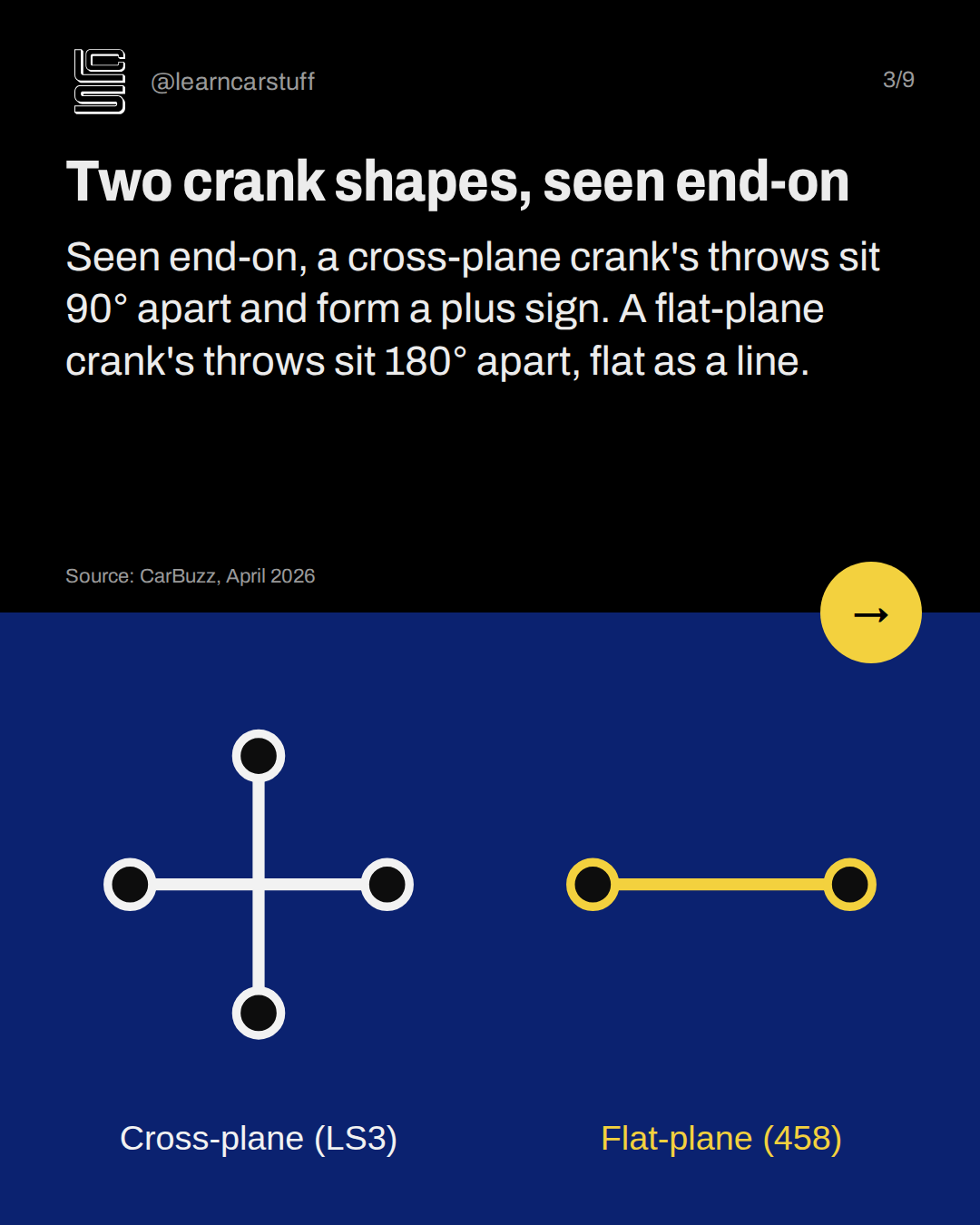
Two crank shapes, seen end-on
Seen end-on, a cross-plane crank's throws sit 90° apart and form a plus sign. A flat-plane crank's throws sit 180° apart, flat as a line.
Source: CarBuzz, April 2026
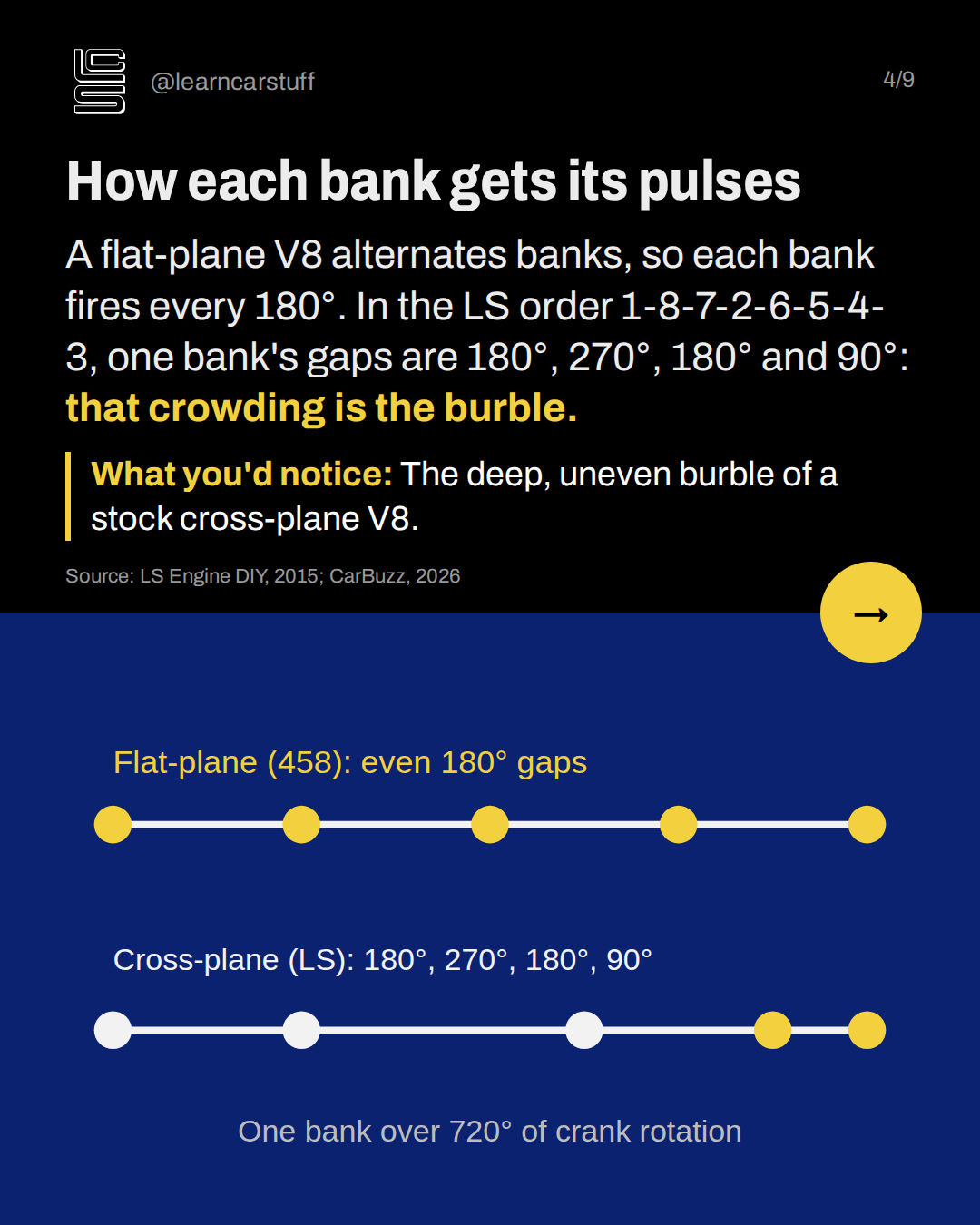
How each bank gets its pulses
A flat-plane V8 alternates banks, so each bank fires every 180°. In the LS order 1-8-7-2-6-5-4-3, one bank's gaps are 180°, 270°, 180° and 90°: that crowding is the burble.
What you'd notice: The deep, uneven burble of a stock cross-plane V8.
Source: LS Engine DIY, 2015; CarBuzz, 2026
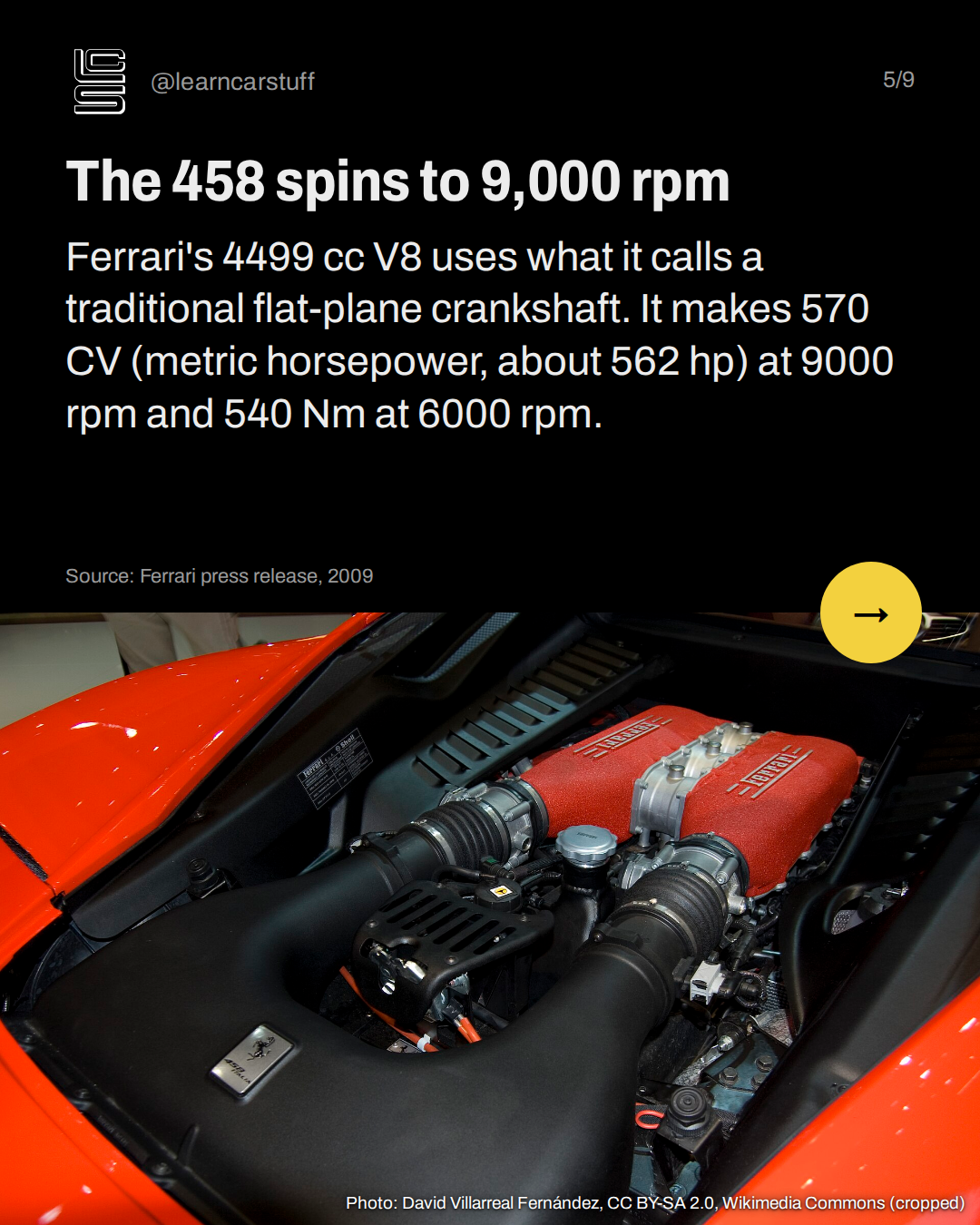
The 458 spins to 9,000 rpm
Ferrari's 4499 cc V8 uses what it calls a traditional flat-plane crankshaft. It makes 570 CV (metric horsepower, about 562 hp) at 9000 rpm and 540 Nm at 6000 rpm.
Source: Ferrari press release, 2009
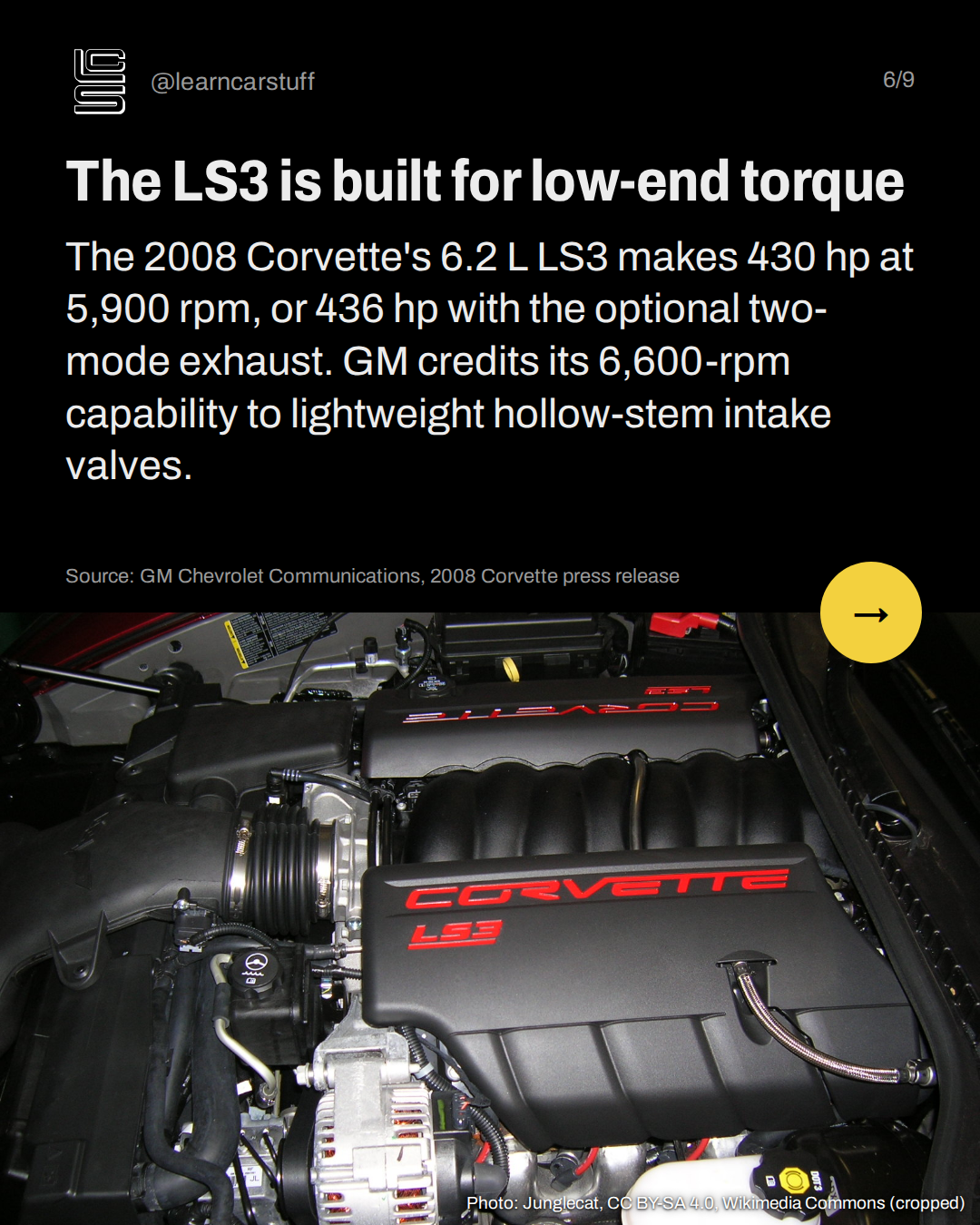
The LS3 is built for low-end torque
The 2008 Corvette's 6.2 L LS3 makes 430 hp at 5,900 rpm, or 436 hp with the optional two-mode exhaust. GM credits its 6,600-rpm capability to lightweight hollow-stem intake valves.
Source: GM Chevrolet Communications, 2008 Corvette press release
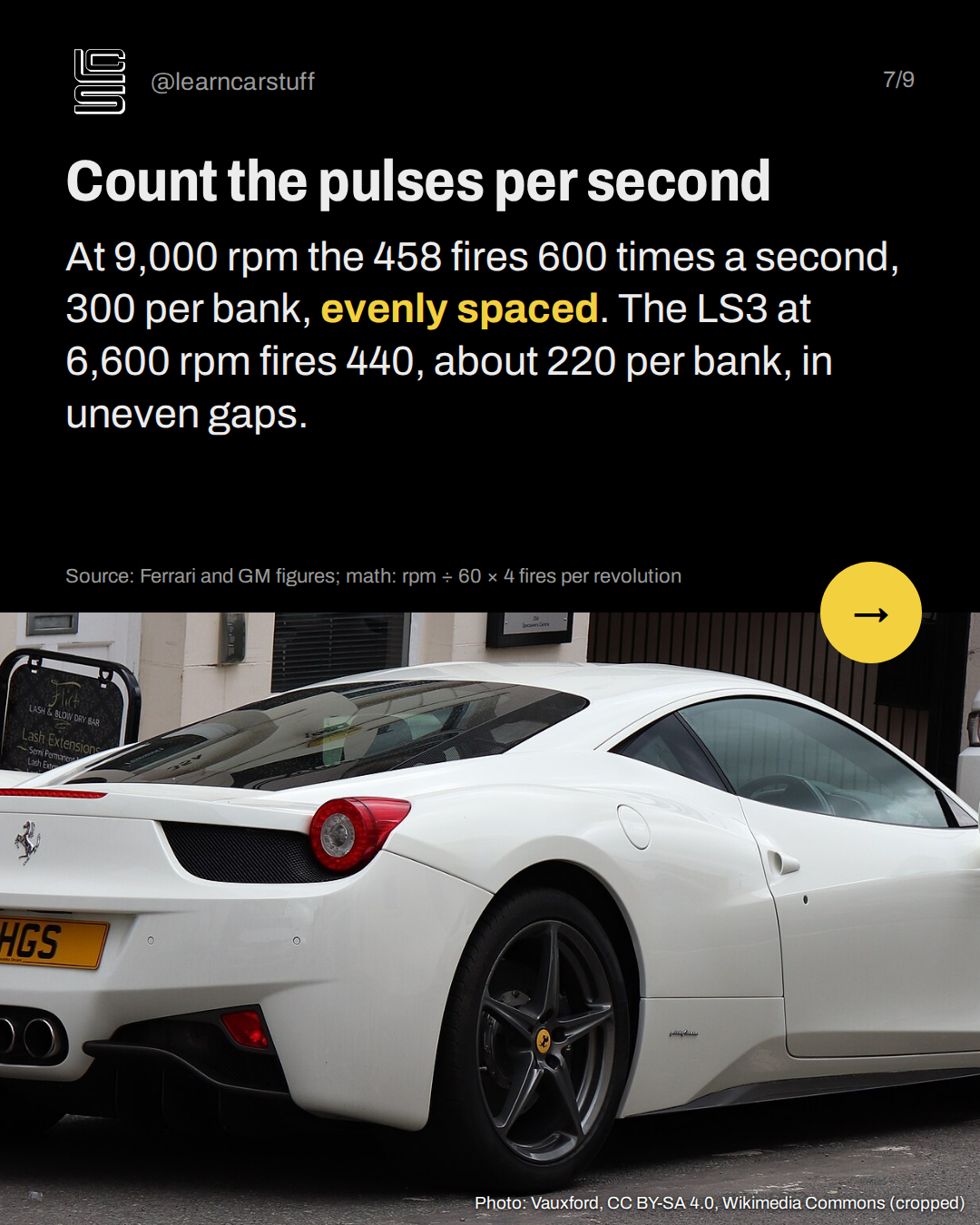
Count the pulses per second
At 9,000 rpm the 458 fires 600 times a second, 300 per bank, evenly spaced. The LS3 at 6,600 rpm fires 440, about 220 per bank, in uneven gaps.
Source: Ferrari and GM figures; math: rpm ÷ 60 × 4 fires per revolution
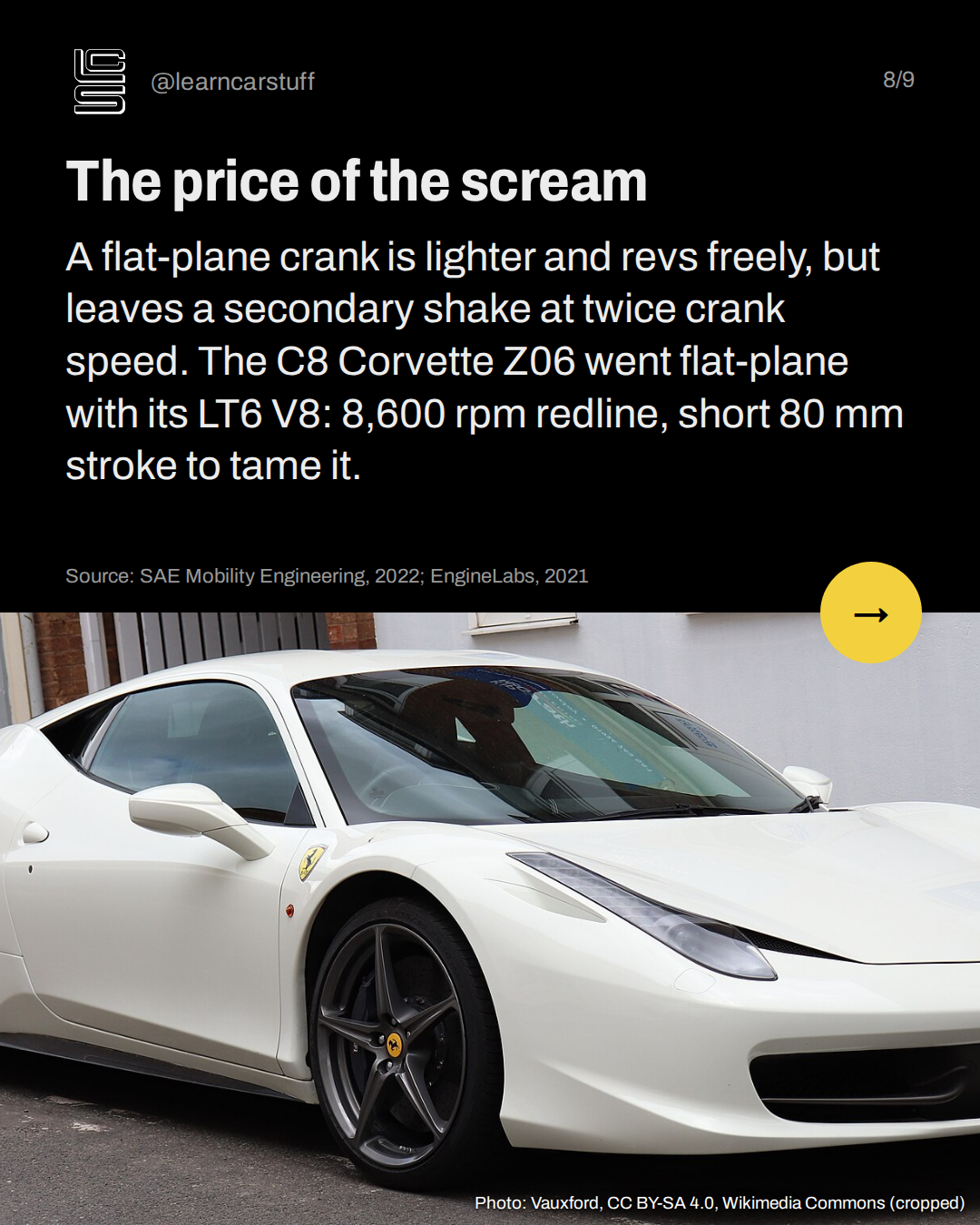
The price of the scream
A flat-plane crank is lighter and revs freely, but leaves a secondary shake at twice crank speed. The C8 Corvette Z06 went flat-plane with its LT6 V8: 8,600 rpm redline, short 80 mm stroke to tame it.
Source: SAE Mobility Engineering, 2022; EngineLabs, 2021
Sources and assumptions
- Ferrari 458 Italia press release (Source: Ferrari), republished by Car Body Design, 2009-07-28: 4499 cc V8, first Ferrari direct-injection mid-rear engine, 'Equipped with the traditional flat-plane crankshaft', 570 CV at 9000 rpm, 540 Nm at 6000 rpm (over 80% from 3250 rpm), 127 CV/litre, 12.5:1 compression (checked 2026-10-05)
- GM/Chevrolet Communications 2008 Corvette press release (reproduced by Corvette Action Center): 2008 Corvette LS3: 376 cu in / 6162 cc; 430 hp @ 5900 and 424 lb-ft @ 4600 standard; 436 hp and 428 lb-ft with optional two-mode exhaust; '6,600-rpm capability'; two-mode exhaust gives 'a more aggressive exhaust sound character' (checked 2026-10-05)
- CarBuzz, 'Flat-Plane V8 vs. Cross-Plane V8: Actual Differences Explained' (Whittle & Raymond, 2026-04-07): Flat-plane throws at 180°, cross-plane at 90°; flat-plane fires strictly alternating banks L-R-L-R; on a cross-plane, two cylinders on the same bank fire one after the other; those exhaust pulses collide in a standard manifold, which gives the deep burble; flat-plane gives a high-pitched howl; cross-plane gives strong low-end torque; 458 revs to 9,000 rpm (checked 2026-10-05)
- SAE Mobility Engineering, 'GM details Corvette's new and mighty LT6 V8' (Bill Visnic, 2022-04-01): Flat-plane V8 is 'a longstanding preference of Ferrari' and improves exhaust scavenging and high-rpm power; it has fewer counterweights than cross-plane cranks; LT6 8,600 rpm redline; short 80 mm stroke and 104.25 mm bore chosen to manage flat-plane vibration; LT6 shares only bore spacing with small-block V8s (checked 2026-10-05)
- EngineLabs, 'The Earth Isn't Flat: The Reality Regarding Flat-Plane Crankshafts' (Jeff Smith, 2021-12-02): Flat-plane always fires alternate banks L-R-L-R; flat-plane produces secondary vibration (twice per revolution); flat-plane still needs counterweights for primary forces; cross-plane consecutive same-bank firing prevents even 180° header tuning (checked 2026-10-05)
- LSX Mag, 'Flat-Plane vs. Cross-Plane: The Gemini V8 Legacy' (Howard Tanner, 2026-06-15): The American V8 has been synonymous with the cross-plane crankshaft; cross-plane fires unevenly per bank, giving the burble; flat-plane gives each bank a pulse every 180° like an inline-four; 90° throw spacing makes the cross-plane V8 smooth (checked 2026-10-05)
- LS Engine DIY, 'GM Gen III LS PCM/ECM: How to Change the Firing Order' (2015-02-14): LS-series firing order 1-8-7-2-6-5-4-3; bank 1 = cylinders 1,3,5,7, bank 2 = 2,4,6,8 (checked 2026-10-05)
Assumptions:
- The LS3 (2008-2013 C6 Corvette base engine) uses a conventional 90° cross-plane crankshaft, as GM small-block V8s do; sources state it for American/LS V8s generally, not in an LS3-specific GM document.
- Per-bank firing gaps are computed from the LS firing order 1-8-7-2-6-5-4-3 with even 90° spacing between successive firings and odd cylinders on one bank: bank 1 fires at 0°, 180°, 450°, 630°, giving gaps of 180°, 270°, 180° and 90°.
- Firing-rate math assumes a four-stroke V8 fires 4 times per crank revolution (8 cylinders over 2 revolutions), the same for both crank types.
- 9,000 rpm is the 458's peak-power rpm per Ferrari. 6,600 rpm is the LS3 'capability' GM quotes, not necessarily the exact fuel-cut on every car.
- Sound also depends on exhaust design, valve timing, intake and rpm; the crank sets the pulse pattern, it is not the only factor.
- The 2005 C6 photo shows an early C6, which had the 6.0 L LS2, also a cross-plane LS. It must not be captioned as an LS3 car.
Photos:
- Photo: Vauxford, CC BY-SA 4.0, Wikimedia Commons (cropped)
- Photo: Vauxford, CC BY-SA 4.0, Wikimedia Commons (cropped)
- Photo: ravas51, CC BY-SA 2.0, Wikimedia Commons (cropped)
- Photo: David Villarreal Fernández, CC BY-SA 2.0, Wikimedia Commons (cropped)
- Photo: Junglecat, CC BY-SA 4.0, Wikimedia Commons (cropped)
- Photo: Handelsgeselschaft, CC BY-SA 4.0, Wikimedia Commons (cropped)
The short version
- Flat-plane throws sit 180° apart.
- Each 458 bank fires in even gaps.
- LS banks fire in uneven gaps.
- A lighter flat-plane crank revs higher but shakes more.