 Learn Car Stuff
Why did Audi put four-wheel drive in a 1980 coupe?
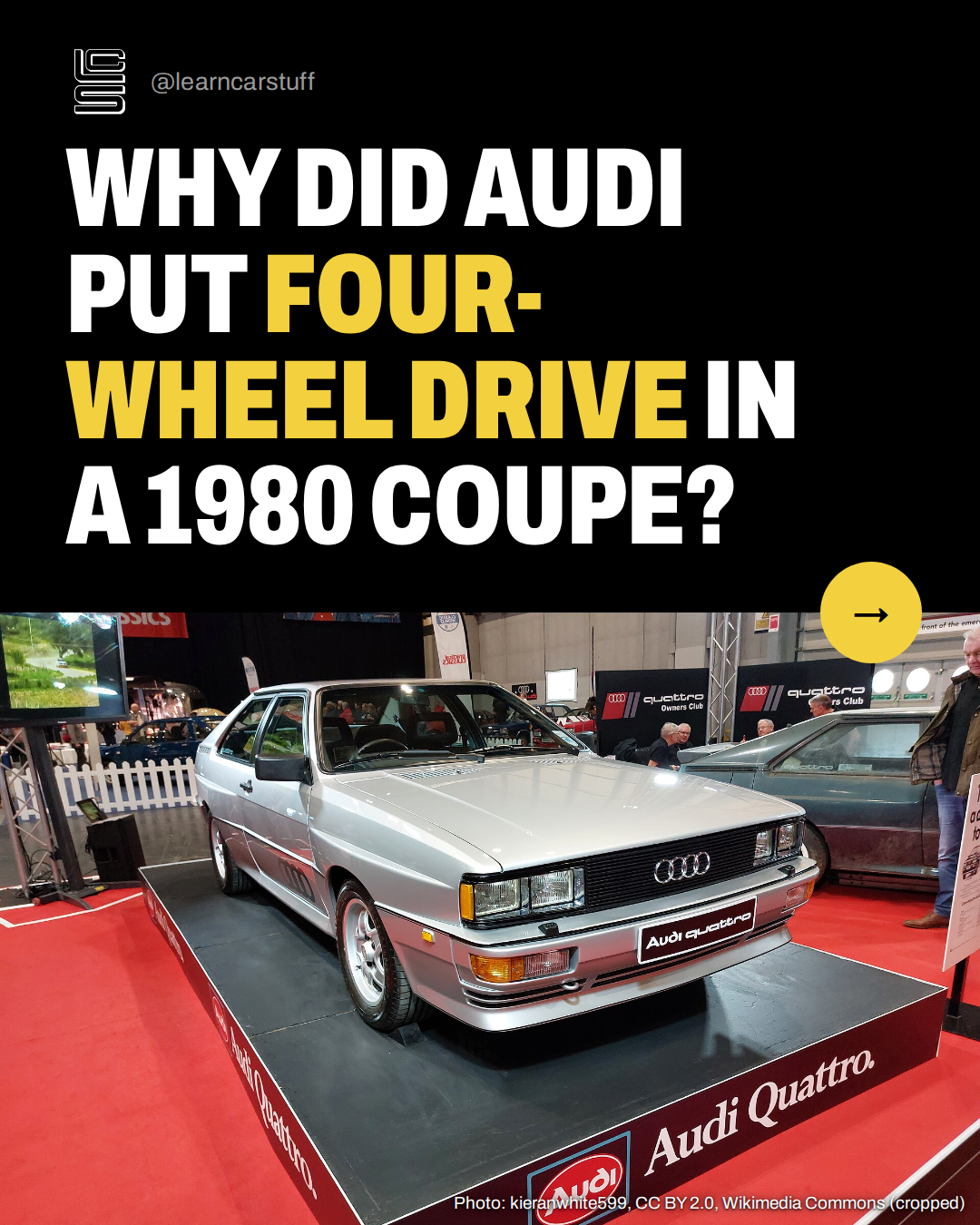
Fast cars were two-wheel drive
Around 1980, four-wheel drive mostly meant off-roaders and heavy hardware. Rally rules at first prohibited it, until the manufacturers agreed to relax them.
Source: evo, 'The WRC years: the birth of quattro'
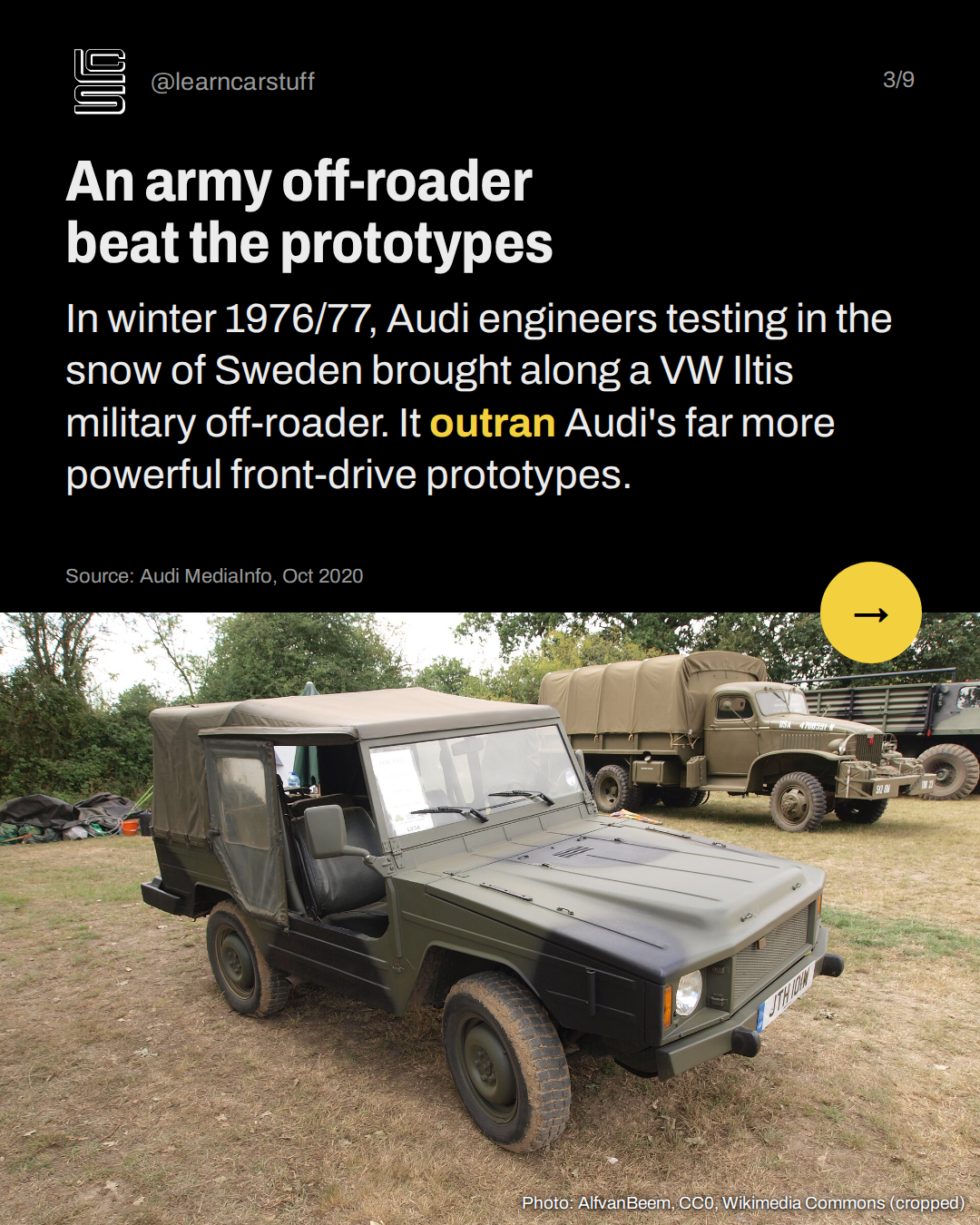
An army off-roader beat the prototypes
In winter 1976/77, Audi engineers testing in the snow of Sweden brought along a VW Iltis military off-roader. It outran Audi's far more powerful front-drive prototypes.
Source: Audi MediaInfo, Oct 2020
It had to be light and compact
Engineer Jörg Bensinger proposed a four-wheel-drive Audi road car. For a fast car, the system needed to be light and compact, with no heavy transfer case and no second propshaft.
Source: evo; Audi MediaInfo, Oct 2020
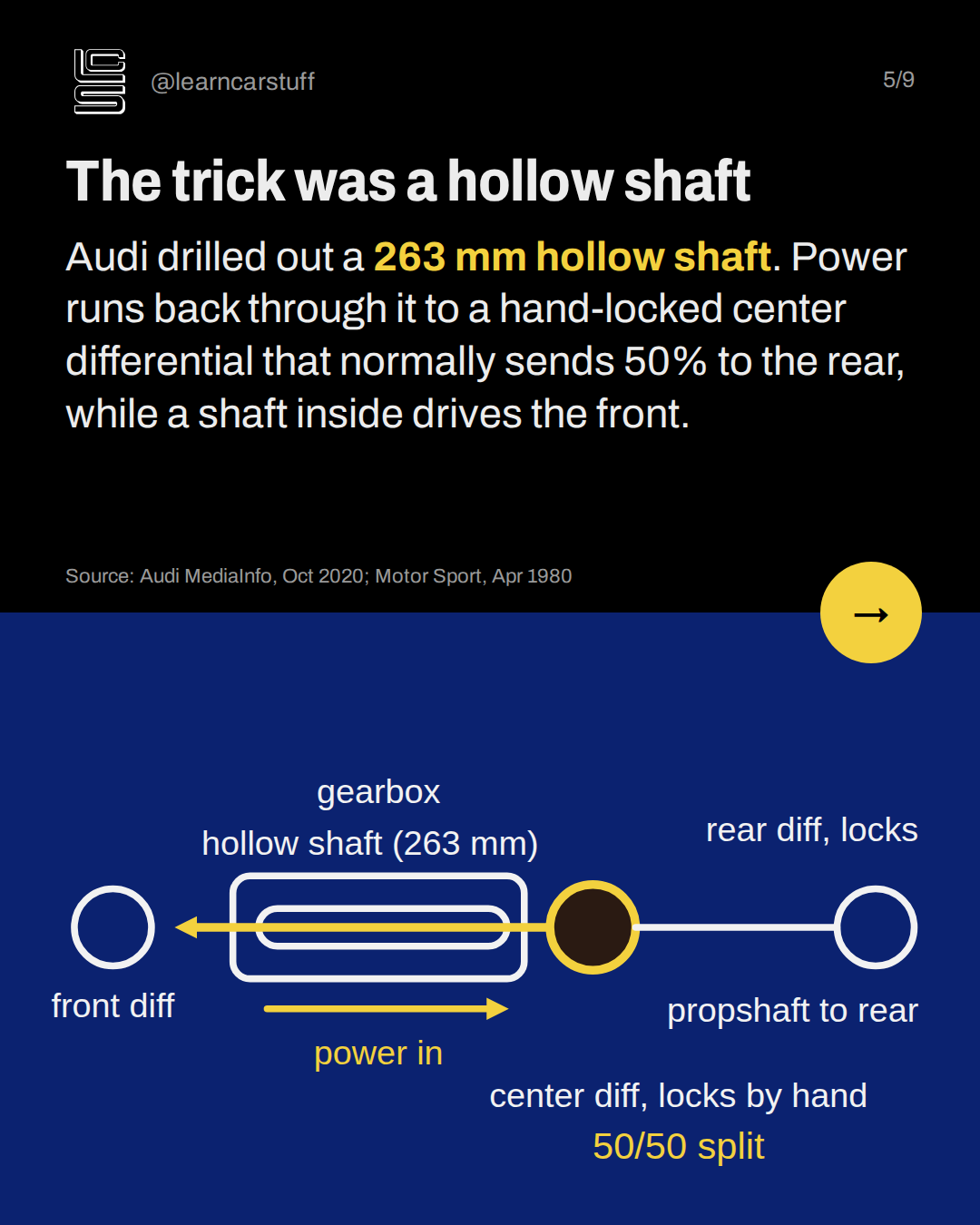
The trick was a hollow shaft
Audi drilled out a 263 mm hollow shaft. Power runs back through it to a hand-locked center differential that normally sends 50% to the rear, while a shaft inside drives the front.
Source: Audi MediaInfo, Oct 2020; Motor Sport, Apr 1980
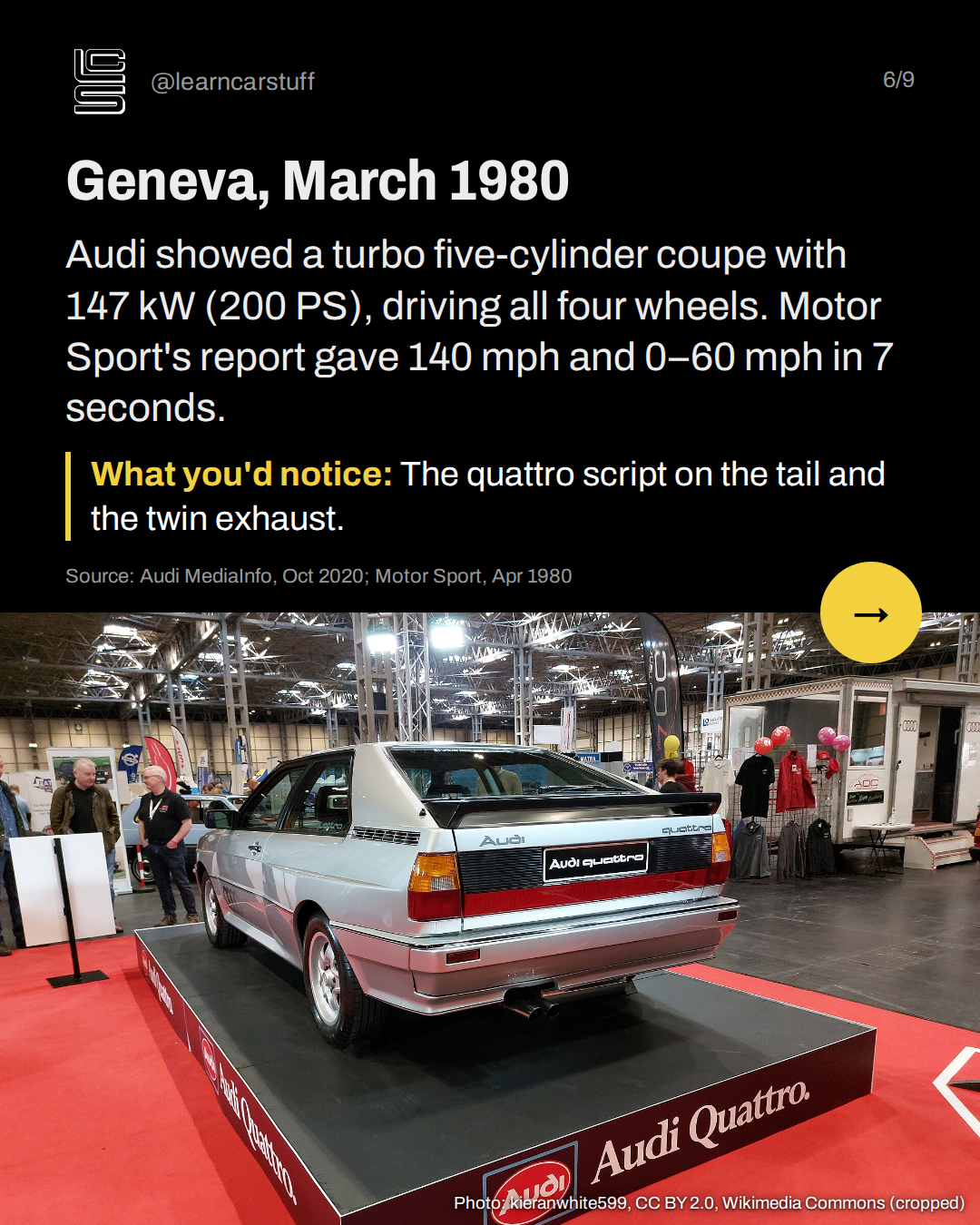
Geneva, March 1980
Audi showed a turbo five-cylinder coupe with 147 kW (200 PS), driving all four wheels. Motor Sport's report gave 140 mph and 0–60 mph in 7 seconds.
What you'd notice: The quattro script on the tail and the twin exhaust.
Source: Audi MediaInfo, Oct 2020; Motor Sport, Apr 1980
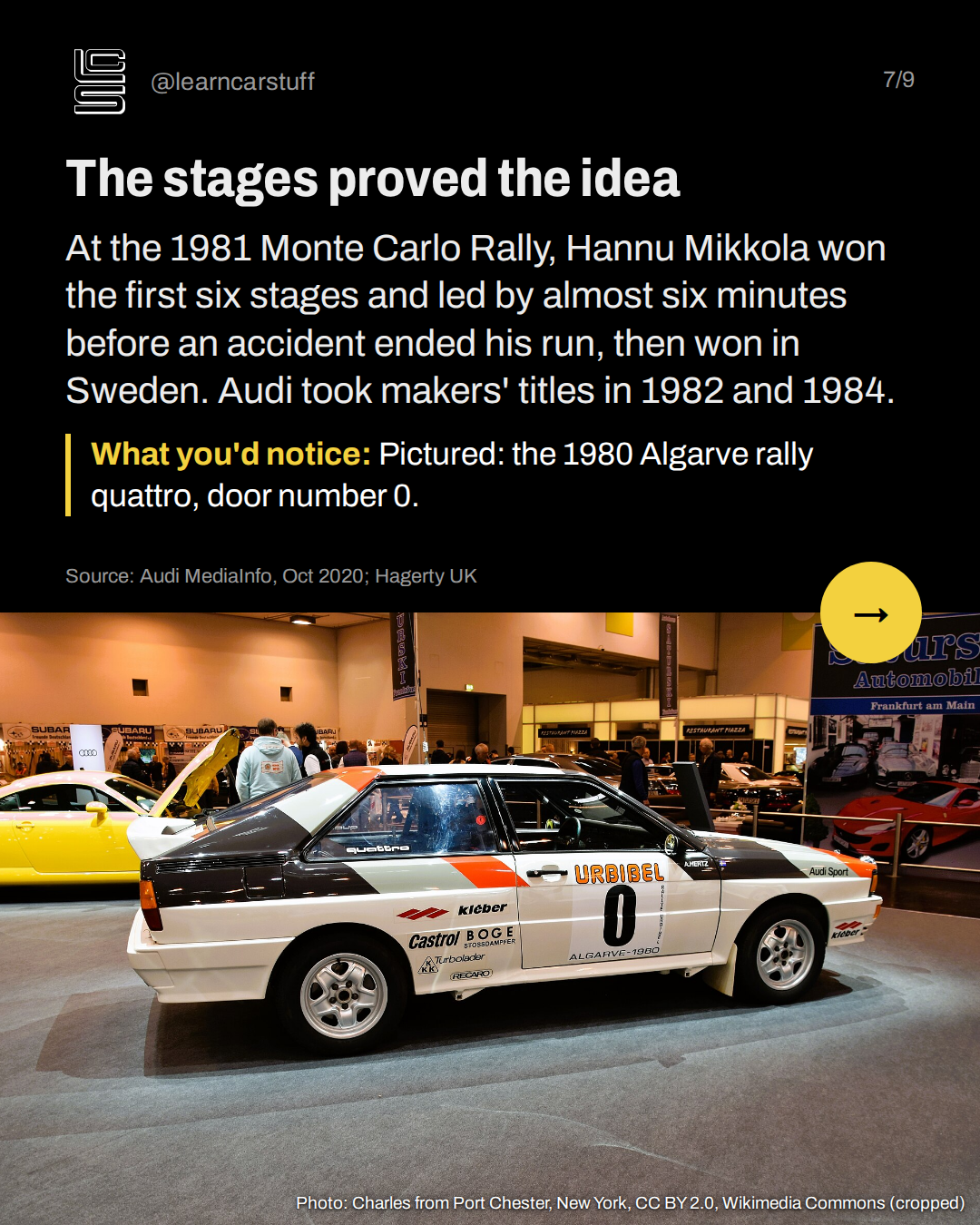
The stages proved the idea
At the 1981 Monte Carlo Rally, Hannu Mikkola won the first six stages and led by almost six minutes before an accident ended his run, then won in Sweden. Audi took makers' titles in 1982 and 1984.
What you'd notice: Pictured: the 1980 Algarve rally quattro, door number 0.
Source: Audi MediaInfo, Oct 2020; Hagerty UK
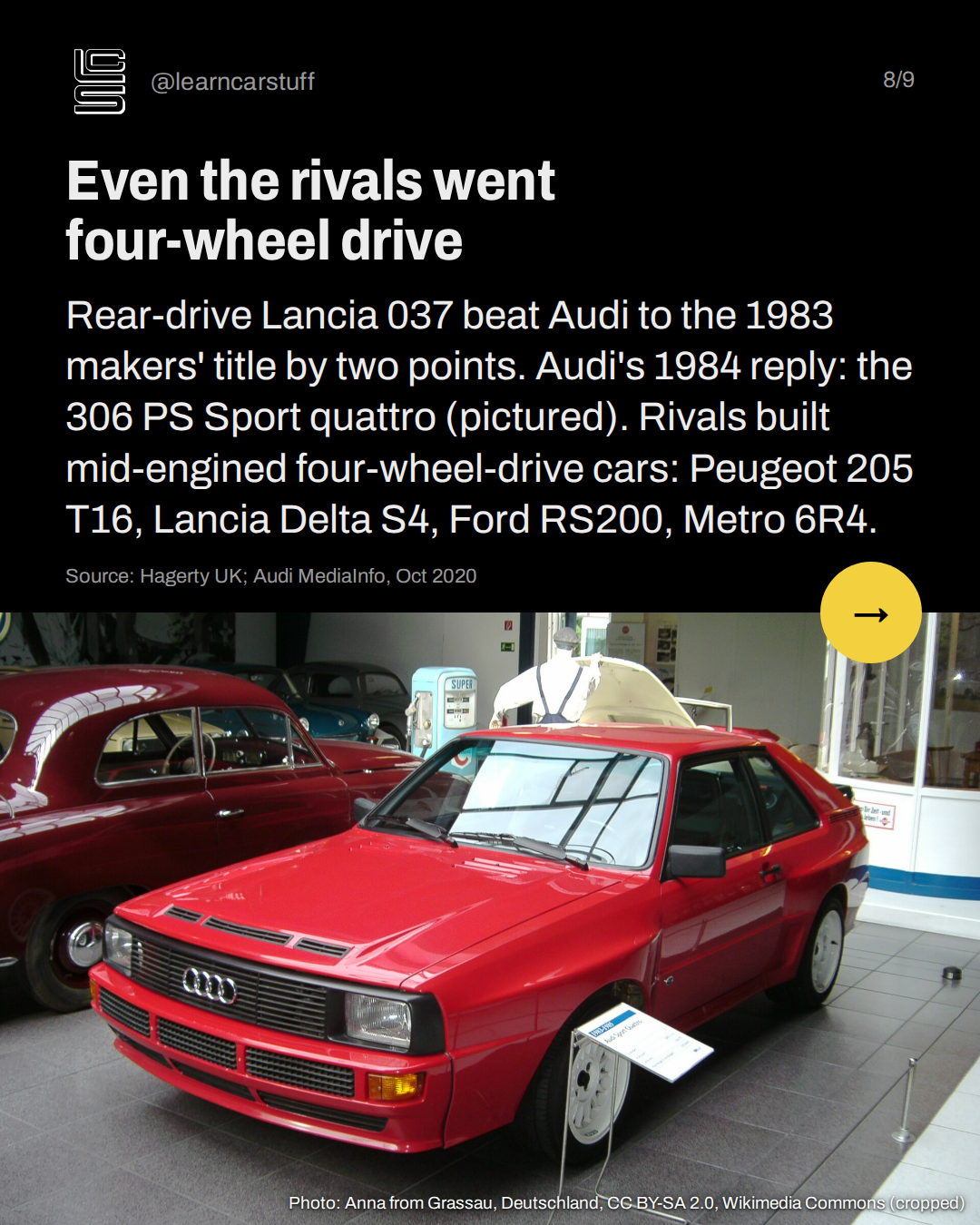
Even the rivals went four-wheel drive
Rear-drive Lancia 037 beat Audi to the 1983 makers' title by two points. Audi's 1984 reply: the 306 PS Sport quattro (pictured). Rivals built mid-engined four-wheel-drive cars: Peugeot 205 T16, Lancia Delta S4, Ford RS200, Metro 6R4.
Source: Hagerty UK; Audi MediaInfo, Oct 2020
Sources and assumptions
- Audi MediaInfo, '40 years of quattro' press information, October 2020 (Audi AG): Winter 1976/77 snow test in Sweden in which an Iltis outperformed the more powerful front-drive prototypes; the need for a lightweight, compact system with no heavy transfer case or second propshaft; the drilled-out 263 mm hollow secondary shaft; the manually locking bevel-gear center differential with 50% to the rear; the rear locking differential; the Geneva 1980 debut with a five-cylinder turbo of 147 kW (200 PS); original planned for low volume and kept on sale until 1991; Sport quattro 1984 with 225 kW (306 PS); Mikkola won the first six stages of the 1981 Monte Carlo, led by almost six minutes, crashed, then won in Sweden; almost 11 million quattro-drive Audis since 1980 (checked 2026-10-05)
- Motor Sport magazine archive, 'Audi Quattro', April 1980: Geneva Motor Show debut March 1980; 200 bhp at 5,500 rpm; lockable inter-axle differential with 50/50 split; a thin shaft running inside the tubular shaft to the front differential; a lockable rear differential developed from the Iltis 4WD cross-country vehicle; 140 mph, 0–60 mph in 7 seconds; price DM 49,990 (checked 2026-10-05)
- evo, 'The WRC years: the birth of quattro': Jörg Bensinger proposed a four-wheel-drive Audi road car during Iltis development; rally regulations at first prohibited four-wheel drive and the manufacturers agreed to relax them; Mikkola and Michèle Mouton each won rallies in 1981 (checked 2026-10-05)
- Hagerty UK, 'How a Finnish rally legend helped hone the Audi Quattro': Audi manufacturers' titles 1982 and 1984; Mikkola drivers' champion 1983 (four wins from 12 rounds); Blomqvist drivers' champion 1984; the rear-drive Lancia 037 beat Audi to the 1983 manufacturers' title by two points; rivals then built four-wheel-drive, mid-engined Group B cars (Peugeot 205 T16, Metro 6R4, Ford RS200, Lancia Delta S4) (checked 2026-10-05)
Assumptions:
- Engine displacement is left off the slides: Motor Sport (April 1980) says 2.2 litres / 2,200 cc and evo says 2.1 litres. The often-quoted 2,144 cc wasn't confirmed on an Audi page I could open. Audi's own figure, 147 kW (200 PS), is the only engine number to use.
- The debut is given as 'March 1980' (Motor Sport, Audi). The exact day, 3 March, appears only in secondary sources, so it isn't used.
- Audi's account places the 1976/77 test in Sweden. Other accounts (DirtFish, Wikipedia) say Finland, February 1977. Use Audi's version ('in the snow of Sweden') or just 'a winter snow test'.
- The Bensinger credit rests on evo. Audi's press kit says only 'a team of Audi engineers'. Wording: 'engineer Jörg Bensinger proposed...'.
- 'Rivals followed' is limited to the four Group B cars Hagerty UK names; the post doesn't claim all road-car makers copied Audi.
- Performance and price figures are Motor Sport's 1980 report, not Audi factory data; label them as such.
- The VW Iltis is a Volkswagen military off-roader (Type 183). The slide calls it 'a VW Iltis military off-roader' and gives no power figure for it.
Photos:
- Photo: kieranwhite599, CC BY 2.0, Wikimedia Commons (cropped)
- Photo: kieranwhite599, CC BY 2.0, Wikimedia Commons (cropped)
- Photo: Charles from Port Chester, New York, CC BY 2.0, Wikimedia Commons (cropped)
- Photo: Anna from Grassau, Deutschland, CC BY-SA 2.0, Wikimedia Commons (cropped)
- Photo: AlfvanBeem, CC0, Wikimedia Commons (cropped)
The short version
- A VW Iltis outran Audi's prototypes in snow.
- Audi needed a light, compact system.
- A hollow shaft replaced the transfer case.
- Rally results pushed rivals to four-wheel drive.



_(52857275453).jpg)
.jpg)
_(1980)_(Owner_Dave_Boatwright).JPG)