 Learn Car Stuff
Where did VTEC start, and what actually kicks in?

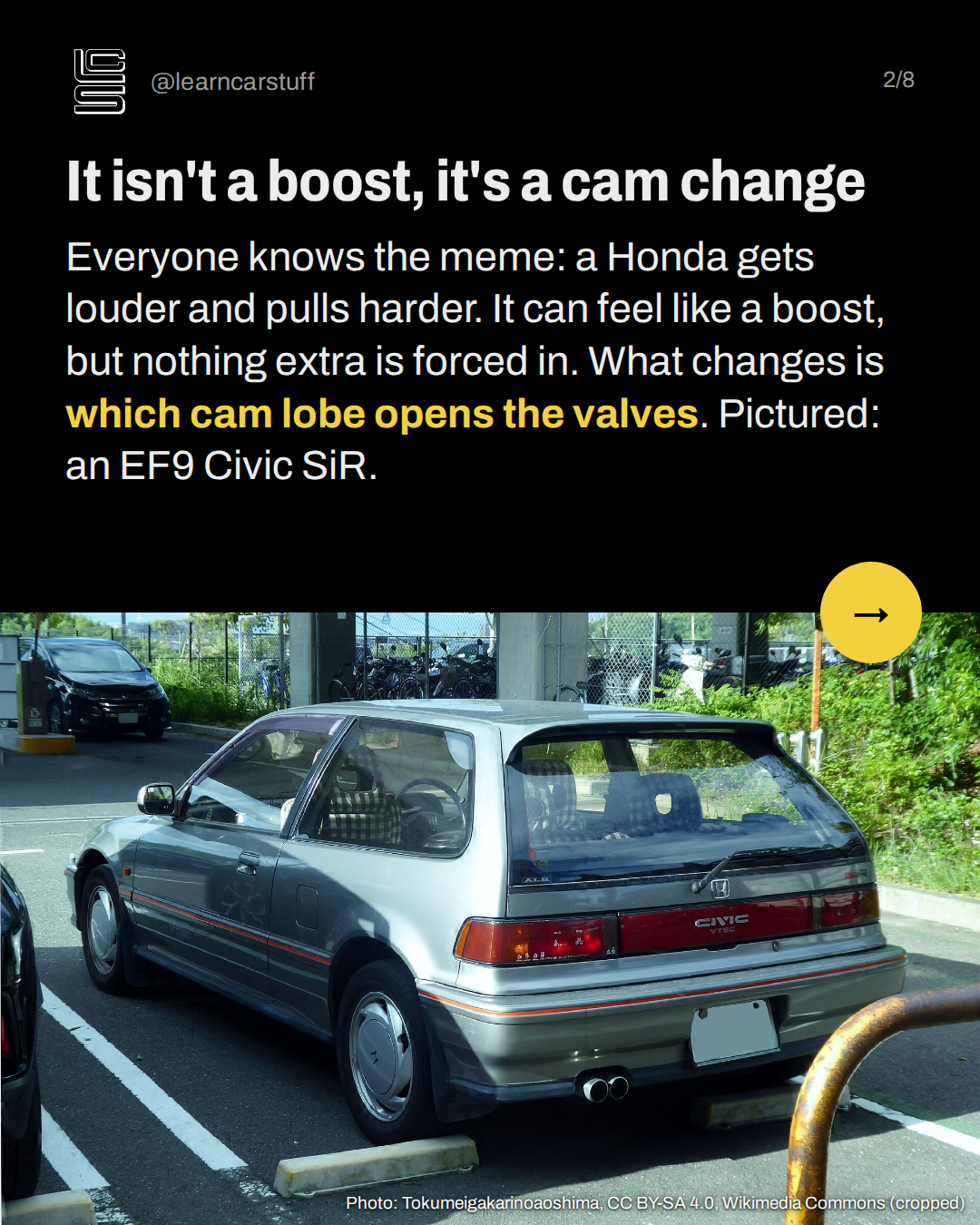
It isn't a boost, it's a cam change
Everyone knows the meme: a Honda gets louder and pulls harder. It can feel like a boost, but nothing extra is forced in. What changes is which cam lobe opens the valves. Pictured: an EF9 Civic SiR.
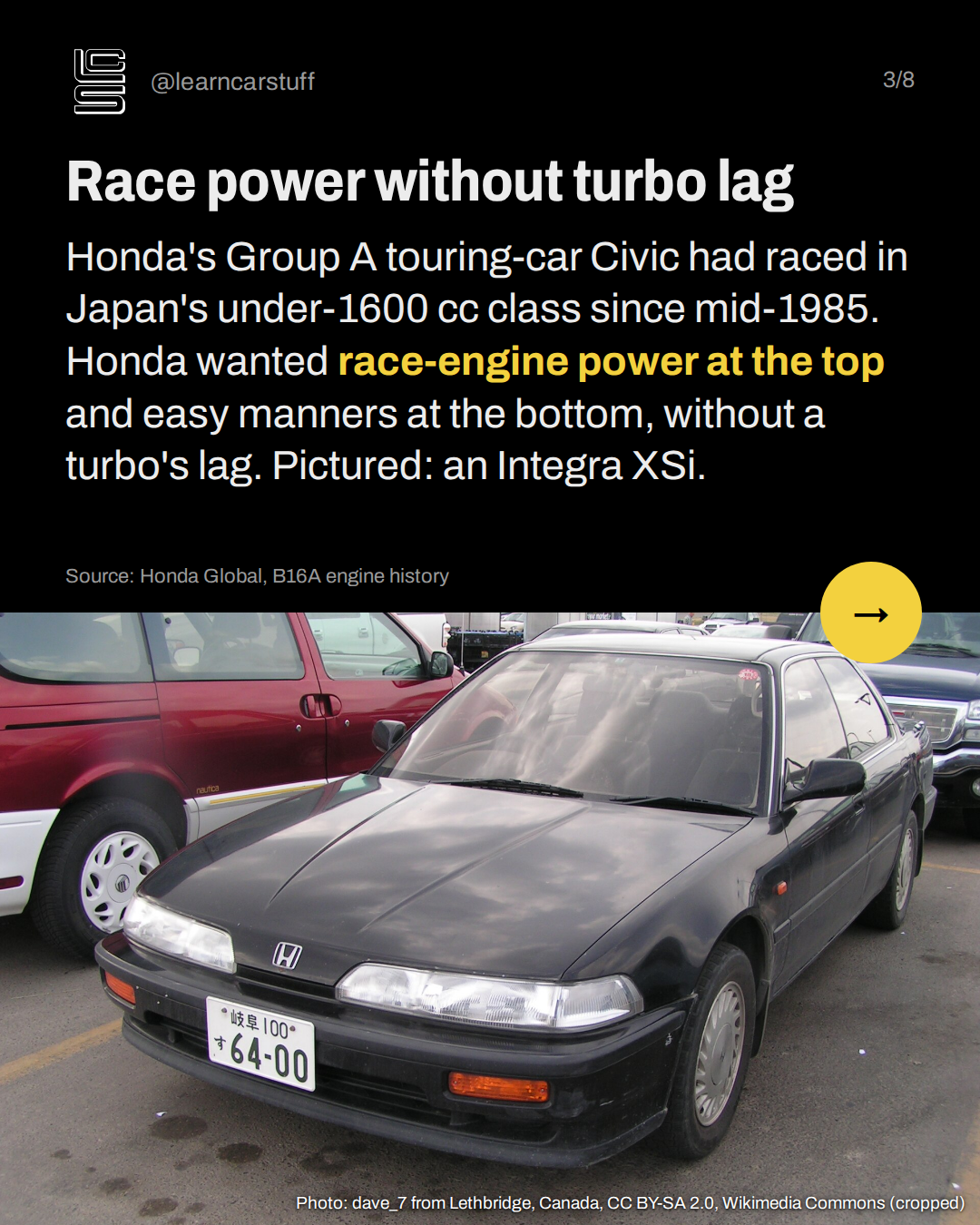
Race power without turbo lag
Honda's Group A touring-car Civic had raced in Japan's under-1600 cc class since mid-1985. Honda wanted race-engine power at the top and easy manners at the bottom, without a turbo's lag. Pictured: an Integra XSi.
Source: Honda Global, B16A engine history
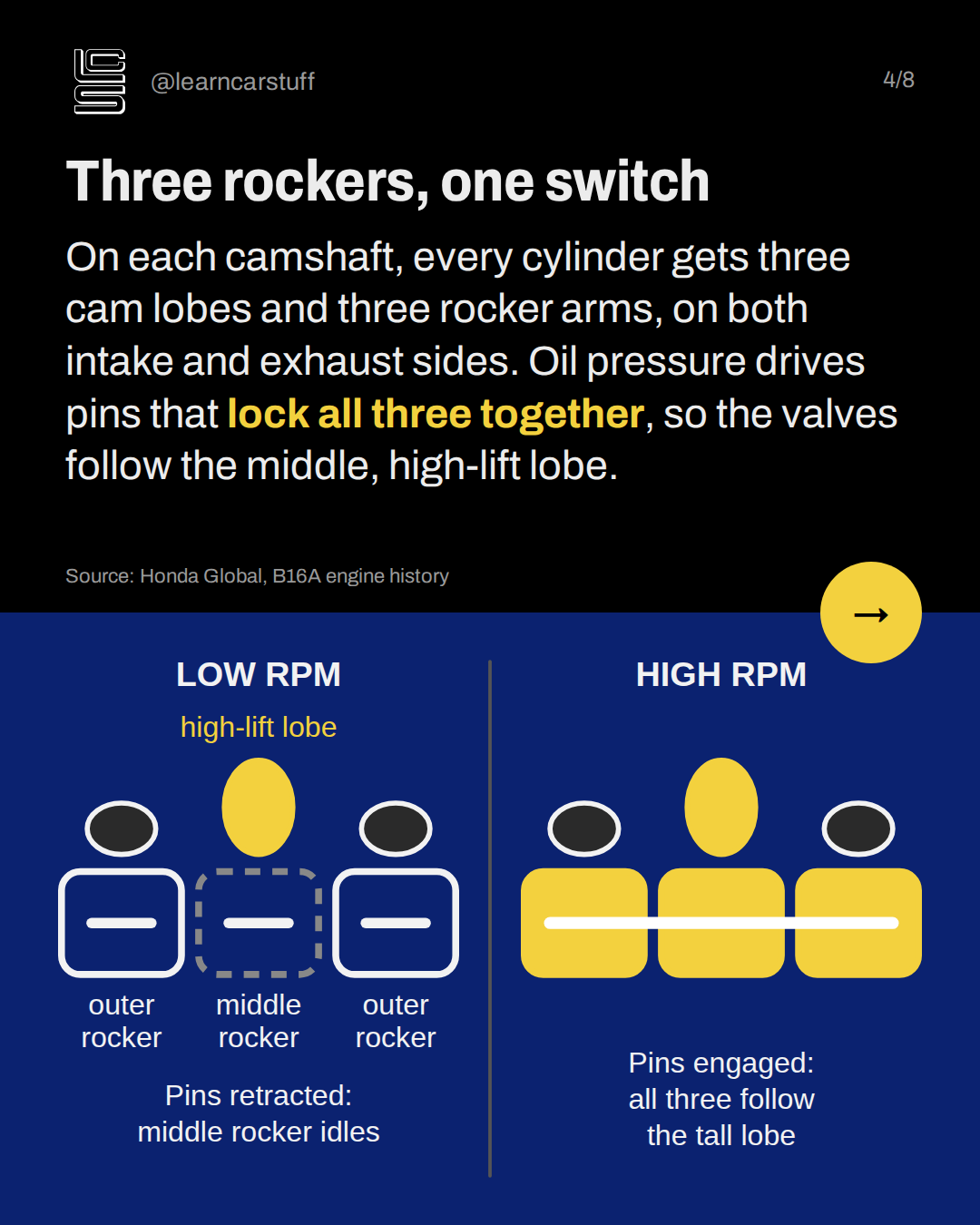
Three rockers, one switch
On each camshaft, every cylinder gets three cam lobes and three rocker arms, on both intake and exhaust sides. Oil pressure drives pins that lock all three together, so the valves follow the middle, high-lift lobe.
Source: Honda Global, B16A engine history
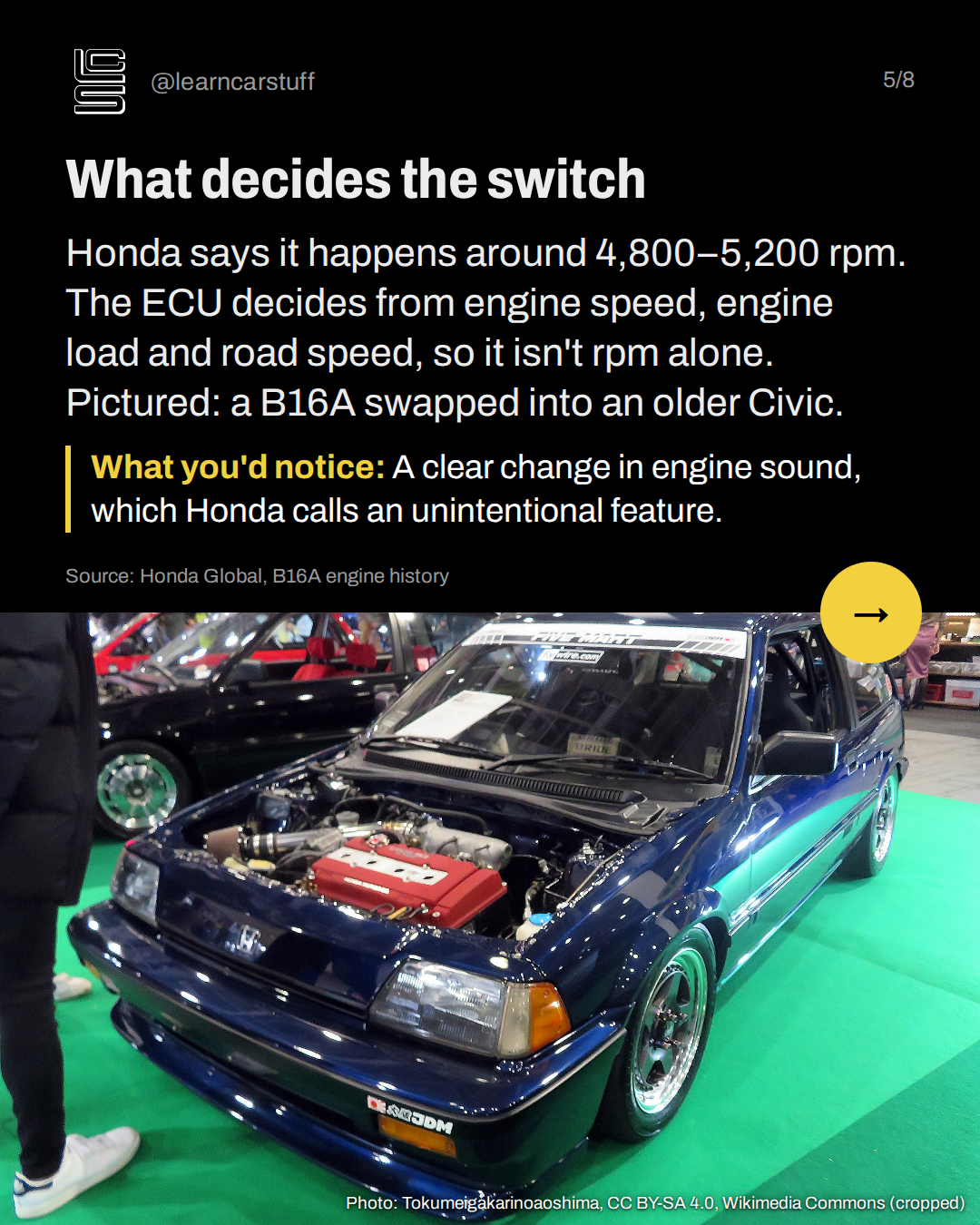
What decides the switch
Honda says it happens around 4,800–5,200 rpm. The ECU decides from engine speed, engine load and road speed, so it isn't rpm alone. Pictured: a B16A swapped into an older Civic.
What you'd notice: A clear change in engine sound, which Honda calls an unintentional feature.
Source: Honda Global, B16A engine history
The math behind 100 PS per liter
The 1989 B16A has an 81.0 × 77.4 mm bore and stroke, about 1,595 cc. It makes 160 PS at 7,600 rpm (PS is metric horsepower), and 160 PS ÷ 1.6 L is 100 PS per liter.
Source: Honda Global, B16A engine history
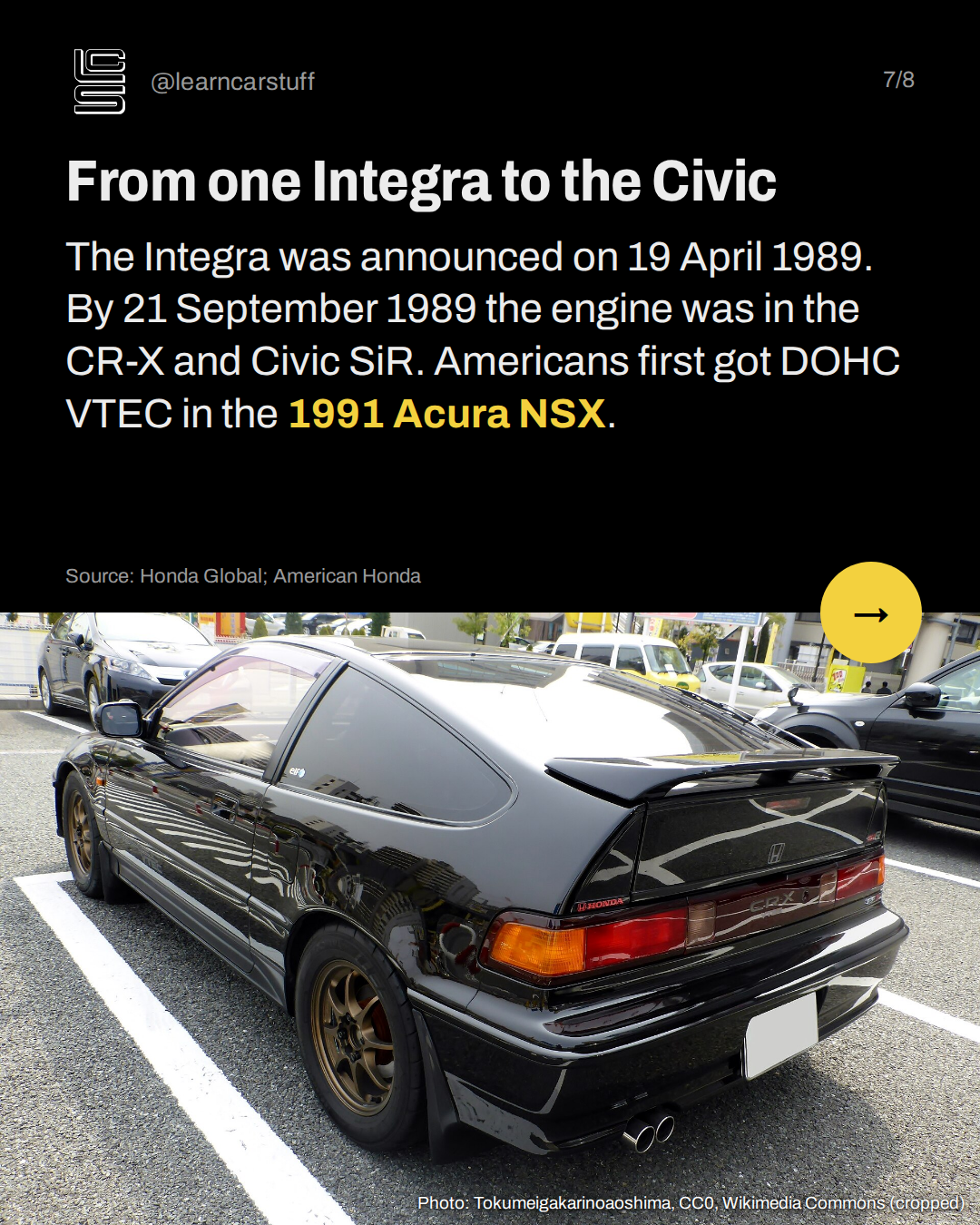
From one Integra to the Civic
The Integra was announced on 19 April 1989. By 21 September 1989 the engine was in the CR-X and Civic SiR. Americans first got DOHC VTEC in the 1991 Acura NSX.
Source: Honda Global; American Honda
Sources and assumptions
- Honda Global: B16A, Honda's Innovative Engine with VTEC (Honda Engines serial): B16A is a 1.6 L inline-4 DOHC NA engine with the world's first variable valve timing and lift technology (VTEC); fitted to the Integra announced 19 April 1989 and the CR-X and Civic launched 21 September 1989; 160 PS at 7,600 rpm, 15.5 kg·m at 7,000 rpm (MT), revs to 8,000 rpm red zone; 100 PS per liter target; bore × stroke 81.0 × 77.4 mm; three cam lobes per cylinder (low-lift at both ends, high-lift between); three rocker arms with hydraulically operated pins that join them; middle rocker in 'idle rotation (lost motion)' when pins are disengaged; on both intake and exhaust sides; switching around 4,800–5,200 rpm; ECU switches on engine speed, engine load and vehicle speed; clear change in engine sound, an 'unintentional feature'; VTEC evolved from REV (1982 motorcycle valve deactivation); Honda's Group A Civic in the under-1600 cc class from mid-1985, champion 1986 until the series ended in 1993; NA chosen to avoid turbo lag; photo caption 'Integra Coupe XSi (1990)' (checked 2026-10-04)
- Honda News (American Honda): Acura VTEC Technology: VTEC = Variable Valve Timing and Lift Electronic Control; 'VTEC made its commercial debut on the 1989 Integra XSi in Japan'; at low speeds the two outer cams work the valves with the centre cam inactive; as revs rise the engine computer signals a spool valve to send oil pressure to a pin that locks the two outer rocker arms to the centre arm; first Acura in the US with DOHC VTEC was the 1991 NSX (checked 2026-10-04)
Assumptions:
- Power is quoted in PS as Honda Global gives it (160 PS). American Honda's release writes '160 horsepower'; the slides should use 160 PS so the figure matches the 100 PS per liter claim.
- Displacement of about 1,595 cc is calculated from Honda's bore and stroke; Honda's page itself says only '1.6-liter'.
- The B16A was offered in both upper Integra trims (XSi and RSi) per secondary sources. The post names only XSi, which is the trim Honda itself names as VTEC's debut car.
- The 'VTEC just kicked in' meme is treated as a known phrase people use, not a sourced fact; the post makes no claim about where it came from.
- The swapped-engine show photos show a B16A according to the Commons titles and show signage (the 2019 card reads 'B16A VTECスワップ'). The red cam cover is consistent with that, but the slide should say 'a B16A', not a specific Integra's engine bay.
Photos:
- Photo: dave_7 from Lethbridge, Canada, CC BY-SA 2.0, Wikimedia Commons (cropped)
- Photo: dave_7 from Lethbridge, Canada, CC BY-SA 2.0, Wikimedia Commons (cropped)
- Photo: Tokumeigakarinoaoshima, CC0, Wikimedia Commons (cropped)
- Photo: Tokumeigakarinoaoshima, CC BY-SA 4.0, Wikimedia Commons (cropped)
- Photo: Tokumeigakarinoaoshima, CC BY-SA 4.0, Wikimedia Commons (cropped)
The short version
- VTEC debuted in the 1989 Integra XSi
- Oil pressure pushes pins that lock three rockers
- The valves then follow the high-lift middle lobe
- Honda says the switch is around 4,800–5,200 rpm
.jpg)
.jpg)
_rear.JPG)
_rear.jpg)
_-_FIVEMART_WONDER_CIVIC_APPROVED_VEHICLE_B16A.jpg)