 Learn Car Stuff
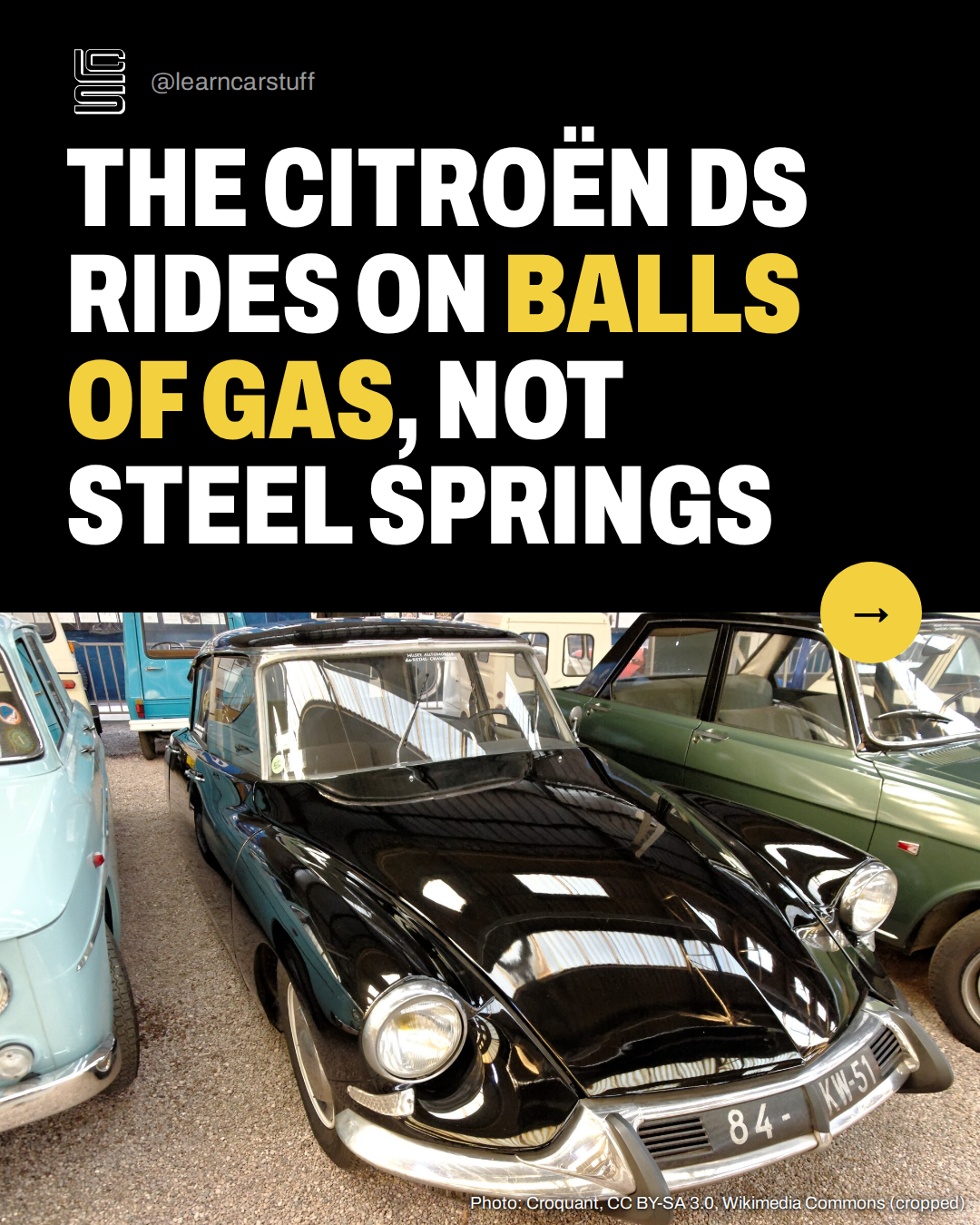
The Citroën DS rides on balls of gas, not steel springs
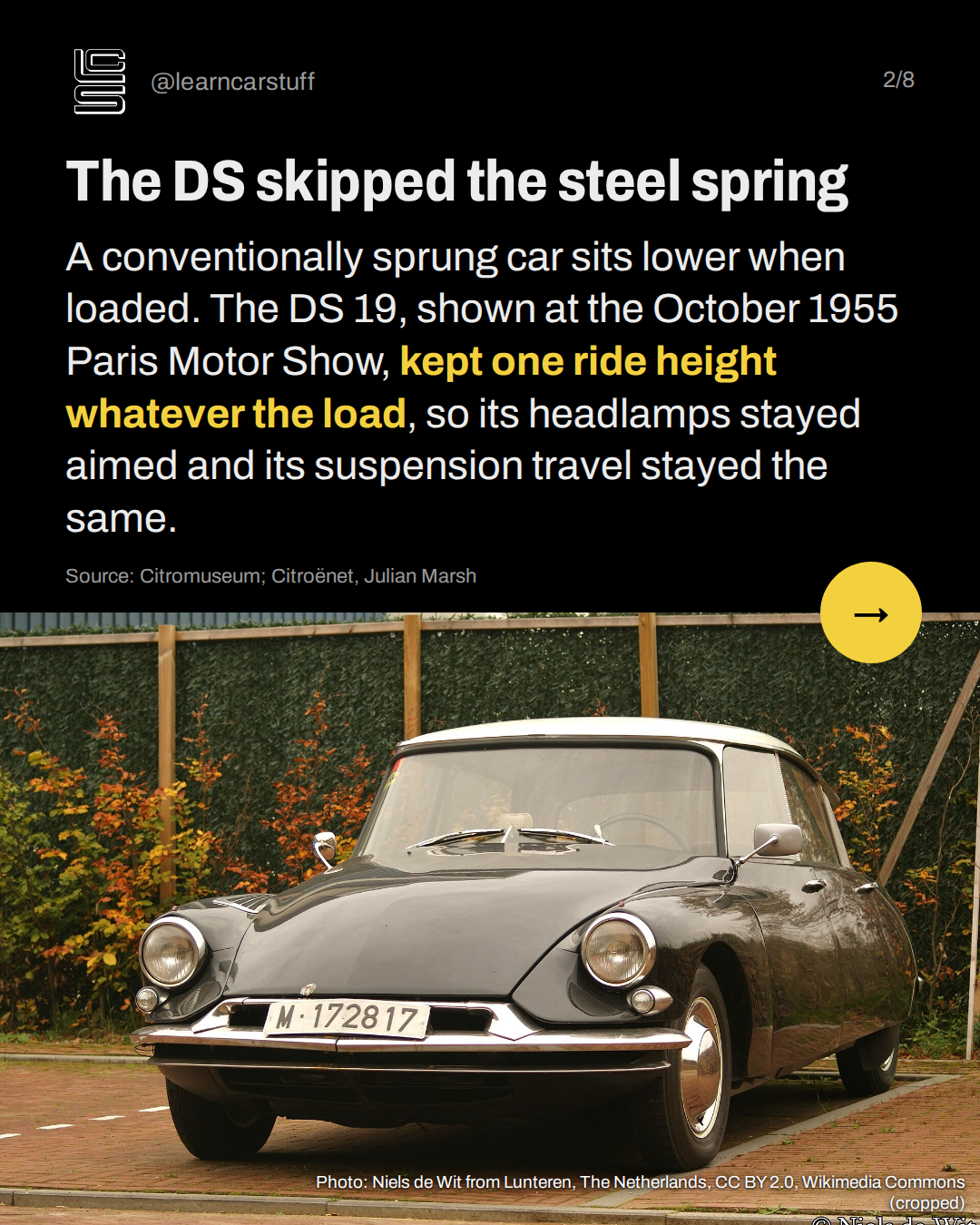
The DS skipped the steel spring
A conventionally sprung car sits lower when loaded. The DS 19, shown at the October 1955 Paris Motor Show, kept one ride height whatever the load, so its headlamps stayed aimed and its suspension travel stayed the same.
Source: Citromuseum; Citroënet, Julian Marsh
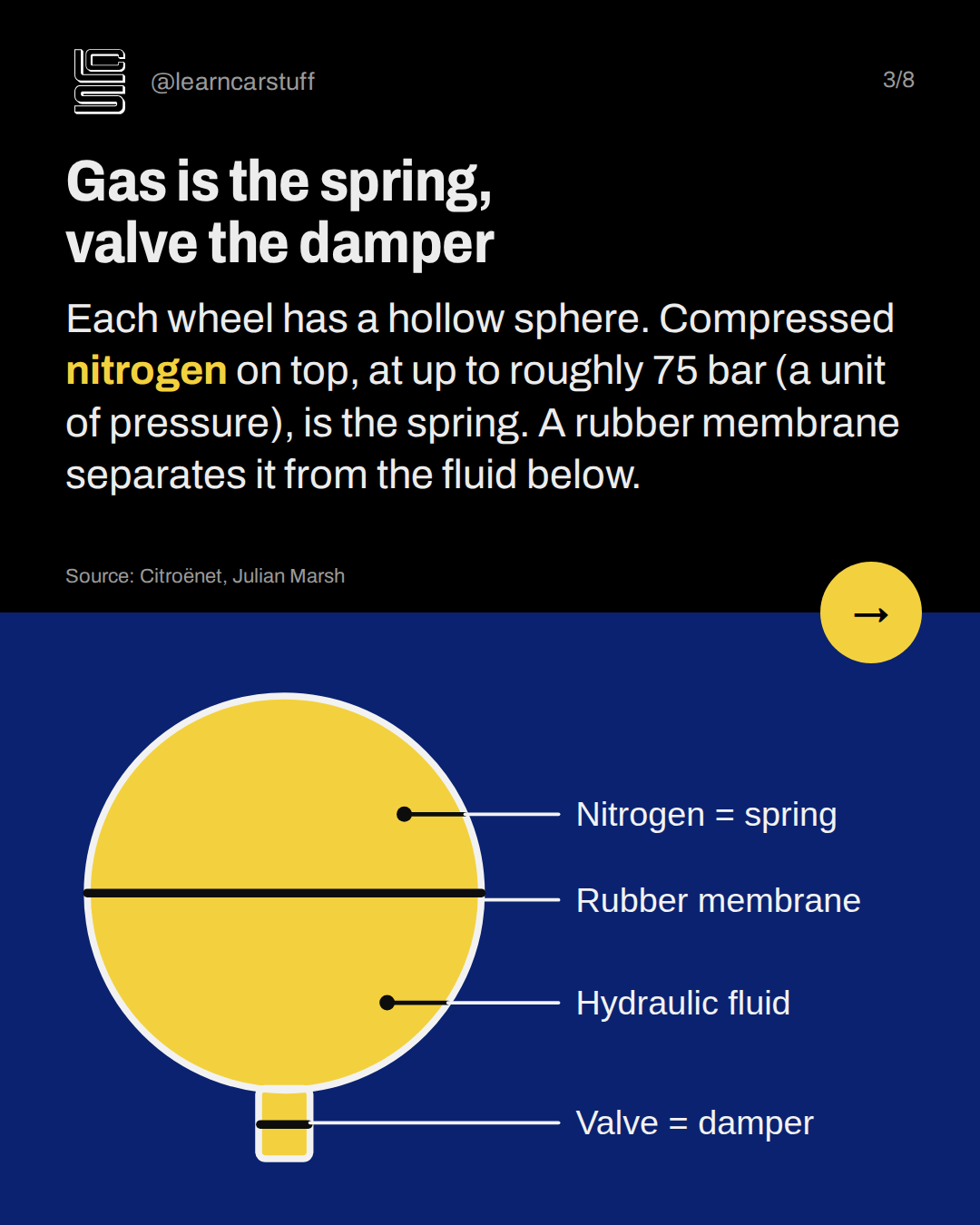
Gas is the spring, valve the damper
Each wheel has a hollow sphere. Compressed nitrogen on top, at up to roughly 75 bar (a unit of pressure), is the spring. A rubber membrane separates it from the fluid below.
Source: Citroënet, Julian Marsh
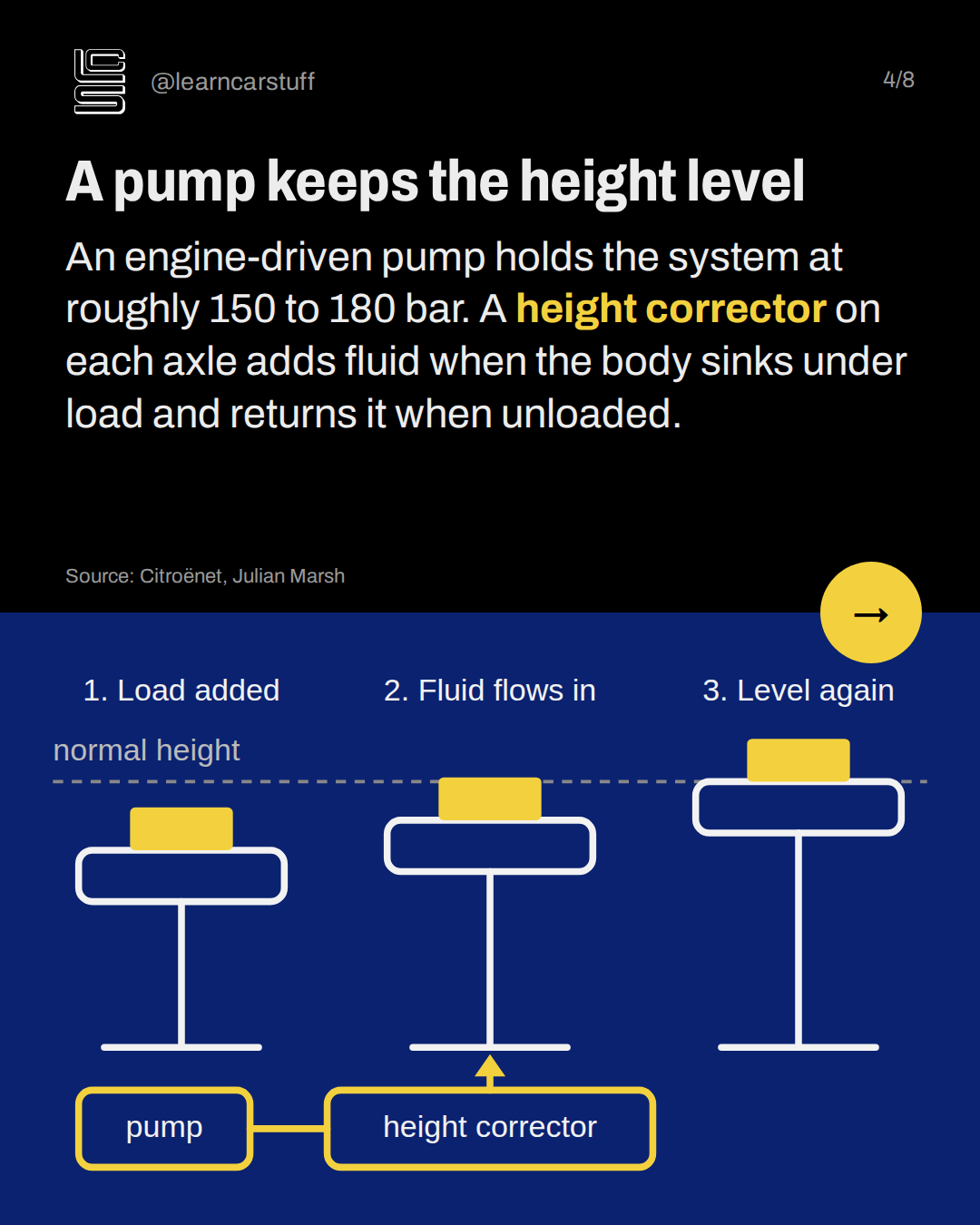
A pump keeps the height level
An engine-driven pump holds the system at roughly 150 to 180 bar. A height corrector on each axle adds fluid when the body sinks under load and returns it when unloaded.
Source: Citroënet, Julian Marsh
What Road & Track saw in 1956
'A few seconds after starting the engine, pressure is built up in the hydraulic system, the body rises, levels, and assumes its normal riding position.' A lever can lift the body higher still.
What you'd notice: A DS sitting low when parked, then rising after it starts.
Source: Road & Track, 1956 road test of the DS-19
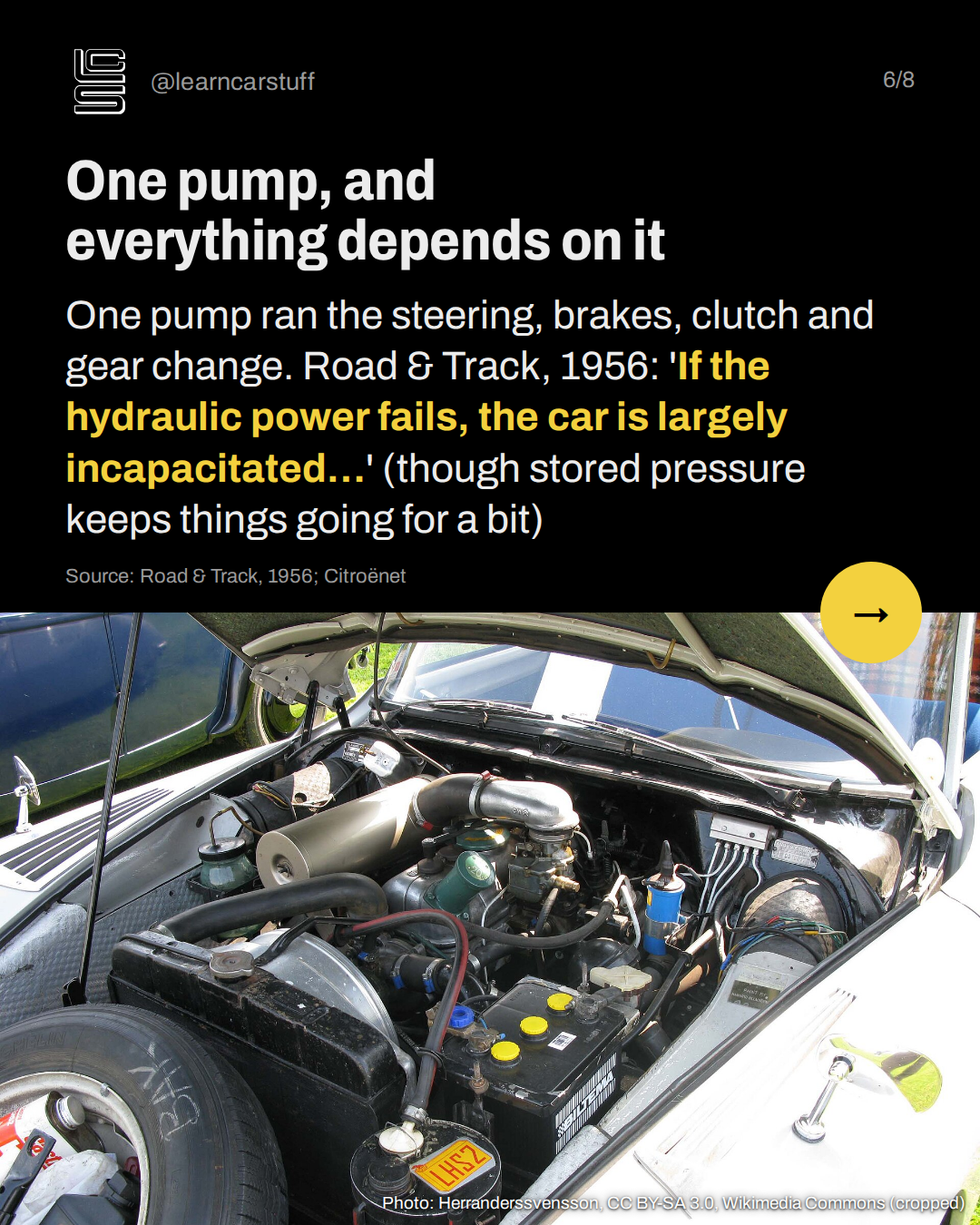
One pump, and everything depends on it
One pump ran the steering, brakes, clutch and gear change. Road & Track, 1956: 'If the hydraulic power fails, the car is largely incapacitated…' (though stored pressure keeps things going for a bit)
Source: Road & Track, 1956; Citroënet
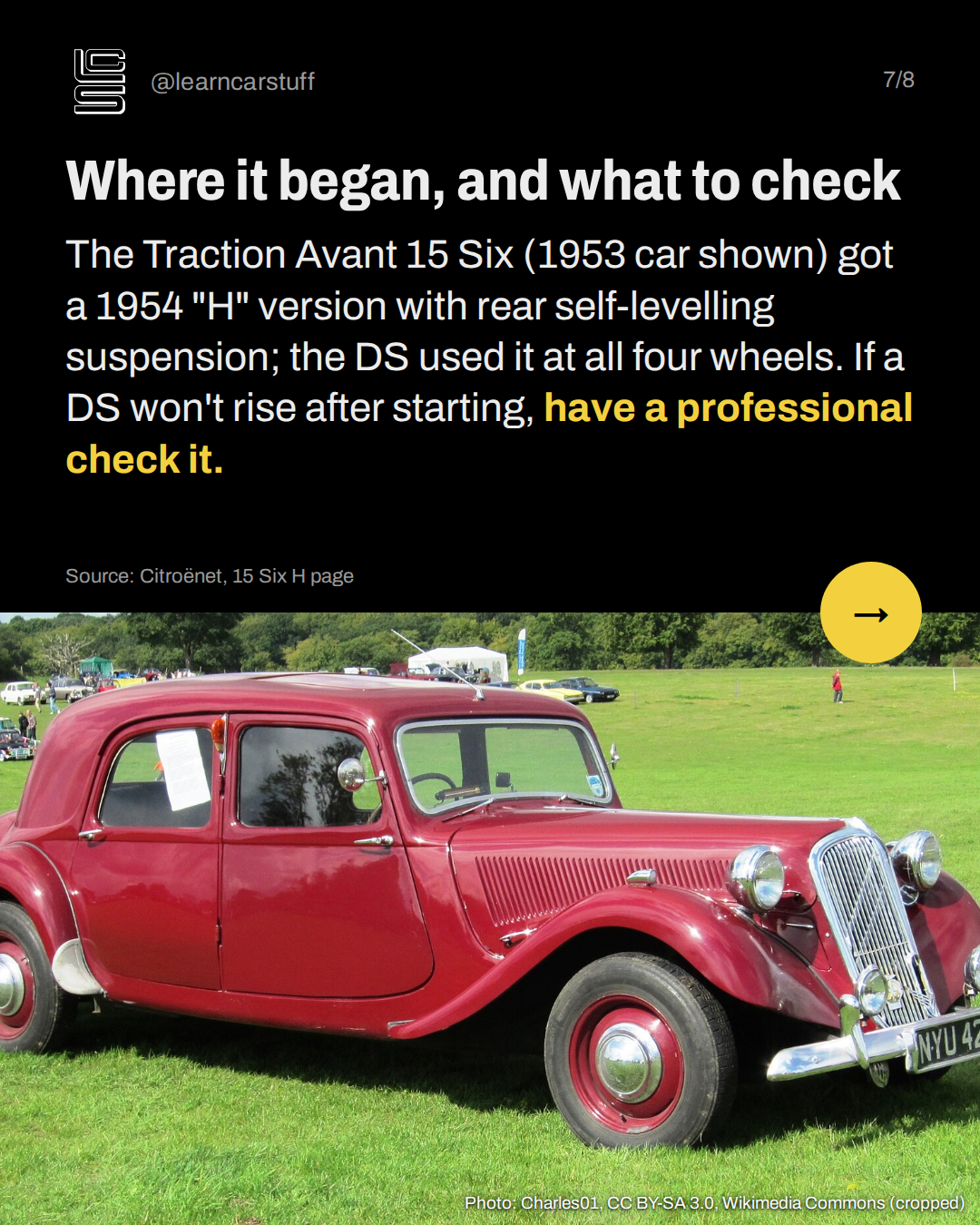
Where it began, and what to check
The Traction Avant 15 Six (1953 car shown) got a 1954 "H" version with rear self-levelling suspension; the DS used it at all four wheels. If a DS won't rise after starting, have a professional check it.
Source: Citroënet, 15 Six H page
Sources and assumptions
- Citromuseum (museum of Citroën cars): DS 19 1955 chassis n°32: DS 19 shown when the Paris Salon opened on 6 October 1955; 12,000 firm orders on the first day and 80,000 during the show; hydropneumatic suspension with ride-height correction whatever the load; power steering; hydraulically operated gearchange and clutch; assisted front disc brakes (checked 2026-10-03)
- Road & Track, 1956 road test of the Citroën DS-19 (reproduced on citroenet.org.uk): 'A few seconds after starting the engine, pressure is built up in the hydraulic system, the body rises, levels, and assumes its normal riding position'; the ride control lever raises the body further; the car self-levels for shifting loads; hydraulic wheel-change method; the hydraulics operate the brakes (inboard front discs, rear drums); no clutch pedal; 'If the hydraulic power fails, the car is largely incapacitated'; 1911 cc engine (checked 2026-10-03)
- Citroënet, 'Citroën hydropneumatics' by Julian Marsh: Each sphere is a hollow metal ball with nitrogen at up to 75 bar on top, separated from the fluid by a flexible rubber membrane; the gas is the spring; a two-way leaf valve in the sphere opening does the damping; an engine-driven pump runs the system at 150 to 180 bar; height correctors add fluid when the body sinks under load and return it to the reservoir when unloaded; constant ride height keeps headlamps aligned and suspension travel the same; on the DS the hydraulics also ran the clutch, gear change and steering; LHM mineral fluid in the mid-1960s made the system thoroughly reliable (checked 2026-10-03)
- Citroën Car Club (UK): Hydraulic Suspension: One gas-pressurised sphere at each wheel, with compressed nitrogen in the upper part and LHM mineral oil in the lower; a height corrector on each axle keeps height correct regardless of load; the driver can raise the car with a selector lever (checked 2026-10-03)
- Citroënet: Traction Avant 15 Six and 15 Six H: The 15 Six H was launched in 1954 with self-levelling hydropneumatic suspension at the rear (checked 2026-10-03)
- Jalopnik, 'Citroën's Hydropneumatic Suspension Made Rides Smoother (With A Catch)', Nicholas Werner, 2025-05-27: The system could also run the brakes, clutch, gear change and steering; self-levelling under load; the main drawback was cost and complexity compared with a steel coil (checked 2026-10-03)
Assumptions:
- Pressures (nitrogen up to 75 bar, system 150 to 180 bar) are Citroënet's general figures for Citroën hydropneumatics and vary by model and year; say 'roughly'.
- 'A few seconds' to rise is Road & Track's 1956 observation of one car; the actual time depends on the car's condition.
- The debut day is 6 October 1955 (the Salon's opening, per Citromuseum); other sources say 5 October (press day), so slides should say 'October 1955 Paris Motor Show'.
- The 12,000 first-day orders figure comes from Citroën heritage material (Citromuseum); call it orders, not sales.
- The photo shows a 1965 DS 19 (museum label), not a 1955 car; the caption should say 1965 DS 19.
- The 'sits low when parked' behaviour is the cars losing pressure with the engine off. The R&T test documents only the rise at start, so the sinking is written as what you would notice, not a timed claim.
Photos:
The short version
- Gas in a sphere is the spring.
- A valve in the sphere does the damping.
- A pump and height correctors keep it level.
- The same hydraulics ran steering and brakes.



.jpg)


.jpg)