 Learn Car Stuff
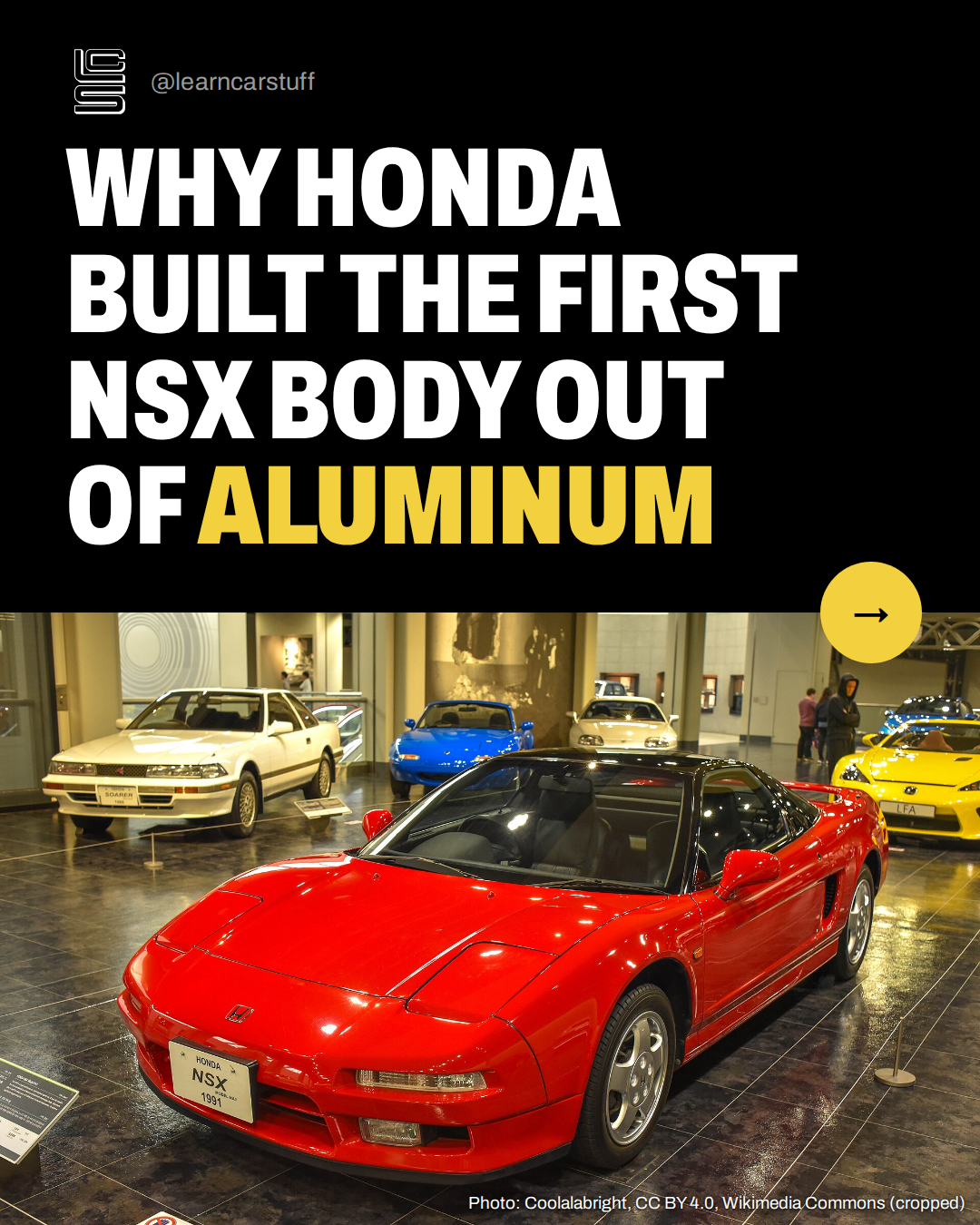
Why Honda built the first NSX body out of aluminum
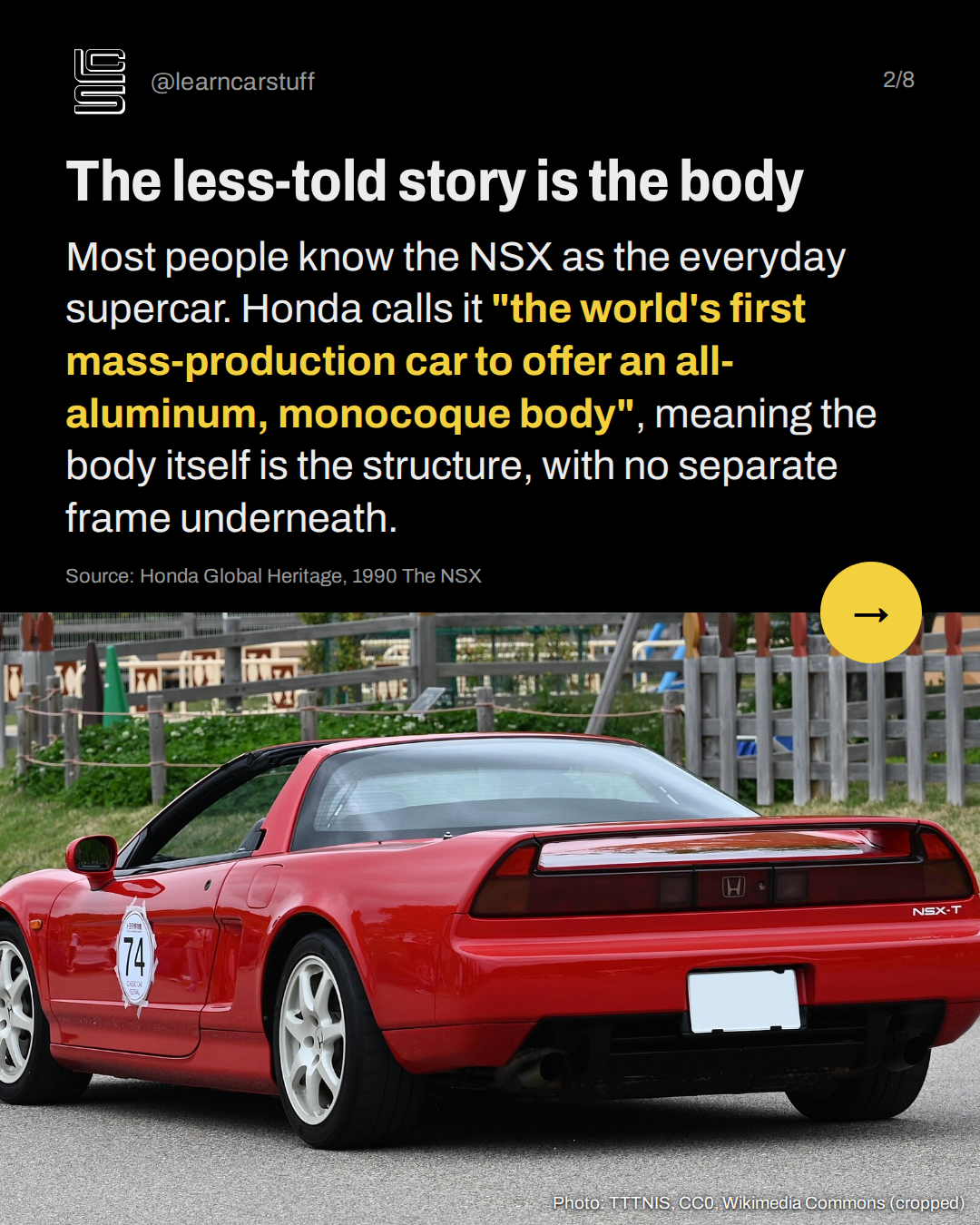
The less-told story is the body
Most people know the NSX as the everyday supercar. Honda calls it "the world's first mass-production car to offer an all-aluminum, monocoque body", meaning the body itself is the structure, with no separate frame underneath.
Source: Honda Global Heritage, 1990 The NSX
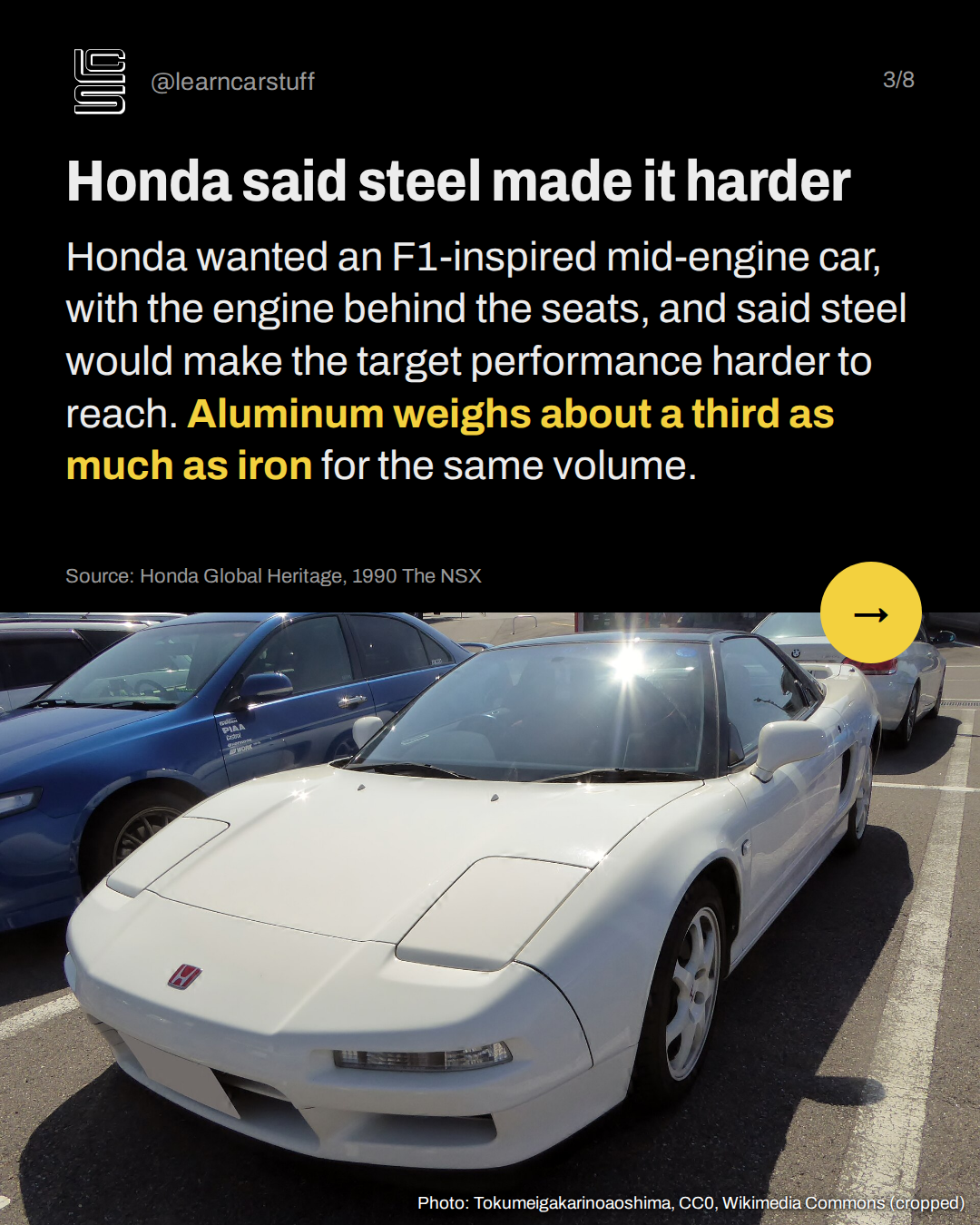
Honda said steel made it harder
Honda wanted an F1-inspired mid-engine car, with the engine behind the seats, and said steel would make the target performance harder to reach. Aluminum weighs about a third as much as iron for the same volume.
Source: Honda Global Heritage, 1990 The NSX
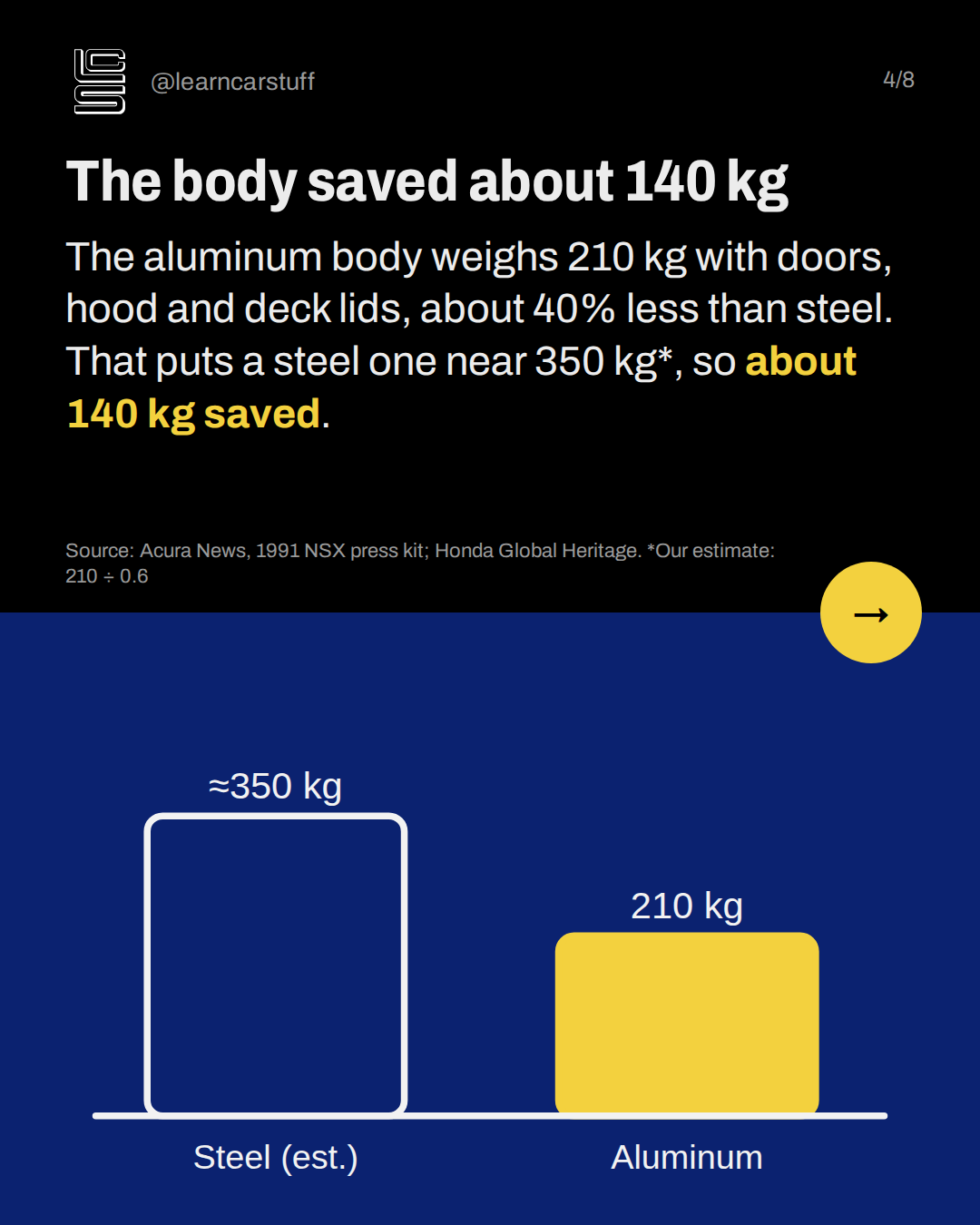
The body saved about 140 kg
The aluminum body weighs 210 kg with doors, hood and deck lids, about 40% less than steel. That puts a steel one near 350 kg*, so about 140 kg saved.
Source: Acura News, 1991 NSX press kit; Honda Global Heritage. *Our estimate: 210 ÷ 0.6
Aluminum made building it harder
Honda says aluminum buckles when stamped and is hard to weld. So it built a plant just for the NSX in Tochigi, with custom spot welders, no traditional assembly line and a maximum of 25 cars a day.
Source: Honda Global Heritage; Acura News, 1991 NSX press kit
Senna called the prototype fragile
In February 1989, Senna drove the prototype: "I feel it's a little fragile." Based on that comment, Honda raised its rigidity targets, and after Nürburgring testing rigidity rose 50% over the figure in place just before.
What you'd notice: Acura says a rigid structure gives a tight, rattle-free interior.
Source: Honda Global Heritage, 1990 The NSX; Acura News, 1991 NSX press kit
The result: 270 hp, 1,365 kg
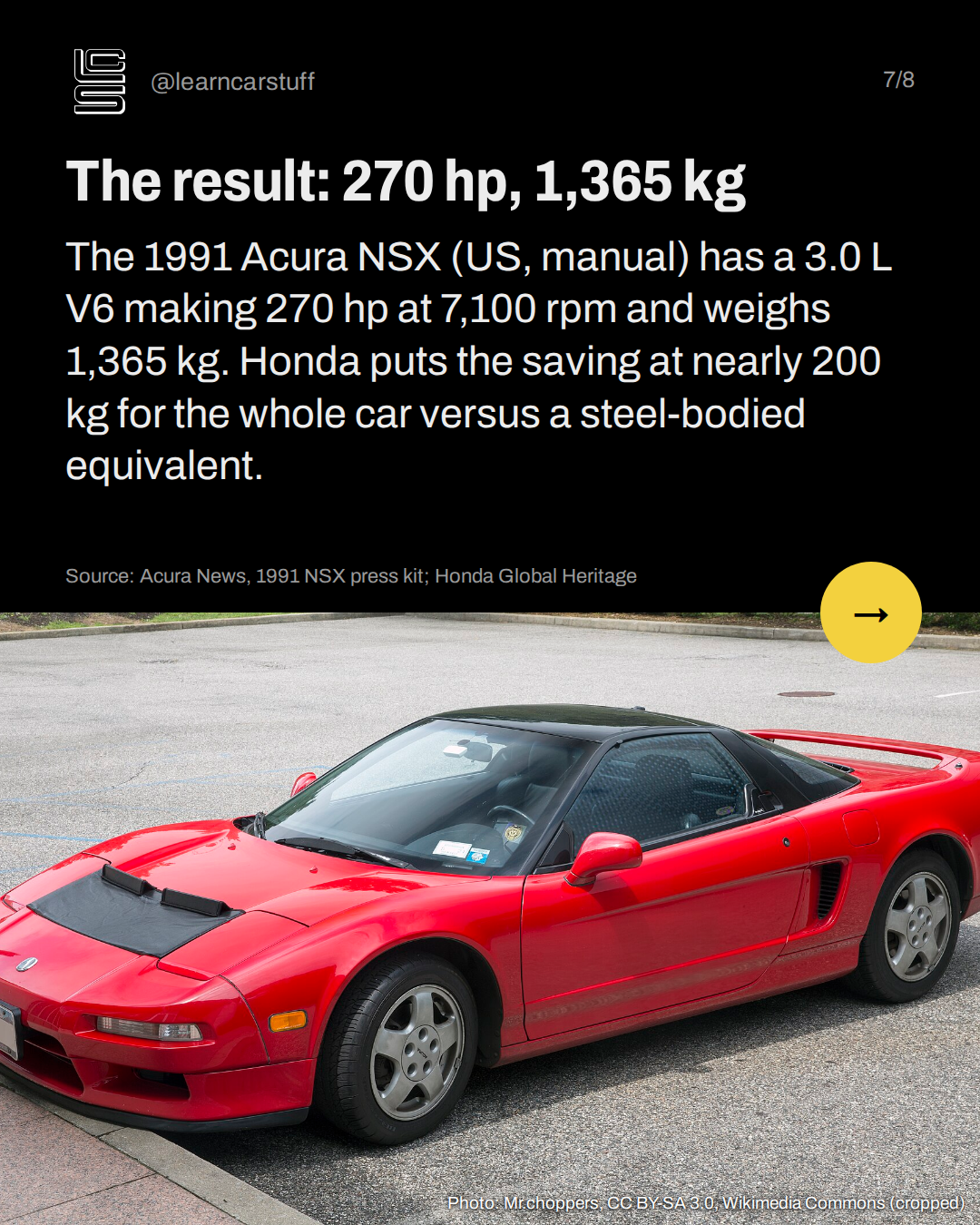
The 1991 Acura NSX (US, manual) has a 3.0 L V6 making 270 hp at 7,100 rpm and weighs 1,365 kg. Honda puts the saving at nearly 200 kg for the whole car versus a steel-bodied equivalent.
Source: Acura News, 1991 NSX press kit; Honda Global Heritage
Sources and assumptions
- Honda Global, Heritage: 1990 The NSX: World's first mass-production car with an all-aluminum monocoque body; 140 kg body and nearly 200 kg whole-car saving vs a steel-bodied equivalent; steel would make the target running performance harder to achieve; aluminum one-third the specific gravity of iron, corrosion resistant, easier to recycle; five aluminum alloys; aluminum prone to buckling in stamping and difficult to weld; dedicated Tochigi plant completed May 1990 with custom aluminum spot welder; 25 units a day; Senna's Feb 1989 'a little fragile' comment and the 50% rigidity increase after the Nürburgring tests; side sill extruded at 600 degrees; UMR layout; NS-X name meaning; Japanese press conference September 1990 (checked 2026-10-03)
- Acura News, 1991 Acura NSX Press Kit (released 1990-06-03): Chassis weighs 210 kg (462 lb) with doors, hood and deck lids, about 40% less than a steel chassis; side sill is a large hollow-section aluminum extrusion and contributes most to bending rigidity; 3.0 L (2,977 cc) DOHC V6, 270 hp at 7,100 rpm (manual), 210 lb-ft at 5,300 rpm, titanium connecting rods, 8,000 rpm redline (manual); curb weight 3,010 lb (1,365 kg) manual, 3,098 lb (1,405 kg) automatic; dedicated hand-crafted assembly plant in Tochigi with no traditional assembly line; maximum 25 vehicles per day; rigid structure gives a tight, rattle-free interior; chromate coating and Dacro-coated steel parts against galvanic corrosion (checked 2026-10-03)
Assumptions:
- The ~350 kg steel figure is derived: Acura's 210 kg is 'about 40% less' than steel, so 210 ÷ 0.6 ≈ 350 kg. It is an approximation, and it matches Honda's separately stated 140 kg body saving.
- Power and weight figures are for the US-market 1991 Acura NSX with the 5-speed manual, per Acura's press kit. Japanese-market ratings differ and are not used.
- Honda calls it a 'monocoque'; some outlets say 'semi-monocoque'. Copy follows Honda's wording.
- The idea's request for Honda figures on repair cost could not be met: neither Honda source gives repair costs or repair rules for the first-generation car, and the certified-shop pages found online cover the 2016+ NSX. Repair cost is left out; the 'cost' slide uses Honda's stated manufacturing difficulties instead.
- Original US price was not verified (the Hagerty page returned 403), so no price appears.
- The Honda heritage page calls the plant 'Saitama Factory's Tochigi Plant'; Acura's press kit says it was on the grounds of Honda's R&D Center in Tochigi. Copy says only 'a plant built just for the NSX in Tochigi'.
Photos:
The short version
- Honda said steel made its target harder.
- The aluminum body is 210 kg, about 140 kg lighter.
- It took a dedicated plant and 25 cars a day.
- After Senna's feedback, rigidity rose 50% over the pre-Nürburgring figure.


_Coupe.jpg)
.jpg)
_front.JPG)
