 Learn Car Stuff
Why did the early MR2 SW20 get a spin-happy name?

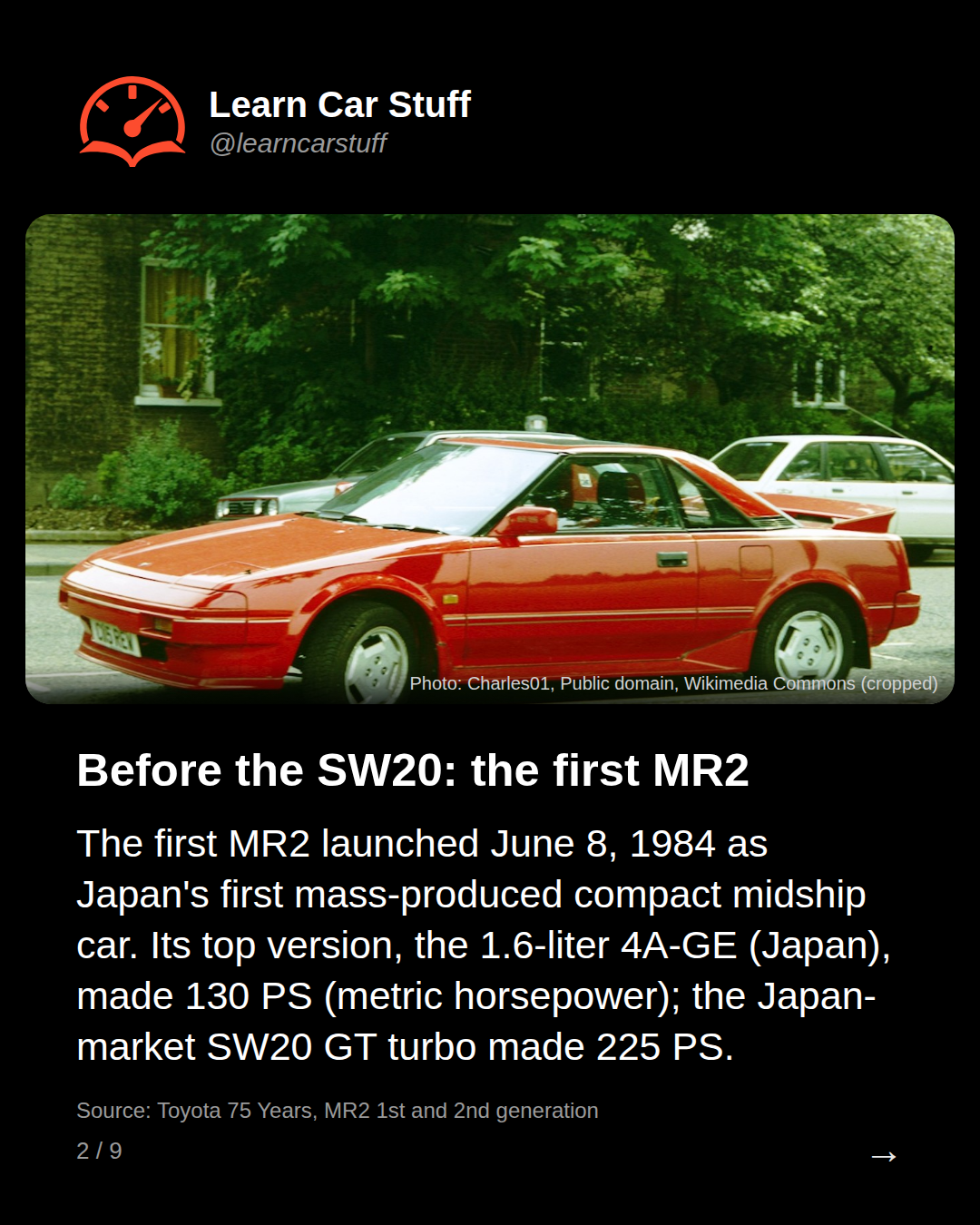
Before the SW20: the first MR2
The first MR2 launched June 8, 1984 as Japan's first mass-produced compact midship car. Its top version, the 1.6-liter 4A-GE (Japan), made 130 PS (metric horsepower); the Japan-market SW20 GT turbo made 225 PS.
Source: Toyota 75 Years, MR2 1st and 2nd generation

The reputation and the excuse
The SW20 arrived on October 17, 1989, with 225 PS in the Japan-market turbo GT. Its reputation was snap-spin. A common line is "that's how mid-engine cars are," but period critics blamed more than the layout.
Source: Toyota 75 Years, MR2 2nd generation; CAR and DRIVER Japan, 1993; Car Throttle
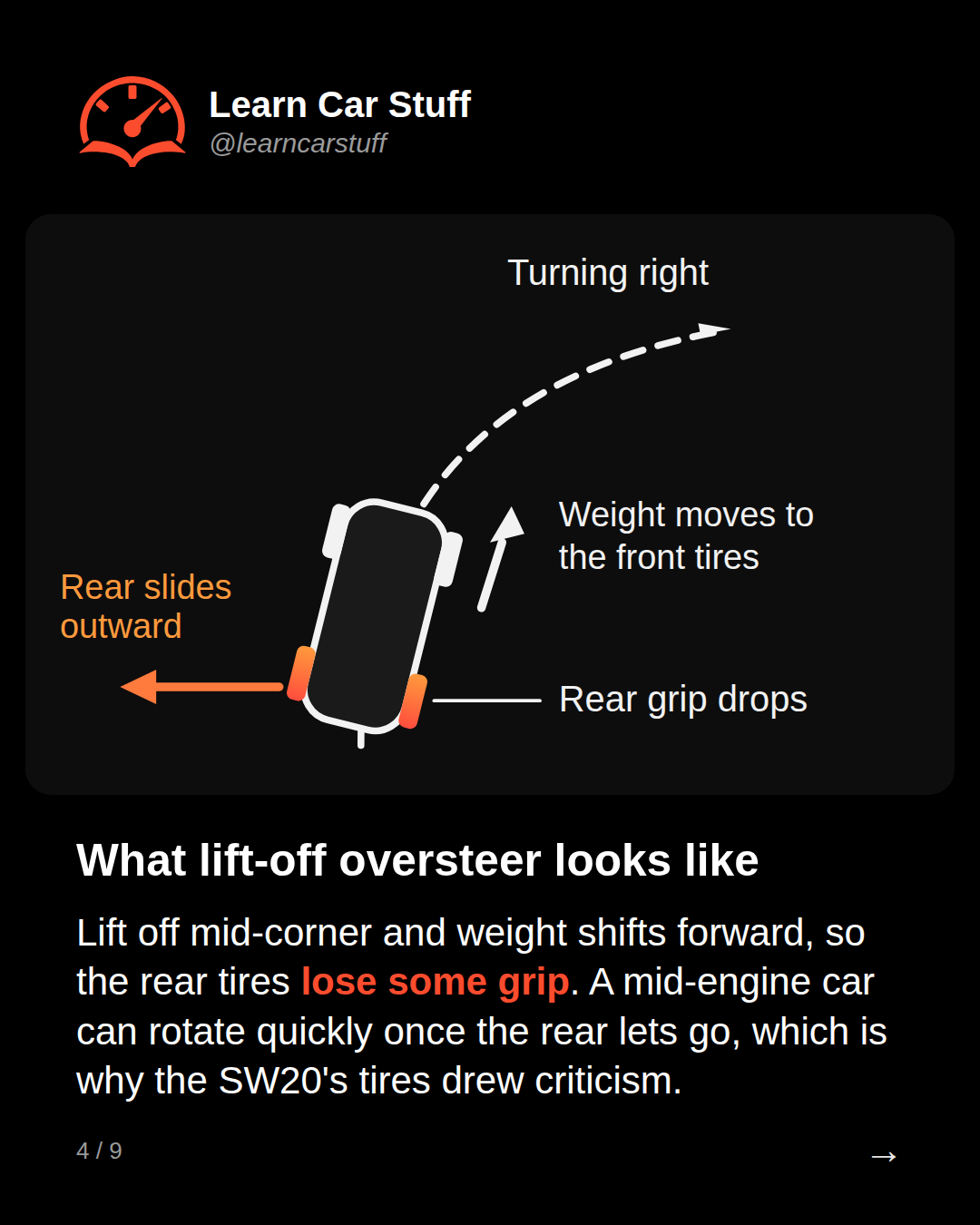
What lift-off oversteer looks like
Lift off mid-corner and weight shifts forward, so the rear tires lose some grip. A mid-engine car can rotate quickly once the rear lets go, which is why the SW20's tires drew criticism.

What the critics blamed
CAR and DRIVER Japan said the early car couldn't cope with 225 PS. WebCarTop blamed weak lateral stiffness and 14-inch tires. Turbo catalog sizes: 195/60R14 front, 205/60R14 rear. Shown: an early non-turbo SW20.
Source: CAR and DRIVER Japan, 1993; WebCarTop, 2017; Cars Japan catalog specs
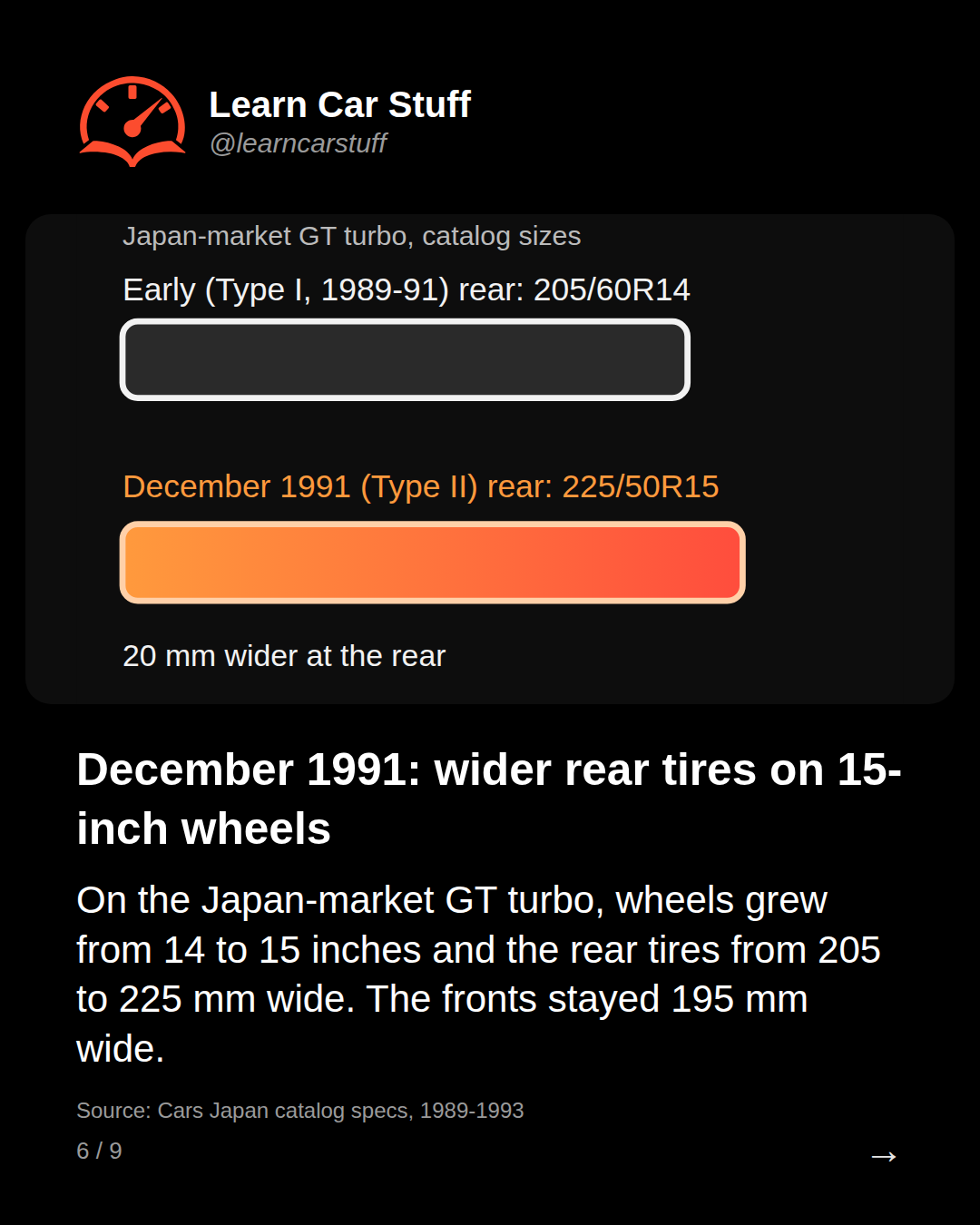
December 1991: wider rear tires on 15-inch wheels
On the Japan-market GT turbo, wheels grew from 14 to 15 inches and the rear tires from 205 to 225 mm wide. The fronts stayed 195 mm wide.
Source: Cars Japan catalog specs, 1989-1993
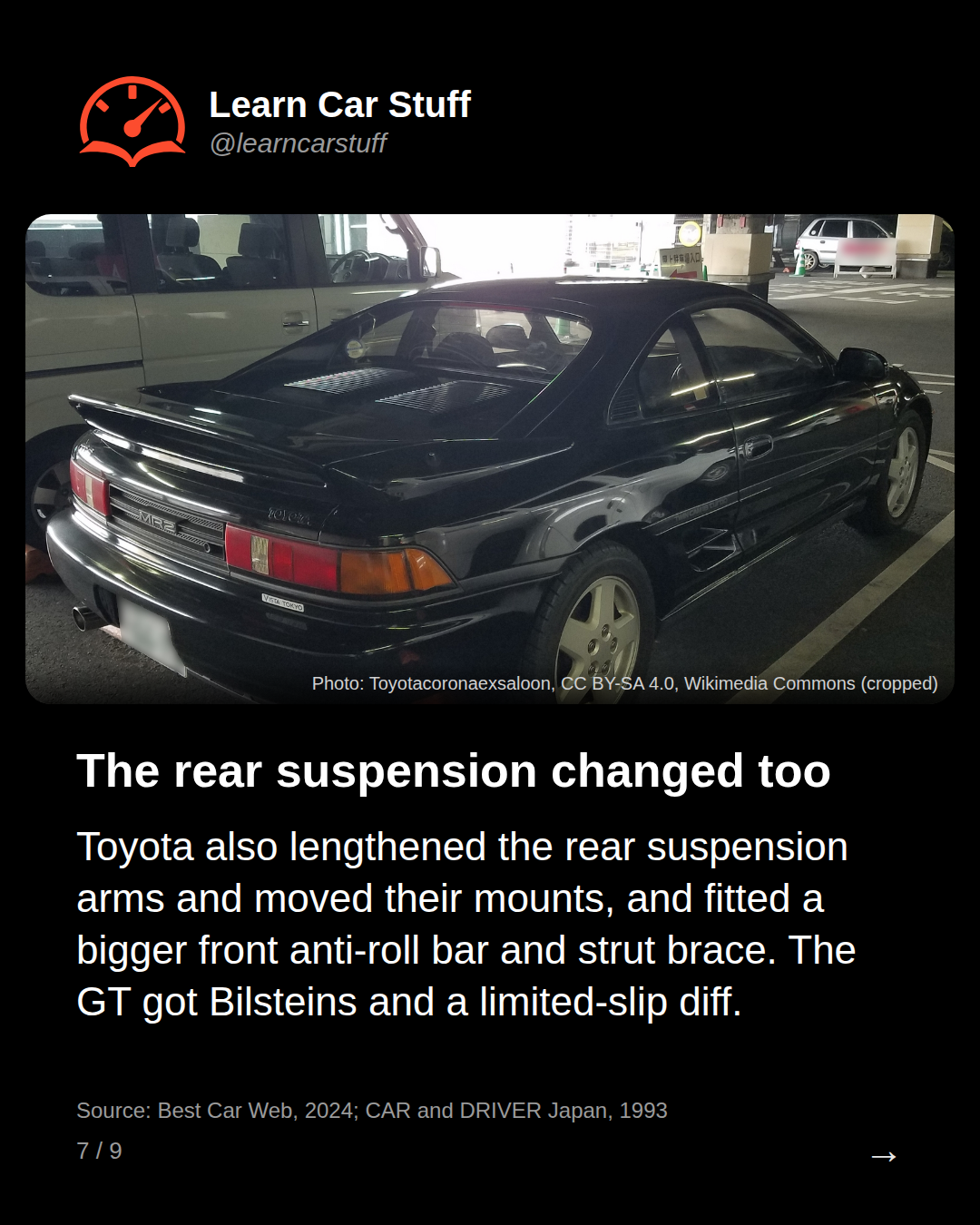
The rear suspension changed too
Toyota also lengthened the rear suspension arms and moved their mounts, and fitted a bigger front anti-roll bar and strut brace. The GT got Bilsteins and a limited-slip diff.
Source: Best Car Web, 2024; CAR and DRIVER Japan, 1993
Tamed with chassis changes, not layout
In 1993, CAR and DRIVER Japan called the revised car a genuine MR sports car. Toyota tamed it with tires, suspension, Bilstein dampers and a limited-slip diff, not by moving the engine. Some owners still prefer the early car.
What you'd notice: Early cars ride on 14-inch wheels; from December 1991 (Japan), 15s.
Source: CAR and DRIVER Japan, 1993; Car Throttle
Sources and assumptions
- Toyota 75 Years: Vehicle Lineage, MR2 2nd generation (Toyota Motor Corporation): SW20 released 1989/10/17; 2.0 turbo GT 225 PS at 6,000 rpm and NA 165 PS; during its model life Toyota 'enhanced its rear stability' and improved the chassis; built by Central Motor Co. (checked 2026-10-02)
- Toyota 75 Years: Vehicle Lineage, MR2 1st generation (Toyota Motor Corporation): Released 1984/6/8; MR2 = midship runabout 2-seater; 'Japan's first mass-produced compact passenger car with a midship engine layout'; 1984-1985 Car of the Year Japan; 4A-GELU 130 PS (checked 2026-10-02)
- Toyota UK: History of Toyota sports cars, MR2: MR2 was Japan's first mass-produced mid-engine car; second generation took a more upmarket approach and stayed on sale about ten years (checked 2026-10-02)
- CAR and DRIVER Japan (caranddriver.co.jp), 1992 Toyota MR2 (E-SW20), Koji Okazaki, issue of 1993-01-26: After the December 1991 change the GT got Bilstein dampers, an LSD and 15-inch tires of different sizes front and rear, which greatly improved handling into 'a genuine MR sports car'; the early car could not cope with the 225 PS turbo and spun its rear wheels or spun out in corners (checked 2026-10-02)
- Best Car Web (bestcarweb.jp), 2024-04-26: Early SW20's spin reputation; December 1991 changes: bigger stabilizer, strut tower bar, rear suspension arms lengthened with changed mounting positions, bigger brakes, viscous LSD standard on the GT turbo; Type III turbo GT went from 225 to 245 PS. (Its Type II tire sizes, 205/55R15 and 225/55R15, conflict with the catalog data and are NOT used.) (checked 2026-10-02)
- WebCarTop (webcartop.jp), Ryuta Fujita, 2017-05-29: Early SW20 criticized for rough handling; suspension lacked lateral stiffness; the 225 PS turbo relied on 14-inch tires (checked 2026-10-02)
- Cars Japan catalog spec database: MR-2 E-SW20 2.0 EGT Turbo (1989.10-1991.12): Type I turbo wheels 14x6J/14x7J; tires 195/60R14 and 205/60R14 (checked 2026-10-02)
- Cars Japan catalog spec database: MR-2 E-SW20 2.0 GT Turbo (1991.12-1993.10): Type II GT turbo tires 195/55R15 front, 225/50R15 rear; wheels 15x6J front, 15x7J rear (checked 2026-10-02)
- Japanese Wikipedia: トヨタ・MR2 (cross-check only, not a slide source): Cross-check: Type II (1991-12) 195/55R15 and 225/50R15, bigger stabilizer, strut bar, rear arm moved, LSD and Bilstein on GT; Type III (1993-11) 245 PS (checked 2026-10-02)
- MR2 Wiki, MKII Changes By Year (owners' wiki, secondary): Rev 1 Japan 10/1989-12/1991 (US 1991-92 model years); Rev 2 Japan 12/1991 onward (US 1993 model year); same tire sizes as the catalog; owners attribute the rear changes to reduced toe change under heavy cornering loads (checked 2026-10-02)
- Car Throttle: Used car buying guide, 2nd-generation Toyota MR2 Turbo: Early cars 'much less progressive break-away at the limit and more prone to snap oversteer'; some enthusiasts prefer the early car's 'lively' nature (opinion) (checked 2026-10-02)
Assumptions:
- The tire and wheel sizes come from Japanese catalog spec databases (Cars Japan), confirmed by two more sources (MR2 Wiki and Japanese Wikipedia). Best Car Web prints different Type II sizes (205/55R15, 225/55R15), which look wrong, so the slides use the catalog sizes.
- The tire comparison uses the Japan-market GT turbo. US cars had the same 14-to-15-inch change, but the US model-year timing (1993 MY) rests only on an owners' wiki and a search snippet. The slides should say 'December 1991 (Japan)' and not give a US date.
- The rear arm change is worded as 'lengthened, with new mounting points', with no length figure. Best Car says 15 mm and owners' forums say 14.5 to 18.5 inches; the two conflict and neither is primary.
- The lift-off oversteer explanation is general vehicle dynamics, phrased with 'roughly'. No weight-split percentage goes on a slide (43/57 comes only from an owners' wiki).
- 'Snap oversteer' and 'widowmaker' are the enthusiast and press labels (Car Throttle; Best Car's spin description). They are reputation, not a measured fact.
- The AW11 sales figure (over 160,000) is dropped because no Toyota source was found.
- Toyota's own record says only that Toyota 'enhanced its rear stability' during the model life. The specific parts come from the Japanese press and catalog data.
Photos:
The short version
- The early SW20: up to 225 PS on 14-inch tires.
- Critics blamed weak lateral stiffness and 14-inch tires.
- December 1991 (Japan): 15-inch wheels, wider rears.
- Rear arms, front bar and LSD changed too.



_(52457950301).jpg)


_G-Limited_coupe_(13813691874).jpg)