 Learn Car Stuff
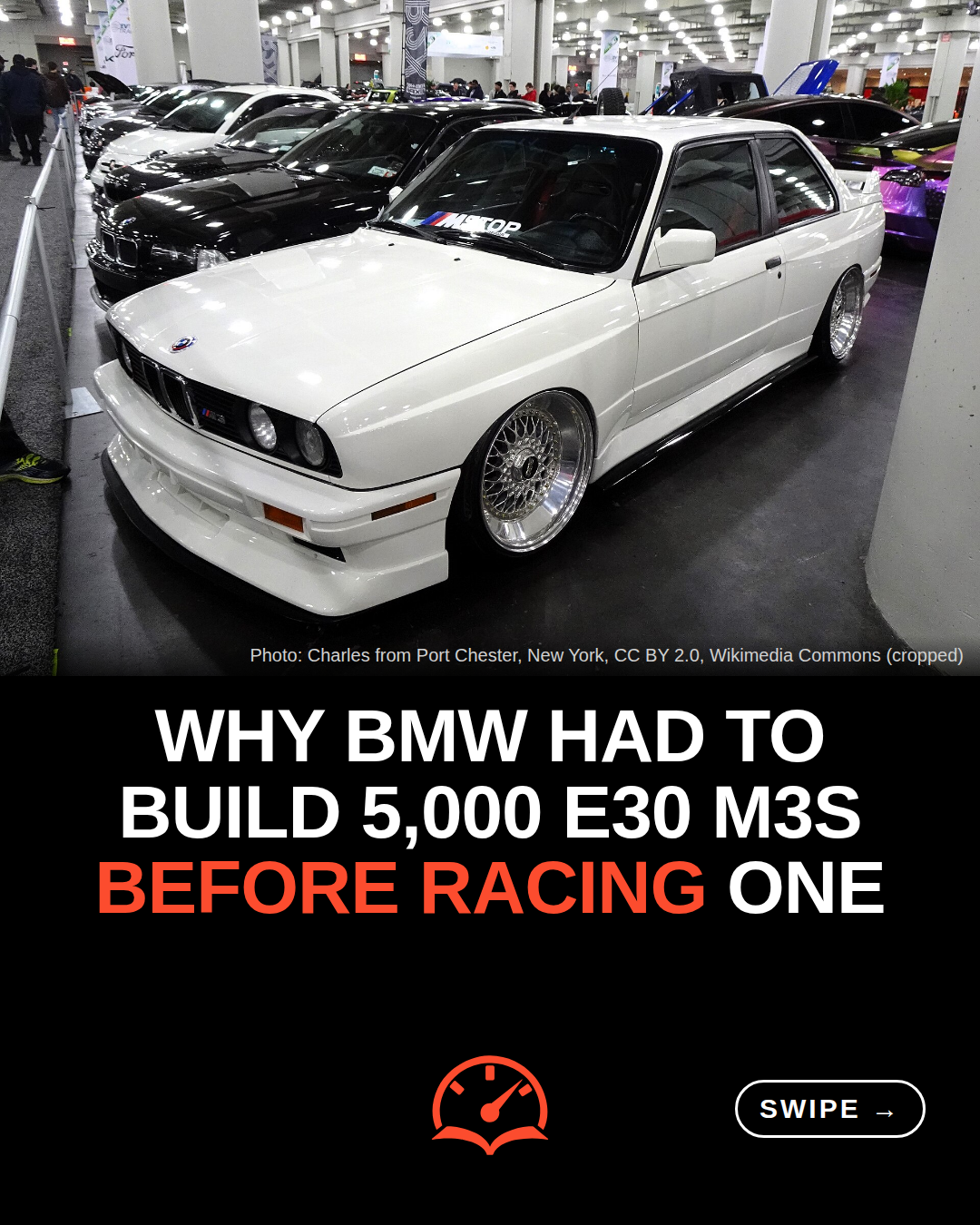
Why BMW had to build 5,000 E30 M3s before racing one
The road car was the entry ticket
It's easy to see the E30 M3 as a fast 3 Series built for buyers. BMW Motorsport designed it to race, and the road car was the entry ticket: BMW developed street and race versions in parallel.
Source: BMW Group USA PressClub, 2026; BMW Group Classic
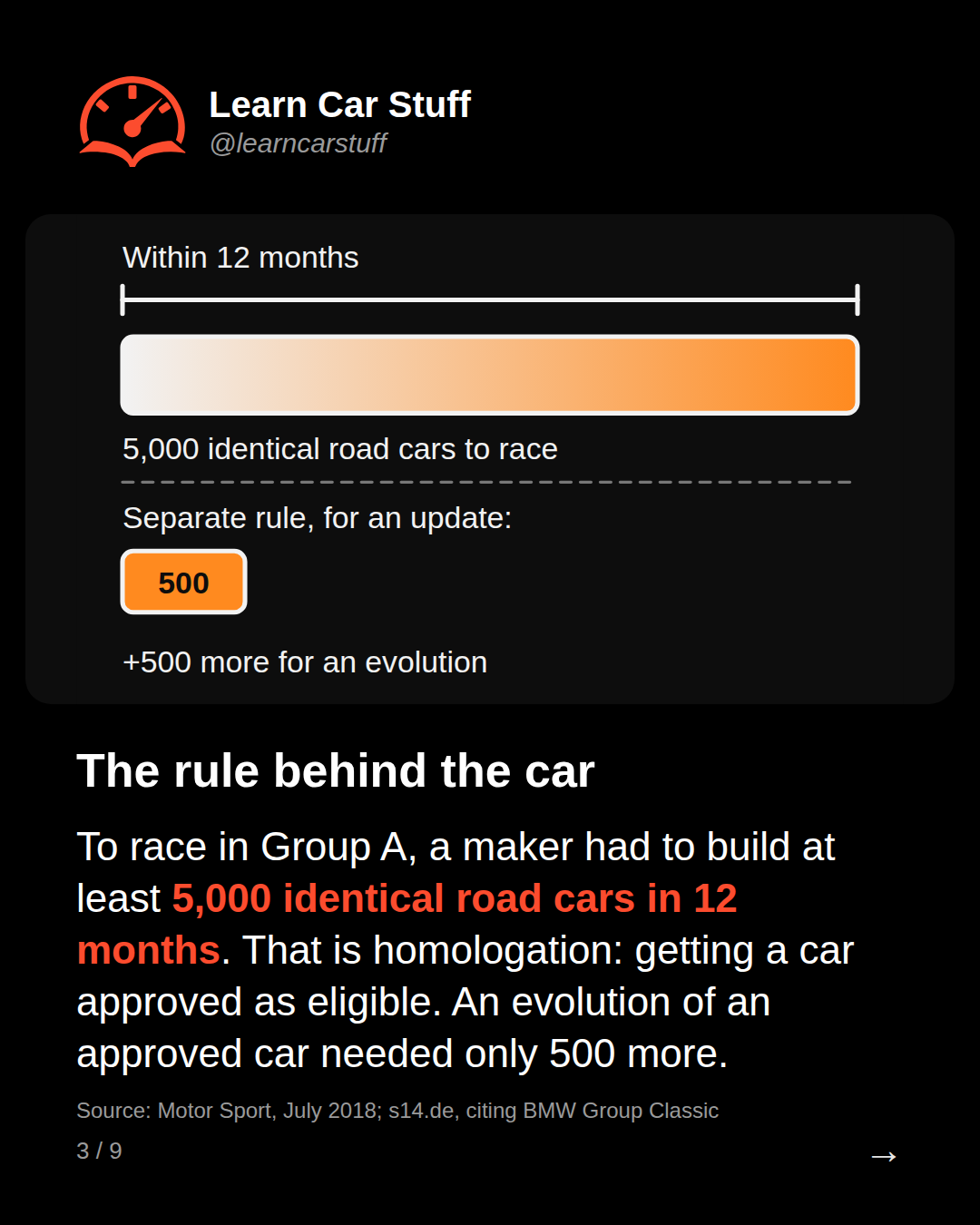
The rule behind the car
To race in Group A, a maker had to build at least 5,000 identical road cars in 12 months. That is homologation: getting a car approved as eligible. An evolution of an approved car needed only 500 more.
Source: Motor Sport, July 2018; s14.de, citing BMW Group Classic
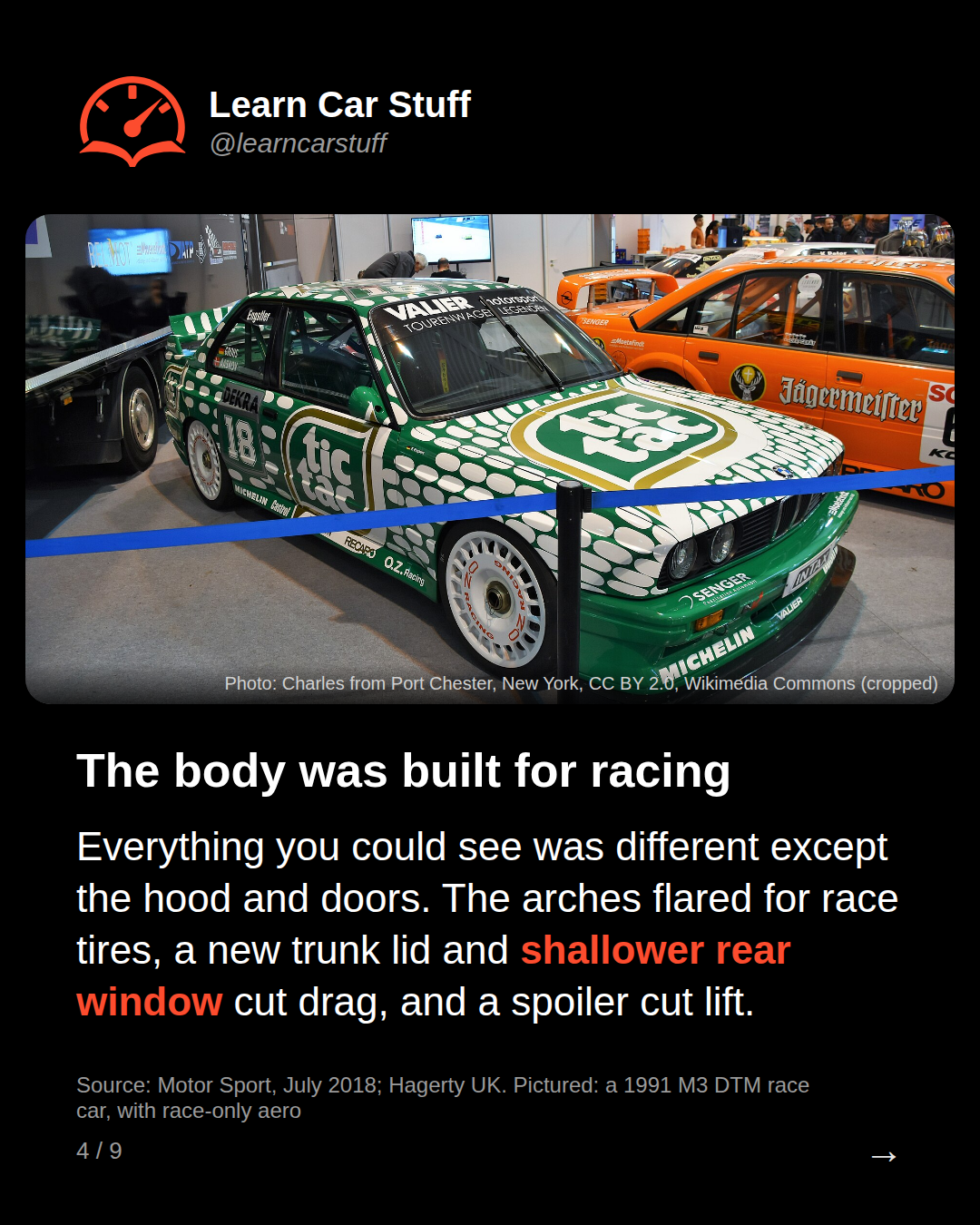
The body was built for racing
Everything you could see was different except the hood and doors. The arches flared for race tires, a new trunk lid and shallower rear window cut drag, and a spoiler cut lift.
Source: Motor Sport, July 2018; Hagerty UK. Pictured: a 1991 M3 DTM race car, with race-only aero
The S14: a 2.3-liter four
The engine was the S14, a 2,302 cc four-cylinder with four valves per cylinder. European road cars made 200 bhp at 6,750 rpm without a catalytic converter, and 195 bhp with one.
Source: Hagerty UK, Buying Guide E30 M3
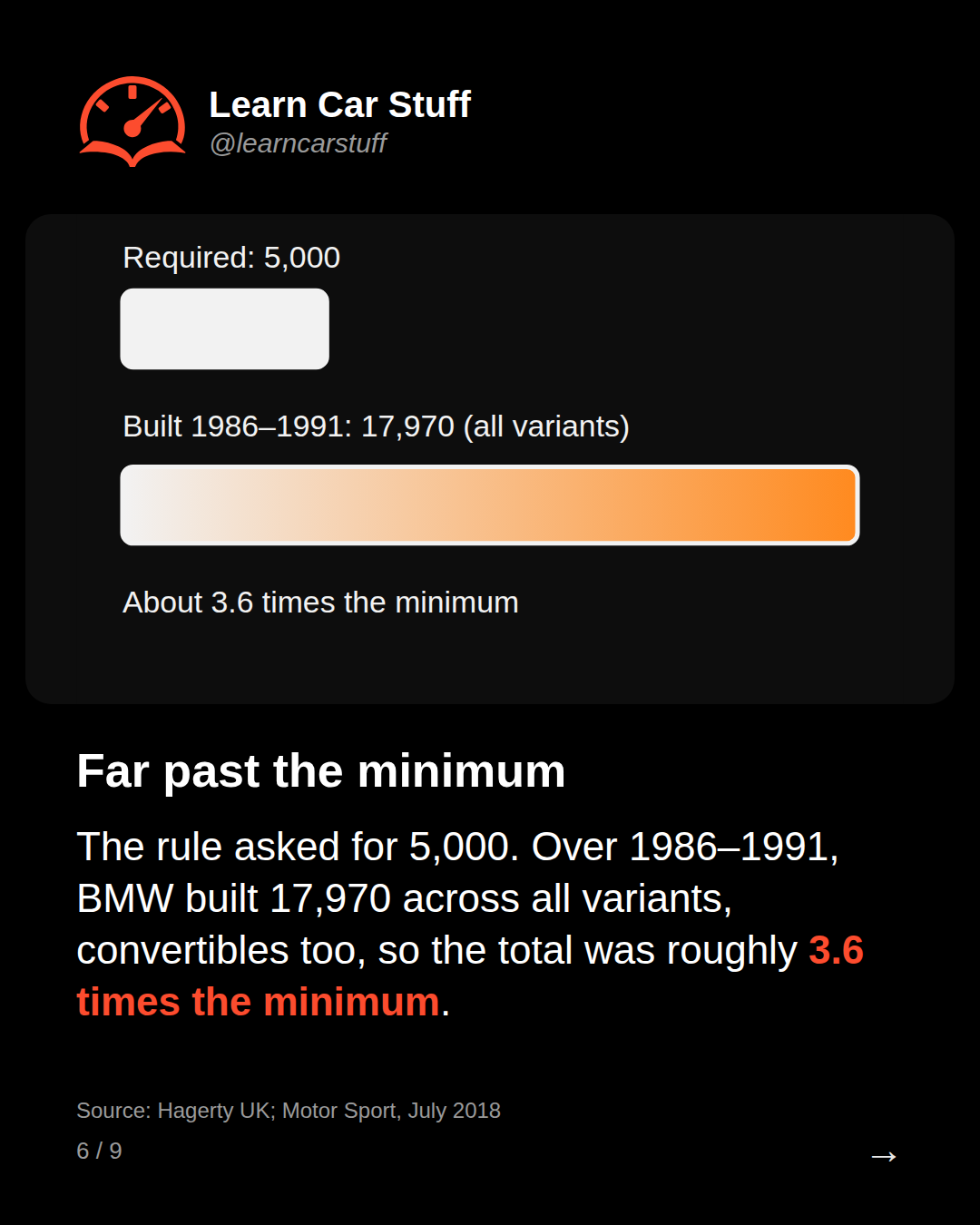
Far past the minimum
The rule asked for 5,000. Over 1986–1991, BMW built 17,970 across all variants, convertibles too, so the total was roughly 3.6 times the minimum.
Source: Hagerty UK; Motor Sport, July 2018
Then it started winning
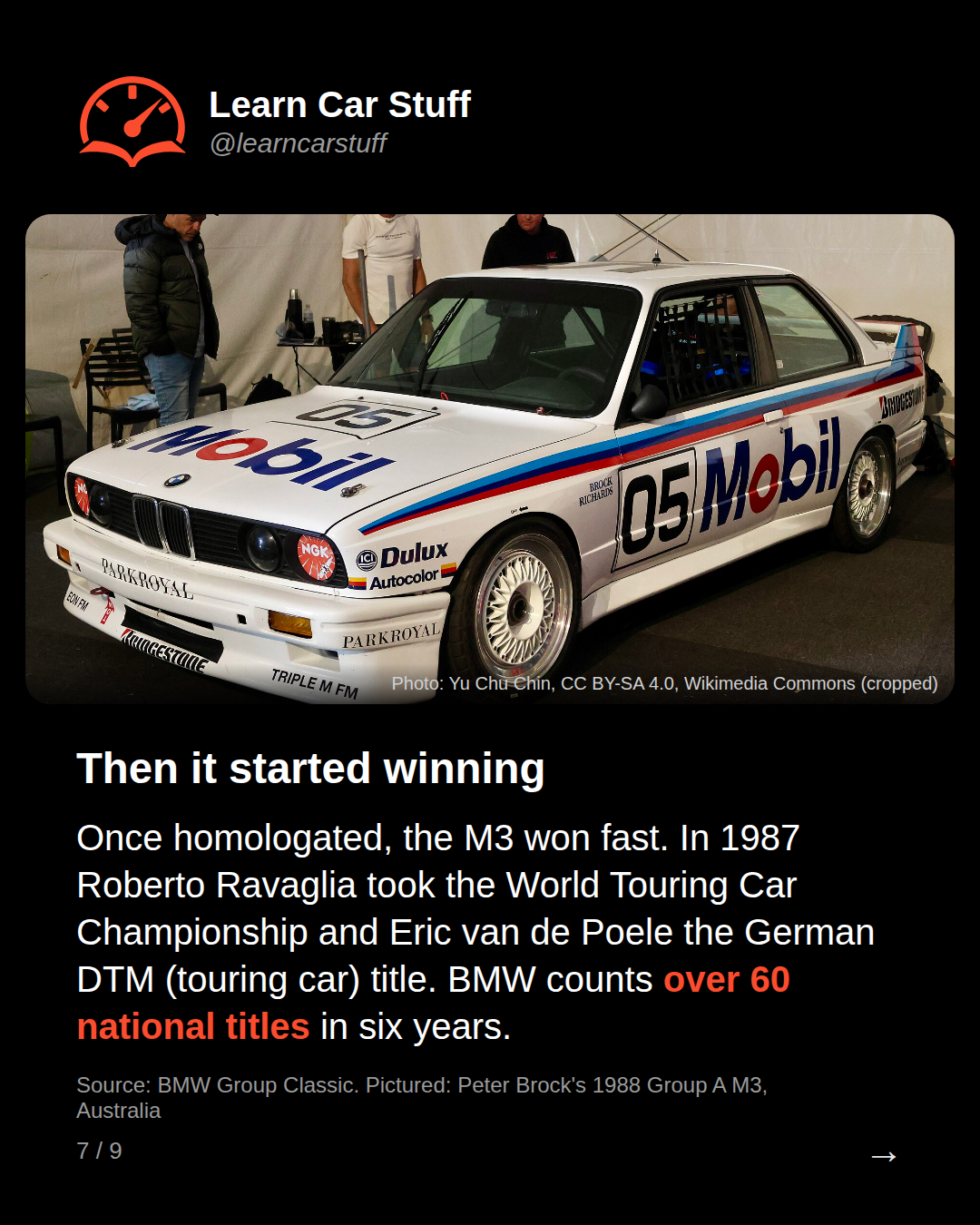
Once homologated, the M3 won fast. In 1987 Roberto Ravaglia took the World Touring Car Championship and Eric van de Poele the German DTM (touring car) title. BMW counts over 60 national titles in six years.
Source: BMW Group Classic. Pictured: Peter Brock's 1988 Group A M3, Australia
A road car the rulebook demanded
Later upgrades came as their own small batches of road cars, like the 1990 Sport Evolution: 600 built, 2.5 liters, 238 bhp. That is what a homologation special is.
Source: BMW Group USA PressClub, 2026; Hagerty UK
Sources and assumptions
- BMW Group USA PressClub: BMW debuts exclusive new ALPINA model at the 31st Amelia Concours 2026, alongside 40 years of the BMW M3: The first M3 (E30) was designed by BMW Motorsport to race; 'Initially, 5000 street examples needed to be produced to homologate the car for Group A competition'; introduced 1986; 600 1990 Sport Evolution street cars with a 2.5-liter four; 'the most successful racing sports touring car ever' (BMW's own claim) (checked 2026-10-01)
- Motor Sport Magazine: BMW M3 (E30), July 2018: To qualify for Group A, BMW had to make 5,000 examples and get them out within 12 months; production ended at almost 18,000; everything visible was different except the bonnet and doors (flares for race tyres, new boot lid and shallower rear window to cut drag, rear spoiler to reduce lift); built in the main factory by specialist teams; 200 bhp road form (checked 2026-10-01)
- Hagerty UK: Buying Guide, BMW M3 E30 (1986–1992): Some 17,970 sold by the end of production; S14 2,302 cc, 200 bhp at 6,750 rpm (195 bhp with catalytic converter); Sport Evolution 2,467 cc, 238 bhp at 7,000 rpm; only the bonnet and doors carried over from the standard saloon; Getrag five-speed with dogleg first (checked 2026-10-01)
- s14.de: BMW M3 (E30) (1986–1991), enthusiast reference citing BMW Group Classic: Group A needed 5,000 identical vehicles within twelve consecutive months, and an evolution of an already homologated model needed only 500; 17,970 total = 17,184 coupes + 786 convertibles (BMW Group Classic figures); homologation no. 5327 valid from 2 March 1987; Evolution II 500 units (checked 2026-10-01)
- BMW Group Classic: BMW M3 Gruppe A DTM 2,3: 1987: Ravaglia World Touring Car Champion, Vogt European champion, van de Poele German champion; Ravaglia German champion 1989; after six years: one world title, two European titles, over 60 national championship titles (checked 2026-10-01)
- BMW Group Classic: World Touring Car Championship: In 1987 Roberto Ravaglia won the Touring Car World Championship in the M3 Group A; the M3 was BMW's first parallel development of a street car and a motorsport car to Group A rules (checked 2026-10-01)
Assumptions:
- The 5,000-in-12-consecutive-months wording rests on Motor Sport ('within 12 months') and s14.de ('twelve consecutive months'). The FIA Appendix J PDF I found is a scanned image of the 1983 edition and I could not read it, so the slide should say '12 months' and attribute the rule to Group A, not quote the FIA text.
- 17,970 comes from Hagerty UK and s14.de (citing BMW Group Classic), not from a BMW page I opened. Motor Sport's 'almost 18,000' is the safer headline, with 17,970 as the exact count credited to Hagerty UK.
- The '3.6 times' ratio is 17,970 / 5,000 = 3.59 and includes every E30 M3 variant, convertibles too.
- Power figures are European-market road cars (200 bhp without a catalytic converter, 195 bhp with one). US-market cars arrived for 1987 and are not quoted.
- Sources disagree on when production started (March vs September 1986), so slides say only '1986'.
- BMW's 'most successful touring car ever' is BMW's own claim. If used, label it as BMW's words.
- The 500-car evolution rule is separate from the 5,000 and must not be merged with it.
Photos:
The short version
- Group A asked for 5,000 road cars.
- BMW had 12 months to build 5,000.
- Over 1986–1991 it built 17,970 in all.
- A homologation special is a rulebook's road car.
_(53627731040).jpg)
_of_Peter_Brock_at_the_2025_Adelaide_Grand_Final.jpg)
_(52568801086).jpg)