 Learn Car Stuff
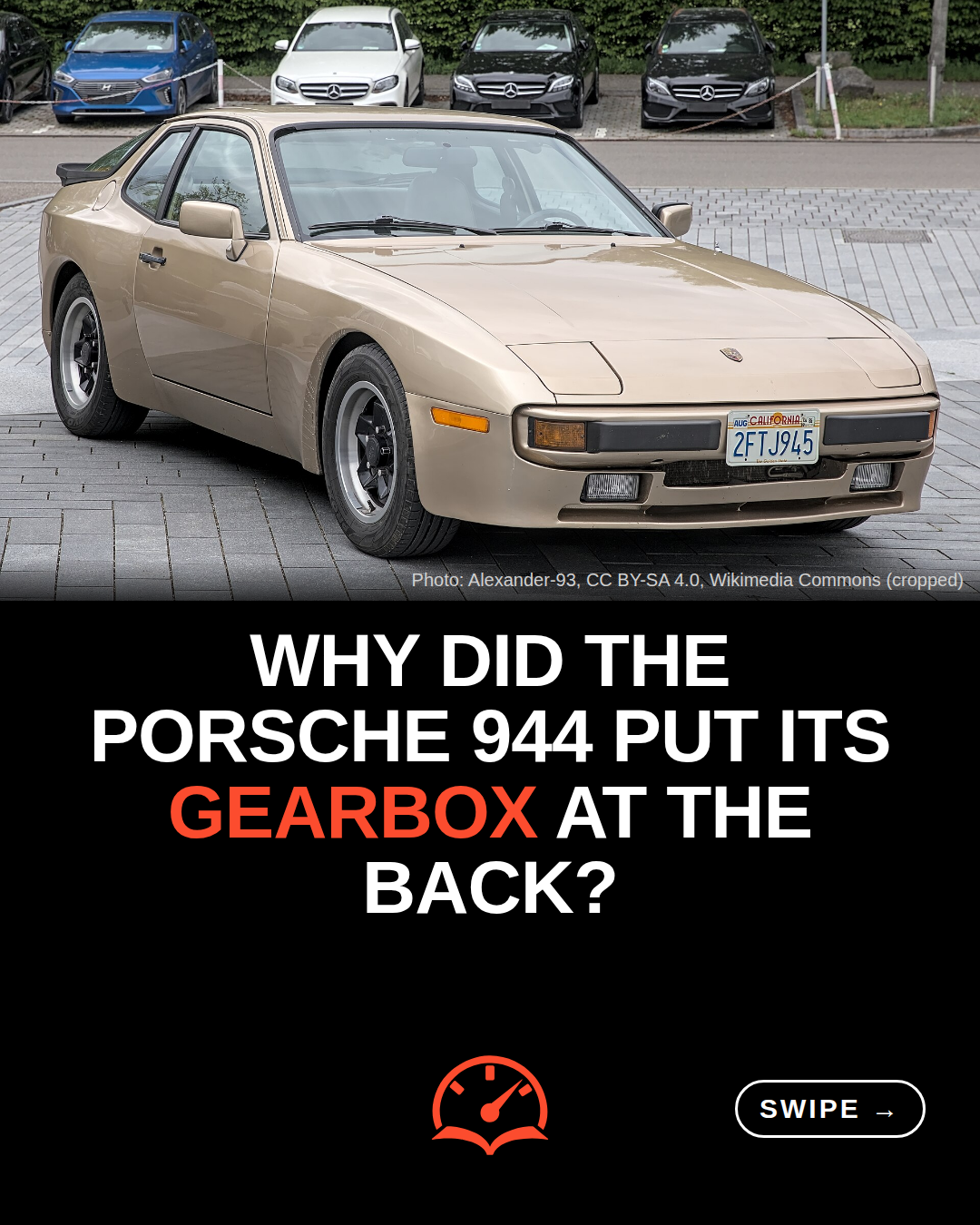
Why did the Porsche 944 put its gearbox at the back?
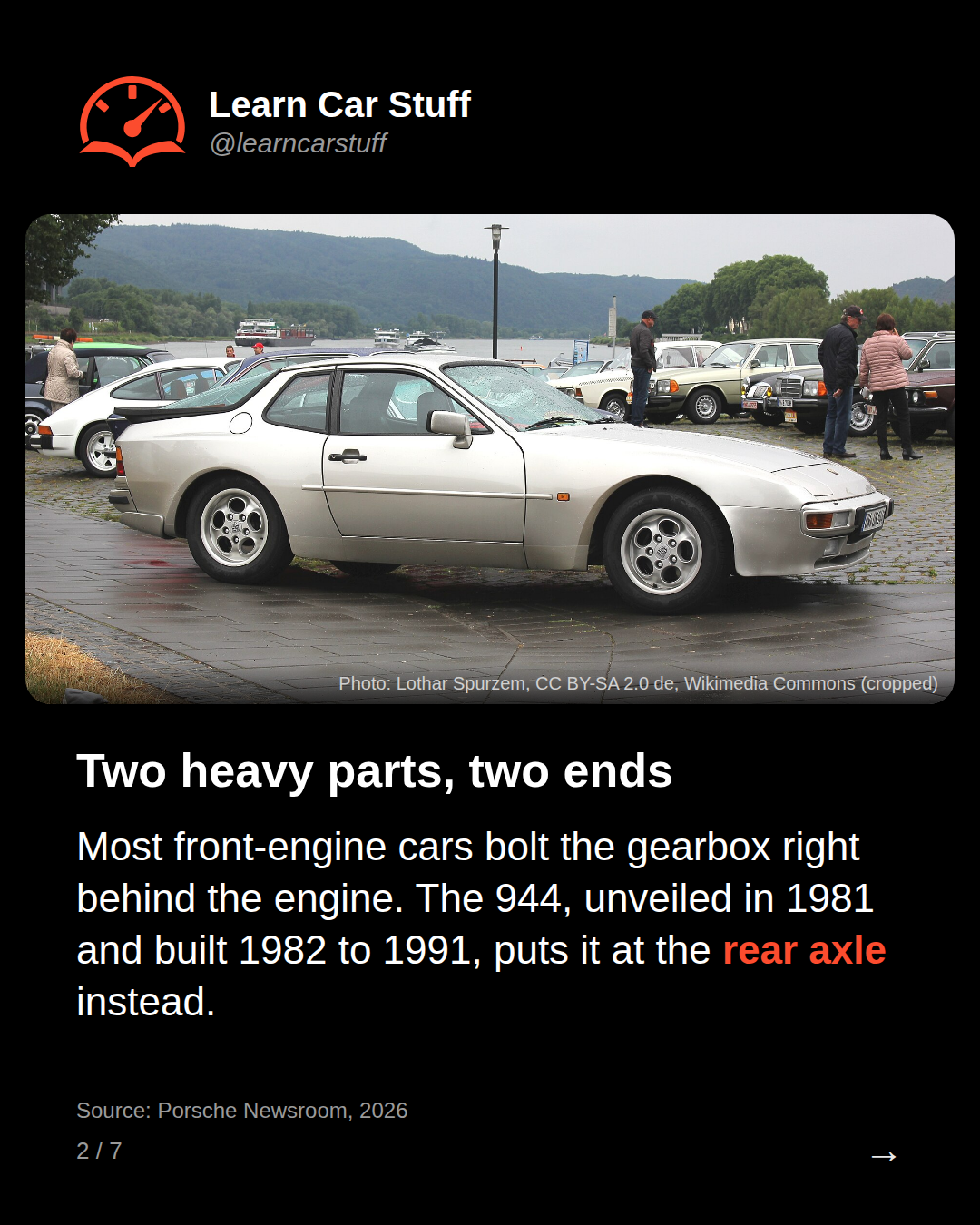
Two heavy parts, two ends
Most front-engine cars bolt the gearbox right behind the engine. The 944, unveiled in 1981 and built 1982 to 1991, puts it at the rear axle instead.
Source: Porsche Newsroom, 2026
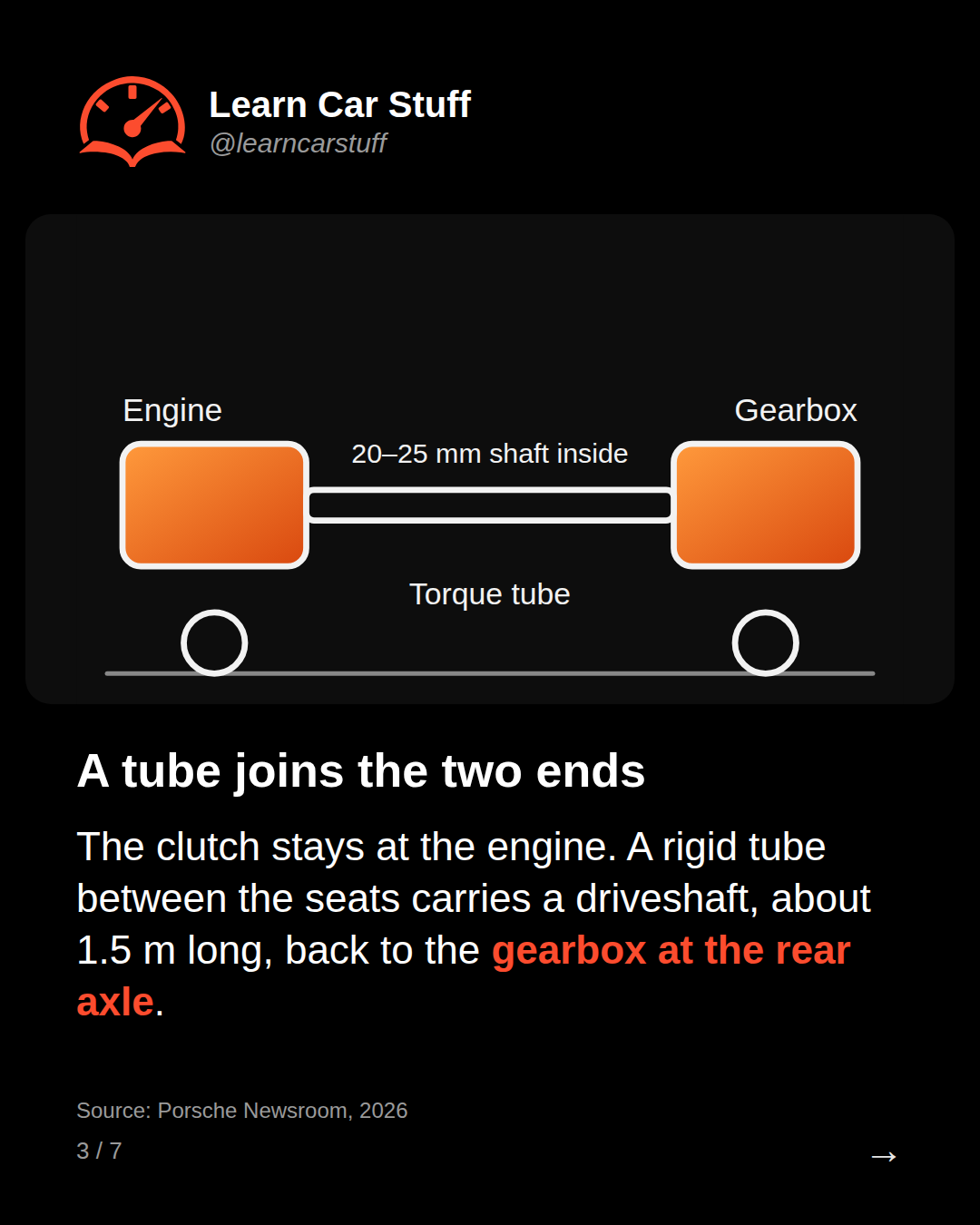
A tube joins the two ends
The clutch stays at the engine. A rigid tube between the seats carries a driveshaft, about 1.5 m long, back to the gearbox at the rear axle.
Source: Porsche Newsroom, 2026
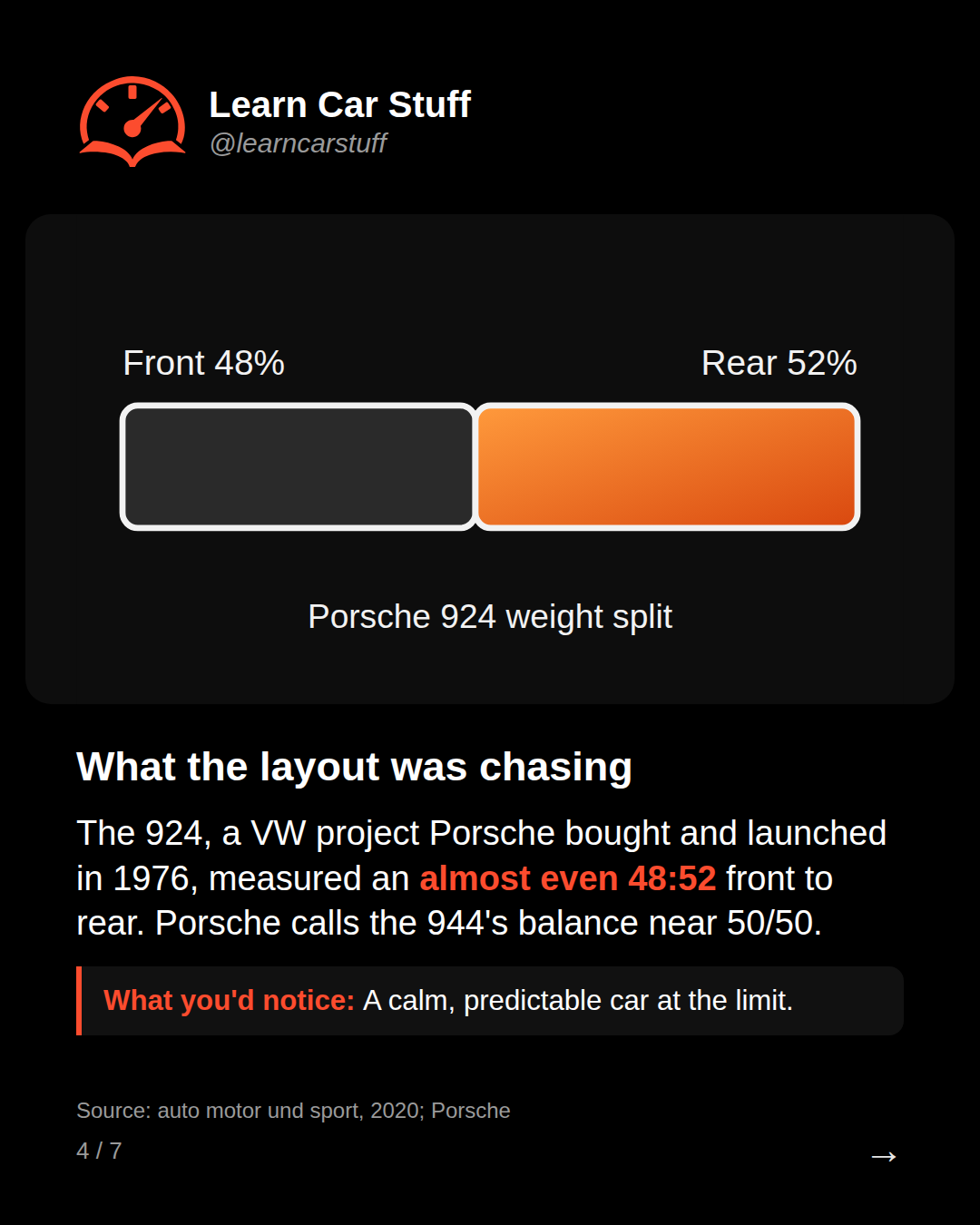
What the layout was chasing
The 924, a VW project Porsche bought and launched in 1976, measured an almost even 48:52 front to rear. Porsche calls the 944's balance near 50/50.
What you'd notice: A calm, predictable car at the limit.
Source: auto motor und sport, 2020; Porsche
The price: a long clutch job
The clutch sits at the engine, so the gearbox and the torque tube both come out to replace it. Clark's Garage lists about 16 hours of average labor for a 944.
Source: Clark's Garage 944 shop manual
Signs worth a specialist's look
A vague gearchange could mean worn linkage bushes. Severe vibration could point to worn torque tube bearings. Either way, have a professional check it.
Source: Prestige & Performance Car, 2026
Sources and assumptions
- Porsche Newsroom: Why is the transaxle concept still so fascinating today? (2026-08-07): Front engine, transmission at the rear axle; rigid central tube from the front to the rear axle, passing between the two front seats; shaft 20 to 25 mm in diameter and about 1.50 m long, supported by multiple ball bearings; near-perfectly balanced axle load, 50:50 ideal; five-speed manual at the rear axle; S2 appeared in 1988 with a 3.0 L four at 155 kW (211 PS) (checked 2026-09-30)
- Porsche: Porsche transaxle models: 924, 944, 928 and 968 explained: 924 revealed 1976; 944 produced 1982 to 1991; base 944 2.5 L four at 163 PS (160 hp); S2 up to 211 PS; 944 'near 50/50 weight distribution'; balance, stability and predictable handling as the reason for the layout (checked 2026-09-30)
- Porsche Newsroom press kit: Forever Young. Celebrating Transaxle, Porsche 944: 944 debuted September 1981 with a 163 hp four-cylinder; 163,302 cars of the 944 series built by the end of production in 1991 (checked 2026-09-30)
- Porsche: Everything about the Porsche 944: Unveiled at the Frankfurt Motor Show in September 1981, first launched in 1982, 2.5-litre inline four, 163,302 produced by 1991 (checked 2026-09-30)
- Porsche Newsroom / Christophorus: Transaxle era: When Porsche redefined itself: The transaxle structure was designed to improve weight distribution (goal 50:50); 924 began as a VW project under development contract EA 425, which VW dropped in late 1974; Porsche bought the rights and launched the 924 in early 1976 (checked 2026-09-30)
- Porsche Newsroom: When the 924 redefined Porsche's DNA (2026-07-31): Engineer Roland Kussmaul names the main advantage as balanced weight distribution between front and rear axle; more than 150,000 924s built 1976 to 1988 (checked 2026-09-30)
- auto motor und sport: Porsche feiert 40 Jahre Transaxle mit 924, 944 und 968 (2020-02-09): The 924's transaxle layout gives an almost even 48:52 percent weight distribution (checked 2026-09-30)
- Clark's Garage 944 shop manual: CLUTCH-01 Clutch Replacement: The transaxle and torque tube must be removed to reach the clutch; average labor 944 16 h, 944 Turbo 20 h / 24 h; 'one of the most intimidating jobs a home mechanic can undertake' (checked 2026-09-30)
- Prestige & Performance Car: Porsche 944 buyer's guide (2026-03-19): Clutch replacement is expensive because the transaxle layout means removing both the torque tube and the gearbox; severe vibration may point to worn torque tube bearings; the gearchange can become vague if the linkages and bushes are worn (checked 2026-09-30)
Assumptions:
- 'Near 50/50' for the 944 is Porsche's own wording. No primary source I opened gives an exact 944 percentage (the 50.7/49.3 figure appears only on Wikipedia), so the slides must not print one for the 944.
- The exact 48:52 figure applies to the 924 (auto motor und sport) and shows how the shared layout performs in numbers. Label it as the 924.
- Production dates: unveiled September 1981 (Frankfurt IAA), produced and sold 1982 to 1991. One Porsche page says 'produced from 1981', so use 'unveiled 1981, built 1982–1991'.
- The 16-hour clutch labor time is the average from Clark's Garage's shop manual for the naturally aspirated 944. Real shop times vary.
- Engine power is quoted in PS only for exact named variants: base 944 2.5 L at 163 PS, 944 S2 3.0 L at 211 PS.
- Any comparison with a conventional front-engine/front-gearbox car stays qualitative, with no invented percentage.
Photos:
The short version
- Engine in front, gearbox at the rear axle
- A tube between the seats carries the driveshaft
- Porsche calls the balance near 50/50
- The trade-off: about 16 hours for a clutch



.JPG)
