 Learn Car Stuff
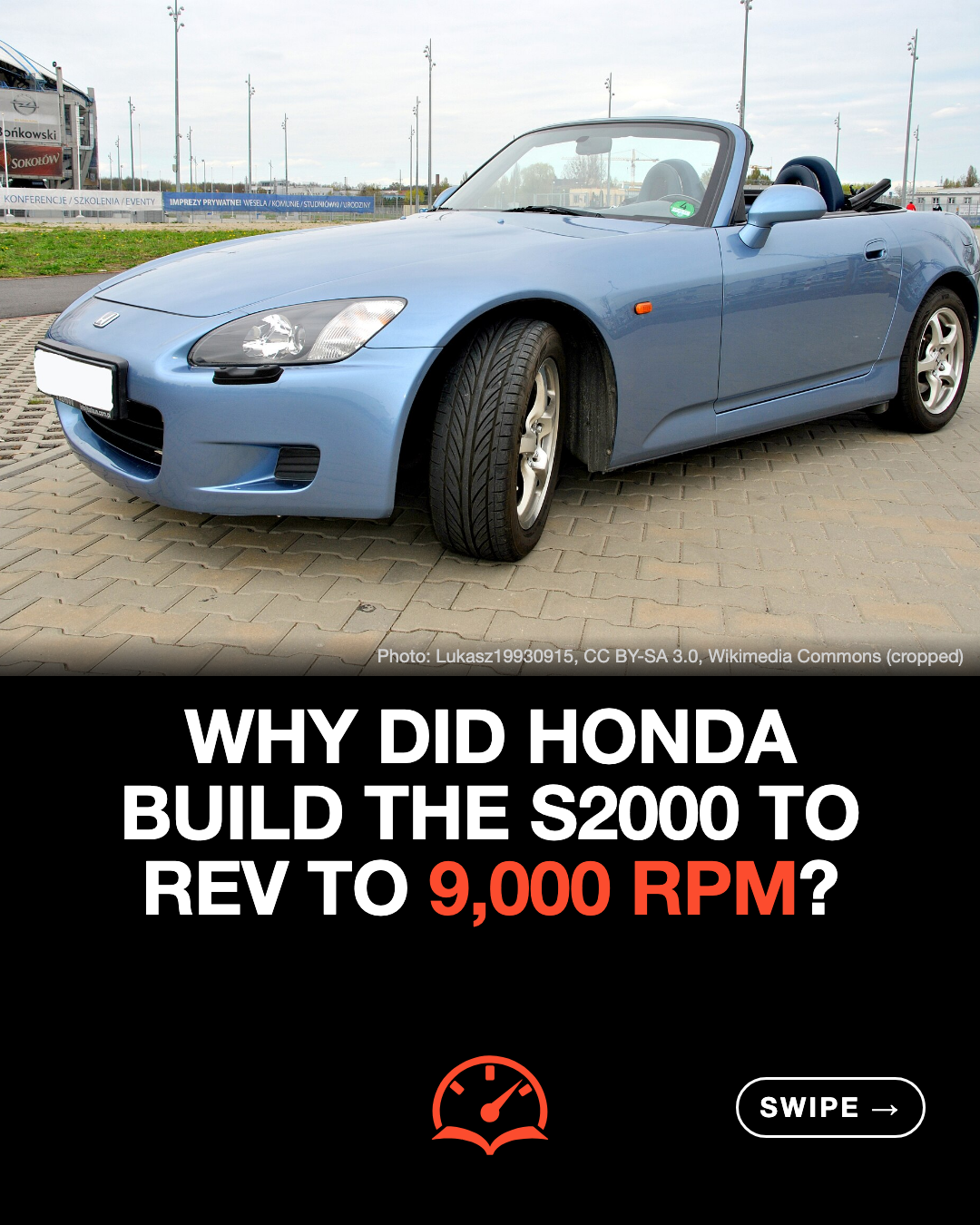
Why did Honda build the S2000 to rev to 9,000 rpm?
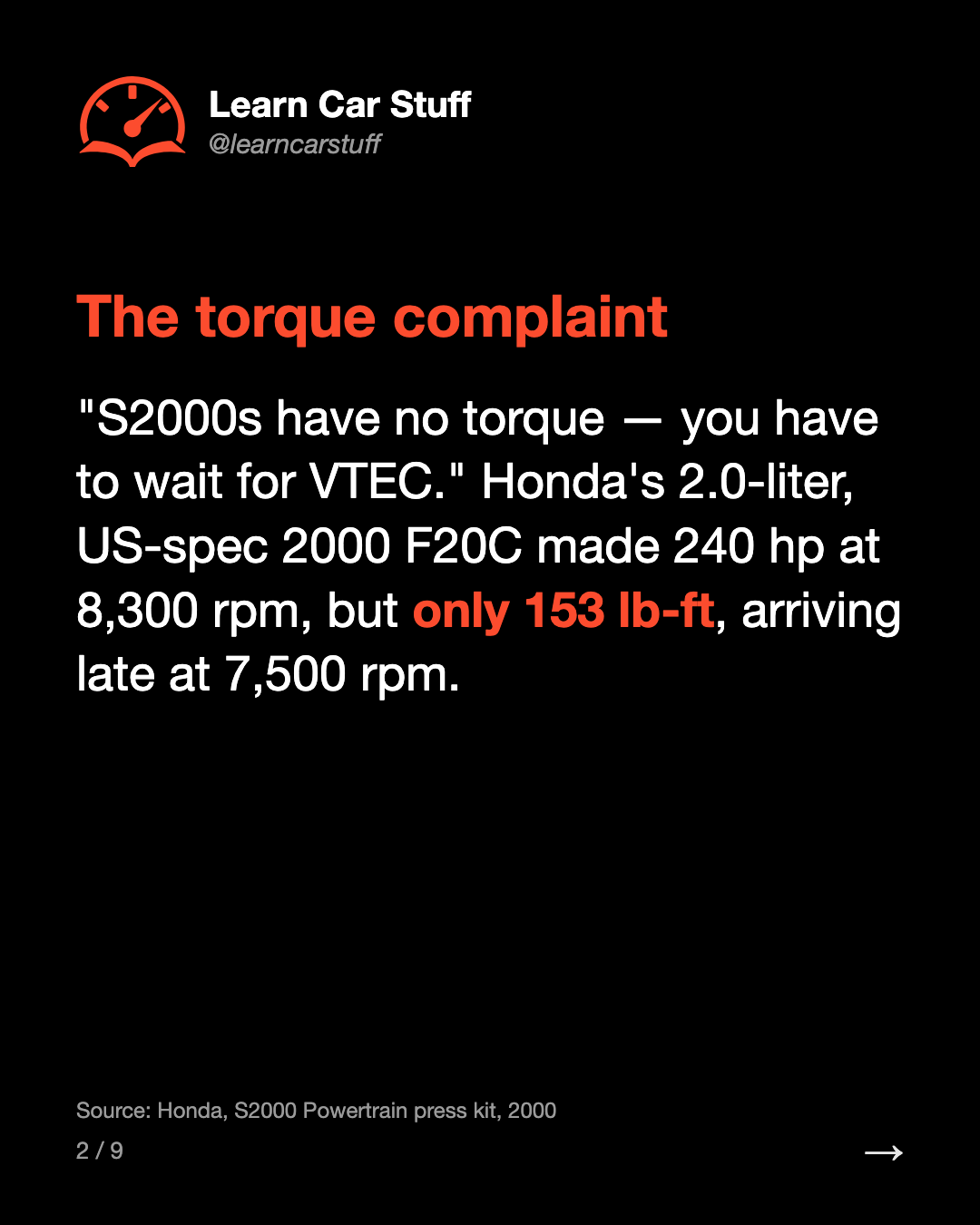
The torque complaint
"S2000s have no torque — you have to wait for VTEC." Honda's 2.0-liter, US-spec 2000 F20C made 240 hp at 8,300 rpm, but only 153 lb-ft, arriving late at 7,500 rpm.
Source: Honda, S2000 Powertrain press kit, 2000
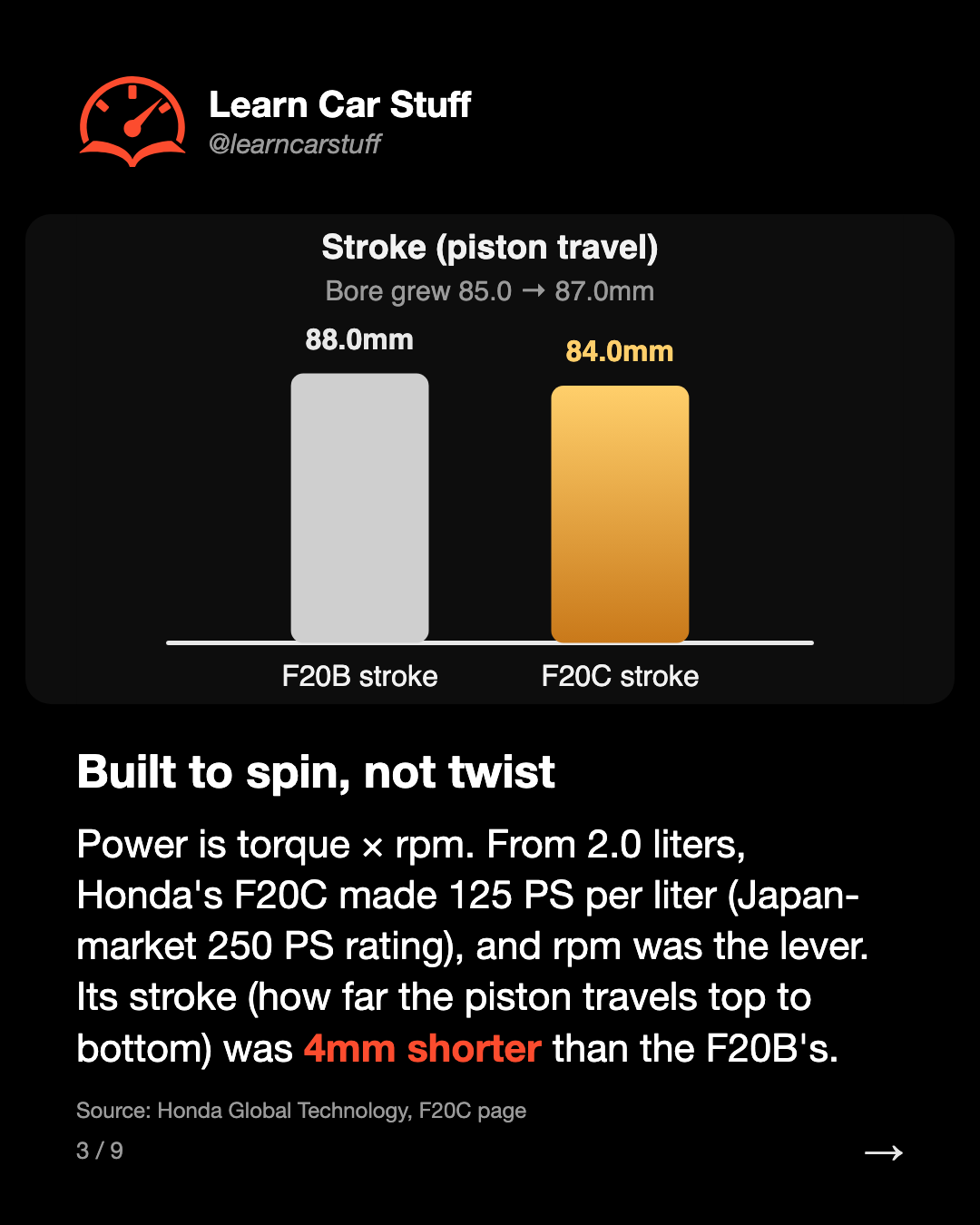
Built to spin, not twist
Power is torque × rpm. From 2.0 liters, Honda's F20C made 125 PS per liter (Japan-market 250 PS rating), and rpm was the lever. Its stroke (how far the piston travels top to bottom) was 4mm shorter than the F20B's.
Source: Honda Global Technology, F20C page
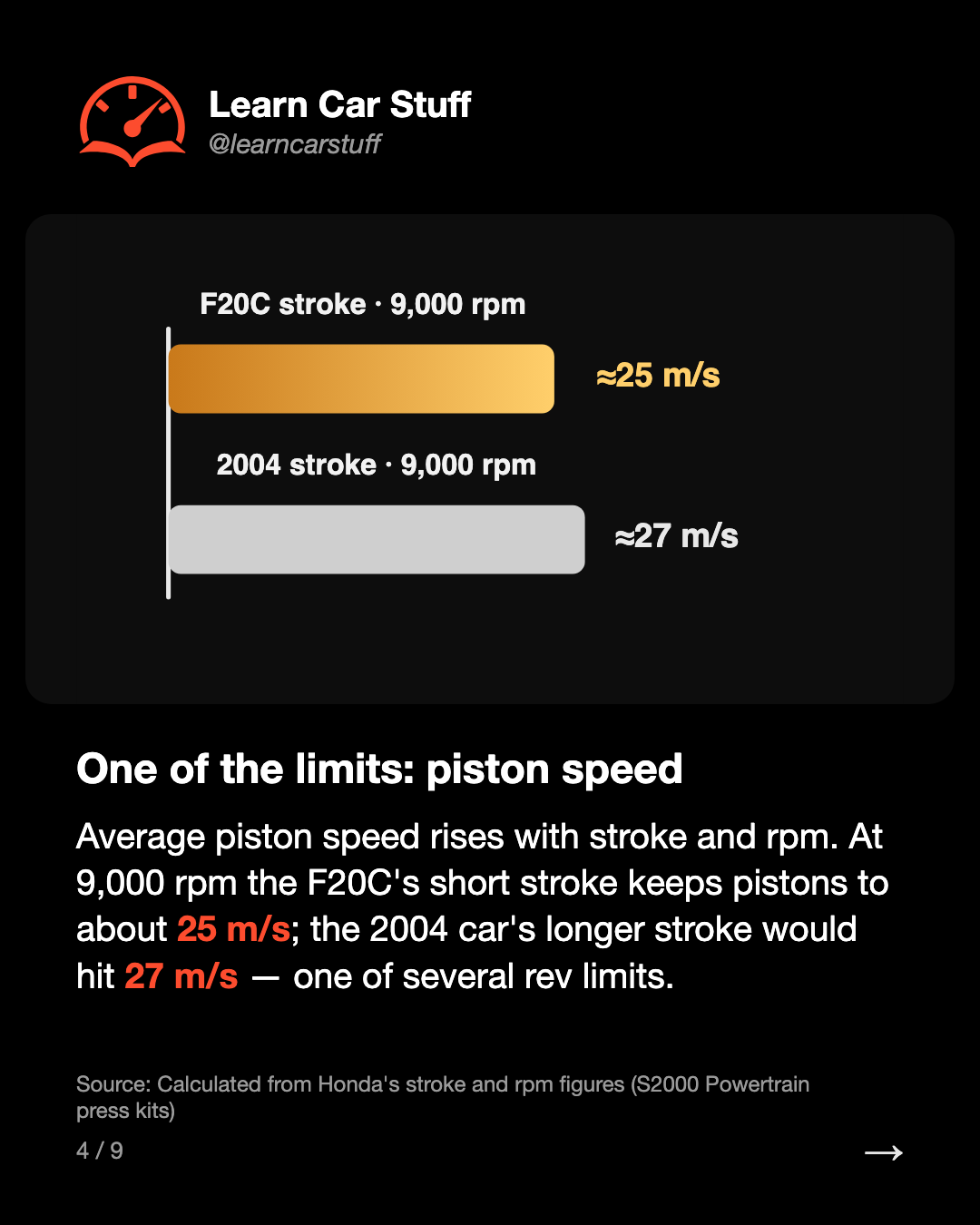
One of the limits: piston speed
Average piston speed rises with stroke and rpm. At 9,000 rpm the F20C's short stroke keeps pistons to about 25 m/s; the 2004 car's longer stroke would hit 27 m/s — one of several rev limits.
Source: Calculated from Honda's stroke and rpm figures (S2000 Powertrain press kits)
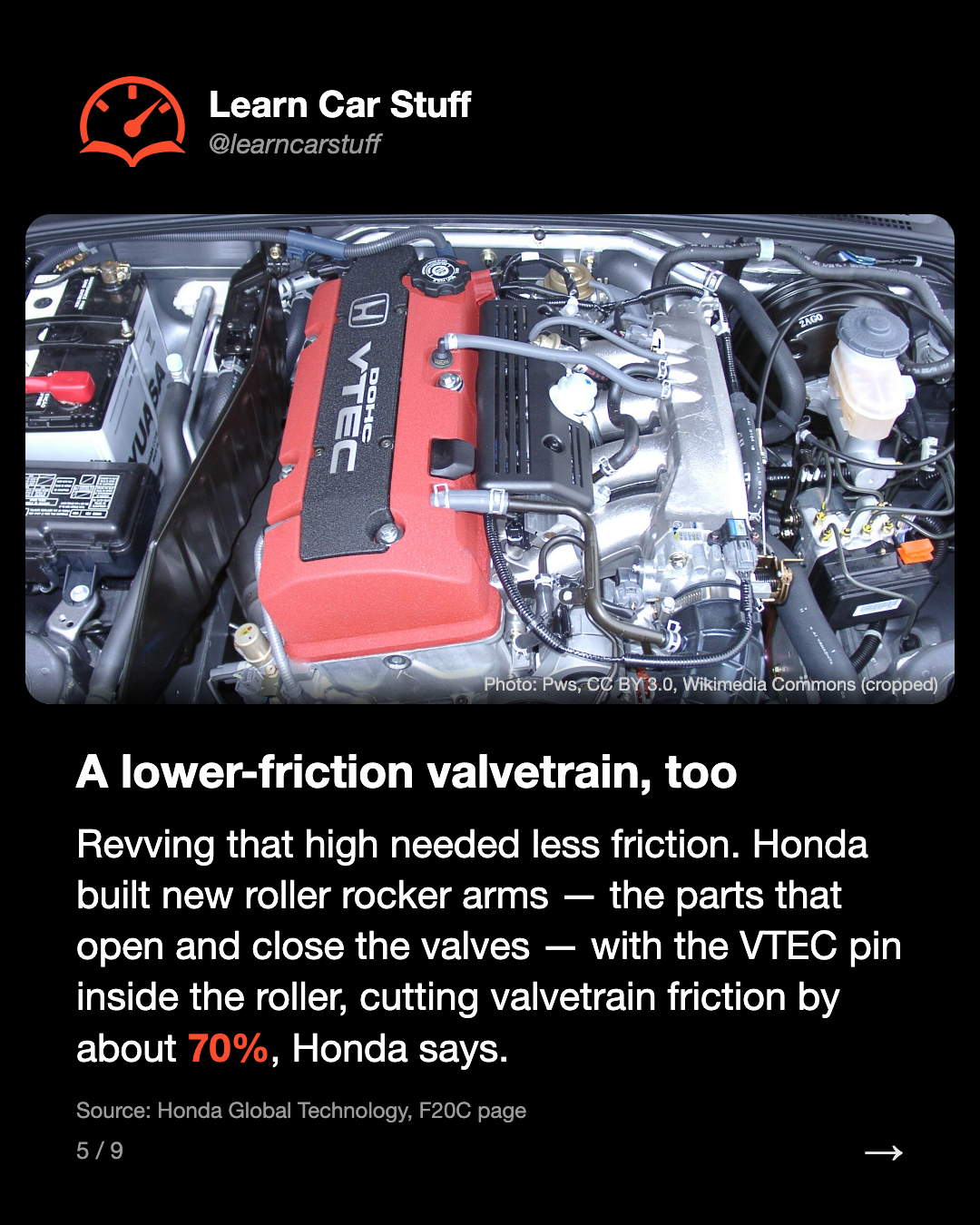
A lower-friction valvetrain, too
Revving that high needed less friction. Honda built new roller rocker arms — the parts that open and close the valves — with the VTEC pin inside the roller, cutting valvetrain friction by about 70%, Honda says.
Source: Honda Global Technology, F20C page
Power without twist
At its 8,300 rpm power peak, 240 hp works out to only about 152 lb-ft. The power comes from rpm, not twisting force. Honda said the early car's useful high-performance power started around 6,000 rpm. That's the torque complaint.
Source: Calculated from Honda's 240 hp @ 8,300 rating; Honda 2004 S2000 Powertrain press kit
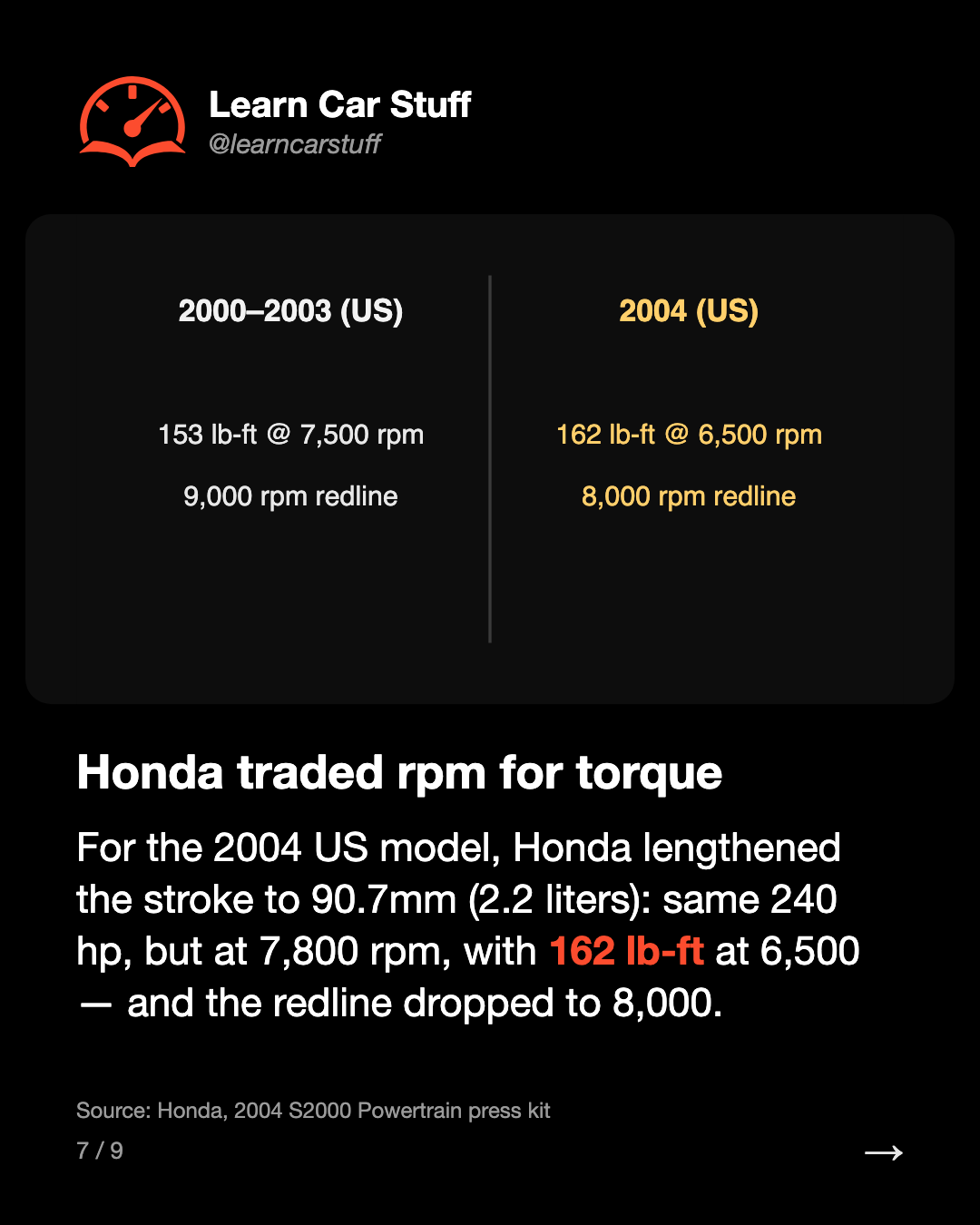
Honda traded rpm for torque
For the 2004 US model, Honda lengthened the stroke to 90.7mm (2.2 liters): same 240 hp, but at 7,800 rpm, with 162 lb-ft at 6,500 — and the redline dropped to 8,000.
Source: Honda, 2004 S2000 Powertrain press kit
Two different S2000s
Neither engine is "better." The F20C is the high-rpm purist's choice; the 2004 US car pulls from lower rpm (about 3,000 vs 6,000, in Honda's words). Which one you'd pick is opinion — not a spec.
Sources and assumptions
- Honda (hondanews.com): Honda S2000 -- Powertrain (original 2000 model-year press kit): 2.0-liter aluminum inline-4, 240 hp @ 8,300 rpm and 153 lb-ft @ 7,500 rpm; 9,000 rpm redline; 87.0 mm bore, 84.0 mm stroke; DOHC with VTEC on intake and exhaust; FRM cylinder liners (checked 2026-09-29)
- Honda (hondanews.com): 2004 Honda S2000 - Powertrain: 2004 displacement grew by 0.2 L by lengthening the stroke to 90.7 mm (bore stays 87.0); 240 hp @ 7,800 rpm and 162 lb-ft @ 6,500 rpm, replacing 240 hp @ 8,300 and 153 lb-ft @ 7,500; 2000–2003 bore/stroke 87.0 × 84.0 mm; useful high-performance power starts at about 3,000 rpm vs about 6,000 rpm on 2000–2003 models (checked 2026-09-29)
- Honda (hondanews.com): Honda S2000 Receives Enhanced Power and Improved Handling for 2004: 2004 model year 2.2-liter engine and the lowered (8,000 rpm) redline (checked 2026-09-29)
- Honda Global Technology: F20C, the ultra-high-revving VTEC engine developed for the S2000 (Japanese): 9,000 rpm redline, 250 PS (JDM), 125 PS per liter; bore enlarged 2 mm to 87.0 and stroke shortened 4 mm to 84.0 vs the F20B's 85.0 × 88.0 to hold down piston speed and allow higher rpm; new roller rocker arms with the VTEC pin inside the roller, metal-injection-molded, cutting valvetrain friction by about 70%; 125 PS/L unbeaten among mass-production engines until 2010 (Honda's claim) (checked 2026-09-29)
- Honda (global.honda): 1999 Japanese launch press release, S2000: S2000 went on sale in Japan in April 1999 (checked 2026-09-29)
- Honda (hondanews.com): 2009 Will Be Final Model Year of Production for Honda S2000: S2000 introduced in 1999 for the 2000 model year, first planned as a limited-edition tribute to Honda's 50th anniversary (checked 2026-09-29)
Assumptions:
- Process caveat for the reviewer: WebFetch, ctx_fetch_and_index and curl were all blocked in this headless session. Every source above was read through WebSearch excerpts restricted to hondanews.com / global.honda / honda.co.jp, not opened in full. Before approval, re-open the two hondanews powertrain press kits to confirm the exact figures.
- Power and torque figures are US-market SAE ratings: 2000–2003 F20C = 240 hp / 153 lb-ft; 2004–2005 F22C1 = 240 hp / 162 lb-ft. The JDM F20C was rated 250 PS. Later US F22C1 ratings changed (2006+: 237 hp @ 7,800 rpm, 162 lb-ft @ 6,800 rpm), so the comparison slide must say '2004 model year, US'.
- The F20C stayed in Japanese- and European-market cars after the US switched to the F22C1 for 2004. Every 'Honda changed it' claim is scoped to the US market.
- Average piston speed = 2 × stroke × rpm ÷ 60, a simplified average. Peak piston speed is higher, and real rev limits also depend on valvetrain, rod ratio and materials. Say 'one of the limits', not 'the limit'.
- Torque at 8,300 rpm (about 152 lb-ft) is derived from the 240 hp rating with hp = lb-ft × rpm ÷ 5,252. It is not a published figure.
- Honda's own 2004 press kit wording calls the 2.2 L's 87.0 × 90.7 mm a 'slightly over square' 1:1.04 ratio. Geometrically the stroke is longer than the bore, so avoid the terms 'oversquare/undersquare' for the 2.2 and just give the numbers.
- 'Useful high-performance power from about 6,000 rpm vs about 3,000 rpm' is Honda's marketing description, not a measured threshold; attribute it to Honda.
- '125 PS/L unbeaten until 2010' is Honda's claim from its own tech page; attribute it to Honda, and don't state it as independent fact.
- Preferring the F20C or the F22C1 is opinion, and must be labeled as opinion.
- Chassis codes AP1/AP2 are not in the verified record; the draft should not use them except as the photo file title says.
Photos:
The short version
- More rpm, not more torque, made the power
- A short stroke and low-friction valvetrain let the F20C rev to 9,000
- 2004 US cars traded rpm for low-end pull
- Neither version is wrong — just different